ignition MITSUBISHI 3000GT 1991 Owner's Guide
[x] Cancel search | Manufacturer: MITSUBISHI, Model Year: 1991, Model line: 3000GT, Model: MITSUBISHI 3000GT 1991Pages: 1146, PDF Size: 76.68 MB
Page 167 of 1146
FUEL SYSTEM - On-vehicle Inspection of MPI Components13-61
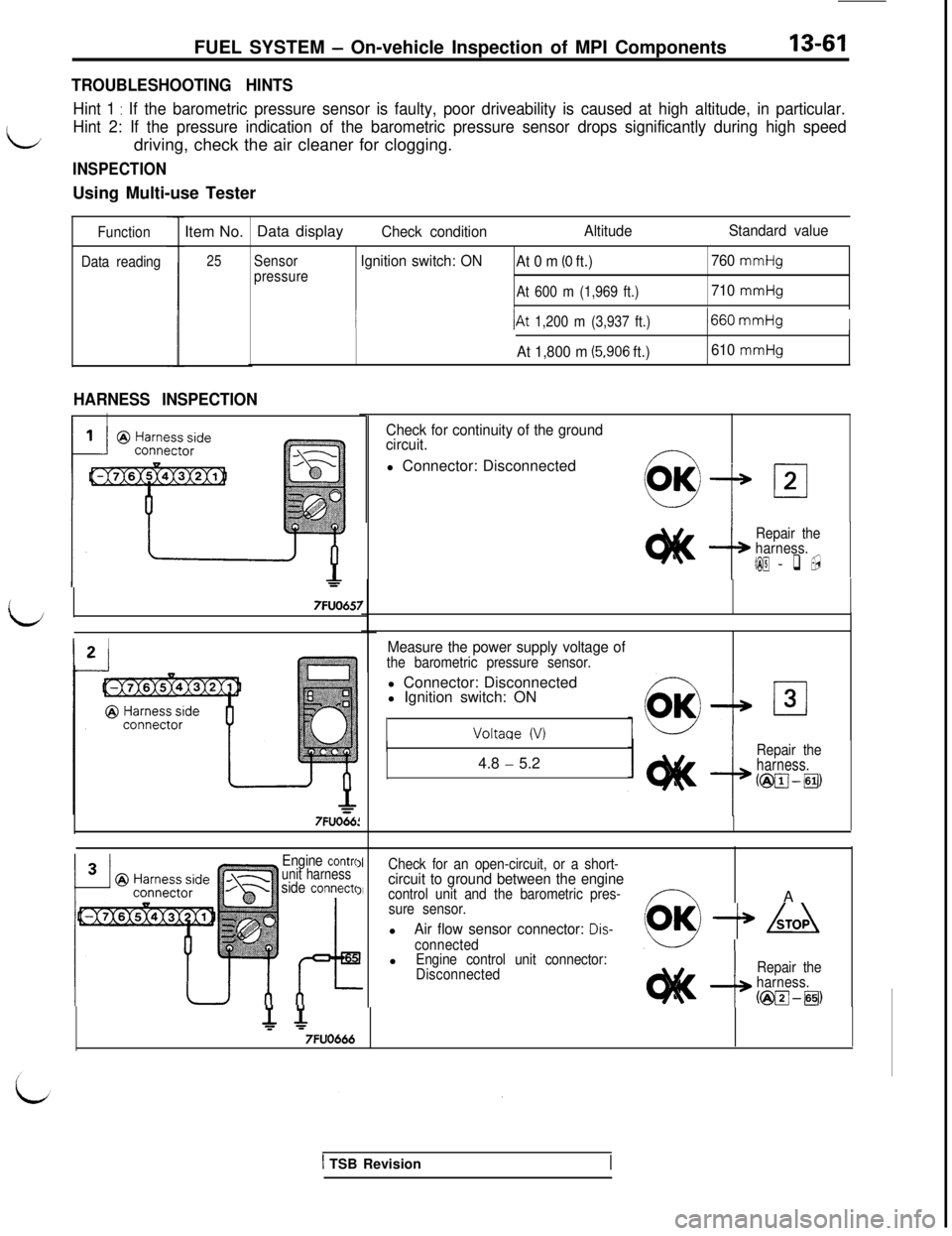
TROUBLESHOOTING HINTS
Hint 1 : If the barometric pressure sensor is faulty, poor driveability is caused at high altitude, in particular.
L
Hint 2: If the pressure indication of the barometric pressure sensor drops significantly during high speeddriving, check the air cleaner for clogging.
INSPECTIONUsing Multi-use Tester
Function
Data readingItem No.’ Data display
25
Check conditionAltitudeStandard value
Sensor
pressureIgnition switch: ON
At 0 m (0 ft.)760 mmHg
At 600 m (1,969 ft.)
710 mmHg
I/At 1,200 m (3,937 ft.)1660 mmHgI
At 1,800 m (5.906 ft.)610 mmHg
HARNESS INSPECTION
II
L
7FUO657
7FUO66:
Check for continuity of the ground
circuit.l Connector: Disconnected
Repair the
harness.
&@I - q ,
Measure the power supply voltage ofthe barometric pressure sensor.l Connector: Disconnected
l Ignition switch: ON
Voltaqe (V)4.8
- 5.2Repair theharness.
KgpJ-pJ,
Engine contraunit harnessside connects
Check for an open-circuit, or a short-circuit to ground between the enginecontrol unit and the barometric pres-,Y---,A
sure sensor.l
Air flow sensor connector: Dis-(OK) -+ kTOA
connectedlEngine control unit connector:
Disconnected
--I
Repair the
harness.
Jg
7FUO666
1 TSB Revision
Page 169 of 1146
id
LFUEL SYSTEM
- On-vehicle Inspection of MPI Components13-63
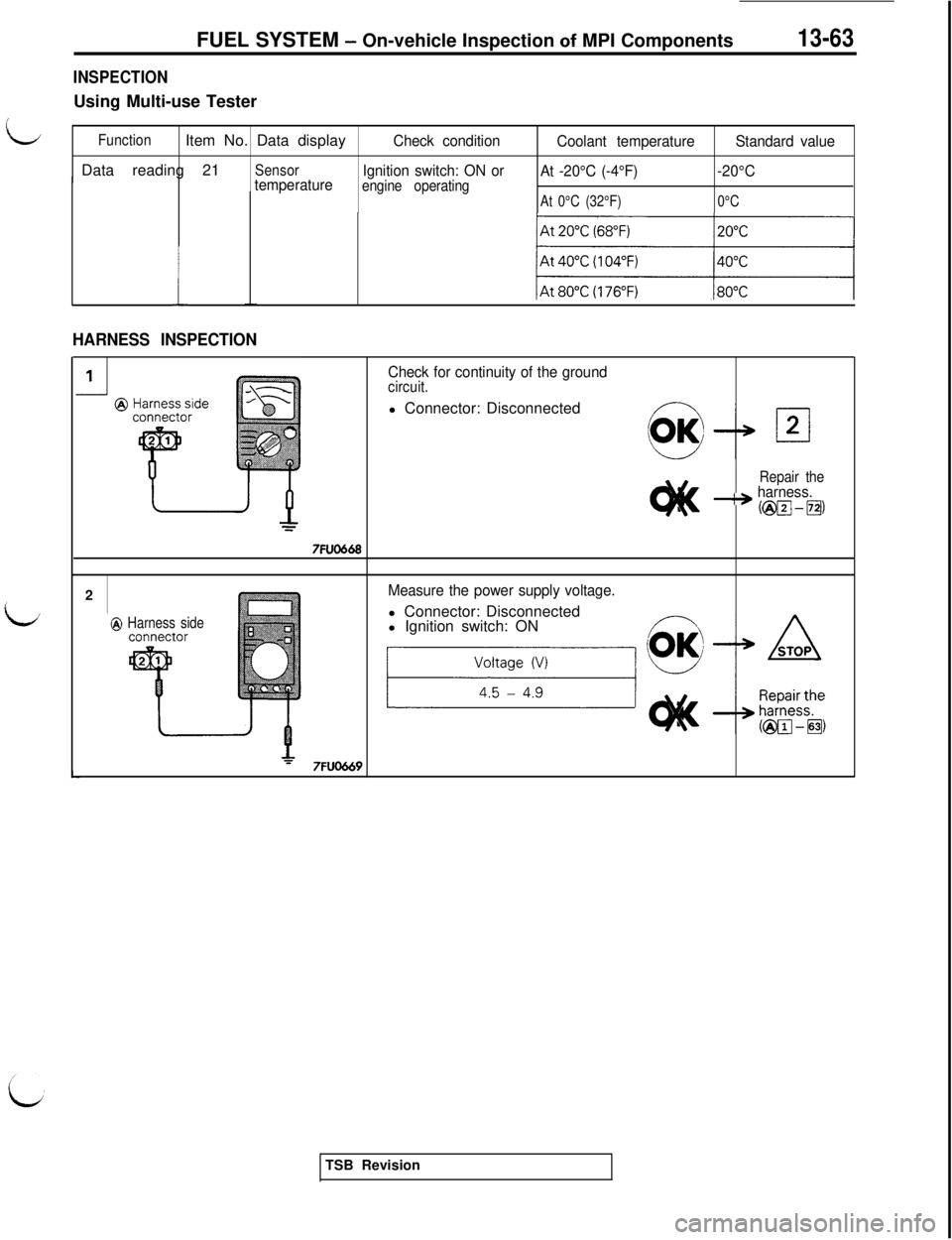
INSPECTIONUsing Multi-use Tester
LFunctionItem No. Data displayCheck condition
Coolant temperatureStandard valueData reading 21
SensorIgnition switch: ON or
At -20°C (-4°F)-20°C
temperatureengine operatingAt 0°C (32°F)0°C
HARNESS INSPECTION
Check for continuity of the groundcircuit.l Connector: Disconnected
Repair the---+ harness.
7FUO6682
Measure the power supply voltage.l Connector: Disconnected
@ Harness sidel Ignition switch: ON
7FUO669TSB Revision
Page 172 of 1146
13-66FUEL SYSTEM - 0n-vehicle Inspection of MPI Components
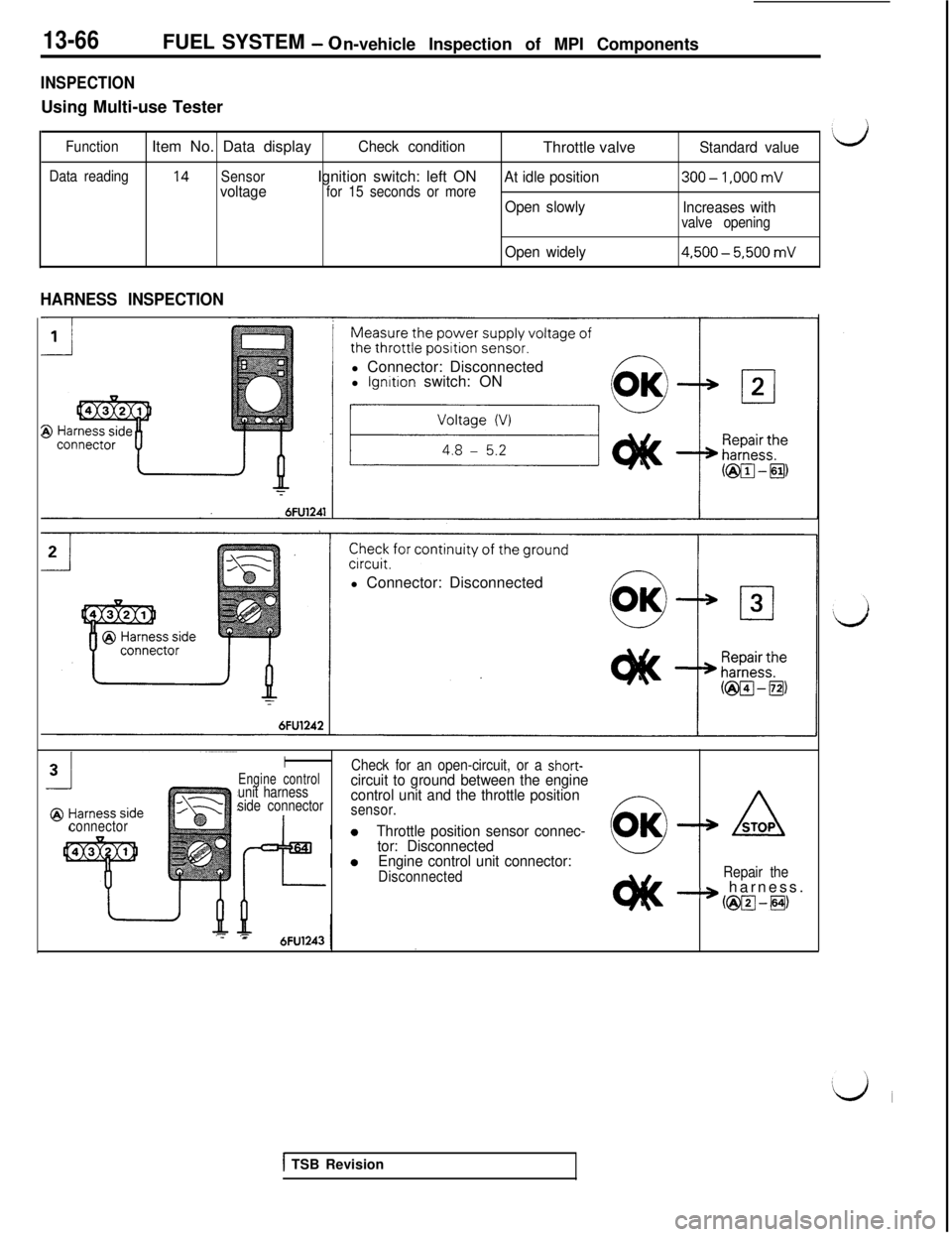
INSPECTIONUsing Multi-use Tester
FunctionItem No. Data displayCheck conditionThrottle valveStandard value‘d
Data reading14SensorIgnition switch: left ONvoltagefor 15 seconds or moreAt idle position300-1.000 mV
Open slowly
Increases withvalve opening
Open widely4.500-5.500 mV
HARNESS INSPECTIONl Connector: Disconnected
l
lgnrtion switch: ON
l Connector: Disconnected
connector
I
Engine controlCheck for an open-circuit, or a short-
unit harnesscircuit to ground between the engine
side connectorcontrol unit and the throttle positionsensor.
Throttle position sensor connec-
tor: Disconnected
Engine control unit connector:
DisconnectedRepair theB-3 harness.
km-8)
-z =6FU1243
[ TSB Revision
Page 174 of 1146
13-68FUEL SYSTEM - On-vehicle Inspection of MPI Components
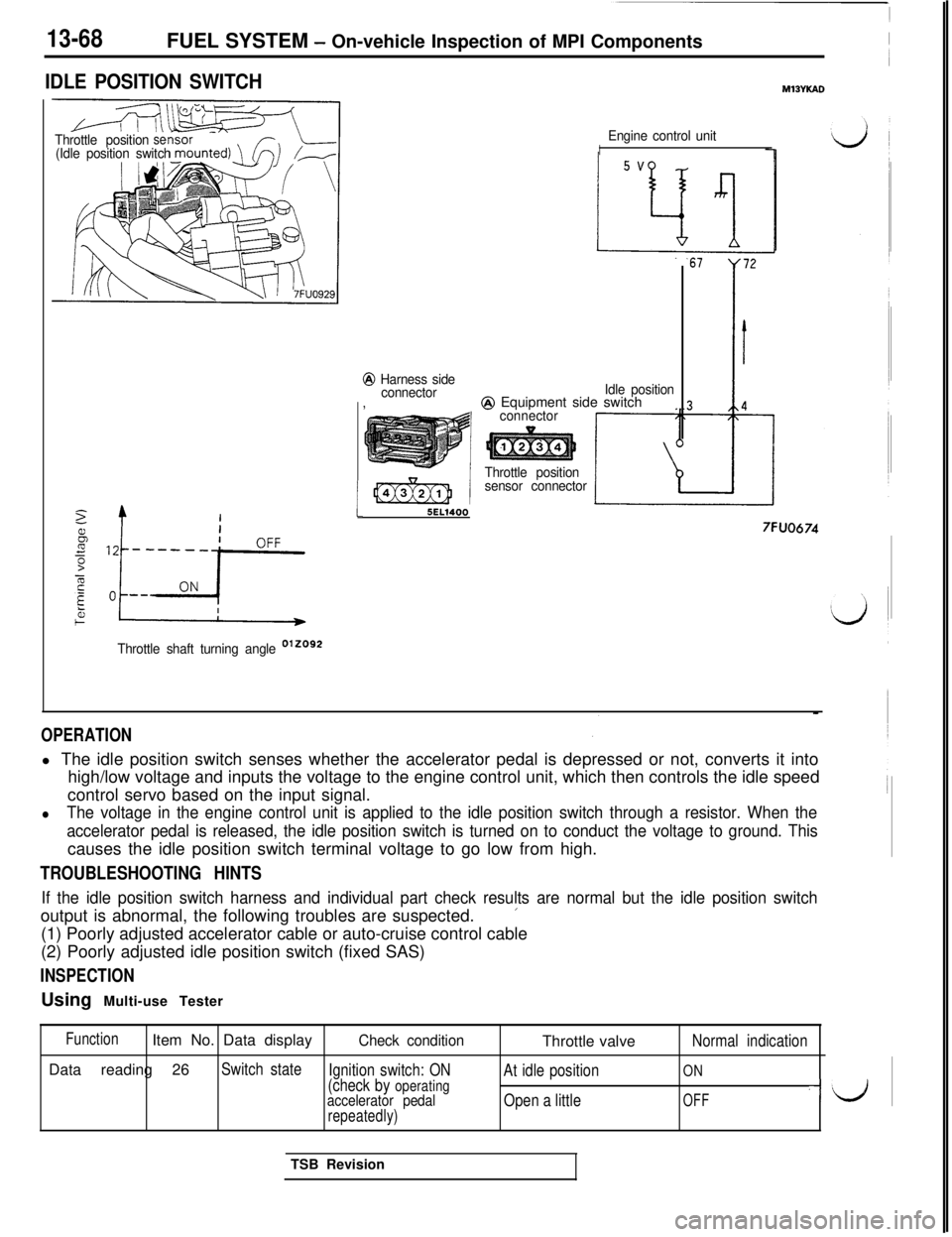
IDLE POSITION SWITCHMlBYKAD
Throttle positionse(Idle position switch
2
/bz----;-p
b+i
Throttle shaft turning angle D’20g2
i
Engine control unitI
@ Harness side
connectorIdle position,
@ Equipment side switchconnector
Throttle position
sensor connector
5EL1400
7FUO674
OPERATIONl The idle position switch senses whether the accelerator pedal is depressed or not, converts it into
high/low voltage and inputs the voltage to the engine control unit, which then controls the idle speed
control servo based on the input signal.
lThe voltage in the engine control unit is applied to the idle position switch through a resistor. When the
accelerator pedal is released, the idle position switch is turned on to conduct the voltage to ground. Thiscauses the idle position switch terminal voltage to go low from high.
TROUBLESHOOTING HINTS
If the idle position switch harness and individual part check results are normal but the idle position switchoutput is abnormal, the following troubles are suspected.
’(1) Poorly adjusted accelerator cable or auto-cruise control cable
(2) Poorly adjusted idle position switch (fixed SAS)
INSPECTIONUsing Multi-use Tester
FunctionItem No. Data displayCheck conditionThrottle valveNormal indicationData reading 26
Switch state
Ignition switch: ONON(check by operatingAt idle position
accelerator pedalOpen a littleOFF-J
repeatedly)TSB Revision
Page 175 of 1146
FUEL SYSTEM - On-vehicle InsDection of MPI ComDonents13-69
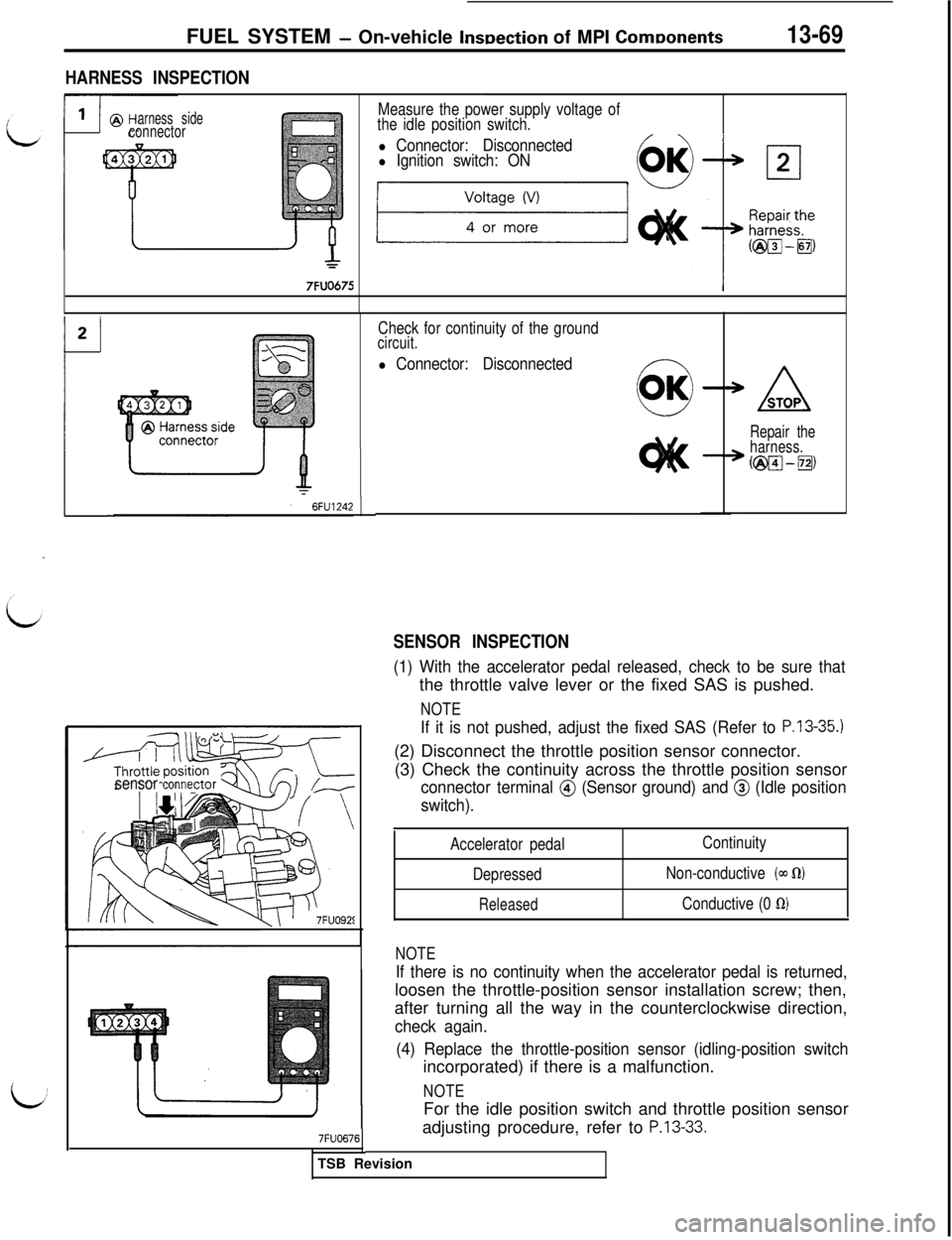
HARNESS INSPECTION
arness sideconnector
7FUO675
Measure the power supply voltage of
the idle position switch.
l Connector: Disconnectedl Ignition switch: ON
Check for continuity of the groundcircuit.
l Connector: Disconnected
SENSOR INSPECTION
sensor tonne
ASTOP
Repair the
harness.
@w--~)
(1) With the accelerator pedal released, check to be sure thatthe throttle valve lever or the fixed SAS is pushed.
NOTE
If it is not pushed, adjust the fixed SAS (Refer to P.13-35.)(2) Disconnect the throttle position sensor connector.
(3) Check the continuity across the throttle position sensor
connector terminal @ (Sensor ground) and @ (Idle position
switch).
Accelerator pedal
Depressed
Released
Continuity
Non-conductive
(a~ KU
Conductive (0 fi)
7FUO676
NOTE
If there is no continuity when the accelerator pedal is returned,loosen the throttle-position sensor installation screw; then,
after turning all the way in the counterclockwise direction,
check again.
(4) Replace the throttle-position sensor (idling-position switchincorporated) if there is a malfunction.
NOTEFor the idle position switch and throttle position sensor
adjusting procedure, refer to
P.13-33.TSB Revision
Page 176 of 1146
FUEL SYSTEM - 0n-vehicleInspection of MPI Components
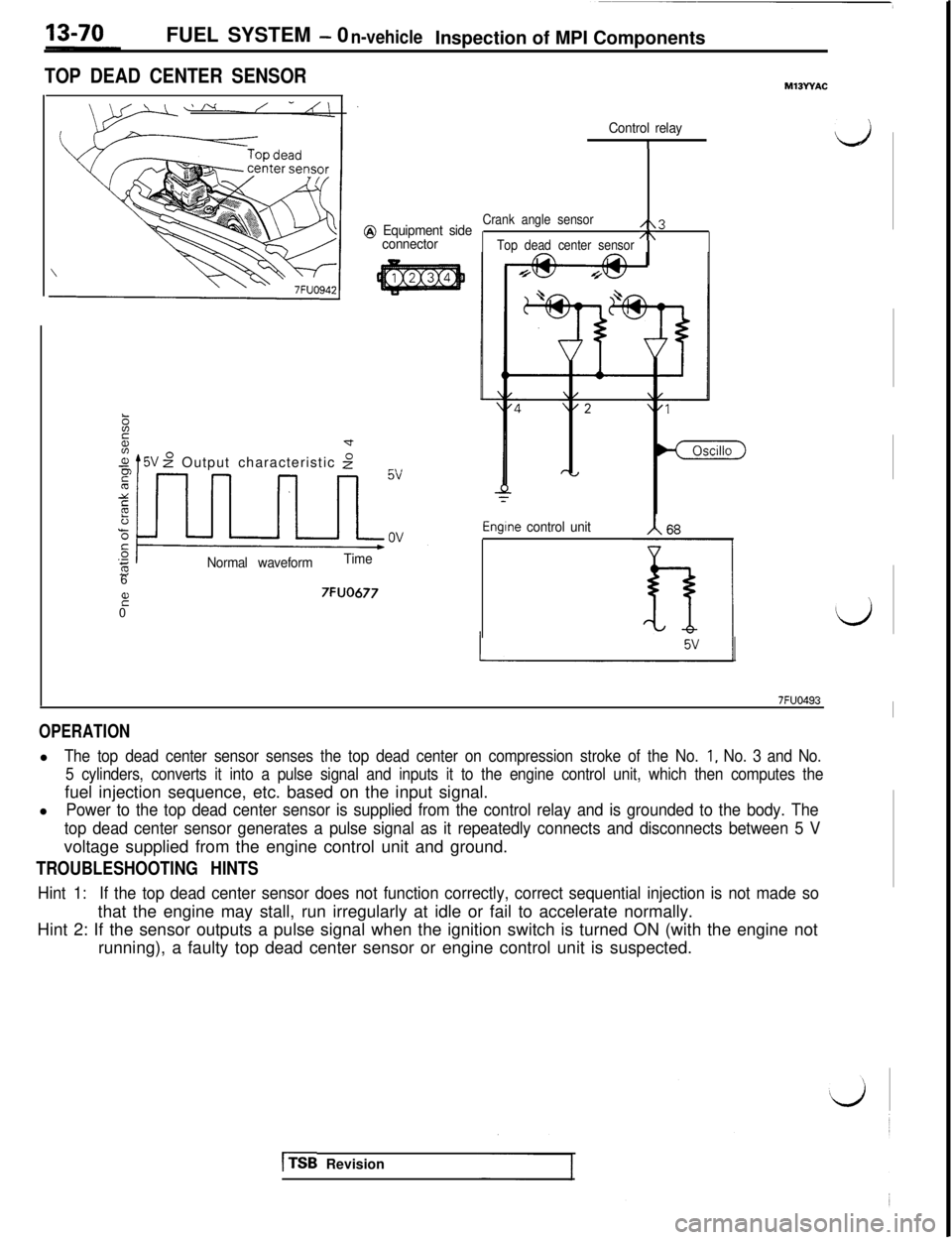
TOP DEAD CENTER SENSOR
Control relay
1d
@ Equipment side
connector
zd
.+$ t5V z” Output characteristic 2r~,
Normal waveformTime6
it07FUO677
Crank angle sensor/\3
Top dead center sensor/\
Engtne control unit
d
7FUO493I
OPERATIONl
The top dead center sensor senses the top dead center on compression stroke of the No. 1, No. 3 and No.
5 cylinders, converts it into a pulse signal and inputs it to the engine control unit, which then computes thefuel injection sequence, etc. based on the input signal.
l
Power to the top dead center sensor is supplied from the control relay and is grounded to the body. The
top dead center sensor generates a pulse signal as it repeatedly connects and disconnects between 5 Vvoltage supplied from the engine control unit and ground.
TROUBLESHOOTING HINTS
Hint 1:If the top dead center sensor does not function correctly, correct sequential injection is not made sothat the engine may stall, run irregularly at idle or fail to accelerate normally.
Hint 2: If the sensor outputs a pulse signal when the ignition switch is turned ON (with the engine not
running), a faulty top dead center sensor or engine control unit is suspected.
[TSB Revision
Page 177 of 1146
iFUEL SYSTEM
- On-vehicle Inspection of MPI Components
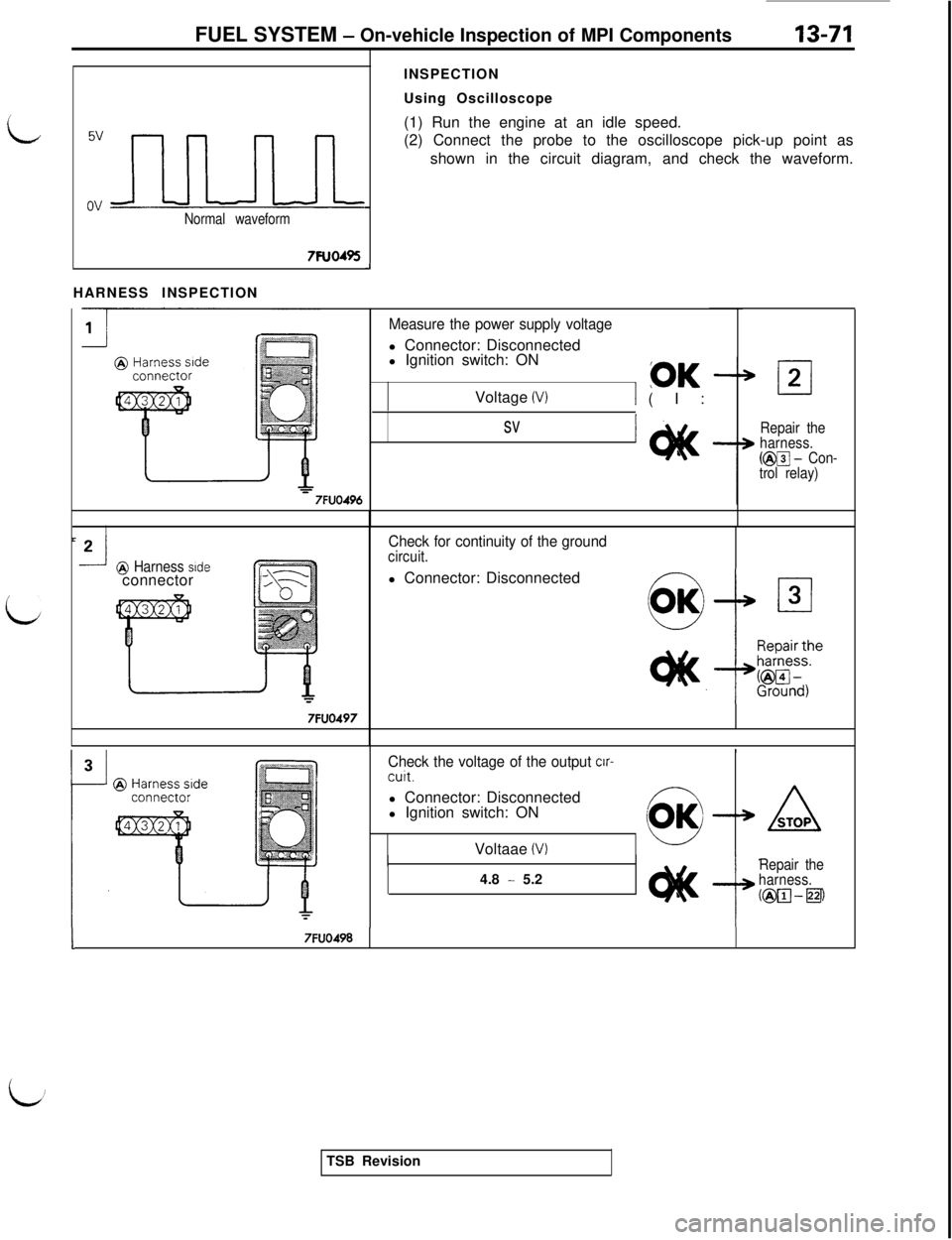
INSPECTION
Using Oscilloscope13-71
::Normal waveform(1) Run the engine at an idle speed.
(2) Connect the probe to the oscilloscope pick-up point as
shown in the circuit diagram, and check the waveform.
7Fuo495HARNESS INSPECTION
= 7FUO496r
i2
@ Harness sideconnectorF
7FUO497
J
Measure the power supply voltagel Connector: Disconnected
l Ignition switch: ON
Voltage
(VI, OK(I:
sv
ib
02
Repair the
harness.
(@m - Con-
trol relay)
ICheck for continuity of the groundcircuit.l Connector: Disconnected
3
~,
Check the voltage of the output err-cuit.l Connector: Disconnected
l Ignition switch: ON
Voltaae
(V)4.8
- 5.2Repair the
harness.
(@El-ED
I7FUO498
idliTSB Revision
Page 178 of 1146

13-72FUEL SYSTEM - On-vehicle Inspection of MPI Components
CRANK ANGLE SENSOR
co.ntiector
Output characteristic
LTime
7FUO682
MllYiAC
Control relay-I-
Crank angle sensorsideA3
Crank angle sensor/\
‘=
Engine controlunft69I
1
h5v
7FUO499
OPERATIONl
The crank angle sensor senses the crank angle (piston position) of each cylinder, converts it into a pulse
signal and inputs it to the engine control unit, which then computes the engine speed and controls the fuelinjection timing and ignition timing based on the input signal.
lPower to the crank angle sensor is supplied from the control relay and is grounded to the body. The crank
angle sensor generates a pulse signal as it repeatedly connects and disconnects between 5 V voltagesupplied from the engine control unit and ground.
TROUBLESHOOTING HINTSHint 1: If unexpected shocks are felt during driving or the engine stalls suddenly during idling, shake the
crank angle sensor harness. If this causes the engine to stall, poor contact of the sensor connector is
suspected.Hint 2: If the crank angle sensor outputs a pulse signal when the ignition switch is turned ON (with the
engine not running), a faulty crank angle sensor or engine control unit is suspected.
Hint 3:
If the tachometer reads 0 rpm when the engine that has failed to start is cranked, faulty crank angleHint 4:sensor or broken timing belt is suspected.
If the tachometer reads 0 rpm when the engine that has failed to start is cranked, the primary current
of the ignition coil is not turned on and off. Therefore, troubles in the ignition circuit and ignition coil orfaulty power transistor is suspected.
Hint 5: If the engine can be run at idle even though the crank angle sensor reading is out of specification,troubles are often in other than the crank angle sensor.
[Examples](1) Faulty engine coolant temperature sensor
(2) Faulty idle speed control servo
(3) Poorly adjusted reference idle speed
TSB Revision
Page 179 of 1146

FUEL SYSTEM - On-vehicle Inspection of MPI Components13-73
INSPECTION
Using Multi-use Tester
FunctionItem No. Data displayCheck conditionCheck content
Normal stateData reading 22
Crankingl Engine cranking
Compare cranking speedIndicated speed
speedl Tachometer connectedand multi-use tester(check on and off ofto agree
reading
primary current of
ignition coil bytachometer)
NOTE(1)The tachometer indicates a third of the actual engine speed. Therefore, 3 times the tachometer indication is theactual engine speed.(2)When the tachometer is set to the 2-cylinder range, it indicates actual engine speed.
FunctionItem No. Data displayCheck conditionCoolant temperatureStandard value
Data reading22Idle speedl Engine: Running atAt -20°C (-4°F)1,300 - 1,500 rpm
idle
l Idle position switch:ONAt 0°C (32°F)At 20°C (68°F)
At 40°C (104°F)
At 80°C (176°F)1,250
- 1,450 rpm
1
,I 00 - 1,300 rpm
950-1,150rpm
600 - 800 rpm
-m-2,-5v
f-lov
---Normal waveform
Using Oscilloscope
(1) Run the engine at idle speed.
(2) Connect the probe to the oscilloscope pick-up point as
shown in the circuit diagram, and check the waveform.
1 TSB Revision
Page 181 of 1146
FUEL SYSTEM - On-vehicle Inspection of MPI Components
L
L
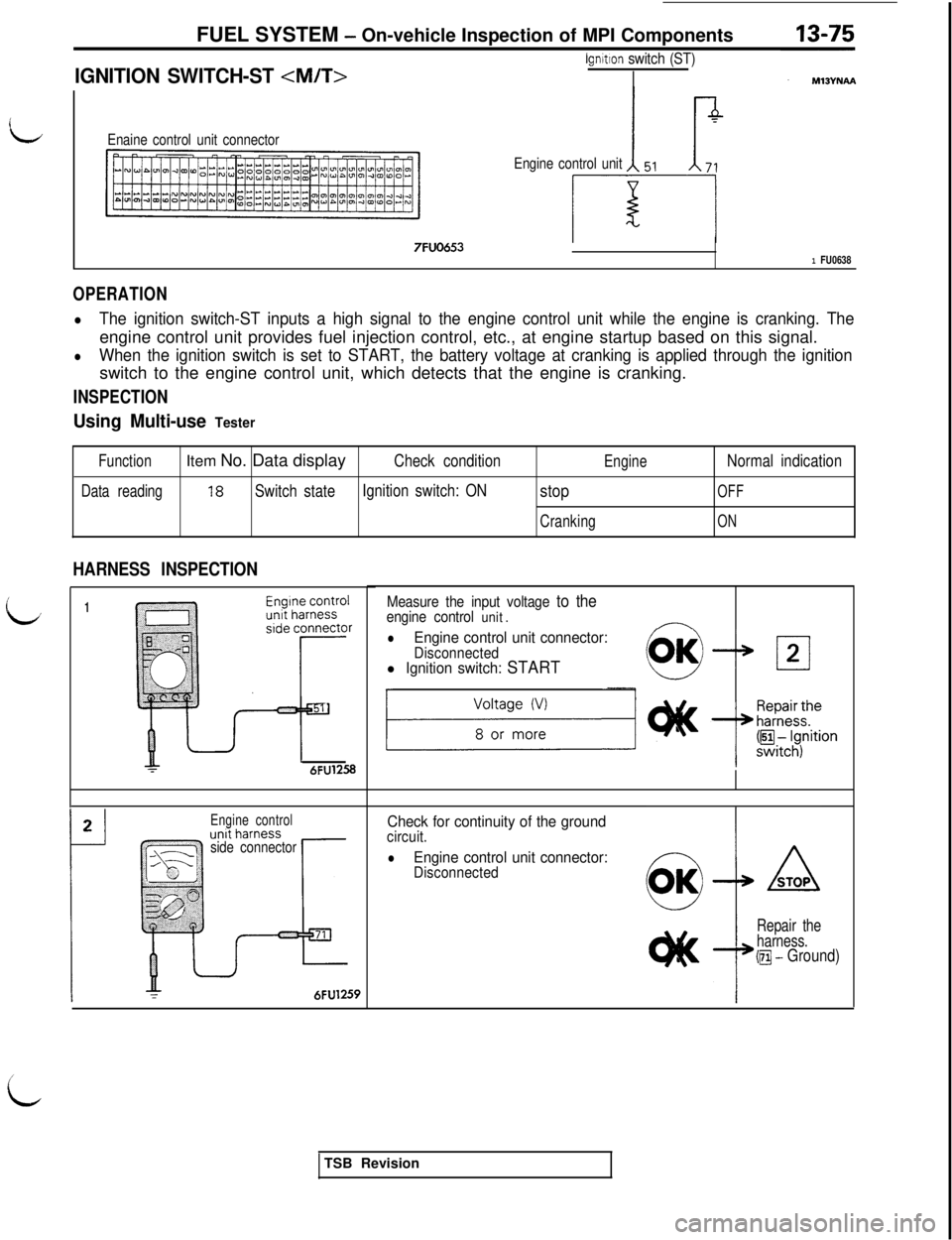
IGNITION SWITCH-ST
lgnitlon switch (ST)
I
Enaine control unit connector
7FUO653
Engine control unit
1 FU0638
OPERATION
lThe ignition switch-ST inputs a high signal to the engine control unit while the engine is cranking. Theengine control unit provides fuel injection control, etc., at engine startup based on this signal.
lWhen the ignition switch is set to START, the battery voltage at cranking is applied through the ignitionswitch to the engine control unit, which detects that the engine is cranking.
INSPECTION
Using Multi-use Tester
FunctionItem No. Data displayCheck conditionEngineNormal indication
Data reading18Switch stateIgnition switch: ONstopOFF
CrankingON
HARNESS INSPECTION
1
L6FU1258
2
1
Engine control
side connector
IY-6FU1259
Measure the input voltage to theengine control unit.nlEngine control unit connector:Disconnectedl Ignition switch: START
Check for continuity of the groundcircuit.
lEngine control unit connector:Disconnected
Repair the
harness.
(m - Ground)
iTSB Revision