oil MITSUBISHI 3000GT 1991 Workshop Manual
[x] Cancel search | Manufacturer: MITSUBISHI, Model Year: 1991, Model line: 3000GT, Model: MITSUBISHI 3000GT 1991Pages: 1146, PDF Size: 76.68 MB
Page 105 of 1146
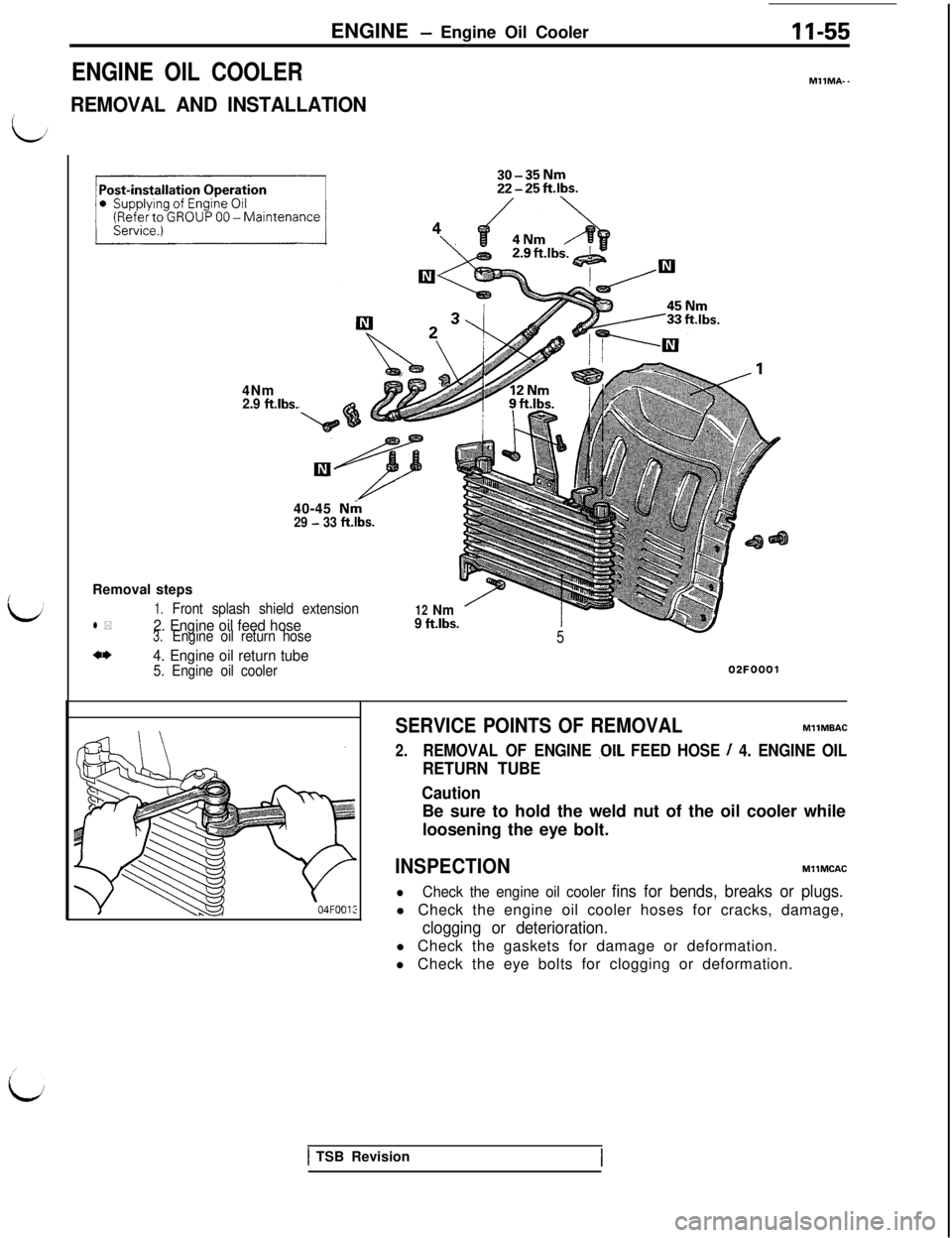
ENGINE - Engine Oil Cooler
ENGINE OIL COOLER
REMOVAL AND INSTALLATION
11-55
MllMA-.4Nm
2.9 ft.lbs.40-45
Nrh
29 - 33 ft.lbs.Removal steps
1.Front splash shield extensionl *2. Engine oil feed hose3.Engine oil return hose
4*4. Engine oil return tube5. Engine oil cooler
12Nm
9 ft.lbs.5
02FOOOi
SERVICE POINTS OF REMOVALMllMBAC
2.REMOVAL OF ENGINE .OIL FEED HOSE / 4. ENGINE OIL
RETURN TUBE
CautionBe sure to hold the weld nut of the oil cooler while
loosening the eye bolt.
INSPECTIONMllMCAC
l
Check the engine oil cooler fins for bends, breaks or plugs.l Check the engine oil cooler hoses for cracks, damage,
clogging or deterioration.l Check the gaskets for damage or deformation.
l Check the eye bolts for clogging or deformation.
1 TSB Revision
Page 108 of 1146
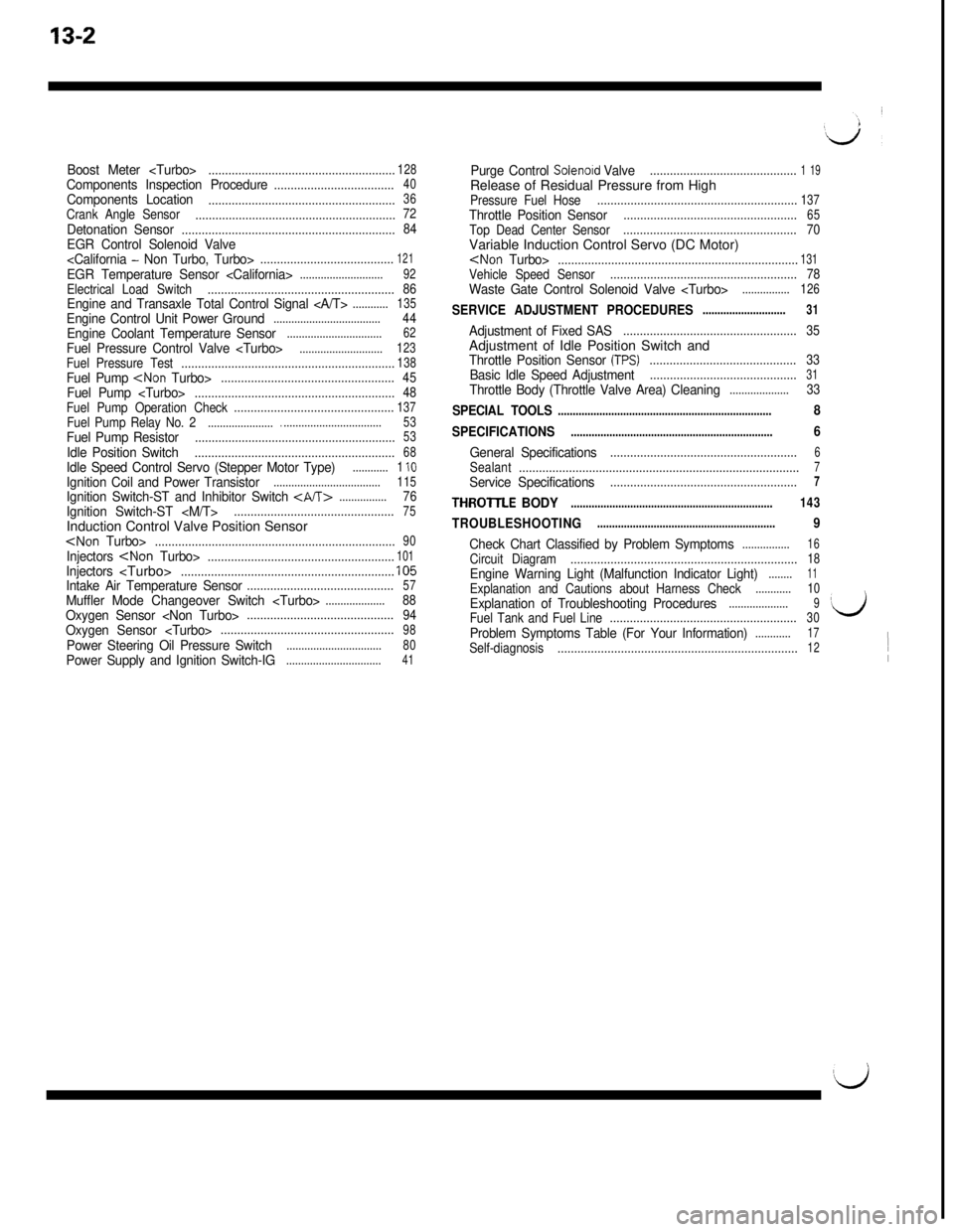
13-2
Boost Meter
Components Location........................................................36
Crank Angle Sensor
............................................................72Detonation Sensor................................................................84EGR Control Solenoid Valve
EGR Temperature Sensor
Fuel Pump Operation Check................................................137Fuel Pump Relay No. 2........................................................53Fuel Pump Resistor............................................................53
Idle Position Switch............................................................68Idle Speed Control Servo (Stepper Motor Type)............1 IOIgnition Coil and Power Transistor....................................115Ignition Switch-ST and Inhibitor Switch ................76Ignition Switch-ST
Injectors
94
Oxygen Sensor
Power Steering Oil Pressure Switch................................80Power Supply and Ignition Switch-IG................................41
Purge Control Solenord Valve............................................1 19Release of Residual Pressure from High
Pressure Fuel Hose............................................................137Throttle Position Sensor....................................................65Top Dead Center Sensor....................................................70Variable Induction Control Servo (DC Motor)
SERVICE ADJUSTMENT PROCEDURES............................31
Adjustment of Fixed SAS....................................................35Adjustment of Idle Position Switch and
Throttle Position Sensor (TPS)............................................33Basic Idle Speed Adjustment............................................31Throttle Body (Throttle Valve Area) Cleaning....................33
SPECIAL TOOLS........................................................................8
SPECIFICATIONS
....................................................................6
General Specifications........................................................6Sealant....................................................................................7Service Specifications........................................................7
THROlTLE BODY....................................................................143
TROUBLESHOOTING............................................................9
Check Chart Classified by Problem Symptoms................16Circuit Diagram....................................................................18Engine Warning Light (Malfunction Indicator Light)........11Explanation and Cautions about Harness Check............10Explanation of Troubleshooting Procedures....................9Fuel Tank and Fuel Line........................................................30
Problem Symptoms Table (For Your Information)............17Self-diagnosis........................................................................12)
I
Page 113 of 1146
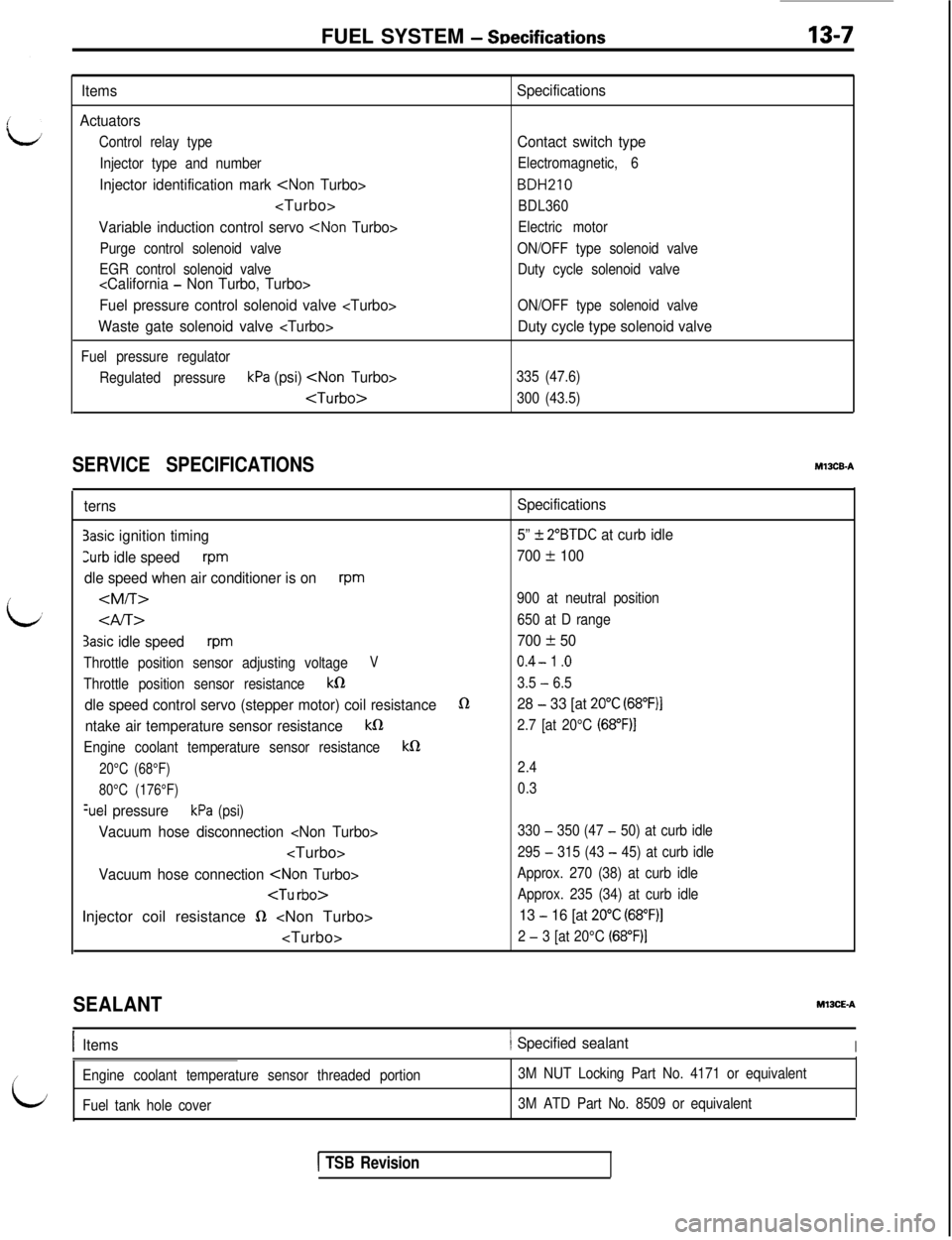
FUEL SYSTEM - SDecifications
L
Items
Actuators
Control relay type
Injector type and number
Injector identification mark
Variable induction control servo
Purge control solenoid valve
EGR control solenoid valve
Fuel pressure control solenoid valve
Waste gate solenoid valve
Fuel pressure regulator
Regulated pressure
kPa (psi)
Specifications
Contact switch type
Electromagnetic, 6
BDH210
BDL360
Electric motor
ON/OFF type solenoid valve
Duty cycle solenoid valve
ON/OFF type solenoid valve
Duty cycle type solenoid valve
335 (47.6)
300 (43.5)
SERVICE SPECIFICATIONS
i
ternsSpecifications
3asic ignition timing5” -t 2”BTDC at curb idle
3urb idle speedrpm700 * 100
dle speed when air conditioner is on
rpm
3asic idle speedrpm700 + 50
Throttle position sensor adjusting voltageV0.4- 1 .o
Throttle position sensor resistancek03.5 - 6.5
dle speed control servo (stepper motor) coil resistance028 - 33 [at 20°C (68”F)I
ntake air temperature sensor resistancekfi2.7 [at 20°C (68”F)I
Engine coolant temperature sensor resistancekQ
20°C (68°F)
2.4
80°C (176°F)0.3
%el pressurekPa (psi)
Vacuum hose disconnection
295 - 315 (43 - 45) at curb idle
Vacuum hose connection
Sz
2 - 3 [at 20°C (68”F)I
SEALANTMlXE-A
IItems1 Specified sealantI
/
L
Engine coolant temperature sensor threaded portion3M NUT Locking Part No. 4171 or equivalent
Fuel tank hole cover3M ATD Part No. 8509 or equivalent
1 TSB Revision
Page 117 of 1146
FUEL SYSTEM - Troubleshooting13-11
L
L
Sensor side6FU1215
Malfunctionl
If the sensor impressed voltage is abnormal, check the wire
for an open circuit or short-circuit to ground and repair as
necessary. If the wire is normal, replace the engine control
unit and check again.l To check the voltage, use a digital voltmeter (or circuit
tester) as a rule.
[However, use an analog voltmeter for checking the power
transistor drive voltage.]ENGINE WARNING LIGHT (MALFUNCTION IN-
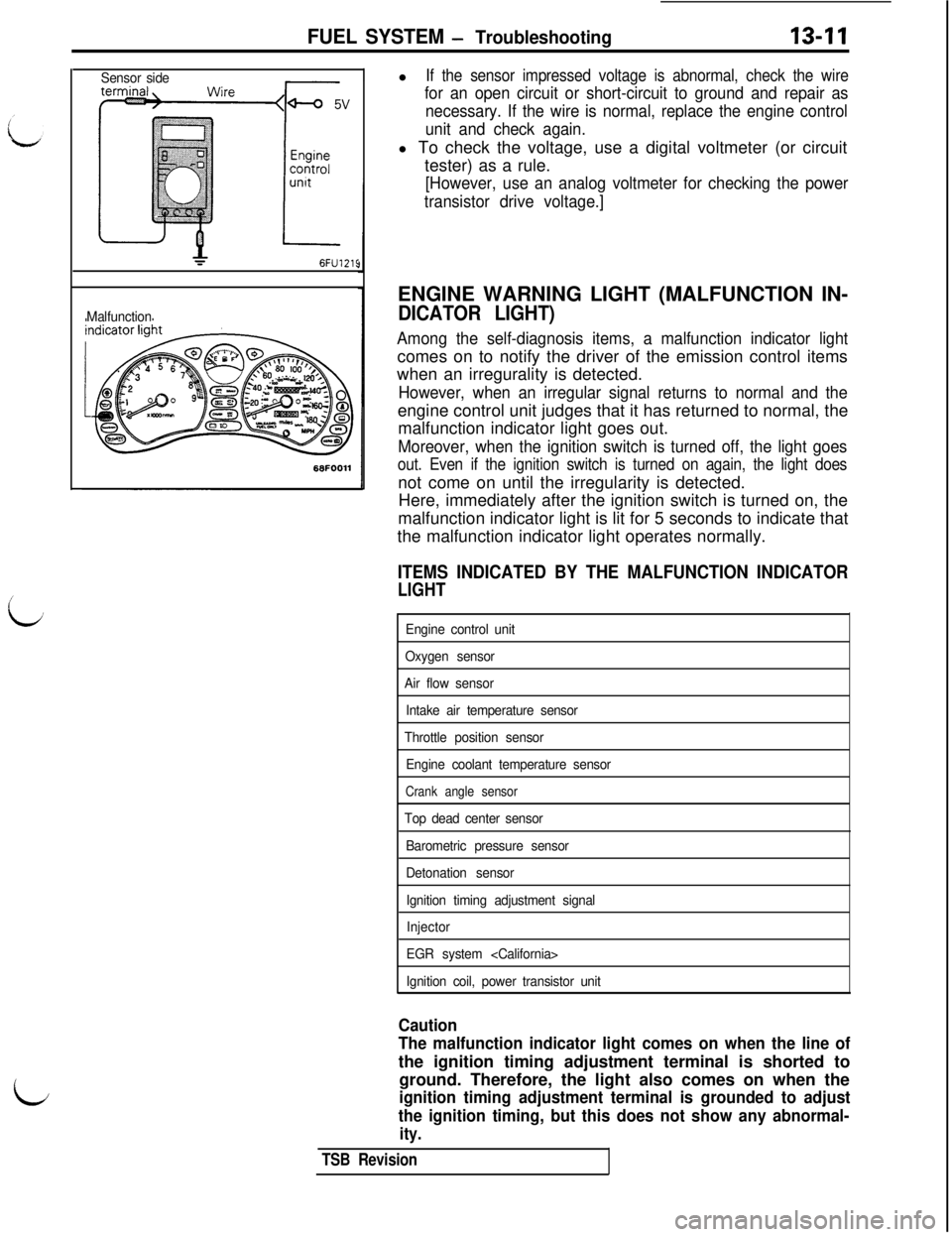
DICATOR LIGHT)
Among the self-diagnosis items, a malfunction indicator lightcomes on to notify the driver of the emission control items
when an irregurality is detected.
However, when an irregular signal returns to normal and theengine control unit judges that it has returned to normal, the
malfunction indicator light goes out.
Moreover, when the ignition switch is turned off, the light goes
out. Even if the ignition switch is turned on again, the light doesnot come on until the irregularity is detected.
Here, immediately after the ignition switch is turned on, the
malfunction indicator light is lit for 5 seconds to indicate that
the malfunction indicator light operates normally.
ITEMS INDICATED BY THE MALFUNCTION INDICATOR
LIGHT
Engine control unit
Oxygen sensor
Air flow sensor
Intake air temperature sensor
Throttle position sensor
Engine coolant temperature sensor
Crank angle sensor
Top dead center sensor
Barometric pressure sensor
Detonation sensor
Ignition timing adjustment signal
Injector
EGR system
Ignition coil, power transistor unit
Caution
The malfunction indicator light comes on when the line ofthe ignition timing adjustment terminal is shorted to
ground. Therefore, the light also comes on when the
ignition timing adjustment terminal is grounded to adjust
the ignition timing, but this does not show any abnormal-
ity.
TSB Revision
Page 120 of 1146
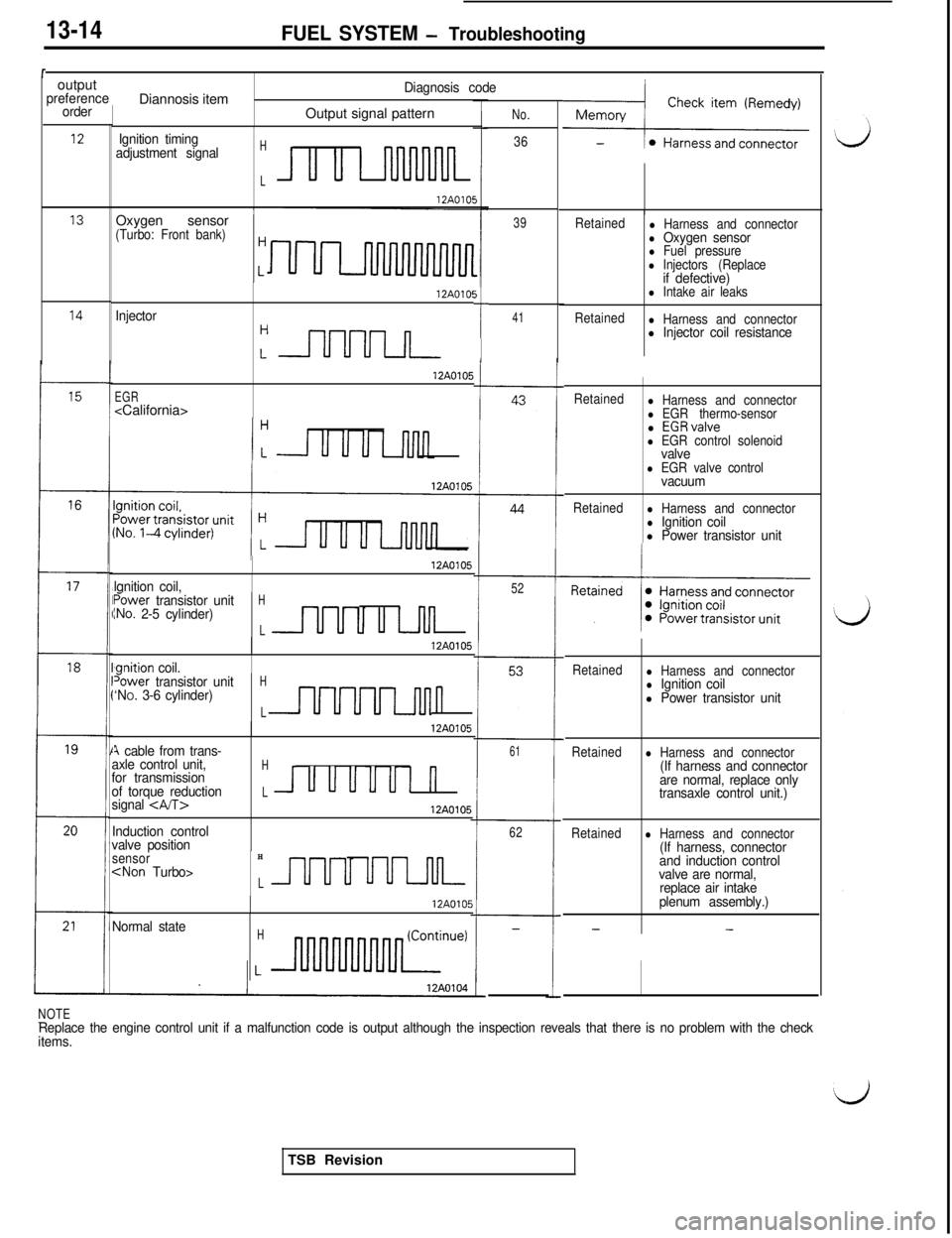
13-14FUEL SYSTEM - Troubleshooting
routput
preference
order
7Diannosis item
Diagnosis code
IOutput signal patternNo.
36
39
121 Ignition timing
adjustment signalH
L
13Oxygen sensor ’(Turbo: Front bank)HRetainedl Harness and connectorl Oxygen sensorl Fuel pressurel Injectors (Replaceif defective)l Intake air leaks
Retained
l Harness and connectorl Injector coil resistance
5
I--
Injector12AOlO!
:nnnn
EGR
12A0105
14
41
Retainedl Harness and connectorl EGR thermo-sensorl EGRvalvel EGR control solenoidvalvel EGR valve controlvacuum
Retainedl Harness and connectorl Ignition coill Power transistor unit
16
lqnition coil,
12A0105
52power transistor unitINO. 2-5 cylinder)H
Lu Lnll
‘qnition coil.
12AO105
18Retainedl Harness and connectorl Ignition coill Power transistor unit
Retainedl Harness and connector(If harness and connector
are normal, replace only
transaxle control unit.)
Retainedl Harness and connector(If harness, connector
and induction control
valve are normal,
replace air intake
plenum assembly.)
--
Tower transistor unitH‘NO. 3-6 cylinder)
Ln
12A0105
A cable from trans-
axle control unit,Hfor transmission
of torque reductionLUUUUUI n
signal 12A0105
Induction control
valve position
61
62
sensorH
12A0105
Normal stateH-
NOTE-Replace the engine control unit if a malfunction code is output although the inspection reveals that there is no problem with the check
items.TSB Revision
Page 142 of 1146
13-36FUEL SYSTEM - 0
n-vehicle Inspection of MPI Components
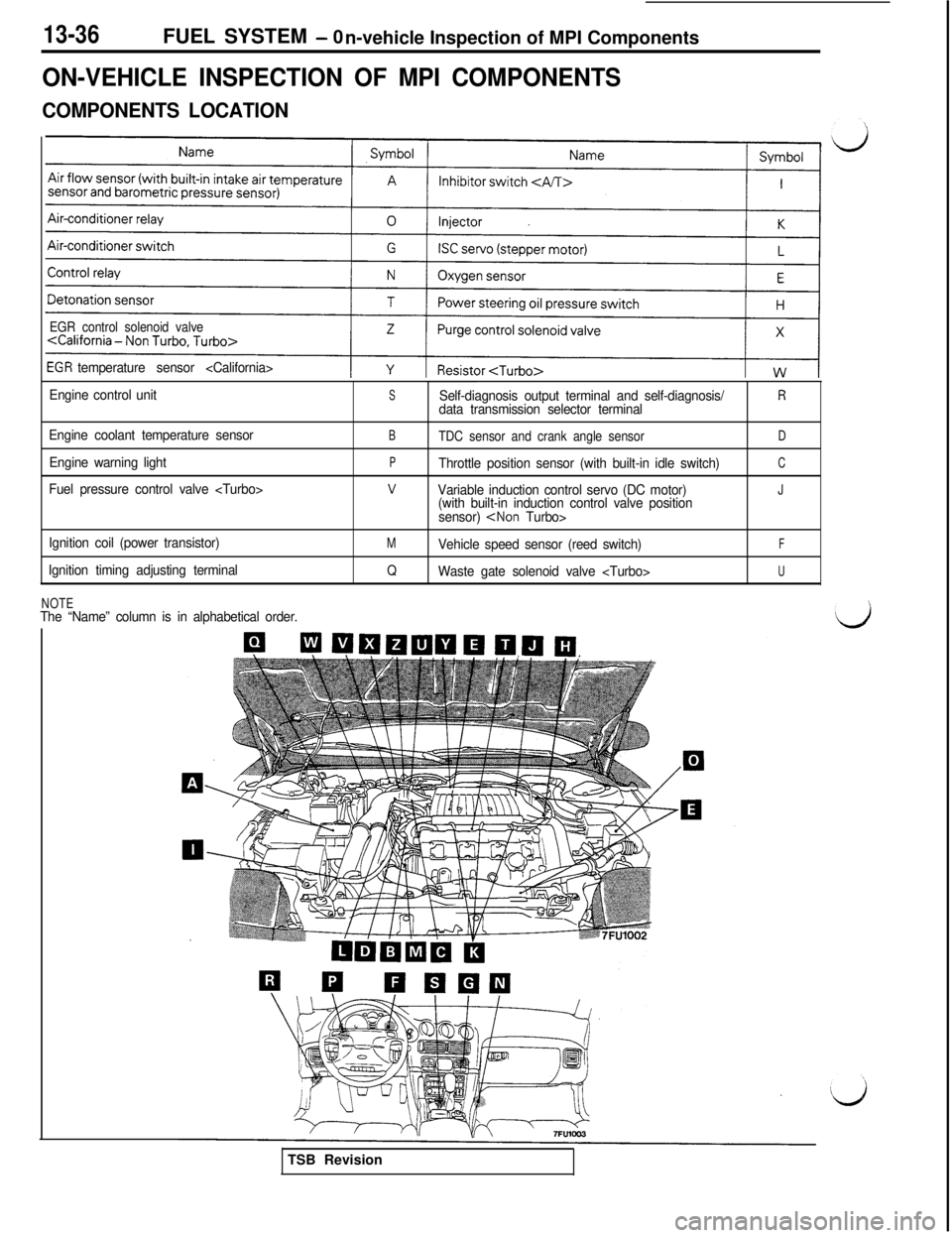
ON-VEHICLE INSPECTION OF MPI COMPONENTS
COMPONENTS LOCATION
EGR control solenoid valve
temperature sensor
Engine control unit
Engine coolant temperature sensor
Engine warning light
Fuel pressure control valve
Ignition coil (power transistor)
Ignition timing adjusting terminal
SSelf-diagnosis output terminal and self-diagnosis/Rdata transmission selector terminal
BTDC sensor and crank angle sensorD
PThrottle position sensor (with built-in idle switch)C
vVariable induction control servo (DC motor)J(with built-in induction control valve position
sensor)
MVehicle speed sensor (reed switch)F
QWaste gate solenoid valve
NOTEThe “Name” column is in alphabetical order.TSB Revision
Page 147 of 1146
FUEL SYSTEM - On-vehicle Inspection of MPI Components13-41
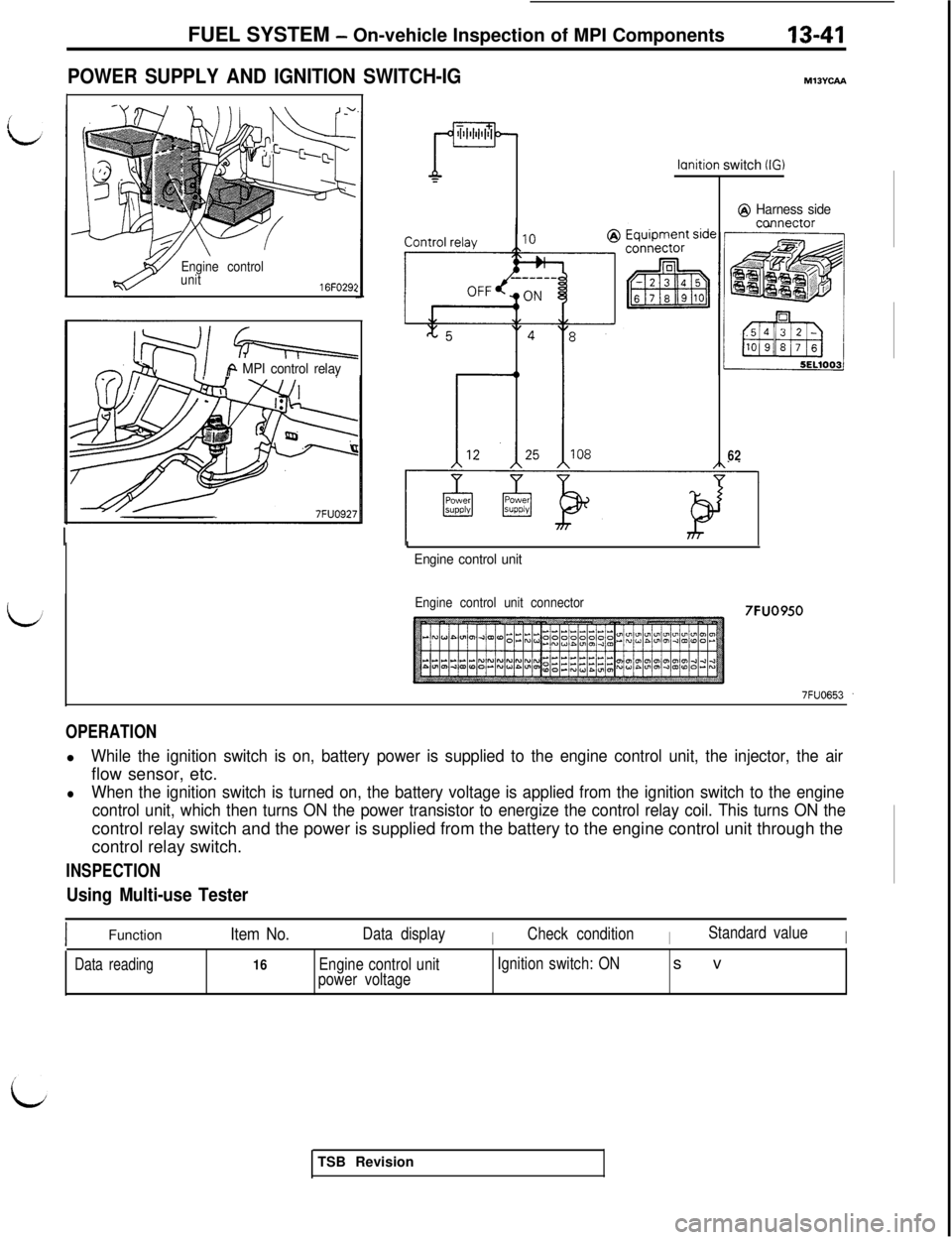
POWER SUPPLY AND IGNITION SWITCH-IG
Engine control
unit
16FO29:
Q-i=++=
iA MPI control relay
ml3Yuu
lcmition switch (IG)
@ Harness sideccmnector
62
I
Engine control unit
Engine control unit connector7FUO950
OPERATIONl
While the ignition switch is on, battery power is supplied to the engine control unit, the injector, the airflow sensor, etc.
lWhen the ignition switch is turned on, the battery voltage is applied from the ignition switch to the engine
control unit, which then turns ON the power transistor to energize the control relay coil. This turns ON thecontrol relay switch and the power is supplied from the battery to the engine control unit through the
control relay switch.
INSPECTION
Using Multi-use Tester
IFunctionItem No.Data displayICheck conditionIStandard valueI
Data reading16Engine control unit
power voltageIgnition switch: ONsv
TSB Revision
Page 151 of 1146
FUEL SYSTEM -On-vehicle Inspection of MPI Components13-45
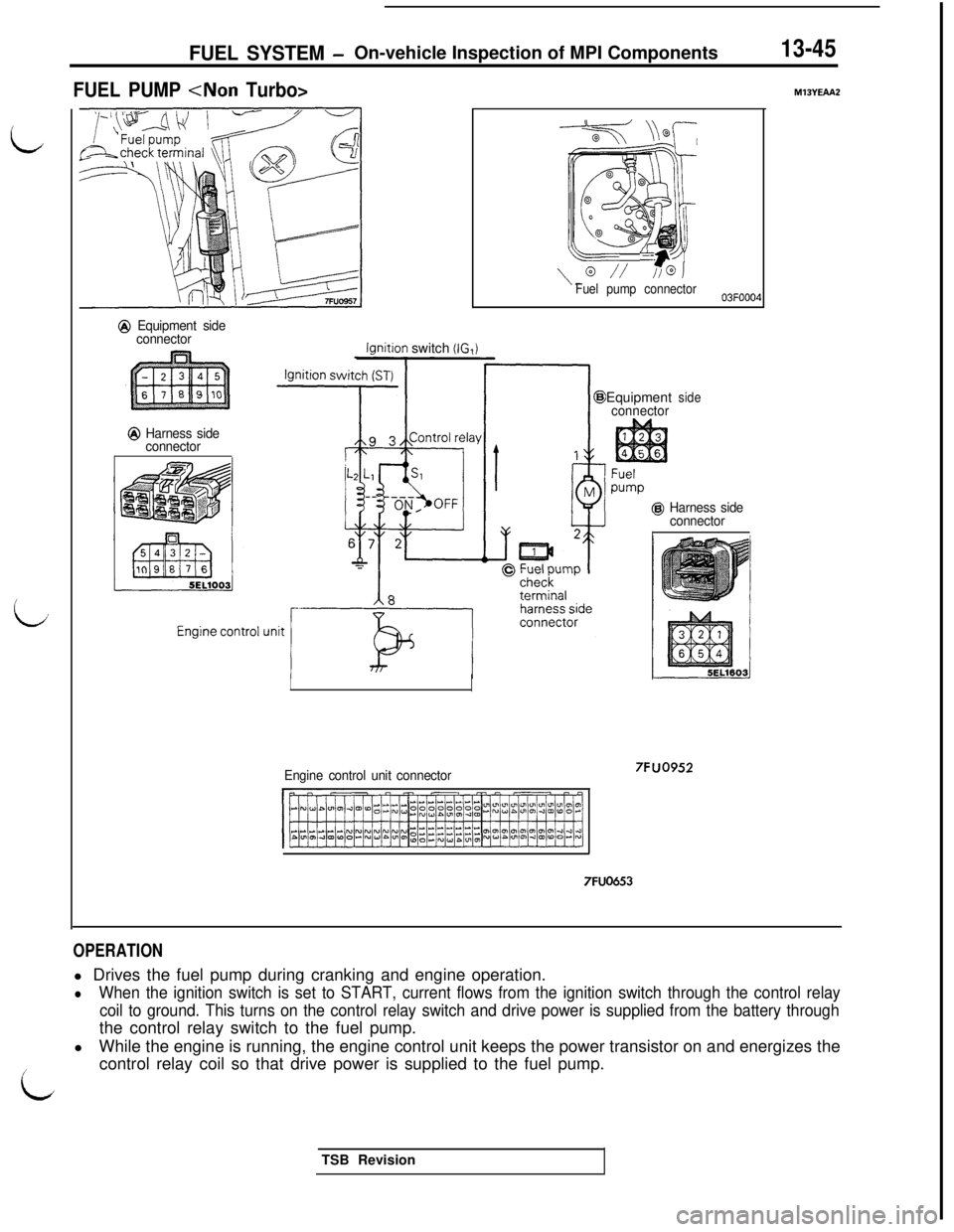
FUEL PUMP
@ Equipment side
connector
@ Harness side
connector
lqnition switch (IG,i
LL--- /A&
\“// //@JFuel pump connector
Engine control unit connectorEquipment
connectorside
@ Harness side
connector
7FUO653
7FUO952
M13YEAA2
OPERATIONl Drives the fuel pump during cranking and engine operation.
lWhen the ignition switch is set to START, current flows from the ignition switch through the control relay
coil to ground. This turns on the control relay switch and drive power is supplied from the battery throughthe control relay switch to the fuel pump.
lWhile the engine is running, the engine control unit keeps the power transistor on and energizes the
icontrol relay coil so that drive power is supplied to the fuel pump.
LTSB Revision
Page 156 of 1146
13-50FUEL SYSTEM - 0
n-vehicle Inspection of MPI Components
OPERATIONControl Relay Operation
l Drives the fuel pump during cranking and engine operation.
l
When the ignition switch is set to START, current flows from the ignition switch through the control relay
coil to ground. This turns on the control relay switch and drive power is supplied from the battery throughthe control relay switch to the fuel pump.
lWhile the engine is running, the engine control unit keeps the power transistor on and energizes the
control relay coil so that drive power is supplied to the fuel pump.
Fuel Pump Relay No. 2 Operation
lChange the fuel pump discharge in two stages by ON-OFF operation of the relay switch for fuel pumprelay No. 2.
lIf the amount of inlet air is small (the engine load is low), the engine control unit turns on the power
transistor to energize the coil of fuel pump relay No. 2, sending drive power to the fuel pump through the
resistor. If the amount of inlet air is large (the engine load is high), the engine control unit turns off thepower transistor to send drive power directly to the fuel pump without passing through the resistor.
INSPECTIONUsing Multi-use Tester
Function
ActuatortestItem No.
Operation
Check conditionCheck itemNormal condition
07Fuel pump isdriven to cir-l Engine crankingHold return hose withl Forced drive of fuelPulsation is felt
culate fuelfingers to feel pulsationpump
Check is made for aboveindicating fuel flow
two conditionsListen to pump operating
sound near fuel tankOperating sound isheard
I/IIII
cFunctionItem No.Operation
Check conditionNormal condition
Actuatortest
13Turn the fuel pump relayNo. 2 from OFF to ONIgnition switch: ONOperating soundis heard.
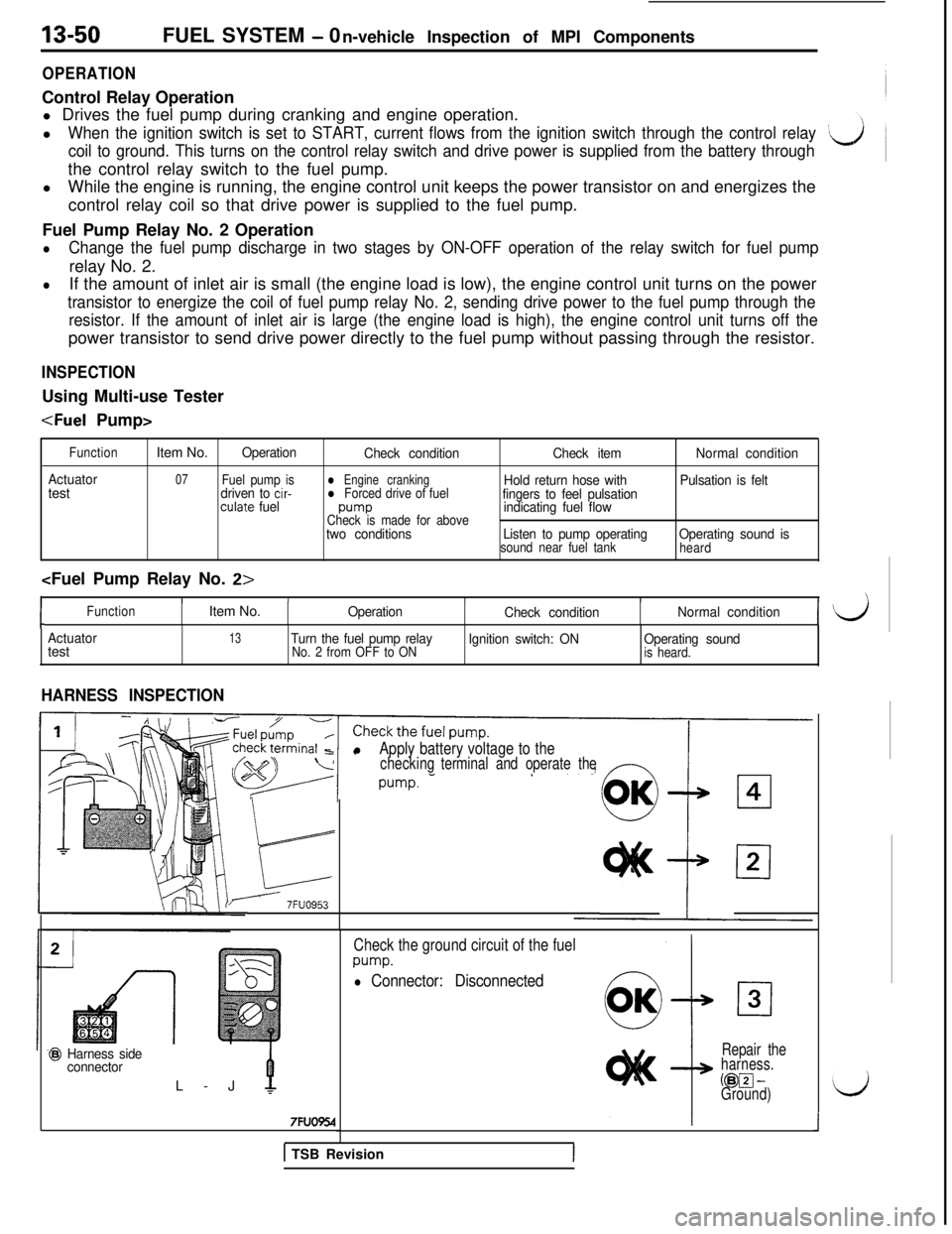
HARNESS INSPECTION
k
J------ 7FUO953
lApply battery voltage to thecheckingterminal and operate the
Check the ground circuit of the fuel
pump.
l Connector: Disconnected
@I Harness side
connectorL-J
7FUO554
Repair the
harness.
@pJ-Ground)
J
1 TSB Revision
Page 160 of 1146
FUEL SYSTEM - 0
n-vehicle Inspection of MPI Components
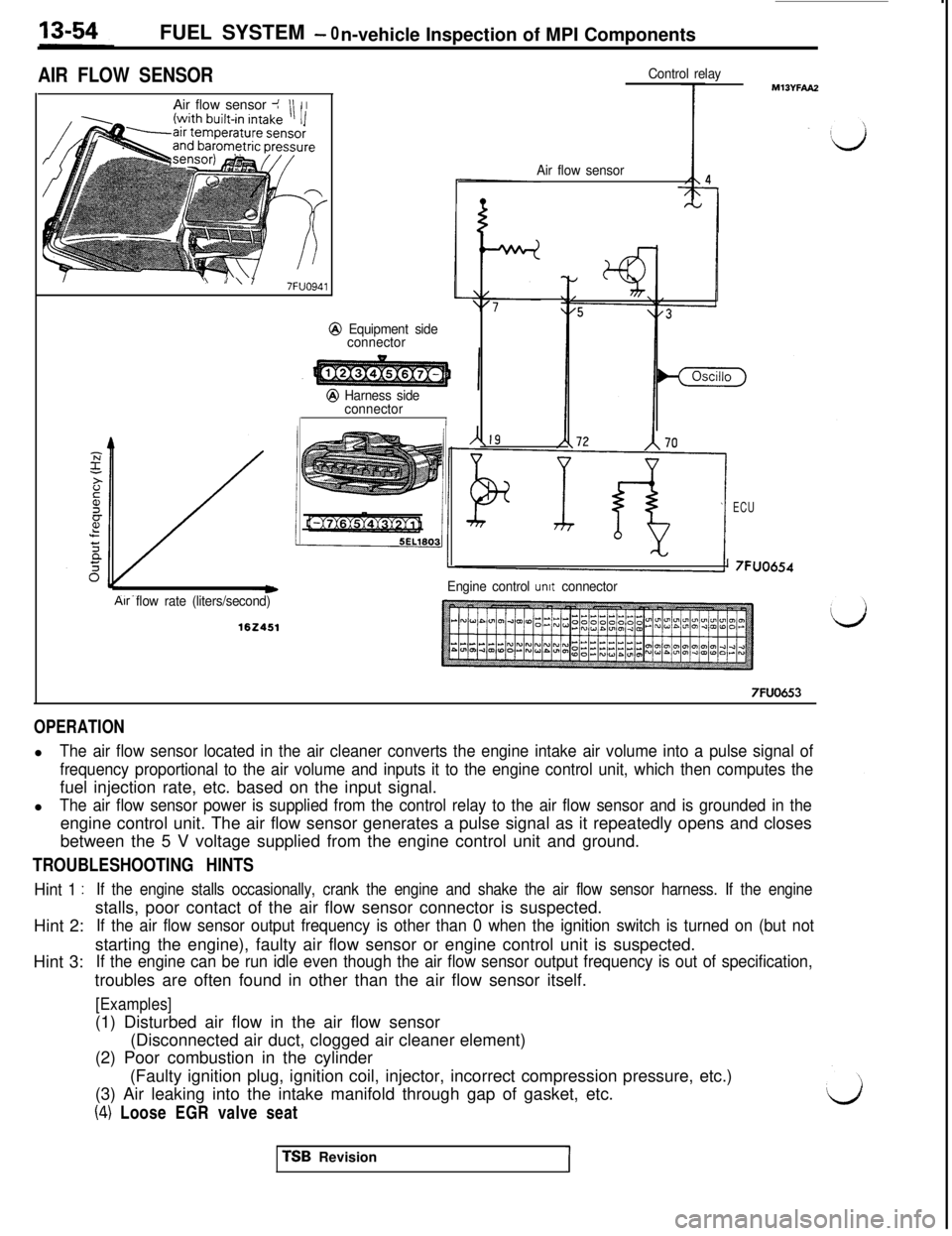
AIR FLOW SENSORAir flow sensor J
III I
\I\Y7FUO941
@ Equipment side
connector
Air flow rate (liters/second)
@ Harness side
connector
I
Control relay
I
Air flow sensor
ECU
’ 7FUO654
Engine control
unit connector
7FUO653
OPERATIONl
The air flow sensor located in the air cleaner converts the engine intake air volume into a pulse signal of
frequency proportional to the air volume and inputs it to the engine control unit, which then computes thefuel injection rate, etc. based on the input signal.
l
The air flow sensor power is supplied from the control relay to the air flow sensor and is grounded in theengine control unit. The air flow sensor generates a pulse signal as it repeatedly opens and closes
between the 5 V voltage supplied from the engine control unit and ground.
TROUBLESHOOTING HINTS
Hint 1 :If the engine stalls occasionally, crank the engine and shake the air flow sensor harness. If the engineHint 2:stalls, poor contact of the air flow sensor connector is suspected.
If the air flow sensor output frequency is other than 0 when the ignition switch is turned on (but notHint 3:starting the engine), faulty air flow sensor or engine control unit is suspected.
If the engine can be run idle even though the air flow sensor output frequency is out of specification,troubles are often found in other than the air flow sensor itself.
[Examples](1) Disturbed air flow in the air flow sensor
(Disconnected air duct, clogged air cleaner element)
(2) Poor combustion in the cylinder
(Faulty ignition plug, ignition coil, injector, incorrect compression pressure, etc.)
(3) Air leaking into the intake manifold through gap of gasket, etc.
(4) Loose EGR valve seatTSB Revision