oil MITSUBISHI 3000GT 1991 Repair Manual
[x] Cancel search | Manufacturer: MITSUBISHI, Model Year: 1991, Model line: 3000GT, Model: MITSUBISHI 3000GT 1991Pages: 1146, PDF Size: 76.68 MB
Page 178 of 1146

13-72FUEL SYSTEM - On-vehicle Inspection of MPI Components
CRANK ANGLE SENSOR
co.ntiector
Output characteristic
LTime
7FUO682
MllYiAC
Control relay-I-
Crank angle sensorsideA3
Crank angle sensor/\
‘=
Engine controlunft69I
1
h5v
7FUO499
OPERATIONl
The crank angle sensor senses the crank angle (piston position) of each cylinder, converts it into a pulse
signal and inputs it to the engine control unit, which then computes the engine speed and controls the fuelinjection timing and ignition timing based on the input signal.
lPower to the crank angle sensor is supplied from the control relay and is grounded to the body. The crank
angle sensor generates a pulse signal as it repeatedly connects and disconnects between 5 V voltagesupplied from the engine control unit and ground.
TROUBLESHOOTING HINTSHint 1: If unexpected shocks are felt during driving or the engine stalls suddenly during idling, shake the
crank angle sensor harness. If this causes the engine to stall, poor contact of the sensor connector is
suspected.Hint 2: If the crank angle sensor outputs a pulse signal when the ignition switch is turned ON (with the
engine not running), a faulty crank angle sensor or engine control unit is suspected.
Hint 3:
If the tachometer reads 0 rpm when the engine that has failed to start is cranked, faulty crank angleHint 4:sensor or broken timing belt is suspected.
If the tachometer reads 0 rpm when the engine that has failed to start is cranked, the primary current
of the ignition coil is not turned on and off. Therefore, troubles in the ignition circuit and ignition coil orfaulty power transistor is suspected.
Hint 5: If the engine can be run at idle even though the crank angle sensor reading is out of specification,troubles are often in other than the crank angle sensor.
[Examples](1) Faulty engine coolant temperature sensor
(2) Faulty idle speed control servo
(3) Poorly adjusted reference idle speed
TSB Revision
Page 179 of 1146

FUEL SYSTEM - On-vehicle Inspection of MPI Components13-73
INSPECTION
Using Multi-use Tester
FunctionItem No. Data displayCheck conditionCheck content
Normal stateData reading 22
Crankingl Engine cranking
Compare cranking speedIndicated speed
speedl Tachometer connectedand multi-use tester(check on and off ofto agree
reading
primary current of
ignition coil bytachometer)
NOTE(1)The tachometer indicates a third of the actual engine speed. Therefore, 3 times the tachometer indication is theactual engine speed.(2)When the tachometer is set to the 2-cylinder range, it indicates actual engine speed.
FunctionItem No. Data displayCheck conditionCoolant temperatureStandard value
Data reading22Idle speedl Engine: Running atAt -20°C (-4°F)1,300 - 1,500 rpm
idle
l Idle position switch:ONAt 0°C (32°F)At 20°C (68°F)
At 40°C (104°F)
At 80°C (176°F)1,250
- 1,450 rpm
1
,I 00 - 1,300 rpm
950-1,150rpm
600 - 800 rpm
-m-2,-5v
f-lov
---Normal waveform
Using Oscilloscope
(1) Run the engine at idle speed.
(2) Connect the probe to the oscilloscope pick-up point as
shown in the circuit diagram, and check the waveform.
1 TSB Revision
Page 186 of 1146

13-80FUEL SYSTEM - 0
n-vehicle Inspection of MPI Components
POWER STEERING OIL PRESSURE SWITCHMlOYQAA
B
$-
Engine control unit
'107
@ Harness side
connector
ml-
Power steering oil
Pressure switch
7FUO536700-2.000 1.500-2.000(100-284) (213-284)Pressure [kPa (psi)]
0, l.oIu
OPERATIONl
The power steering oil pressure switch converts presence/absence of power steering load into low/high
voltage and inputs it to the engine control unit, which then controls the idle speed control servo based on
this signal.l The battery voltage in the engine control unit is applied through a resistor to the power steering oil
pressure switch. Steering operation causes the power steering oil pressure to increase, turning the
switch on. As a result, continuity is produced between the battery voltage applied and ground. This
causes the power steering oil pressure terminal voltage to go from high to low.
TSB Revision
Page 187 of 1146
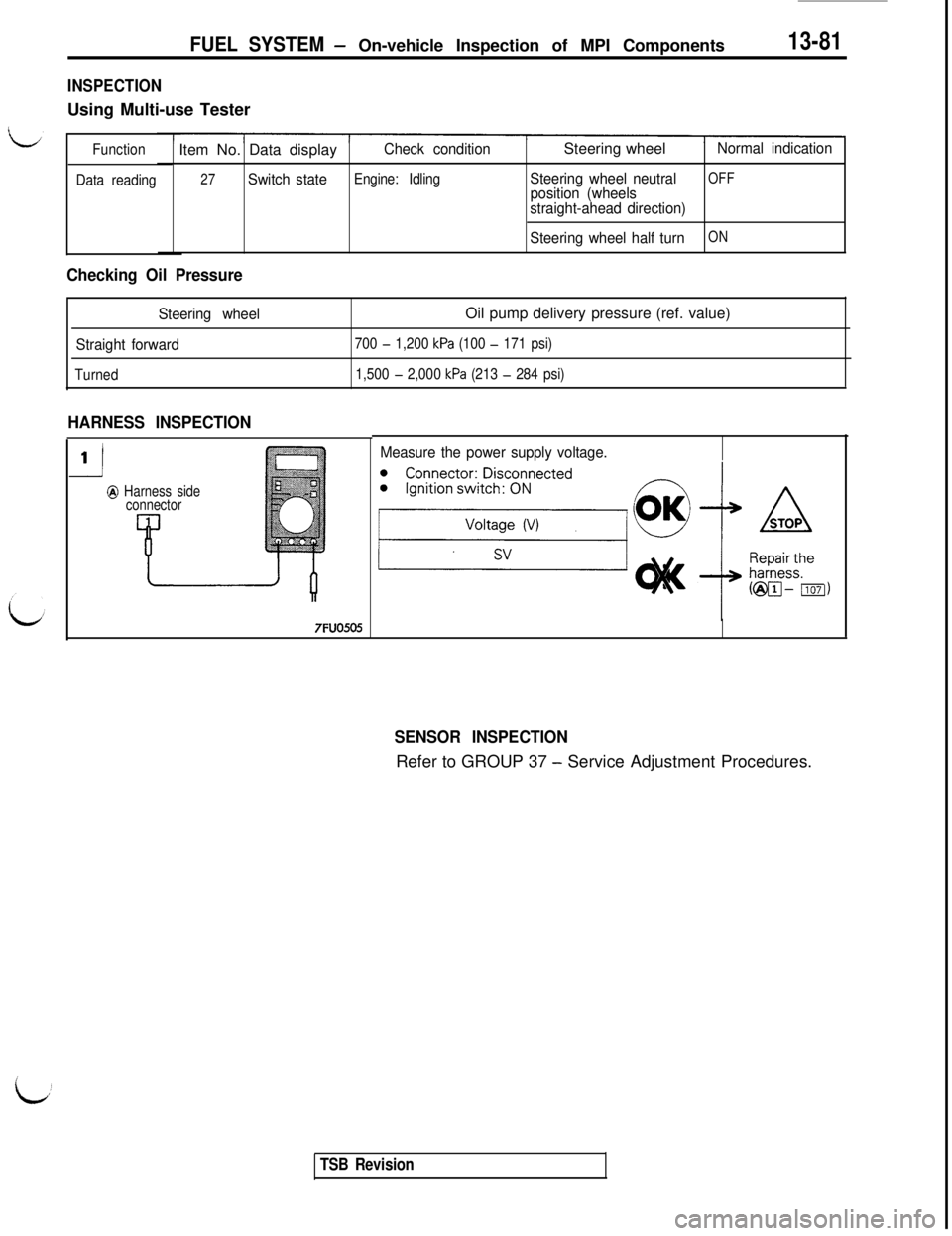
FUEL SYSTEM- On-vehicle Inspection of MPI Components13-81
INSPECTIONUsing Multi-use Tester
Function
Data readingItem No. Data displayCheck conditionSteering wheelNormal indication
27Switch stateEngine: IdlingSteering wheel neutralOFFposition (wheels
straight-ahead direction)
Steering wheel half turn
ON
Checking Oil Pressure
Steering wheelOil pump delivery pressure (ref. value)
Straight forward700 - 1,200 kPa (100 - 171 psi)
Turned1,500
- 2,000 kPa (213 - 284 psi)
HARNESS INSPECTION
i1
@ Harness side
connector
Measure the power supply voltage.
SENSOR INSPECTIONRefer to GROUP 37
- Service Adjustment Procedures.
TSB Revision
Page 188 of 1146

13-82FUEL SYSTEM - On-vehicle Inspection of MPI Components
AIR CONDITIONER SWITCH AND POWER RELAY
\
*I \\-- \
Air conditronerAir conditioner
control unitAir conditioner
compressor lock
controllerr
Engine control unit
Dual pressureswitch
M13YRAA2
b1IFF
Air conditioner
compressor
Engine control
unit connector
7FUO966
7FUO653
OPERATION
lThe air conditioner switch applies the battery voltage to the engine control unit when the air conditioner is
turned on.
lWhen the air conditioner ON signal is input, the engine control unit drives the idle speed control servo and
turns ON the power transistor. As a result, the air conditioner power relay coil is energized to turn on therelay switch, which activates the air compressor magnetic clutch.
TROUBLESHOOTING HINTS
If the air compressor magnet clutch is not activated when the air conditioner switch is turned on during idling,faulty air conditioner control system is suspected.
INSPECTION
Using Multi-use Tester
AIR CONDITIONER SWITCH
Function1 Item No. 1 Data display 1Check condition) Air conditioner switch 1 Normal indication IData reading 28
Switch stateEngine: Idling (airOFFOFFcompressor to be running
when air conditionerONONswitch is ON)\k”JTSB Revision
Page 207 of 1146
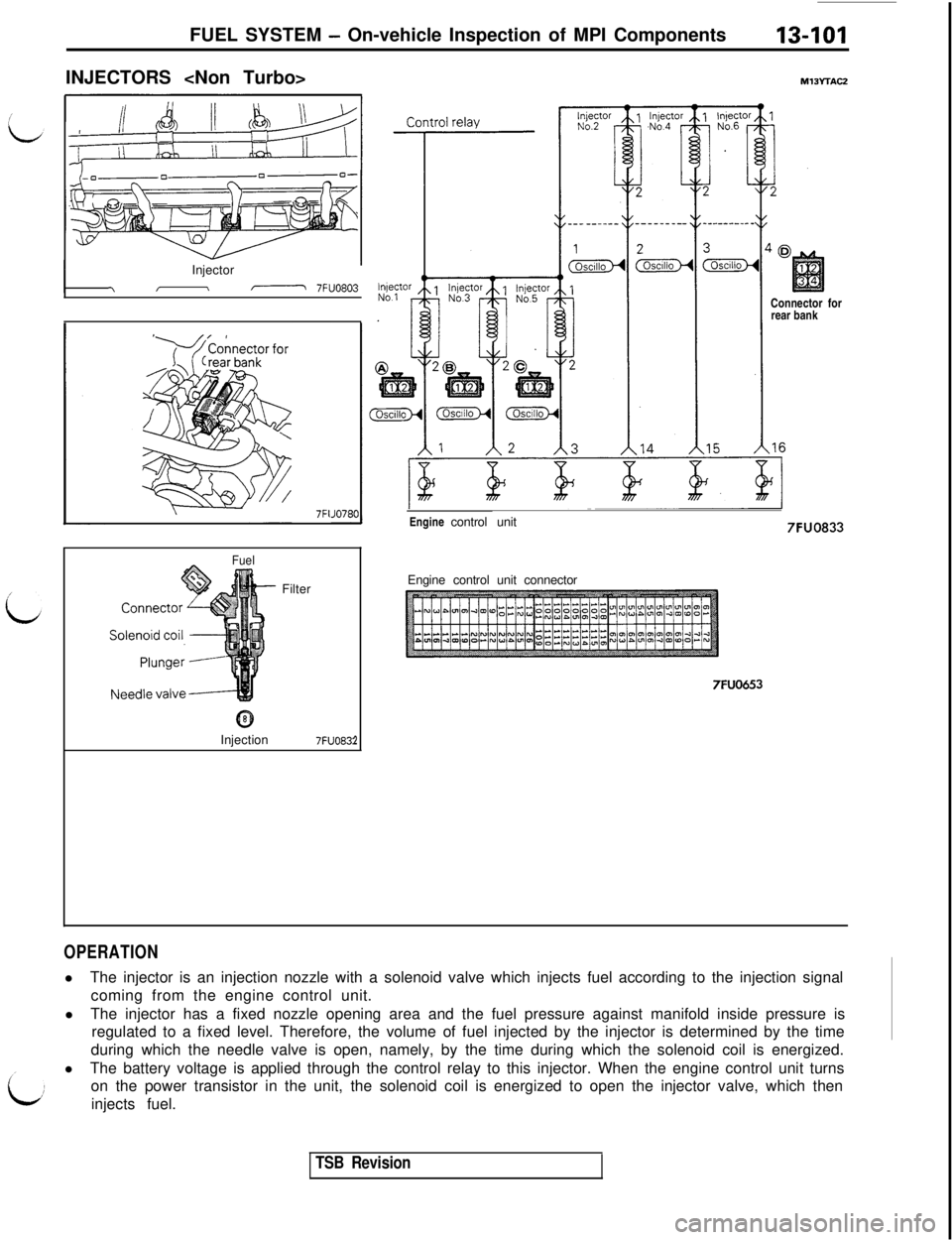
FUEL SYSTEM - On-vehicle Inspection of MPI Components13-101INJECTORS
M13YTAC2
IInjectorII\- 7FUO803
7FI
FuelFilter
@Injection
7FUO83:2Connector for
rear bank
Engine control unit7FUO833
Engine control unit connector
7FUO653
OPERATIONlThe injector is an injection nozzle with a solenoid valve which injects fuel according to the injection signal
coming from the engine control unit.
lThe injector has a fixed nozzle opening area and the fuel pressure against manifold inside pressure is
regulated to a fixed level. Therefore, the volume of fuel injected by the injector is determined by the time
during which the needle valve is open, namely, by the time during which the solenoid coil is energized.
lThe battery voltage is applied through the control relay to this injector. When the engine control unit turns
on the power transistor in the unit, the solenoid coil is energized to open the injector valve, which then
injects fuel.
TSB Revision
Page 208 of 1146

13-102FUEL SYSTEM - On-vehicle Inspection of MPI Components
TROUBLESHOOTING HINTSHint 1: If the engine is hard to start when hot, check fuel pressure and check the injector for leaks.
Hint 2:If the injector does not when the engine that is hard to start is cranked, the following as well as the
Iinjector itself may be responsible.
(1) Faulty power supply circuit to the engine control unit, faulty ground circuit
\-J
-(2) Faulty control relay
Hint 3:(3) Faulty crank angle sensor, top dead center sensor
If there is any cylinder whose idle state remains unchanged when the fuel injection of injectors is cut
one after another during idling, make following checks about such cylinder.
(1) Injector and harness check
(2) Ignition plug and high tension cable check
(3) Compression pressure check
Hint 4: If the injector harness and individual part checks have resulted normal but the injector drive time is
out of specification, the following troubles are suspected.
(1)Poor combustion in the cylinder (faulty ignition plug, ignition coil, compression pressure, etc.)
(2) Loose EGR valve seating
(3) High engine resistance
INSPECTIONUsing Multi-use Tester
FunctionItem No. Data displayCheck conditionCoolant temperatureStandard valueData reading 41
Drive time”’Engine: Cranking0°C (32”F)*zApprox. 17 ms
20°C (68°F)Approx. 46 ms
8O"C(176"F)Approx. 11 ms
Function
Data readingItem No.Data display
41Drive time*3l Engine coolant tem-perature: 80 to 95°C700 rpm (Idle)2.4-3.0 ms
(176 to 205°F)2,000 rpm2.0-2.6
msl Lamps, electric coolingfan, accessory units:When sharp racing isTo increaseAll OFF
madel Transaxle: Neutral
(P range for vehicle
with A/T)l Steering wheel: Neutral
Check conditionEngine stateStandard value ,
.---NOTE“I : The injector drive time refers to when the supply voltage is 11 V and the cranking speed is less than 250 rpm.*2: When coolant temperature is lower than 0°C (32°F). injection ismade by four-cylinders.---simultaneously.
“3: When the vehicle is new [within initial operation of about 500 km (300 miles)], the injector drive time may be about
10% longer.
Function
Actuator testItem No.
Drive content
Check conditionNormal state
01No. 1 injector shut offEngine: Idling afterIdle state to change
02No. 2 injector shut offwarm-up
(Shut off the injectorsfurther (becoming less
in sequence during afterstable or stalling)
03
No. 3 injector shut offengine warm-up, check
04No. 4 injector shut offthe idling condition)
05No. 5 injector shut off
06No. 6 injector shut off
TSB Revision
Page 216 of 1146
\
7FUO64;Ball beam
‘9
L PlntleControl relay
@ Harness side
connector
\/1, \,\/“1“3 “4 â")
13-110FUEL SYSTEM - On-vehicle Inspection of MPI Components
IDLE SPEED CONTROL SERVO (STEPPER MOTOR TYPE)\
7FUO64;Ball beam
‘9
L PlntleControl relay
@ Harness side
connector
\/1, \,\/“1“3 “4 “6Idle speed
control servo
OSCIIIOOSCIIIOOSClllOosclllomu--
/(a /(IT ),!j /I,, Enginecontrol unit
BPPP
7FUO518Engine control unit connector
7FUO653
OPERATION
lThe intake air volume during idling is controlled by opening ‘or closing the servo valve provided in the air
path that bypasses the throttle valve.’
lThe servo valve is opened or closed by operating the stepper motor in the speed control servo in normal or
reverse direction.
lThe battery power is supplied to the stepper motor through the control relay. As the engine control unit
turns on power transistors in the unit one after another, the stepper motor coil is energized and the motor
rotates in normal or reverse direction.
TROUBLESHOOTING HINTSHint 1:If the stepper motor step increases to 100 to 120 steps or decreases to 0 step, faulty stepper motor
or open circuit in the harness is suspected.
Hint 2: If the idle speed control servo harness and individual part checks have resulted normal but the
stepper motor steps are out of specification, the following faults are suspected.
(I) Poorly adjusted reference idle speed
(2) Deposit on the throttle valve
(3) Air leaking into the intake manifold through gasket gap
(4) Loose EGR valve seat
(5)Poor combustion in the cylinder (faulty ignition plug, ignition coil, injector, low compression
pressure, etc.)
\L.J
1 TSB RevisionI
Page 219 of 1146
idFUEL SYSTEM
- On-vehicle Inspection of MPI Components13-113
‘El
‘a
~
63
7FUOOlO(stepper motor)
7FUO98CIdle speed
MD998463
7FUOO78
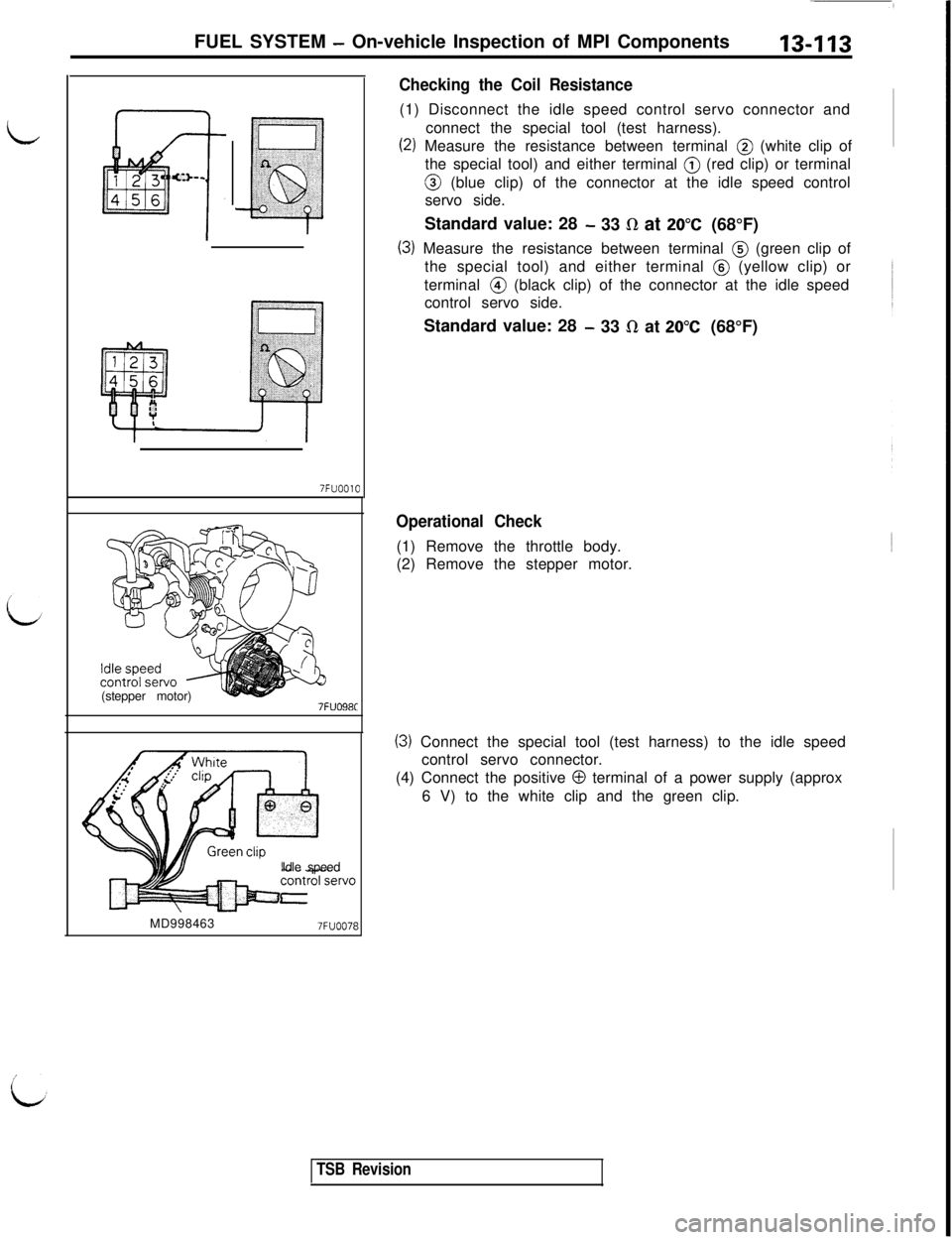
Checking the Coil Resistance(1) Disconnect the idle speed control servo connector and
connect the special tool (test harness).
(2) Measure the resistance between terminal @ (white clip of
the special tool) and either terminal @ (red clip) or terminal@ (blue clip) of the connector at the idle speed control
servo side.
Standard value: 28
- 33 !2 at 20°C (68°F)
(3) Measure the resistance between terminal @ (green clip of
the special tool) and either terminal @ (yellow clip) or
terminal @ (black clip) of the connector at the idle speed
control servo side.
Standard value: 28
- 33 CR at 20°C (68°F)
Operational Check(1) Remove the throttle body.
(2) Remove the stepper motor.
(3) Connect the special tool (test harness) to the idle speed
control servo connector.
(4) Connect the positive
0 terminal of a power supply (approx
6 V) to the white clip and the green clip.
TSB Revision
Page 221 of 1146
FUEL SYSTEM - On-vehicle Inspection of MPI Components
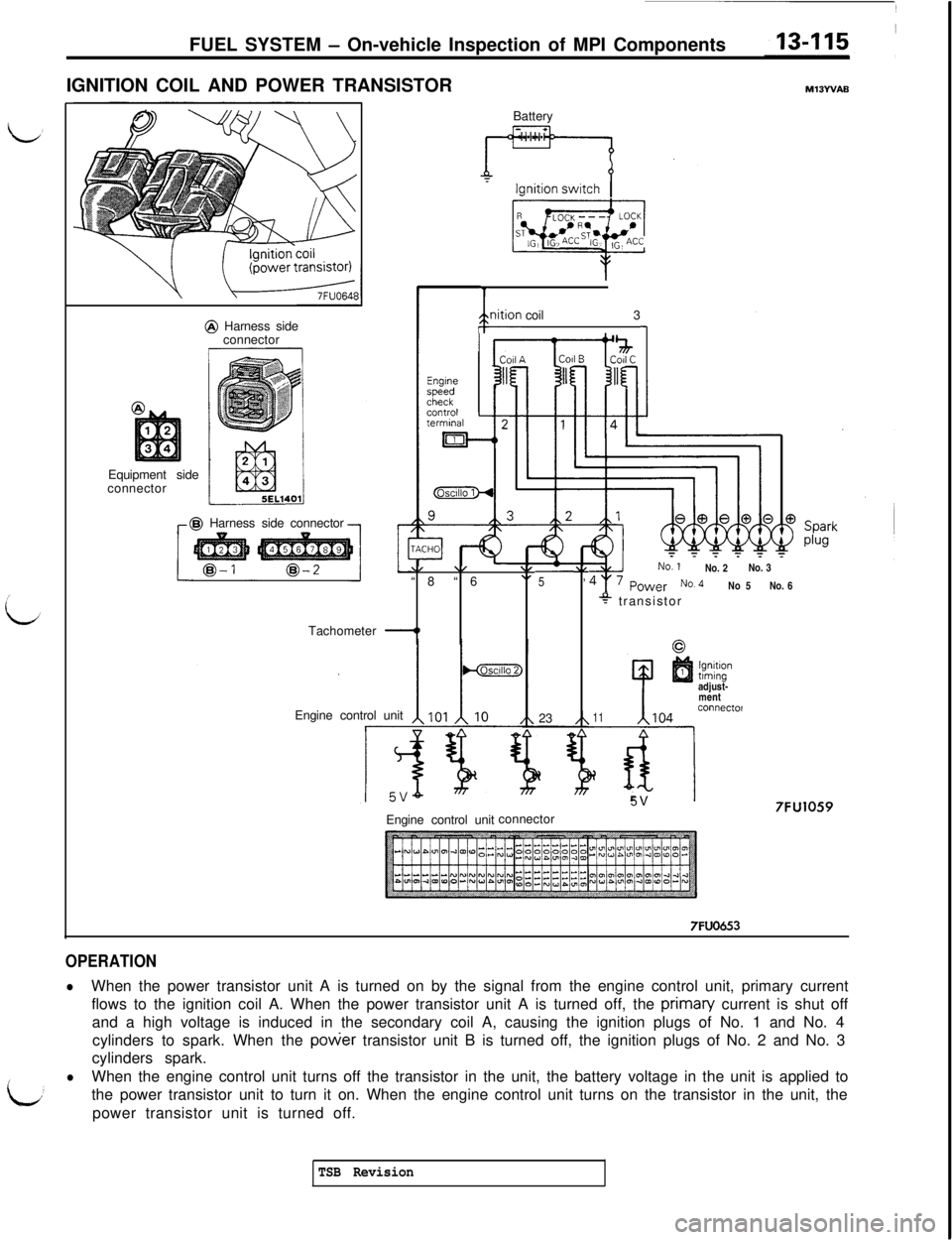
IGNITION COIL AND POWER TRANSISTOR
MlBYVABEquipment side
connector@ Harness side
connector@ Harness side connector
Tachometer
-1Battery
/gnition coil1 3
Engine control unit
\/\/\IAL“8 “6.,,523No. 2No. 3
No 5No. 6
* transistor
5Y
lgnltlontamingadjust-
mentconnectof
11104
d
w5V
7FU1059Engine control unitconnector
7FUO453
OPERATION
lWhen the power transistor unit A is turned on by the signal from the engine control unit, primary current
flows to the ignition coil A. When the power transistor unit A is turned off, the primaty current is shut off
and a high voltage is induced in the secondary coil A, causing the ignition plugs of No. 1 and No. 4
cylinders to spark. When the
power transistor unit B is turned off, the ignition plugs of No. 2 and No. 3
cylinders spark.
L
lWhen the engine control unit turns off the transistor in the unit, the battery voltage in the unit is applied to
the power transistor unit to turn it on. When the engine control unit turns on the transistor in the unit, the
power transistor unit is turned off.
TSB Revision