oil MITSUBISHI 3000GT 1991 Manual PDF
[x] Cancel search | Manufacturer: MITSUBISHI, Model Year: 1991, Model line: 3000GT, Model: MITSUBISHI 3000GT 1991Pages: 1146, PDF Size: 76.68 MB
Page 222 of 1146
13-116FUEL SYSTEM - 0
n-vehicle Inspection of MPI Components
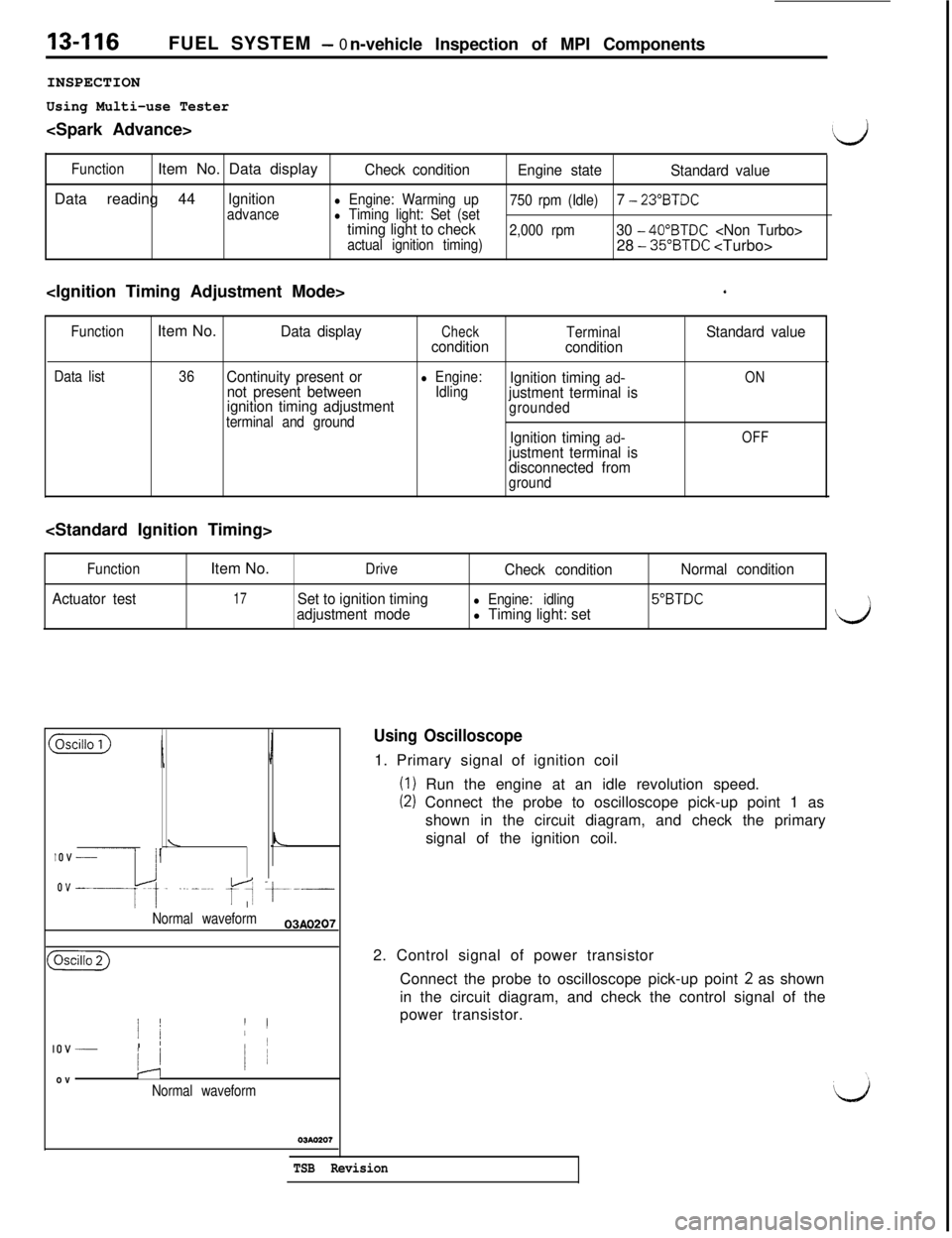
INSPECTION
Using Multi-use Tester
(d
FunctionItem No. Data displayCheck condition
Engine state
Standard valueData reading 44
Ignitionadvancel Engine: Warming up
750 rpm (Idle)7 - 23”BTDCl Timing light: Set (settiming light to check2,000 rpm30 - 40”BTDC
‘
Function
Data listItem No.Data displayCheckTerminalStandard value
condition
condition
36Continuity present or
not present betweenl Engine:
IdlingIgnition timing ad-ON
ignition timing adjustmentjustment terminal isterminal and groundgrounded
Ignition timing ad-OFFjustment terminal is
disconnected from
ground
Function
Actuator testItem No.
DriveCheck conditionNormal condition
17Set to ignition timingl Engine: idling5”BTDCadjustment model Timing light: set\
($Gizi)
IJ
\LIOV _
ovep~,. ..~_~.~ fA t---.-
I
Normal waveform03AO207
(
j /’ II
IOV _I ’/
/ 1ovIJ
Normal waveform
Using Oscilloscope1. Primary signal of ignition coil
(I) Run the engine at an idle revolution speed.
(2) Connect the probe to oscilloscope pick-up point 1 as
shown in the circuit diagram, and check the primary
signal of the ignition coil.
2. Control signal of power transistor
Connect the probe to oscilloscope pick-up point
2 as shown
in the circuit diagram, and check the control signal of the
power transistor.
TSB Revision
Page 223 of 1146
FUEL SYSTEM - On-vehicle Inspection of MPI Components13-117
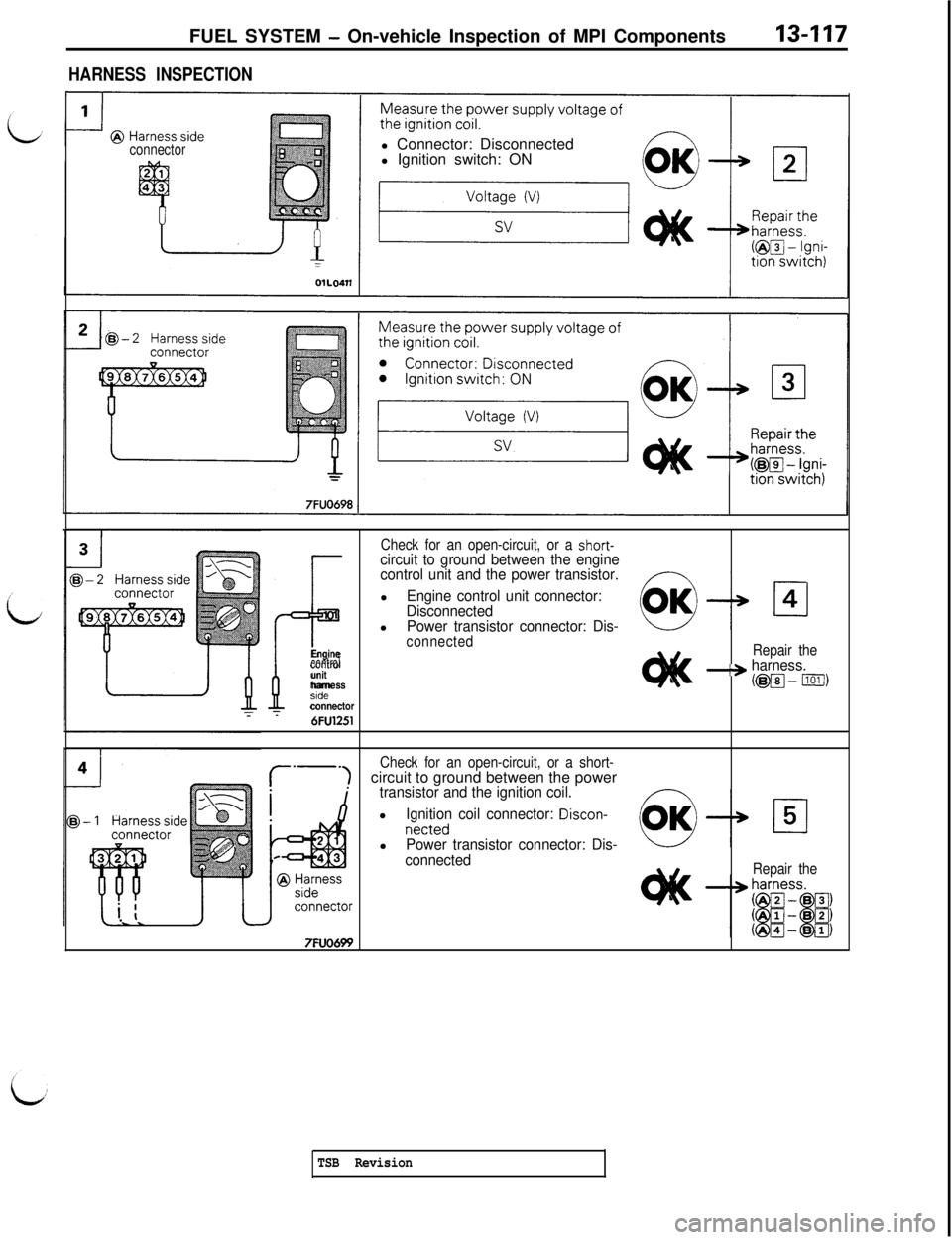
HARNESS INSPECTION
connectorl Connector: Disconnected
l Ignition switch: ON
Check for an open-circuit, or a short-
P
circuit to ground between the engine
control unit and the power transistor.l
Engine control unit connector:
Disconnectedl
Power transistor connector: Dis-connectedEngineRepair thecontrolunit-+ harness.harness(@@J-1101/)stdeconnector
T6FU1251
Check for an open-circuit, or a short-circuit to ground between the power
transistor and the ignition coil.l
Ignition coil connector: Discon-netted
l
Power transistor connector: Dis-
connected
Repair the
7FUO699
TSB Revision
Page 225 of 1146
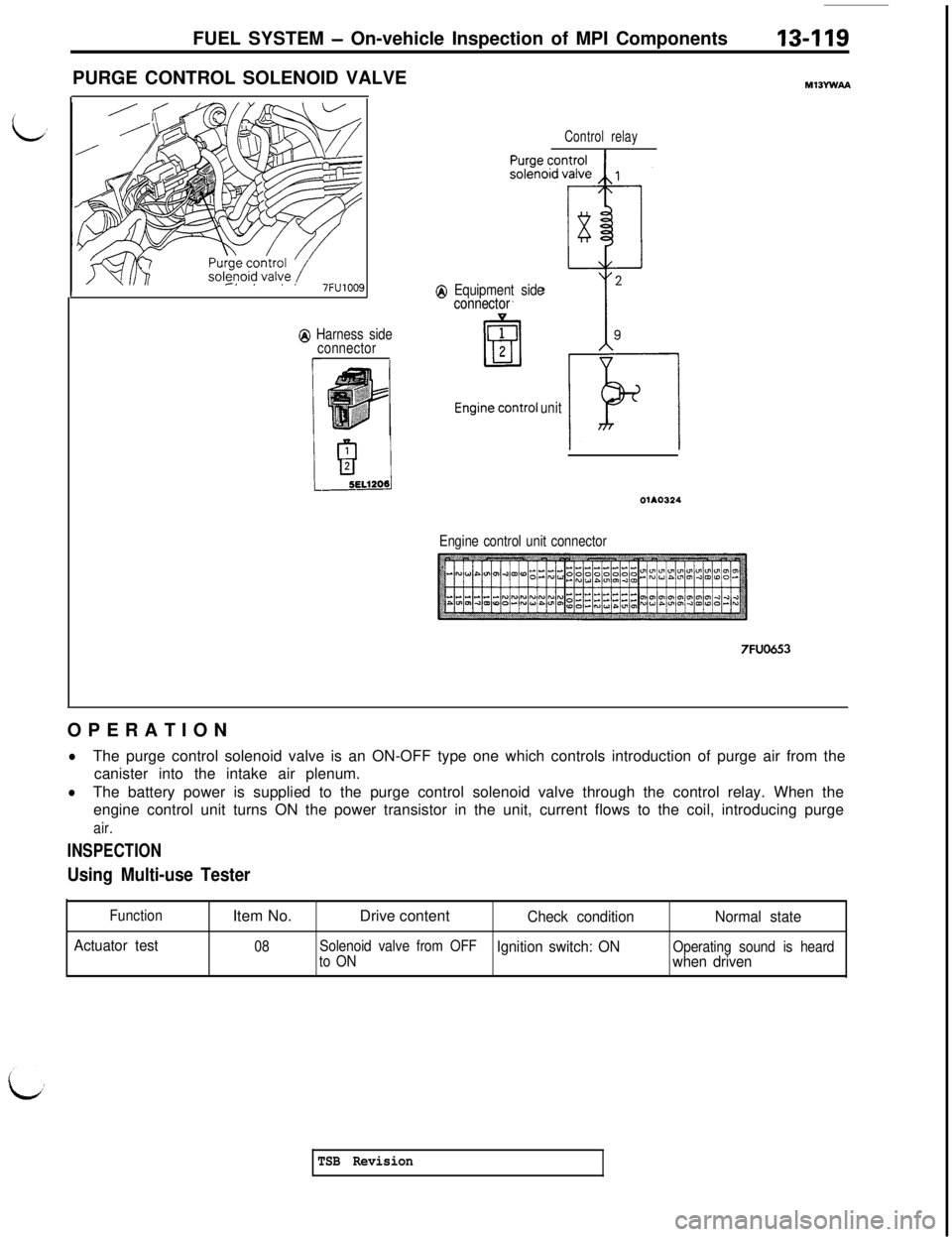
FUEL SYSTEM - On-vehicle Inspection of MPI Components13-119PURGE CONTROL SOLENOID VALVE
Q Harness side
connector
I
Control relay
@ Equipment side
connector connector
unit
OlAO324
Engine control unit connector
7FUO653OPERATION
lThe purge control solenoid valve is an ON-OFF type one which controls introduction of purge air from the
canister into the intake air plenum.
lThe battery power is supplied to the purge control solenoid valve through the control relay. When the
engine control unit turns ON the power transistor in the unit, current flows to the coil, introducing purge
air.
INSPECTION
Using Multi-use Tester
Function
Actuator testItem No.Drive content
Check conditionNormal state
08Solenoid valve from OFFIgnition switch: ONOperating sound is heard
to ONwhen driven
TSB Revision
Page 227 of 1146
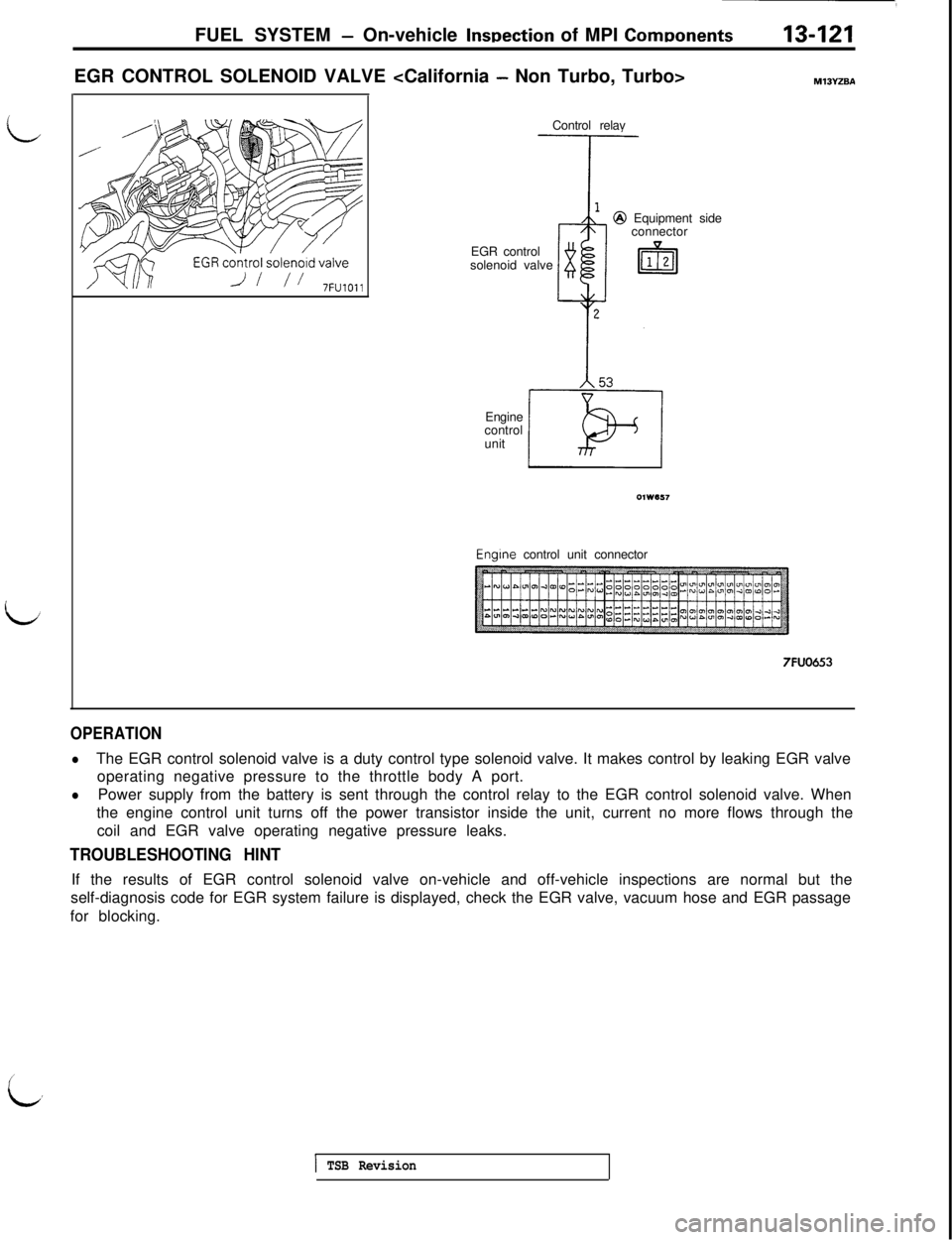
FUEL SYSTEM - On-vehicle lnwection of MPI ComDonents13-121
LEGR CONTROL SOLENOID VALVE
EGR control
solenoid valve@ Equipment side
connector
Engine
control
unitEngine control unit connector
7FUO653
OPERATION
lThe EGR control solenoid valve is a duty control type solenoid valve. It makes control by leaking EGR valve
operating negative pressure to the throttle body A port.
lPower supply from the battery is sent through the control relay to the EGR control solenoid valve. When
the engine control unit turns off the power transistor inside the unit, current no more flows through the
coil and EGR valve operating negative pressure leaks.
TROUBLESHOOTING HINTIf the results of EGR control solenoid valve on-vehicle and off-vehicle inspections are normal but the
self-diagnosis code for EGR system failure is displayed, check the EGR valve, vacuum hose and EGR passage
for blocking.
c.
1 TSB Revision
Page 229 of 1146
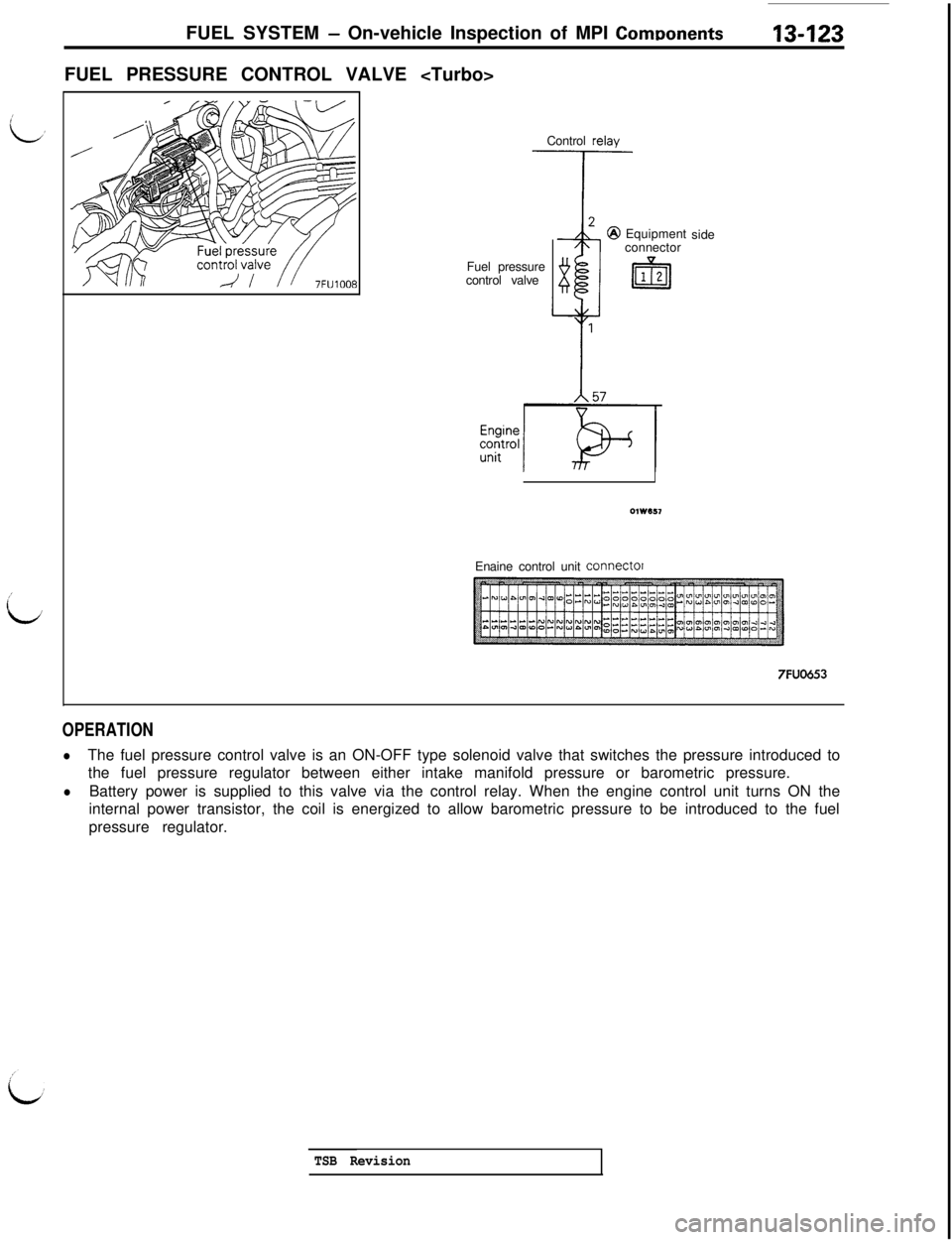
FUEL SYSTEM - On-vehicle Inspection of MPI ComDonents13-123FUEL PRESSURE CONTROL VALVE
Control relay
Fuel pressure
control valveEquipment
connectorside
Enaine control unit
connector
7FUO653
OPERATION
lThe fuel pressure control valve is an ON-OFF type solenoid valve that switches the pressure introduced to
the fuel pressure regulator between either intake manifold pressure or barometric pressure.
lBattery power is supplied to this valve via the control relay. When the engine control unit turns ON the
internal power transistor, the coil is energized to allow barometric pressure to be introduced to the fuel
pressure regulator.
TSB Revision
Page 231 of 1146
FUEL SYSTEM - On-vehicle Inspection of MPI Components13-125
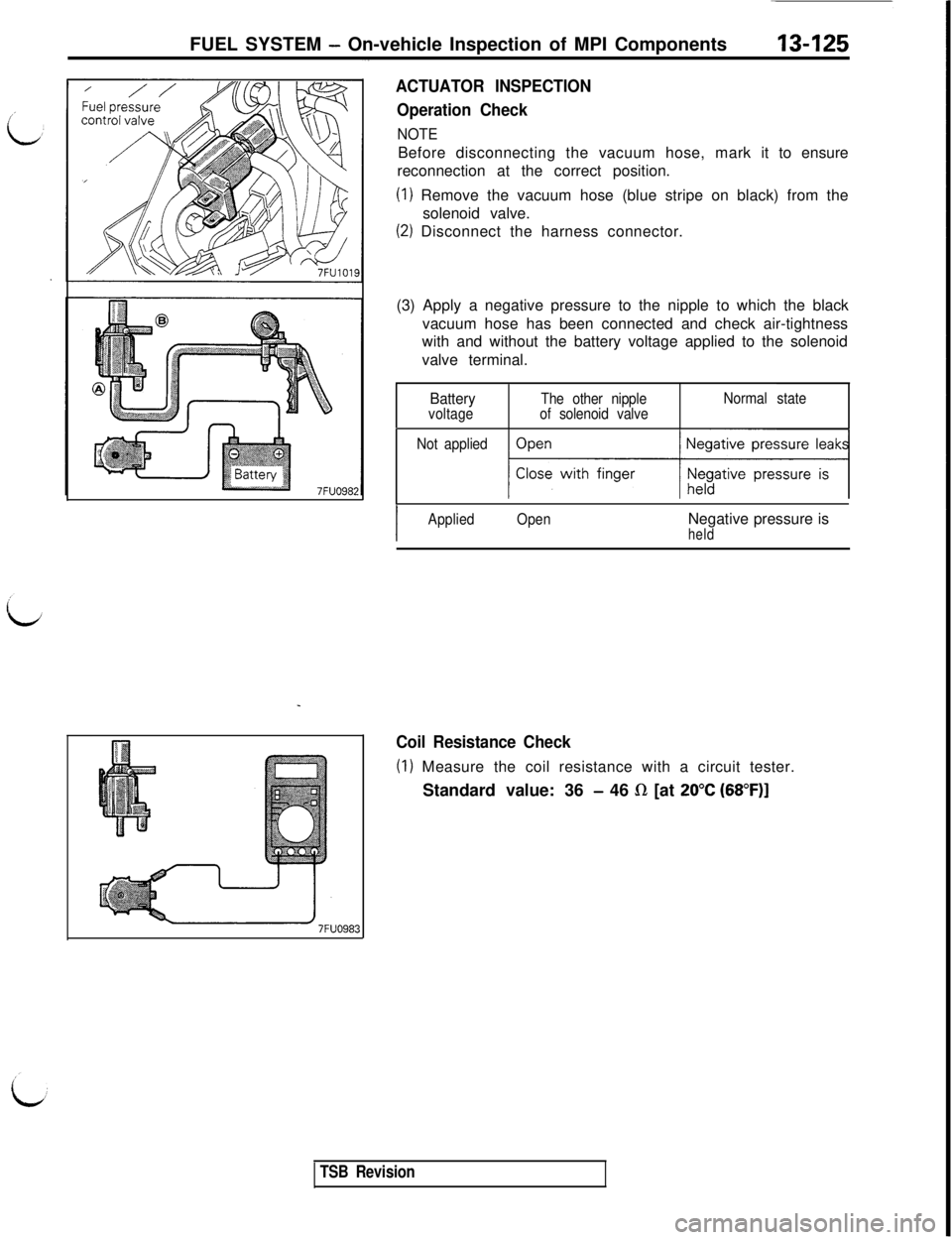
ACTUATOR INSPECTION
Operation Check
NOTEBefore disconnecting the vacuum hose, mark it to ensure
reconnection at the correct position.
(1) Remove the vacuum hose (blue stripe on black) from the
solenoid valve.
(2) Disconnect the harness connector.
(3) Apply a negative pressure to the nipple to which the black
vacuum hose has been connected and check air-tightness
with and without the battery voltage applied to the solenoid
valve terminal.
BatteryvoltageThe other nipple
of solenoid valveNormal state
Not applied
qj
I
AppliedOpenNegative pressure isheld
Coil Resistance Check
(I) Measure the coil resistance with a circuit tester.
Standard value: 36
- 46 R [at 20°C (68”F)]
TSB Revision
Page 232 of 1146
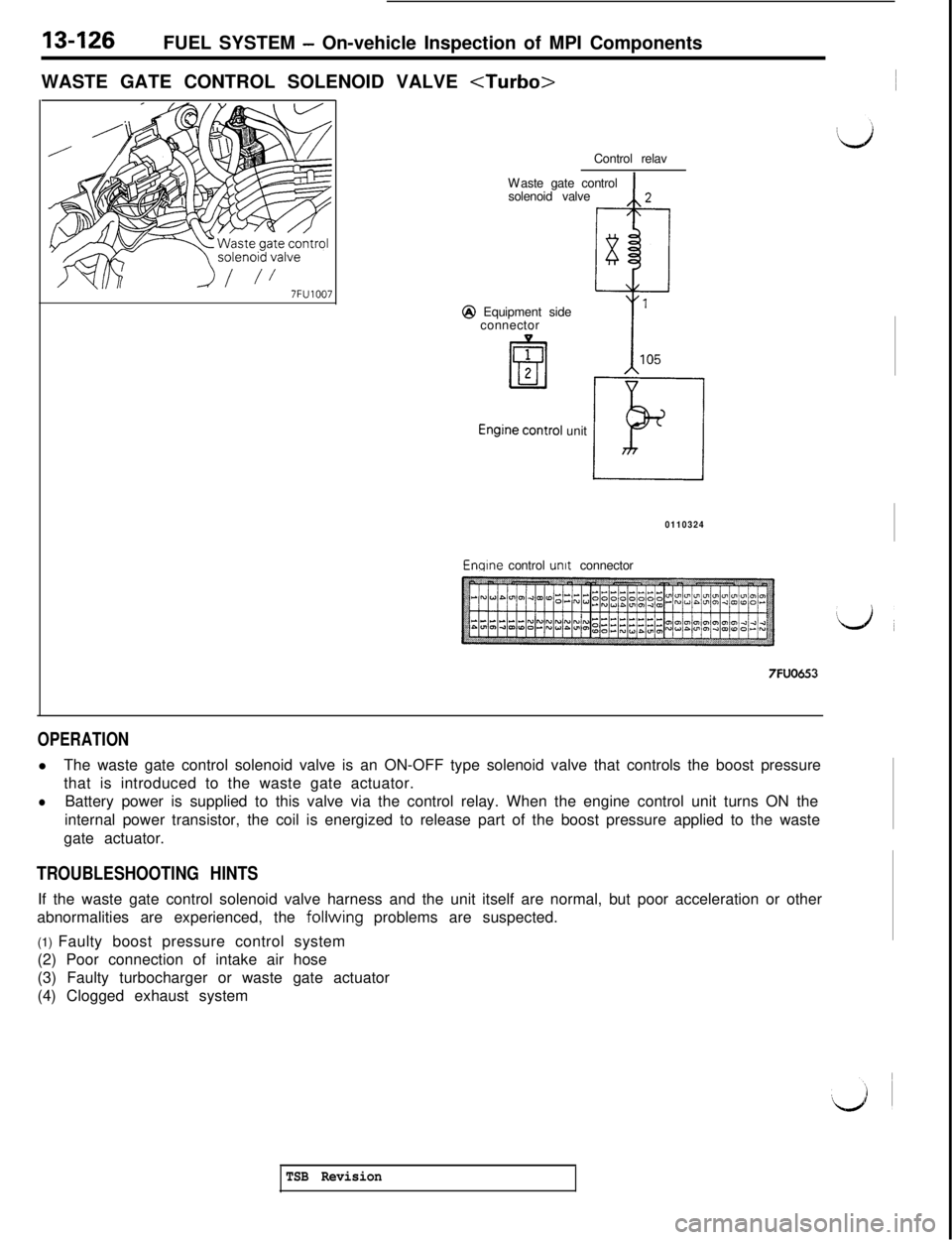
13-126FUEL SYSTEM - On-vehicle Inspection of MPI Components
WASTE GATE CONTROL SOLENOID VALVE
7FU1007Control relav
Waste gate control
solenoid valve
Q Equipment side
connector
unit
0110324Enqlne control unit connector
7FUO653
OPERATIONlThe waste gate control solenoid valve is an ON-OFF type solenoid valve that controls the boost pressure
that is introduced to the waste gate actuator.
lBattery power is supplied to this valve via the control relay. When the engine control unit turns ON the
internal power transistor, the coil is energized to release part of the boost pressure applied to the waste
gate actuator.
TROUBLESHOOTING HINTSIf the waste gate control solenoid valve harness and the unit itself are normal, but poor acceleration or other
abnormalities are experienced, the
follwing problems are suspected.
(1) Faulty boost pressure control system
(2) Poor connection of intake air hose
(3) Faulty turbocharger or waste gate actuator
(4) Clogged exhaust system
TSB Revision
Page 235 of 1146
FUEL SYSTEM - On-vehicle Inspection of MPI Components13-129
i
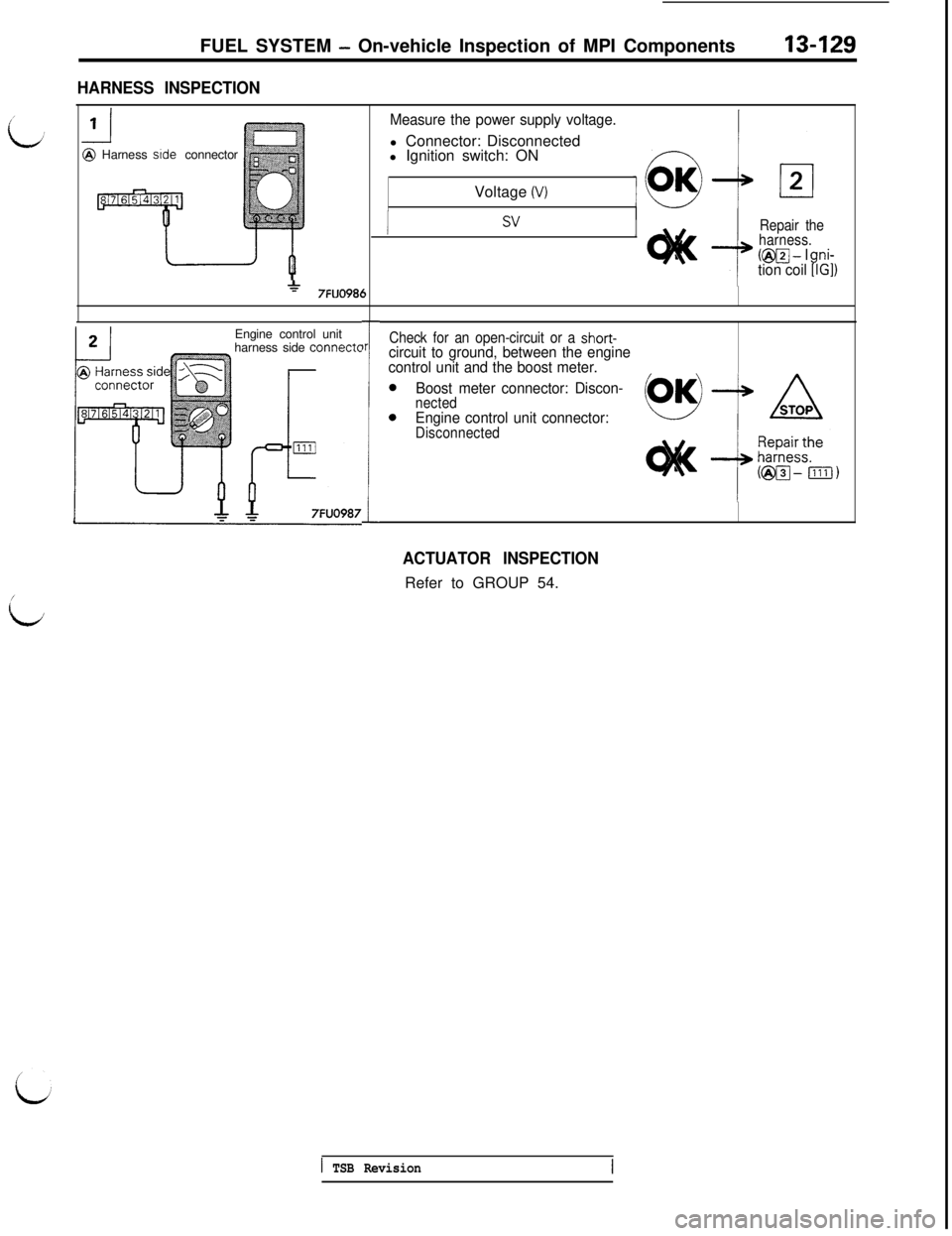
HARNESS INSPECTION@ Harness side connector
*7FUO986Engine control unit
harness side
connect0r
1
Measure the power supply voltage.l Connector: Disconnected
l Ignition switch: ON
Voltage
(V)
svRepair the
harness.
(@I@-- Ini-tion coil9IG])
Check for an open-circuit or a short-circuit to ground, between the engine
control unit and the boost meter.
Boost meter connector: Discon-
nectedEngine control unit connector:Disconnected
ACTUATOR INSPECTIONRefer to GROUP 54.
1 TSB Revision
Page 248 of 1146
13-142FUEL SYSTEM - Injector
SERVICE POINT OF REMOVAL
MlBSSAI1. DISCONNECTION OF HIGH PRESSURE FUEL HOSE
Bleed the residual pressure within the fuel pipe line so as to
LA;prevent the flow of fuel.
Caution
Cover the hose connection with rags to prevent splash
of fuel that could be caused by some residual pressurein the fuel pipe line.
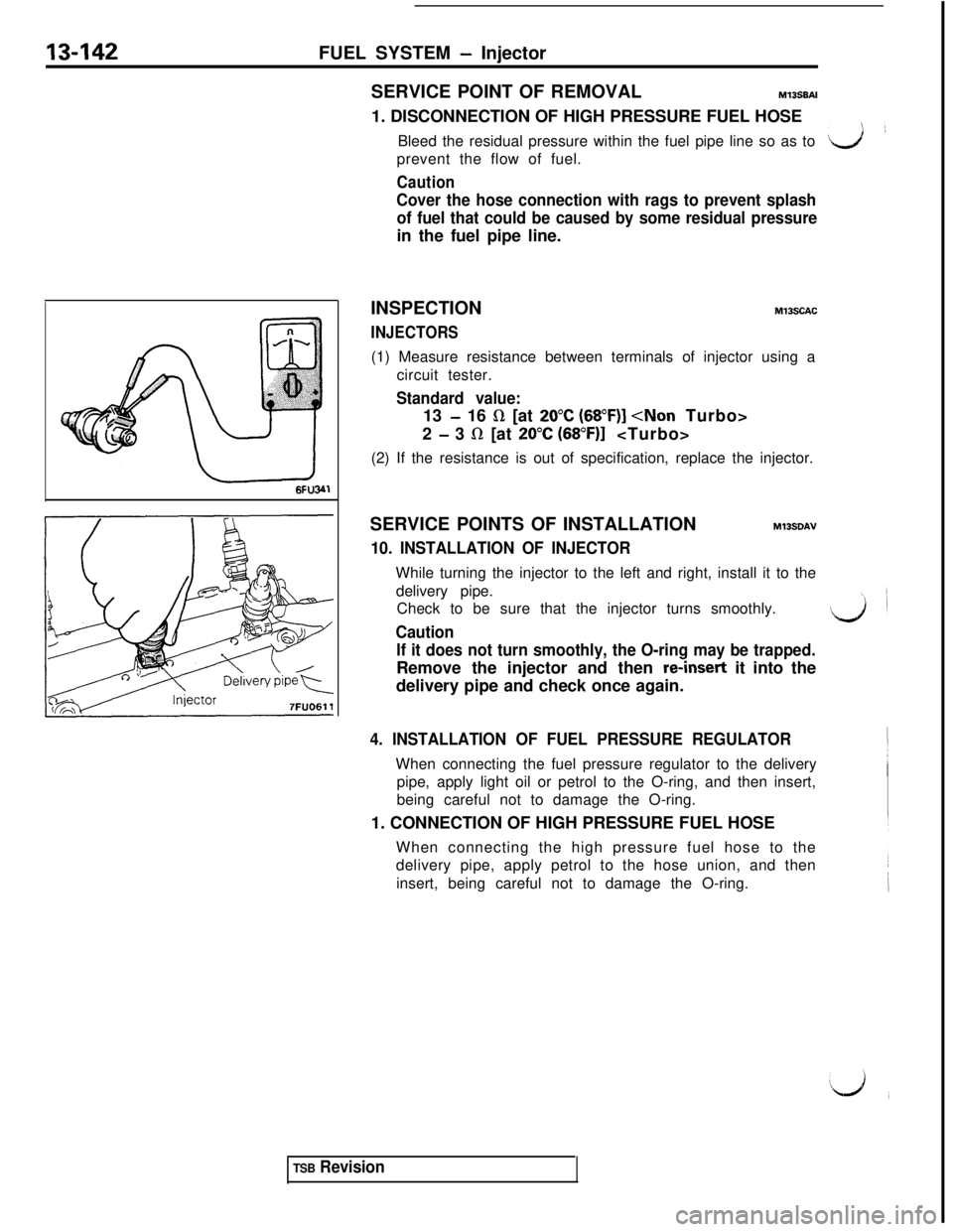
INSPECTION
INJECTORS
M13SCAC(1) Measure resistance between terminals of injector using a
circuit tester.
Standard value:13
- 16 R [at 20°C (68”F)]
2
- 3 LR [at 20°C (68”F)l
(2) If the resistance is out of specification, replace the injector.
SERVICE POINTS OF INSTALLATION
MlBSDAV
10. INSTALLATION OF INJECTORWhile turning the injector to the left and right, install it to the
delivery pipe.
Check to be sure that the injector turns smoothly.
LCaution
If it does not turn smoothly, the O-ring may be trapped.Remove the injector and then
m-insert it into the
delivery pipe and check once again.
4. INSTALLATION OF FUEL PRESSURE REGULATORWhen connecting the fuel pressure regulator to the delivery
pipe, apply light oil or petrol to the O-ring, and then insert,
being careful not to damage the O-ring.
1. CONNECTION OF HIGH PRESSURE FUEL HOSE
When connecting the high pressure fuel hose to the
delivery pipe, apply petrol to the hose union, and then
insert, being careful not to damage the O-ring.
TSB Revision
Page 258 of 1146
13-152FUEL SYSTEM- Fuel Line and Vapor Line
03FOO3
05FOO735 Nm7r; ft
Ihr-k” ._..I_.
@dFlare nut,xSERVICE POINTS OF REMOVAL
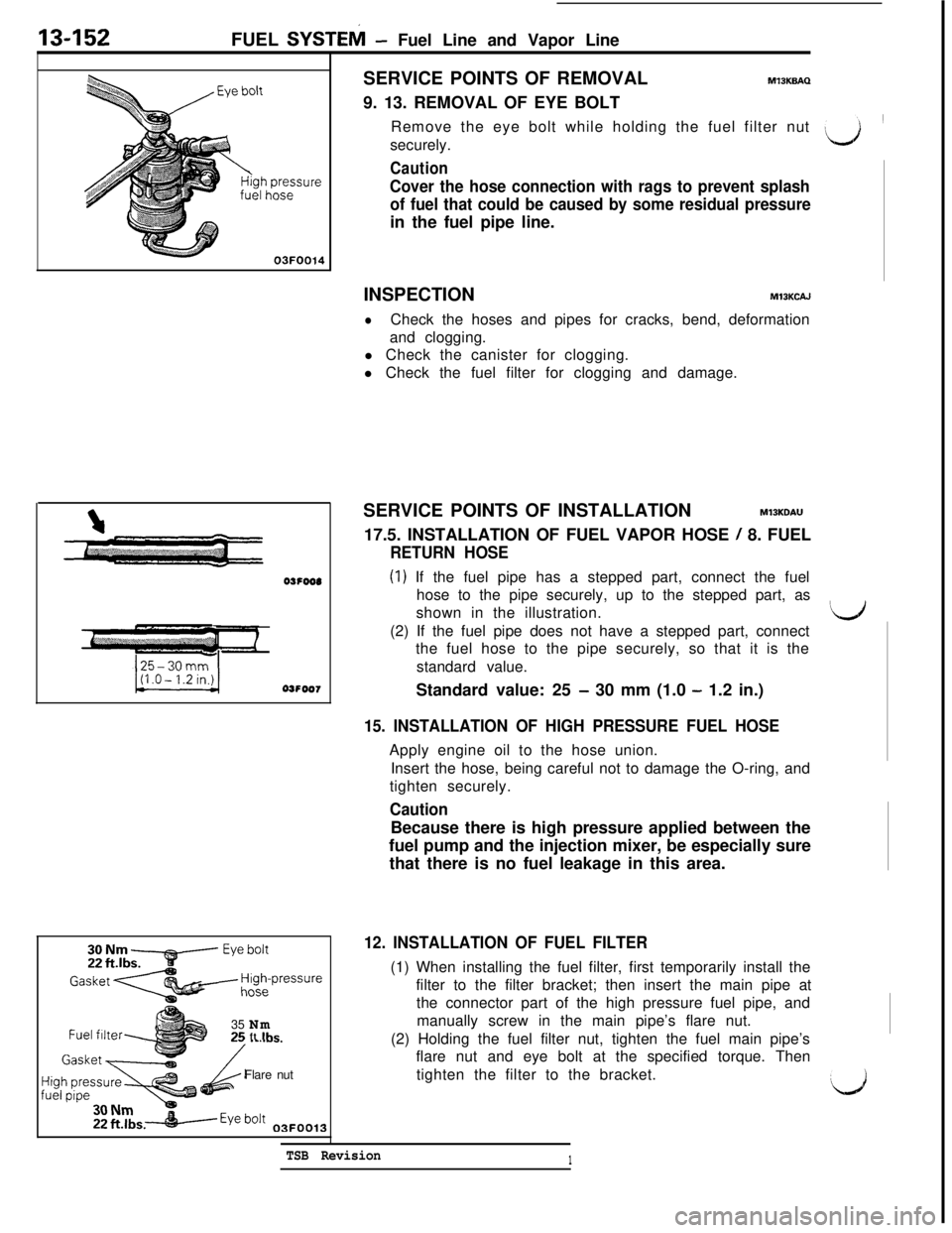
MlBKBAQ9. 13. REMOVAL OF EYE BOLT
Remove the eye bolt while holding the fuel filter nut
\securely.
Caution
Cover the hose connection with rags to prevent splash
of fuel that could be caused by some residual pressurein the fuel pipe line.
INSPECTION
MIBKCAJ
lCheck the hoses and pipes for cracks, bend, deformation
and clogging.
l Check the canister for clogging.
l Check the fuel filter for clogging and damage.
SERVICE POINTS OF INSTALLATION
MlSKDAU17.5. INSTALLATION OF FUEL VAPOR HOSE
/ 8. FUEL
RETURN HOSE
(1) If the fuel pipe has a stepped part, connect the fuel
hose to the pipe securely, up to the stepped part, as
shown in the illustration.
Iti(2) If the fuel pipe does not have a stepped part, connect
the fuel hose to the pipe securely, so that it is the
standard value.
Standard value: 25
- 30 mm (1.0 - 1.2 in.)
15. INSTALLATION OF HIGH PRESSURE FUEL HOSEApply engine oil to the hose union.
Insert the hose, being careful not to damage the O-ring, and
tighten securely.
CautionBecause there is high pressure applied between the
fuel pump and the injection mixer, be especially sure
that there is no fuel leakage in this area.
12. INSTALLATION OF FUEL FILTER(1) When installing the fuel filter, first temporarily install the
filter to the filter bracket; then insert the main pipe at
the connector part of the high pressure fuel pipe, and
manually screw in the main pipe’s flare nut.
(2) Holding the fuel filter nut, tighten the fuel main pipe’s
flare nut and eye bolt at the specified torque. Then
tighten the filter to the bracket.
TSB Revision1
‘d