suspension MITSUBISHI 3000GT 1991 Manual PDF
[x] Cancel search | Manufacturer: MITSUBISHI, Model Year: 1991, Model line: 3000GT, Model: MITSUBISHI 3000GT 1991Pages: 1146, PDF Size: 76.68 MB
Page 715 of 1146
iREAR SUSPENSION
3
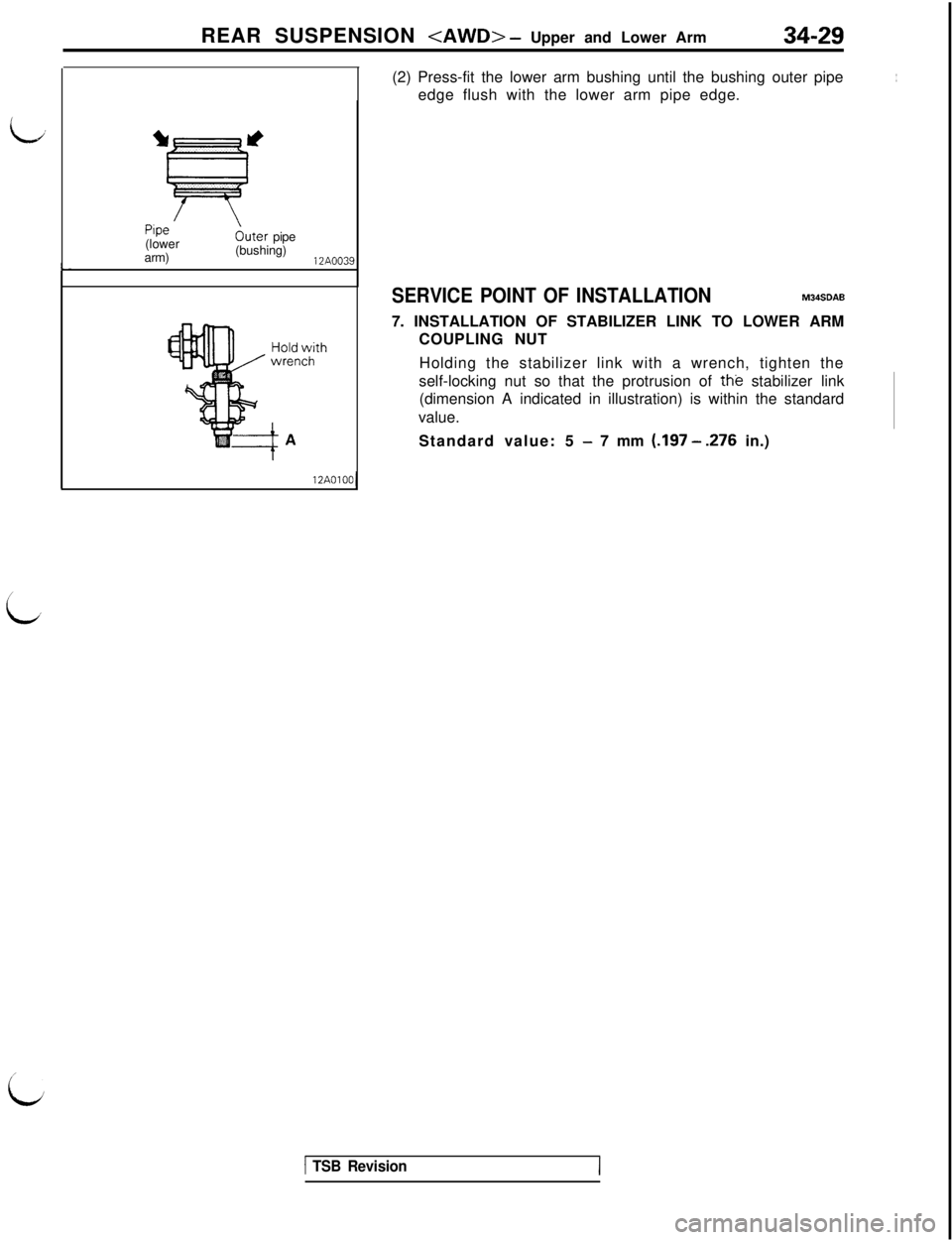
Pipe.(lower
arm)tluter pipe
(bushing)12A003512AOlOC(2) Press-fit the lower arm bushing until the bushing outer pipe
edge flush with the lower arm pipe edge.
SERVICE POINT OF INSTALLATIONM34SDAB7. INSTALLATION OF STABILIZER LINK TO LOWER ARM
COUPLING NUT
Holding the stabilizer link with a wrench, tighten the
self-locking nut so that the protrusion of
thG stabilizer link
(dimension A indicated in illustration) is within the standard
value.
Standard value: 5
- 7 mm (.197 - .276 in.)
I
c
1 TSB Revision
Page 716 of 1146
34-30REAR SUSPENSION
TRAILING ARMM34TA-B1
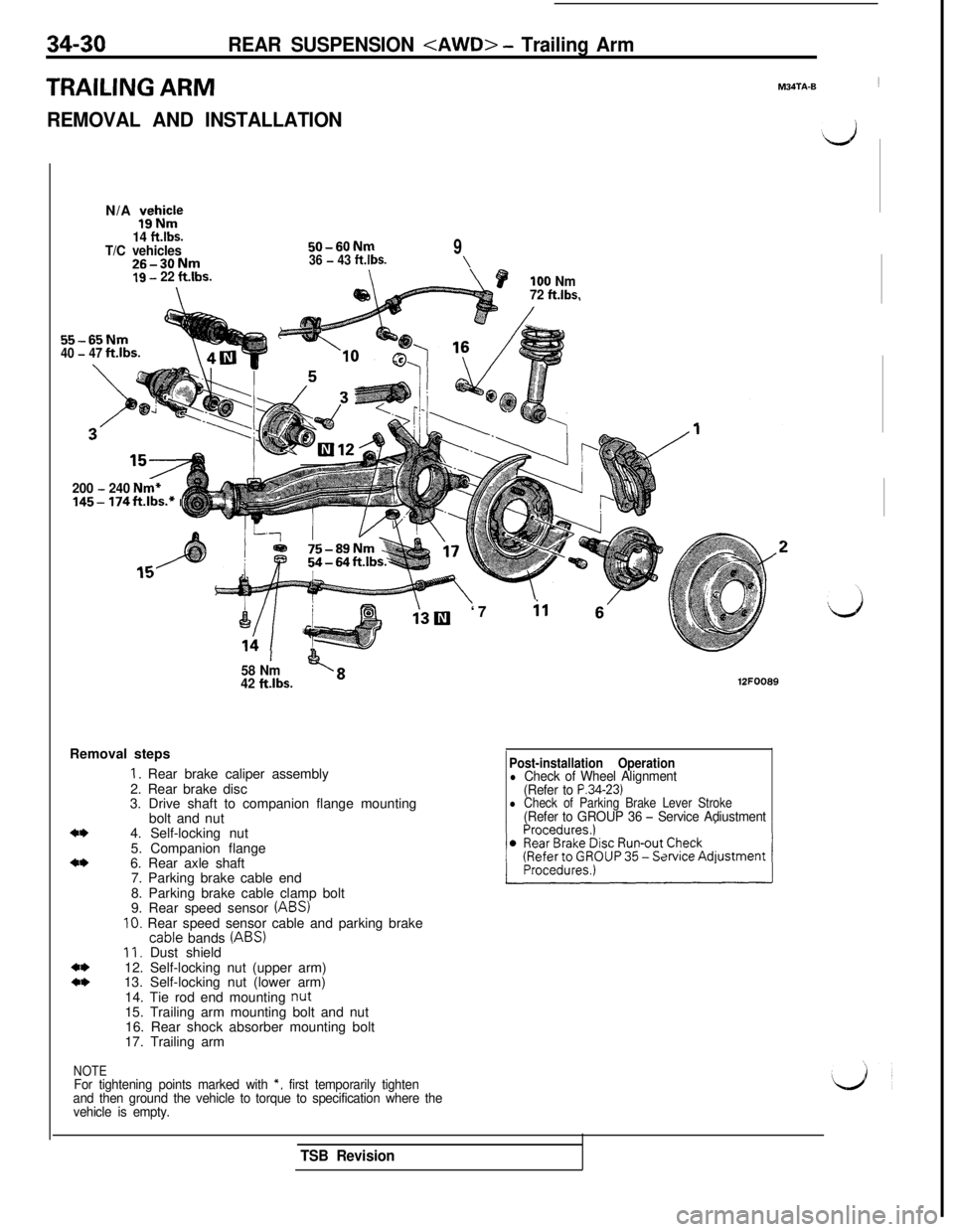
REMOVAL AND INSTALLATIONN/A
$icJ
14 ft.lbs.T/C vehicles26-30Nm
50-60Nm936 - 43 ftlbs.\19 - 22 ft.lbs.
55-65Nm40 - 47ft.lbs.
200
- 240 Nm*145- 174ft.lbs.* I
P100 Nm
72 ft.lbs.
58 Nm’ <842 ft.lbs.Removal steps
*I)
*I)
+*+*
1. Rear brake caliper assembly
2. Rear brake disc
3. Drive shaft to companion flange mounting
bolt and nut
4. Self-locking nut
5. Companion flange
6. Rear axle shaft
7. Parking brake cable end
8. Parking brake cable clamp bolt
9. Rear speed sensor
(ABS)IO. Rear speed sensor cable and parking brake
cable bands (ABS)II. Dust shield
12. Self-locking nut (upper arm)
13. Self-locking nut (lower arm)
14. Tie rod end mounting
nut15. Trailing arm mounting bolt and nut
16. Rear shock absorber mounting bolt
17. Trailing arm
NOTEFor tightening points marked with *, first temporarily tighten
and then ground the vehicle to torque to specification where the
vehicle is empty.‘7
il 6’
12FOO89
Post-installation Operationl Check of Wheel Alignment
(Refer to P.34-23)l Check of Parking Brake Lever Stroke(Refer to GROUP 36 - Service Adiustment
TSB Revision
Page 717 of 1146
REAR SUSPENSION
IIMB990241-01MB990211-01
12AO612
Pressure fittingRemoval
12A030!Trading arm bushing12A029
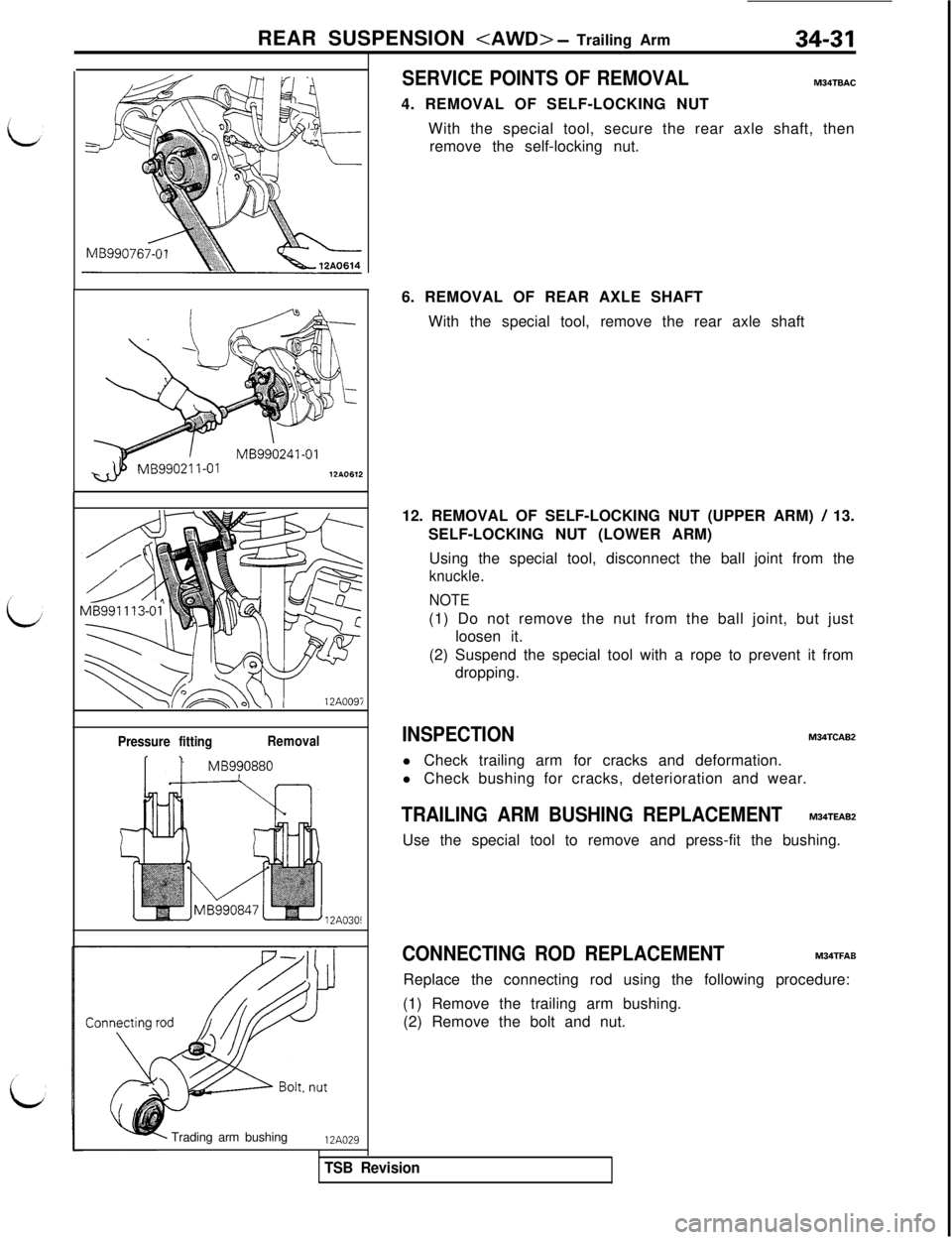
SERVICE POINTS OF REMOVALM34TBAC4. REMOVAL OF SELF-LOCKING NUT
With the special tool, secure the rear axle shaft, then
remove the self-locking nut.
6. REMOVAL OF REAR AXLE SHAFT
With the special tool, remove the rear axle shaft
12. REMOVAL OF SELF-LOCKING NUT (UPPER ARM)
/ 13.
SELF-LOCKING NUT (LOWER ARM)
Using the special tool, disconnect the ball joint from the
knuckle.
NOTE(1) Do not remove the nut from the ball joint, but just
loosen it.
(2) Suspend the special tool with a rope to prevent it from
dropping.
INSPECTIONM34TCAB2l Check trailing arm for cracks and deformation.
l Check bushing for cracks, deterioration and wear.
TRAILING ARM BUSHING REPLACEMENTM34TEAE2Use the special tool to remove and press-fit the bushing.
CONNECTING ROD REPLACEMENTM34TFABReplace the connecting rod using the following procedure:
(1) Remove the trailing arm bushing.
(2) Remove the bolt and nut.
TSB Revision
Page 718 of 1146
34-32REAR SUSPENSION
Bolt B
12A0'291BOUY
Guide shaft
\,center lme
-MB991 254
,,+.s
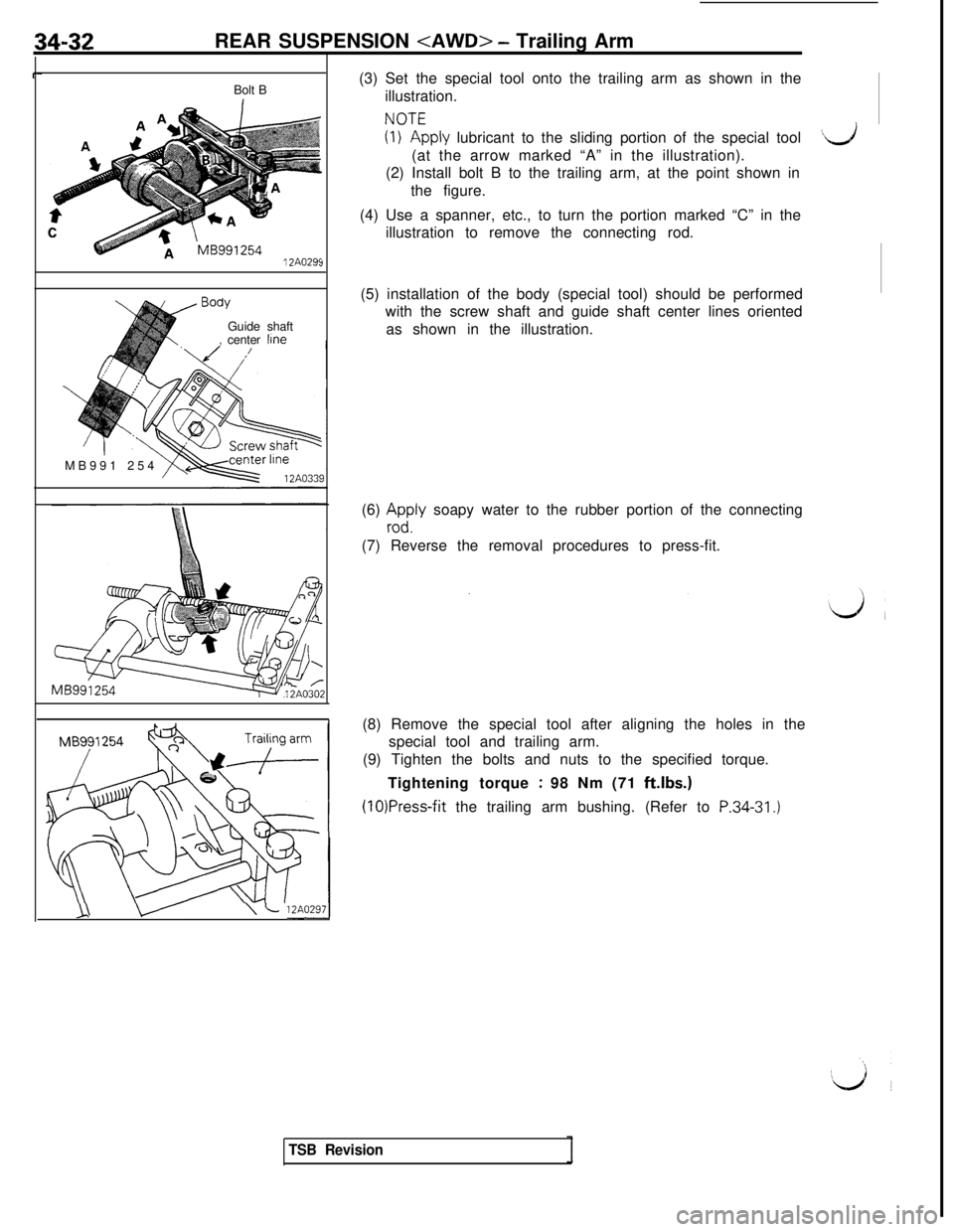
Y v\ L VA02971(3) Set the special tool onto the trailing arm as shown in the
illustration.
FP’dpply lubricant to the sliding portion of the special tool
(at the arrow marked “A” in the illustration).‘d(2) Install bolt B to the trailing arm, at the point shown in
the figure.
(4) Use a spanner, etc., to turn the portion marked “C” in the
illustration to remove the connecting rod.
(5) installation of the body (special tool) should be performed
with the screw shaft and guide shaft center lines oriented
as shown in the illustration.
(6)
Apdply soapy water to the rubber portion of the connecting
(7) Reverse the removal procedures to press-fit.
(8) Remove the special tool after aligning the holes in the
special tool and trailing arm.
(9) Tighten the bolts and nuts to the specified torque.
Tightening torque
: 98 Nm (71 ftlbs.)(IO)Press-fit the trailing arm bushing. (Refer to
P.34-31.)
TSB Revision
Page 719 of 1146
L
REAR SUSPENSION
SHOCK ABSORBER ASSEMBLY
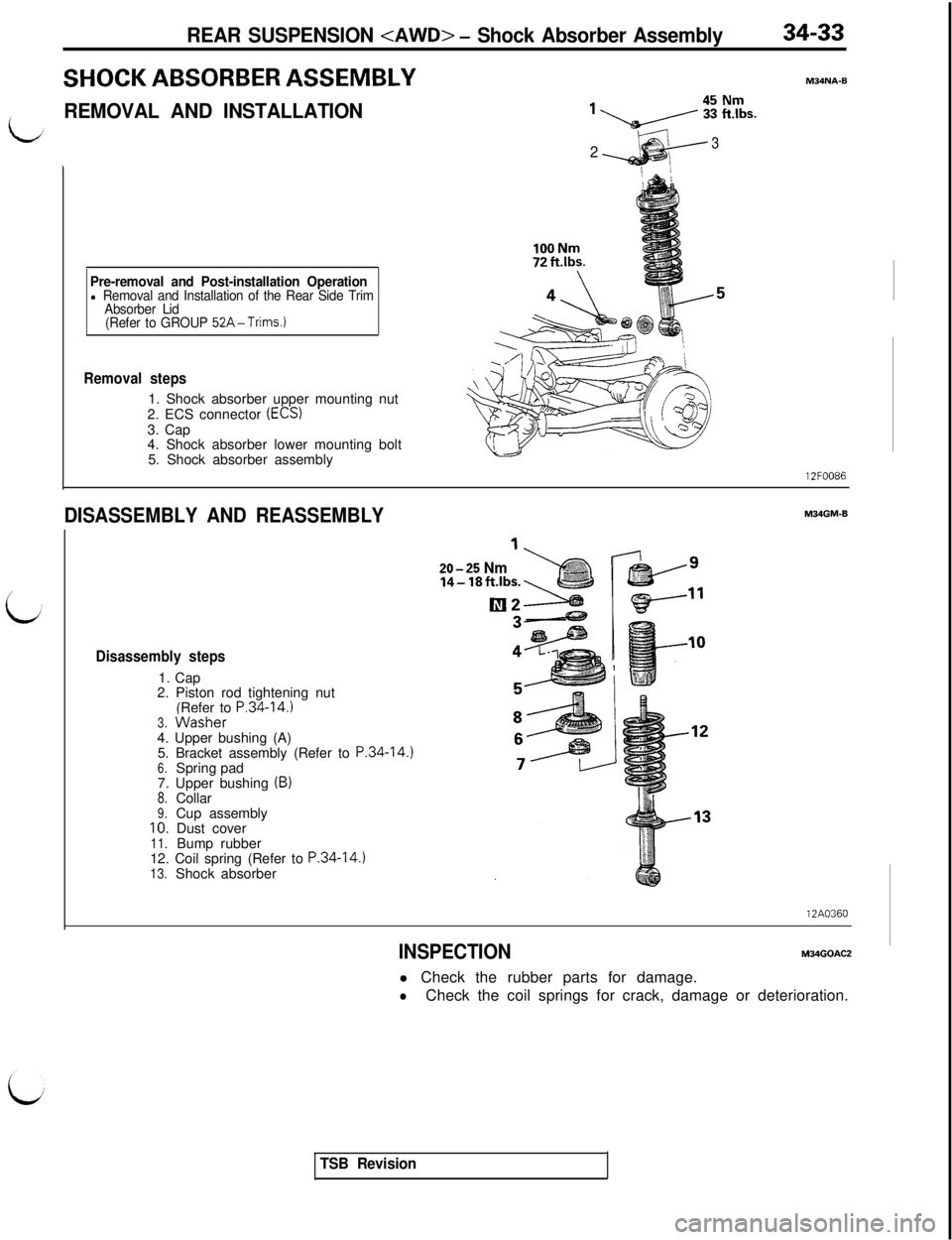
REMOVAL AND INSTALLATION1 v i5 KS
23
,
Pre-removal and Post-installation Operation
l Removal and Installation of the Rear Side Trim
Absorber Lid
(Refer to GROUP 52A-Trims.)
Removal steps1. Shock absorber upper mounting nut
2. ECS connector
(ECS)3. Cap
4. Shock absorber lower mounting bolt
5. Shock absorber assembly
M34NA-612FOO86
M34GM-BDISASSEMBLY AND REASSEMBLY
20-25 Nm14- 18ft.lbs.
Disassembly steps1. Cap
2. Piston rod tightening nut
(Refer to
P.34-14.)3.hasher4. Upper bushing (A)
5. Bracket assembly (Refer to
P.34-14.)6.Spring pad
7. Upper bushing (B)8.Collar9.Cup assembly10.Dust cover11.Bump rubber
12. Coil spring (Refer to P.34-14.)13.Shock absorber
12A0360
INSPECTIONM34GOAC2l Check the rubber parts for damage.
lCheck the coil springs for crack, damage or deterioration.
TSB Revision
Page 720 of 1146
34-34REAR SUSPENSION
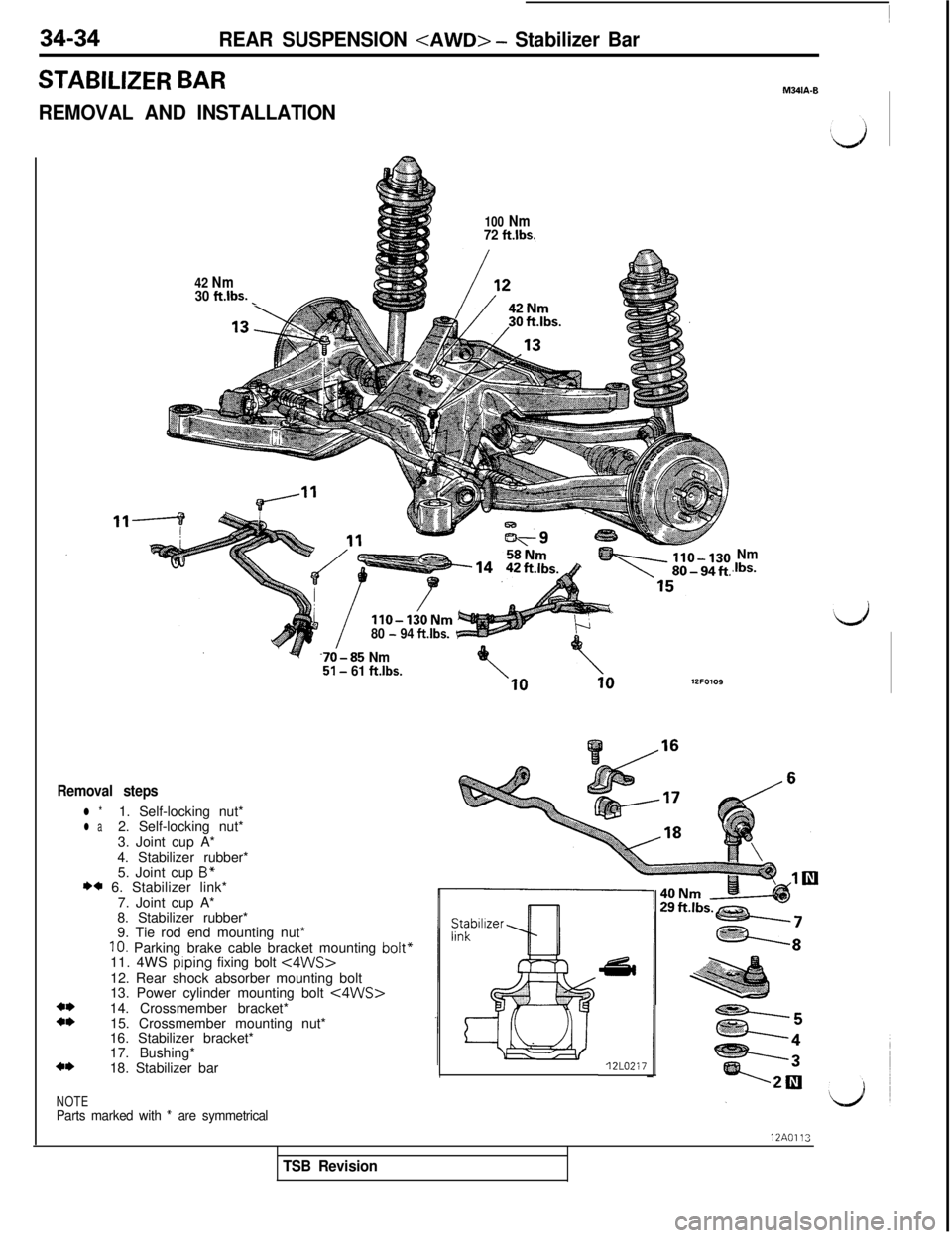
STABILIZER BAR
REMOVAL AND INSTALLATION
100 Nm72 ft.lbs.
42 Nm4
30 ft.lbs._
/IIO-130Nm80 - 94 ftlbs.
70-85 Nm51- 61 ftlbs.
Removal steps
l *1. Self-locking nut*l a2. Self-locking nut*
3. Joint cup A*
4. Stabilizer rubber*
5. Joint cup
B”I)* 6. Stabilizer link*
7. Joint cup A*
8. Stabilizer rubber*
9. Tie rod end mounting nut*
IO. Parking brake cable bracket mounting bolt”11. 4WS prping fixing bolt <4WS>12. Rear shock absorber mounting bolt
13. Power cylinder mounting bolt
<4WS>14. Crossmember bracket*
15. Crossmember mounting nut*
16. Stabilizer bracket*
17. Bushing*
18. Stabilizer bar
NOTEParts marked with * are symmetrical12L0217
Nm.Ibs.
M341A.B12A0113
TSB Revision
Page 721 of 1146
REAR SUSPENSION
----
-7
--;:-
hIlll~~II’
L IT ;
E!
.’
,.GLZ,
?,,..,”il.//,:”, /.’
\12AOll'Clip r&g
h12LO24'
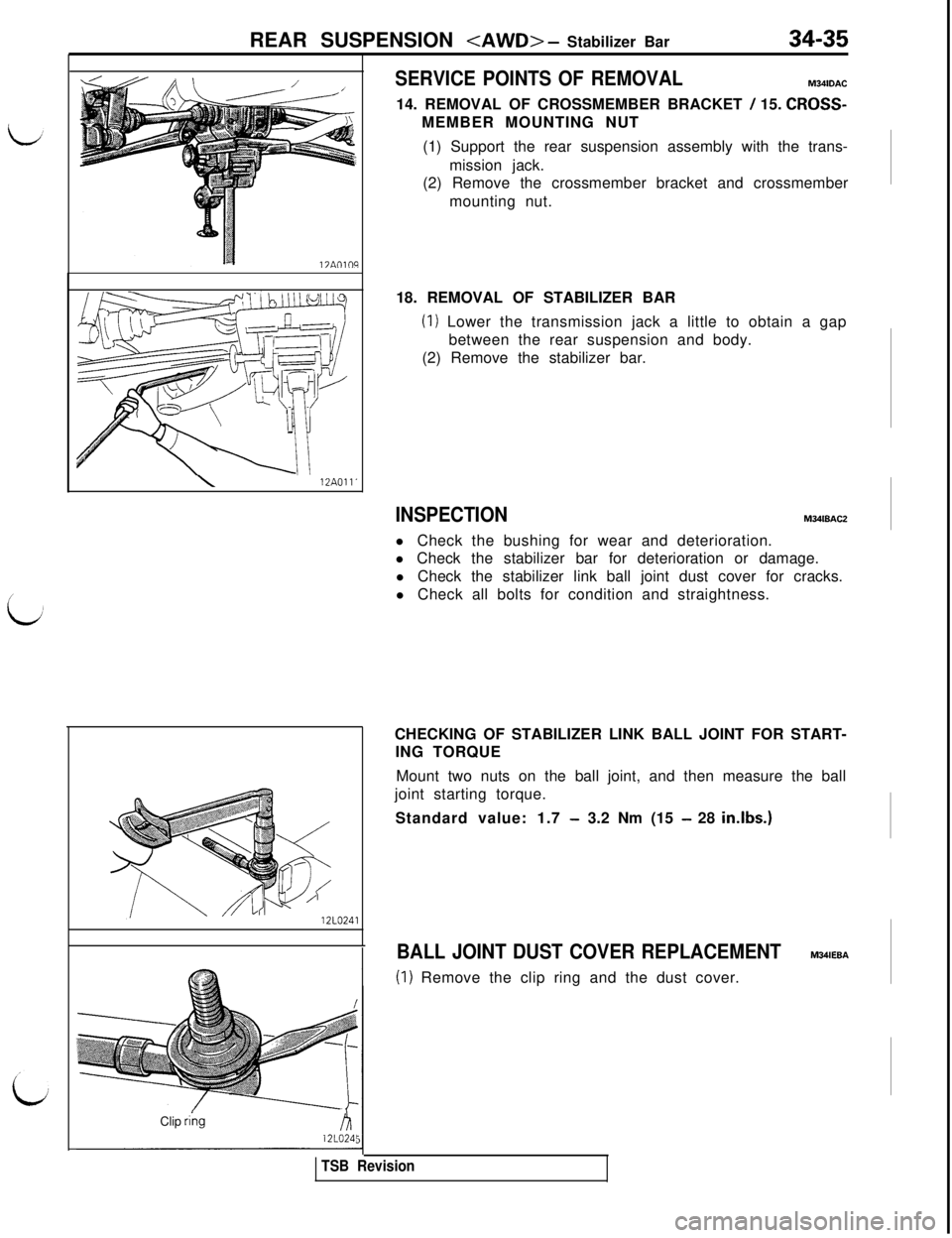
SERVICE POINTS OF REMOVALM34lDAC
14. REMOVAL OF CROSSMEMBER BRACKET
/ 15. CROSS-MEMBER MOUNTING NUT
(1) Support the rear suspension assembly with the trans-
mission jack.
(2) Remove the crossmember bracket and crossmember
mounting nut.
18. REMOVAL OF STABILIZER BAR
(1) Lower the transmission jack a little to obtain a gap
between the rear suspension and body.
(2) Remove the stabilizer bar.
INSPECTIONM341BACZ
l Check the bushing for wear and deterioration.
l Check the stabilizer bar for deterioration or damage.
l Check the stabilizer link ball joint dust cover for cracks.
l Check all bolts for condition and straightness.
CHECKING OF STABILIZER LINK BALL JOINT FOR START-
ING TORQUE
Mount two nuts on the ball joint, and then measure the ball
joint starting torque.
Standard value: 1.7
- 3.2 Nm (15 - 28 in.lbs.)
BALL JOINT DUST COVER REPLACEMENTM34lEBA
(1) Remove the clip ring and the dust cover.
TSB Revision
Page 722 of 1146
34-36REAR SUSPENSION
TaDe here
Clip ring ends
(Could be 180”
opposite end) 12PO25;
lZAOll012AOlOC
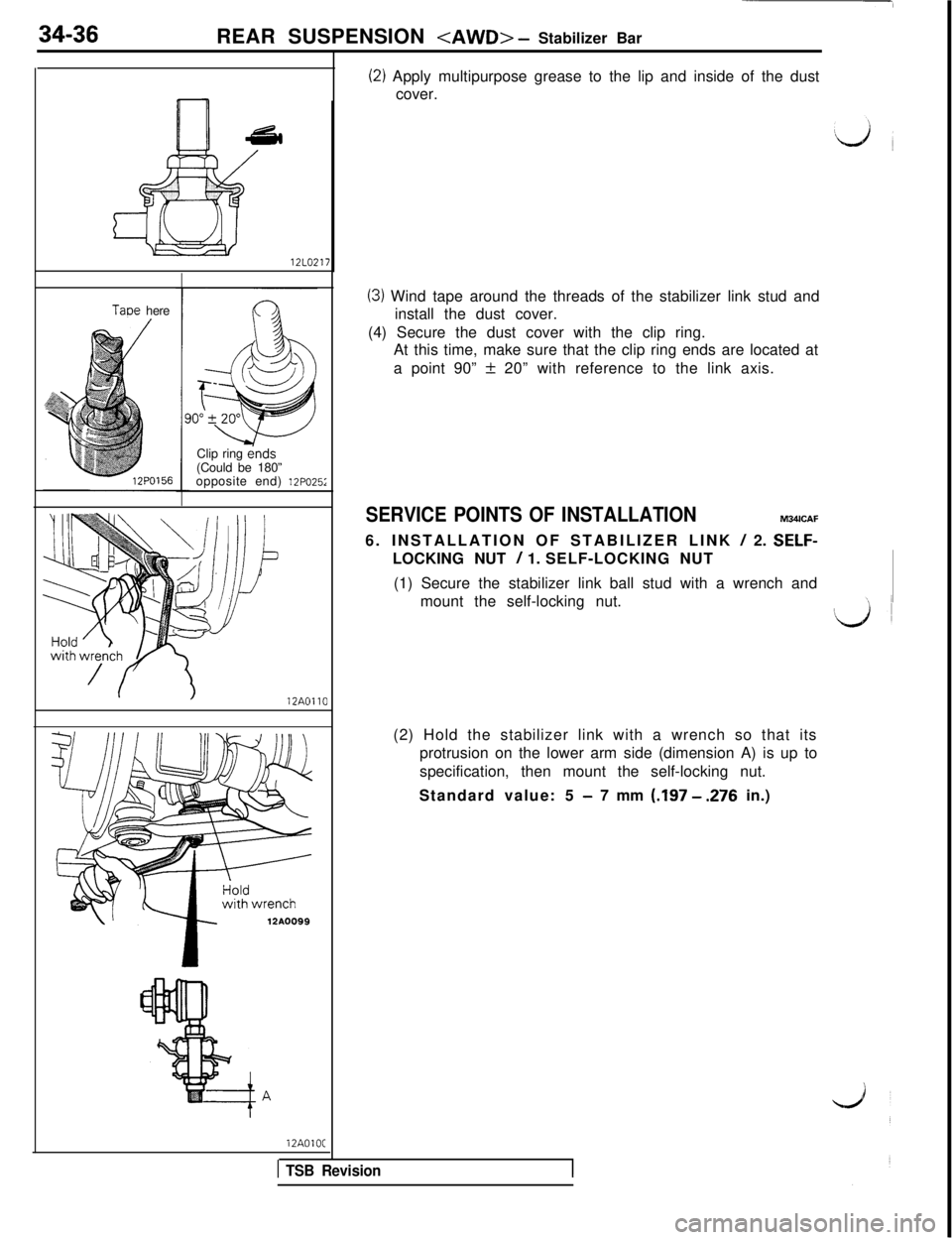
(2) Apply multipurpose grease to the lip and inside of the dust
cover.
(3) Wind tape around the threads of the stabilizer link stud and
install the dust cover.
(4) Secure the dust cover with the clip ring.
At this time, make sure that the clip ring ends are located at
a point 90”
f 20” with reference to the link axis.
SERVICE POINTS OF INSTALLATIONM34lCAF
6. INSTALLATION OF STABILIZER LINK
/ 2. SELF-LOCKING NUT
/ 1. SELF-LOCKING NUT
(1) Secure the stabilizer link ball stud with a wrench and
mount the self-locking nut.
(2) Hold the stabilizer link with a wrench so that its
protrusion on the lower arm side (dimension A) is up to
specification, then mount the self-locking nut.
Standard value: 5
- 7 mm (.197 - .276 in.)
1 TSB Revision
Page 780 of 1146
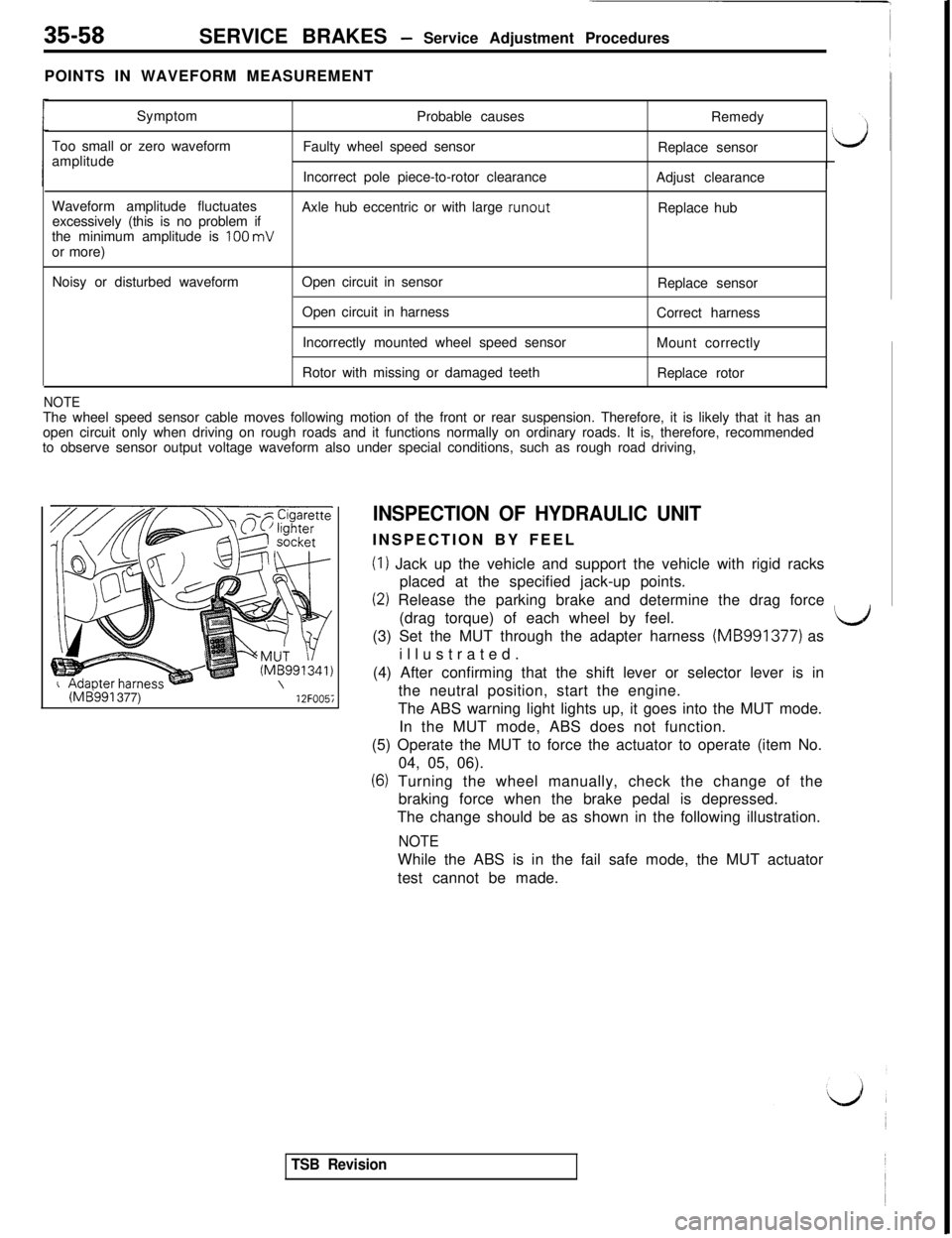
35-58SERVICE BRAKES - Service Adjustment Procedures
POINTS IN WAVEFORM MEASUREMENT
Symptom
Too small or zero waveform
amplitudeProbable causes
Faulty wheel speed sensorRemedy
Replace sensor
Incorrect pole piece-to-rotor clearance
Adjust clearance
Waveform amplitude fluctuates
excessively (this is no problem ifAxle hub eccentric or with large runout
Replace hub
the minimum amplitude is
100 mV
or more)
Noisy or disturbed waveformOpen circuit in sensor
Open circuit in harness
Incorrectly mounted wheel speed sensor
Rotor with missing or damaged teethReplace sensor
Correct harness
Mount correctly
Replace rotor
NOTEThe wheel speed sensor cable moves following motion of the front or rear suspension. Therefore, it is likely that it has an
open circuit only when driving on rough roads and it functions normally on ordinary roads. It is, therefore, recommended
to observe sensor output voltage waveform also under special conditions, such as rough road driving,
(ME!991 377)12FOO5i
INSPECTION OF HYDRAULIC UNITINSPECTION BY FEEL
(I) Jack up the vehicle and support the vehicle with rigid racks
placed at the specified jack-up points.
(2) Release the parking brake and determine the drag force
(drag torque) of each wheel by feel.
LJ(3) Set the MUT through the adapter harness (MB991377) as
illustrated.
(4) After confirming that the shift lever or selector lever is in
the neutral position, start the engine.
The ABS warning light lights up, it goes into the MUT mode.
In the MUT mode, ABS does not function.
(5) Operate the MUT to force the actuator to operate (item No.
04, 05, 06).
(6) Turning the wheel manually, check the change of the
braking force when the brake pedal is depressed.
The change should be as shown in the following illustration.
NOTEWhile the ABS is in the fail safe mode, the MUT actuator
test cannot be made.
TSB Revision
Page 863 of 1146
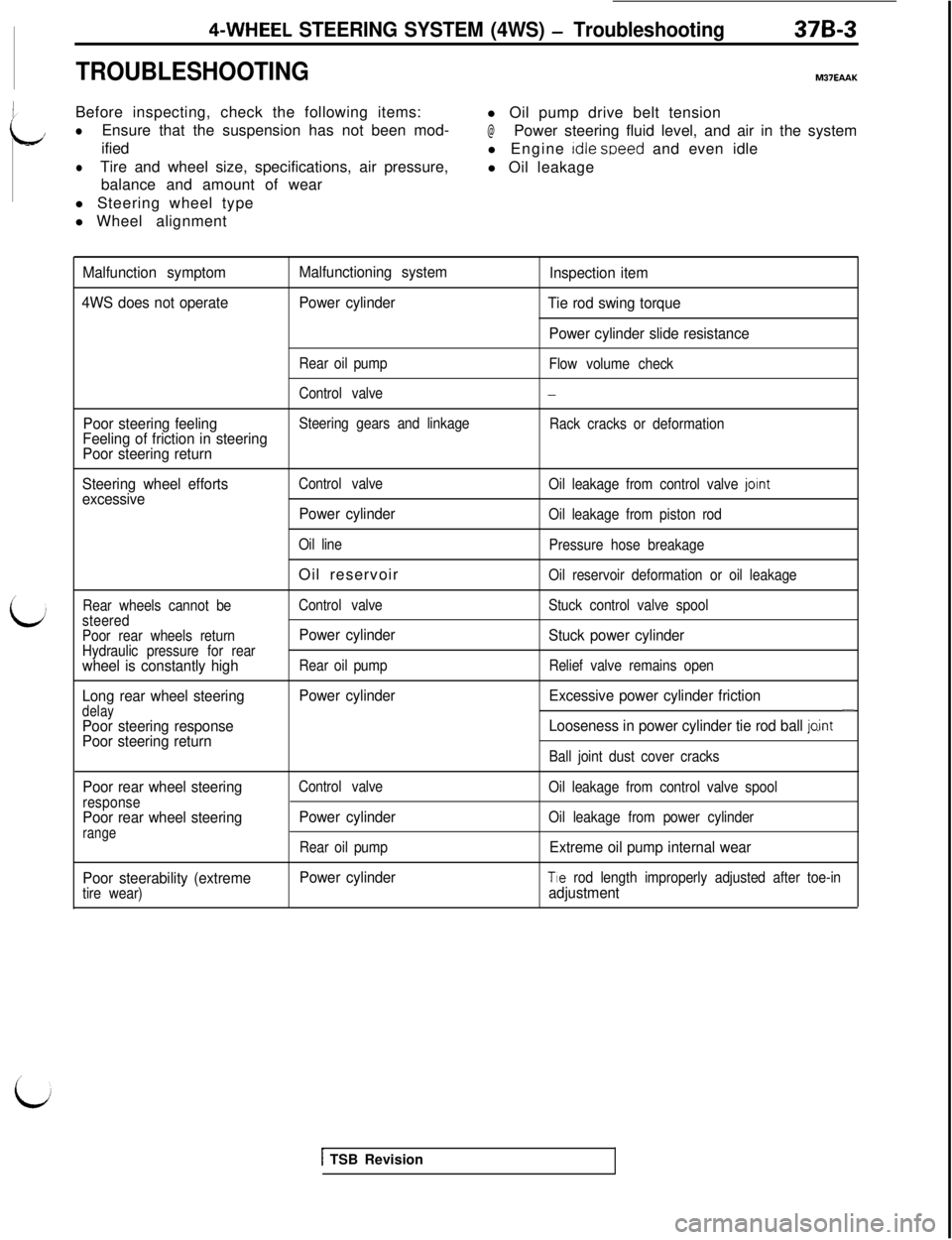
4-WHEEL STEERING SYSTEM (4WS) - Troubleshooting
TROUBLESHOOTING
37B-3
M37EMKBefore inspecting, check the following items:
l Oil pump drive belt tension
lEnsure that the suspension has not been mod-@Power steering fluid level, and air in the system
ified
l Engine
Idle soeed and even idle
lTire and wheel size, specifications, air pressure,
l Oil leakage
balance and amount of wear
l Steering wheel type
l Wheel alignment
Malfunction symptom
4WS does not operateMalfunctioning system
Power cylinderInspection item
Tie rod swing torque
Power cylinder slide resistance
Rear oil pump
Flow volume check
Control valve
-
Poor steering feelingSteering gears and linkage
Rack cracks or deformationFeeling of friction in steering
Poor steering return
Steering wheel efforts
excessive
Control valve
Oil leakage from control valve jornt
Rear wheels cannot be
steered
Poor rear wheels return
Hydraulic pressure for rear
wheel is constantly high
Long rear wheel steering
delayPoor steering response
Poor steering returnPower cylinder
Oil lineOil reservoir
Control valve
Power cylinder
Rear oil pump
Power cylinder
Oil leakage from piston rod
Pressure hose breakage
Oil reservoir deformation or oil leakage
Stuck control valve spool
Stuck power cylinder
Relief valve remains open
Excessive power cylinder friction-
Looseness in power cylinder tie rod ball jo.int
Ball joint dust cover cracks
Poor rear wheel steeringresponsePoor rear wheel steeringrange
Poor steerability (extremetire wear)Control valve
Power cylinder
Rear oil pump
Power cylinder
Oil leakage from control valve spool
Oil leakage from power cylinder
Extreme oil pump internal wear
Tie rod length improperly adjusted after toe-inadjustment
[ TSB Revision