key MITSUBISHI 3000GT 1991 Service Manual
[x] Cancel search | Manufacturer: MITSUBISHI, Model Year: 1991, Model line: 3000GT, Model: MITSUBISHI 3000GT 1991Pages: 1146, PDF Size: 76.68 MB
Page 20 of 1146
00-16GENERAL - Towina and Hoistina
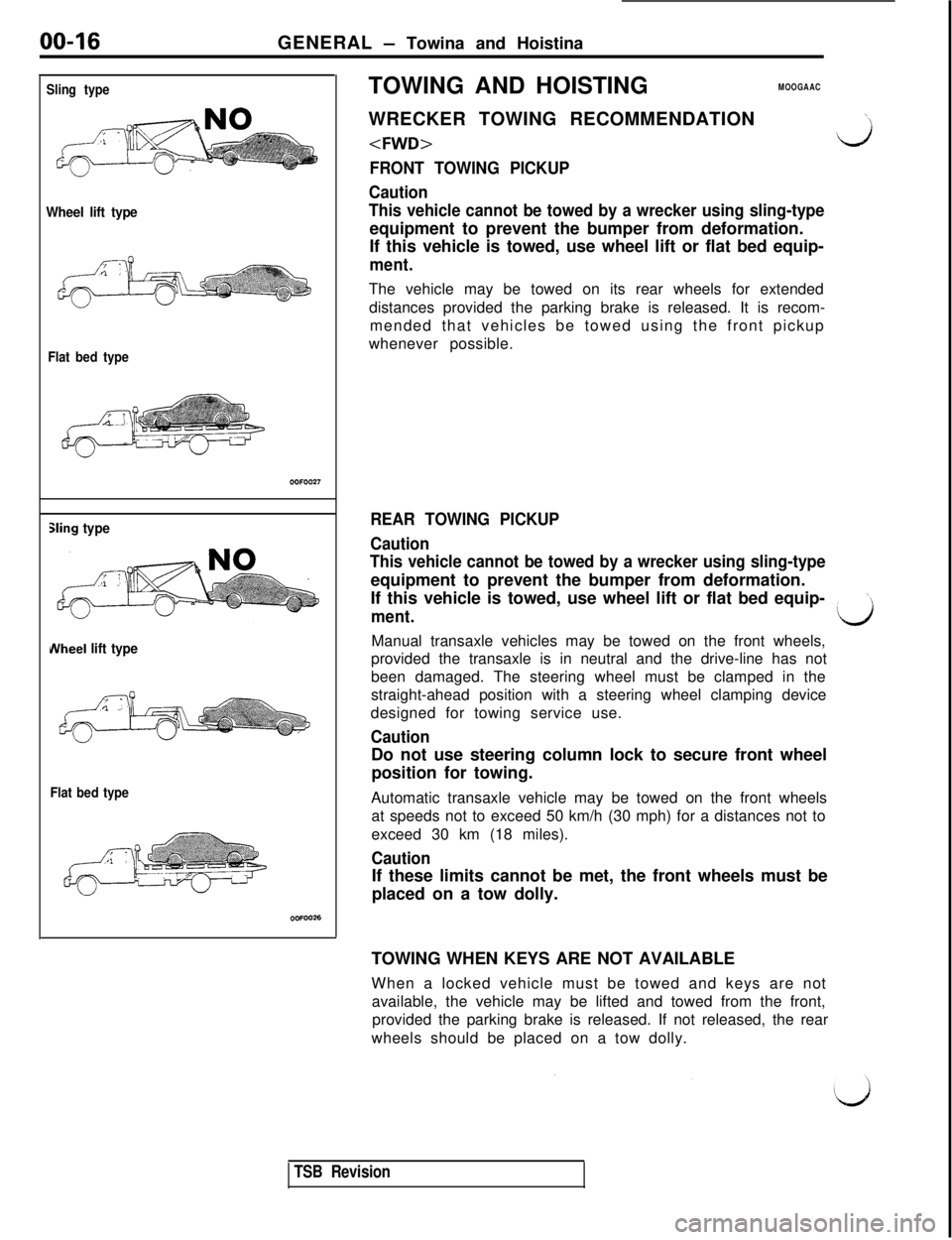
Sling type
Wheel lift type
Flat bed type
Sling type
Wheel lift type
Flat bed typeTOWING AND HOISTING
MOOGAACWRECKER TOWING RECOMMENDATION
FRONT TOWING PICKUP
Caution
\‘i
d
This vehicle cannot be towed by a wrecker using sling-typeequipment to prevent the bumper from deformation.
If this vehicle is towed, use wheel lift or flat bed equip-
ment.The vehicle may be towed on its rear wheels for extended
distances provided the parking brake is released. It is recom-
mended that vehicles be towed using the front pickup
whenever possible.
REAR TOWING PICKUP
Caution
This vehicle cannot be towed by a wrecker using sling-typeequipment to prevent the bumper from deformation.
If this vehicle is towed, use wheel lift or flat bed equip-
\
ment.‘L*3Manual transaxle vehicles may be towed on the front wheels,
provided the transaxle is in neutral and the drive-line has not
been damaged. The steering wheel must be clamped in the
straight-ahead position with a steering wheel clamping device
designed for towing service use.
CautionDo not use steering column lock to secure front wheel
position for towing.
Automatic transaxle vehicle may be towed on the front wheels
at speeds not to exceed 50 km/h (30 mph) for a distances not to
exceed 30 km (18 miles).
CautionIf these limits cannot be met, the front wheels must be
placed on a tow dolly.
TOWING WHEN KEYS ARE NOT AVAILABLE
When a locked vehicle must be towed and keys are not
available, the vehicle may be lifted and towed from the front,
provided the parking brake is released. If not released, the rear
wheels should be placed on a tow dolly.
TSB Revision
Page 118 of 1146

13-12FUEL SYSTEM - Troubleshooting
MALFUNCTION INDICATOR LIGHT INSPECTION
(1) Check that when the ignition switch is turned on, the lightilluminates for about 5 seconds and then goes out.
(2) If the light does not illuminate, check for open circuit in
dharness, blown fuse and blown bulb.
SELF-DIAGNOSIS
The engine control unit monitors the input/output signals (some
signals at all times and the others under specified conditions) ofthe engine control unit.
When it is noticed that an irregularity has continued for a
specified time or longer from when the irregular signal is
initially monitored, passing a certain number, the engine controlunit judges that an irregularity has occurred, memorizes the
malfunction code, and outputs the signal to the self-diagnosis
output terminal.
There are 21 diagnosis items, including the normal state, andthe diagnosis results can be read out with a voltmeter or
multi-use tester.Moreover, since memorization of the malfunction codes is
backed up directly by the battery, the diagnosis results are
memorized even if the ignition key is turned off. The malfunc-
tion codes will, however, be erased when the battery terminalor the engine control unit connector is disconnected.
The malfunction code can also be erased by turning on the
ignition switch and sending the malfunction code erase signalfrom the multi-use tester to the engine control unit.
CautionIf the sensor connector is disconnected with the ignition
_ _switch turned on, the malfunction code is memorized. Ind
this case, send the malfunction code erase signal from themulti-use tester to the engine control unit or disconnect
the battery terminal
(-) for 10 seconds or more, and the
diagnosis memory will be erased.
The 21 diagnosis items are provided as follows, and if plural
items are activated, they are all indicated sequentially from the
smallest code number.
CautionThe malfunction code for the ignition timing adjustment
signal is output when the line of the ignition timing
adjustment terminal is shorted to ground. Therefore, the
malfunction code is also output when the ignition timing
adjustment terminal is grounded to adjust the ignition
timing, but this does not show any abnormality.
TSB Revision
Page 278 of 1146
13-172CRUISE CONTROL SYSTEM - Troubleshooting
SELF-DIAGNOSIS CHECKING
Self-diagnosis checking is performed when there has been an
automatic cancellation without cancel switch operation.
‘1 ’
NOTE‘LAEven when the ignition key is placed in the OFF position, all
diagnosis codes are stored and retained, until the battery cable
is disconnected, to make sure that the problems encountered
in the past can be checked.
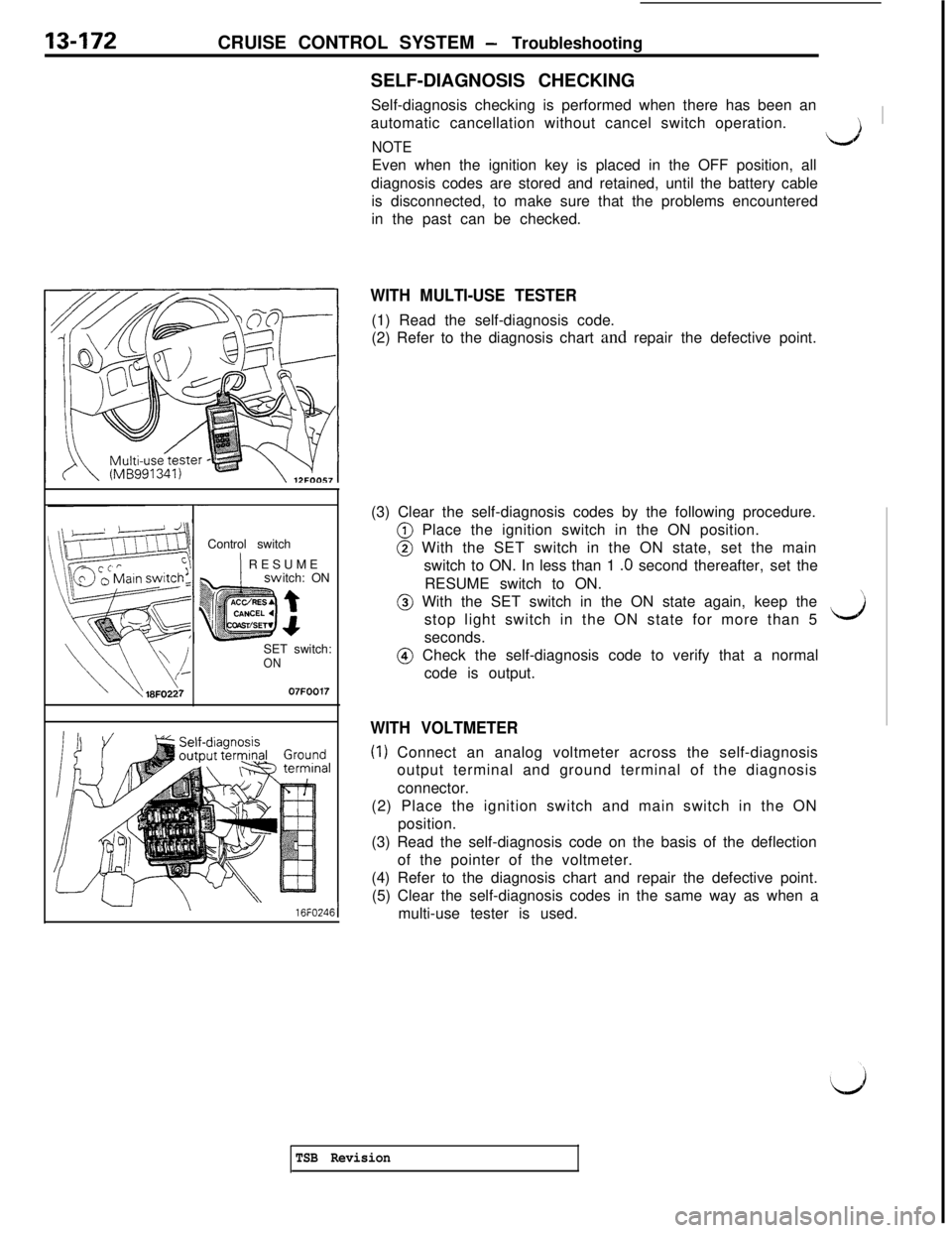
Control switch
1 RESUME
itch: ON
t
4SET switch:
ON
07FOO17
-\16FO2461
WITH MULTI-USE TESTER(1) Read the self-diagnosis code.
(2) Refer to the diagnosis chart and repair the defective point.
(3) Clear the self-diagnosis codes by the following procedure.@ Place the ignition switch in the ON position.@ With the SET switch in the ON state, set the main
switch to ON. In less than 1
.O second thereafter, set the
RESUME switch to ON.@ With the SET switch in the ON state again, keep the
’stop light switch in the ON state for more than 5dseconds.@ Check the self-diagnosis code to verify that a normal
code is output.
WITH VOLTMETER
(1) Connect an analog voltmeter across the self-diagnosis
output terminal and ground terminal of the diagnosis
connector.
(2) Place the ignition switch and main switch in the ON
position.
(3) Read the self-diagnosis code on the basis of the deflection
of the pointer of the voltmeter.
(4) Refer to the diagnosis chart and repair the defective point.
(5) Clear the self-diagnosis codes in the same way as when a
multi-use tester is used.
TSB Revision
Page 285 of 1146
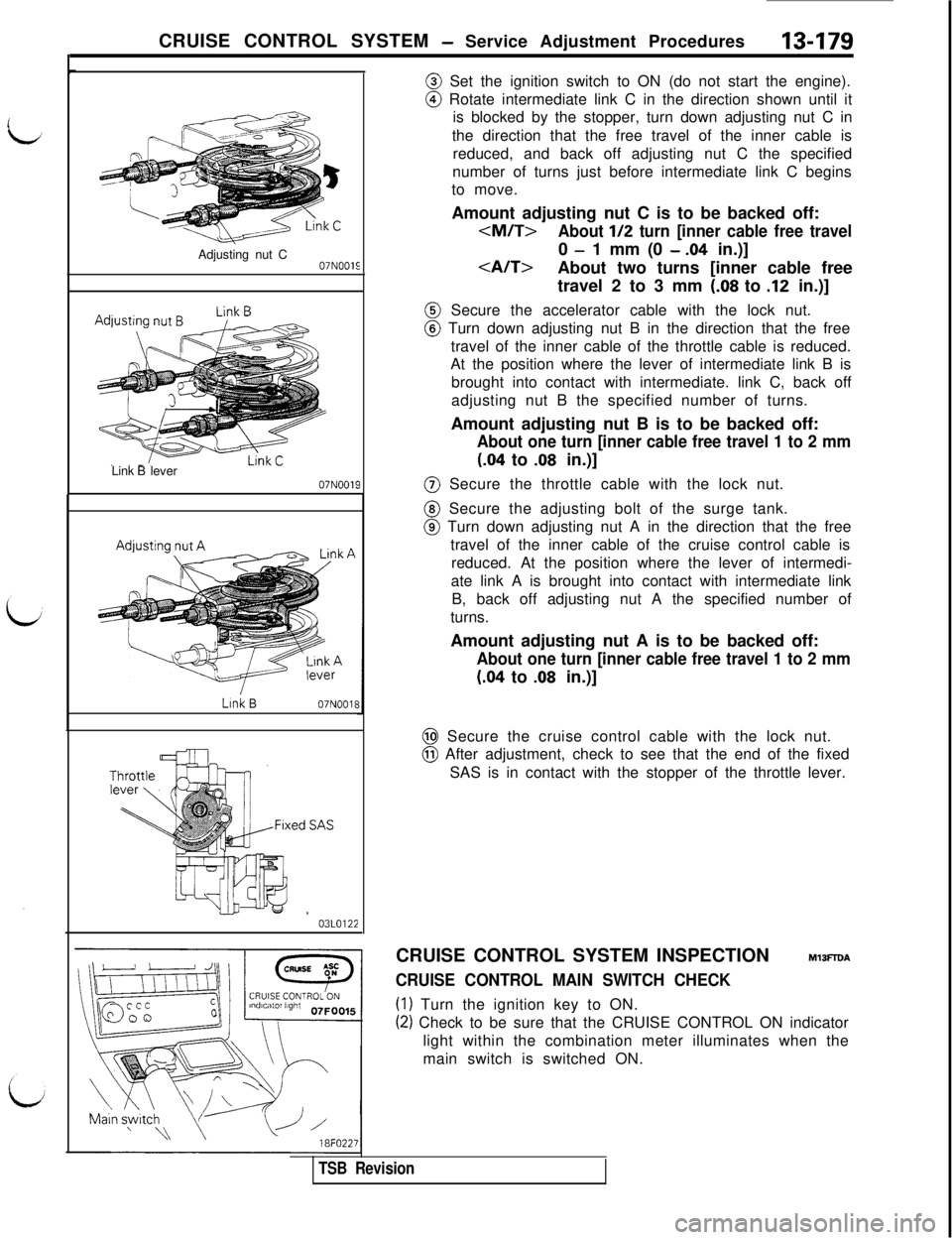
CRUISE CONTROL SYSTEM - Service Adjustment Procedures13-179Adjusting nut C
07NOOlELink Blever
07N0019Link
B07NOOlE
y,jj--ww ,03LO122
\\ \18FO2.2'@ Set the ignition switch to ON (do not start the engine).@ Rotate intermediate link C in the direction shown until it
is blocked by the stopper, turn down adjusting nut C in
the direction that the free travel of the inner cable is
reduced, and back off adjusting nut C the specified
number of turns just before intermediate link C begins
to move.
Amount adjusting nut C is to be backed off:
- 1 mm (0 - .04 in.)]
About two turns [inner cable free
travel 2 to 3 mm
(.08 to .12 in.)]@ Secure the accelerator cable with the lock nut.@ Turn down adjusting nut B in the direction that the free
travel of the inner cable of the throttle cable is reduced.
At the position where the lever of intermediate link B is
brought into contact with intermediate. link C, back off
adjusting nut B the specified number of turns.
Amount adjusting nut B is to be backed off:
About one turn [inner cable free travel 1 to 2 mm
(.04 to .08 in.)]@ Secure the throttle cable with the lock nut.@ Secure the adjusting bolt of the surge tank.@ Turn down adjusting nut A in the direction that the free
travel of the inner cable of the cruise control cable is
reduced. At the position where the lever of intermedi-
ate link A is brought into contact with intermediate link
B, back off adjusting nut A the specified number of
turns.
Amount adjusting nut A is to be backed off:
About one turn [inner cable free travel 1 to 2 mm
(.04 to .08 in.)]@ Secure the cruise control cable with the lock nut.@ After adjustment, check to see that the end of the fixed
SAS is in contact with the stopper of the throttle lever.
CRUISE CONTROL SYSTEM INSPECTION
MlBFlDA
CRUISE CONTROL MAIN SWITCH CHECK
(1) Turn the ignition key to ON.
(2) Check to be sure that the CRUISE CONTROL ON indicator
light within the combination meter illuminates when the
main switch is switched ON.
TSB Revision
Page 389 of 1146
MANUAL TRANSAXLE
110*u011009FO12
SERVICE ADJUSTMENT PROCEDURES
MZZFBAEl
TRANSMISSION OIL LEVEL INSPECTIONRefer to GROUP 00
- Maintenance Service.
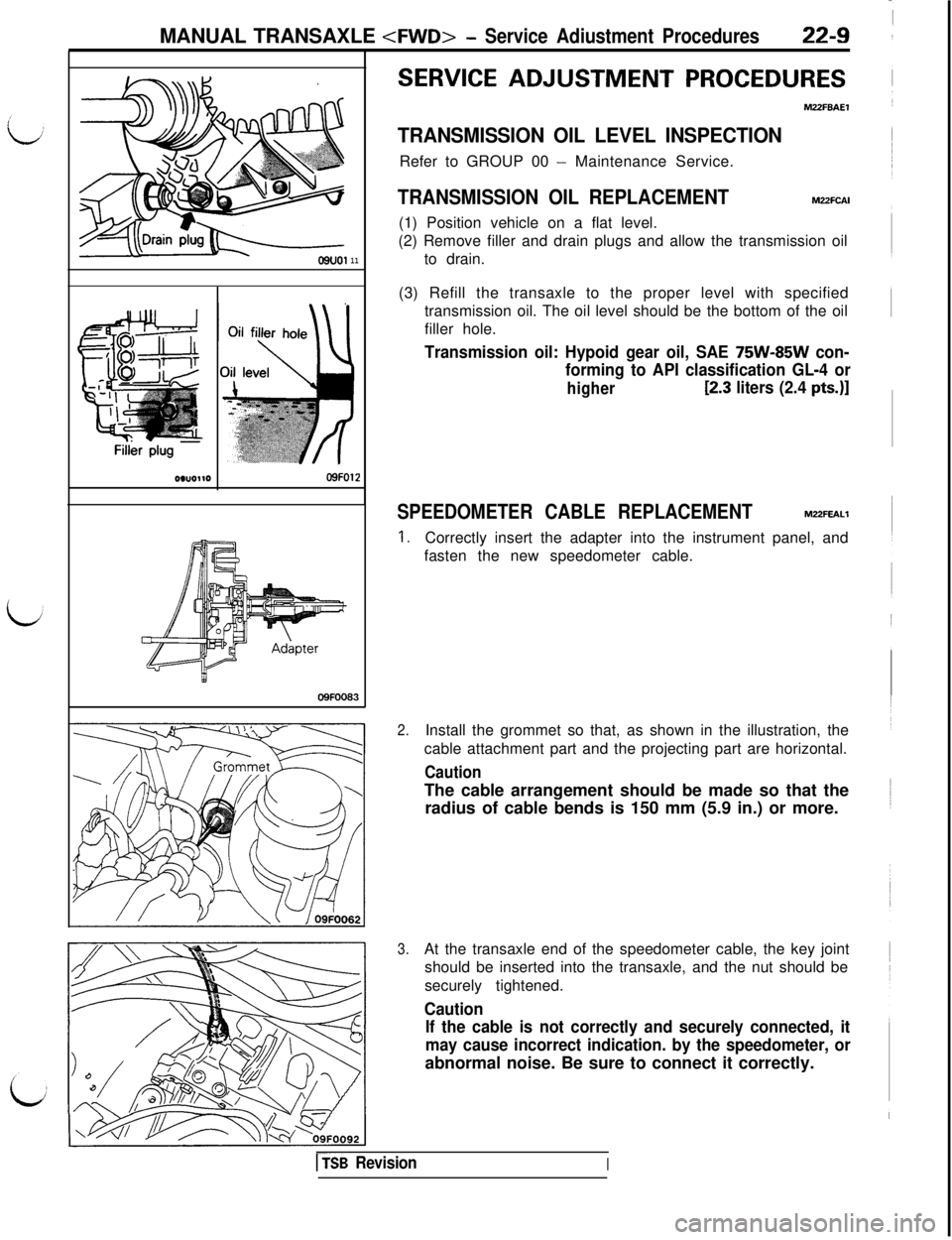
TRANSMISSION OIL REPLACEMENTM22FCAI(1) Position vehicle on a flat level.
(2) Remove filler and drain plugs and allow the transmission oil
to drain.
(3) Refill the transaxle to the proper level with specified
transmission oil. The oil level should be the bottom of the oil
filler hole.
Transmission oil: Hypoid gear oil, SAE 75W-85W con-
forming to API classification GL-4 or
higherC2.3 liters (2.4 pts.)]
SPEEDOMETER CABLE REPLACEMENTMUFEALl
1.Correctly insert the adapter into the instrument panel, and
fasten the new speedometer cable.
2.Install the grommet so that, as shown in the illustration, the
cable attachment part and the projecting part are horizontal.
CautionThe cable arrangement should be made so that the
radius of cable bends is 150 mm (5.9 in.) or more.
3.At the transaxle end of the speedometer cable, the key joint
should be inserted into the transaxle, and the nut should be
securely tightened.
Caution
If the cable is not correctly and securely connected, it
may cause incorrect indication. by the speedometer, orabnormal noise. Be sure to connect it correctly.
DSB RevisionI
Page 408 of 1146
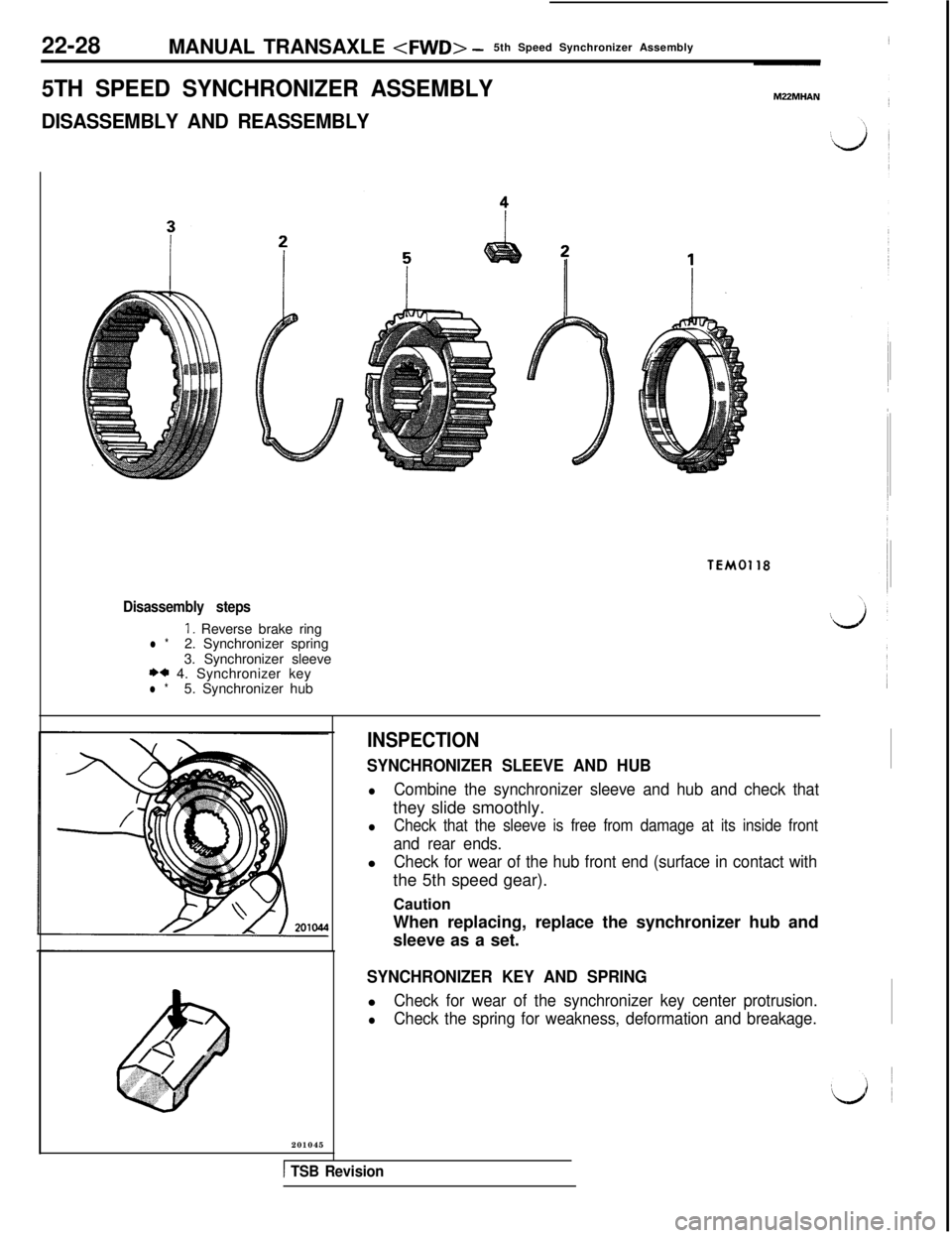
22-28
MANUAL TRANSAXLE
5TH SPEED SYNCHRONIZER ASSEMBLY
DISASSEMBLY AND REASSEMBLY
TEMOl18
Disassembly steps
1. Reverse brake ringl *2. Synchronizer spring
3. Synchronizer sleeve
** 4. Synchronizer keyl *5. Synchronizer hub
@
/r /
JI,::. ‘..-‘. .\:’201045
INSPECTION
SYNCHRONIZER SLEEVE AND HUB
lCombine the synchronizer sleeve and hub and check thatthey slide smoothly.
lCheck that the sleeve is free from damage at its inside front
and rear ends.l
Check for wear of the hub front end (surface in contact withthe 5th speed gear).
Caution
When replacing, replace the synchronizer hub and
sleeve as a set.
SYNCHRONIZER KEY AND SPRINGl
Check for wear of the synchronizer key center protrusion.
lCheck the spring for weakness, deformation and breakage.
1 TSB Revision
Page 409 of 1146
MANUAL TRANSAXLE
22-29
i
Oil groove
Springprotrusion
201001a
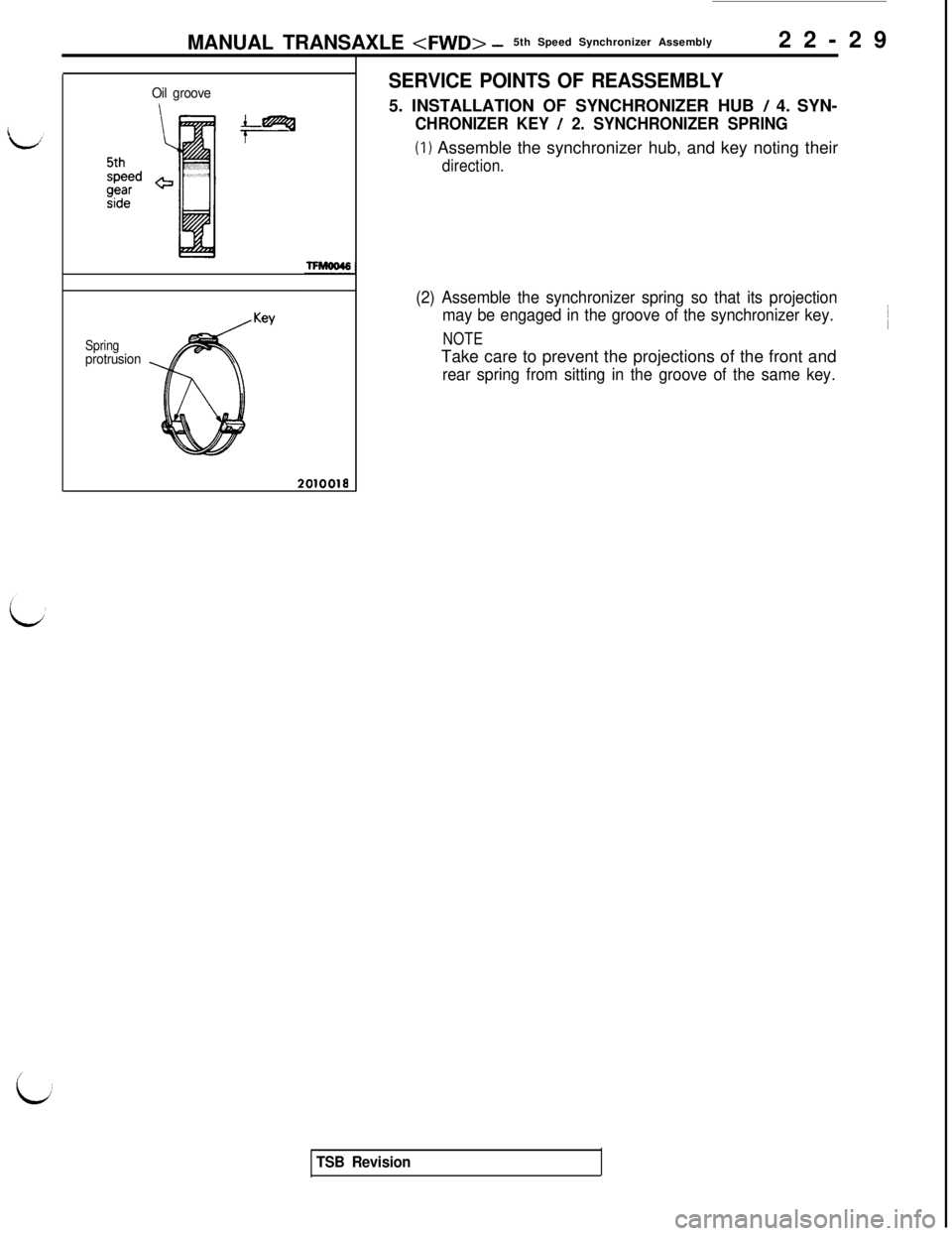
SERVICE POINTS OF REASSEMBLY5. INSTALLATION OF SYNCHRONIZER HUB
/ 4. SYN-
CHRONIZER KEY / 2. SYNCHRONIZER SPRING
(1) Assemble the synchronizer hub, and key noting their
direction.
(2) Assemble the synchronizer spring so that its projection
may be engaged in the groove of the synchronizer key.
NOTETake care to prevent the projections of the front and
rear spring from sitting in the groove of the same key.
TSB Revision
Page 410 of 1146
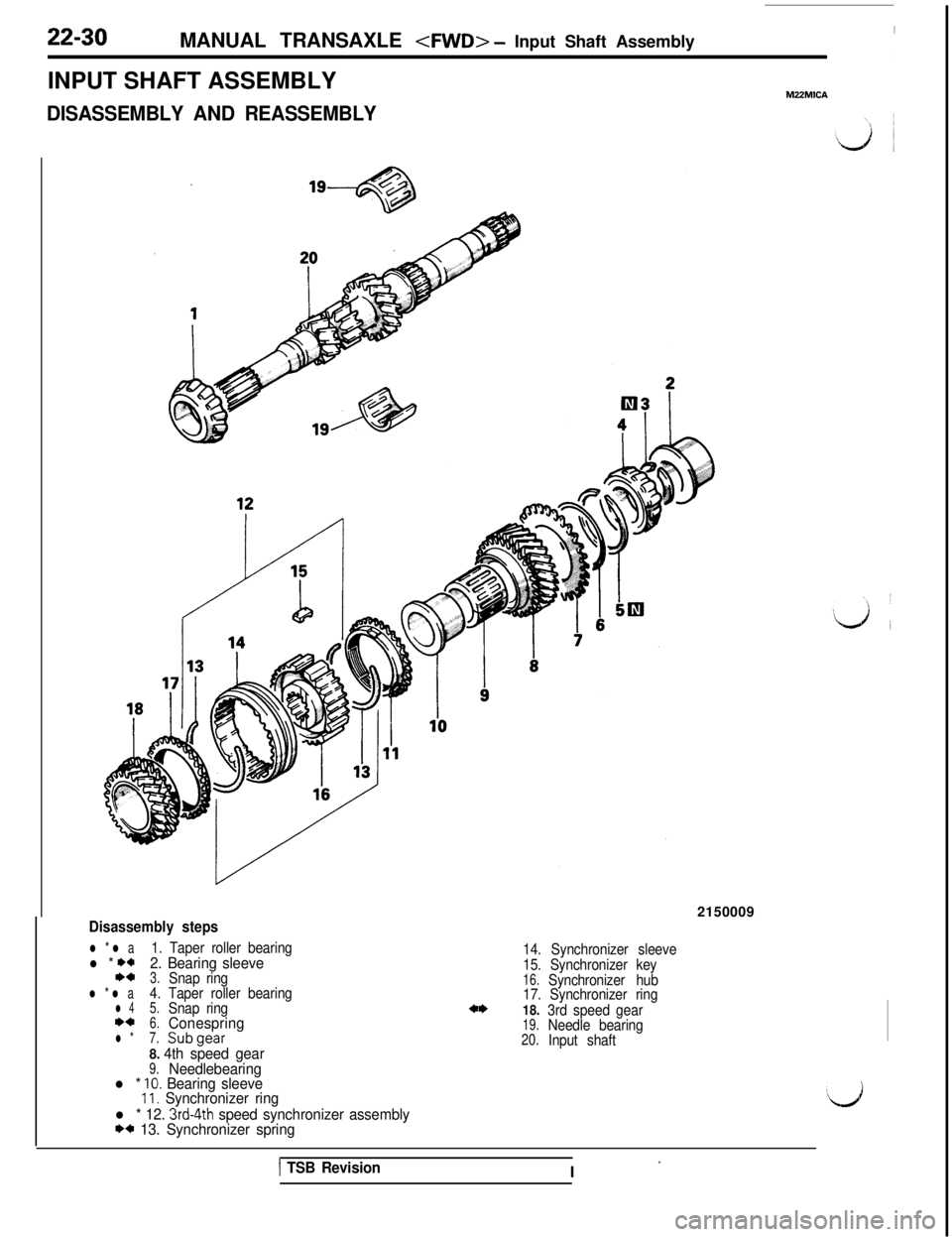
22-30
MANUAL TRANSAXLE
INPUT SHAFT ASSEMBLY
MZZMICA
DISASSEMBLY AND REASSEMBLY2150009
Disassembly steps
l * l a1. Taper roller bearingl * *a2. Bearing sleeveI)+3.Snap ringl * l a4. Taper roller bearingl 45.Snap ring**6.Conespringl *7.Subgear
8. 4th speed gear
9.Needlebearingl * 10. Bearing sleeveII. Synchronizer ring
l * 12. 3rd-4th speed synchronizer assembly** 13. Synchronizer spring
14. Synchronizer sleeve
15. Synchronizer key
16.Synchronizer hub
17. Synchronizer ring
18.
3rd speed gear
19.Needle bearing20.Input shaft
1 TSB RevisionI ’
Page 412 of 1146
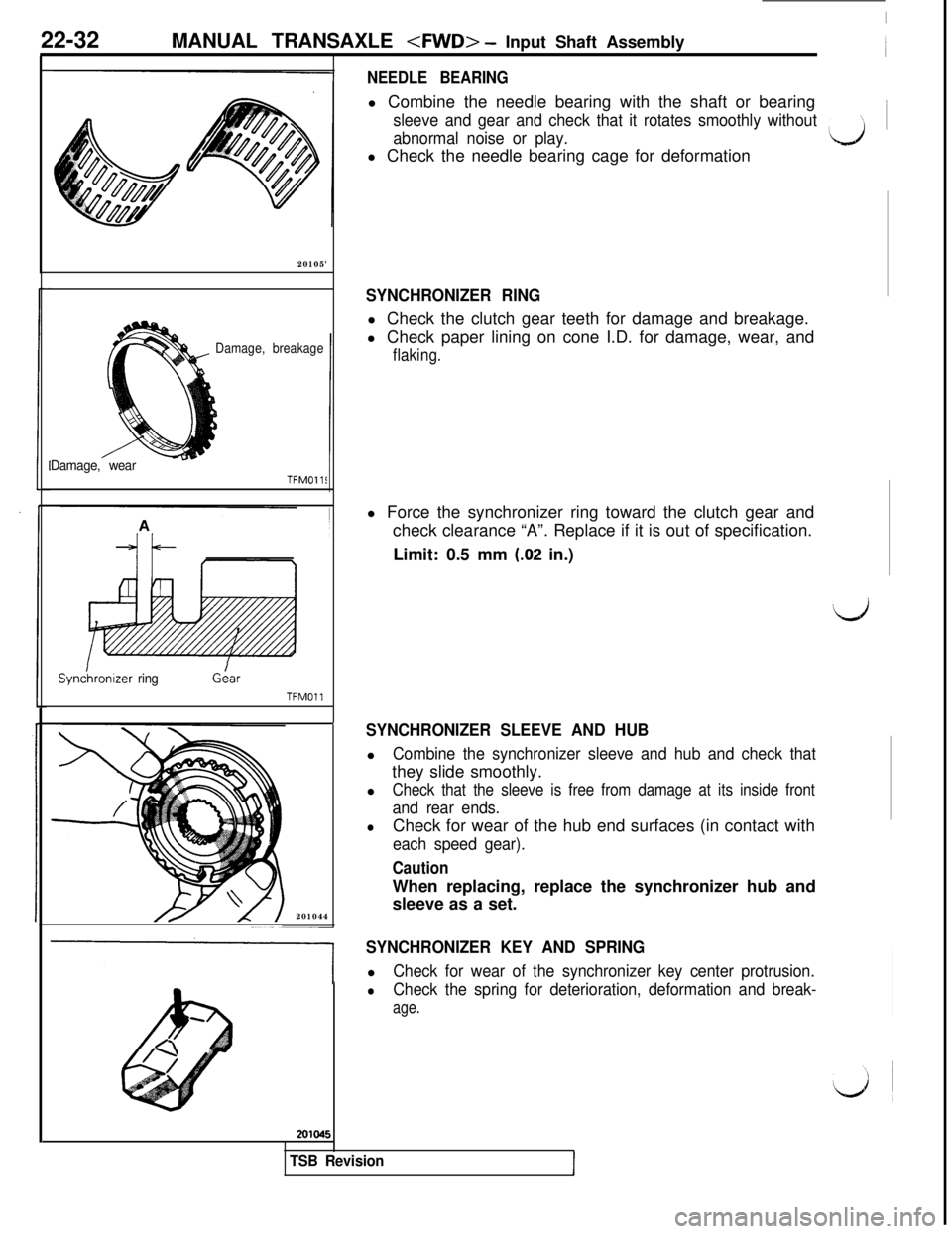
22-32MANUAL TRANSAXLE
20105'
Damage, breakage
Damage, wearTFMOll!
Synchnizer ringGLar
TFMOll201044
/
NEEDLE BEARINGl Combine the needle bearing with the shaft or bearing
sleeve and gear and check that it rotates smoothly without
abnormal noise or play.l Check the needle bearing cage for deformation
SYNCHRONIZER RINGl Check the clutch gear teeth for damage and breakage.
l Check paper lining on cone I.D. for damage, wear, and
flaking.l Force the synchronizer ring toward the clutch gear and
check clearance “A”. Replace if it is out of specification.
Limit: 0.5 mm
(.02 in.)
SYNCHRONIZER SLEEVE AND HUBl
Combine the synchronizer sleeve and hub and check thatthey slide smoothly.
l
Check that the sleeve is free from damage at its inside front
and rear ends.
lCheck for wear of the hub end surfaces (in contact with
each speed gear).
CautionWhen replacing, replace the synchronizer hub and
sleeve as a set.
SYNCHRONIZER KEY AND SPRINGl
Check for wear of the synchronizer key center protrusion.
lCheck the spring for deterioration, deformation and break-
age.
TSB Revision
Page 413 of 1146
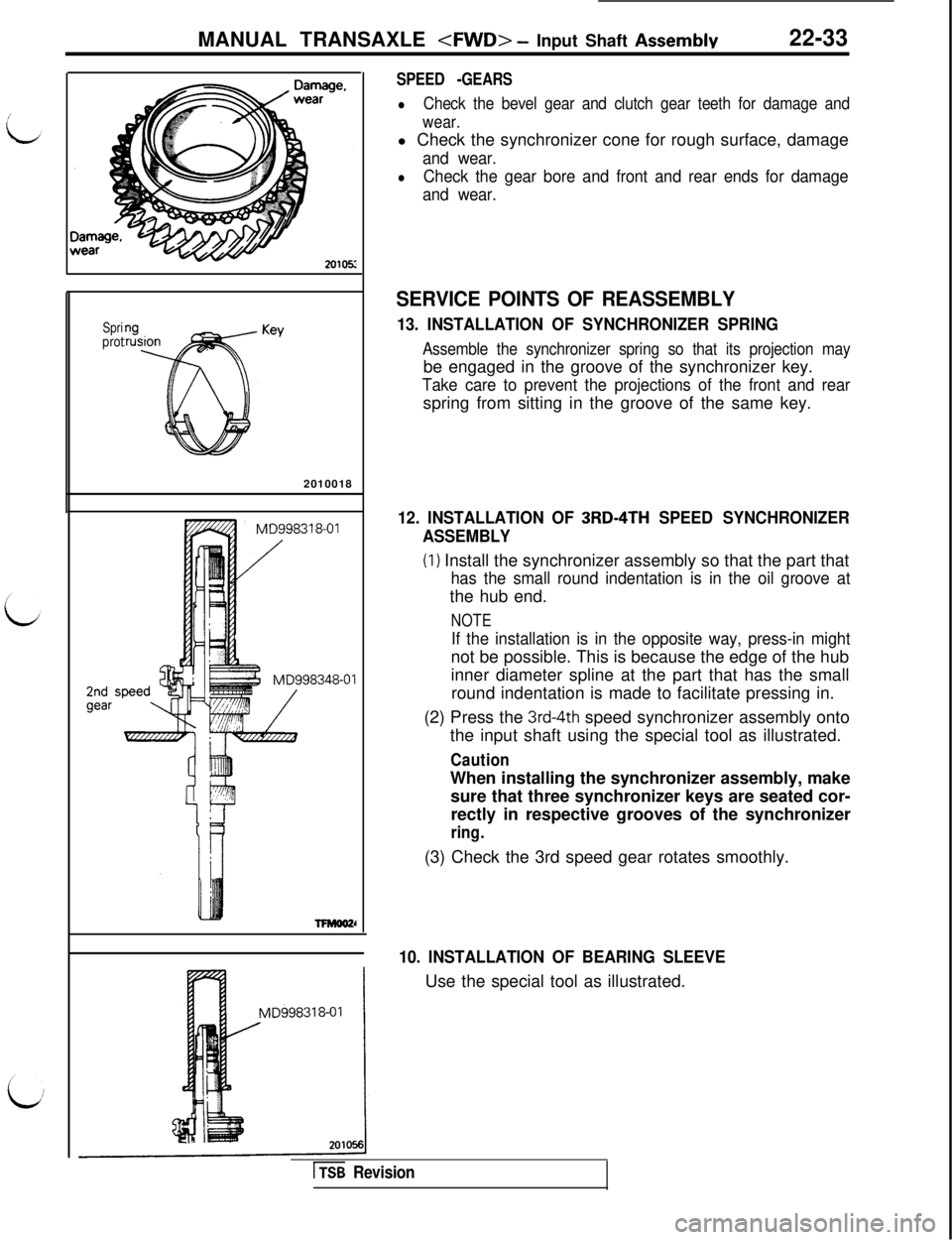
MANUAL TRANSAXLE
SpriprotKey2010018
MD998348-01
SPEED -GEARS
lCheck the bevel gear and clutch gear teeth for damage and
wear.l Check the synchronizer cone for rough surface, damage
and wear.
lCheck the gear bore and front and rear ends for damage
and wear.
SERVICE POINTS OF REASSEMBLY
13. INSTALLATION OF SYNCHRONIZER SPRING
Assemble the synchronizer spring so that its projection maybe engaged in the groove of the synchronizer key.
Take care to prevent the projections of the front and rearspring from sitting in the groove of the same key.
12. INSTALLATION OF 3RD-4TH SPEED SYNCHRONIZER
ASSEMBLY
(I) Install the synchronizer assembly so that the part that
has the small round indentation is in the oil groove atthe hub end.
NOTE
If the installation is in the opposite way, press-in mightnot be possible. This is because the edge of the hub
inner diameter spline at the part that has the small
round indentation is made to facilitate pressing in.
(2) Press the
3rd-4th speed synchronizer assembly onto
the input shaft using the special tool as illustrated.
CautionWhen installing the synchronizer assembly, make
sure that three synchronizer keys are seated cor-
rectly in respective grooves of the synchronizer
ring.(3) Check the 3rd speed gear rotates smoothly.
10. INSTALLATION OF BEARING SLEEVEUse the special tool as illustrated.
rTSB Revision