coolant level MITSUBISHI 3000GT 1991 Service Manual
[x] Cancel search | Manufacturer: MITSUBISHI, Model Year: 1991, Model line: 3000GT, Model: MITSUBISHI 3000GT 1991Pages: 1146, PDF Size: 76.68 MB
Page 38 of 1146

00-34 GENERAL - Recommended Lubricants and Lubricant Capacities Table
SELECTION OF COOLANT
COOLANTRelation between Antifreeze Concentration and Specific Gravity
I
\
‘d I
ExampleThe safe operating temperature is -15°C (5°F) when the measured specific gravity is 1.058 at the coolant
temperature of 20°C (68°F).
Caution1. If the concentration of the coolant is below 30%, the anti-corrosion property will be adversely
affected. In addition, if the concentration is above 60%, both the anti-freeze and engine cooling
properties will decrease, affecting the engine adversely. For these reasons, be sure to maintain theconcentration level within the specified range.
2. Do not use a mixture of different brands of anti-freeze.
-/‘.
1 TSB RevisionI
Page 42 of 1146
00-38GENERAL - Maintenance Service
00F0006
:Vehicles with air conditioner>OOFOO07
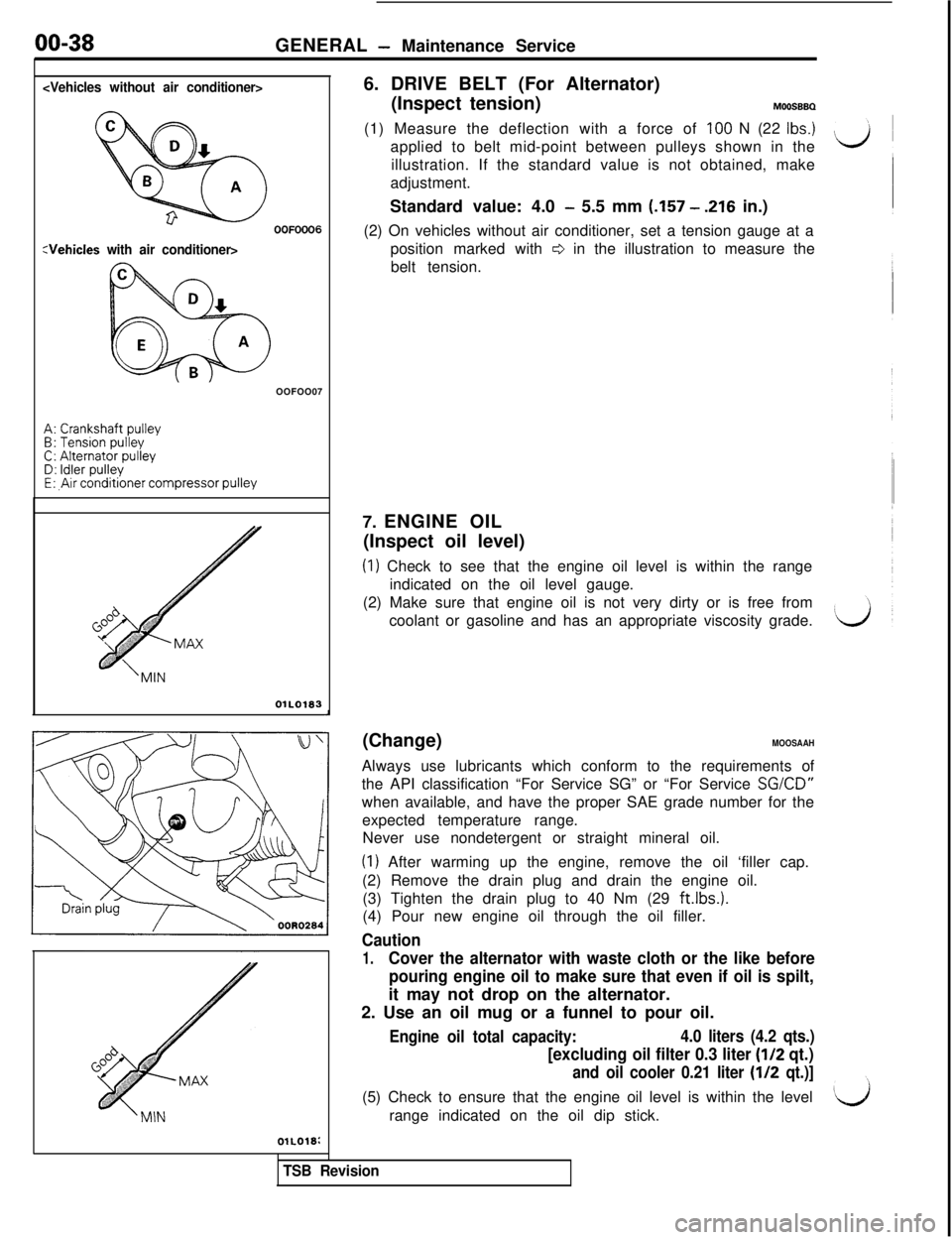
A: Crankshaft pulleyB: Tension pulleyC: Alternator pulleyD: Idler pulleyE: ,Air conditioner compressor pulley
OlLO183
OlLO18:(Inspect tension)
MOOS88(1(1) Measure the deflection with a force of
100 N (22 Ibs.)applied to belt mid-point between pulleys shown in the
illustration. If the standard value is not obtained, make
adjustment.
Standard value: 4.0
- 5.5 mm (.157 - 216 in.)
(2) On vehicles without air conditioner, set a tension gauge at a
position marked with
r3 in the illustration to measure the
belt tension.
7. ENGINE OIL
(Inspect oil level)
(I) Check to see that the engine oil level is within the range
indicated on the oil level gauge.
(2) Make sure that engine oil is not very dirty or is free from
coolant or gasoline and has an appropriate viscosity grade.J
(Change)
MOOSAAHAlways use lubricants which conform to the requirements of
the API classification “For Service SG” or “For Service
SGKD”when available, and have the proper SAE grade number for the
expected temperature range.
Never use nondetergent or straight mineral oil.
(1) After warming up the engine, remove the oil ‘filler cap.
(2) Remove the drain plug and drain the engine oil.
(3) Tighten the drain plug to 40 Nm (29 ft.lbs.).
(4) Pour new engine oil through the oil filler.
Caution
1.Cover the alternator with waste cloth or the like before
pouring engine oil to make sure that even if oil is spilt,it may not drop on the alternator.
2. Use an oil mug or a funnel to pour oil.
Engine oil total capacity:4.0 liters (4.2 qts.)
[excluding oil filter 0.3 liter (l/2 qt.)
and oil cooler 0.21 liter (l/2 qt.)](5) Check to ensure that the engine oil level is within the level
range indicated on the oil dip stick.
TSB Revision
Page 45 of 1146
GENERAL - Maintenance Service00-41
Good
t-lVA0283
I04FOOOd(4) Check the oil filter for clogging and damage and replace if
necessary.
(5) Clean drain plug and tighten drain plug with gasket to 30
-35 Nm (22
- 25 ft.lbs.).
(6) Clean both gasket surfaces of transaxle case and oil pan.
(7) Install oil pan with new gasket and tighten oil pan bolts to
10 - 12 Nm (7.5 - 8.5 ft.lbs.).
(8) Pour 4.5 liters (4.8 qts.) of specified ATF into case through
dipstick hole. [Total quantity of ATF required is approx. 7.5
liters (7.9 qts.). Actually however, approx. 4.5 liters (4.8 qts.)
of fluid can be replaced because rest of fluid remains in
torque converter.]
Specified fluid: Dia ATF SP or MITSUBISHI PLUS ATF or
equivalent(9) Start engine and allow to idle for at least two minutes.
Then, with parking brake on, move selector lever momen-
tarily to each position, ending in “N” Neutral position.
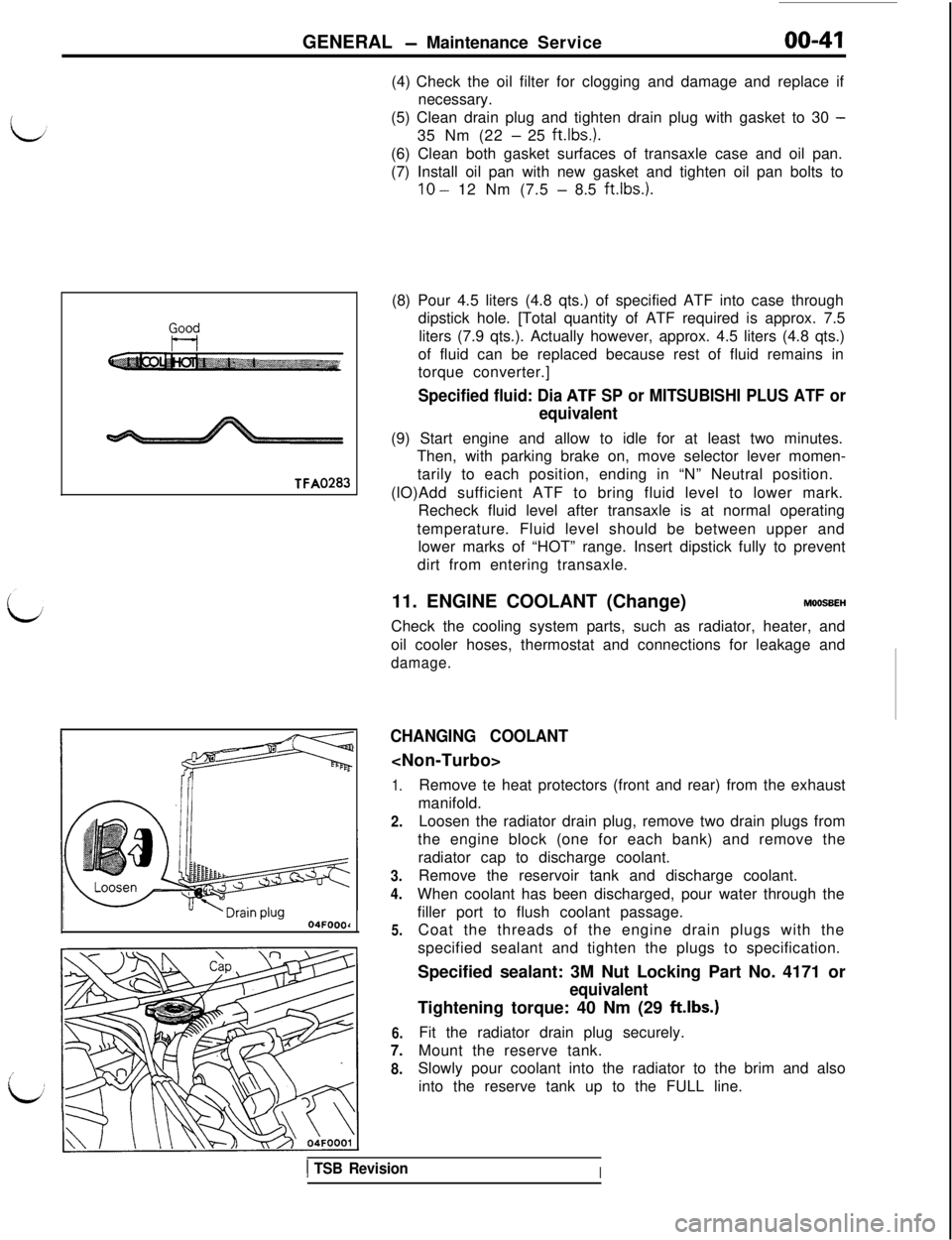
(lO)Add sufficient ATF to bring fluid level to lower mark.
Recheck fluid level after transaxle is at normal operating
temperature. Fluid level should be between upper and
lower marks of “HOT” range. Insert dipstick fully to prevent
dirt from entering transaxle.
11. ENGINE COOLANT (Change)
MOOSBEHCheck the cooling system parts, such as radiator, heater, and
oil cooler hoses, thermostat and connections for leakage and
damage.
CHANGING COOLANT
1.
2.
3.
4.
5.
6.
7.
8.Remove te heat protectors (front and rear) from the exhaust
manifold.
Loosen the radiator drain plug, remove two drain plugs from
the engine block (one for each bank) and remove the
radiator cap to discharge coolant.
Remove the reservoir tank and discharge coolant.
When coolant has been discharged, pour water through the
filler port to flush coolant passage.
Coat the threads of the engine drain plugs with the
specified sealant and tighten the plugs to specification.
Specified sealant: 3M Nut Locking Part No. 4171 or
equivalentTightening torque: 40 Nm (29
ftlbs.)Fit the radiator drain plug securely.
Mount the reserve tank.
Slowly pour coolant into the radiator to the brim and also
into the reserve tank up to the FULL line.
1 TSB RevisionI
Page 301 of 1146
COOLING - Service Adiustment Procedures.14-7
SERVICE ADJUSTMENT PROCEDURES
ENGINE COOLANT LEAK CHECKMl4FAAF
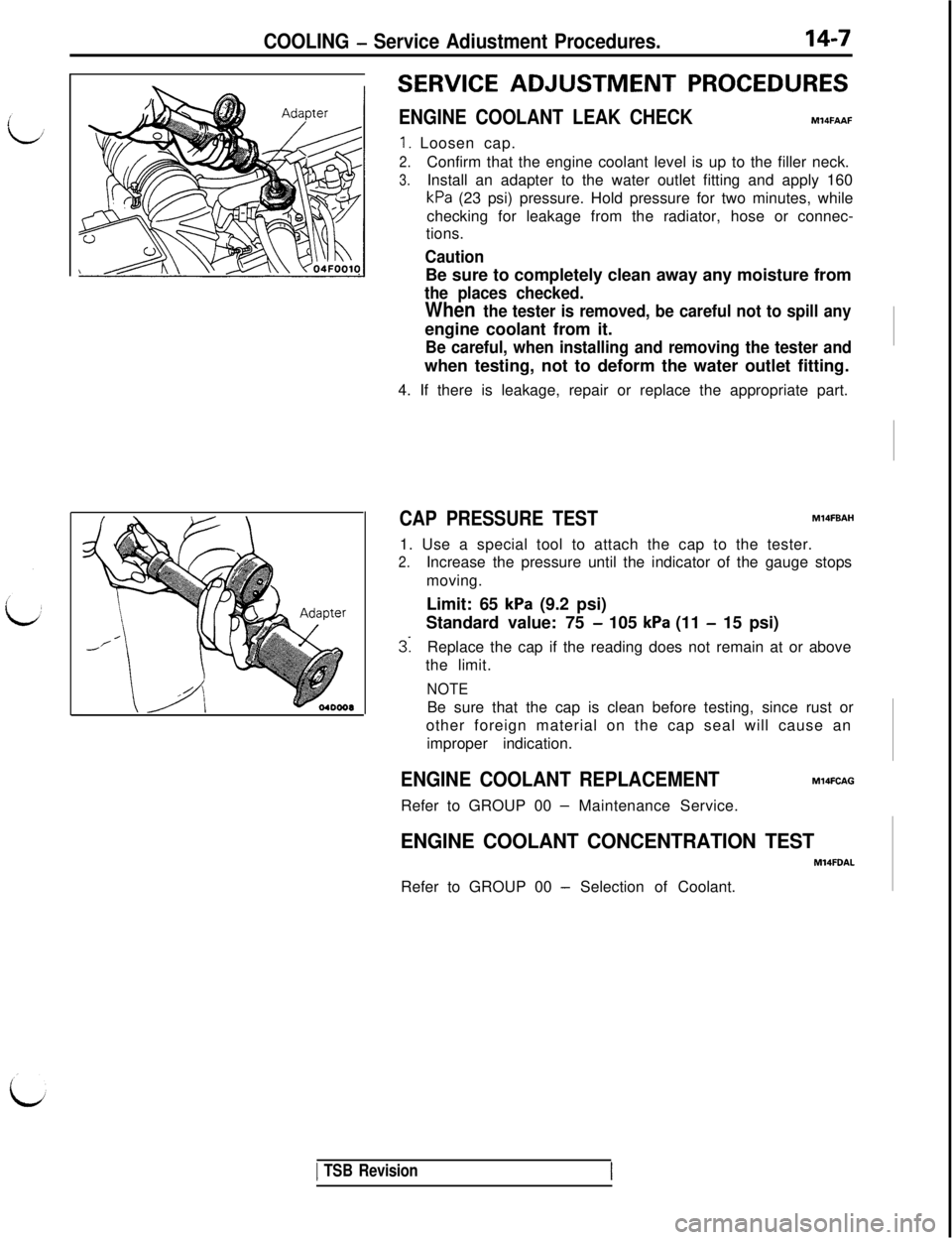
1. Loosen cap.
2.Confirm that the engine coolant level is up to the filler neck.
3.Install an adapter to the water outlet fitting and apply 160
kPa (23 psi) pressure. Hold pressure for two minutes, while
checking for leakage from the radiator, hose or connec-
tions.
CautionBe sure to completely clean away any moisture from
the places checked.
When the tester is removed, be careful not to spill anyengine coolant from it.
Be careful, when installing and removing the tester andwhen testing, not to deform the water outlet fitting.
4. If there is leakage, repair or replace the appropriate part.
CAP PRESSURE TESTM14FBAH1. Use a special tool to attach the cap to the tester.
2.Increase the pressure until the indicator of the gauge stops
moving.
Limit: 65
kPa (9.2 psi)
Standard value: 75
- 105 kPa (11 - 15 psi)
3:Replace the cap if the reading does not remain at or above
the limit.
NOTEBe sure that the cap is clean before testing, since rust or
other foreign material on the cap seal will cause an
improper indication.
ENGINE COOLANT REPLACEMENTM14FCAGRefer to GROUP 00
- Maintenance Service.
ENGINE COOLANT CONCENTRATION TEST
M14FDALRefer to GROUP 00
- Selection of Coolant.
1 TSB Revision
Page 495 of 1146
AUTOMATIC TRANSAXLE - Troubleshootinn23-43
CONVERTER STALL TESTStall test consist of determining maximum engine
speed obtained at full throttle in “D” and
“I?”positions. This test checks torque converter
statoroverrunning clutch operation, and holding ability of
transaxle clutches and low-reverse brake.
Caution
During this test, make sure that no one stand in
front of or behind vehicle.
1. Check transaxle fluid level. Fluid should be at
normal operating temperature
[70 - 80°C (160 -
18O”F)I. Engine coolant should also be at normal
operating temperature
[80 - 90°C (180 - 19O”F)l.2. Apply chocks to both rear wheels.
3. Attach engine tachometer.
4. Apply parking and service brakes fully.
5. Start engine.
6. With selector lever in “D” position, depress
accelerator pedal fully to read engine maximum
rpm. Do not hold throttle wide open any longer
than is necessary to obtain maximum engine
rpm reading, and never longer than 5 seconds at
a time. If more than one stall test is required,
operate engine at approximately 1,000 rpm in
neutral for 2 minutes to cool transaxle fluid
between tests.
Stall speed: 2,200
- 3,200 rpm
7.Place selector lever to “R” position and perform
stall test by the same procedure as in foregoing
item.
Stall Speed Above Specification in “D”
If stall speed is higher than specification, rear clutch
or overrunning clutch of transaxle is slipping. In this
case, perform hydraulic test to locate cause of
slippage.
Stall Speed Above Specification in “R”
If stall speed is higher than specification, front
clutch of transaxle or low-reverse brake is slipping.
In this case, perform hydraulic test to locate cause
of slippage.
Stall Speed Below Specification in “D” and “R”
If stall speed is lower than specification, insufficient
engine output or faulty torque converter is sus-
pected. Check for engine misfiring, ignition timing,
valve clearance, etc. If these are good, torque
converter is faulty.
TRANSAXLE CONTROL
Symptom
Selector lever operationis stiff
Probable cause
Incorrect adjustment of sleeve
Remedy
Adjust
Incorrect adjustment of control cable
Excessive wear of detent plate
Worn contact surfaces of pushbutton
and sleeve
Adjust
Replace
Replace
Starter motor does notMalfunction in inhibitor switchReplace
operate with the selector
lever in the “N” or “P”Incorrect adjustment of control cableAdjust
position
Will not shift to
4-speed
Malfunction of starter relay
Malfunction of OD switchReplace
Replace
1 TSB RevisionI