key MITSUBISHI 3000GT 1991 User Guide
[x] Cancel search | Manufacturer: MITSUBISHI, Model Year: 1991, Model line: 3000GT, Model: MITSUBISHI 3000GT 1991Pages: 1146, PDF Size: 76.68 MB
Page 416 of 1146
22-36MANUAL TRANSAXLE
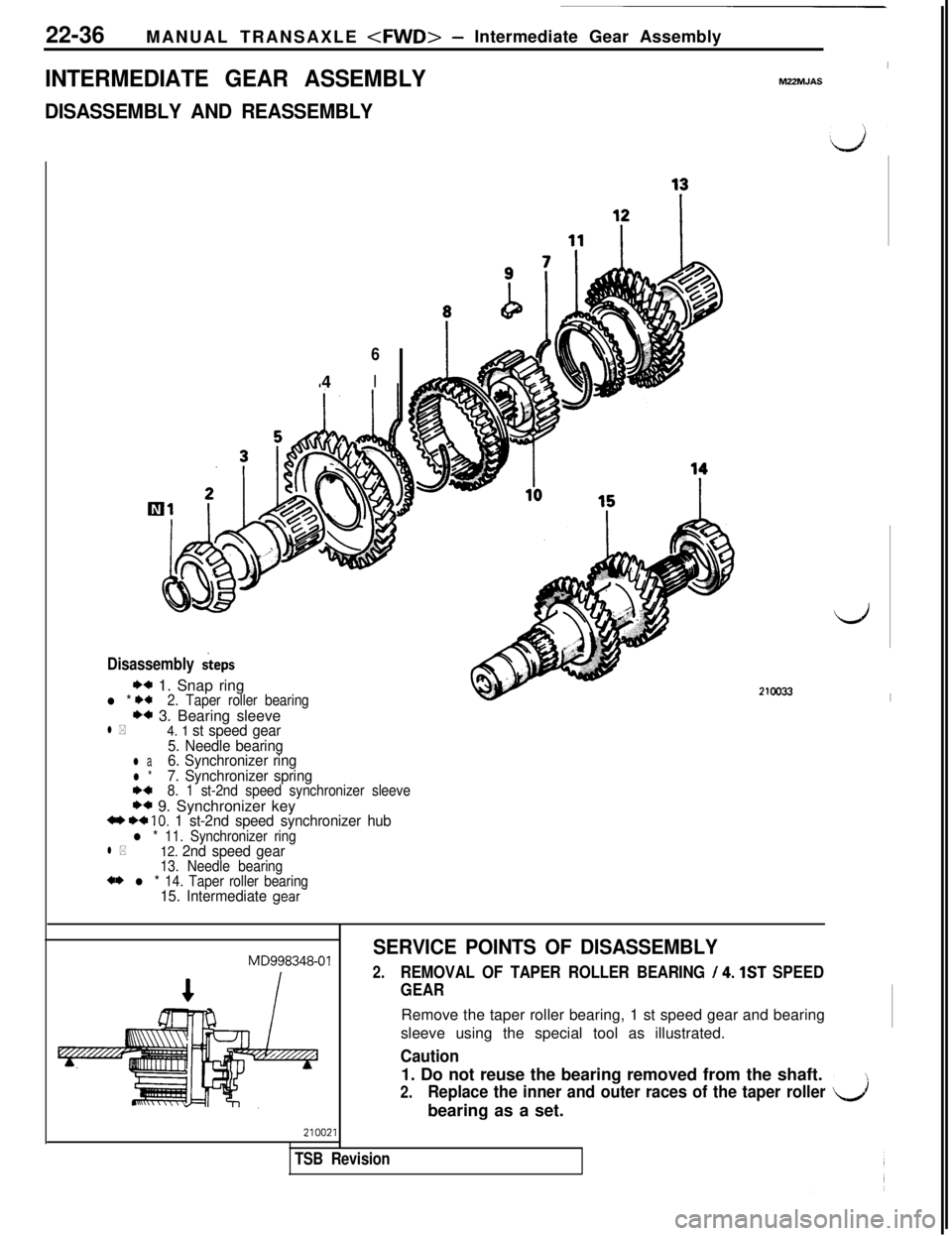
INTERMEDIATE GEAR ASSEMBLY
IMZZMJAS
DISASSEMBLY AND REASSEMBLY
64
I
Disassembly steps
I)* 1. Snap ringl * **2. Taper roller bearing
** 3. Bearing sleevel *4. 1 st speed gear
5. Needle bearing
l a6. Synchronizer ring
l **C7. Synchronizer spring8. 1 st-2nd speed synchronizer sleeve
I)* 9. Synchronizer key*I) I)+ IO. 1 st-2nd speed synchronizer hubl * 11. Synchronizer ringl *12. 2nd speed gear13. Needle bearing** l * 14. Taper roller bearing
d
I
15. Intermediate gear-
MD998348-01
TSB Revision
SERVICE POINTS OF DISASSEMBLY
2.REMOVAL OF TAPER ROLLER BEARING / 4.1ST SPEED
GEARRemove the taper roller bearing, 1 st speed gear and bearing
sleeve using the special tool as illustrated.
Caution1. Do not reuse the bearing removed from the shaft.
2.Replace the inner and outer races of the taper rollerbearing as a set.d
Page 418 of 1146
22-38
MANUAL TRANSAXLE
Damage and breakage
TFMOllE
Syndhronizer ringGAarTFMOll:201045
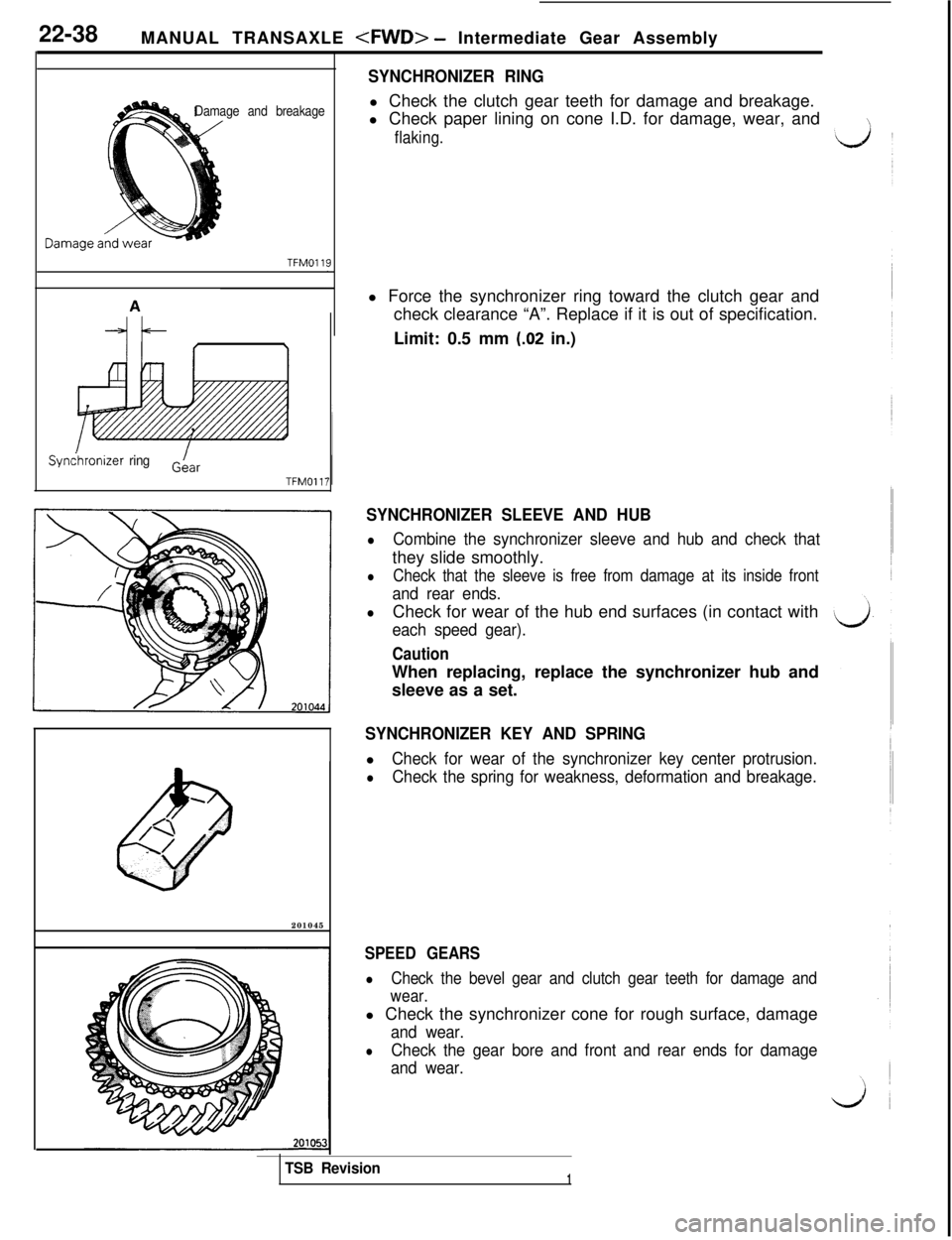
SYNCHRONIZER RINGl Check the clutch gear teeth for damage and breakage.
l Check paper lining on cone I.D. for damage, wear, and
flaking.l Force the synchronizer ring toward the clutch gear and
check clearance “A”. Replace if it is out of specification.
Limit: 0.5 mm
(.02 in.)
SYNCHRONIZER SLEEVE AND HUB
lCombine the synchronizer sleeve and hub and check thatthey slide smoothly.
lCheck that the sleeve is free from damage at its inside front
and rear ends.
lCheck for wear of the hub end surfaces (in contact with
each speed gear).
CautionWhen replacing, replace the synchronizer hub and
sleeve as a set.
SYNCHRONIZER KEY AND SPRINGl
Check for wear of the synchronizer key center protrusion.
lCheck the spring for weakness, deformation and breakage.
SPEED GEARS
lCheck the bevel gear and clutch gear teeth for damage and
wear.l Check the synchronizer cone for rough surface, damage
and wear.
lCheck the gear bore and front and rear ends for damage
and wear.
TSB Revision
1
Page 419 of 1146
MANUAL TRANSAXLE
22-39
/
MD998350-01
Identificationmark
Front +
Identi-
fication
markSERVICE POINTS OF REASSEMBLY
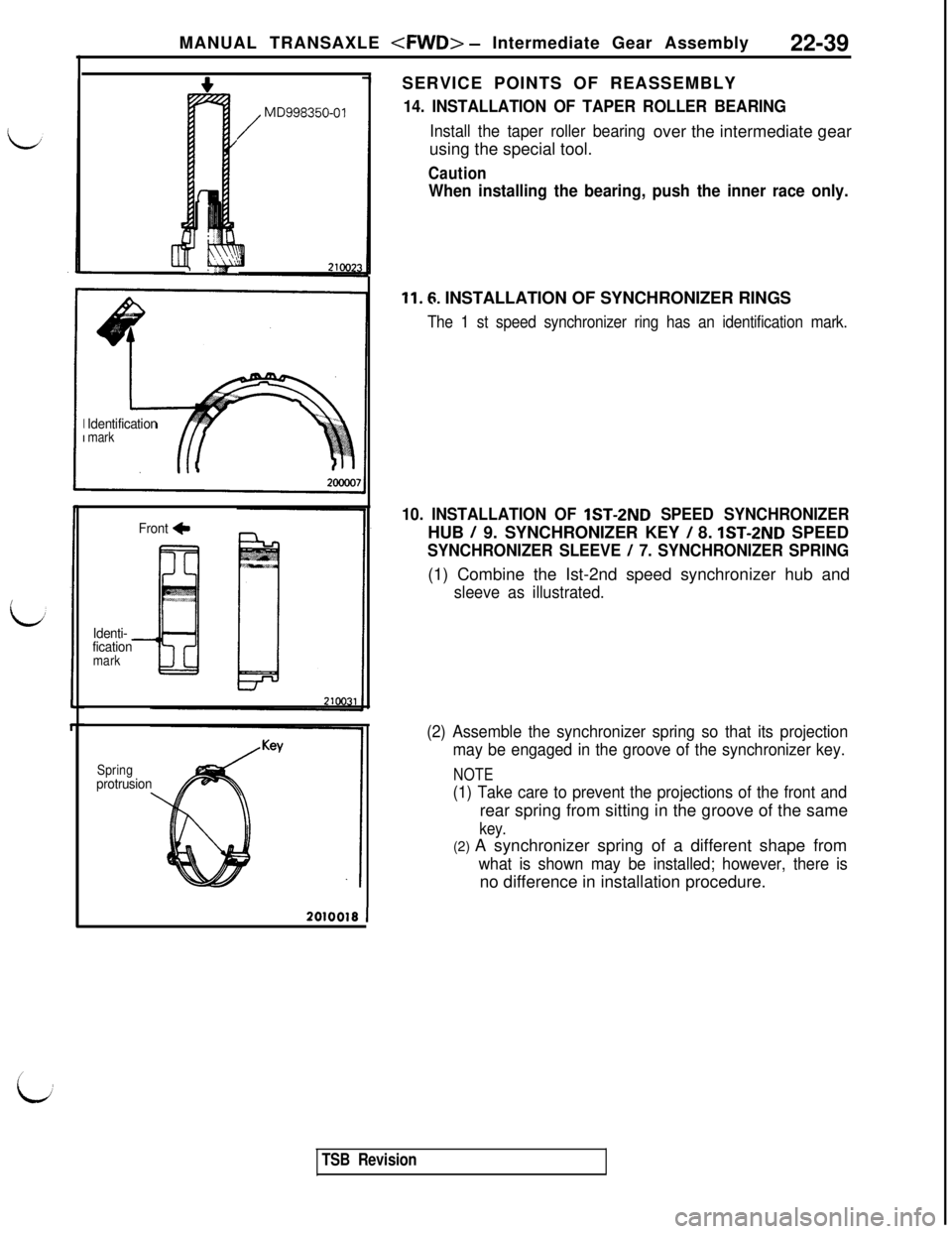
14. INSTALLATION OF TAPER ROLLER BEARING
Install the taper roller bearingusing the special tool.over the intermediate gear
Caution
When installing the bearing, push the inner race only.
Springprotrusion11.8. INSTALLATION OF SYNCHRONIZER RINGS
The 1 st speed synchronizer ring has an identification mark.
10. INSTALLATION OF lST-2ND SPEED SYNCHRONIZERHUB
/ 9. SYNCHRONIZER KEY / 8. lST-2ND SPEED
SYNCHRONIZER SLEEVE / 7. SYNCHRONIZER SPRING(1) Combine the Ist-2nd speed synchronizer hub and
sleeve as illustrated.
(2) Assemble the synchronizer spring so that its projection
may be engaged in the groove of the synchronizer key.
NOTE
(1) Take care to prevent the projections of the front andrear spring from sitting in the groove of the same
key.(2) A synchronizer spring of a different shape from
what is shown may be installed; however, there isno difference in installation procedure.
i
TSB Revision
Page 420 of 1146
22-40
MANUAL TRANSAXLE
MD998350-01
/
1 st-2ndspeedsynchronizer
assembly
MD998348-012100022
MD998350-01
1st speed
gear
20106
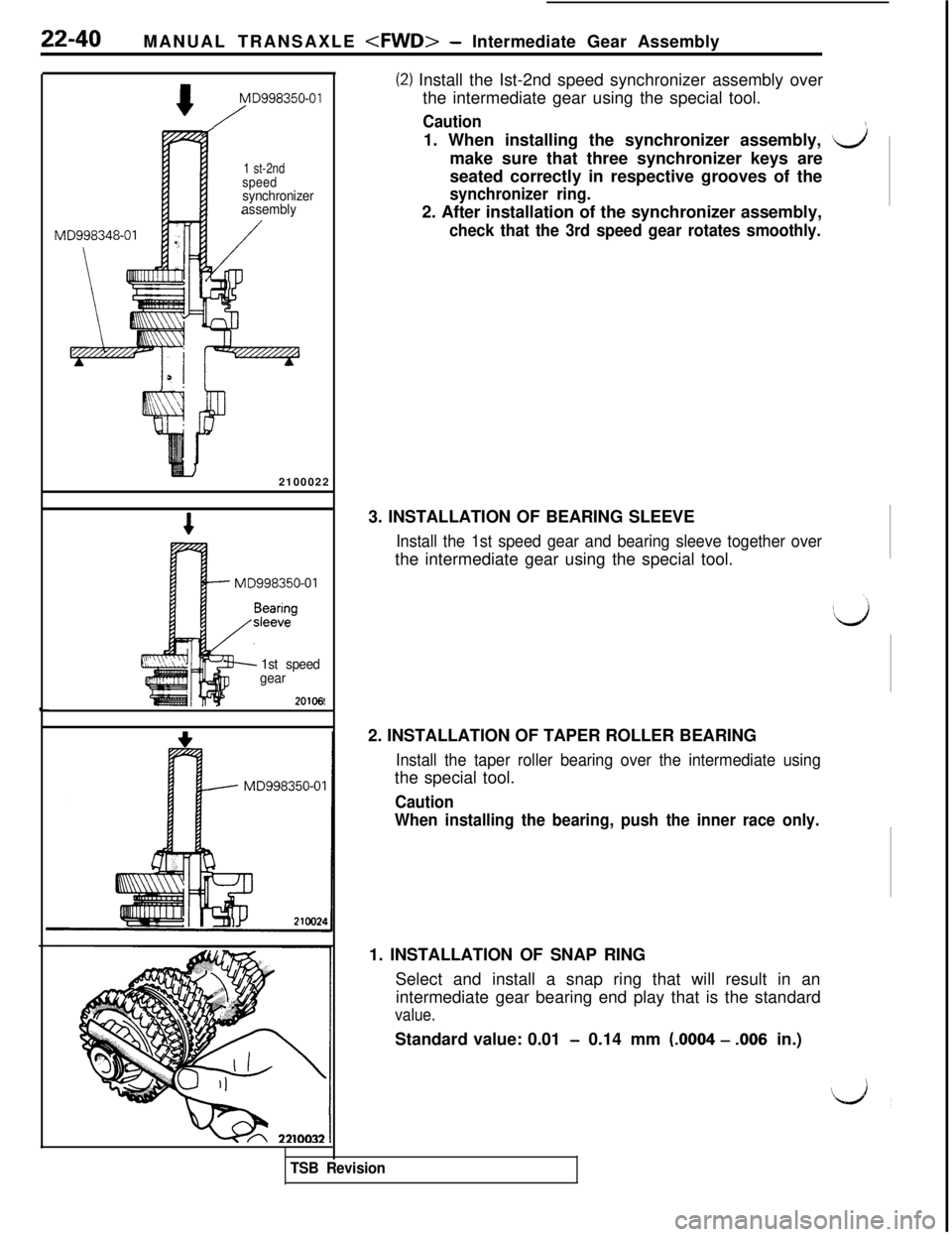
(2) Install the Ist-2nd speed synchronizer assembly over
the intermediate gear using the special tool.
Caution1. When installing the synchronizer assembly,
L/:make sure that three synchronizer keys are
seated correctly in respective grooves of the
synchronizer ring.2. After installation of the synchronizer assembly,
check that the 3rd speed gear rotates smoothly.3. INSTALLATION OF BEARING SLEEVE
Install the 1st speed gear and bearing sleeve together overthe intermediate gear using the special tool.
2. INSTALLATION OF TAPER ROLLER BEARING
Install the taper roller bearing over the intermediate usingthe special tool.
Caution
When installing the bearing, push the inner race only.1. INSTALLATION OF SNAP RING
Select and install a snap ring that will result in an
intermediate gear bearing end play that is the standard
value.Standard value: 0.01
- 0.14 mm (.0004 - .006 in.)
TSB Revision
Page 443 of 1146
23-1
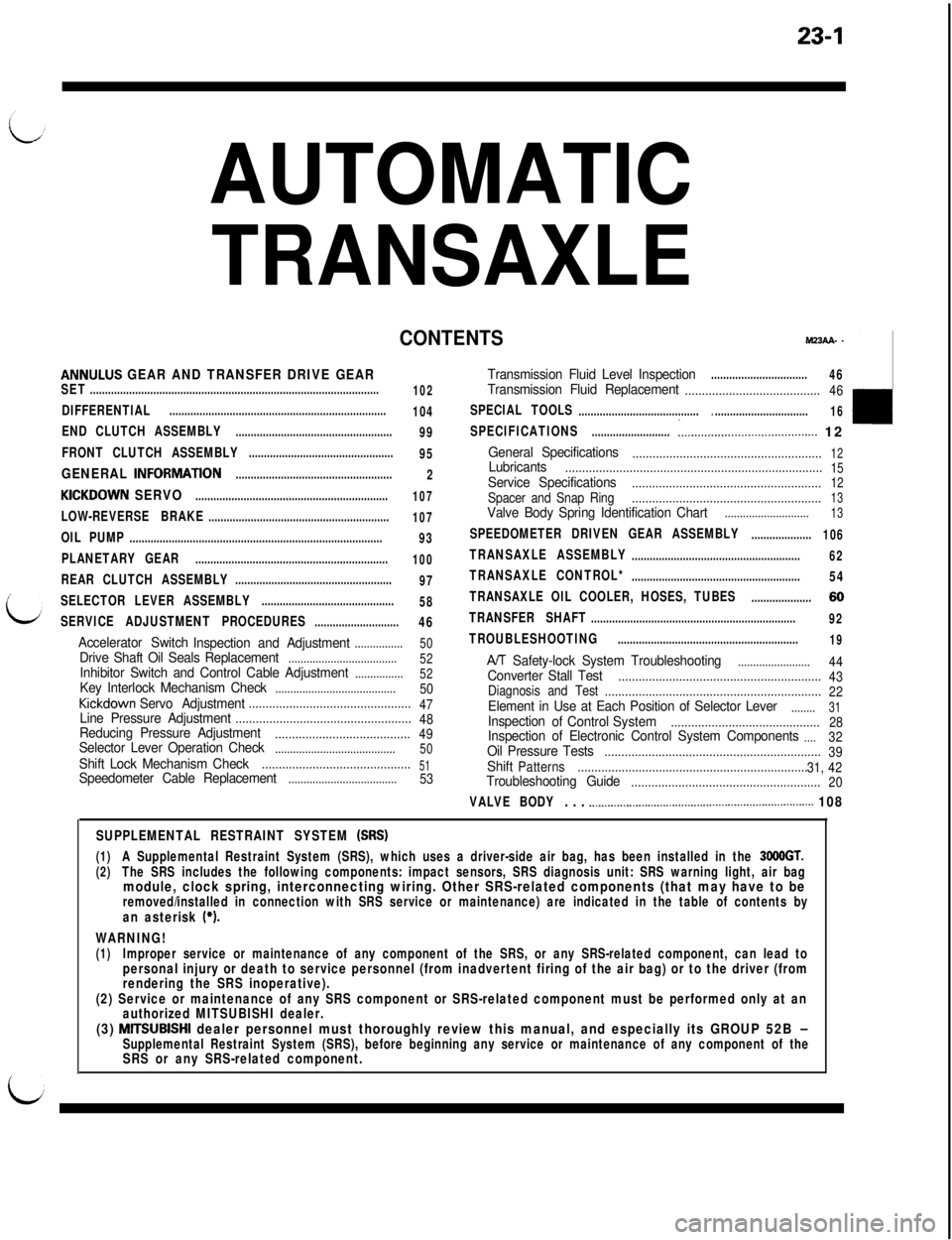
AUTOMATIC
TRANSAXLE
CONTENTSMZJAA- _
ANNULUS GEAR AND TRANSFER DRIVE GEARTransmission Fluid Level Inspection................................46SET................................................................................................
102Transmission Fluid Replacement........................................
46
DIFFERENTIAL........................................................................104SPECIAL TOOLS........................................................................
16
:......................................... 12IEND CLUTCH ASSEMBLY....................................................99SPECIFICATIONS..........................
FRONT CLUTCH ASSEMBLY................................................95
GENERAL INFORMATlON....................................................2
KICKDOWN SERVO................................................................
107
LOW-REVERSE BRAKE............................................................
107
OIL PUMP....................................................................................93
PLANETARY GEAR................................................................
100
REAR CLUTCH ASSEMBLY....................................................97
SELECTOR LEVER ASSEMBLY............................................58
SERVICE ADJUSTMENT PROCEDURES............................46
Accelerator Switch
Inspection and Adjustment................
50Drive Shaft Oil Seals Replacement....................................
52Inhibitor Switch and Control Cable Adjustment................
52Key Interlock Mechanism Check........................................50KickdownServo Adjustment................................................
47Line Pressure Adjustment....................................................
48Reducing Pressure Adjustment........................................
49Selector Lever Operation Check........................................
50Shift Lock Mechanism Check............................................51Speedometer Cable Replacement....................................53
General Specifications........................................................12Lubricants............................................................................15Service Specifications........................................................12Spacer and Snap Ring........................................................13Valve Body Spring Identification Chart............................13
SPEEDOMETER DRIVEN GEAR ASSEMBLY....................106
TRANSAXLE ASSEMBLY........................................................62
TRANSAXLE CONTROL*........................................................54
TRANSAXLE OIL COOLER, HOSES, TUBES
....................66
TRANSFER SHAFT....................................................................92
TROUBLESHOOTING............................................................
19
A/T Safety-lock System Troubleshooting........................44Converter Stall Test............................................................
43
Diagnosis and Test
................................................................
22
Element in Use at Each Position of Selector Lever........31Inspection
of ControlSystem............................................
28Inspection of Electronic Control System Components....32Oil Pressure Tests................................................................
39ShiftPatterns....................................................................
31,42Troubleshooting Guide........................................................
20
VALVE BODY. . . .._._.................................................................... 108
SUPPLEMENTAL RESTRAINT SYSTEM (SRS)
(1)A Supplemental Restraint System (SRS), which uses a driver-side air bag, has been installed in the 3668GT.(2)The SRS includes the following components: impact sensors, SRS diagnosis unit: SRS warning light, air bagmodule, clock spring, interconnecting wiring. Other SRS-related components (that may have to beremoved/installed in connection with SRS service or maintenance) are indicated in the table of contents byan asterisk (*).
WARNING!(1)Improper service or maintenance of any component of the SRS, or any SRS-related component, can lead topersonal injury or death to service personnel (from inadvertent firing of the air bag) or to the driver (from
rendering the SRS inoperative).
(2) Service or maintenance of any SRS component or SRS-related component must be performed only at an
authorized MITSUBISHI dealer.
(3) MlTSUBISHI dealer personnel must thoroughly review this manual, and especially its GROUP 52B -Supplemental Restraint System (SRS), before beginning any service or maintenance of any component of the
ISRS or any SRS-related component.
Page 474 of 1146
![MITSUBISHI 3000GT 1991 User Guide 23-22AUTOMATIC TRANSAXLE - Troubleshooting
0”
TM362
DIAGNOSIS AND TEST
FLUID LEVEL AND CONDITION
1.Drive until the fluid temperature reaches the usual tempera-
ture
[70 - 80°C (160 - 18O”F)].2.](/img/19/57085/w960_57085-473.png "MITSUBISHI 3000GT 1991 User Guide 23-22AUTOMATIC TRANSAXLE - Troubleshooting
0”
TM362
DIAGNOSIS AND TEST
FLUID LEVEL AND CONDITION
1.Drive until the fluid temperature reaches the usual tempera-
ture
[70 - 80°C (160 - 18O”F)].2.")
23-22AUTOMATIC TRANSAXLE - Troubleshooting
0”
TM362
DIAGNOSIS AND TEST
FLUID LEVEL AND CONDITION
1.Drive until the fluid temperature reaches the usual tempera-
ture
[70 - 80°C (160 - 18O”F)].2. Place vehicle on level floor.
3. Move selector lever sequentially to every position to fill
torque converter and hydraulic circuit with fluid, then place
lever in “N” Neutral position. This operation is necessary to
be sure that fluid level check is accurate.
4. Before removing dipstick, wipe all dirt from area around
dipstick. Then take out the dipstick and check the condition
of the fluid.
The transaxle should be overhauled under the following
conditions.
l If there is a “burning” odor.
l If the fluid color has become noticeably blacker.
lIf there is a noticeably great amount of metal particles in
the fluid.
5.Check to see if fluid level is in “HOT” range on dipstick. If
fluid level is low, add automatic transaxle fluid until level
reaches “HOT” range.
Low fluid level can cause a variety of conditions because it
allows pump to take in air along with fluid. Air trapped in
hydraulic circuit forms bubbles which make fluid spongy.
Therefore, pressures will be erratic.
Improper filling can also raise fluid level too high. When
transaxle has too much fluid, gears churn up foam and
cause same conditions which occur with low fluid level,
resulting in accelerated deterioration of automatic transaxle
fluid.
dIn either case, air bubbles can cause overheating, fluid
oxidation, which can interfere with normal valve, clutch, and
servo operation. Foaming can also result in fluid escaping
from transaxle vent where it may be mistaken for a leak.
6. Be sure to examine fluid on dipstick closely.
,CONTROL CABLEWhether control cable is properly adjusted can be confirmed by
checking whether inhibitor switch is performing well.
1. Apply parking brakes and service brakes securely.
2. Place selector lever to “R” range.
3. Set ignition key to “ST” position.
4. Slowly move the selector lever upward until it clicks as it
fits in notch of “P” range. If starter motor operates when
lever makes a click, “P” position is correct.
5.Then slowly move selector lever to “N” range by the same
procedure as in foregoing paragraph. If starter motor
operates when selector lever fits in
“N”, “N” position is
correct.
6. Also check to be sure the vehicle doesn’t begin to move
and the lever doesn’t stop between P-R-N-D.
7. The control cable is properly adjusted if, as described
above, the starter motor starts at both the “P” range and
the “N” range.
TSB Revision
Page 475 of 1146
AUTOMATIC TRANSAXLE - Troubleshootina23-23
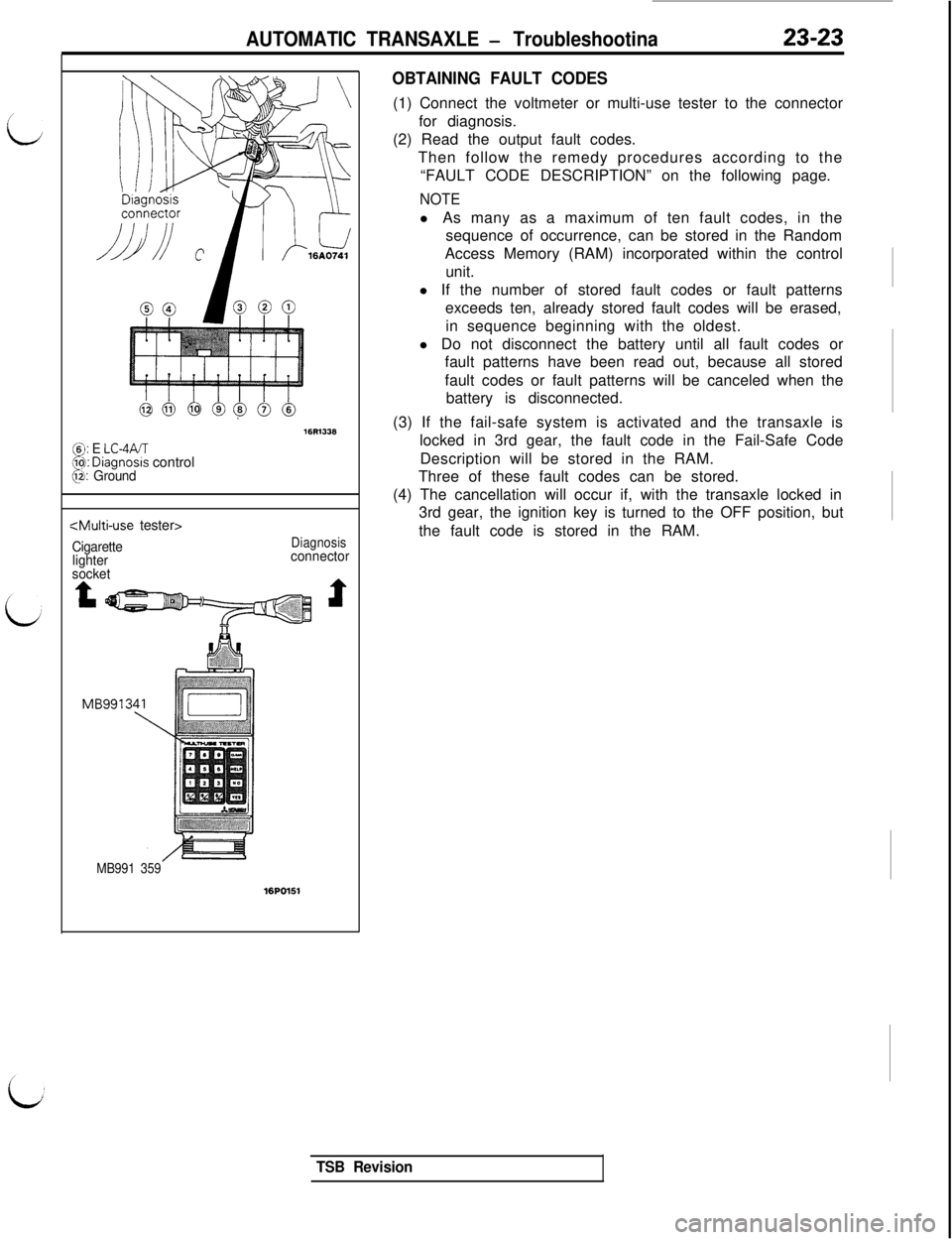
p: E LC-4A/T~9: Dlagnosls control@I: Ground
:Multi-use tester>
Cigarette
lighter
socketDiagnosisconnector
MB991 359
16POl51
OBTAINING FAULT CODES(1) Connect the voltmeter or multi-use tester to the connector
for diagnosis.
(2) Read the output fault codes.
Then follow the remedy procedures according to the
“FAULT CODE DESCRIPTION” on the following page.
NOTEl As many as a maximum of ten fault codes, in the
sequence of occurrence, can be stored in the Random
Access Memory (RAM) incorporated within the control
unit.
l If the number of stored fault codes or fault patterns
exceeds ten, already stored fault codes will be erased,
in sequence beginning with the oldest.
l Do not disconnect the battery until all fault codes or
fault patterns have been read out, because all stored
fault codes or fault patterns will be canceled when the
battery is disconnected.
(3) If the fail-safe system is activated and the transaxle is
locked in 3rd gear, the fault code in the Fail-Safe Code
Description will be stored in the RAM.
Three of these fault codes can be stored.
(4) The cancellation will occur if, with the transaxle locked in
3rd gear, the ignition key is turned to the OFF position, but
the fault code is stored in the RAM.
TSB Revision
Page 496 of 1146
23-44AUTOMATIC TRANSAXLE - Troubleshootina
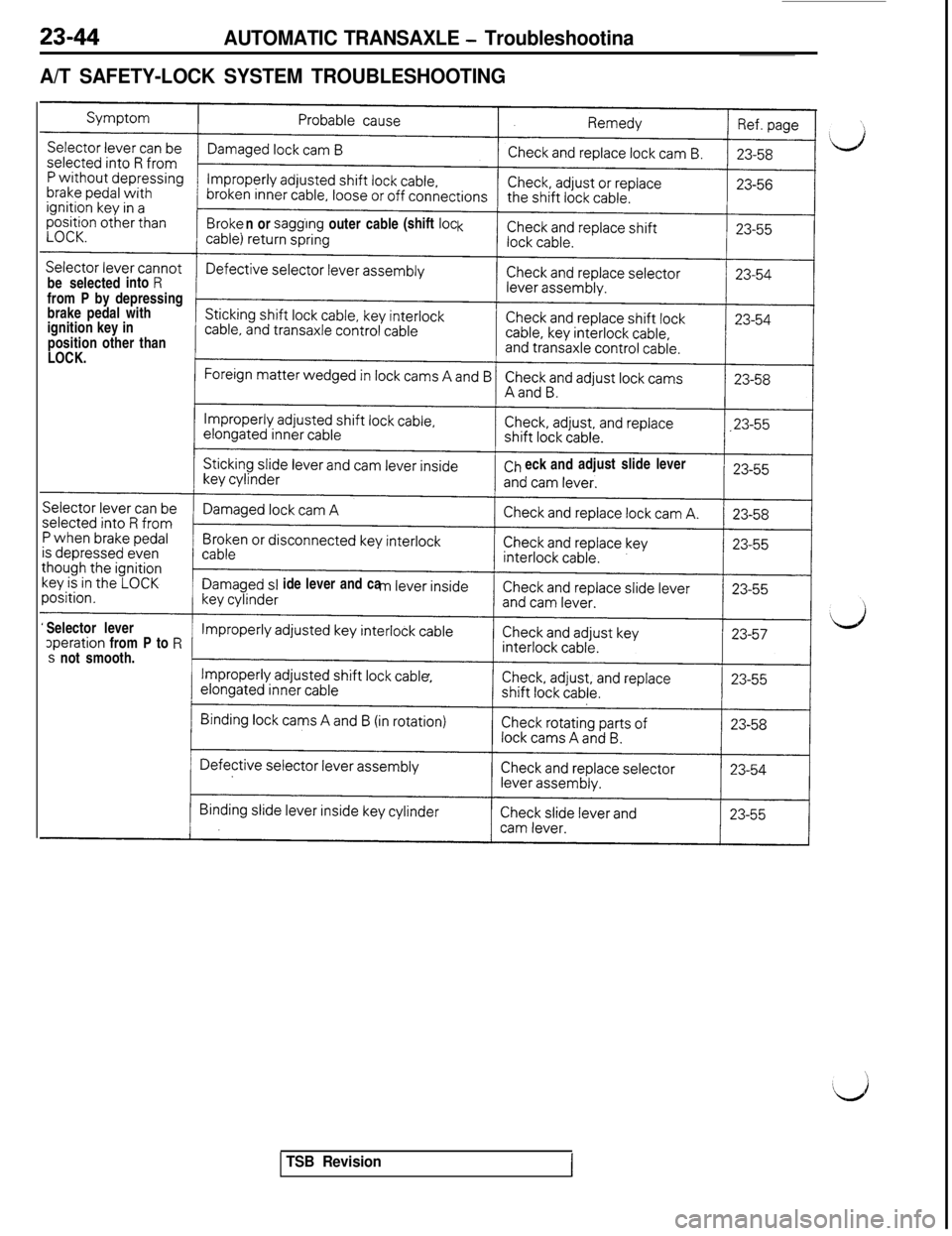
A/T SAFETY-LOCK SYSTEM TROUBLESHOOTINGbe selectedinto
Rfrom P by depressing
brake pedal with
ignition key in
position other than
LOCK.n or sagging outer cable(shift
loteck andadjust slide lever
ide lever and ca
Selector lever
Iperation from P to Rs not smooth.
TSB Revision
Page 497 of 1146
AUTOMATIC TRANSAXLE - Troubleshooting23-45Symptom
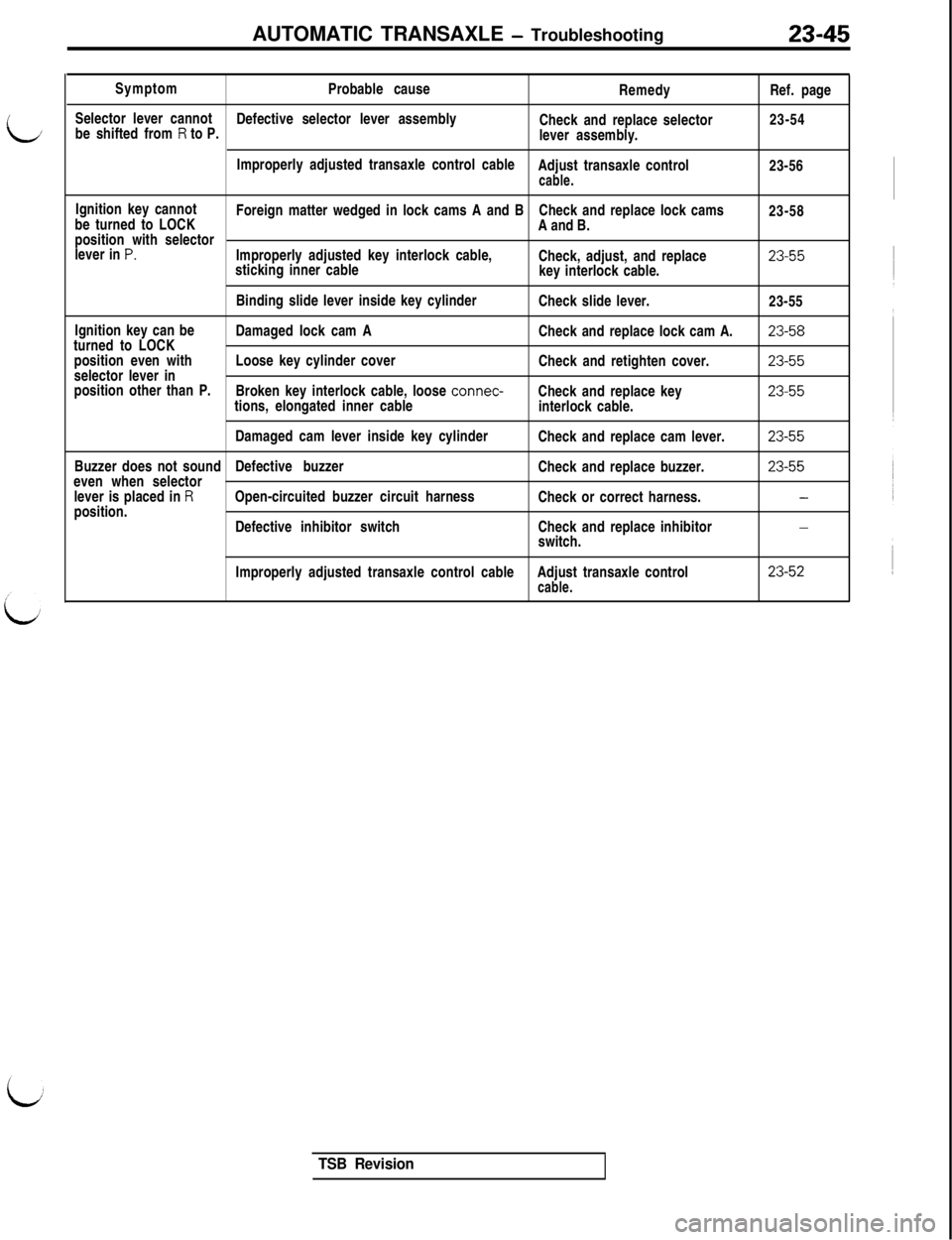
Probable cause
RemedyRef. page
Selector lever cannot
be shifted from
R to P.Defective selector lever assembly
Check and replace selector23-54
lever assembly.
Improperly adjusted transaxle control cable
Adjust transaxle control
23-56
cable.Ignition key cannot
Foreign matter wedged in lock cams A and B
23-58
be turned to LOCKCheck and replace lock cams
A and B.
position with selector
lever in
P.Improperly adjusted key interlock cable,
sticking inner cableCheck, adjust, and replace213-55key interlock cable.
Binding slide lever inside key cylinder
Check slide lever.
23-55
Ignition key can be
Damaged lock cam A
Check and replace lock cam A.
2:3-58turned to LOCK
position even withLoose key cylinder cover
Check and retighten cover.
2:3-55selector lever in
position other than P.
Broken key interlock cable, loose connec-
Check and replace key
2355tions, elongated inner cable
interlock cable.
Damaged cam lever inside key cylinder
Check and replace cam lever.
2:3-55Buzzer does not soundDefective buzzer
Check and replace buzzer.
2:3-55even when selector
lever is placed in
ROpen-circuited buzzer circuit harness
Check or correct harness.-position.
Defective inhibitor switchCheck and replace inhibitor
-switch.
Improperly adjusted transaxle control cableAdjust transaxle control
2:3-52
cable.
TSB Revision
Page 502 of 1146
23-50AUTOMATIC TRANSAXLE - service AdiustmentProcedures
09FO117
m09FOO19
L Pushbuttonv09FOO61
@ Button pressed (while brakepedal is depressed)c Button not pressed@ Button pressed
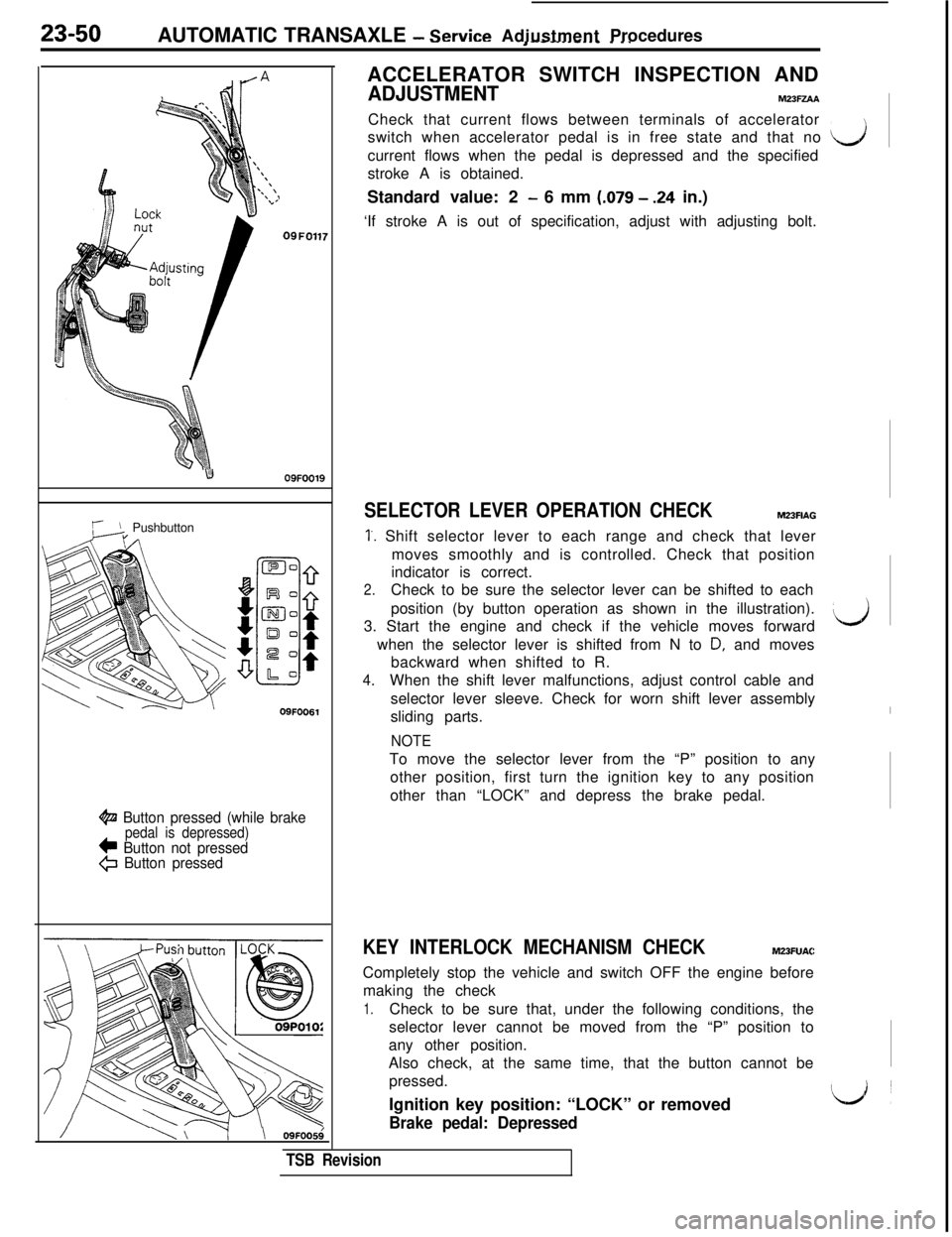
/\ \\ OSFODdACCELERATOR SWITCH INSPECTION AND
ADJUSTMENTM23FZAACheck that current flows between terminals of accelerator
switch when accelerator pedal is in free state and that no
dcurrent flows when the pedal is depressed and the specified
stroke A is obtained.
Standard value: 2
- 6 mm (.079 - .24 in.)
‘If stroke A is out of specification, adjust with adjusting bolt.
SELECTOR LEVER OPERATION CHECKM23FIAG
1.. Shift selector lever to each range and check that lever
moves smoothly and is controlled. Check that position
indicator is correct.
2.Check to be sure the selector lever can be shifted to each
position (by button operation as shown in the illustration).
3. Start the engine and check if the vehicle moves forward
dwhen the selector lever is shifted from N to
D, and moves
backward when shifted to R.
4.When the shift lever malfunctions, adjust control cable and
selector lever sleeve. Check for worn shift lever assembly
sliding parts.
I
NOTETo move the selector lever from the “P” position to any
other position, first turn the ignition key to any position
other than “LOCK” and depress the brake pedal.
KEY INTERLOCK MECHANISM CHECKM23FlJACCompletely stop the vehicle and switch OFF the engine before
making the check
1.Check to be sure that, under the following conditions, the
selector lever cannot be moved from the “P” position to
any other position.
Also check, at the same time, that the button cannot be
pressed.
Ignition key position: “LOCK” or removed
Brake pedal: Depressed
TSB Revision