oil change MITSUBISHI 3000GT 1991 Service Manual
[x] Cancel search | Manufacturer: MITSUBISHI, Model Year: 1991, Model line: 3000GT, Model: MITSUBISHI 3000GT 1991Pages: 1146, PDF Size: 76.68 MB
Page 40 of 1146
00-36GENERAL - Scheduled Maintenance Table / Maintenance Service
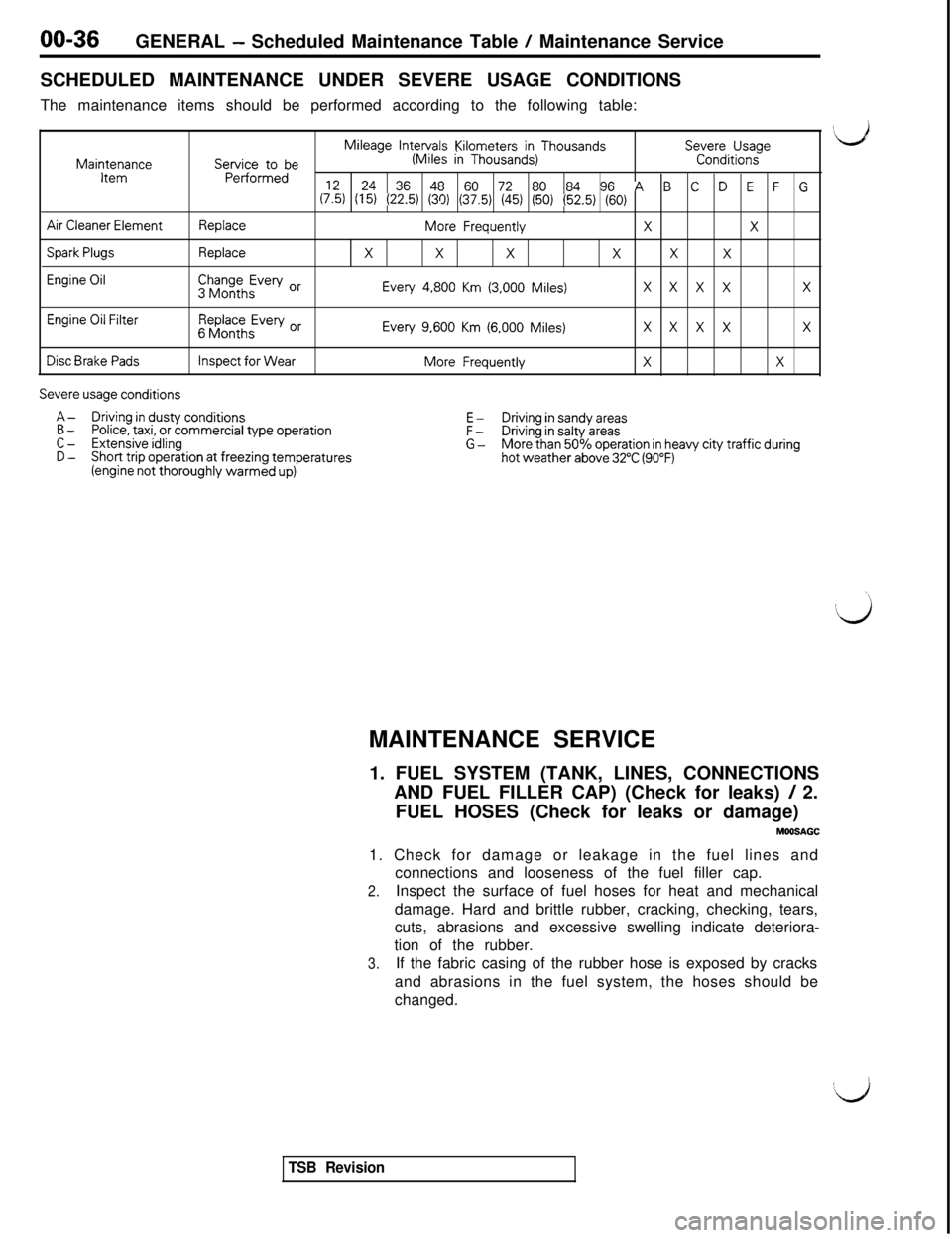
SCHEDULED MAINTENANCE UNDER SEVERE USAGE CONDITIONS
The maintenance items should be performed according to the following table:
Mileage Intervals Kilometers in ThousandsSevere Usage
MaintenanceService to be(Miles in Thousands)Conditions
itemPerformed
(6 (15) (22.5) (30) (37.5) (45) (50) (52.5) (60)24 36 48 60 72 80 84 96 A B C D E F G
Air Cleaner ElementReplaceMore FrequentlyXX
Spark PlugsReplaceXXXXXX
Engine OilChange Every Or3 MonthsEvery 4,800 Km (3,000 Miles)x x x xX
Engine Oil FilterReplace Every or6 MonthsEvery 9,600 Km (6.000 Miles)x x x xX
Disc Brake PadsInspect for WearMore FrequentlyXX
Severe usage conditions
A-Driving in dusty conditionsE -B -Police, taxi, or commercial type operationF -Driving in sandy areas
C -Extensive idlingG -Driving in salty areas
D -Short trip operation at freezing temperaturesMore than 50% operation in heavy city traffic during
(engine not thoroughly warmed up)hot weather above 32°C (90°F)MAINTENANCE SERVICE
1. FUEL SYSTEM (TANK, LINES, CONNECTIONS
AND FUEL FILLER CAP) (Check for leaks)
/ 2.
FUEL HOSES (Check for leaks or damage)MWShGC
1. Check for damage or leakage in the fuel lines and
connections and looseness of the fuel filler cap.
2.Inspect the surface of fuel hoses for heat and mechanical
damage. Hard and brittle rubber, cracking, checking, tears,
cuts, abrasions and excessive swelling indicate deteriora-
tion of the rubber.
3.If the fabric casing of the rubber hose is exposed by cracks
and abrasions in the fuel system, the hoses should be
changed.
TSB Revision
Page 42 of 1146
00-38GENERAL - Maintenance Service
00F0006
:Vehicles with air conditioner>OOFOO07
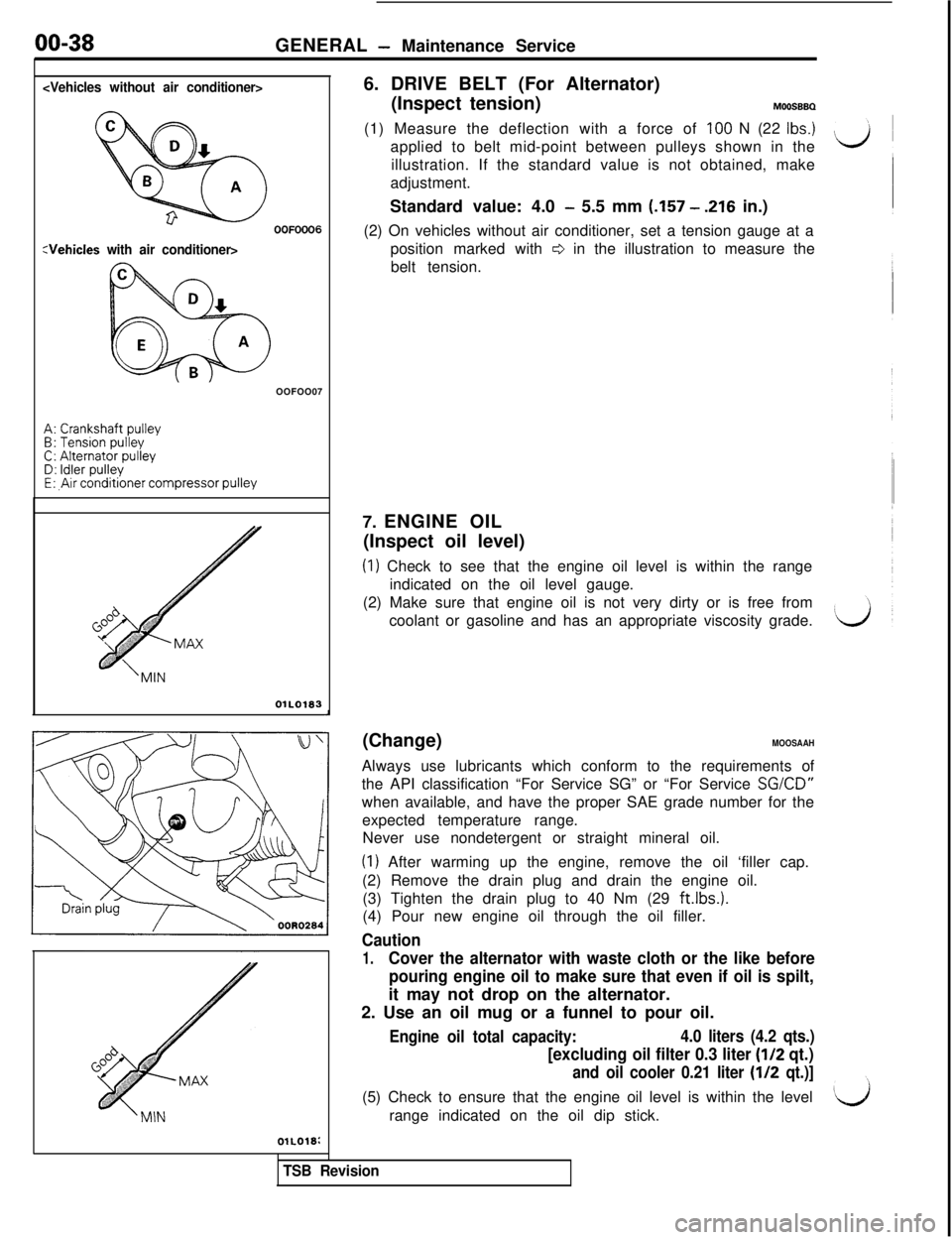
A: Crankshaft pulleyB: Tension pulleyC: Alternator pulleyD: Idler pulleyE: ,Air conditioner compressor pulley
OlLO183
OlLO18:(Inspect tension)
MOOS88(1(1) Measure the deflection with a force of
100 N (22 Ibs.)applied to belt mid-point between pulleys shown in the
illustration. If the standard value is not obtained, make
adjustment.
Standard value: 4.0
- 5.5 mm (.157 - 216 in.)
(2) On vehicles without air conditioner, set a tension gauge at a
position marked with
r3 in the illustration to measure the
belt tension.
7. ENGINE OIL
(Inspect oil level)
(I) Check to see that the engine oil level is within the range
indicated on the oil level gauge.
(2) Make sure that engine oil is not very dirty or is free from
coolant or gasoline and has an appropriate viscosity grade.J
(Change)
MOOSAAHAlways use lubricants which conform to the requirements of
the API classification “For Service SG” or “For Service
SGKD”when available, and have the proper SAE grade number for the
expected temperature range.
Never use nondetergent or straight mineral oil.
(1) After warming up the engine, remove the oil ‘filler cap.
(2) Remove the drain plug and drain the engine oil.
(3) Tighten the drain plug to 40 Nm (29 ft.lbs.).
(4) Pour new engine oil through the oil filler.
Caution
1.Cover the alternator with waste cloth or the like before
pouring engine oil to make sure that even if oil is spilt,it may not drop on the alternator.
2. Use an oil mug or a funnel to pour oil.
Engine oil total capacity:4.0 liters (4.2 qts.)
[excluding oil filter 0.3 liter (l/2 qt.)
and oil cooler 0.21 liter (l/2 qt.)](5) Check to ensure that the engine oil level is within the level
range indicated on the oil dip stick.
TSB Revision
Page 43 of 1146
GENERAL - Maintenance Service00-39ogPOO268. ENGINE OIL FILTER (Change)
MOOEAEJThe quality of replacement filters varies considerably. Only high
quality filters should be used to assure most efficient service.
Genuine oil filters require that the filter be capable of
withstanding a pressure of 256 psi are high quality filters and
are recommended as follows:
Oil Filter Part No.
MITSUBISHI Genuine Parts: MD136790
ENGINE OIL FILTER SELECTIONThis vehicle is equipped with a full-flow, throw-away oil filter.
The same type of replacement filter is recommended as a
replacement filter for this vehicle. It is possible, particularly in
cold weather, that this vehicle may develop high oil pressure
for a short duration. You should be sure that any replacement
filter used on this vehicle is a high-quality filter and is capable of
withstanding a pressure of 256 psi (1,765
kpa) (manufacturer’s
specifications) to avoid filter and engine damage. The following
is a highquality filter and is strongly recommended for use on
this vehicle: Mitsubishi Engine Oil Filter P/N MD136790.
Any replacement oil filter should be installed in accordance with
the oil filter manufacturer’s installation instructions.
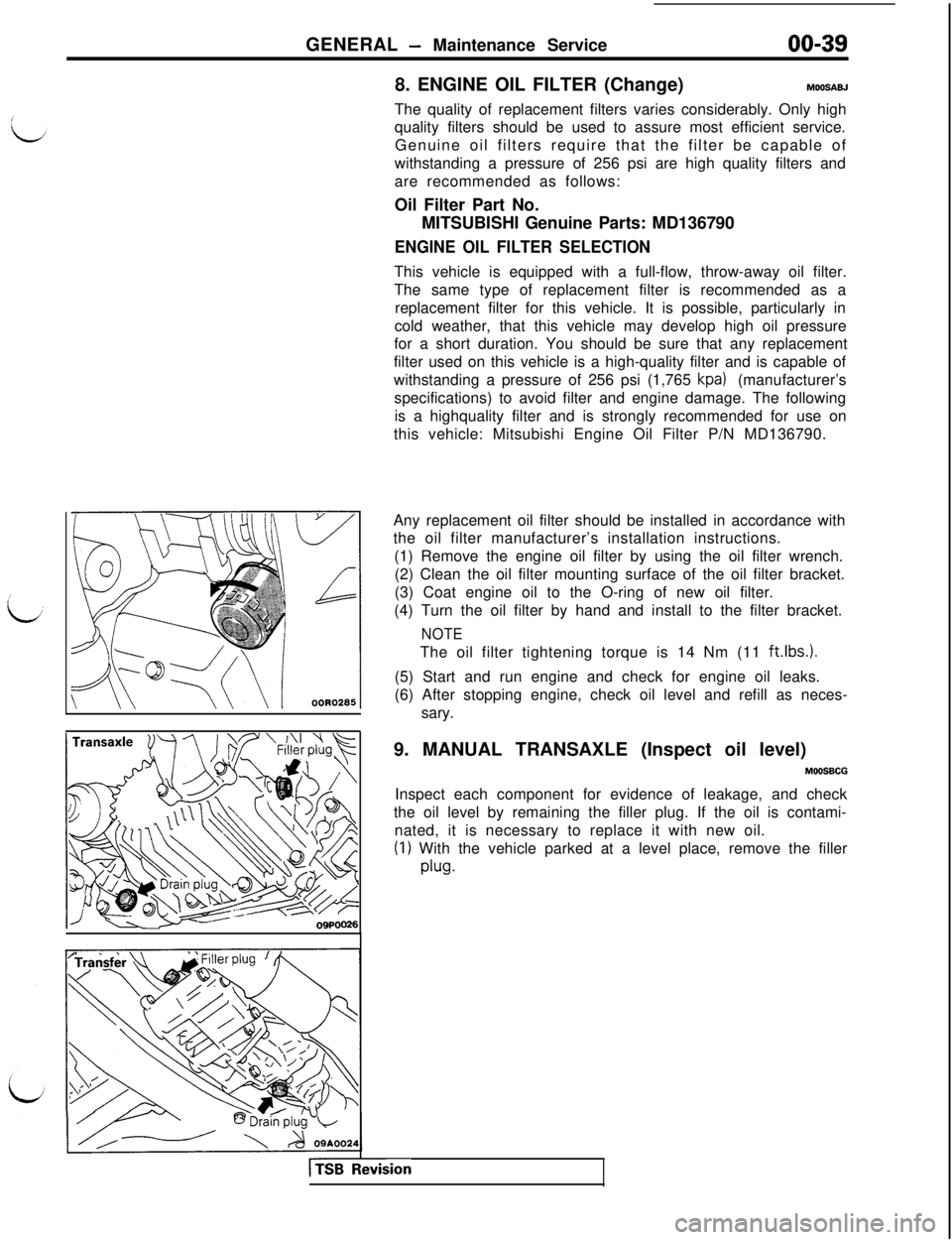
(1) Remove the engine oil filter by using the oil filter wrench.
(2) Clean the oil filter mounting surface of the oil filter bracket.
(3) Coat engine oil to the O-ring of new oil filter.
(4) Turn the oil filter by hand and install to the filter bracket.
NOTEThe oil filter tightening torque is 14 Nm (11
ft.lbs.1.(5) Start and run engine and check for engine oil leaks.
(6) After stopping engine, check oil level and refill as neces-
sary.
9. MANUAL TRANSAXLE (Inspect oil level)
MOOSBCGInspect each component for evidence of leakage, and check
the oil level by remaining the filler plug. If the oil is contami-
nated, it is necessary to replace it with new oil.
(1) With the vehicle parked at a level place, remove the filler
plug.
-Revision
Page 44 of 1146
00-40
GENERAL - Maintenance Service
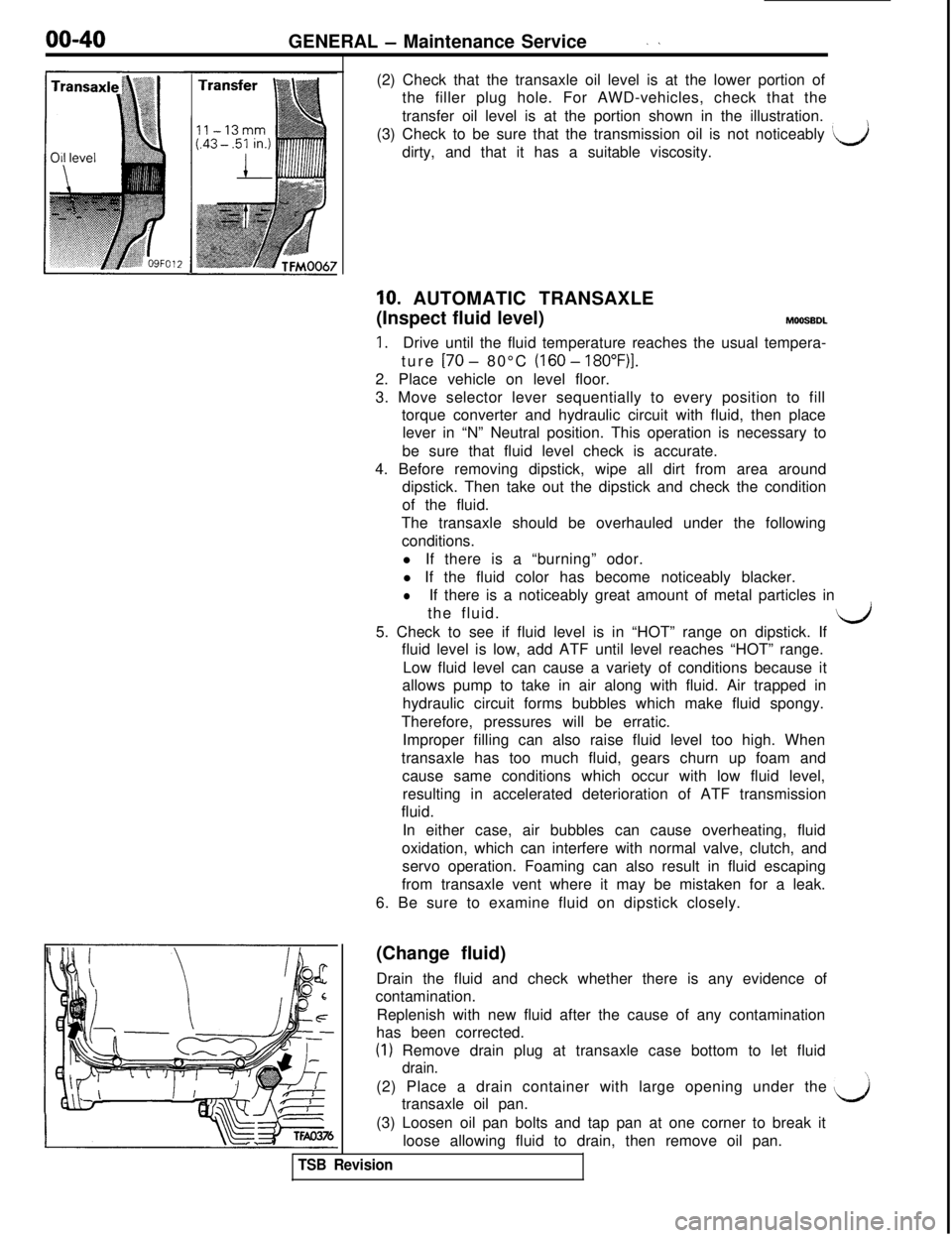
(2) Check that the transaxle oil level is at the lower portion of
the filler plug hole. For AWD-vehicles, check that the
transfer oil level is at the portion shown in the illustration.
(3) Check to be sure that the transmission oil is not noticeably
‘ddirty, and that it has a suitable viscosity.
10. AUTOMATIC TRANSAXLE
(Inspect fluid level)
MOOSEDL
1.Drive until the fluid temperature reaches the usual tempera-
ture
[70 - 80°C (160 - 18O”F)I.2. Place vehicle on level floor.
3. Move selector lever sequentially to every position to fill
torque converter and hydraulic circuit with fluid, then place
lever in “N” Neutral position. This operation is necessary to
be sure that fluid level check is accurate.
4. Before removing dipstick, wipe all dirt from area around
dipstick. Then take out the dipstick and check the condition
of the fluid.
The transaxle should be overhauled under the following
conditions.
l If there is a “burning” odor.
l If the fluid color has become noticeably blacker.
lIf there is a noticeably great amount of metal particles in
the fluid.
5. Check to see if fluid level is in “HOT” range on dipstick. If
fluid level is low, add ATF until level reaches “HOT” range.
Low fluid level can cause a variety of conditions because it
allows pump to take in air along with fluid. Air trapped in
hydraulic circuit forms bubbles which make fluid spongy.
Therefore, pressures will be erratic.
Improper filling can also raise fluid level too high. When
transaxle has too much fluid, gears churn up foam and
cause same conditions which occur with low fluid level,
resulting in accelerated deterioration of ATF transmission
fluid.
In either case, air bubbles can cause overheating, fluid
oxidation, which can interfere with normal valve, clutch, and
servo operation. Foaming can also result in fluid escaping
from transaxle vent where it may be mistaken for a leak.
6. Be sure to examine fluid on dipstick closely.
L/(Change fluid)
Drain the fluid and check whether there is any evidence of
contamination.
Replenish with new fluid after the cause of any contamination
has been corrected.
(1) Remove drain plug at transaxle case bottom to let fluid
drain.(2) Place a drain container with large opening under the
transaxle oil pan.
(3) Loosen oil pan bolts and tap pan at one corner to break it
loose allowing fluid to drain, then remove oil pan.
d
TSB Revision
Page 45 of 1146
GENERAL - Maintenance Service00-41
Good
t-lVA0283
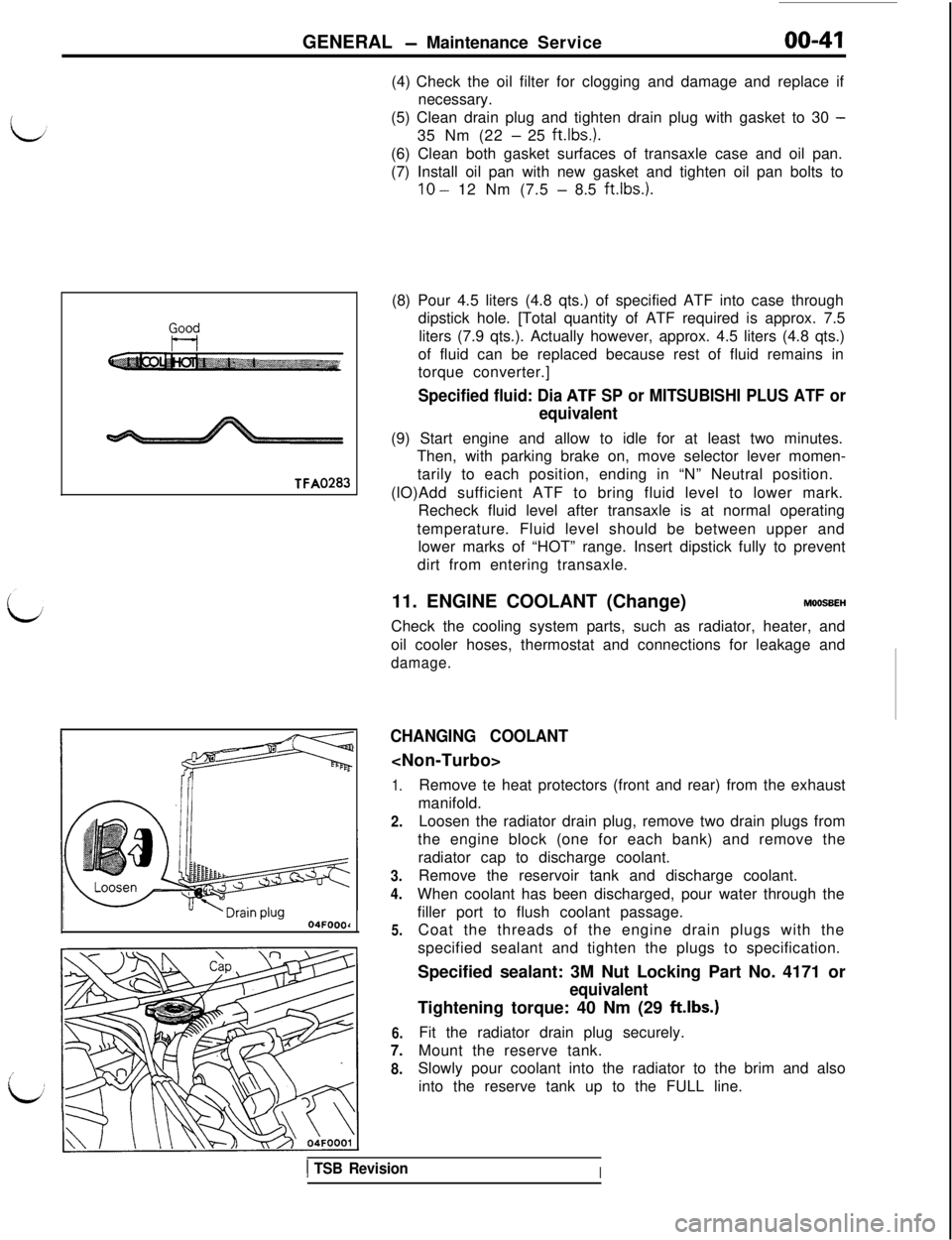
I04FOOOd(4) Check the oil filter for clogging and damage and replace if
necessary.
(5) Clean drain plug and tighten drain plug with gasket to 30
-35 Nm (22
- 25 ft.lbs.).
(6) Clean both gasket surfaces of transaxle case and oil pan.
(7) Install oil pan with new gasket and tighten oil pan bolts to
10 - 12 Nm (7.5 - 8.5 ft.lbs.).
(8) Pour 4.5 liters (4.8 qts.) of specified ATF into case through
dipstick hole. [Total quantity of ATF required is approx. 7.5
liters (7.9 qts.). Actually however, approx. 4.5 liters (4.8 qts.)
of fluid can be replaced because rest of fluid remains in
torque converter.]
Specified fluid: Dia ATF SP or MITSUBISHI PLUS ATF or
equivalent(9) Start engine and allow to idle for at least two minutes.
Then, with parking brake on, move selector lever momen-
tarily to each position, ending in “N” Neutral position.
(lO)Add sufficient ATF to bring fluid level to lower mark.
Recheck fluid level after transaxle is at normal operating
temperature. Fluid level should be between upper and
lower marks of “HOT” range. Insert dipstick fully to prevent
dirt from entering transaxle.
11. ENGINE COOLANT (Change)
MOOSBEHCheck the cooling system parts, such as radiator, heater, and
oil cooler hoses, thermostat and connections for leakage and
damage.
CHANGING COOLANT
1.
2.
3.
4.
5.
6.
7.
8.Remove te heat protectors (front and rear) from the exhaust
manifold.
Loosen the radiator drain plug, remove two drain plugs from
the engine block (one for each bank) and remove the
radiator cap to discharge coolant.
Remove the reservoir tank and discharge coolant.
When coolant has been discharged, pour water through the
filler port to flush coolant passage.
Coat the threads of the engine drain plugs with the
specified sealant and tighten the plugs to specification.
Specified sealant: 3M Nut Locking Part No. 4171 or
equivalentTightening torque: 40 Nm (29
ftlbs.)Fit the radiator drain plug securely.
Mount the reserve tank.
Slowly pour coolant into the radiator to the brim and also
into the reserve tank up to the FULL line.
1 TSB RevisionI
Page 47 of 1146
GENERAL - Maintenance Service00-43
15. DRIVE SHAFT BOOTS (Inspect for grease
leaks and damage)
MOOSBJD1. These components, which are permanently lubricated at
the factory, do not require periodic lubrication. Damaged
boots should be replaced to prevent leakage or contamina-
tion of the, grease.
2.Inspect the boots for proper sealing, leakage and damage.
Replace it if defective.
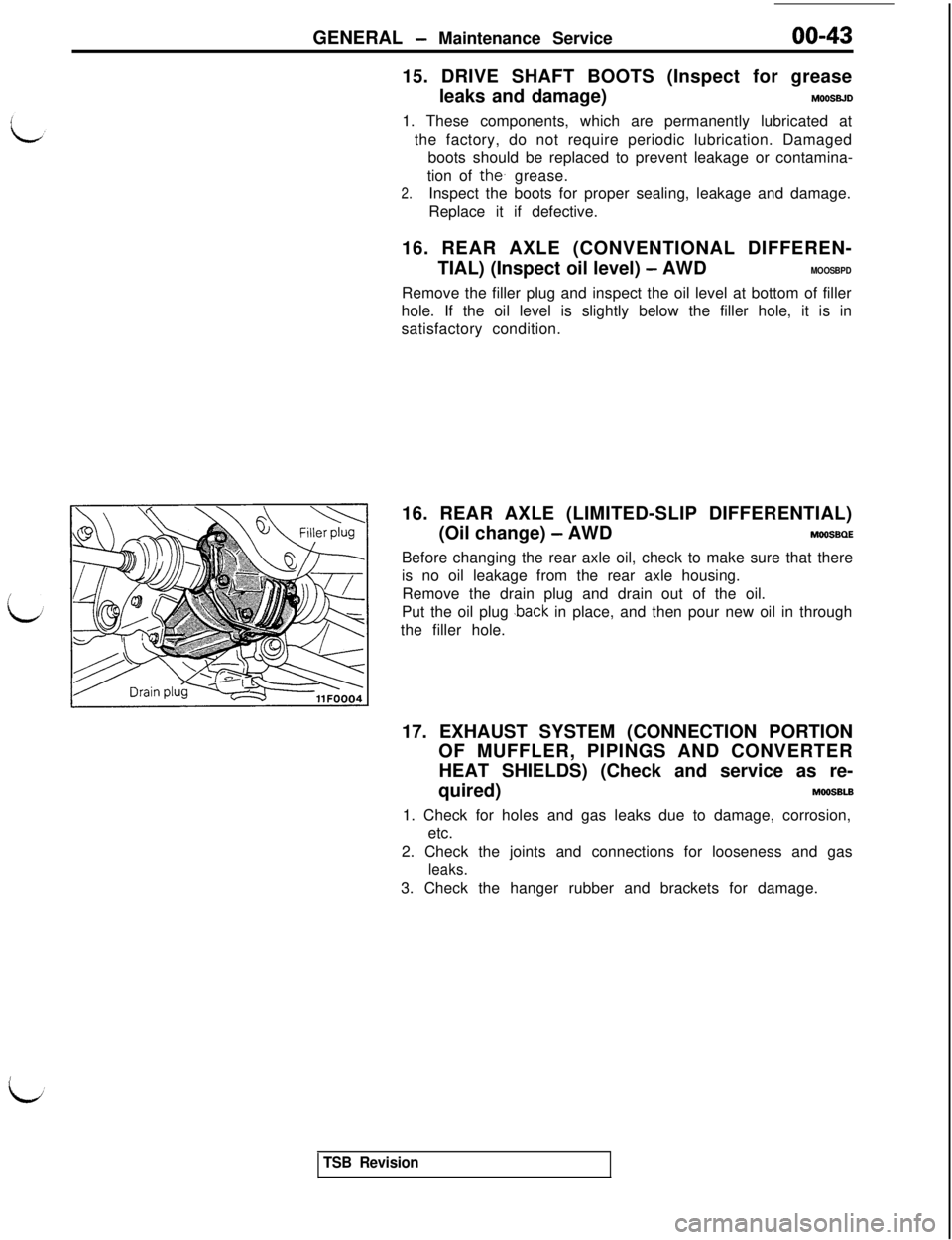
16. REAR AXLE (CONVENTIONAL DIFFEREN-
TIAL) (Inspect oil level)
- AWDMOOSBPDRemove the filler plug and inspect the oil level at bottom of filler
hole. If the oil level is slightly below the filler hole, it is in
satisfactory condition.
16. REAR AXLE (LIMITED-SLIP DIFFERENTIAL)
(Oil change)
- AWDMOOSBQEBefore changing the rear axle oil, check to make sure that there
is no oil leakage from the rear axle housing.
Remove the drain plug and drain out of the oil.
Put the oil plug
,back in place, and then pour new oil in through
the filler hole.
17. EXHAUST SYSTEM (CONNECTION PORTION
OF MUFFLER, PIPINGS AND CONVERTER
HEAT SHIELDS) (Check and service as re-
quired)
MOOSBLB1. Check for holes and gas leaks due to damage, corrosion,
etc.
2. Check the joints and connections for looseness and gas
leaks.3. Check the hanger rubber and brackets for damage.
TSB Revision
Page 60 of 1146

II-IOENGINE - Troubleshooting
TROUBLESHOOTINGmiwm
SymptomProbable cause
RemedyI,aJ
Compression too low) Cylinder head gasket blown1 Replace gasketI
Piston ring worn or damage
Piston or cylinder worn
Replace rings
Repair or replace piston and/or cylinder
block
Valve seat worn or damage
Repair or replace valve and/or seat ring
3il pressure drop
Engine oil level too lowCheck engine oil level
Oil pressure switch faulty
Oil filter clogged
Replace oil pressure switch
Install new filter
Oil pump gears or cover worn
Thin or diluted engine oilReplace gears and/or cover
Change engine oil to correct viscosity
1 Oil relief valve stuck (opened)) Repair relief valve
Excessive bearing clearance
Replace bearingsIbOil relief valve stuck (closed)
Incorrect lash adjusterRepair relief valve
Replace lash adjuster Oil pressure too high
Noisy valves
Thin or diluted engine oil (low oil pressure)Change engine oil
Valve stem or valve guide worn or damageReplace valve and/or guide
Connecting rod noise/
nain bearing noiseInsufficient oil supplyCheck engine oil level
Thin or diluted engine oilChange engine oil
Excessive bearing clearanceReplace bearings
Timing belt noise
Incorrect belt tensionAdjust belt tension
TSB Revision
Page 108 of 1146
13-2
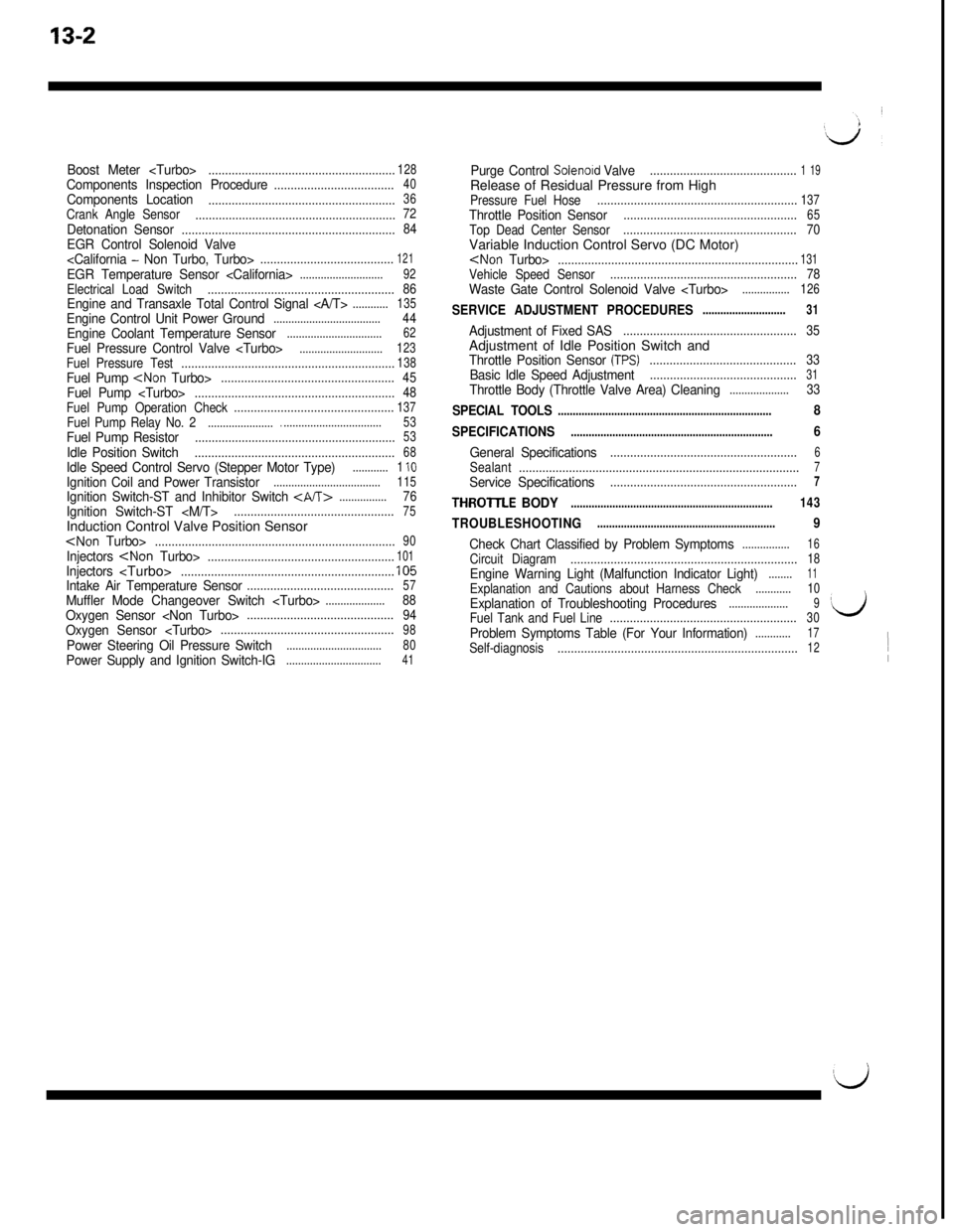
Boost Meter
Components Location........................................................36
Crank Angle Sensor
............................................................72Detonation Sensor................................................................84EGR Control Solenoid Valve
EGR Temperature Sensor
Fuel Pump Operation Check................................................137Fuel Pump Relay No. 2........................................................53Fuel Pump Resistor............................................................53
Idle Position Switch............................................................68Idle Speed Control Servo (Stepper Motor Type)............1 IOIgnition Coil and Power Transistor....................................115Ignition Switch-ST and Inhibitor Switch ................76Ignition Switch-ST
Injectors
94
Oxygen Sensor
Power Steering Oil Pressure Switch................................80Power Supply and Ignition Switch-IG................................41
Purge Control Solenord Valve............................................1 19Release of Residual Pressure from High
Pressure Fuel Hose............................................................137Throttle Position Sensor....................................................65Top Dead Center Sensor....................................................70Variable Induction Control Servo (DC Motor)
SERVICE ADJUSTMENT PROCEDURES............................31
Adjustment of Fixed SAS....................................................35Adjustment of Idle Position Switch and
Throttle Position Sensor (TPS)............................................33Basic Idle Speed Adjustment............................................31Throttle Body (Throttle Valve Area) Cleaning....................33
SPECIAL TOOLS........................................................................8
SPECIFICATIONS
....................................................................6
General Specifications........................................................6Sealant....................................................................................7Service Specifications........................................................7
THROlTLE BODY....................................................................143
TROUBLESHOOTING............................................................9
Check Chart Classified by Problem Symptoms................16Circuit Diagram....................................................................18Engine Warning Light (Malfunction Indicator Light)........11Explanation and Cautions about Harness Check............10Explanation of Troubleshooting Procedures....................9Fuel Tank and Fuel Line........................................................30
Problem Symptoms Table (For Your Information)............17Self-diagnosis........................................................................12)
I
Page 156 of 1146
13-50FUEL SYSTEM - 0
n-vehicle Inspection of MPI Components
OPERATIONControl Relay Operation
l Drives the fuel pump during cranking and engine operation.
l
When the ignition switch is set to START, current flows from the ignition switch through the control relay
coil to ground. This turns on the control relay switch and drive power is supplied from the battery throughthe control relay switch to the fuel pump.
lWhile the engine is running, the engine control unit keeps the power transistor on and energizes the
control relay coil so that drive power is supplied to the fuel pump.
Fuel Pump Relay No. 2 Operation
lChange the fuel pump discharge in two stages by ON-OFF operation of the relay switch for fuel pumprelay No. 2.
lIf the amount of inlet air is small (the engine load is low), the engine control unit turns on the power
transistor to energize the coil of fuel pump relay No. 2, sending drive power to the fuel pump through the
resistor. If the amount of inlet air is large (the engine load is high), the engine control unit turns off thepower transistor to send drive power directly to the fuel pump without passing through the resistor.
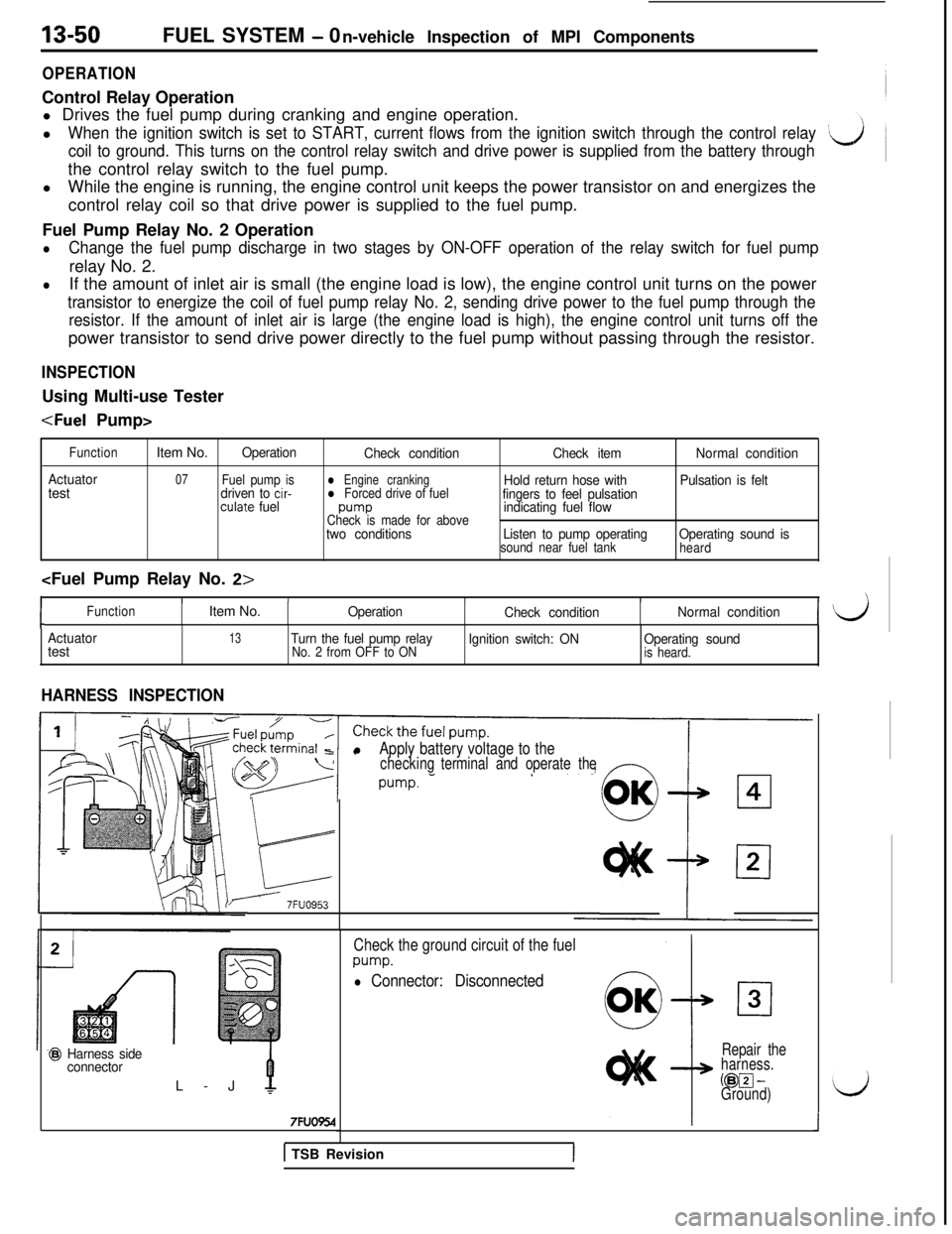
INSPECTIONUsing Multi-use Tester
Function
ActuatortestItem No.
Operation
Check conditionCheck itemNormal condition
07Fuel pump isdriven to cir-l Engine crankingHold return hose withl Forced drive of fuelPulsation is felt
culate fuelfingers to feel pulsationpump
Check is made for aboveindicating fuel flow
two conditionsListen to pump operating
sound near fuel tankOperating sound isheard
I/IIII
cFunctionItem No.Operation
Check conditionNormal condition
Actuatortest
13Turn the fuel pump relayNo. 2 from OFF to ONIgnition switch: ONOperating soundis heard.
HARNESS INSPECTION
k
J------ 7FUO953
lApply battery voltage to thecheckingterminal and operate the
Check the ground circuit of the fuel
pump.
l Connector: Disconnected
@I Harness side
connectorL-J
7FUO554
Repair the
harness.
@pJ-Ground)
J
1 TSB Revision
Page 208 of 1146
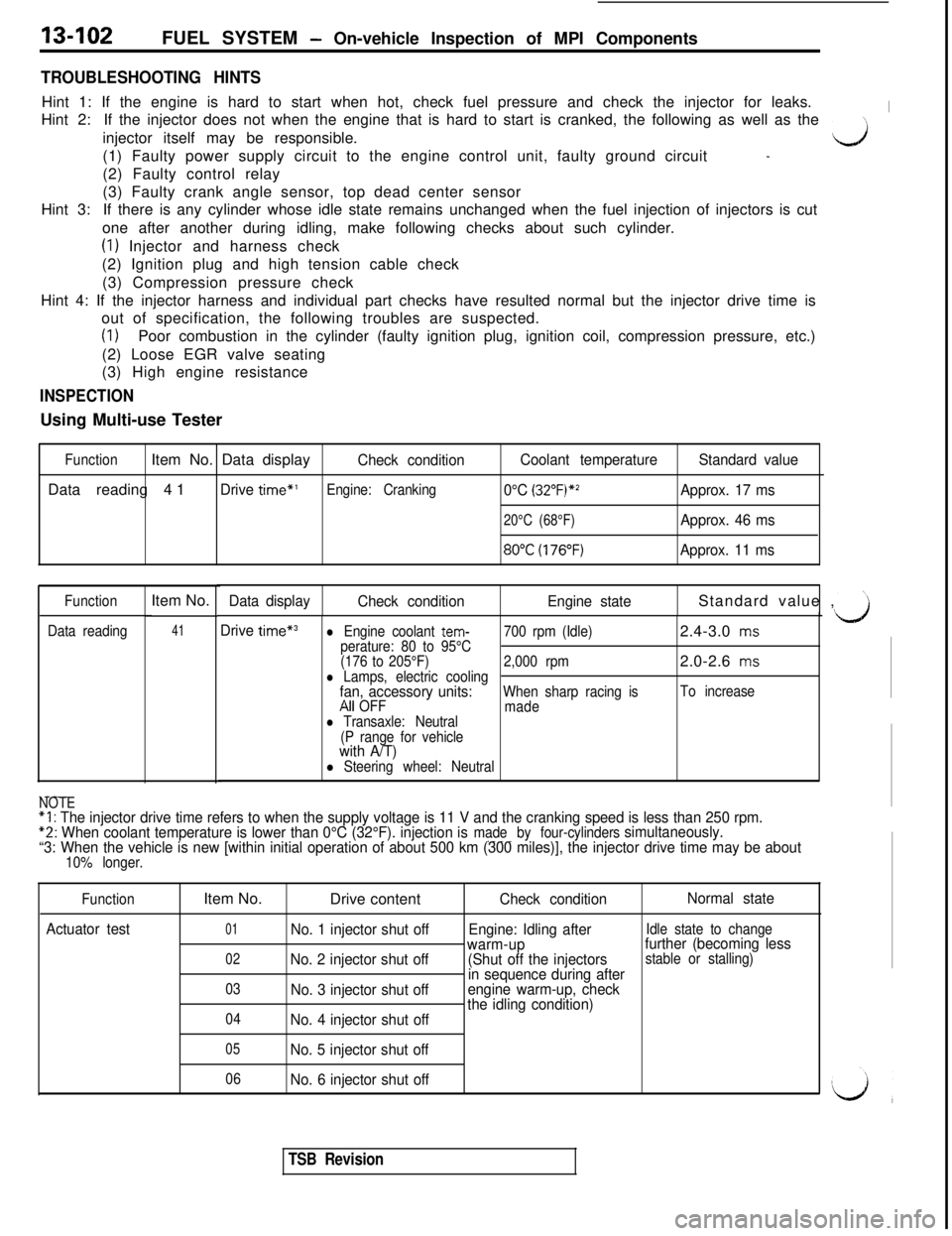
13-102FUEL SYSTEM - On-vehicle Inspection of MPI Components
TROUBLESHOOTING HINTSHint 1: If the engine is hard to start when hot, check fuel pressure and check the injector for leaks.
Hint 2:If the injector does not when the engine that is hard to start is cranked, the following as well as the
Iinjector itself may be responsible.
(1) Faulty power supply circuit to the engine control unit, faulty ground circuit
\-J
-(2) Faulty control relay
Hint 3:(3) Faulty crank angle sensor, top dead center sensor
If there is any cylinder whose idle state remains unchanged when the fuel injection of injectors is cut
one after another during idling, make following checks about such cylinder.
(1) Injector and harness check
(2) Ignition plug and high tension cable check
(3) Compression pressure check
Hint 4: If the injector harness and individual part checks have resulted normal but the injector drive time is
out of specification, the following troubles are suspected.
(1)Poor combustion in the cylinder (faulty ignition plug, ignition coil, compression pressure, etc.)
(2) Loose EGR valve seating
(3) High engine resistance
INSPECTIONUsing Multi-use Tester
FunctionItem No. Data displayCheck conditionCoolant temperatureStandard valueData reading 41
Drive time”’Engine: Cranking0°C (32”F)*zApprox. 17 ms
20°C (68°F)Approx. 46 ms
8O"C(176"F)Approx. 11 ms
Function
Data readingItem No.Data display
41Drive time*3l Engine coolant tem-perature: 80 to 95°C700 rpm (Idle)2.4-3.0 ms
(176 to 205°F)2,000 rpm2.0-2.6
msl Lamps, electric coolingfan, accessory units:When sharp racing isTo increaseAll OFF
madel Transaxle: Neutral
(P range for vehicle
with A/T)l Steering wheel: Neutral
Check conditionEngine stateStandard value ,
.---NOTE“I : The injector drive time refers to when the supply voltage is 11 V and the cranking speed is less than 250 rpm.*2: When coolant temperature is lower than 0°C (32°F). injection ismade by four-cylinders.---simultaneously.
“3: When the vehicle is new [within initial operation of about 500 km (300 miles)], the injector drive time may be about
10% longer.
Function
Actuator testItem No.
Drive content
Check conditionNormal state
01No. 1 injector shut offEngine: Idling afterIdle state to change
02No. 2 injector shut offwarm-up
(Shut off the injectorsfurther (becoming less
in sequence during afterstable or stalling)
03
No. 3 injector shut offengine warm-up, check
04No. 4 injector shut offthe idling condition)
05No. 5 injector shut off
06No. 6 injector shut off
TSB Revision