diagnostic MITSUBISHI 380 2005 Workshop Manual
[x] Cancel search | Manufacturer: MITSUBISHI, Model Year: 2005, Model line: 380, Model: MITSUBISHI 380 2005Pages: 1500, PDF Size: 47.87 MB
Page 837 of 1500

AUTO A/C DIAGNOSIS
HEATER, AIR CONDITIONING AND VENTILATION55-136
ACTUATOR TEST REFERENCEM1554005200133
MUT-III DIAGNOSTIC
TOOL DISPLAYITEM NO. INSPECTION ITEM DRIVE CONTENT
Blower fan: OFF 83 Blower motor OFF
Blower fan: Middle 84 Middle speed
Blower fan: High 85 High speed
Air mix damper motor:
0%42 Air mixing damper control motor Opening degree: approx.
0% (Max cool)
Air mix damper motor:
100%43 Opening degree: approx.
100% (Max hot)
Air outlet c/o damper:
FA C E70 Mode selection damper control
motorFA C E
Air outlet c/o damper: Bi_
Level67 FOOT/FACE
Air outlet c/o damper:
FOOT71 FOOT
Air outlet c/o damper:
DEF/FOOT69 DEF/FOOT
Air outlet c/o damper:
DEF68 DEF
Idle up request: high load 74 Idle speed HIGH idle up
Idle up request: low load 75 LOW idle up
Idle up request: OFF 76 OFF
Rear defogger switch:
OFF40 Rear window defogger switch Rear window defogger: OFF
Rear defogger switch:
ON41 Rear window defogger: ON
Idle up request: OFF 50 Idle up operation Idle up: OFF
Idle up request: low load 51 Idle up: low load
Idle up request: high load 52 Idle up: high load
Condenser: 0% 77 Condenser fan OFF
Condenser: 50% 79 Middle speed
Rheostat: 0% 80 Rheostat- Illumination control OFF
Rheostat: 100% 81 Full duty
Rheostat: 50% 82 Half duty
Page 841 of 1500
SPECIAL TOOLS
HEATER, AIR CONDITIONING AND VENTILATION55-140
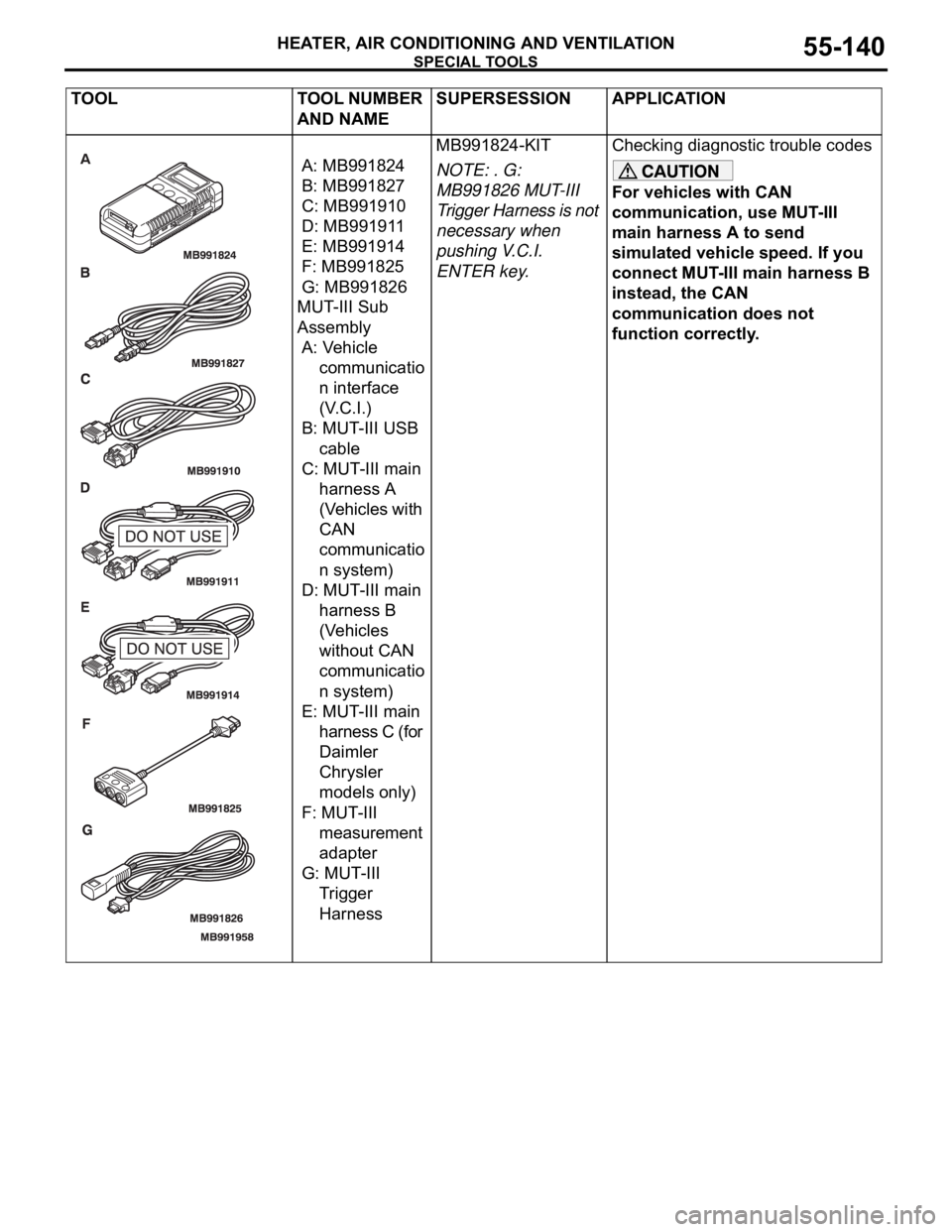
A: MB991824
B: MB991827
C: MB991910
D: MB991911
E: MB991914
F: MB991825
G: MB991826
MUT-III Sub
Assembly
A: Vehicle
communicatio
n interface
(V.C.I.)
B: MUT-III USB
cable
C: MUT-III main
harness A
(Vehicles with
CAN
communicatio
n system)
D: MUT-III main
harness B
(Vehicles
without CAN
communicatio
n system)
E: MUT-III main
harness C (for
Daimler
Chrysler
models only)
F: MUT-III
measurement
adapter
G: MUT-III
Trigger
HarnessMB991824-KIT
NOTE: . G:
MB991826 MUT-III
Trigger Harness is not
necessary when
pushing V.C.I.
ENTER key.Checking diagnostic trouble codes
For vehicles with CAN
communication, use MUT-III
main harness A to send
simulated vehicle speed. If you
connect MUT-III main harness B
instead, the CAN
communication does not
function correctly. TOOL TOOL NUMBER
AND NAMESUPERSESSION APPLICATION
Page 861 of 1500
SENSORS
HEATER, AIR CONDITIONING AND VENTILATION55-160
SENSORS
REMOVAL AND INSTALLATIONM1554001900088
Required Special Tools:
: Diagnostic Tool (MUT-III Sub Assembly)
MB991824: Vehicle Communication Interface
(V.C.I.)
MB991827: MUT-III USB Cable
MB991910: MUT-III Main Harness A
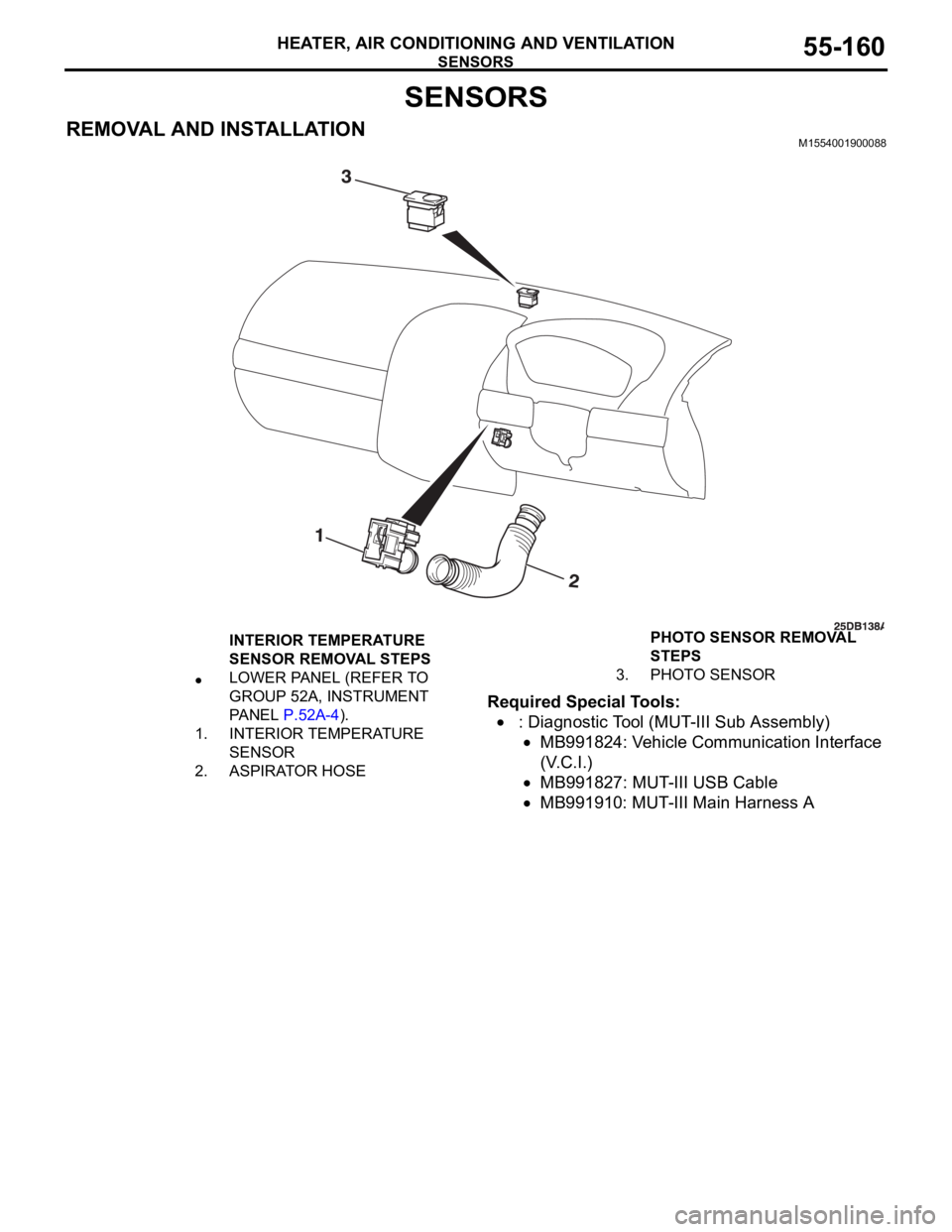
INTERIOR TEMPERATURE
SENSOR REMOVAL STEPS
LOWER PANEL (REFER TO
GROUP 52A, INSTRUMENT
PA N E L P.52A-4).
1. INTERIOR TEMPERATURE
SENSOR
2. ASPIRATOR HOSEPHOTO SENSOR REMOVAL
STEPS
3. PHOTO SENSOR
Page 862 of 1500
SENSORS
HEATER, AIR CONDITIONING AND VENTILATION55-161
INSPECTIONM1554002000130.
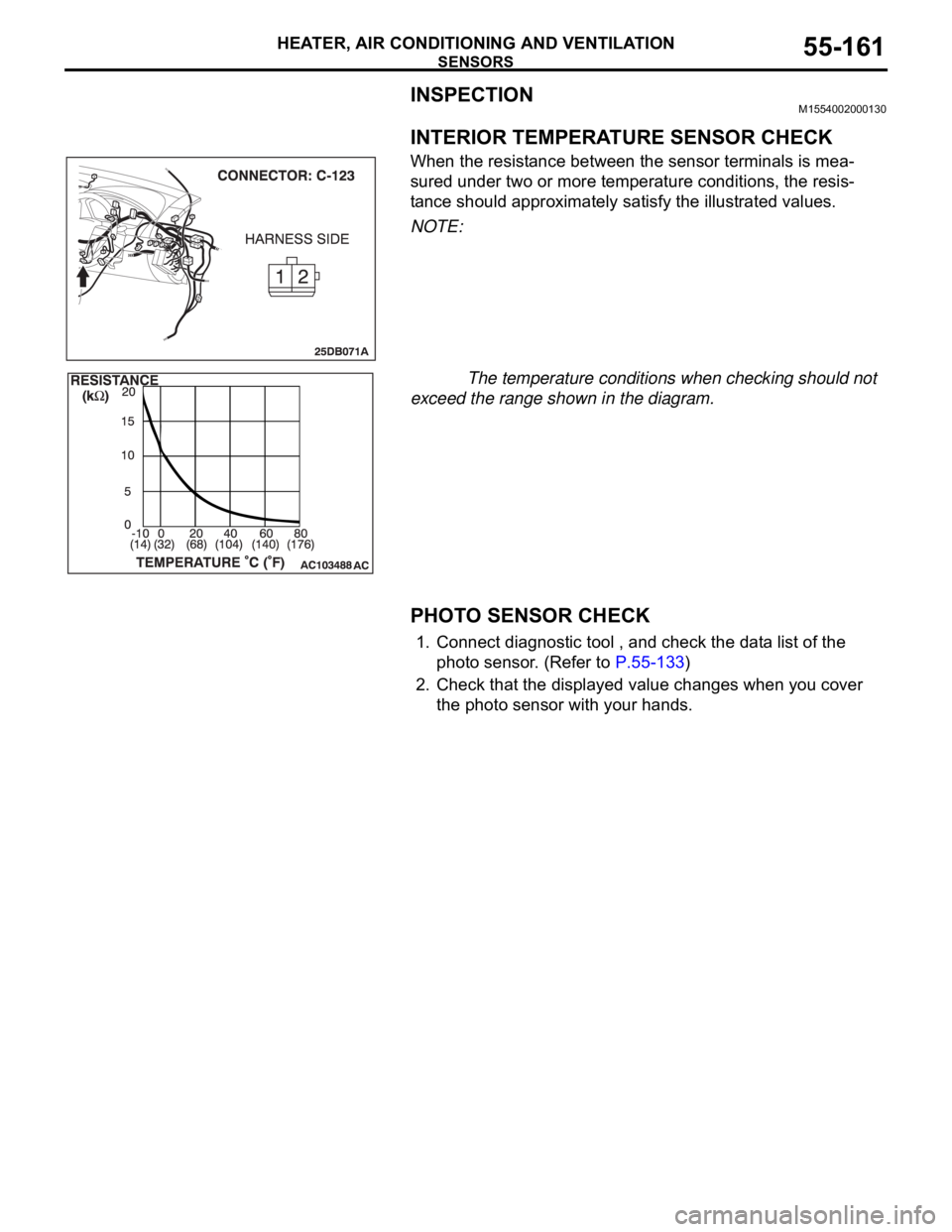
INTERIOR TEMPERATURE SENSOR CHECK
When the resistance between the sensor terminals is mea-
sured under two or more temperature conditions, the resis-
tance should approximately satisfy the illustrated values.
NOTE:
The temperature conditions when checking should not
exceed the range shown in the diagram.
.
PHOTO SENSOR CHECK
1. Connect diagnostic tool , and check the data list of the
photo sensor. (Refer to P.55-133)
2. Check that the displayed value changes when you cover
the photo sensor with your hands.
Page 917 of 1500

GENERAL DESCRIPTION
ENGINE COOLING14-2
GENERAL DESCRIPTIONM1141000100401
The cooling system is designed to keep every
part of the engine at appropriate temperature in
whatever condition the engine may be operated.
The cooling method is of the water-cooled, pres-
sure forced circulation type in which the water
pump pressurizes coolant and circulates it
throughout the engine. If the coolant temperature exceeds the prescribed temperature, the thermo-
stat opens to circulate the coolant through the
radiator as well so that the heat absorbed by the
coolant may be radiated into the air. The water
pump is of the centrifugal type and is driven by
the drive belt from the crankshaft. The radiator is
the corrugated fin, down flow type.
SPECIAL TOOLM1141000600279
ENGINE COOLING DIAGNOSIS
INTRODUCTIONM1141005300347
The system cools the engine so that it does not over-
heat and maintains the engine at an optimum tem-
perature. The system components are the radiator,
water pump, thermostat, condenser and fan assem-
blies. Possible faults include low coolant, contamina-
tion, belt loosening and component damage.
TROUBLESHOOTING STRATEGYM1141005200340
Use these steps to plan your diagnostic strategy. If
you follow them carefully, you will be sure to find
most of the engine cooling faults.
1. Gather information from the customer.2. Verify that the condition described by the
customer exists.
3. Find and repair the malfunction by following the
SYMPTOM CHART.
4. Verify that the malfunction is eliminated. TOOL TOOL NUMBER AND
NAMESUPERSESSION APPLICATION
MB991871
LLC changerGeneral service tool Coolant refilling
Page 961 of 1500
GENERAL DESCRIPTION
INTAKE AND EXHAUST15-2
GENERAL DESCRIPTIONM1151000100446
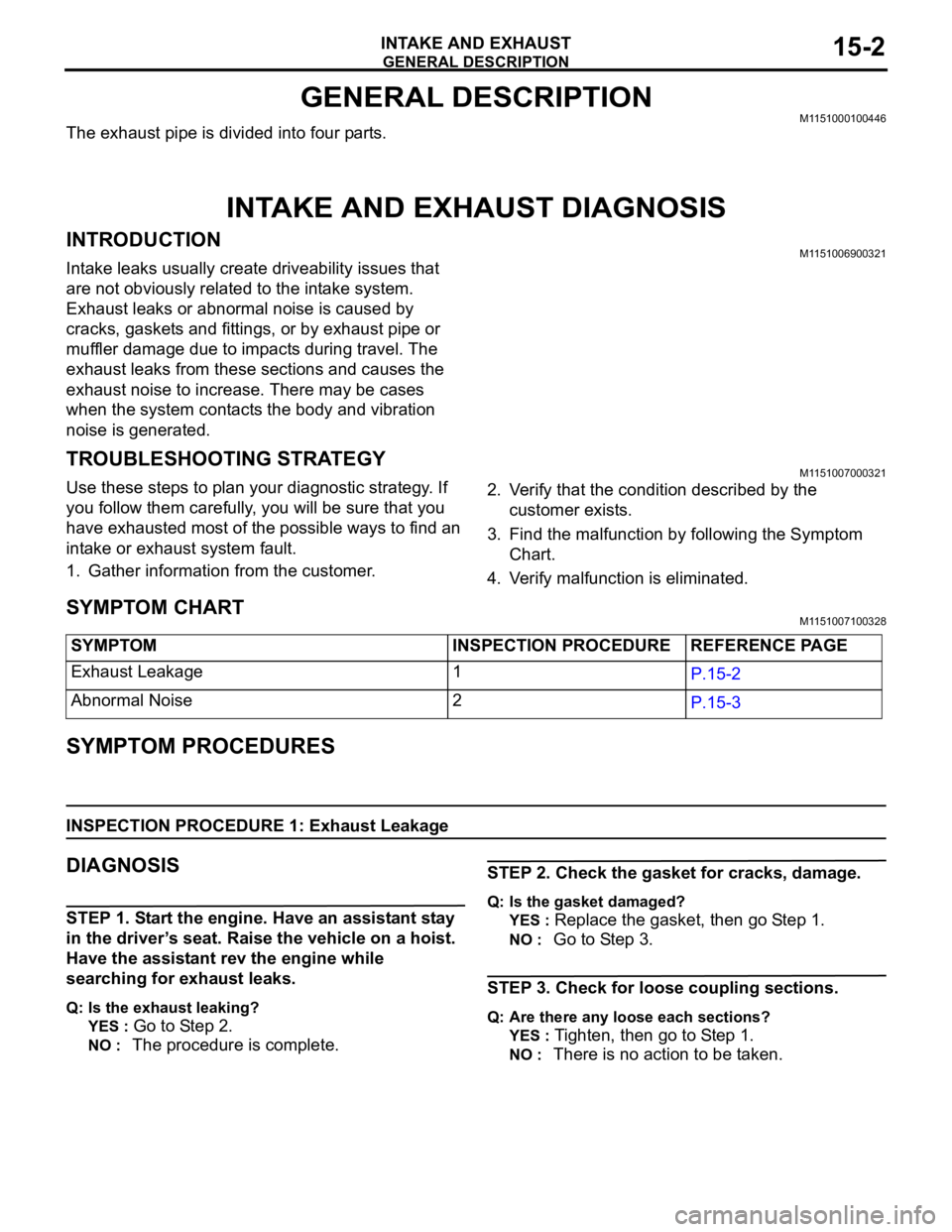
The exhaust pipe is divided into four parts.
INTAKE AND EXHAUST DIAGNOSIS
INTRODUCTIONM1151006900321
Intake leaks usually create driveability issues that
are not obviously related to the intake system.
Exhaust leaks or abnormal noise is caused by
cracks, gaskets and fittings, or by exhaust pipe or
muffler damage due to impacts during travel. The
exhaust leaks from these sections and causes the
exhaust noise to increase. There may be cases
when the system contacts the body and vibration
noise is generated.
TROUBLESHOOTING STRATEGYM1151007000321
Use these steps to plan your diagnostic strategy. If
you follow them carefully, you will be sure that you
have exhausted most of the possible ways to find an
intake or exhaust system fault.
1. Gather information from the customer.2. Verify that the condition described by the
customer exists.
3. Find the malfunction by following the Symptom
Chart.
4. Verify malfunction is eliminated.
SYMPTOM CHARTM1151007100328
SYMPTOM PROCEDURES
INSPECTION PROCEDURE 1: Exhaust Leakage
DIAGNOSIS
STEP 1. Start the engine. Have an assistant stay
in the driver’s seat. Raise the vehicle on a hoist.
Have the assistant rev the engine while
searching for exhaust leaks.
Q: Is the exhaust leaking?
YES :
Go to Step 2.
NO : The procedure is complete.
STEP 2. Check the gasket for cracks, damage.
Q: Is the gasket damaged?
YES :
Replace the gasket, then go Step 1.
NO : Go to Step 3.
STEP 3. Check for loose coupling sections.
Q: Are there any loose each sections?
YES :
Tighten, then go to Step 1.
NO : There is no action to be taken. SYMPTOM INSPECTION PROCEDURE REFERENCE PAGE
Exhaust Leakage 1
P.15-2
Abnormal Noise 2
P.15-3
Page 983 of 1500
CHARGING SYSTEM
ENGINE ELECTRICAL16-6
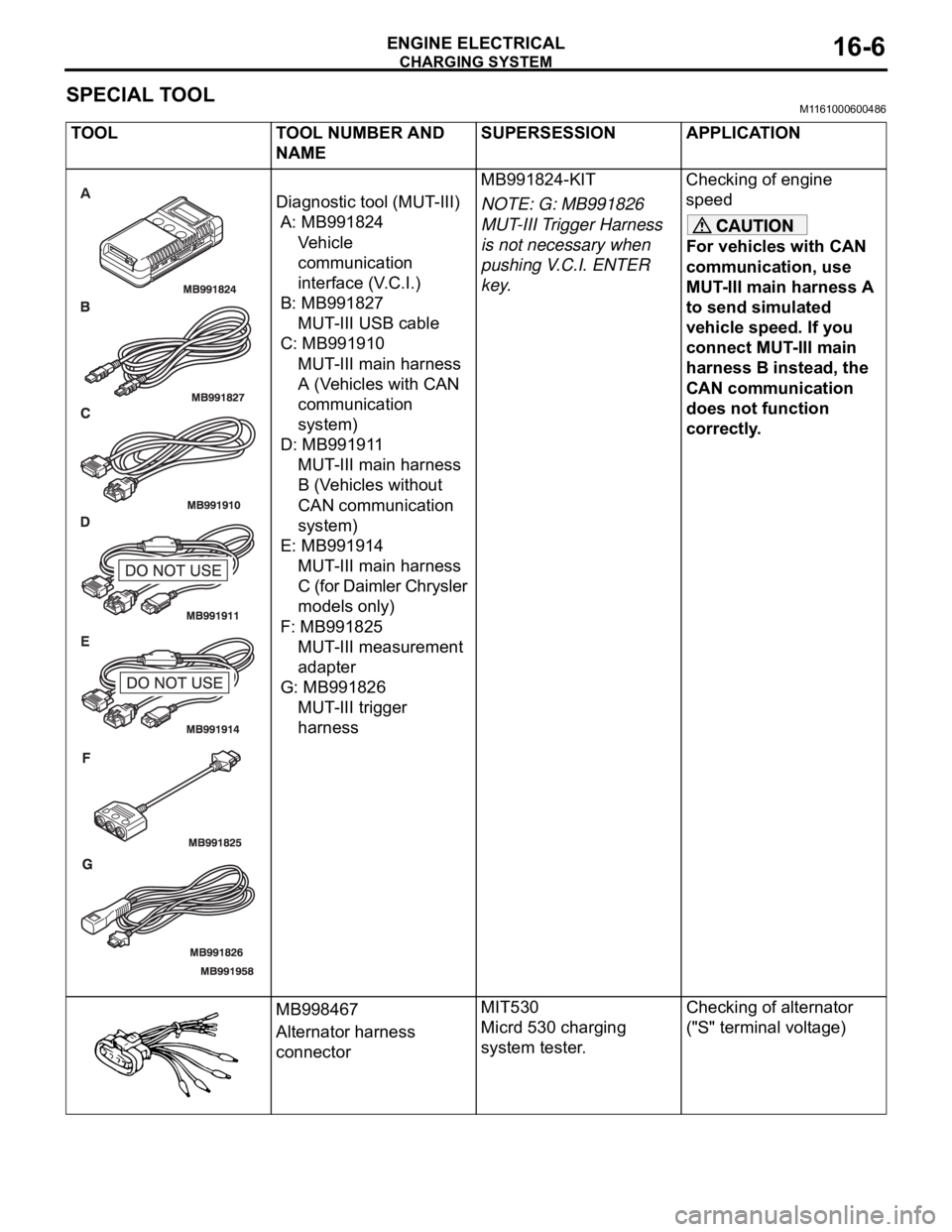
SPECIAL TOOLM1161000600486
TOOL TOOL NUMBER AND
NAMESUPERSESSION APPLICATION
Diagnostic tool (MUT-III)
A: MB991824
Ve h i c l e
communication
interface (V.C.I.)
B: MB991827
MUT-III USB cable
C: MB991910
MUT-III main harness
A (Vehicles with CAN
communication
system)
D: MB991911
MUT-III main harness
B (Vehicles without
CAN communication
system)
E: MB991914
MUT-III main harness
C (for Daimler Chrysler
models only)
F: MB991825
MUT-III measurement
adapter
G: MB991826
MUT-III trigger
harnessMB991824-KIT
NOTE: G: MB991826
MUT-III Trigger Harness
is not necessary when
pushing V.C.I. ENTER
key.Checking of engine
speed
For vehicles with CAN
communication, use
MUT-III main harness A
to send simulated
vehicle speed. If you
connect MUT-III main
harness B instead, the
CAN communication
does not function
correctly.
MB998467
Alternator harness
connectorMIT530
Micrd 530 charging
system tester.Checking of alternator
("S" terminal voltage)
Page 984 of 1500
CHARGING SYSTEM
ENGINE ELECTRICAL16-7
ON-VEHICLE SERVICE
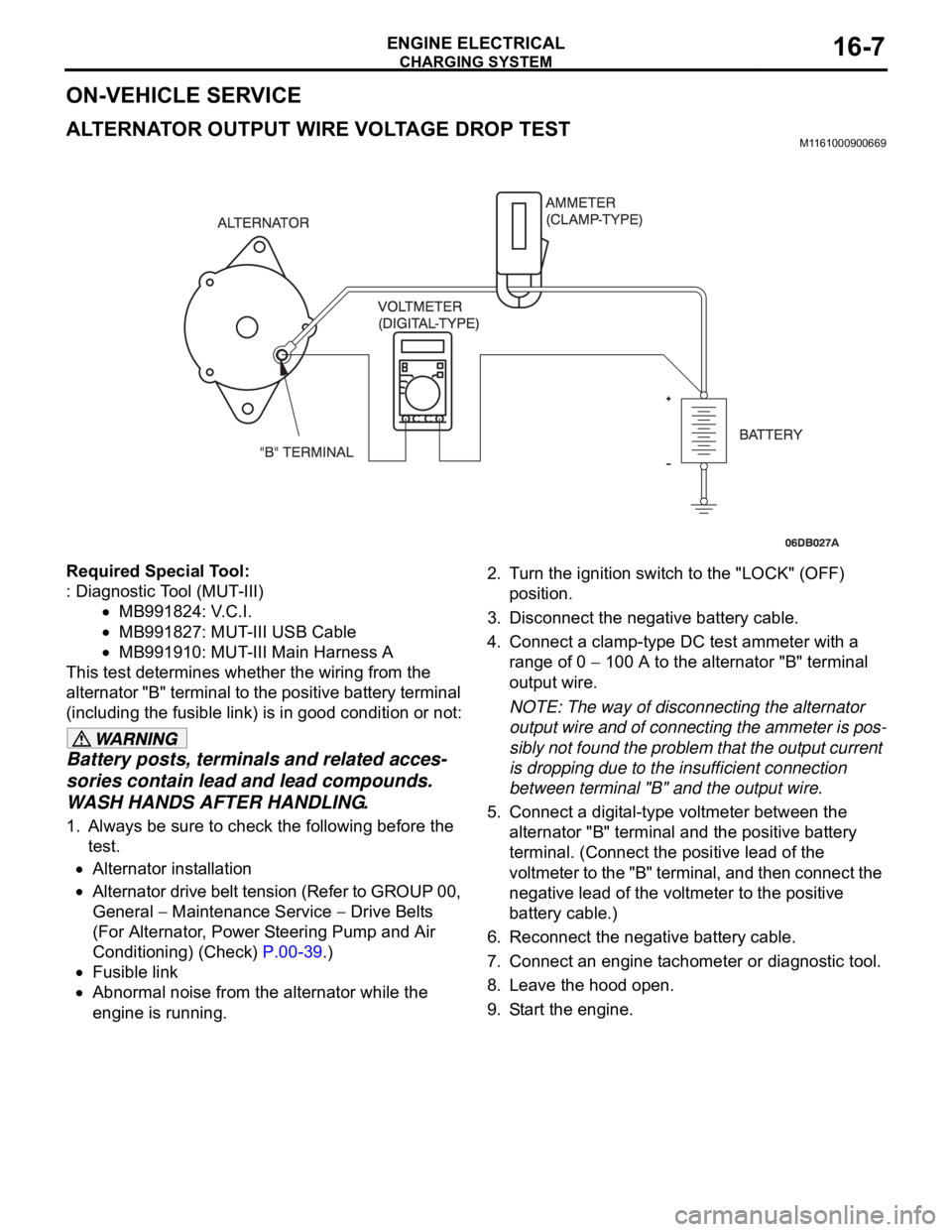
ALTERNATOR OUTPUT WIRE VOLTAGE DROP TESTM1161000900669
Required Special Tool:
: Diagnostic Tool (MUT-III)
MB991824: V.C.I.
MB991827: MUT-III USB Cable
MB991910: MUT-III Main Harness A
This test determines whether the wiring from the
alternator "B" terminal to the positive battery terminal
(including the fusible link) is in good condition or not:
Battery posts, terminals and related acces-
sories contain lead and lead compounds.
WASH HANDS AFTER HANDLING.
1. Always be sure to check the following before the
test.
Alternator installation
Alternator drive belt tension (Refer to GROUP 00,
General
Maintenance Service Drive Belts
(For Alternator, Power Steering Pump and Air
Conditioning) (Check) P.00-39.)
Fusible link
Abnormal noise from the alternator while the
engine is running.2. Turn the ignition switch to the "LOCK" (OFF)
position.
3. Disconnect the negative battery cable.
4. Connect a clamp-type DC test ammeter with a
range of 0
100 A to the alternator "B" terminal
output wire.
NOTE: The way of disconnecting the alternator
output wire and of connecting the ammeter is pos-
sibly not found the problem that the output current
is dropping due to the insufficient connection
between terminal "B" and the output wire.
5. Connect a digital-type voltmeter between the
alternator "B" terminal and the positive battery
terminal. (Connect the positive lead of the
voltmeter to the "B" terminal, and then connect the
negative lead of the voltmeter to the positive
battery cable.)
6. Reconnect the negative battery cable.
7. Connect an engine tachometer or diagnostic tool.
8. Leave the hood open.
9. Start the engine.
Page 985 of 1500
CHARGING SYSTEM
ENGINE ELECTRICAL16-8
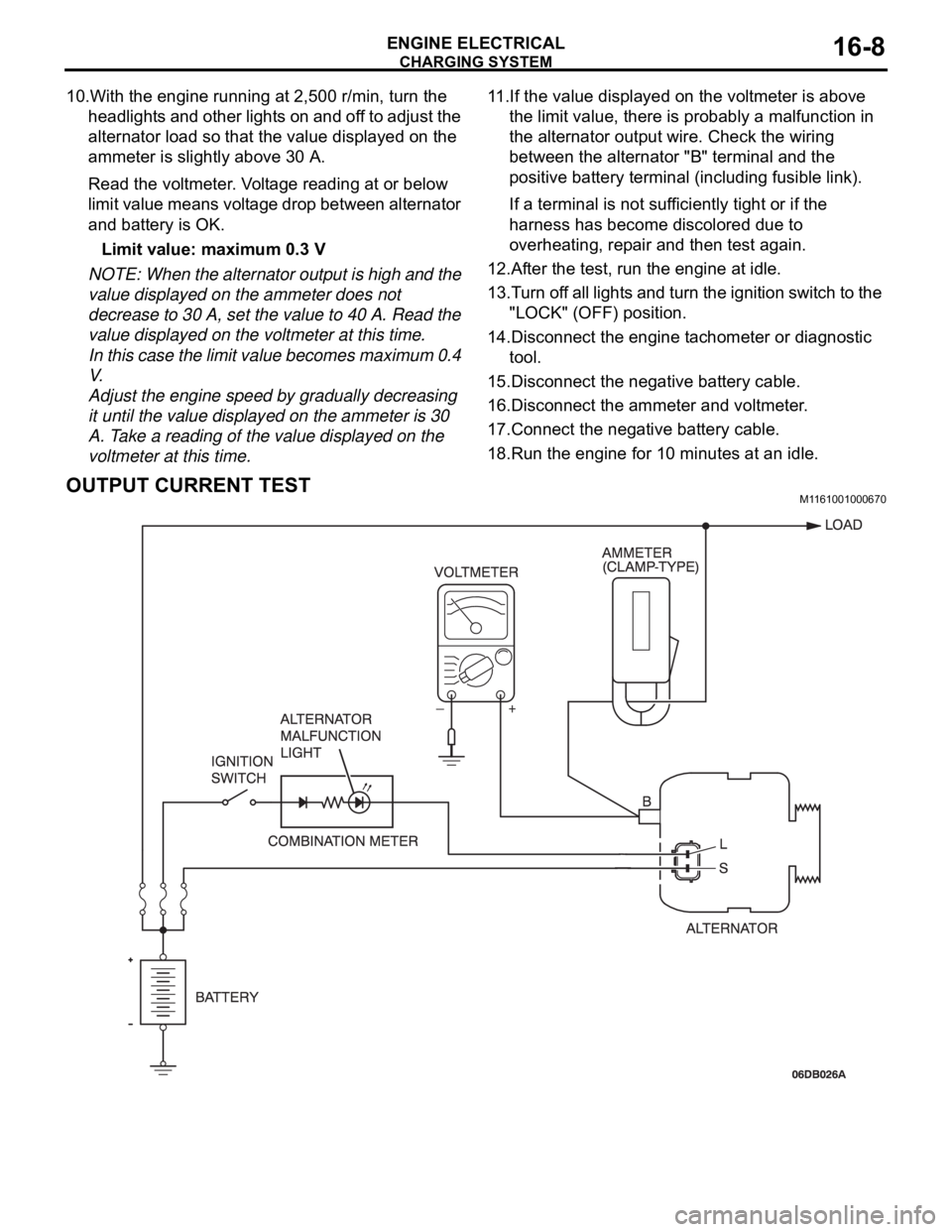
10.With the engine running at 2,500 r/min, turn the
headlights and other lights on and off to adjust the
alternator load so that the value displayed on the
ammeter is slightly above 30 A.
Read the voltmeter. Voltage reading at or below
limit value means voltage drop between alternator
and battery is OK.
Limit value: maximum 0.3 V
NOTE: When the alternator output is high and the
value displayed on the ammeter does not
decrease to 30 A, set the value to 40 A. Read the
value displayed on the voltmeter at this time.
In this case the limit value becomes maximum 0.4
V.
Adjust the engine speed by gradually decreasing
it until the value displayed on the ammeter is 30
A. Take a reading of the value displayed on the
voltmeter at this time.11.If the value displayed on the voltmeter is above
the limit value, there is probably a malfunction in
the alternator output wire. Check the wiring
between the alternator "B" terminal and the
positive battery terminal (including fusible link).
If a terminal is not sufficiently tight or if the
harness has become discolored due to
overheating, repair and then test again.
12.After the test, run the engine at idle.
13.Turn off all lights and turn the ignition switch to the
"LOCK" (OFF) position.
14.Disconnect the engine tachometer or diagnostic
tool.
15.Disconnect the negative battery cable.
16.Disconnect the ammeter and voltmeter.
17.Connect the negative battery cable.
18.Run the engine for 10 minutes at an idle.
OUTPUT CURRENT TESTM1161001000670
Page 986 of 1500
CHARGING SYSTEM
ENGINE ELECTRICAL16-9
Required Special Tool:
: Diagnostic Tool (MUT-III)
MB991824: V.C.I.
MB991827: MUT-III USB Cable
MB991910: MUT-III Main Harness A
This test determines whether the alternator outputs
normal current. For best results, use a charging sys-
tem tester. If not available, follow the steps below.
Battery posts, terminals and related acces-
sories contain lead and lead compounds.
WASH HANDS AFTER HANDLING.
1. Before the test, always be sure to check the
following.
Alternator installation
Battery (Refer to GROUP 54A, Chassis Electrical
Battery On-vehicle Service Battery Check
P.54A-5.)
NOTE: The battery to be used should be slightly
discharged. The load in a fully-charged battery
will be insufficient and the test may not be able to
be carried out correctly.
Alternator drive belt tension (Refer to GROUP 00,
General
Maintenance Service Drive Belts
(For Alternator, Power Steering Pump and Air
Conditioning) (Check) P.00-39.)
Fusible link
Abnormal noise from the alternator while the
engine is running.
2. Turn the ignition switch to the "LOCK" (OFF)
position.
3. Disconnect the negative battery cable.
Never use clips to connect the wire. Loose
connections (for example, using clips) will
lead to a serious accident because of high
current.
4. Connect a clamp-type DC test ammeter with a
range of 0
120 A to the alternator "B" terminal
output wire.
5. Connect a voltmeter with a range of 0
20 V
between the alternator "B" terminal and ground.
(Connect the positive lead of the voltmeter to the
"B" terminal, and then connect the negative lead
of the voltmeter to ground.)
6. Connect the negative battery cable.
7. Connect an engine tachometer or diagnostic tool.
8. Leave the hood open.9. Check to be sure that the reading on the voltmeter
is equal to the battery positive voltage.
NOTE: If the voltage is 0 V, the cause is probably
an open circuit in the wire or fusible link between
the alternator "B" terminal and the battery positive
terminal or malfunctioning voltmeter.
10.After turning on the headlights, start the engine.
NOTE: Because the current from the battery will
soon drop after the engine is started, step 11
should be carried out as quickly as possible in
order to obtain the maximum current output value.
11.Immediately after setting the headlights to high
beam and turning the heater blower switch to the
highest position, increase the engine speed to
2,500 r/min and read the maximum current output
value displayed on the ammeter.
Limit value: 70 % of nominal current output
NOTE: For the nominal current output, refer to the
Alternator Specifications.
NOTE: The current output value will depend on
the electrical load and the temperature of the
alternator body.
NOTE: If the electrical load is small while testing,
the specified level of current may not be output
even though the alternator is normal. In such
cases, increase the electrical load by leaving the
headlights turned on for some time to discharge
the battery or by using the lighting system in
another vehicle, and then test again.
NOTE: The specified level of current also may not
be output if the temperature of the alternator body
or the ambient temperature is too high. In such
cases, cool the alternator and then test again.
12.The reading on the ammeter should be above the
limit value. If the reading is below the limit value
and the alternator output wire is normal, remove
the alternator from the engine and check the
alternator.
13.Run the engine at idle speed after the test.
14.Turn the ignition switch to the "LOCK" (OFF)
position.
15.Disconnect the engine tachometer or diagnostic
tool.
16.Disconnect the negative battery cable.
17.Disconnect the ammeter and voltmeter .
18.Connect the negative battery cable.
19.Run the engine for 10 minutes at an idle.