lock MITSUBISHI 380 2005 Workshop Manual
[x] Cancel search | Manufacturer: MITSUBISHI, Model Year: 2005, Model line: 380, Model: MITSUBISHI 380 2005Pages: 1500, PDF Size: 47.87 MB
Page 830 of 1500
AUTO A/C DIAGNOSIS
HEATER, AIR CONDITIONING AND VENTILATION55-129
DIAGNOSIS
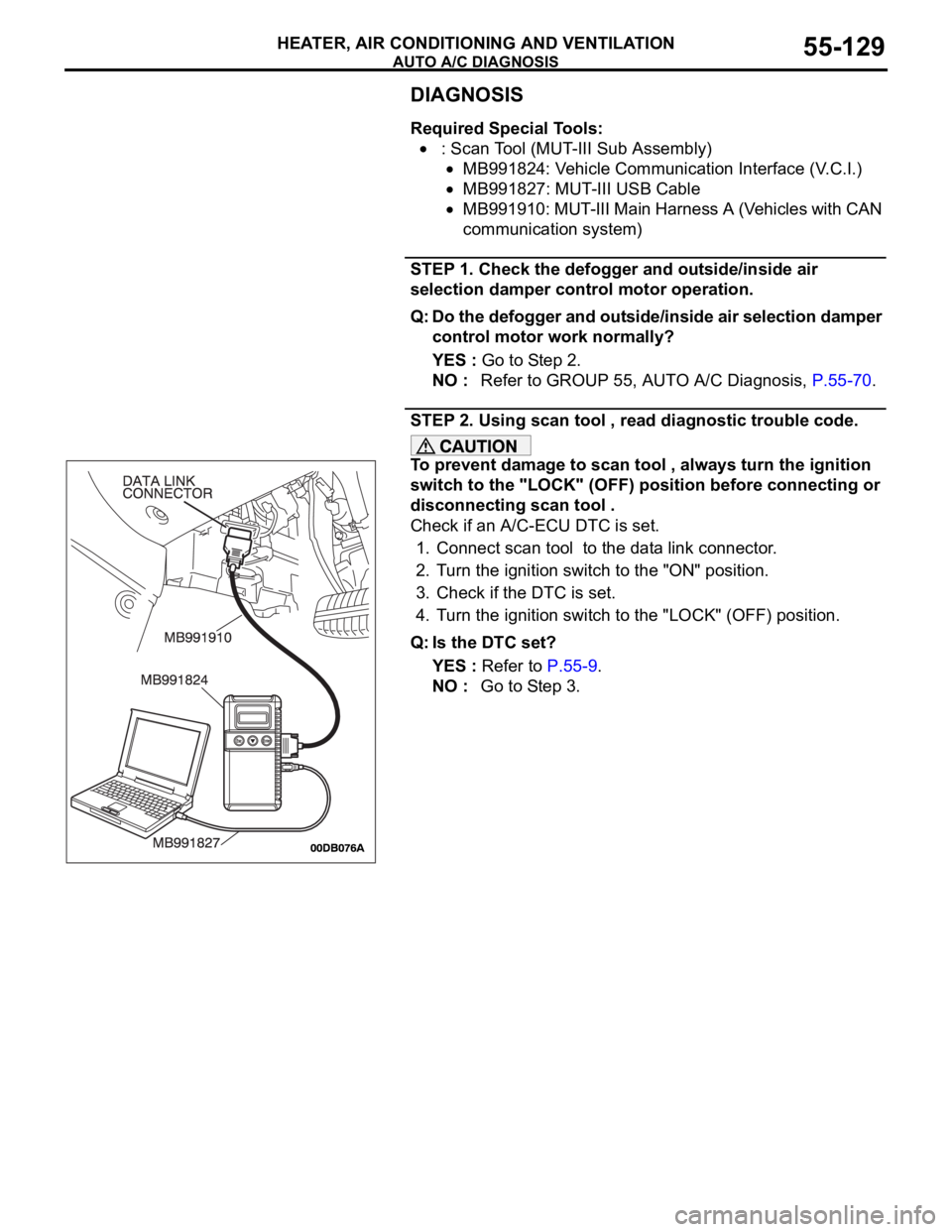
Required Special Tools:
: Scan Tool (MUT-III Sub Assembly)
MB991824: Vehicle Communication Interface (V.C.I.)
MB991827: MUT-III USB Cable
MB991910: MUT-III Main Harness A (Vehicles with CAN
communication system)
STEP 1. Check the defogger and outside/inside air
selection damper control motor operation.
Q: Do the defogger and outside/inside air selection damper
control motor work normally?
YES : Go to Step 2.
NO : Refer to GROUP 55, AUTO A/C Diagnosis, P.55-70.
STEP 2. Using scan tool , read diagnostic trouble code.
To prevent damage to scan tool , always turn the ignition
switch to the "LOCK" (OFF) position before connecting or
disconnecting scan tool .
Check if an A/C-ECU DTC is set.
1. Connect scan tool to the data link connector.
2. Turn the ignition switch to the "ON" position.
3. Check if the DTC is set.
4. Turn the ignition switch to the "LOCK" (OFF) position.
Q: Is the DTC set?
YES : Refer to P.55-9.
NO : Go to Step 3.
Page 831 of 1500
AUTO A/C DIAGNOSIS
HEATER, AIR CONDITIONING AND VENTILATION55-130
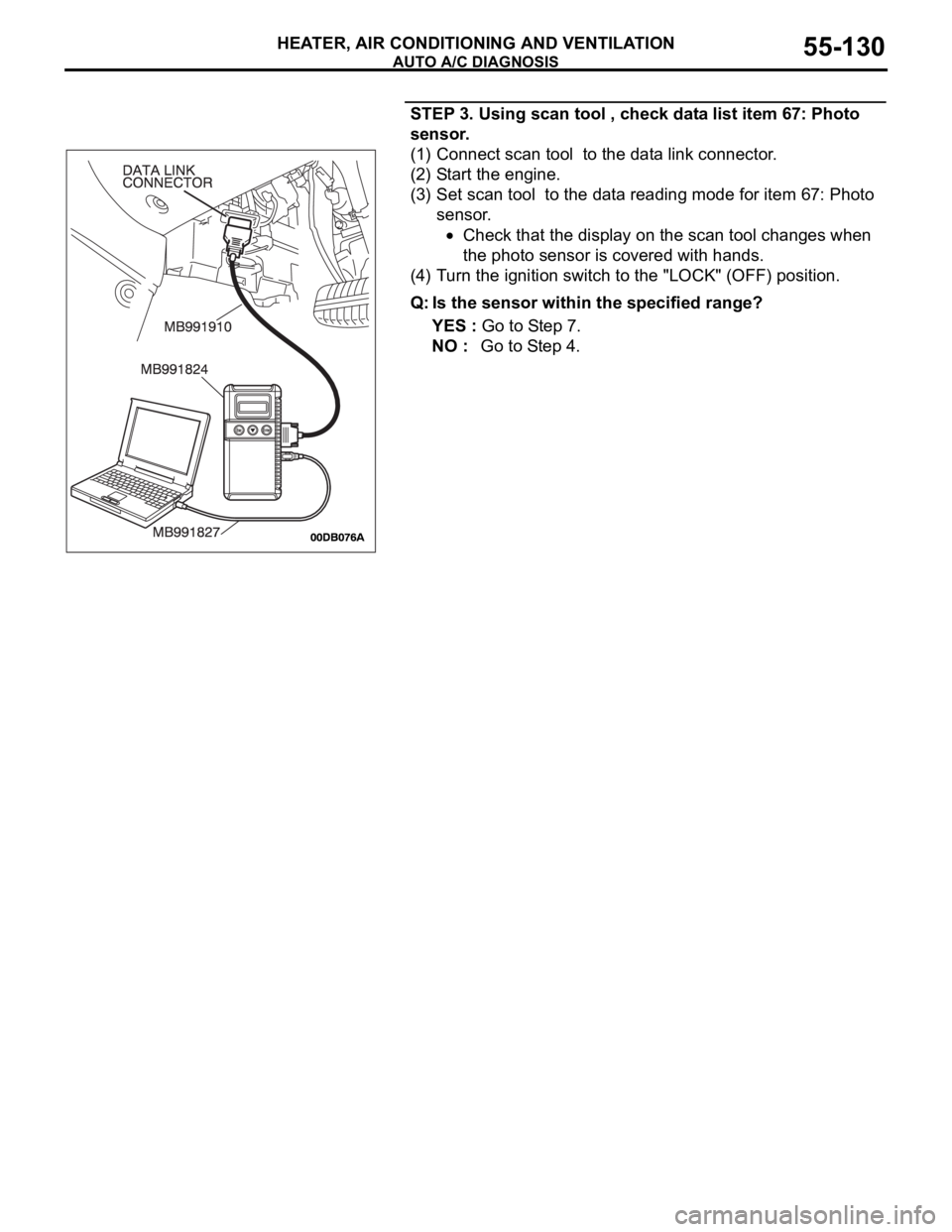
STEP 3. Using scan tool , check data list item 67: Photo
sensor.
(1) Connect scan tool to the data link connector.
(2) Start the engine.
(3) Set scan tool to the data reading mode for item 67: Photo
sensor.
Check that the display on the scan tool changes when
the photo sensor is covered with hands.
(4) Turn the ignition switch to the "LOCK" (OFF) position.
Q: Is the sensor within the specified range?
YES : Go to Step 7.
NO : Go to Step 4.
Page 852 of 1500
HEATER UNIT, HEATER CORE, BLOWER ASSEMBLY AND EVAPORATOR UNIT
HEATER, AIR CONDITIONING AND VENTILATION55-151
HEATER UNIT, HEATER CORE, BLOWER ASSEMBLY AND
EVAPORATOR UNIT
REMOVAL AND INSTALLATIONM1552021400012
Before removing the front seat assembly, refer to GROUP 52B, Service Precautions
P.52B-16 and Air Bag Module and Clock Spring P.52B-237.
Pre-removal and Post-installation Operation
Refrigerant draining and Refilling (Refer to Charging and
Discharging P.55-142).
Engine coolant Draining and Refilling (Refer to GROUP
00, Engine coolant P.00-47).
Instrument Panel Removal and Installation (Refer to
GROUP 52A, Instrument Panel P.52A-4).
Steering Column Shaft Assembly Removal and Installa-
tion (Refer to GROUP 37A, Steering ShaftP.37-25).
Floor Console Removal and Installation (Refer to GROUP
52A, Floor Console P.52A-10).
Front Seat Assembly Removal and Installation (Refer to
GROUP 52A, Front Seat P.52A-21).
² Strut Tower Bar (Refer to GROUP 42, Removal And
InstallationP.42-12.)
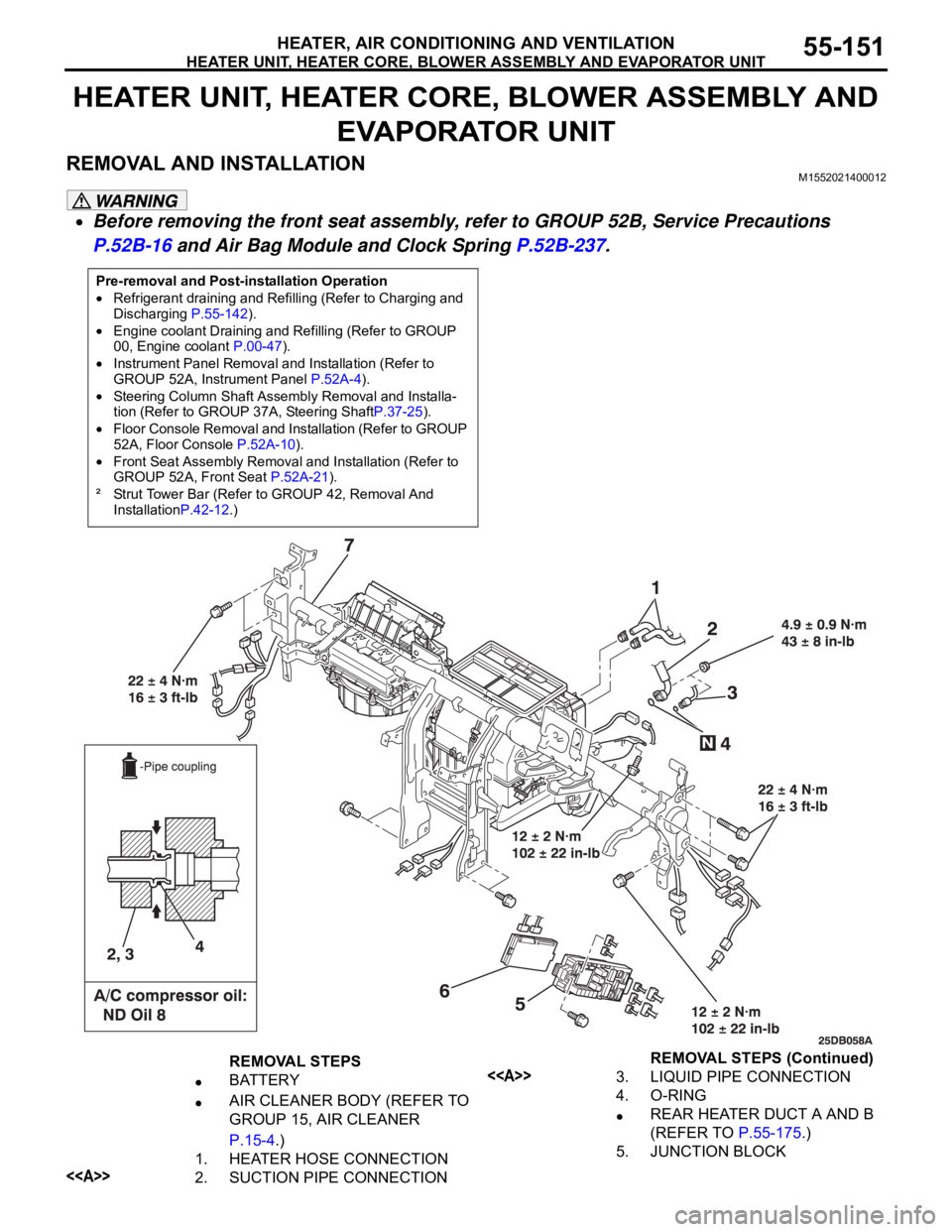
REMOVAL STEPS
BATTERY
AIR CLEANER BODY (REFER TO
GROUP 15, AIR CLEANER
P.15-4.)
1. HEATER HOSE CONNECTION
<>2. SUCTION PIPE CONNECTION
<>3. LIQUID PIPE CONNECTION
4. O-RING
REAR HEATER DUCT A AND B
(REFER TO P.55-175.)
5. JUNCTION BLOCKREMOVAL STEPS (Continued)
Page 872 of 1500
Page 875 of 1500
REFRIGERANT LINE
HEATER, AIR CONDITIONING AND VENTILATION55-174
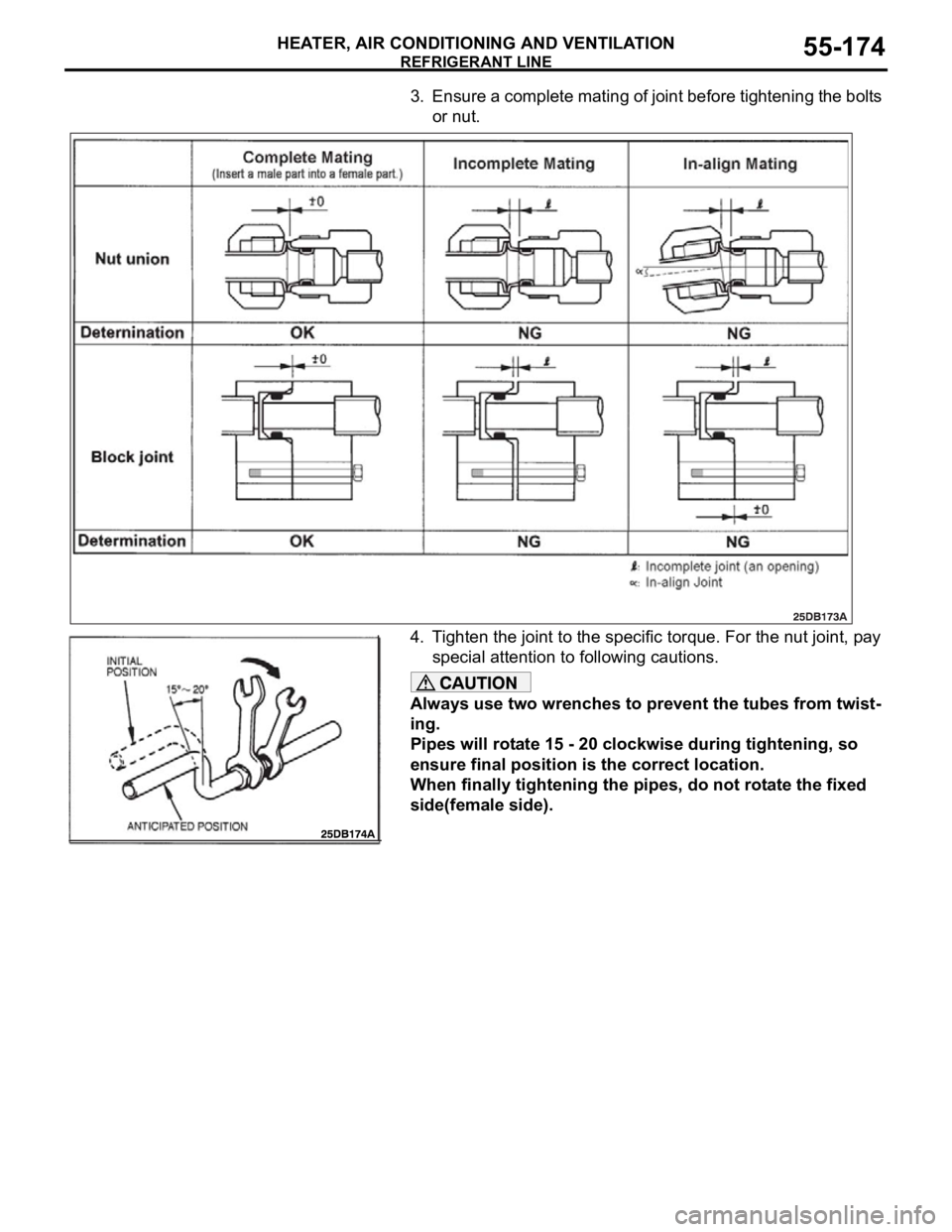
3. Ensure a complete mating of joint before tightening the bolts
or nut.
4. Tighten the joint to the specific torque. For the nut joint, pay
special attention to following cautions.
Always use two wrenches to prevent the tubes from twist-
ing.
Pipes will rotate 15 - 20 clockwise during tightening, so
ensure final position is the correct location.
When finally tightening the pipes, do not rotate the fixed
side(female side).
Page 907 of 1500
HOW TO DIAGNOSE
GENERAL
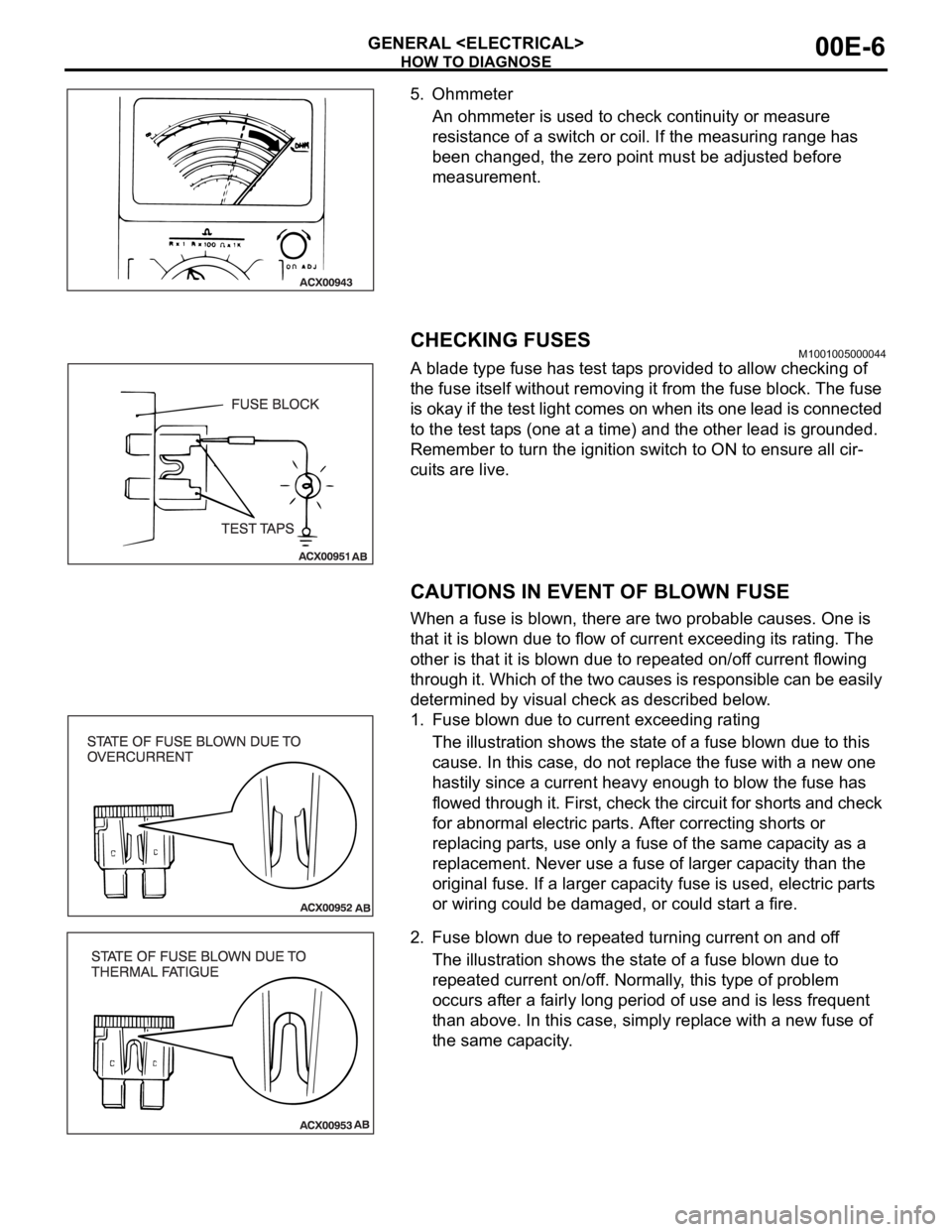
5. Ohmmeter
An ohmmeter is used to check continuity or measure
resistance of a switch or coil. If the measuring range has
been changed, the zero point must be adjusted before
measurement.
CHECKING FUSESM1001005000044
A blade type fuse has test taps provided to allow checking of
the fuse itself without removing it from the fuse block. The fuse
is okay if the test light comes on when its one lead is connected
to the test taps (one at a time) and the other lead is grounded.
Remember to turn the ignition switch to ON to ensure all cir-
cuits are live.
CAUTIONS IN EVENT OF BLOWN FUSE
When a fuse is blown, there are two probable causes. One is
that it is blown due to flow of current exceeding its rating. The
other is that it is blown due to repeated on/off current flowing
through it. Which of the two causes is responsible can be easily
determined by visual check as described below.
1. Fuse blown due to current exceeding rating
The illustration shows the state of a fuse blown due to this
cause. In this case, do not replace the fuse with a new one
hastily since a current heavy enough to blow the fuse has
flowed through it. First, check the circuit for shorts and check
for abnormal electric parts. After correcting shorts or
replacing parts, use only a fuse of the same capacity as a
replacement. Never use a fuse of larger capacity than the
original fuse. If a larger capacity fuse is used, electric parts
or wiring could be damaged, or could start a fire.
2. Fuse blown due to repeated turning current on and off
The illustration shows the state of a fuse blown due to
repeated current on/off. Normally, this type of problem
occurs after a fairly long period of use and is less frequent
than above. In this case, simply replace with a new fuse of
the same capacity.
Page 911 of 1500
HOW TO DIAGNOSE
GENERAL
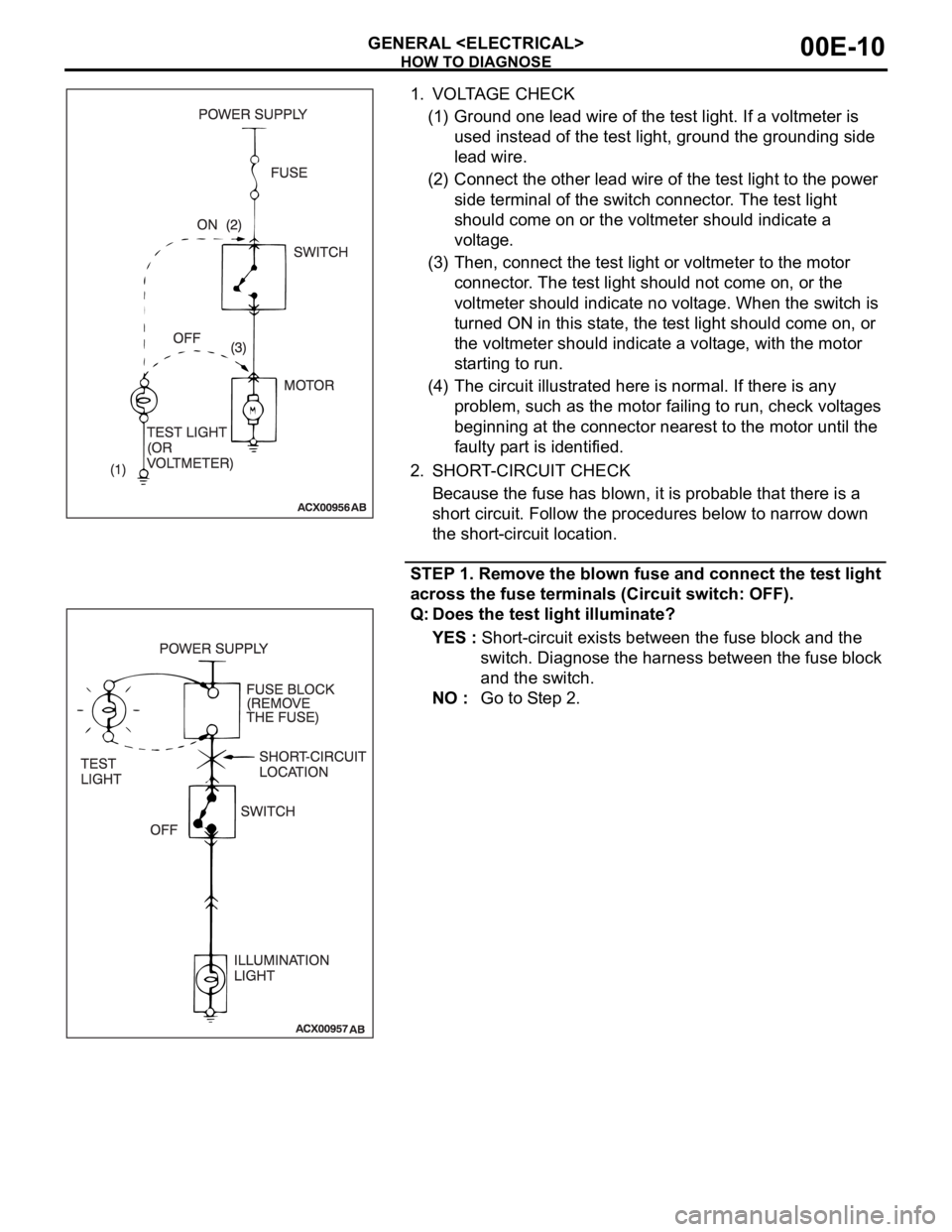
1. VOLTAGE CHECK
(1) Ground one lead wire of the test light. If a voltmeter is
used instead of the test light, ground the grounding side
lead wire.
(2) Connect the other lead wire of the test light to the power
side terminal of the switch connector. The test light
should come on or the voltmeter should indicate a
voltage.
(3) Then, connect the test light or voltmeter to the motor
connector. The test light should not come on, or the
voltmeter should indicate no voltage. When the switch is
turned ON in this state, the test light should come on, or
the voltmeter should indicate a voltage, with the motor
starting to run.
(4) The circuit illustrated here is normal. If there is any
problem, such as the motor failing to run, check voltages
beginning at the connector nearest to the motor until the
faulty part is identified.
2. SHORT-CIRCUIT CHECK
Because the fuse has blown, it is probable that there is a
short circuit. Follow the procedures below to narrow down
the short-circuit location.
STEP 1. Remove the blown fuse and connect the test light
across the fuse terminals (Circuit switch: OFF).
Q: Does the test light illuminate?
YES : Short-circuit exists between the fuse block and the
switch. Diagnose the harness between the fuse block
and the switch.
NO : Go to Step 2.
Page 921 of 1500
ENGINE COOLING DIAGNOSIS
ENGINE COOLING14-6
DIAGNOSIS
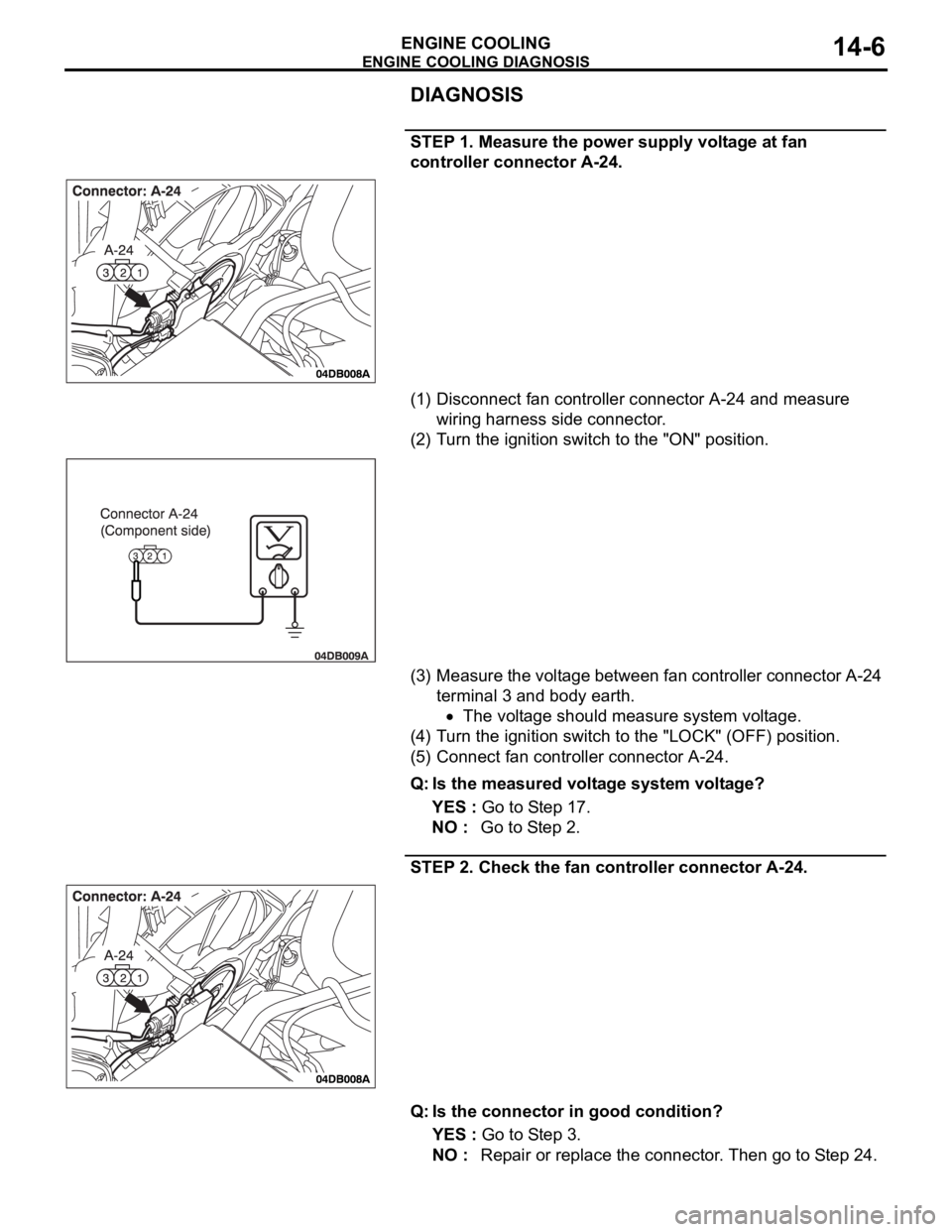
STEP 1. Measure the power supply voltage at fan
controller connector A-24.
(1) Disconnect fan controller connector A-24 and measure
wiring harness side connector.
(2) Turn the ignition switch to the "ON" position.
(3) Measure the voltage between fan controller connector A-24
terminal 3 and body earth.
The voltage should measure system voltage.
(4) Turn the ignition switch to the "LOCK" (OFF) position.
(5) Connect fan controller connector A-24.
Q: Is the measured voltage system voltage?
YES : Go to Step 17.
NO : Go to Step 2.
STEP 2. Check the fan controller connector A-24.
Q: Is the connector in good condition?
YES : Go to Step 3.
NO : Repair or replace the connector. Then go to Step 24.
Page 922 of 1500
ENGINE COOLING DIAGNOSIS
ENGINE COOLING14-7
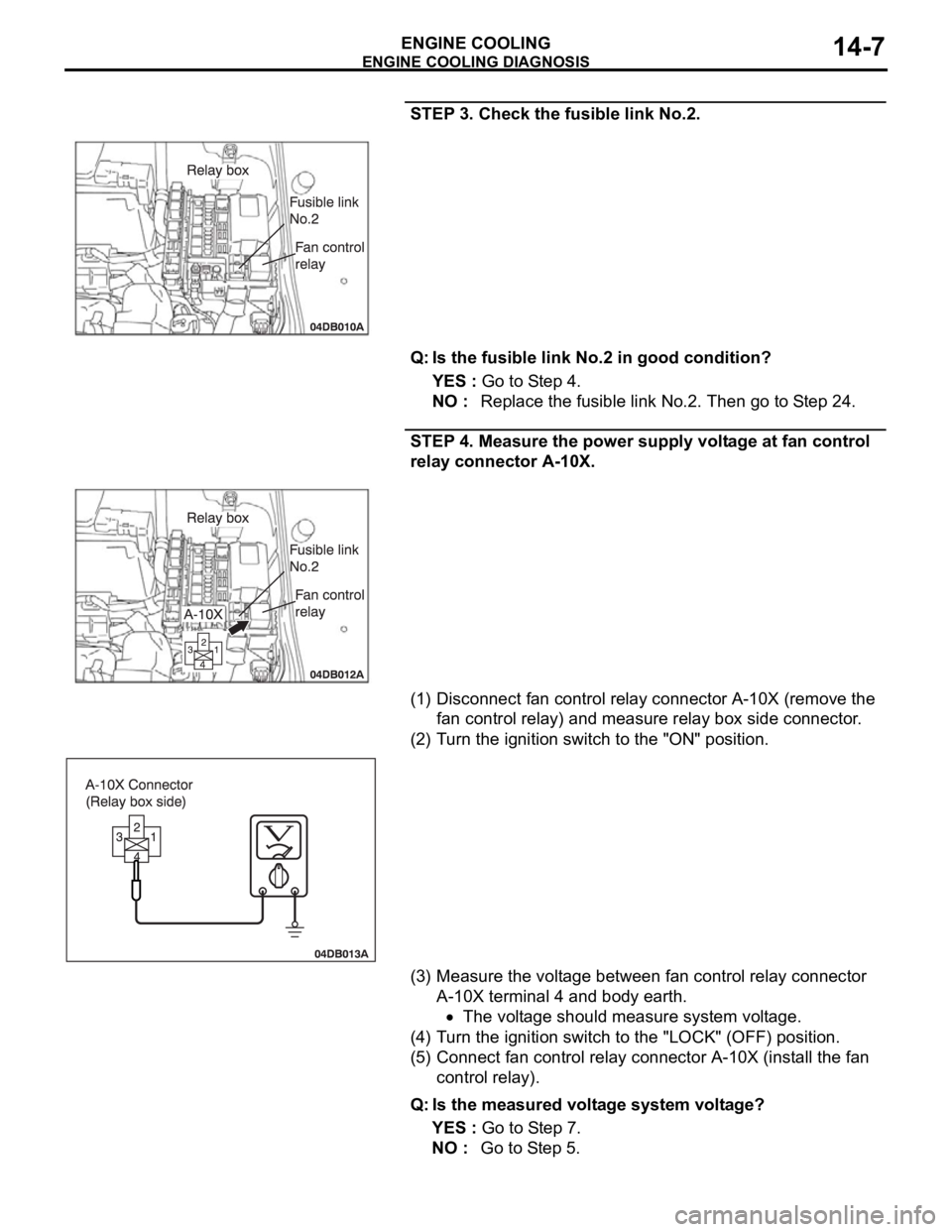
STEP 3. Check the fusible link No.2.
Q: Is the fusible link No.2 in good condition?
YES : Go to Step 4.
NO : Replace the fusible link No.2. Then go to Step 24.
STEP 4. Measure the power supply voltage at fan control
relay connector A-10X.
(1) Disconnect fan control relay connector A-10X (remove the
fan control relay) and measure relay box side connector.
(2) Turn the ignition switch to the "ON" position.
(3) Measure the voltage between fan control relay connector
A-10X terminal 4 and body earth.
The voltage should measure system voltage.
(4) Turn the ignition switch to the "LOCK" (OFF) position.
(5) Connect fan control relay connector A-10X (install the fan
control relay).
Q: Is the measured voltage system voltage?
YES : Go to Step 7.
NO : Go to Step 5.
Page 925 of 1500
ENGINE COOLING DIAGNOSIS
ENGINE COOLING14-10
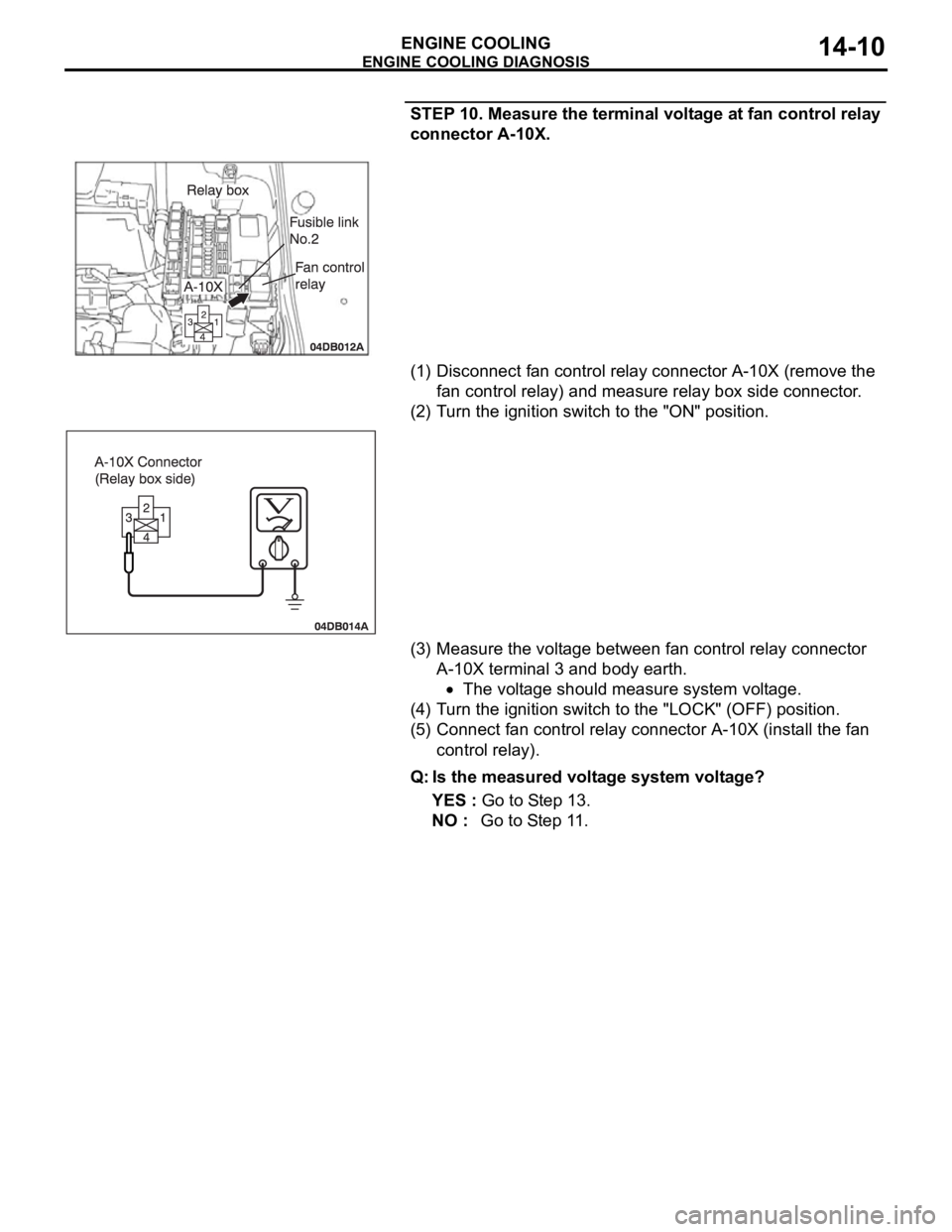
STEP 10. Measure the terminal voltage at fan control relay
connector A-10X.
(1) Disconnect fan control relay connector A-10X (remove the
fan control relay) and measure relay box side connector.
(2) Turn the ignition switch to the "ON" position.
(3) Measure the voltage between fan control relay connector
A-10X terminal 3 and body earth.
The voltage should measure system voltage.
(4) Turn the ignition switch to the "LOCK" (OFF) position.
(5) Connect fan control relay connector A-10X (install the fan
control relay).
Q: Is the measured voltage system voltage?
YES : Go to Step 13.
NO : Go to Step 11.