approximately MITSUBISHI COLT 2008 Owner's Manual (in English)
[x] Cancel search | Manufacturer: MITSUBISHI, Model Year: 2008, Model line: COLT, Model: MITSUBISHI COLT 2008Pages: 450, PDF Size: 14.57 MB
Page 34 of 450
1-6 Locking and unlocking
1
To unlock
Press the UNLOCK switch (2) to unlock all the doors and the
tailgate.
If they are unlocked while the room lamp is not illuminated,
the room lamp will be turned on for approximately 15 seconds
and the turn-signal lamps will blink twice.
NOTE● If the UNLOCK switch (2) is pressed and any of the doors
or tailgate is not opened within approximately 30 seconds:
relocking will automatically occur.
● It is possible to modify the functions as follows:
For further information, contact your MITSUBISHI
MOTORS Authorized Service Point.
• The time from pressing of the UNLOCK switch (2) to
the moment of automatic locking can be changed.
• The confirmation function (f lashing of the turn-signal
lamps) can be set to operate only when the doors and
tailgate are locked or only when the doors and tailgate
are unlocked.
• The confirmation function (which indicates locking or unlocking of the doors and ta ilgate with the flash of the
turn-signal lamps) can be deactivated.
• The number of times the turn-signal lamps are flashed by the confirmation function can be changed.
Operation of the Dead Lock System
For vehicles with a Dead Lock System, the Dead Lock System
can be set using the remote controller.
(Refer to “Dead Lock System’’ on page 1-10.)
NOTE● For vehicles with a Dead Lo ck System, the keyless entry
system will not work while the key is in the ignition
switch.
● Pressing the LOCK switch (1) has no effect (no locking
takes place) if a door or the tailgate is open.
● The remote control switch will operate within about 4m
from the vehicle. However, the operating range of the
remote control switch may chan ge if the vehicle is located
near a TV transmitting tower, power station, or radio
broadcasting station.
● If the turn-signal lamps flash 9 times when you press the
remote control switch, the battery may have run down.
Have the battery replaced by a MITSUBISHI MOTORS
Authorized Service Point.
● If your remote control switch is lost or damaged, please
contact your MITSUBISHI MOTORS Authorized Service
Point for a replacement remote control switch.
● If you wish to add a remote control switch, please contact
your MITSUBISHI MOTORS Authorized Service Point.
A maximum of eight remote control switches are availa-
ble for your vehicle.
Page 73 of 450
Seat and seat belts2-25
2
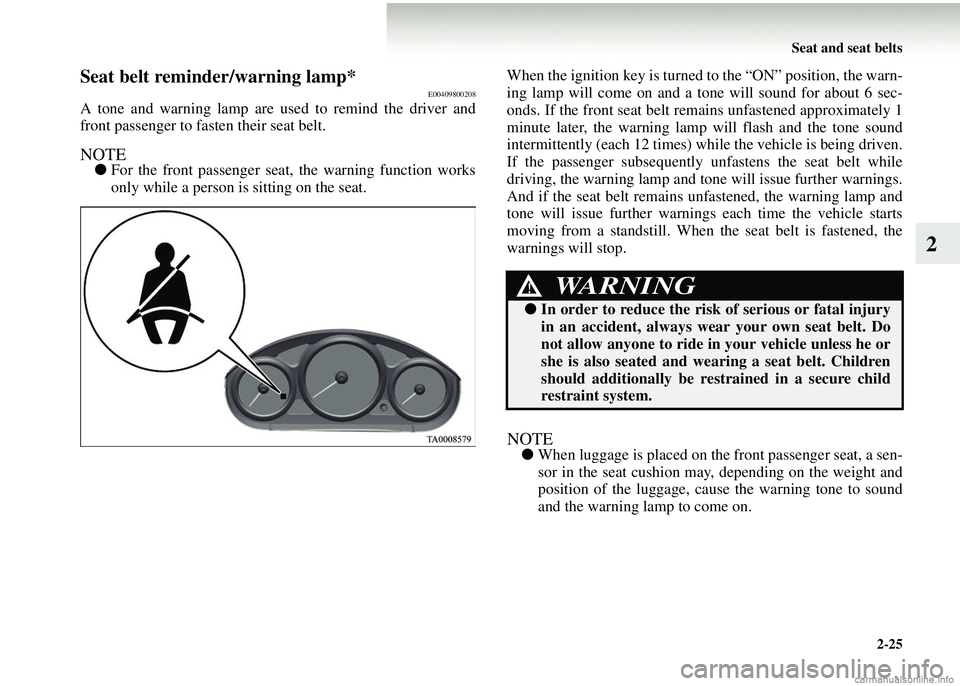
Seat belt reminder/warning lamp*E00409800208
A tone and warning lamp are used to remind the driver and
front passenger to fasten their seat belt.
NOTE●For the front passenger seat, the warning function works
only while a person is sitting on the seat. When the ignition key is turned to the “ON” position, the warn-
ing lamp will come on and a tone will sound for about 6 sec-
onds. If the front seat belt rema
ins unfastened approximately 1
minute later, the warning lamp will flash and the tone sound
intermittently (each 12 times) while the vehicle is being driven.
If the passenger subsequently unfastens the seat belt while
driving, the warning lamp and tone will issue further warnings.
And if the seat belt remains unfastened, the warning lamp and
tone will issue further warnings each time the vehicle starts
moving from a standstill. When th e seat belt is fastened, the
warnings will stop.
NOTE● When luggage is placed on th e front passenger seat, a sen-
sor in the seat cushion may, depending on the weight and
position of the luggage, cause the warning tone to sound
and the warning lamp to come on.
WARNING!
● In order to reduce the risk of serious or fatal injury
in an accident, always wear your own seat belt. Do
not allow anyone to ride in your vehicle unless he or
she is also seated and we aring a seat belt. Children
should additionally be re strained in a secure child
restraint system.
Page 106 of 450

2-58 Seat and seat belts
2
Deployment of front air bagsE00407501077
The front air bags ARE DESIGNED TO DEPLOY when…
The front air bags are designed to deploy when the vehicle suf-
fers a moderate to severe frontal impact. A typical condition is
shown in the illustration.
The front air bags will deploy if the severity of the impact is
above the designed threshold level, comparable to a collision at
approximately 25 km/h (16 mph) when impacting straight into
a solid wall that does not move or deform. If the severity of the
impact is below the above threshold level, the front air bags
may not deploy. However, this threshold speed will be consid-
erably higher if the vehicle stri kes an object that absorbs the
impact by either deforming or moving (for example, another
stationary vehicle, pole or a guard rail). As frontal collisions can easily move you out of position, it is
important always to w
ear the seat belts correctly. Your seat belt
will help to keep you at a sa fe distance from the steering wheel
and instrument panel during the initial stages of air bag deploy-
ment. The initial stage of air bag inflation is the most forceful,
and may cause a serious or fatal injury. Moreover, the seat belts
in your vehicle are your primary means of protection in a colli-
sion. The SRS (Supplemental Re straint System) air bags are
designed to provide additional protection. Therefore, for your
safety and the safety of all the occupants, make sure that the
seat belts are always worn correctly.
A head-on collision with a solid wall at a speed of
approximately 25 km/h (16 mph) or higher Moderate to severe frontal impact within the shaded
area between the arrows
Page 188 of 450

4-22 Starting and driving
4Manual transmission
E00602000232
The shift pattern is shown on the gearshift lever knob. Be sure
to always fully depress the clutch pedal before attempting to
shift the lever.
NOTE●
If it is hard to shift into 1st, depress the clutch pedal again;
the shift will then be easier to make.
● To shift into reverse from 5th gear, move the gearshift
lever to the “N” (Neutral) position, and then shift it into
reverse.
● To avoid grinding noises when shifting into reverse, wait
approximately 3 seconds with the clutch depressed when
the vehicle is stationary.
Changing gearsE00610600022
Always use care to change the gear with the vehicle speed
matched to the engine speed. Proper shifting will improve fuel
economy and prolong engine life.
Avoid shifting down at high speed, as this may cause excessive
engine speed (the tachometer needle into the red zone) and
damage the engine.
CAUTION!
● Do not move the gearshif t lever into reverse while
the vehicle is moving forward; doing so will damage
the transmission.
● Do not rest your foot on the clutch pedal while driv-
ing as this will cause prem ature clutch wear or dam-
age.
Page 206 of 450
4-40 Starting and driving
4
●The ABS becomes operative after the vehicle has acceler-
ated to a speed in excess of approximately 10 km/h (6
mph). It stops operat ing when the vehicle decelerates to a
speed below approximately 10 km/h (6 mph).Electric power steering system
E00607400026
The electric power steering system reduces the effort required
to turn the steering wheel. It operates while the engine is run-
ning.
NOTE● If you repeatedly turn the st eering wheel fully to either
side (while parking, for example), a protective function
that prevents the system from overheating will be acti-
vated, making the steering action gradually heavier. In this
event, turn the steering wheel as little as possible for a
while. When the system’s temperature decreases, the
steering action will return to normal.
● If you turn the steering wheel while the vehicle is station-
ary with its headlamps on, the headlamps may grow dim.
This phenomenon does not indicate a fault. The head-
lamps will return to their original brightness after a short
while.
CAUTION!
●Do not stop the engine while driving. With the
engine stopped, the steeri ng action would become
extremely heavy and an une xpected accident might
occur.
Page 209 of 450

Starting and driving4-43
4
Traction control system (TCL)E00611800021
On slippery surfaces, the traction control system (TCL) pre-
vents the drive wheels from exces sive spinning, thus helping
the vehicle to start m oving from a stop. It also provides suffi-
cient driving force and steerin g performance as the vehicle
turns at accelerated speeds.
NOTE● When moving out of mud or fresh snow, pressing the
accelerator pedal may not cause the engine speed to
increase.
Active stability control system (ASC)E00612000020
The active stability control syst em (ASC) is designed to help
maintain the vehicle’s control in slippery conditions, or during
rapid steering manoeuvres. It works by controlling the engine
output and the brake on each wheel.
NOTE● The active stability control system (ASC) functions at
speeds of approximately 10 km/h or higher.CAUTION!
● When driving a vehicle on a snowy or icy road, be
sure to install snow tyre s and drive the vehicle at
moderate speeds.
Page 355 of 450

Maintenance8-13
8
Diesel- powered vehicles
If the level drops below the “LOW” level on the reserve tank,
open the lid and add coolant to the “FULL” level.
Anti-freeze
The engine coolant contains an ethylene glycol anti-corrosion
agent. The cylinder head and wa ter pump housing are cast alu-
minium alloy, and periodic changing of the engine coolant is
necessary to prevent corrosion of these parts.
Use a High-quality ethylene glycol based coolant. This has
excellent protection against corros ion and rust formation of all
metals including aluminium and can avoid blockages in the
radiator, heater, cylinder head, engine block, etc.
Because of the necessity of this anti-corrosion agent, the cool-
ant must not be replaced with plain water even in summer. The
required concentration of anti -freeze differs depending on the
expected ambient temperature.
During cold weather
If the temperatures in your ar ea drop below freezing, there is a
danger that the coolant in the engine or radiator could freeze
and cause severe damage to the engine and/or radiator. Add a
sufficient amount of anti-freeze to the coolant to prevent it
from freezing.
The engine coolant mixture used at the factory provides protec-
tion against freezing for temperat ures as low as approximately
-30 °C. The concentration should be checked before the start of
cold weather and anti-freeze added to the system if necessary.
WARNING!
●Do not open the reserve tank while the engine is hot.
The coolant system is under pressure and any hot
coolant escaping coul d cause severe burns.
Ambient temperature
(minimum) °C -30 -35 -50
Anti-freeze
concentration % 45 50 60
CAUTION!
●
Do not use alcohol or me thanol anti-freeze or any
engine coolants mixed with alcohol or methanol
anti-freeze. The use of an improper anti-freeze can
cause corrosion of the aluminium components.
● For effective anti-corro sion and anti-freeze per-
formance, keep the anti -freeze concentration within
a range of 45 to 60 %.
Concentrations exceeding 60 % will result in a
reduction of both the an ti-freeze and cooling per-
formance, thus adversel y affecting the engine.
●Do not top up with water only.
Water by itself reduces th e rust-protective and anti-
freeze qualities of the cool ant and has a lower boil-
ing point. It can also cause damage to the cooling
system if it should freeze. Do not use tap water, as it
can cause corrosion and rust formation.