brakes MITSUBISHI ECLIPSE 1990 Service Manual
[x] Cancel search | Manufacturer: MITSUBISHI, Model Year: 1990, Model line: ECLIPSE, Model: MITSUBISHI ECLIPSE 1990Pages: 391, PDF Size: 15.27 MB
Page 3 of 391
TALON
BACKUP
README.N or for additional information
PreViOUSlVmanufactured.a *-a- .I._..-1-L,.* _____ #Q ^_^__ l L.-Orintul in U.S.A.
GROUP INDEXROSA. - -
General. . . . . . . . . . . . . . . . . . . . . . . . . . . . . .. . . . . . . . . . . . . . . . . .
Front Suspensio n................................
.
Brakes - Eir$rii. . . . . . . . . . . . . . . . . . . . . . . . . . ..s...
Clutch. . . . . . . . . . . . . . . . . . . . . . . . . . . . . . . . . . . . . . . . . . . . . . . . . . . .
Cooling. . . . . . :. . . . .. . . . . . . . . . . . . . . . . . . . . . . . . . . . . . . . . . . .
Electrical. . . . . . . . . . . . . . . . . . . . . . . . . . . ..-..................
Engine....................................................
. . . . . . . . . . . . . . . . . . . . . . . . . . . . . . . . . . . . . . . .
Propeller Shaft and Universal. . . . . . . .
ml
. . . . . . . . . . . . . . . . . . . . . . . . . . . . . . . .
Power steeringCD
ManualTransaxl e - Automatic....................
m
Bodym
Heaters and Air ConditioningRI
A
Emission Control Systems
Page 8 of 391
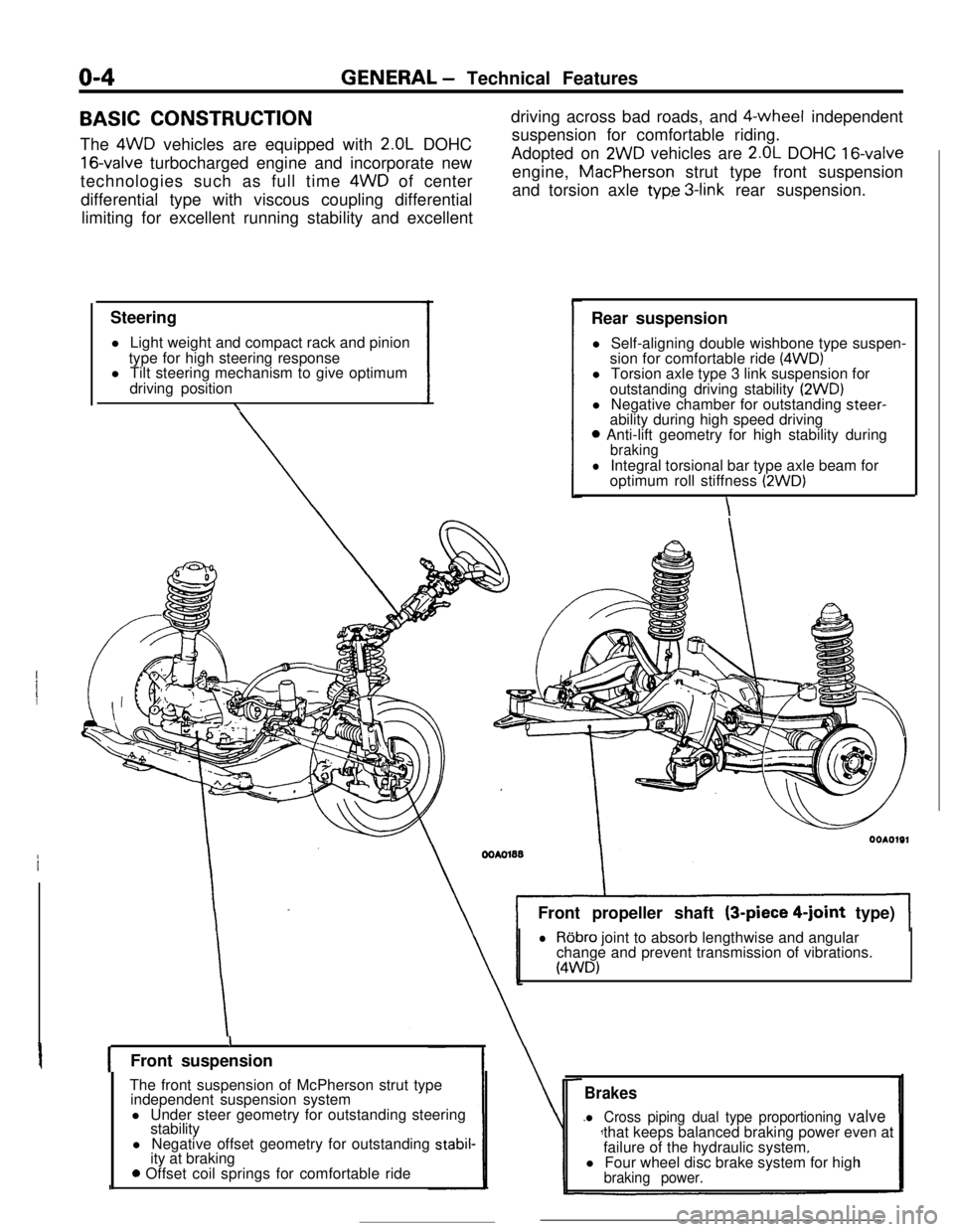
o-4GENERAL - Technical Features
BASIC CONSTRUCTION
The 4WD vehicles are equipped with
2.OL DOHC
16-valve turbocharged engine and incorporate new
technologies such as full time 4WD of center
differential type with viscous coupling differential
limiting for excellent running stability and excellent
Steering
l Light weight and compact rack and pinion
type for high steering response
l Tilt steering mechanism to give optimum
driving position
\driving across bad roads, and $-wheel independent
suspension for comfortable riding.
Adopted on
2WD vehicles are 2.OL DOHC 16-valveengine, MacPherson strut type front suspension
and torsion axle
typ.e 3-link rear suspension.
Rear suspension
l Self-aligning double wishbone type suspen-
sion for comfortable ride
(4WD)l Torsion axle type 3 link suspension for
outstanding driving stability
(2WD)l Negative chamber for outstanding steer-
ability during high speed driving
0 Anti-lift geometry for high stability duringbraking
lIntegral torsional bar type axle beam for
optimum roll stiffness (2WD)
\Front propeller shaft (3-piece
4-joint type)
lRobro joint to absorb lengthwise and angular
change and prevent transmission of vibrations.
(4WD)
IFront suspension
The front suspension of McPherson strut type
independent suspension system
l Under steer geometry for outstanding steering
stability
l Negative offset geometry for outstanding
stabil-ity at braking
0 Offset coil springs for comfortable ride
Brakes
l Cross piping dual type proportioning valvethat keeps balanced braking power even at
failure of the hydraulic system.
l Four wheel disc brake system for high
braking power.
Page 23 of 391
FRONT SUSPENSION - Anti-dive Geometry / Negative-offset Geometry2-5ANTI-DIVE GEOMETRY
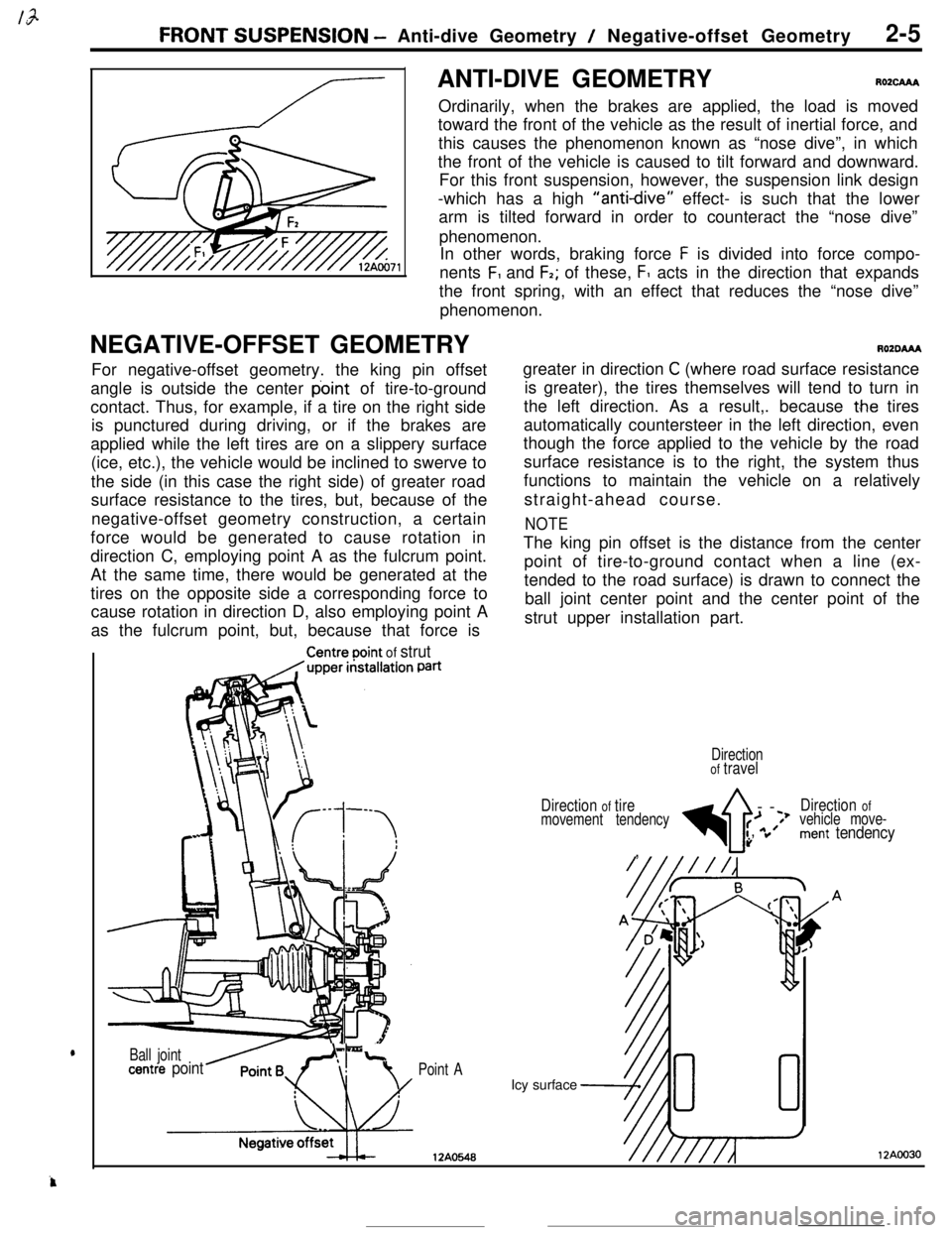
RO2cAAAOrdinarily, when the brakes are applied, the load is moved
toward the front of the vehicle as the result of inertial force, and
this causes the phenomenon known as “nose dive”, in which
the front of the vehicle is caused to tilt forward and downward.
For this front suspension, however, the suspension link design
-which has a high
“anti-dive” effect- is such that the lower
arm is tilted forward in order to counteract the “nose dive”
phenomenon.
In other words, braking force
F is divided into force compo-
nents
F, and F2; of these, F1 acts in the direction that expands
the front spring, with an effect that reduces the “nose dive”
phenomenon.
NEGATIVE-OFFSET GEOMETRY
AOZDAAAFor negative-offset geometry. the king pin offset
angle is outside the center point of tire-to-ground
contact. Thus, for example, if a tire on the right side
is punctured during driving, or if the brakes are
applied while the left tires are on a slippery surface
(ice, etc.), the vehicle would be inclined to swerve to
the side (in this case the right side) of greater road
surface resistance to the tires, but, because of the
negative-offset geometry construction, a certain
force would be generated to cause rotation in
direction C, employing point A as the fulcrum point.
At the same time, there would be generated at the
tires on the opposite side a corresponding force to
cause rotation in direction D, also employing point A
as the fulcrum point, but, because that force is
Centreooint of strutPatigreater in direction
C (where road surface resistance
is greater), the tires themselves will tend to turn in
the left direction. As a result,. because
t.he tires
automatically countersteer in the left direction, even
though the force applied to the vehicle by the road
surface resistance is to the right, the system thus
functions to maintain the vehicle on a relatively
straight-ahead course.
NOTEThe king pin offset is the distance from the center
point of tire-to-ground contact when a line (ex-
tended to the road surface) is drawn to connect the
ball joint center point and the center point of the
strut upper installation part.
Point AIcy surface
12AO548
Ball jointLcentre point
Directionof travel
Direction
of tire
4--
Direction ofmovement tendency>f;’*Jvehicle move-:’
”ment tendency,
12AOO30
Page 37 of 391
BRAKES
CONTENTS
Page 39 of 391
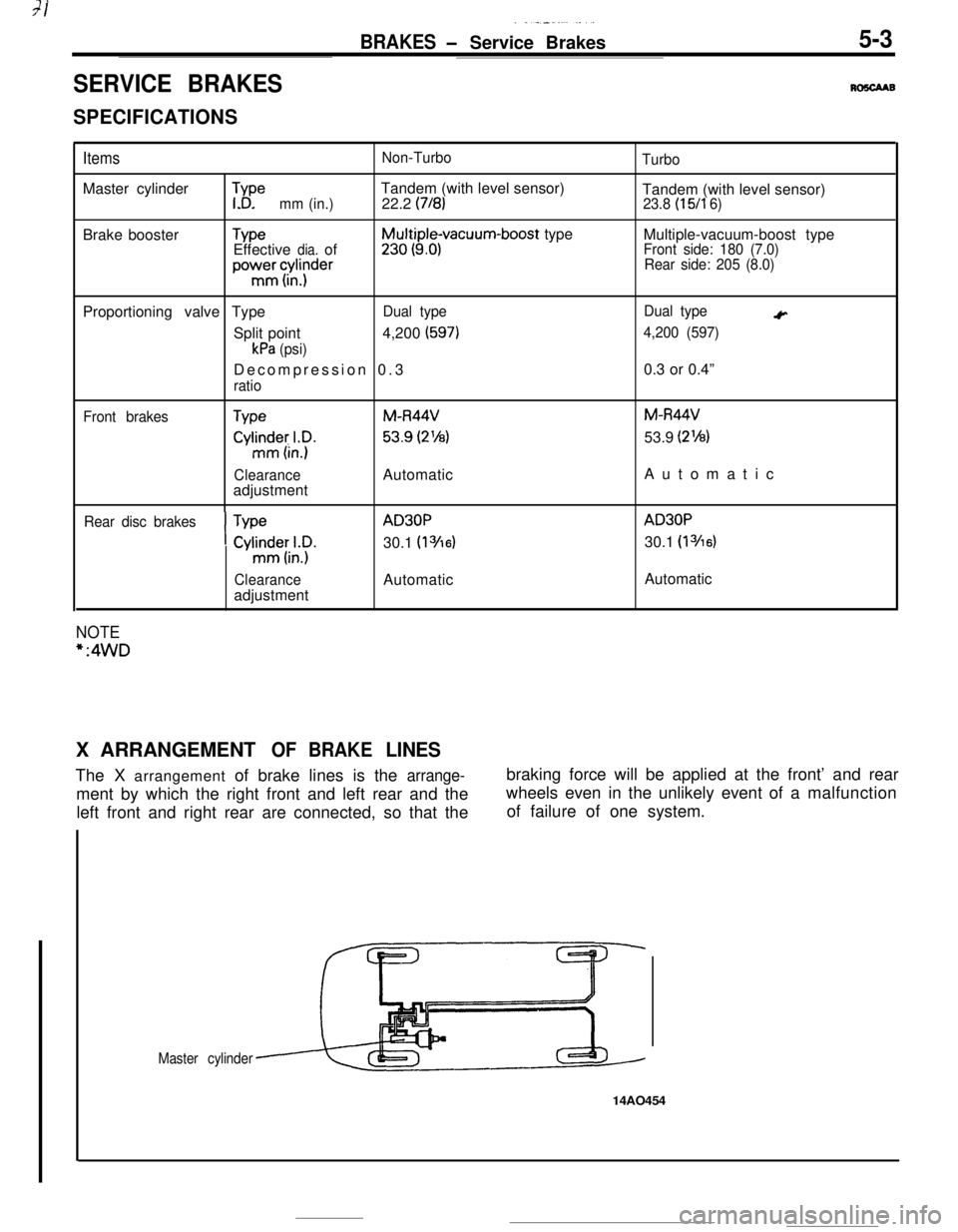
BRAKES - Service Brakes 5-3
$eTandem (with level sensor)
(718)
Brake boosterTYpeEffective dia. of
y3tt$;ivacuum-boost type
powmermc&;der
Proportioning valve Type Dual type
(597)
kPa (psi)
Decompression 0. 3
(15/l 6)
Multiple-vacuum-boost type
c
4,200 (597)
TypeM-R44VM-R44V
cyhnxLy.53.9 (2’/8) 53.9 (2%)
Clearance Automatic Automati
c
I
TypeAD30PAD30P
Cyl~itl;.~. 30.1 (13/16) 30.1 (13/16)
Clearance Automatic Automatic
*:4WD
X
ARRANGEMENT OF BRAKE LINES
Page 41 of 391
7-.
BRAKES - Service Brakes5-5
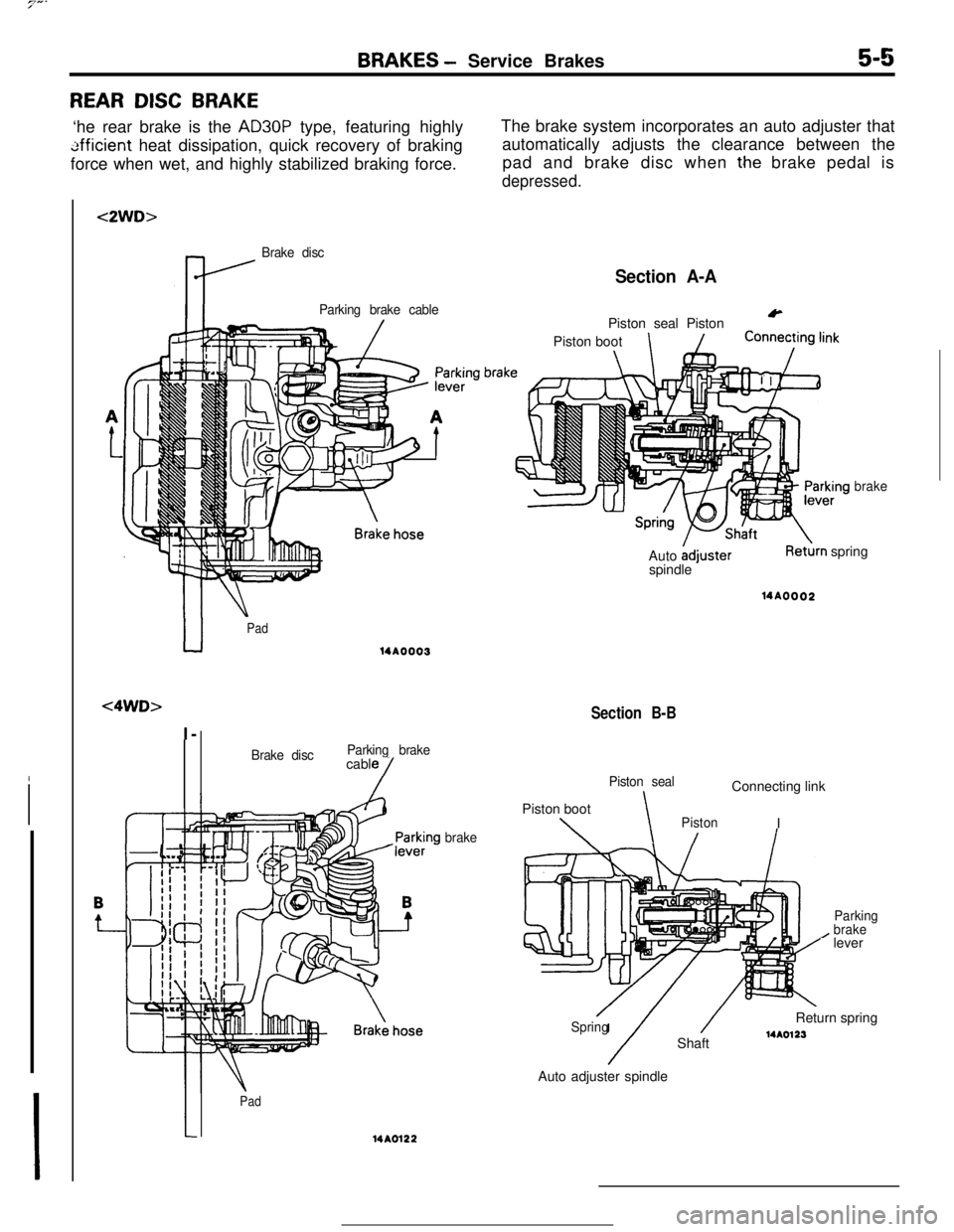
REAR DISC BRAKE‘he rear brake is the
AD30P type, featuring highly
tifficient heat dissipation, quick recovery of braking
force when wet, and highly stabilized braking force.The brake system incorporates an auto adjuster that
automatically adjusts the clearance between the
pad and brake disc when
t.he brake pedal is
depressed.
<2WD>
Brake disc
Parking brake cable
Section A-A
&
u
Pad
<4WD>I-
14A0003
Brake discParking brakecable
/
Pad14A0122
brake
brakPiston seal Piston
Piston boot
\
brakeAuto
AdjusterspindleRet&n spring14AOOO2
Section B-B
Piston sealConnecting link
Piston boot
\\PistonI
/
Parking
brakelever
/Spring
/
/Return spring
Shaft14A0123Auto adjuster spindle
Page 42 of 391
5-6BRAKES - Service Brakes
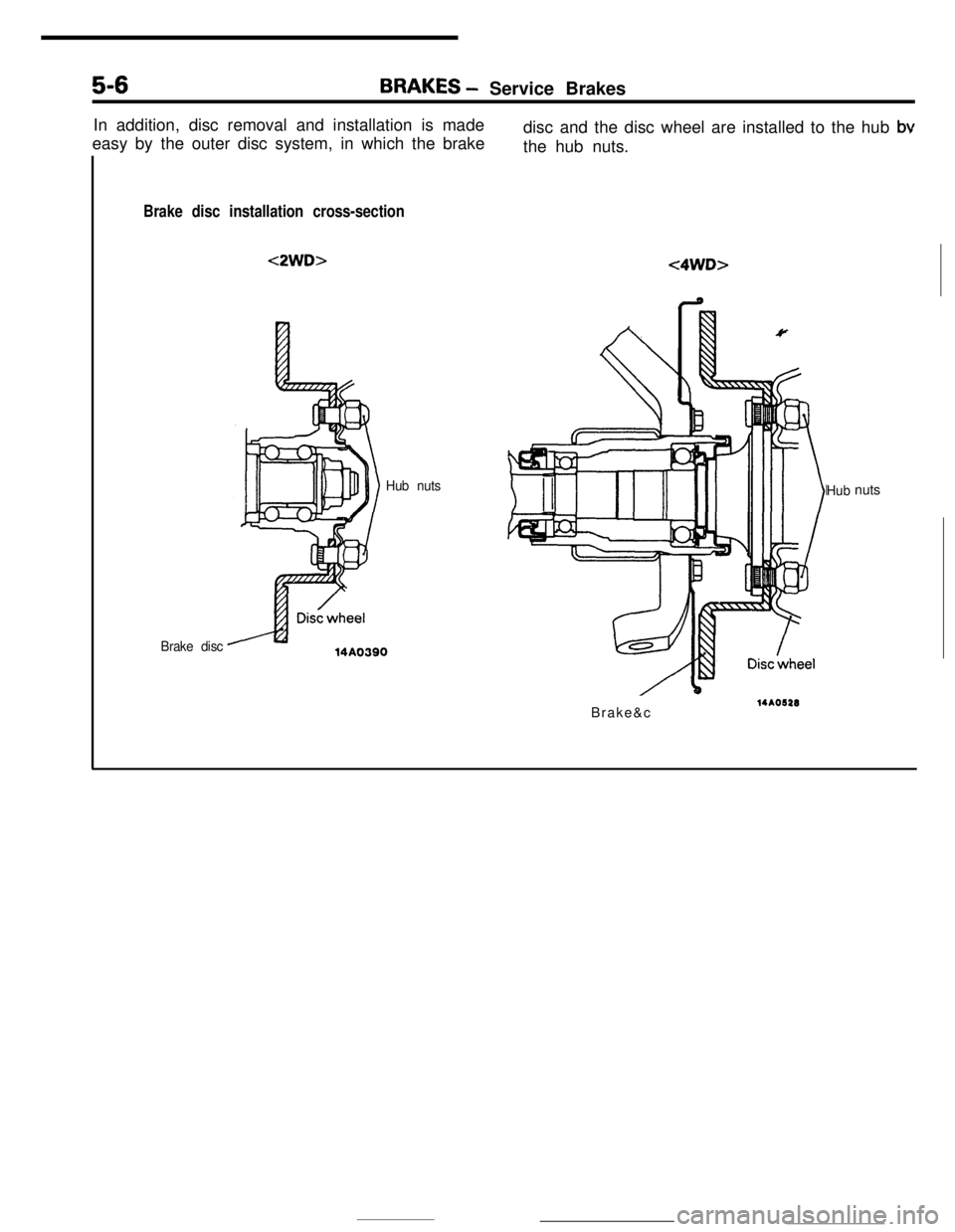
In addition, disc removal and installation is made
easy by the outer disc system, in which the brakedisc and the disc wheel are installed to the hub
bvthe hub nuts.
Brake disc installation cross-section<2WD>
<4WD>
Hub nuts
Brake disc14AO390Hubnuts
Brake&c
14AO622
Page 43 of 391
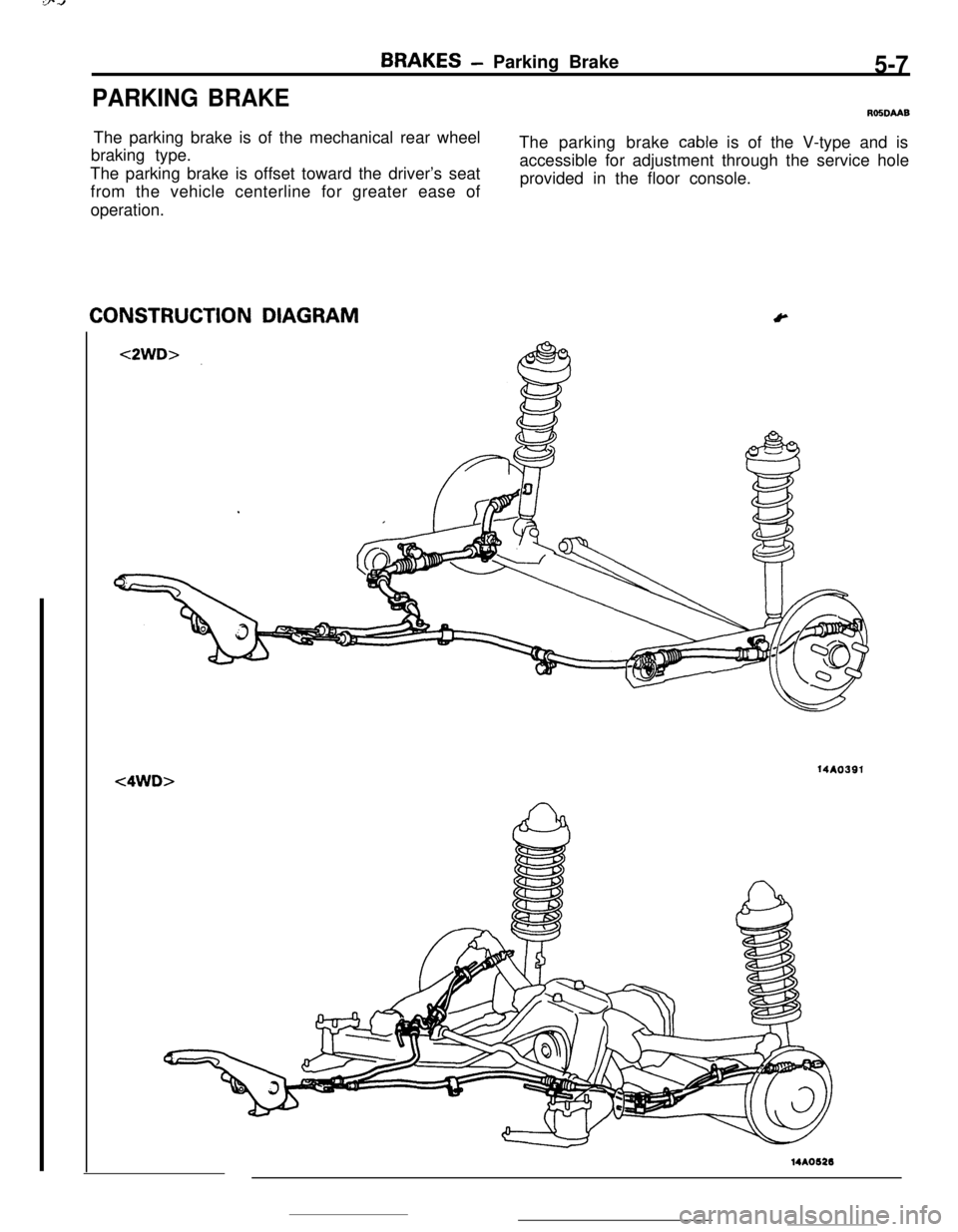
PARKING BRAKE
BRAKES- Parking Brake5-7
ROSDMBThe parking brake is of the mechanical rear wheel
braking type.The parking brake
cable is of the V-type and is
The parking brake is offset toward the driver’s seataccessible for adjustment through the service hole
provided in the floor console.
from the vehicle centerline for greater ease of
operation.CONSTRUCTION DIAGRAM
Y14AO391
<4WD>14A0626
Page 197 of 391
- ._ ____.-.-- -.._ -.-.- - ..__-
17-4 REAR SUSPENSION tZWD>- Wheel Alignment / Anti-lift Geometry
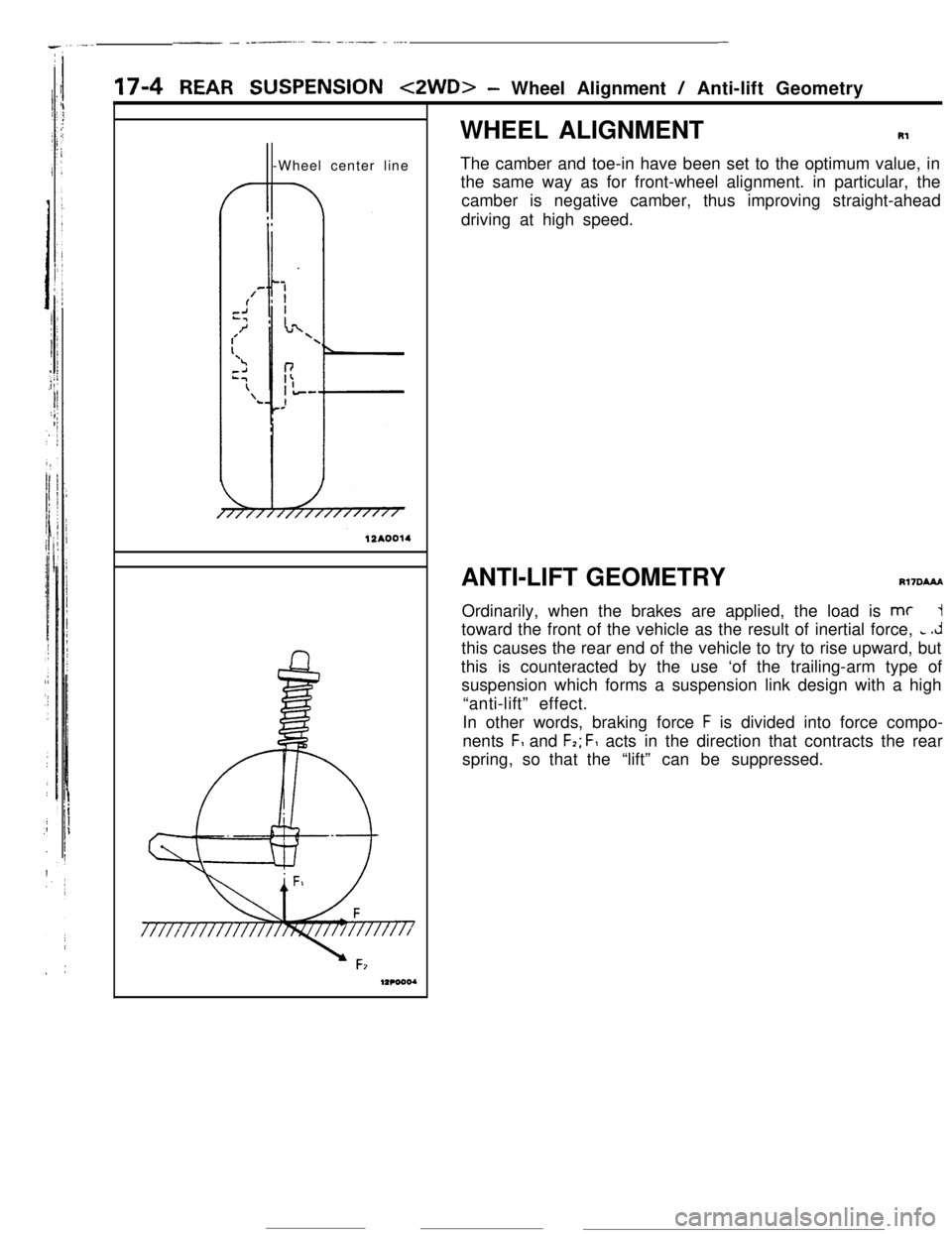
-Wheel center lineWHEEL ALIGNMENTRl
The camber and toe-in have been set to the optimum value, in
the same way as for front-wheel alignment. in particular, the
camber is negative camber, thus improving straight-ahead
driving at high speed.
ANTI-LIFT GEOMETRY
Rl7DAAAOrdinarily, when the brakes are applied, the load is
mc1toward the front of the vehicle as the result of inertial force,
c .Jthis causes the rear end of the vehicle to try to rise upward, but
this is counteracted by the use ‘of the trailing-arm type of
suspension which forms a suspension link design with a high
“anti-lift” effect.
In other words, braking force
F is divided into force compo-
nents
F, and F,; F, acts in the direction that contracts the rear
spring, so that the“lift” can be suppressed.
Page 247 of 391
I,?+7_-AUTOMATIC TRANSAXLE
- Transaxle Mechanism21-23
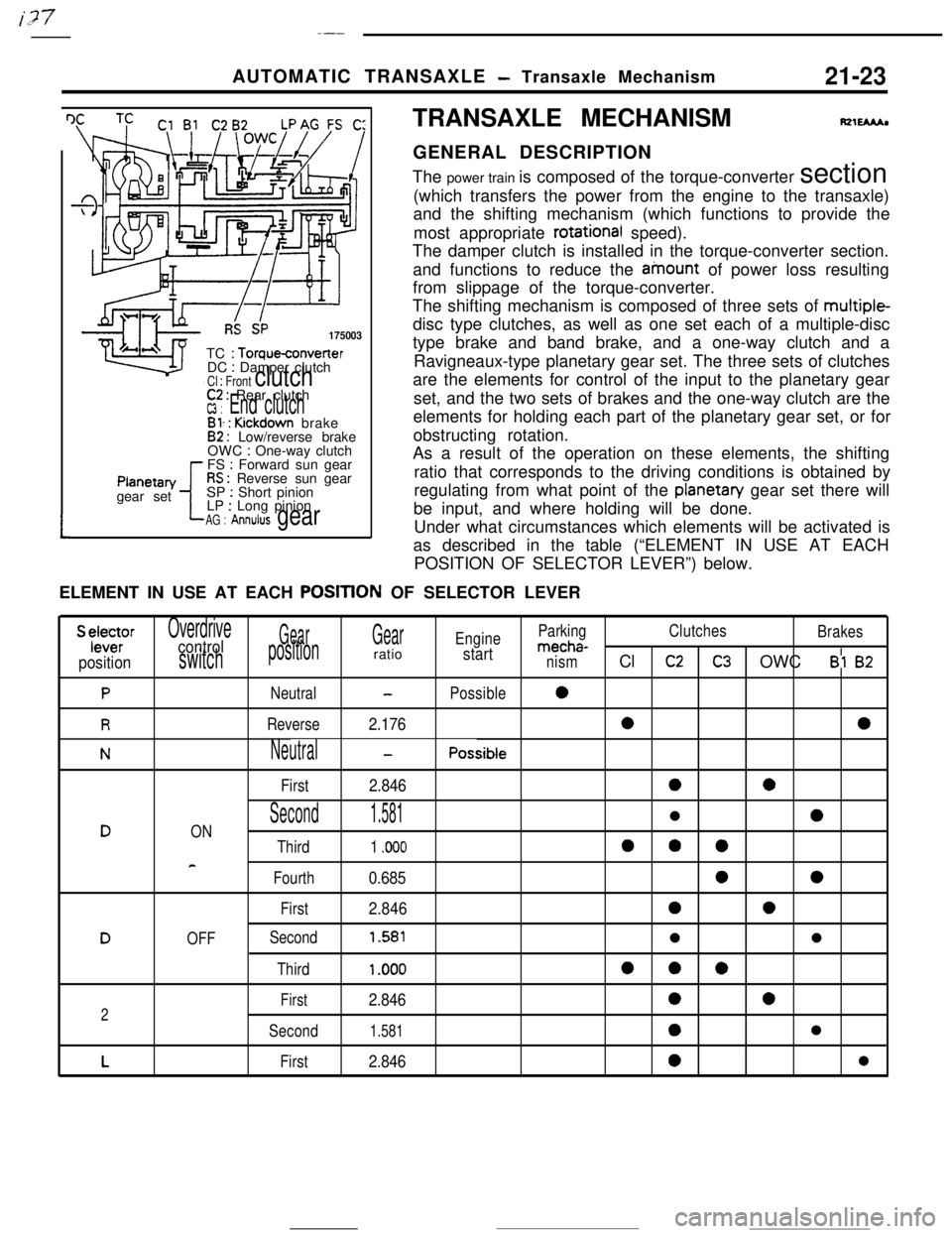
I IRS SP175003TC
: Torqueconverter
DC : Damper clutchCl : Front clutch
tPlanetan/
gear set
C2 : Rear clutchW : End clutchBl. : Kickdown brake82 : Low/reverse brake
OWC : One-way clutch
FS : Forward sun gearRS : Reverse sun gear
SP : Short pinion
LP : Long pinionAG : Annulus gearTRANSAXLE MECHANISM
fQlEMhGENERAL DESCRIPTION
The power train is composed of the torque-converter section
(which transfers the power from the engine to the transaxle)
and the shifting mechanism (which functions to provide the
most appropriate
rotational speed).
The damper clutch is installed in the torque-converter section.
and functions to reduce the ainount of power loss resulting
from slippage of the torque-converter.
The shifting mechanism is composed of three sets of multiple-
disc type clutches, as well as one set each of a multiple-disc
type brake and band brake, and a one-way clutch and a
Ravigneaux-type planetary gear set. The three sets of clutches
are the elements for control of the input to the planetary gear
set, and the two sets of brakes and the one-way clutch are the
elements for holding each part of the planetary gear set, or for
obstructing rotation.
As a result of the operation on these elements, the shifting
ratio that corresponds to the driving conditions is obtained by
regulating from what point of the
planetan/ gear set there will
be input, and where holding will be done.
Under what circumstances which elements will be activated is
as described in the table (“ELEMENT IN USE AT EACH
POSITION OF SELECTOR LEVER”) below.
ELEMENT IN USE AT EACH
POSITtON OF SELECTOR LEVER
S ylele~rOverdriveGearGearEngineParkingClutches
Brakescontrolmecha-
positionswitchpositionratiostartnismCl c2C3 OWC Bl 82
PNeutral-Possible0
RReverse2.17600
NNeutral-Possible
First
2.8460a
Second1.581l0DON
Third1 .ooo000
e
Fourth0.68500
First2.84600
DOFFSecond1.581ll
Third1 .ooo000
First2.846002
Second1.5810l
LFirst2.8460l