ESP MITSUBISHI GALANT 1989 Service User Guide
[x] Cancel search | Manufacturer: MITSUBISHI, Model Year: 1989, Model line: GALANT, Model: MITSUBISHI GALANT 1989Pages: 1273, PDF Size: 37.62 MB
Page 351 of 1273
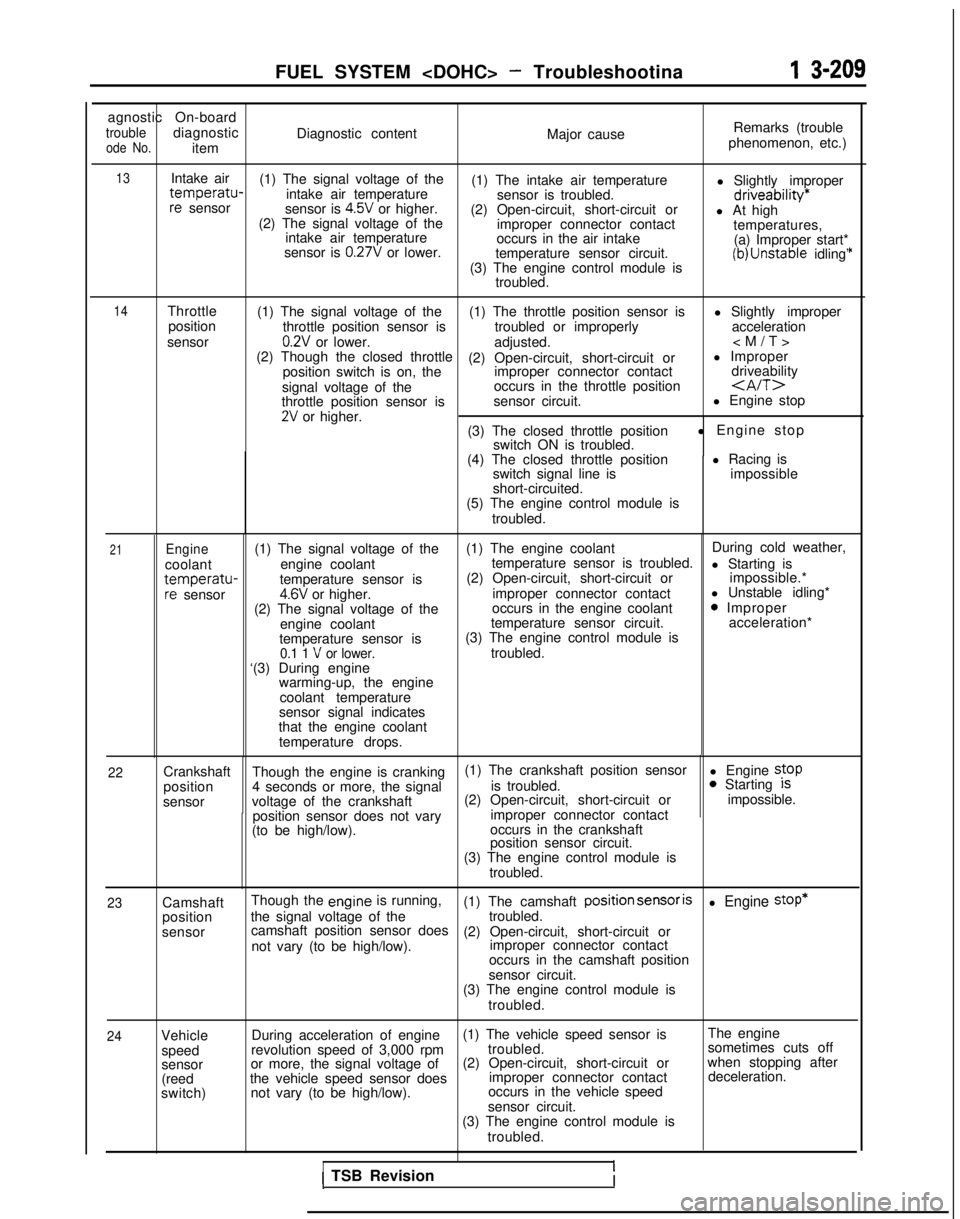
FUEL SYSTEM
agnostic On-boardtroublediagnosticode No.item
Diagnostic content
Major causeRemarks (trouble
phenomenon, etc.)
13Intake air (1) The signal voltage of the
(1) The intake air temperature l Slightly impropertemperatu-intake air temperature
sensor is troubled.driveability*re sensorsensor is 4.5V or higher.(2) Open-circuit, short-circuit or l At high
(2) The signal voltage of the improper connector contacttemperatures,
intake air temperature occurs in the air intake
(a) Improper start*
sensor is
0.27V or lower. temperature sensor circuit. (b)Unstable
idling’
(3) The engine control module is
troubled.
14Throttle
position
sensor (1) The signal voltage of the
(1) The throttle position sensor is l Slightly improper
throttle position sensor is troubled or improperly acceleration
0.2V or lower.adjusted.
(2) Though the closed throttle (2) Open-circuit, short-circuit or l Improper
position switch is on, the improper connector contact driveability
signal voltage of the occurs in the throttle position
throttle position sensor is
sensor circuit. l Engine stop2V or higher.
(3) The closed throttle position l Engine stop
switch ON is troubled.
(4) The closed throttle position l Racing is
switch signal line is impossible
short-circuited.
(5) The engine control module is
troubled.
21Engine(1) The signal voltage of the (1) The engine coolant During cold weather,
coolant engine coolant temperature sensor is troubled.
l Starting is
temperatu-temperature sensor is(2) Open-circuit, short-circuit or
impossible.*re sensor4.6V or higher.improper connector contact l Unstable idling*
(2) The signal voltage of the occurs in the engine coolant0 Improper
engine coolant temperature sensor circuit.
acceleration*
temperature sensor is (3) The engine control module is
0.1 1 V or lower.troubled.
‘(3) During engine warming-up, the engine
coolant temperature
sensor signal indicates
that the engine coolant
temperature drops.
22Crankshaft Though the engine is cranking (1) The crankshaft position sensor
l Engine s,tOp
position4 seconds or more, the signal is troubled.0 Starting Is
sensor
voltage of the crankshaft (2) Open-circuit, short-circuit or
impossible.
position sensor does not vary improper connector contact
(to be high/low). occurs in the crankshaft
position sensor circuit.
(3) The engine control module is
troubled.
23Camshaft Though the engine is running,
(1) The camshaft pOSitiOn
Sensor iSl Engine stoP*position the signal voltage of the troubled.
sensor camshaft position sensor does
(2) Open-circuit, short-circuit or
not vary (to be high/low). improper connector contact
occurs in the camshaft position
sensor circuit.
(3) The engine control module is
troubled.
24Vehiclespeed
sensor
(reed
switch) During acceleration of engine
(1) The vehicle speed sensor is The engine
revolution speed of 3,000 rpm troubled.sometimes cuts off
or more, the signal voltage of (2) Open-circuit, short-circuit or when stopping after
the vehicle speed sensor does improper connector contact
deceleration.
not vary (to be high/low). occurs in the vehicle speed
sensor circuit.
(3) The engine control module is
troubled.
II1 TSB RevisionI
c
Page 355 of 1273
FUEL SYSTEM
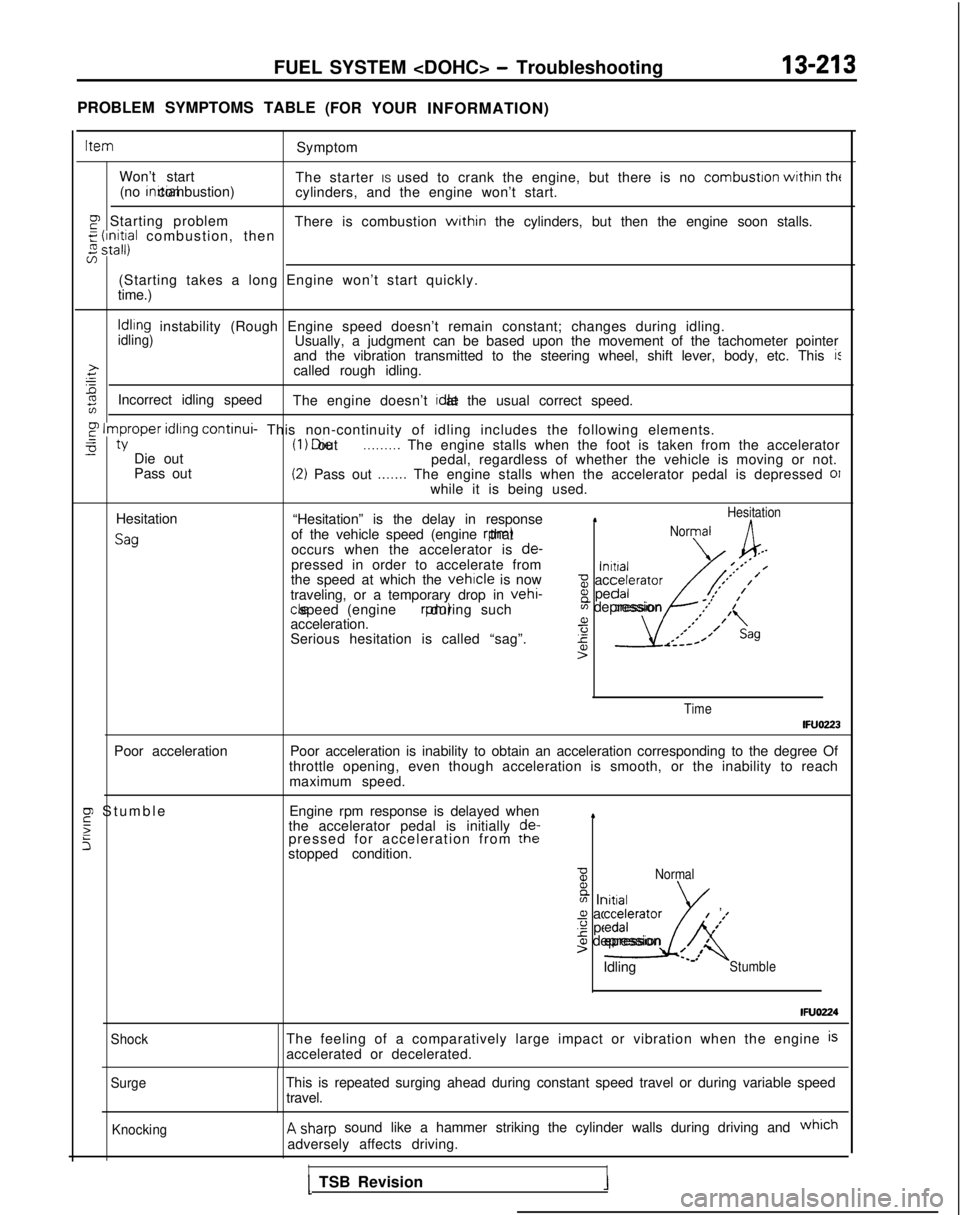
PROBLEM SYMPTOMS TABLE(FORYOUR
INFORMATION) Item
Symptom
Won’t start The starter IS used to crank the engine, but there is no combustron
withrn
tht(no inrtial combustion)
cylinders, and the engine won’t start.
p Starting problem There is combustion within the cylinders, but then the engine soon stalls.g
$$a combustion, then
5
(Starting takes a long Engine won’t start quickly.
time.)
Idling instability (Rough Engine speed doesn’t remain constant; changes du\
ring idling.idling)Usually, a judgment can be based upon the movement of the tachometer poi\
nter
and the vibration transmitted to the steering wheel, shift lever, body, \
etc. This i:>.ccalled rough idling.=
%zIncorrect idling speed The engine doesn’t Idle at the usual correct speed.
F
Improper
idling continui-
This non-continuity of idling includes the following elements.-0tY (I 1 Die out .._.__... The engine stalls when the foot is taken from the accelerator-Die out
pedal, regardless of whether the vehicle is moving or not.
Pass out(2) Pass out .._.... The engine stalls when the accelerator pedal is depressed 01while it is being used.
Hesitation
Sag
“Hesitation” is the delay in response1Hesitation
of the vehicle speed (engine rpm) thatNormal
occurs when the accelerator is
de-,--pressed in order to accelerate from\alnrtral-’‘** /the speed at which the vehicle is nowz accelerator,’ ’
traveling, or a temporary drop in vehi-8 pedal/*’
,’ ,’
cle speed (engine rpm) during such
acceleration. a
Serious hesitation is called “sag”.
4sAK
m depression .I’
1’
,’*;’ I(,
r-----
4’>
Time
IFUOZ23
Poor acceleration Poor acceleration is inability to obtain an acceleration corresponding t\
o the degree Of
throttle opening, even though acceleration is smooth, or the inability t\
o reach maximum speed.
F Stumbl
e
5
5
Engine rpm response is delayed when
the accelerator pedal is initially de-
pressed for acceleration from the
stopped condition.4
BNormal B
m Initiala acceleratorg pedal
I
’
-2
/#’
01 depression4t’>’ /Idling L’Stumble
IFUO224
ShockThe feeling of a comparatively large impact or vibration when the engine\
isaccelerated or decelerated.
SurgeThis is repeated surging ahead during constant speed travel or during va\
riable speed
travel.
KnockingA sharp sound like a hammer striking the cylinder walls during driving and which
adversely affects driving.
II1 TSB Revision1
Page 432 of 1273
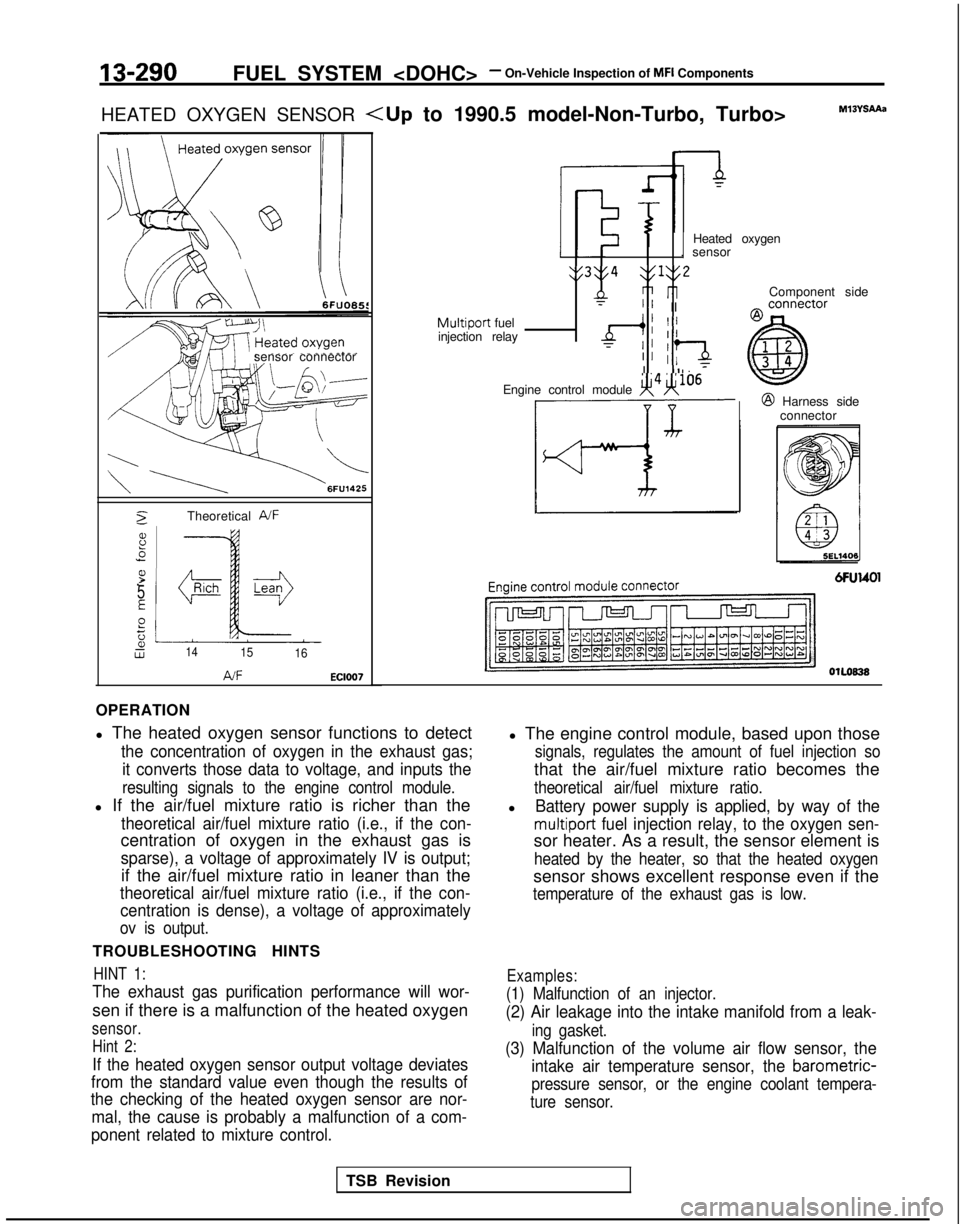
13-290FUEL SYSTEM
HEATED OXYGEN SENSOR
sensor connector
2Theoretical A/F
8.5
P.-
5
E
Pt;2Lw1415 16
AJFEC1007
Component side
Heated oxygen
. sensor
y3y4 $1y2
nri rlT” IIMultiport fuel
injection relayd; II
TII :‘aII Il. 7
Engine control module x4H106@ Harness side
connector
OlLoB38
OPERATION
l The heated oxygen sensor functions to detect
the concentration of oxygen in the exhaust gas;
it converts those data to voltage, and inputs the
resulting signals to the engine control module.
l If the air/fuel mixture ratio is richer than the
theoretical air/fuel mixture ratio (i.e., if the con-
centration of oxygen in the exhaust gas is
sparse), a voltage of approximately IV is output;
if the air/fuel mixture ratio in leaner than the
theoretical air/fuel mixture ratio (i.e., if the con-centration is dense), a voltage of approximately
ov is output.
TROUBLESHOOTING HINTS
HINT 1:
The exhaust gas purification performance will wor-
sen if there is a malfunction of the heated oxygen
sensor.
Hint 2:
If the heated oxygen sensor output voltage deviates
from the standard value even though the results of
the checking of the heated oxygen sensor are nor-
mal, the cause is probably a malfunction of a com-
ponent related to mixture control.
l The engine control module, based upon those
signals, regulates the amount of fuel injection so
that the air/fuel mixture ratio becomes the
theoretical air/fuel mixture ratio.
lBattery power supply is applied, by way of the
multiport fuel injection relay, to the oxygen sen-
sor heater. As a result, the sensor element is
heated by the heater, so that the heated oxygen
sensor shows excellent response even if the
temperature of the exhaust gas is low.
Examples:
(1) Malfunction of an injector.
(2) Air leakage into the intake manifold from a leak-
ing gasket.
(3) Malfunction of the volume air flow sensor, the intake air temperature sensor, the
barometric-
pressure sensor, or the engine coolant tempera-
ture sensor.
TSB Revision
Page 467 of 1273

t&-----Eye bolt
Gasket
Fuel filter
#-----
Flare nut
;y;; main ------A\
J")
FUEL SYSTEM
Mounting
bolts 03F008
I--l03FOO7Standard value: 20-25 mm (8-1.0 in.)
t&-----Eye bolt
Gasket
Fuel filter
#-----
Flare nut
;y;; main ------A\
J
I
-.
High-presfuel hose
J-ring
O”
SERVICE POINTS OF REMOVALMlSKBAMl
1. REMOVAL OF EYE BOLT
Remove the eye bolt while holding the fuel filter nut
securely.
Caution
Cover the hose connection with rags to prevent splash
of fuel that could be caused by some residual pressure
in the fuel pipe line.
3. REMOVAL OF FUEL FILTER (1) Loosen the main pipe flare nut while holding the fuelfilter nut securely.
(2) Remove the fuel filter mounting bolts, and then remove the fuel filter from the bracket.
INSPECTIONMlOKCABl
l Check the hose and pipes for cracks, bend, deformationand clogging.
lCheck the evaporative emission canister for clogging.
l Check the fuel filter for clogging and damage.
SERVICE POINTS OF INSTALLATIONMlJKDAPl
6. INSTALLATION OF FUEL VAPOR HOSE/4. FUEL RE-
TURN HOSE
(1) If the fuel pipe has a stepped part, connect the fuel
hose to the pipe securely, up to the stepped part, as
shown in the figure.
(2) If the fuel pipe does not have a stepped part, connect the fuel hose to the pipe securely, so that it is the
standard value.
3. INSTALLATION OF FUEL FILTER (1) When installing the fuel filter, first temporarily install thefilter to the filter bracket; then insert the main pipe at
the connector part of the filter, and manually screw in
the main pipe’s flare nut.
(2) Holding the fuel filter nut, tighten the fuel main pipe’s
flare nut and eye bolt at the specified torque. Then
tighten the filter to the bracket.
TSB Revision 2. INSTALLATION OF HIGH PRESSURE FUEL HOSE
Apply engine oil to the hose union.
Insert the hose, being careful not to damage the O-ring, and
tighten securely.
Caution
Because there is high pressure applied between the
fuel pump and the injection mixer, be especially sure
that there is no fuel leakage in this area.
Page 468 of 1273
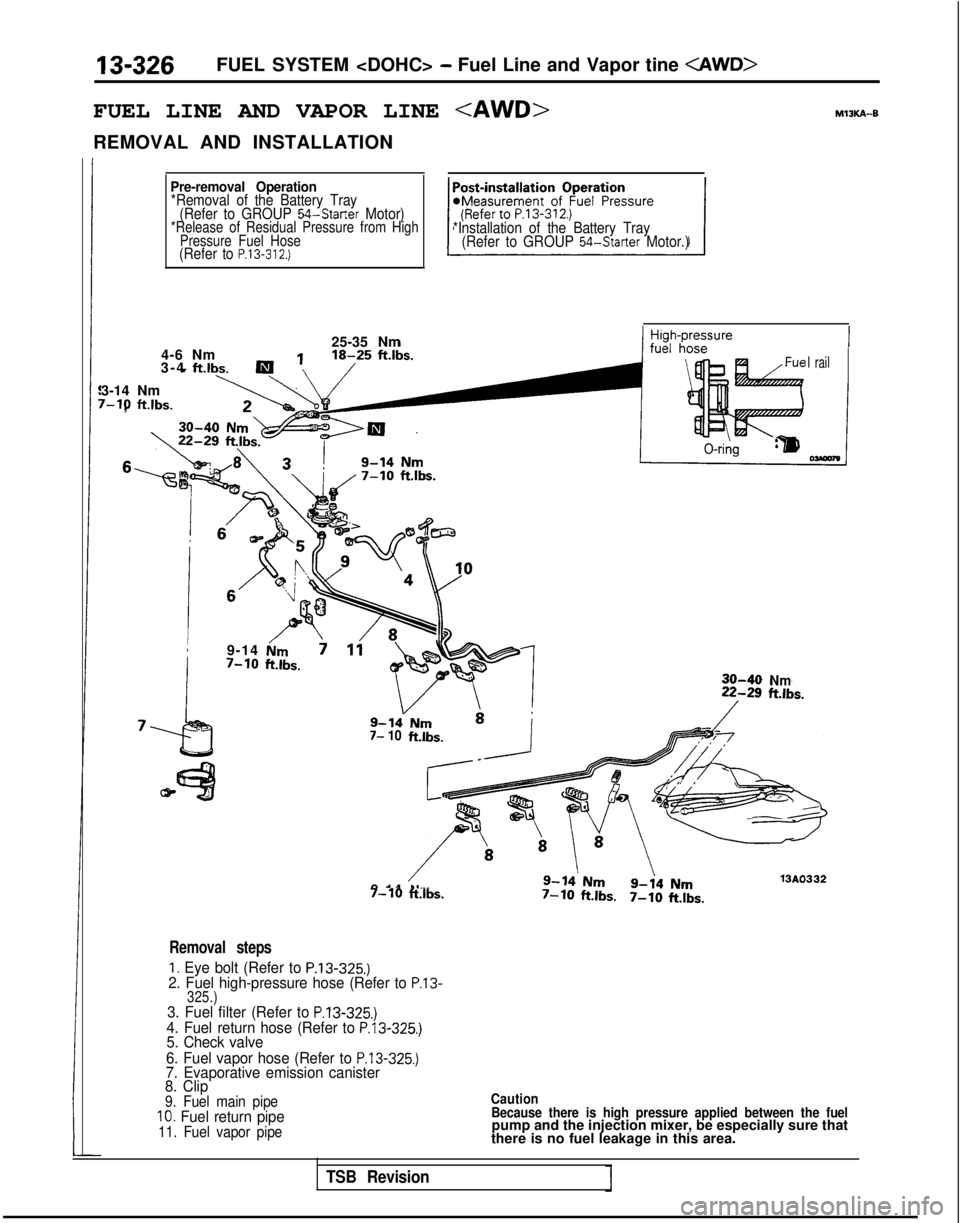
13-326FUEL SYSTEM
FUEL LINE AND VAPOR LINE
REMOVAL AND INSTALLATION
Pre-removal Operation*Removal of the Battery Tray(Refer to GROUP 54-Starter Motor)*Release of Residual Pressure from High Pressure Fuel Hose
(Refer to P.13-312.)
*Installation of the Battery Tray(Refer to GROUP 54-Starter Motor.)
25-35 Nm
4-6 Nm
3-4
ft.lbs.i
3-14 Nm v-10
ftlbs.
,
I rail
9-14rGm7-10ft.lbs.30-40Nm
7- 10 ftlbs.
13AO3329-14Nm7-10ft.lbs.7-10ft.lbs.7-10
ftlbs.
Removal steps
1. Eye bolt (Refer to P.13-325.)2. Fuel high-pressure hose (Refer to P.13-325.)3. Fuel filter (Refer to P.13-325.)4. Fuel return hose (Refer to P.13-325.)5. Check valve
6. Fuel vapor hose (Refer to
P.13-325.)7. Evaporative emission canister
8. Clip
9. Fuel main pipe10. Fuel return pipe11. Fuel vapor pipe Caution
Because there is high pressure applied between the fuelpump and the injection mixer, be especially sure that
there is no fuel leakage in this area.
TSB Revision
Page 495 of 1273
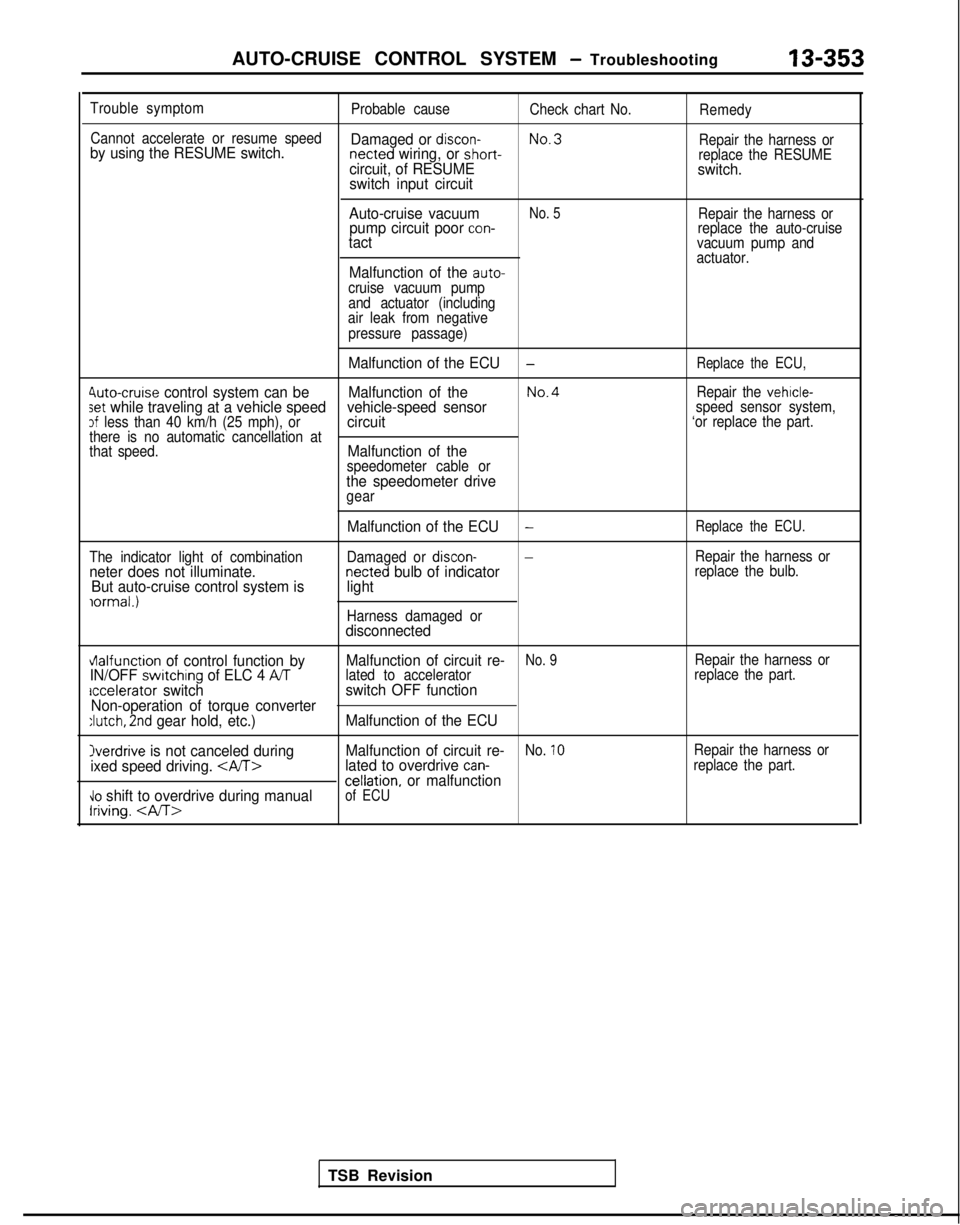
AUTO-CRUISE CONTROL SYSTEM - Troubleshooting13-353
Trouble symptom
Probable causeCheck chart No.Remedy
Cannot accelerate or resume speed
No.3
by using the RESUME switch. Damaged or discon- netted wiring, or short-
Repair the harness orcircuit, of RESUMEreplace the RESUMEswitch.
switch input circuit
Auto-cruise vacuum
No. 5Repair the harness orpump circuit poor con-replace the auto-cruisetactvacuum pump and
actuator.
Malfunction of the auto-cruise vacuum pump
and actuator (including
air leak from negative
pressure passage)
Malfunction of the ECU-Replace the ECU,
4uto-cruise control system can be Malfunction of theNo.4Repair the vehicle-set while traveling at a vehicle speed vehicle-speed sensorspeed sensor system,3f less than 40 km/h (25 mph), orcircuit‘or replace the part.
there is no automatic cancellation at
that speed.
Malfunction of thespeedometer cable orthe speedometer drivegear
The indicator light of combination
neter does not illuminate. But auto-cruise control system is
iormal.)
Malfunction of the ECU-Replace the ECU.
Damaged or discon--Repair the harness ornetted bulb of indicatorreplace the bulb.light
Harness damaged ordisconnected
vlalfunction of control function by Malfunction of circuit re-No. 9Repair the harness orIN/OFF switchrng of ELC 4 ATlated to accelerator
replace the part.accelerator switchswitch OFF function
Non-operation of torque converter
:lutch, 2nd gear hold, etc.) Malfunction of the ECU
Overdrive is not canceled during Malfunction of circuit re-No. 10Repair the harness or
ixed speed driving. lated to overdrive can-replace the part.cellation, or malfunction\lo shift to overdrive during manualIriving.
of ECU
TSB Revision
Page 501 of 1273

Page 553 of 1273
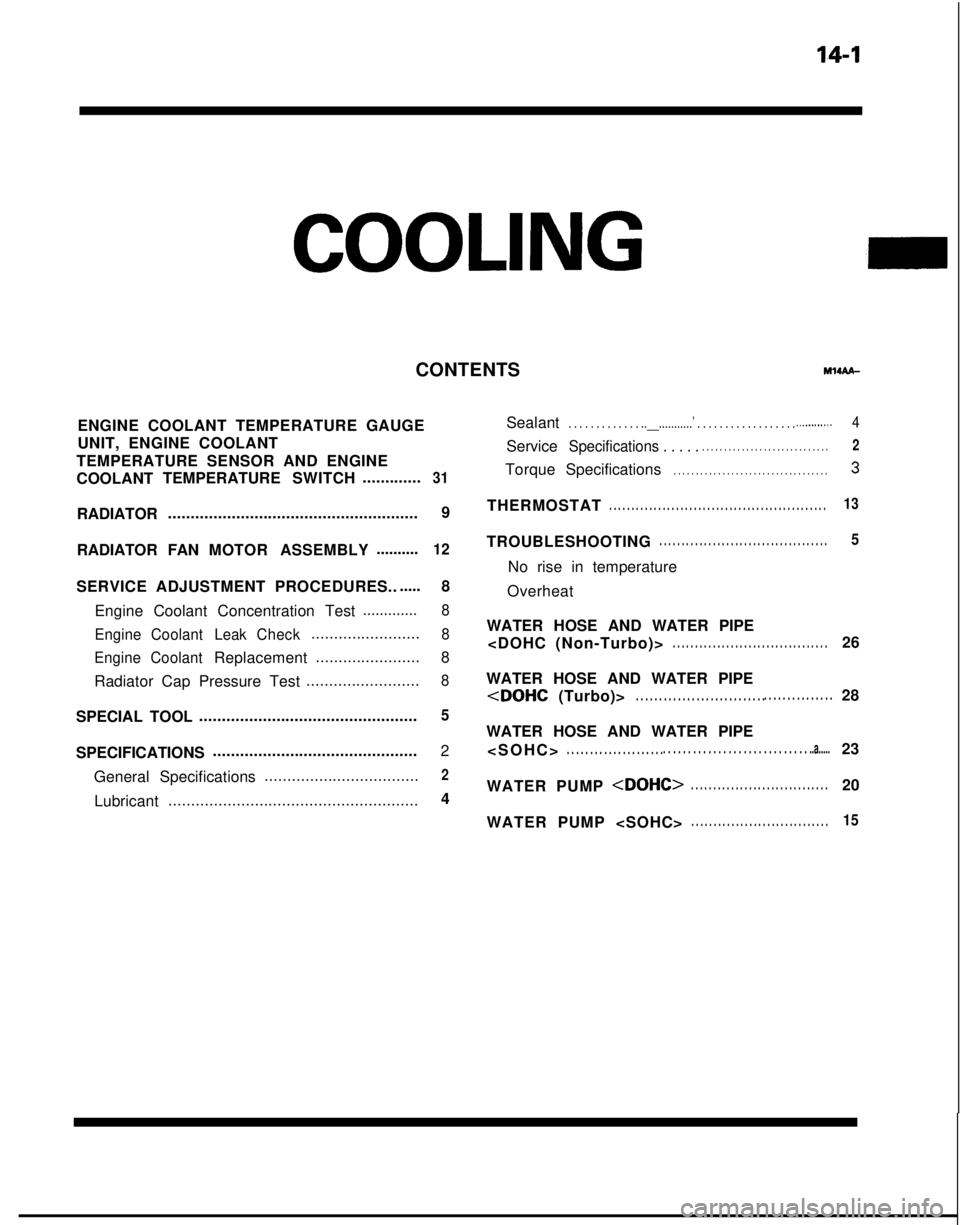
14-1
COOLING
ENGINE COOLANT TEMPERATURE GAUGE
UNIT, ENGINE COOLANT
TEMPERATURE SENSOR AND ENGINE
COOLANT TEMPERATURE
SWITCH.............
31
RADIATOR ....................................................... 9
RADIATOR FAN MOTOR ASSEMBLY ..........
12
SERVICE ADJUSTMENT PROCEDURES..
.....
8
Engine Coolant Concentration Test .............
8
Engine Coolant LeakCheck
........................8
Engine Coolant
Replacement .......................
8
Radiator Cap Pressure Test .........................
8
SPECIAL TOOL................................................5
SPECIFICATIONS .............................................
2
General Specifications ..................................
2
Lubricant
....................................................... 4
CONTENTS
IM14AA-
Sealant. . . . . . . . . . . . . ..__...........’ . . . . . . . . . . . . . \
. . . . . .._.........4
ServiceSpecifications . . . . .. . . . . . . . . . . . . . . . . . . . . . . . . . . . .2
Torque
Specifications. . . . . . . . . . . . . . . . . . . . . . . . . . . . . . . . . . .3
THERMOSTAT. . . . . . . . . . . . . . . . . . . . . . . . . . . . . . . . . . . . \
. . . . . . . . . . . . .13
TROUBLESHOOTING. . . . . . . . . . . . . . . . . . . . . . . . . . . . . . . . . . . . \
. .5
No rise in temperature
Overheat
WATER HOSE AND WATER PIPE
. . . . . . . . . . . . . . . . . . . . . . . . . . . . . . . . . . .26
WATER HOSE AND WATER PIPE
WATER HOSE AND WATER PIPE
. . . . . . . . . . . . . . . . . . . . .
. . . . . . . . . . . . . . . . . . . . . . . . . . . . . ..a.....23
WATER PUMP
WATER PUMP
. . . . . . . . . . . . . . . . . . . . . . . . . . . . . . .15
Page 651 of 1273

21-1
CLUTCH
CONTENTS
CLUTCH CONTROL. . . . . . . . . . . . . . . . . . . . . . . . . . . . . . . . . . . . \
. . . . .10SPECIFICATIONS. . . . . . . . . . . . . . . ..*...........................2
CLUTCHMASTER CYLINDER. . . . . . . . . . . . . . . . . . . . . . . .12GeneralSpecifications. . . . . . . . . . . . . . . . . . . . . . . . . . . . . . . . . .2
CLUTCH PEDALLubricants . . . . . . . . . . . . . . . . . . . . . . . . . . . . . . .\
. . . . . . . . . . . . . . . . . . . . . . .3. . . . . . . . . . . . . . . . . . . . . . . . . . . . . . . . . . . . \
. . . . . . . . . .7
ServiceSpecifications. . . . . . . . . . . . . . . . . . . . . . . . . . . . . . . . . . .2
CLUTCHRELEASECYLINDER. . . . . . . . . . . . . . . . . . . . . . .13Torque Specifications . . . . . . . . . .._.......................3
SERVICE ADJUSTMENT PROCEDURES . . . . . . . 5TROUBLESHOOTING. . . . . . . . . . . . . . . . . . . . . . . . . . . . . . . . . . . . \
. .4
Bleeding. . . . . . . . . . . . . . . . . . . . . . . . . . . . . . . .6Clutch chatters
Clutch Pedal Inspection and Adjustment . . . .
5Clutch noise
Clutch pedal feels “heavy”
Clutch slips
Gear shift malfunction
CAUTION When
servicing clutch assemblies or com-
ponents for vehicles with SOHC engine
(Up to 1991 models), do NOT create dust
by sanding or by cleaning clutch parts
with a dry brush or with compressed air.
(A water dampened cloth should be used).
The clutch disc contains “Asbestos Fibers”
which can become airborne if dust is
created during service operations. Breath-
ing dust containing “Asbestos Fibers”
may cause serious bodily harm.
Page 749 of 1273
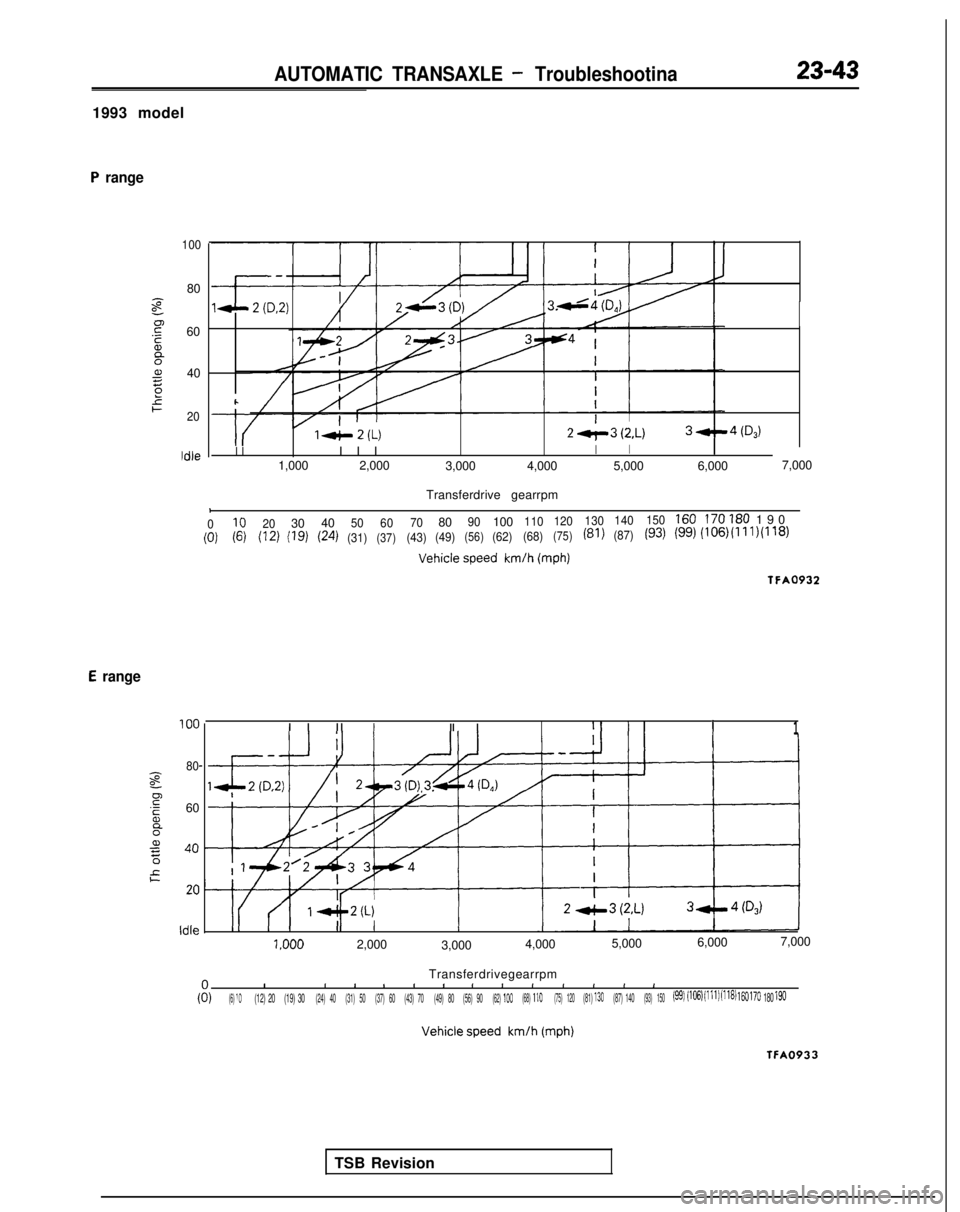
AUTOMATIC TRANSAXLE - Troubleshootina
1993 model
P range
100
80
60 40
20
Idle
1-1 2 (D.2)
c
tfI* 2(L)2-13 (2,L)3--4(b)
I II I III
1,000 2,000 3,000 4,000 5,000 6,000 7,000
Transferdrive gearrpm
1
0102030 4050 60 708090100110120 130140 150160170 180 19
0
(0)(6)(12)119)(24)(31)(37)(43)
(49)(56)(62) (68)(75)(81)(87)(93)(99) (106)(111)(118)
Vehiclespeed km/h(mph)
TFA0932
E range
31
F.-c
ti
a,
5:‘5
if
100
80
-
60 Idle
I I
II
III II1
1,0002,000
3,0004,000
5,0006,000
7,000
Transferdrivegearrpm ,
III
tIIII , , , tI(00)(6) 10(12) 20 (19) 30(24) 40 (31) 50 (37) 60
(43) 70(49) 80(56) 90(62) 100(68) 110
(75) 120(81) 130(87) 140(93) 150(99)(106)(111)(118) 160 170 180 190
Vehiclespeed km/h(mph)
TFA0933
TSB Revision