automatic MITSUBISHI GALANT 1989 Service User Guide
[x] Cancel search | Manufacturer: MITSUBISHI, Model Year: 1989, Model line: GALANT, Model: MITSUBISHI GALANT 1989Pages: 1273, PDF Size: 37.62 MB
Page 46 of 1273
GENERAL -Maintenance Service
(1O)Star-t engine and allow to idle for at least two minutes.
Then, with parking brake on, move selector
fever
momentarily to each position, ending in “N” Neutral
position.
(11)Add sufficient ATF to bring fluid level to lower mark.
Recheck fluid level after transaxle is at normal Operating
temperature. Fluid level should be between upper and lower marks of
“HOT” range, Insert dipstick fully to prevent dirt from
entering transaxle.
OOA0051
11 .ENGINE
COOLANT (Change)MOOSEEAC
Check the cooling system parts, such as radiator, heater,
and oil cooler hoses, thermostat and connections for
leakage and damage.
CHANGE COOLANT
1. Remove the radiator cap.
2. Loosen the drain plug to drain the coolant.
3. Drain the coolant from the reserve tank.
4. After draining the coolant, tighten the drain plug securely.
5.Supply the coolant into the radiator until it is filled up to
its filler neck.
6. Supply the coolant into the reserve tank.
7. After warming the engine until the thermostat opens, remove the radiator cap and check the coolant level.
8.Supply the coolant into the radiator until it is filled up to
its filler neck, and install the radiator cap securely.
9.Fill the reserve tank with coolant up to the “FULL” line.
14K512
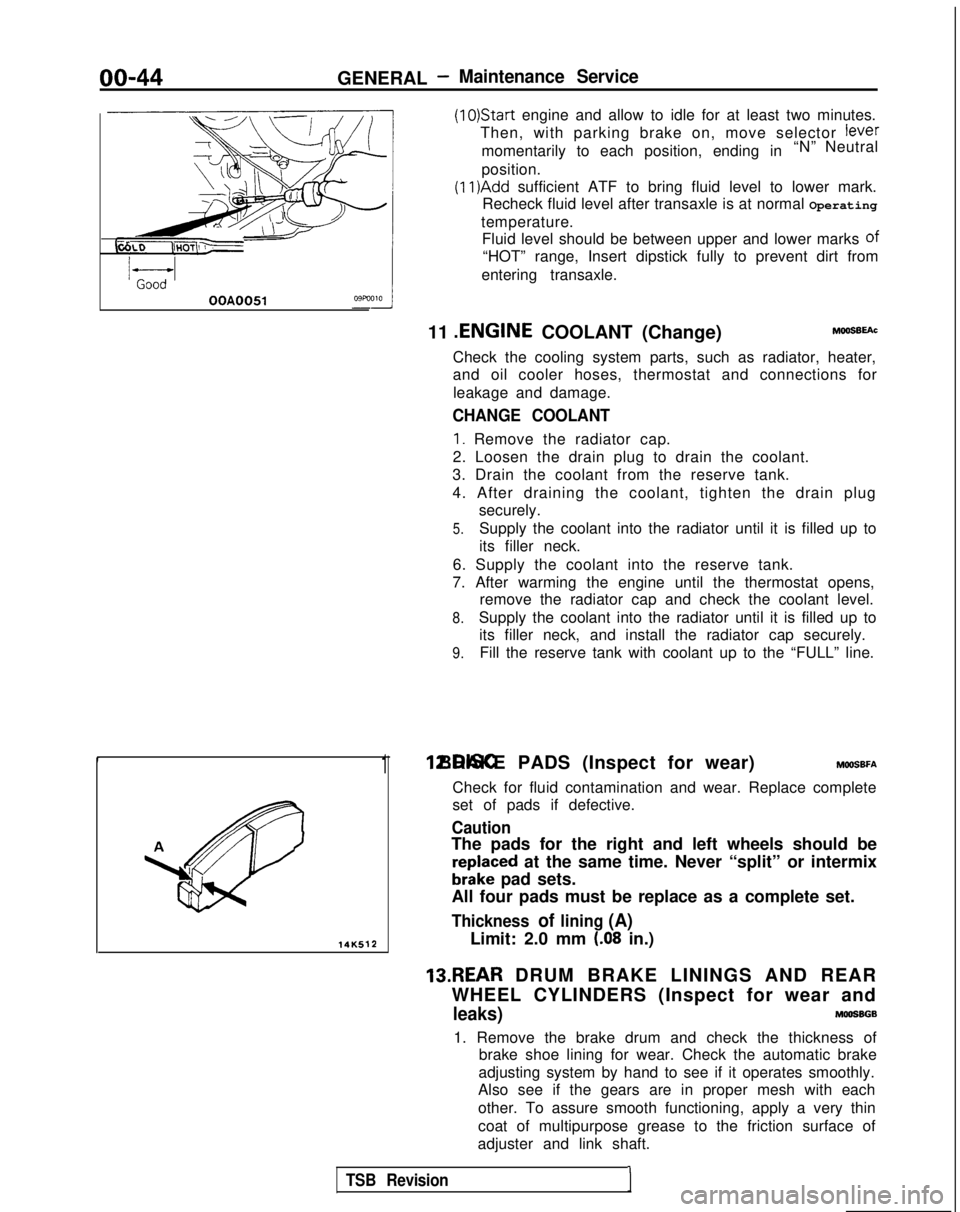
1 12.DISC BRAKE PADS (Inspect for wear) MWSBFA
Check for fluid contamination and wear. Replace complete
set of pads if defective.
Caution
The pads for the right and left wheels should be
reDlaced at the same time. Never “split” or intermix
brkke pad sets.
All four pads must be replace as a complete set.
Thickness of lining (A)
Limit: 2.0 mm (.08 in.)
13.REAR DRUM BRAKE LININGS AND REAR
WHEEL CYLINDERS (Inspect for wear and
leaks)MOOSBGB
1. Remove the brake drum and check the thickness of brake shoe lining for wear. Check the automatic brake
adjusting system by hand to see if it operates smoothly.
Also see if the gears are in proper mesh with each
other. To assure smooth functioning, apply a very thin
coat of multipurpose grease to the friction surface of
adjuster and link shaft.
TSB Revision1
Page 145 of 1273
FUEL SYSTEM
FUEL SYSTEM
GENERAL INFORMATION
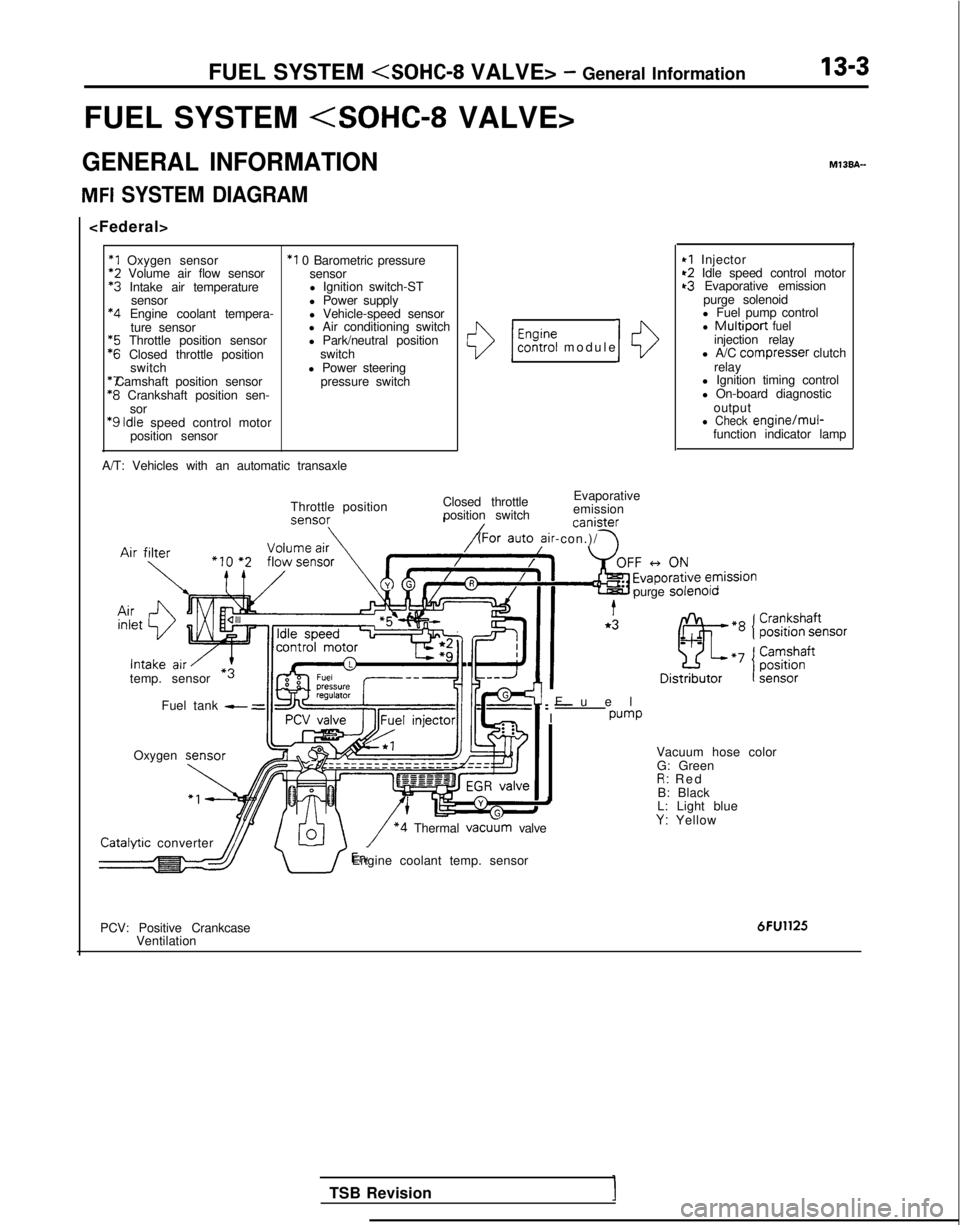
MFI SYSTEM DIAGRAM
*1 Oxygen sensor
*2
Volume air flow sensor *3
Intake air temperature
sensor *4
Engine coolant tempera-
ture sensor *5
Throttle position sensor *6
Closed throttle position
switch *7 Camshaft position sensor
*8
Crankshaft position sen-
sor
‘9 Idle
speed control motor
position sensor
*I 0 Barometric pressure sensor
l Ignition switch-ST
l Power supply
l Vehicle-speed sensor
l Air conditioning switch
l Park/neutral position
switch
l Power steering pressure switch
A/T: Vehicles with an automatic transaxle
()/ $%?i modul
e
Closed throttle Evaporative
position switch emission canister
ir-con.)/ \
10
Throttle position
temp. sensor Fuel tank
- =
Oxygen M13BA-
I
*I Injector~2 Idle speed control motort3 Evaporative emission
purge solenoid
l Fuel pump control
l Multiport fuelinjection relay
l A/C compresser clutch
relay
l Ignition timing control
l On-board diagnostic
output
l Check engine/mul-function indicator lamp
Fue
l
: -
I
pump
purge
solenolo Catalvtic
converter
\/ *4 Thermal vacu
G: Green
R: Re
d
B: Black
L: Light blue
Y: Yellow
dJJ/ U’Engine coolant temp. sensor
PCV: Positive Crankcase Ventilation
6FU1125
TSB Revision
Page 174 of 1273
13-32
FUEL SYSTEM
FUEL TANK AND FUEL LINEMlBEAAA
Symptom Probable cause Remedy
Engtne malfunctions
Bent or kinked fuel pipe or hose Repair or replace3ue to insufficient fuel
SUPPlYClogged fuel pipe or hoseClean or replace
Clogged fuel filter or in-tank fuel filter Replace
Water in fuel filter Replace the fuel filter or clean the fuel tank
and fuel line
Dirty or rusted fuel tank interior Malfunctioning fuel pump
(Clogged filter in the pump) Clean or replace
Replace
Evaporative emission Mispiping of vapor line
Correct
control system malfunc-
tions (When fuel tank Disconnect vapor line piping joint Correct
filler tube cap is re- moved, pressure releas-
Folded, bent, cracked or clogged vapor line Replace
ng noise is heard) Faulty fuel tank filler tube cap
Malfunctioning fuel tank pressure control
valve Replace
Replace
LL
m ~~ : Paper clip-
F l!;“I /yFp- -
izd--_7-01
A0086SERVICE ADJUSTMENT PROCEDURES
CURB IDLE SPEED INSPECTION
MlBFHAFt
(1) The vehicle should be prepared as follows before the inspection.
lEngine coolant temperature: 85-95°C (185-203°F)
l Lights, electric cooling fan and accessories: OFF
l Transaxle: Neutral
(P for vehicles with an automatic
transaxle)
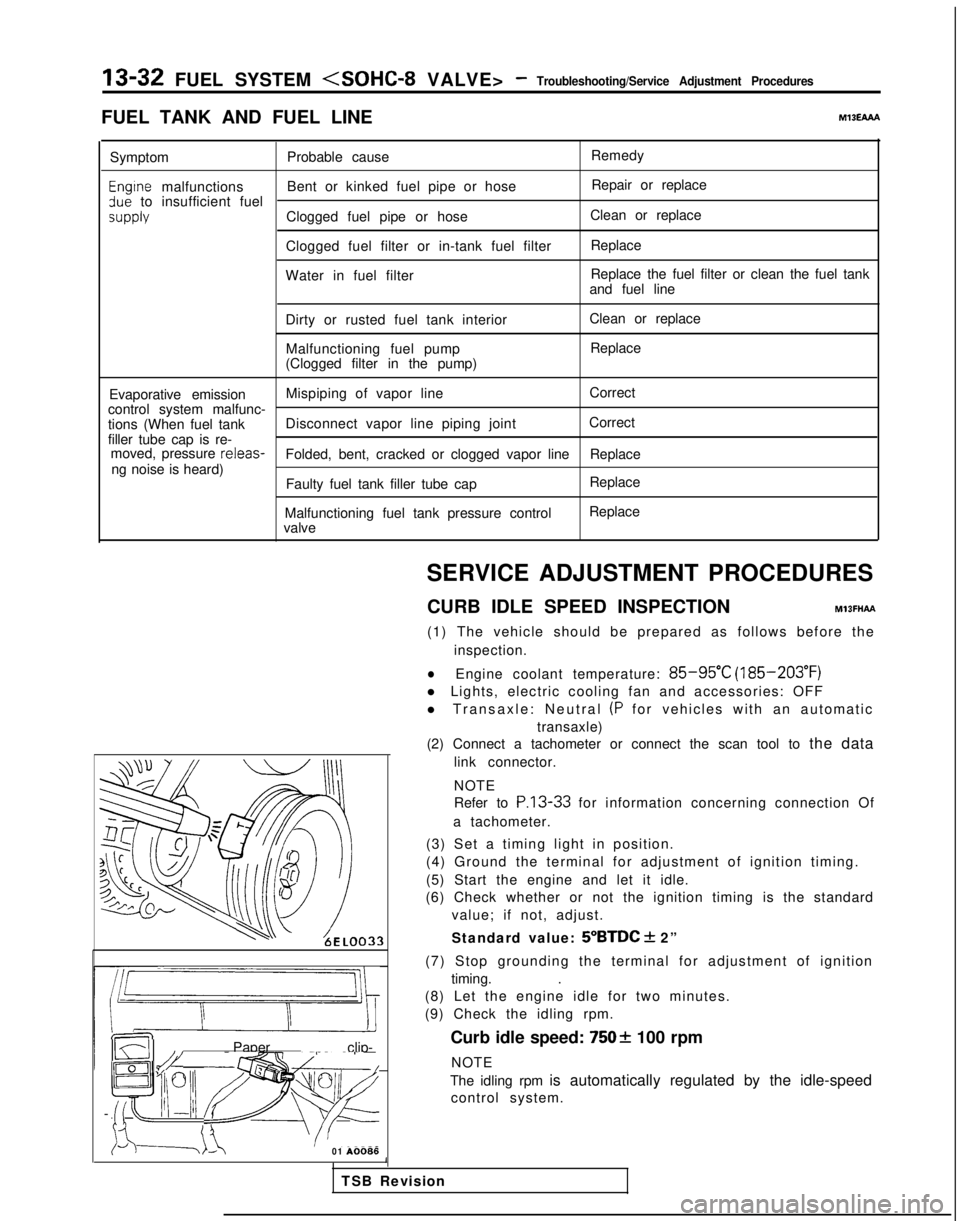
(2) Connect a tachometer or connect the scan tool to the data
link connector.
NOTE
Refer to
P.13-33 for information concerning connection Of
a tachometer.
(3) Set a timing light in position.
(4) Ground the terminal for adjustment of ignition timing.
(5) Start the engine and let it idle.
(6) Check whether or not the ignition timing is the standard
value; if not, adjust.
Standard value:
5”BTDC + 2”
(7) Stop grounding the terminal for adjustment of ignition timing. .
(8) Let the engine idle for two minutes.
(9) Check the idling rpm.
Curb idle speed:
7502 100 rpm
NOTE
The idling rpm is automatically regulated by the idle-speed control system.
1
TSB Revision
Page 175 of 1273
FUEL SYSTEM
For a female
pin
For a male pin
(insert at side (Insert at lock tab side.,
opposite from lock tab.)
OlLO246
(10)lf not within the standard value range, refer to the CHECK
CHART CLASSIFIED BY PROBLEM SYMPTOMS and check the
MFI component.
BASIC IDLE SPEED ADJUSTMENT
MlBFHBA
(1) The vehicle should be prepared as follows before the inspection and adjustment.
l Engine coolant temperature:
85-95°C (185-205°F)
l Lights, electric cooling fan and accessories: OFF
l Transaxle: Neutral
(P for vehicles with an automatic
transaxle)
(2) Slacken the accelerator cable enough.
(3) Connect the scan tool to the data link connector (white).
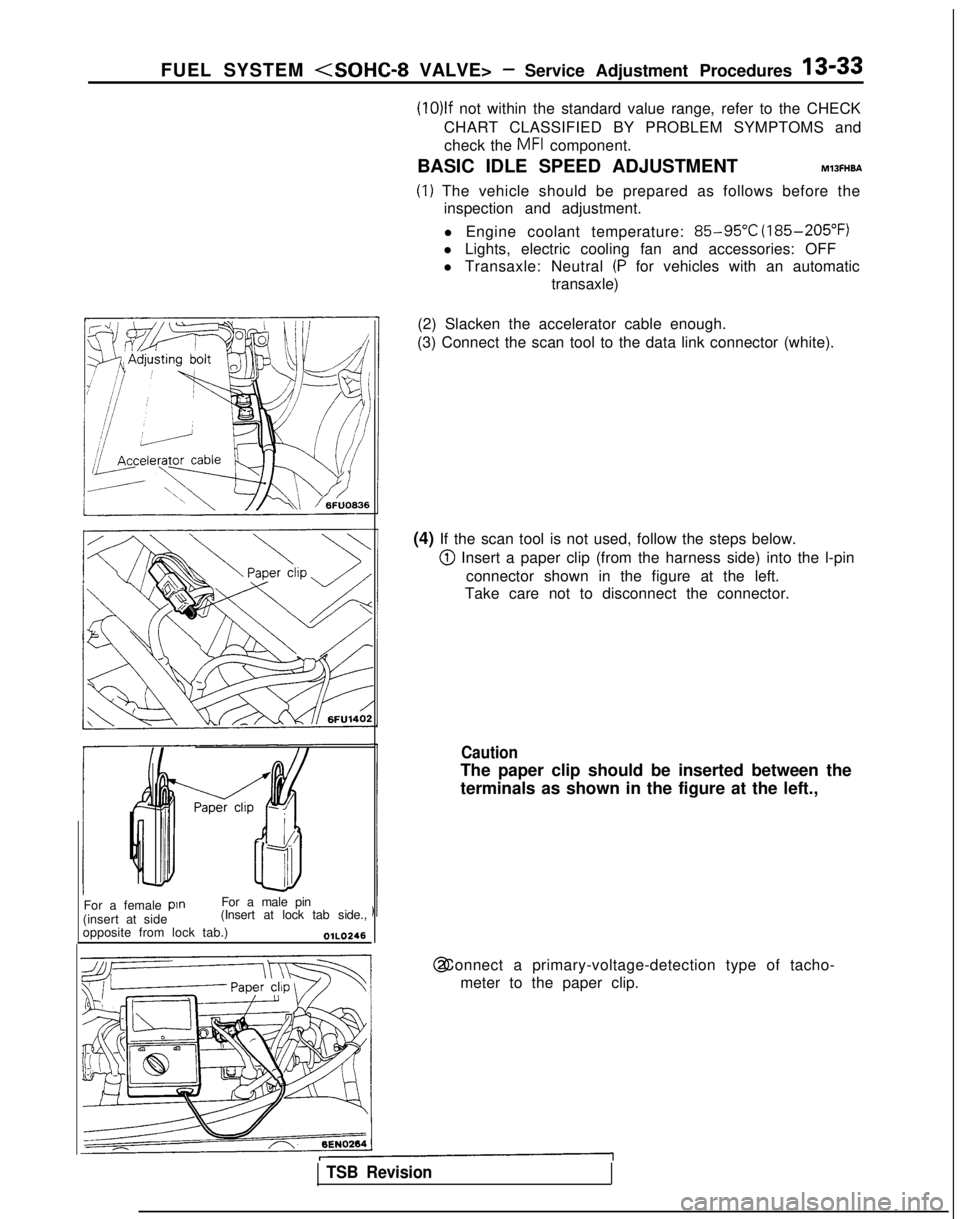
(4) If the scan tool is not used, follow the steps below.
@I Insert a paper clip (from the harness side) into the l-pin connector shown in the figure at the left.
Take care not to disconnect the connector.
Caution
The paper clip should be inserted between the
terminals as shown in the figure at the left., @ Connect a primary-voltage-detection type of tacho-
meter to the paper clip.
TSB Revision
Page 200 of 1273
13-58 FUEL SYSTEM
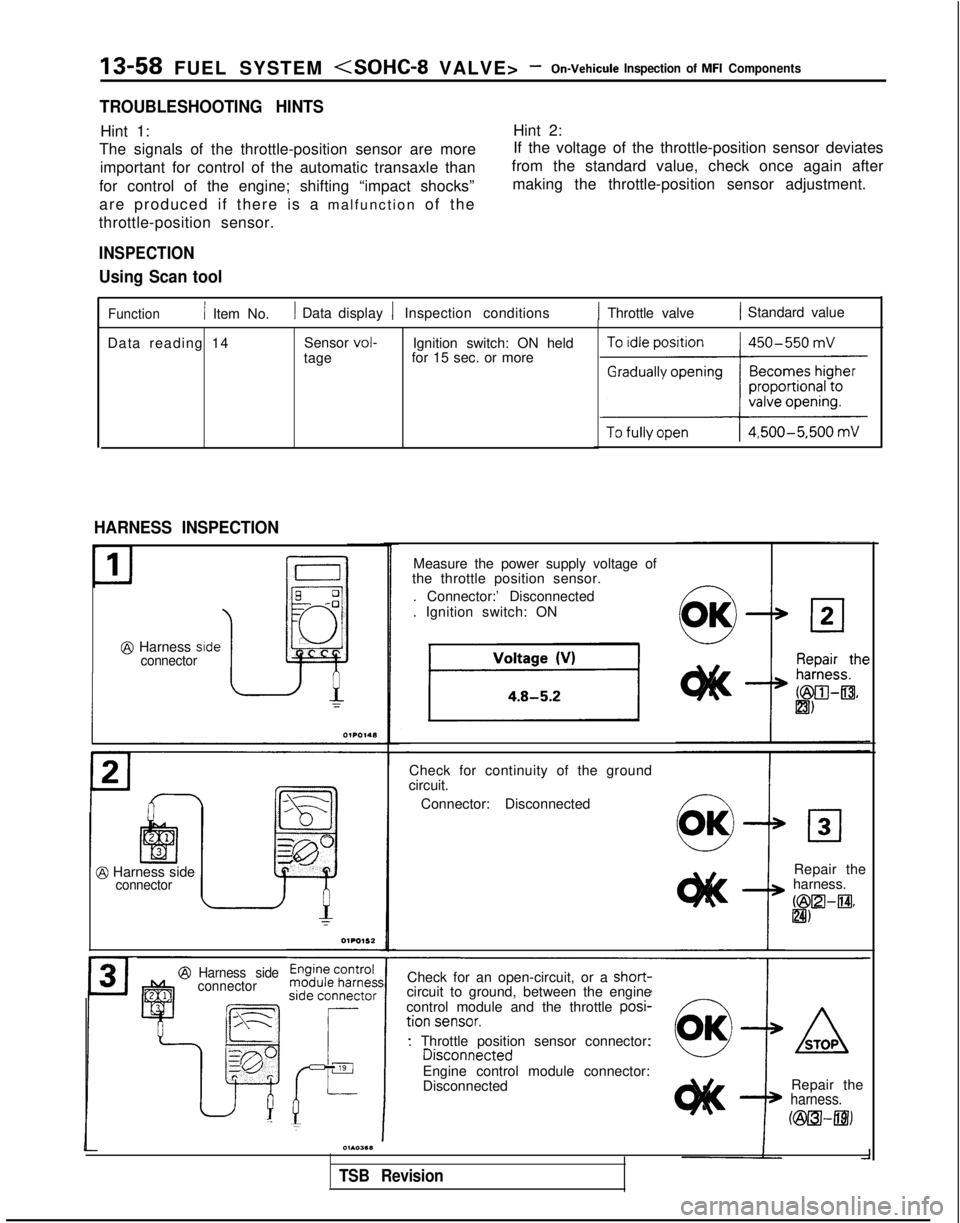
TROUBLESHOOTING HINTS
Hint 1:Hint 2:
The signals of the throttle-position sensor are more If the voltage of the throttle-position sensor deviates
important for control of the automatic transaxle than from the standard value, check once again after
for control of the engine; shifting “impact shocks” making the throttle-position sensor adjustment.
are produced if there is a malfunction of the
throttle-position sensor.
INSPECTION
Using Scan tool
Function/ Item No.1 Data display 1 Inspection conditions1 Throttle valve1 Standard value
Data reading 14 Sensor
vol-tageIgnition switch: ON held
for 15 sec. or more
HARNESS INSPECTION
E q-0
JJ ~
@ Harness side0
connector
@ Harness sideconnector
Harness side
connector
Measure the power supply voltage of
the throttle position sensor.
. Connector:’ Disconnected
. Ignition switch: ON
Check for continuity of the ground
circuit.
Connector: Disconnected
Repair the
harness.
bZilZl-m* &I)
Check for an open-circuit, or a short-
circuit to ground, between the engine
control module and the throttle posi-
. Throttle position sensor connector: Engine control module connector:
Disconnected Repair the
harness.
Fi&TUI-mj
01103611
TSB Revision
Page 203 of 1273
FUEL SYSTEM
CLOSED THROTTLE POSITION SWITCH
control -Idle speed control
motor connector
@ Component sideconnector
@ Harness sideconnector
II
ISC plunger
_---__
III*Throttle shaft turning angle
01209
2
-
Engine control module
1
6
3
OFF
aI
ON
-z
Closed throttleDosition switch
lFUO479
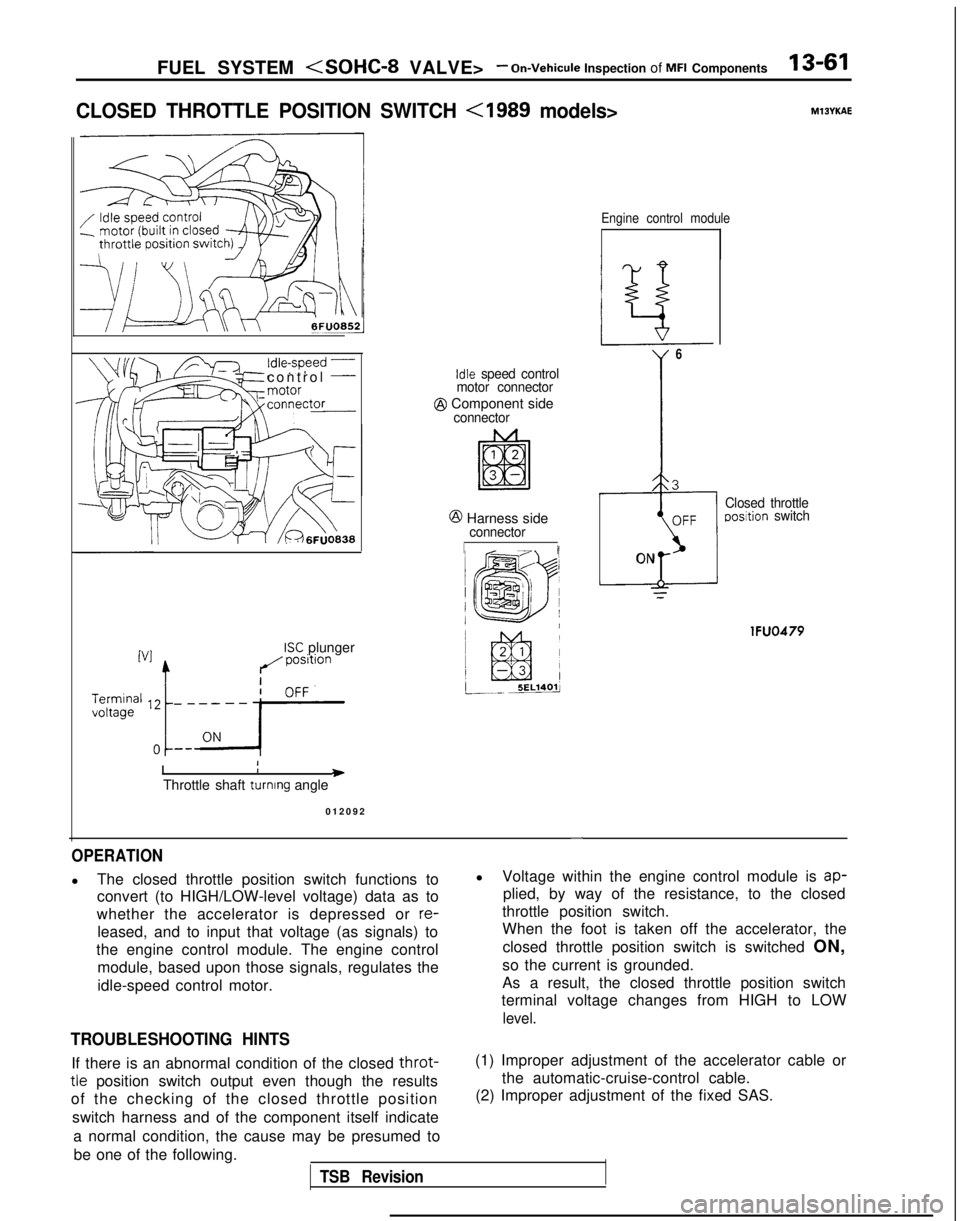
OPERATION
l
The closed throttle position switch functions to
convert (to HIGH/LOW-level voltage) data as to
whether the accelerator is depressed or
re-
leased, and to input that voltage (as signals) to
the engine control module. The engine control module, based upon those signals, regulates the
idle-speed control motor.
TROUBLESHOOTING HINTS
l Voltage within the engine control module is ap-
plied, by way of the resistance, to the closed
throttle position switch.
When the foot is taken off the accelerator, the
closed throttle position switch is switched ON,
so the current is grounded.
As a result, the closed throttle position switch
terminal voltage changes from HIGH to LOW
level.
If there is an abnormal condition of the closed throt-
tle position switch output even though the results
of the checking of the closed throttle position
switch harness and of the component itself indicate
a normal condition, the cause may be presumed tobe one of the following.
TSB Revision
(1) Improper adjustment of the accelerator cable or the automatic-cruise-control cable.
(2) Improper adjustment of the fixed SAS.
Page 275 of 1273
FUEL SYSTEM
FUEL TANK AND FUEL LINEMIBEAAB
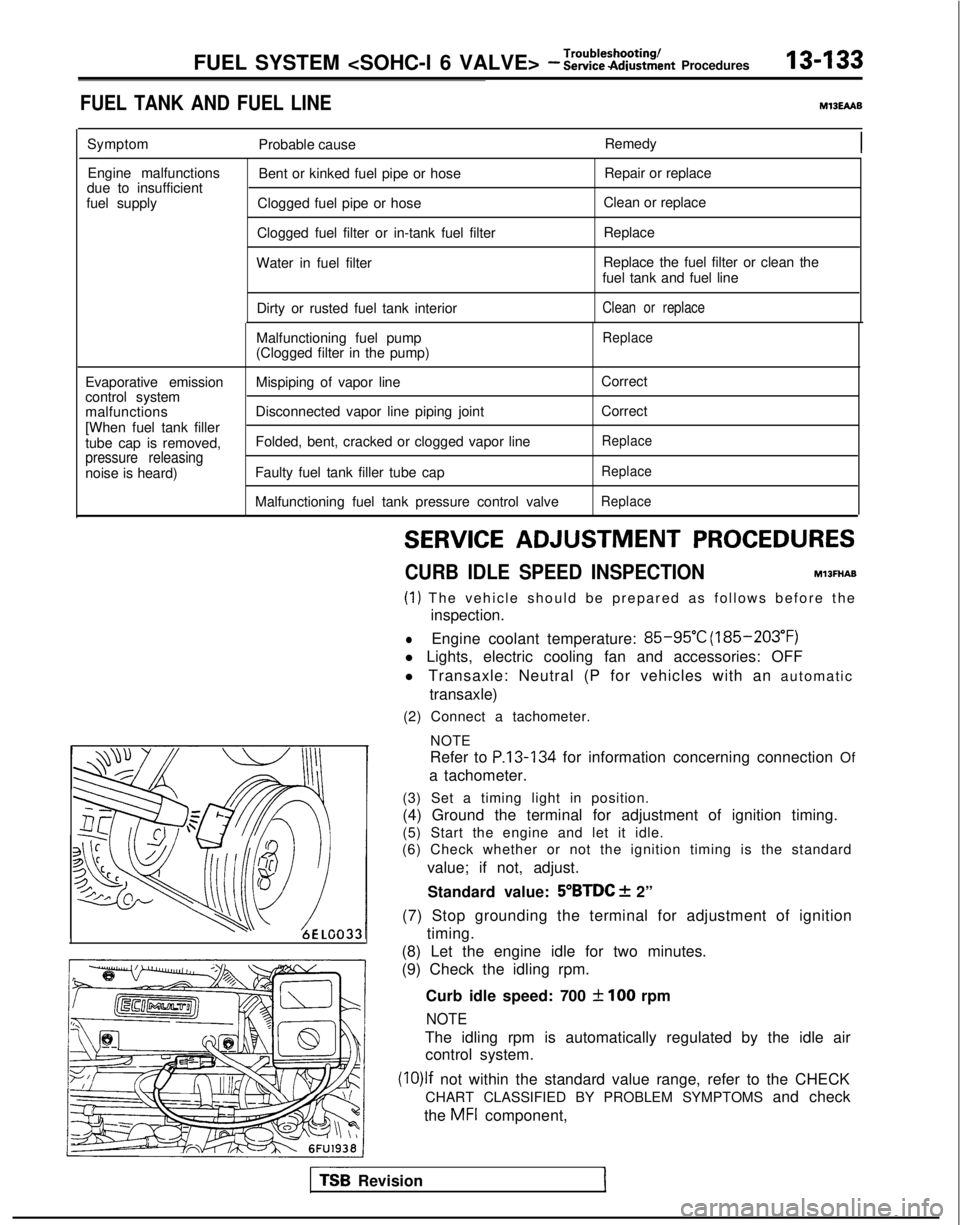
Symptom
Probable cause Remedy
Engine malfunctions
due to insufficient
fuel supply Bent or kinked fuel pipe or hose
Clogged fuel pipe or hose
Clogged fuel filter or in-tank fuel filter
Water in fuel filter Repair or replace
Clean or replace
Replace
Replace the fuel filter or clean the
fuel tank and fuel line
Dirty or rusted fuel tank interior
Clean or replace
Malfunctioning fuel pump
(Clogged filter in the pump)Replace
Evaporative emission
control system
malfunctions
[When fuel tank filler
tube cap is removed,
pressure releasingnoise is heard) Mispiping of vapor line
Disconnected vapor line piping joint
Folded, bent, cracked or clogged vapor line
Faulty fuel tank filler tube cap
Malfunctioning fuel tank pressure control valve Correct
Correct
Replace
Replace
Replace
SERVICE ADJUSTMENT
PROCEDURES
CURB IDLE SPEED INSPECTIONhll3MAE
(1) The vehicle should be prepared as follows before th
e
inspection.
lEngine coolant temperature: 85-95°C (185-203°F)
l Lights, electric cooling fan and accessories: OFF
l Transaxle: Neutral (P for vehicles with an automatic
transaxle)
(2) Connect a tachometer.
NOTE
Refer to
P.13-134 for information concerning connection Of
a tachometer.
(3) Set a timing light in position.
(4) Ground the terminal for adjustment of ignition timing.
(5) Start the engine and let it idle.
(6) Check whether or not the ignition timing is the standard
value; if not, adjust.
Standard value:
5”BTDC f 2”
(7) Stop grounding the terminal for adjustment of ignition timing.
(8) Let the engine idle for two minutes.
(9) Check the idling rpm.
Curb idle speed: 700
31100 rpm
NOTE
The idling rpm is automatically regulated by the idle aircontrol system.
(lO)lf not within the standard value range, refer to the CHECK
CHART CLASSIFIED BY PROBLEM SYMPTOMS and check
the
MFI component,
TS6 Revision1
Page 300 of 1273
On-Vehicle Inspection of MFI
13-158FUEL SYSTEM (SOHC-16 VALVE> - Components
OPERATION
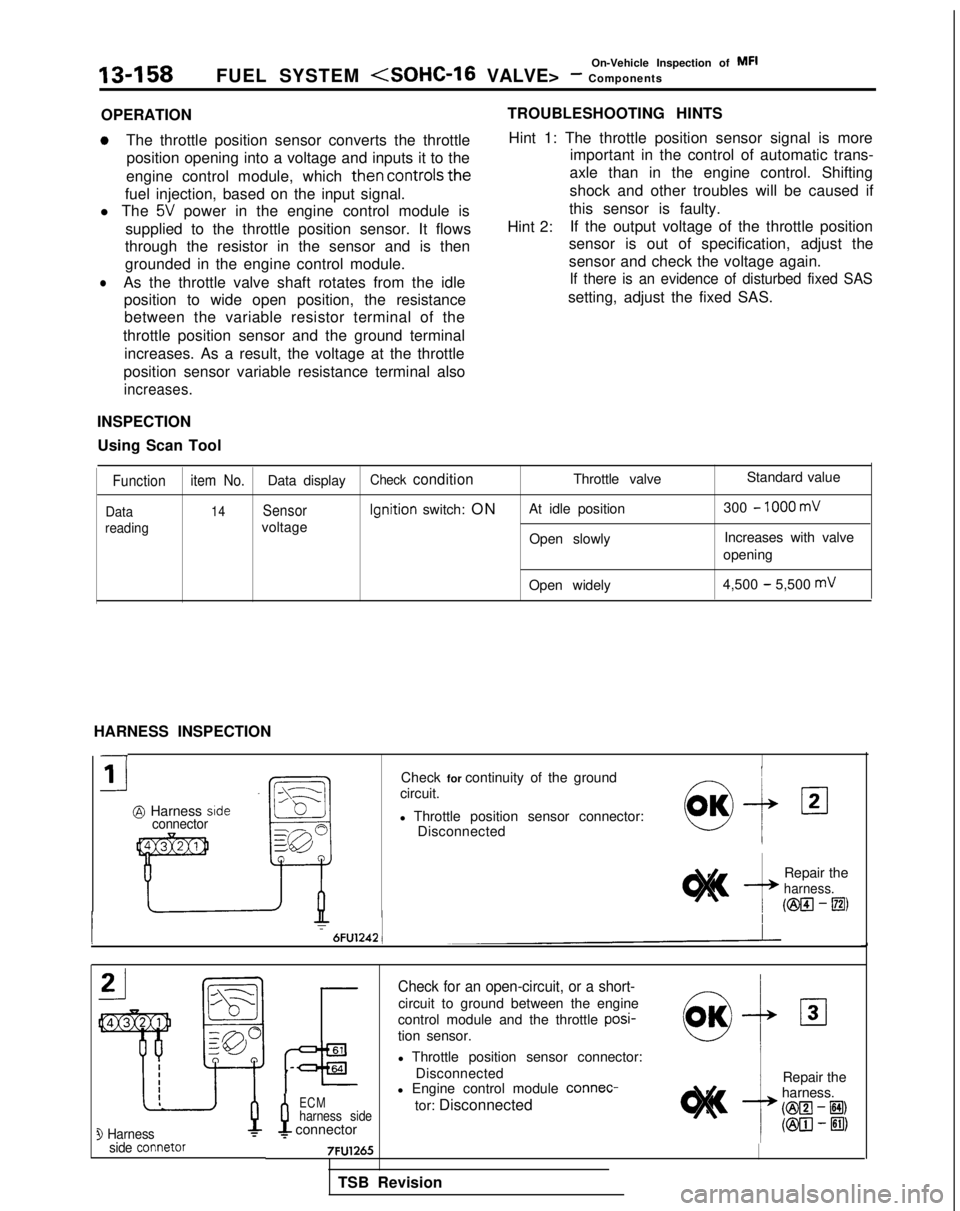
aThe throttle position sensor converts the throttle position opening into a voltage and inputs it to the
engine control module, which
then controls
the
fuel injection, based on the input signal.
l The
5V power in the engine control module is
supplied to the throttle position sensor. It flows
through the resistor in the sensor and is then
grounded in the engine control module.
lAs the throttle valve shaft rotates from the idle position to wide open position, the resistancebetween the variable resistor terminal of the
throttle position sensor and the ground terminal increases. As a result, the voltage at the throttle
position sensor variable resistance terminal also
increases.
INSPECTION
Using Scan Tool TROUBLESHOOTING HINTS
Hint 1: The throttle position sensor signal is more important in the control of automatic trans-
axle than in the engine control. Shifting
shock and other troubles will be caused if
this sensor is faulty.
Hint 2: If the output voltage of the throttle position
sensor is out of specification, adjust the
sensor and check the voltage again.
If there is an evidence of disturbed fixed SAS
setting, adjust the fixed SAS.
Function item No.Data displayCheck conditionThrottle valve Standard value
Data14Sensor Ignition
switch: ON At idle position 300 - 1000 mV
readingvoltage
Open slowlyIncreases with valve
opening
Open widely 4,500
- 5,500 mV
HARNESS INSPECTION
-
i1
@ Harness sideconnector
Check for continuity of the ground
circuit.
l Throttle position sensor connector: Disconnected
Repair the
harness.
(ml-m
3 Harnessside connetor
P
ECMharness sidef connector
Check for an open-circuit, or a short-
circuit to ground between the engine
control module and the throttle posi-
tion sensor.
l Throttle position sensor connector:
Disconnected
l Engine control module connec-
tor: Disconnected Repair the
harness. @El
- El)
(@III-ElII
TSB Revision
Page 387 of 1273
FUEL SYSTEM
cl989 models> -a’i\.-upI t
SERVICE ADJUSTMENT PROCEDURES
CURB IDLE SPEED INSPECTION
MlSFHAB
(1) The vehicle should be prepared as follows before the inspection.
l Engine coolant temperature:
85-95°C (185-205°F)
l Lights, electric cooling fan and accessories: OFF
l Transaxle: Neutral
(P for vehicles with an automatic
transaxle)
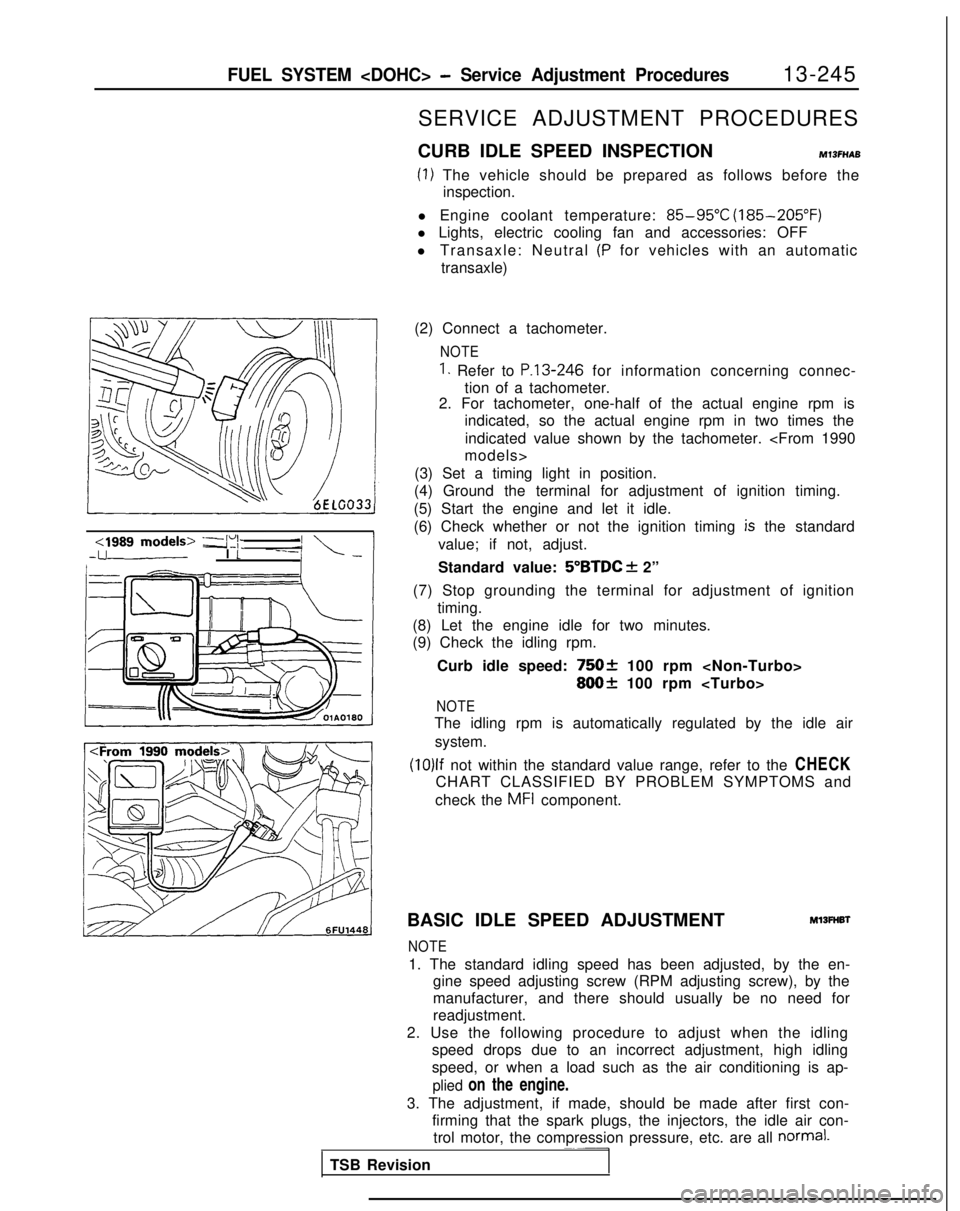
(2) Connect a tachometer.
NOTE
1. Refer to P.13-246 for information concerning connec-
tion of a tachometer.
2. For tachometer, one-half of the actual engine rpm is
indicated, so the actual engine rpm in two times the
indicated value shown by the tachometer.
(3) Set a timing light in position.
(4) Ground the terminal for adjustment of ignition timing.
(5) Start the engine and let it idle.
(6) Check whether or not the ignition timing
is the standard
value; if not, adjust.
Standard value:
5”BTDC f 2”
(7) Stop grounding the terminal for adjustment of ignition timing.
(8) Let the engine idle for two minutes.
(9) Check the idling rpm.
Curb idle speed:
75Ok 100 rpm
800+ 100 rpm
NOTE
The idling rpm is automatically regulated by the idle airsystem.
(10)lf not within the standard value range, refer to the CHECK
CHART CLASSIFIED BY PROBLEM SYMPTOMS and
check the
MFI component.
BASIC IDLE SPEED ADJUSTMENT
Ml3FHBl
NOTE
1. The standard idling speed has been adjusted, by the en- gine speed adjusting screw (RPM adjusting screw), by the
manufacturer, and there should usually be no need for
readjustment.
2. Use the following procedure to adjust when the idling speed drops due to an incorrect adjustment, high idling
speed, or when a load such as the air conditioning is ap-
plied on the engine.
3. The adjustment, if made, should be made after first con- firming that the spark plugs, the injectors, the idle air con-trol motor, the compression pressure, etc. are all
normal.~~-
TSB Revision
Page 388 of 1273
13-246FUEL SYSTEM
17k&---,!E~,~~/iY I
(1) The vehicle should be prepared as follows before the
inspection and adjustment.
l Engine coolant temperature:
85-95°C (185-205°F)
l Lights, electric cooling fan and accessories: OFF l Transaxle: Neutral (P for vehicles with an automatic transaxle)
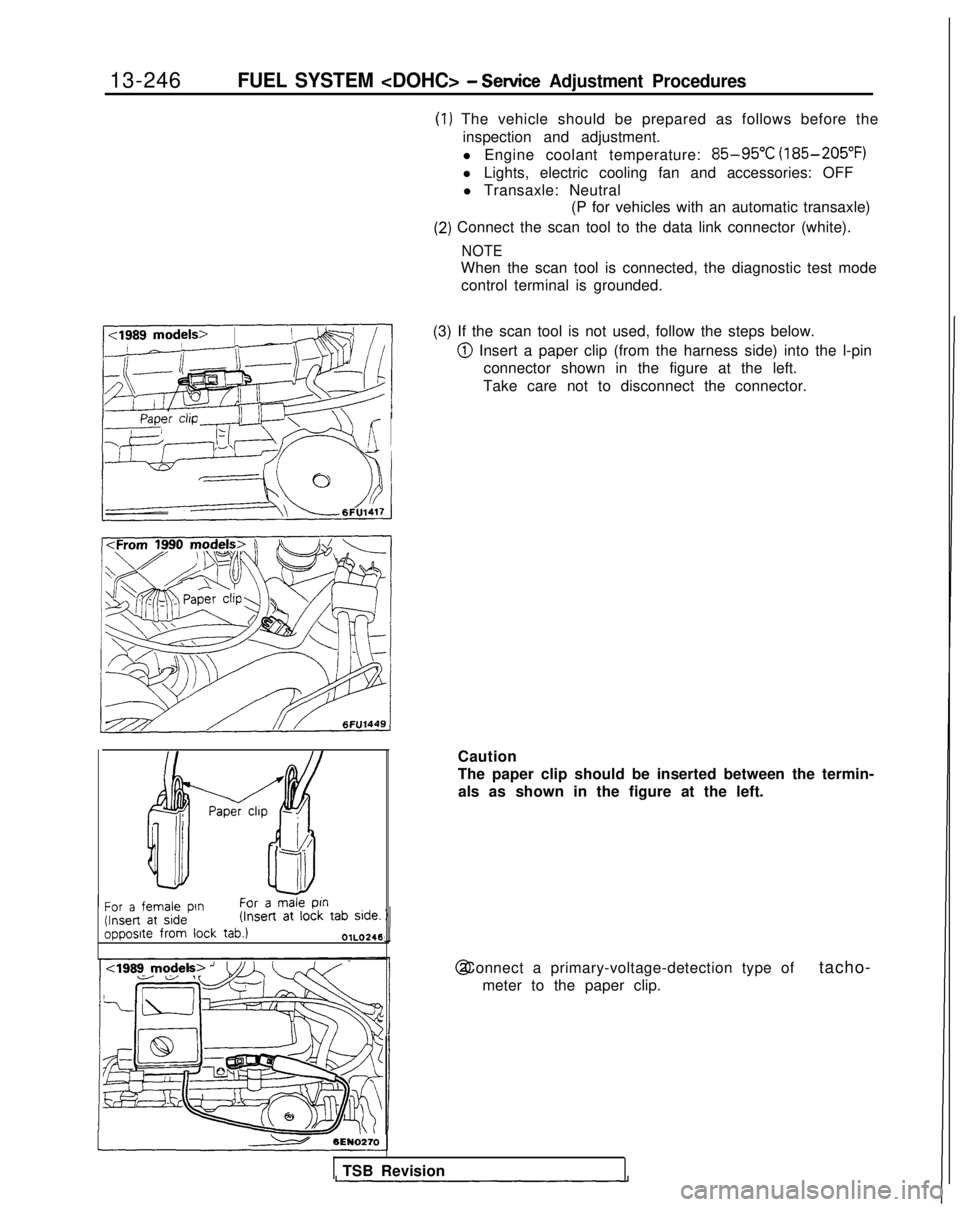
(2) Connect the scan tool to the data link connector (white).
NOTE
When the scan tool is connected, the diagnostic test mode
control terminal is grounded.
(3) If the scan tool is not used, follow the steps below.
@ Insert a paper clip (from the harness side) into the l-pin connector shown in the figure at the left.
Take care not to disconnect the connector.
/ Paper chp -
f!f--i!t
Ah
-II
For a female pin
For a male
ptn (Insert
at side (Insert
at
lock tab side.
opposite from
lock
tab.)OlL0246
Caution
The paper clip should be inserted between the termin-
als as shown in the figure at the left. @ Connect a primary-voltage-detection type of
tacho-
meter to the paper clip.
TSB Revision