brake MITSUBISHI L200 2015 (in English) Service Manual
[x] Cancel search | Manufacturer: MITSUBISHI, Model Year: 2015, Model line: L200, Model: MITSUBISHI L200 2015Pages: 418, PDF Size: 25.8 MB
Page 312 of 418
WARNINGlElectrolyte is corrosive diluted sulphuric
acid.
If electrolyte (battery acid) comes into contact with your hands, eyes, clothes and
the painted surface of your vehicle, it should be thoroughly flushed with water.If electrolyte gets in your eyes, flush them
with water immediately and thoroughly, and get prompt medical attention.CAUTIONl Do not attempt to start the engine by pulling
or pushing the vehicle.
It could damage your vehicle.
l Always wear protective eye goggles when
working near the battery.
l Keep the battery out of the reach of children.NOTEl
On vehicles with anti-lock brake system, if
the vehicle is put in motion without fully charging the battery, it might cause the loss
of smooth engine operation and the antilock brake warning lamp to illuminate.
Refer to “Anti-lock brake system (ABS)” on
page 6-45.Engine overheating
E00800602777
If the water temperature gauge indication re-
mains in the overheating zone for a long
time, the engine may be overheating. If this occurs, take the following corrective meas-
ures: 1. Stop the vehicle in a safe place.
2. Check whether steam is coming from the
engine compartment.
[If steam does not come from the engine
compartment]
With the engine still running, raise the bonnet to ventilate the engine compart-
ment.
[If steam is coming from the engine
compartment]
Stop the engine, and when the steam
stops, raise the bonnet to ventilate the engine compartment. Restart the engine.WARNINGl Do not open the bonnet while steam is
coming from the engine compartment. It
could cause steam or hot water to spurt out, causing burns. Hot water could spurt
out even when there is no steam coming out, and some parts will be very hot. Be
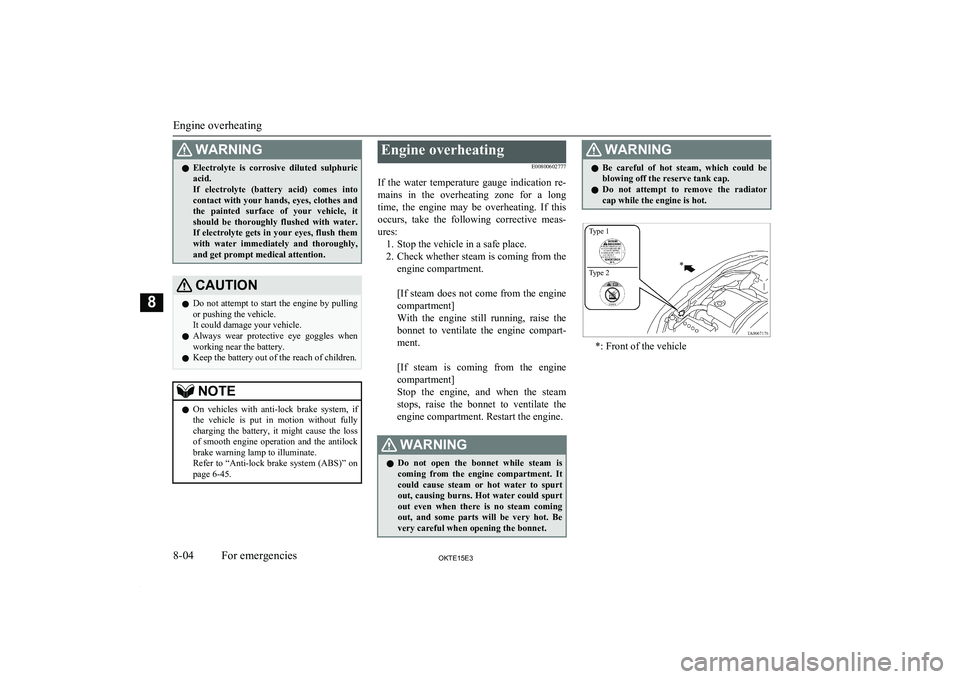
very careful when opening the bonnet.WARNINGl Be careful of hot steam, which could be
blowing off the reserve tank cap.
l Do not attempt to remove the radiator
cap while the engine is hot.
*: Front of the vehicle
Engine overheating
8-04OKTE15E3For emergencies8 Type 1
Type 2
Page 321 of 418
To use the jack handle (Clubcab, Double cab with rear re-tractable power window only)
E00802400124
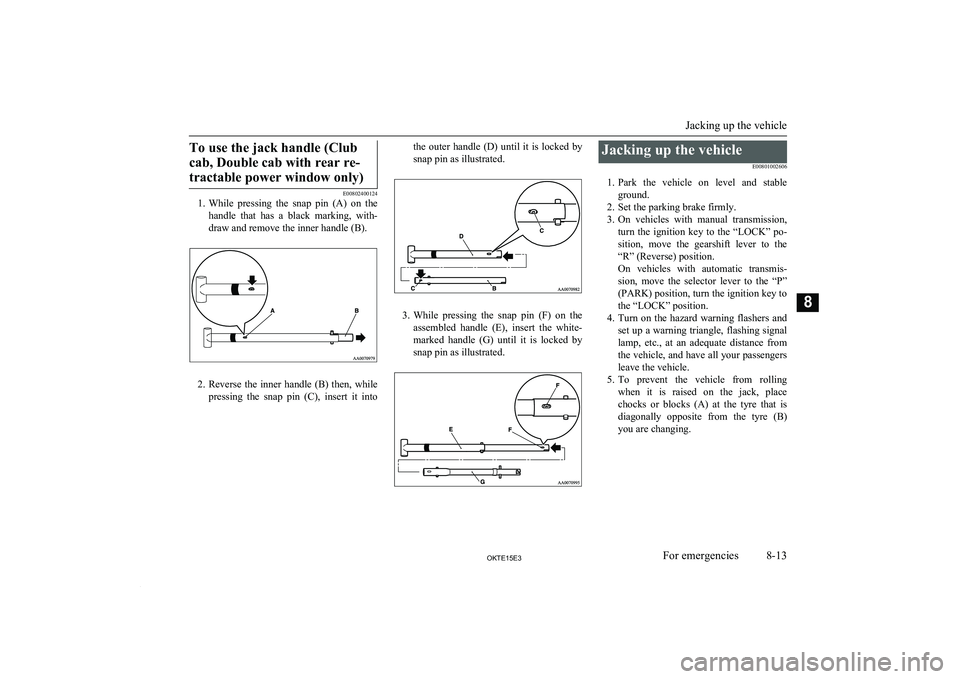
1. While pressing the snap pin (A) on the
handle that has a black marking, with-draw and remove the inner handle (B).
2. Reverse the inner handle (B) then, while
pressing the snap pin (C), insert it into
the outer handle (D) until it is locked by
snap pin as illustrated.
3. While pressing the snap pin (F) on the
assembled handle (E), insert the white-
marked handle (G) until it is locked by snap pin as illustrated.
Jacking up the vehicle
E00801002606
1. Park the vehicle on level and stable
ground.
2. Set the parking brake firmly.
3. On vehicles with manual transmission,
turn the ignition key to the “LOCK” po-
sition, move the gearshift lever to the “R” (Reverse) position.
On vehicles with automatic transmis- sion, move the selector lever to the “P” (PARK) position, turn the ignition key tothe “LOCK” position.
4. Turn on the hazard warning flashers and
set up a warning triangle, flashing signal lamp, etc., at an adequate distance from
the vehicle, and have all your passengers
leave the vehicle.
5. To prevent the vehicle from rolling
when it is raised on the jack, place
chocks or blocks (A) at the tyre that is diagonally opposite from the tyre (B)
you are changing.
Jacking up the vehicle
8-13OKTE15E3For emergencies8
Page 326 of 418
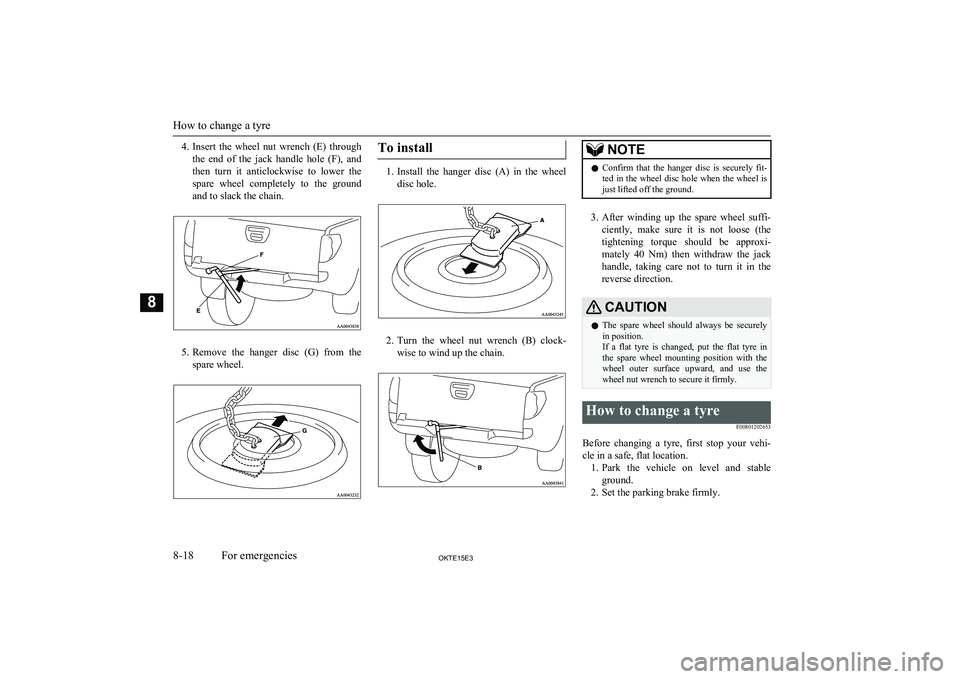
4.Insert the wheel nut wrench (E) through
the end of the jack handle hole (F), and
then turn it anticlockwise to lower the spare wheel completely to the ground
and to slack the chain.
5. Remove the hanger disc (G) from the
spare wheel.
To install
1. Install the hanger disc (A) in the wheel
disc hole.
2. Turn the wheel nut wrench (B) clock-
wise to wind up the chain.
NOTEl Confirm that the hanger disc is securely fit-
ted in the wheel disc hole when the wheel isjust lifted off the ground.
3. After winding up the spare wheel suffi-
ciently, make sure it is not loose (the tightening torque should be approxi-
mately 40 Nm) then withdraw the jack
handle, taking care not to turn it in the
reverse direction.
CAUTIONl The spare wheel should always be securely
in position.
If a flat tyre is changed, put the flat tyre in
the spare wheel mounting position with the wheel outer surface upward, and use the wheel nut wrench to secure it firmly.How to change a tyre
E00801202653
Before changing a tyre, first stop your vehi-cle in a safe, flat location. 1. Park the vehicle on level and stable
ground.
2. Set the parking brake firmly.
How to change a tyre
8-18OKTE15E3For emergencies8
Page 331 of 418
CAUTIONlOn 2WD vehicles, if the transmission is mal-
functioning or damaged, transport the vehi- cle with the driving wheels on a carriage (Type C, D or E) as illustrated.
l If you tow a vehicle with automatic trans-
mission with the driving wheels on the
ground (Type B) as illustrated, make sure
that the towing speed and distance given be- low are never exceeded, causing damage to the transmission.
Towing speed: 50 km/h (30 mph)
Towing distance: 50 km (30 miles)
For the towing speed and the towing dis- tance, follow the local driving laws and reg-
ulations.
Towing with front wheels off
the ground (Type B)
Place the gearshift lever in the “N” (Neutral) position (manual transmission) or the selector
lever in the “N” (NEUTRAL) position (auto- matic transmission).
Release the parking brake.
CAUTIONl Never tow an automatic transmission vehicle
with the front wheels up (and the rear wheels
on the ground) (Type B) when the automatic transmission fluid level is low. This may
cause serious and expensive damage to the
transmission.
Towing with rear wheels off the
ground (Type C)
Place the gearshift lever in the “N” (Neutral)
position (manual transmission) or the selector
lever in the “N” (NEUTRAL) position (auto- matic transmission). Turn the ignition key to
the “ACC” position and secure the steering wheel in a straight ahead position with a rope
or tie-down strap. Never place the ignition switch in the “LOCK” position when towing.
Emergency towing
If towing service is not available in an emer- gency, your vehicle may be temporarily tow-ed by a cable or chain secured to the towinghook.
If your vehicle is to be towed by another ve-
hicle, pay careful attention to the following
points.
If your vehicle is to be towed by
another vehicle
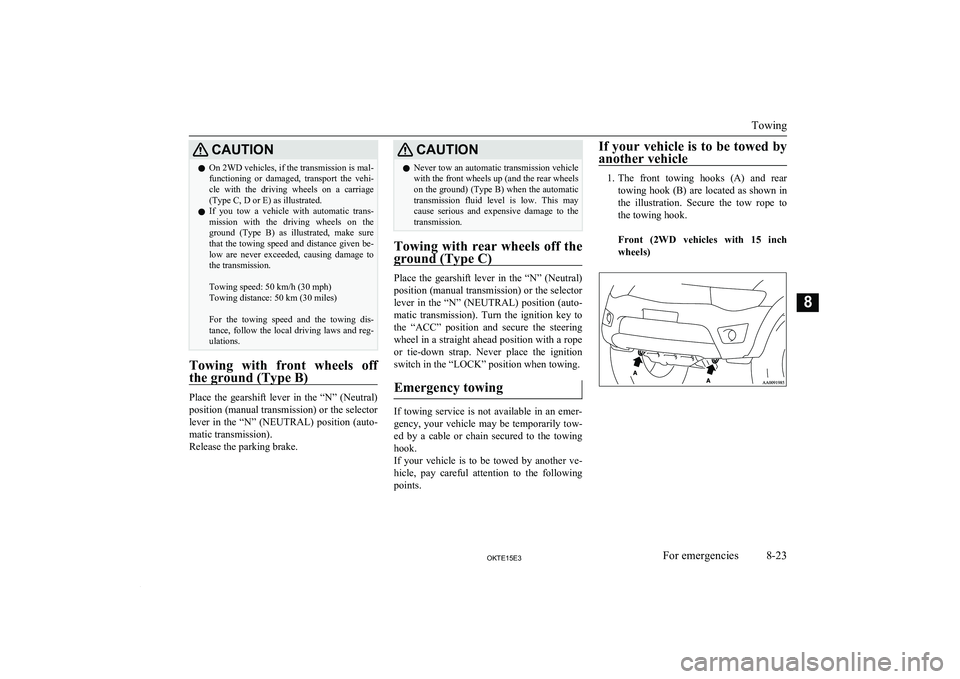
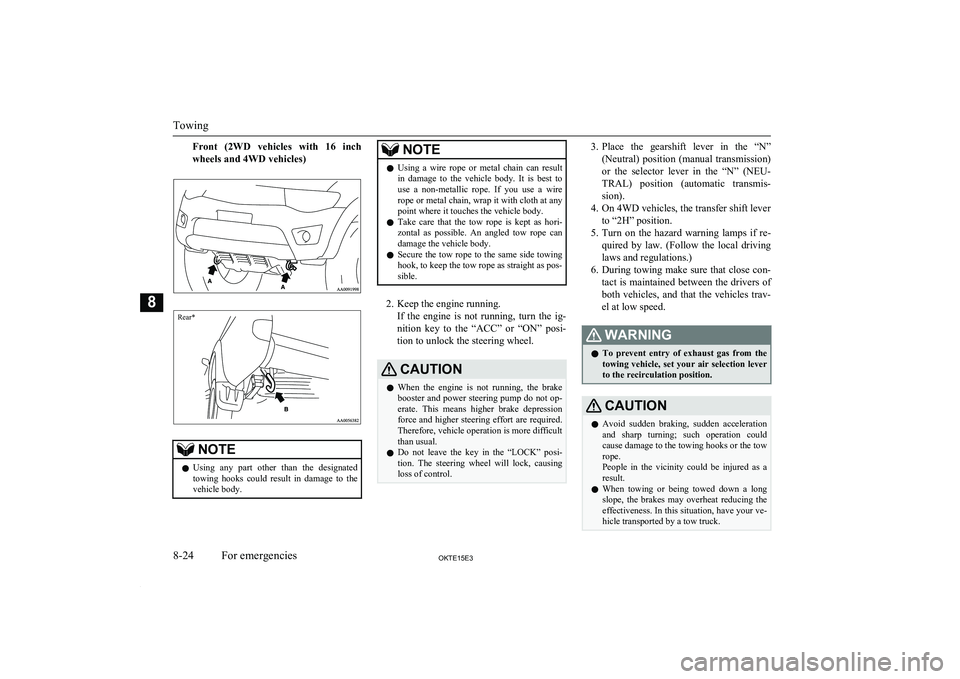
1. The front towing hooks (A) and rear
towing hook (B) are located as shown inthe illustration. Secure the tow rope to
the towing hook.
Front (2WD vehicles with 15 inch wheels)Towing
8-23OKTE15E3For emergencies8
Page 332 of 418
Front (2WD vehicles with 16 inchwheels and 4WD vehicles)Rear*
NOTEl Using any part other than the designated
towing hooks could result in damage to the
vehicle body.NOTEl Using a wire rope or metal chain can result
in damage to the vehicle body. It is best to use a non-metallic rope. If you use a wire
rope or metal chain, wrap it with cloth at any
point where it touches the vehicle body.
l Take care that the tow rope is kept as hori-
zontal as possible. An angled tow rope can
damage the vehicle body.
l Secure the tow rope to the same side towing
hook, to keep the tow rope as straight as pos-
sible.
2. Keep the engine running.
If the engine is not running, turn the ig-
nition key to the “ACC” or “ON” posi- tion to unlock the steering wheel.
CAUTIONl When the engine is not running, the brake
booster and power steering pump do not op- erate. This means higher brake depression
force and higher steering effort are required.
Therefore, vehicle operation is more difficult than usual.
l Do not leave the key in the “LOCK” posi-
tion. The steering wheel will lock, causing loss of control.3. Place the gearshift lever in the “N”
(Neutral) position (manual transmission) or the selector lever in the “N” (NEU-
TRAL) position (automatic transmis-
sion).
4. On 4WD vehicles, the transfer shift lever to “2H” position.
5. Turn on the hazard warning lamps if re-
quired by law. (Follow the local driving laws and regulations.)
6. During towing make sure that close con-
tact is maintained between the drivers of both vehicles, and that the vehicles trav-
el at low speed.WARNINGl To prevent entry of exhaust gas from the
towing vehicle, set your air selection lever to the recirculation position.CAUTIONl Avoid sudden braking, sudden acceleration
and sharp turning; such operation could
cause damage to the towing hooks or the tow
rope.
People in the vicinity could be injured as a
result.
l When towing or being towed down a long
slope, the brakes may overheat reducing the effectiveness. In this situation, have your ve-hicle transported by a tow truck.
Towing
8-24OKTE15E3For emergencies8
Page 334 of 418
Avoid racing the engine or spinning thewheels. Prolonged efforts to free a stuck ve-
hicle may result in overheating and transmis- sion failure. Allow the engine to idle for a
few minutes to let the transmission cool be-
tween rocking attempts.
If the vehicle remains stuck after several rocking attempts, seek other assistance.WARNINGl When attempting to rock your vehicle out
of a stuck position, be sure that the area
around the vehicle is clear of people and
physical objects. The rocking motion may cause the vehicle to suddenly launch for-ward or backward, causing injury or
damage to nearby people or objects.
On 2WD vehicles, it is recommended to start
the vehicle with parking brake partially, but
not completely, applied by slightly pulling the parking brake lever.
After the vehicle has become free, do not for-
get to release the parking brake.
NOTEl Depress the accelerator pedal gradually
when starting the vehicle.On a flooded road
l Avoid flooded roads. Water could enter
the brake discs, resulting in temporarily
ineffective brakes. In such cases, lightly
depress the brake pedal to see if the brakes operate properly. If they do not,
lightly depress the pedal several times while driving in order to dry the brake
pads.
l When driving in rain or on a road with
many puddles a layer of water may form between the tyres and the road surface.
This reduces a tyre’s frictional resistance
on the road, resulting in loss of steering stability and braking capability.
To cope with this, observe the following
items:
(a)Drive your vehicle at slow speed. (b)Do not drive on worn tyres. Al-
ways maintain the specified tyre
inflation pressures.On a snow-covered or frozen
road
l When driving on a snow-covered or fro-
zen road, it is recommended that you use snow tyres or tyre chains.
Refer to the “Snow tyres” and “Tyre
chains” sections.
l Avoid high-speed operation, sudden ac-
celeration, abrupt brake application and
sharp cornering.
l Depressing the brake pedal during travel
on snowy or icy roads may cause tyre
slippage and skidding. When traction be-
tween the tyres and the road is reduced the wheels may skid and the vehicle can-
not readily be brought to a stop by con- ventional braking techniques. Brakingwill differ, depending upon whether you
have anti-lock brake system (ABS). If you do have ABS, brake by pressing the brake system pedal hard, and keeping it
pressed. If you do not have ABS, pump
the brake pedal with short rapid jabs, each time fully applying and fully re-
leasing for greatest effect.
l Allow extra distance between your vehi-
cle and the vehicle in front of you, and avoid sudden braking.
Operation under adverse driving conditions
8-26OKTE15E3For emergencies8
Page 340 of 418
CAUTIONlSome types of hot water washing equipment
apply high pressure and heat to the vehicle.
They may cause heat distortion and damage to the vehicle resin parts and may result in
flooding of the vehicle interior. Therefore;
observe the following.
• Maintain a distance of approx. 50 cm or
more between the vehicle body and the washing nozzle.
• When washing around the door glass,
hold the nozzle at a distance of more than
50 cm and at right angles to the glass sur-
face.
l After washing the vehicle, drive the vehicle
slowly while lightly depressing the brake
pedal several times in order to dry out the brakes.
Leaving the brakes wet could result in re-
duced braking performance. Also, there is a possibility that they could freeze up or be-
come inoperative due to rust, rendering the vehicle unable to move.
l When using an automatic car wash, pay at-
tention to the following items, referring to the operation manual or consulting a car
wash operator. If the following procedure is not followed, it could result in damage to
your vehicle.
• The outside mirrors are retracted.
• If your vehicle is equipped with the pillar
antenna, it can be retracted.
• If your vehicle is equipped with the roof
antenna, it can be removed.During cold weather
Salt and other chemicals spread on the roads
in some areas in winter can have a harmful effect on the vehicle body. You should there-
fore wash the vehicle as often as possible in accordance with our care-instructions. It is
recommended to have a preservative applied
and the underfloor protection checked before and after the cold weather season.
After washing your vehicle, wipe off all wa- terdrops from the rubber parts around the
doors to prevent the doors from freezing.
NOTEl To prevent freezing of the weatherstripping
on the doors, bonnet, etc., they should be treated with silicone spray.Waxing
E00901000687
Waxing the vehicle will help prevent the ad-
herence of dust and road chemicals to the paintwork. Apply a wax solution after wash- ing the vehicle, or at least once every three
months to assist displacing of water.
Do not wax your vehicle in direct sunlight.
You should wax after the surfaces have
cooled.
CAUTIONl Waxes containing high abrasive compounds
should not be used. Such waxes remove rust and stains effectively from the paintwork but
they are harmful to the lustre on the painted
surface and the plated surface.
Further, they are harmful to glossy surfaces such as grille, garnish, mouldings, etc.
l Do not use petrol or paint thinners to remove
road tar or other contamination to the vehi-
cle surface.
l Do not apply wax on the areas having black
mat coating as it can cause uneven discolou-
ration, patches, blurs, etc. If stained with wax, immediately wipe off with a piece of
soft cloth and warm water.
l On vehicles with a sunroof, be careful when
waxing the area around the sunroof opening, not to put any wax on the weatherstrip
(black rubber). If stained with wax, the weatherstrip cannot maintain a weatherproof
seal with the sunroof.Polishing
E00901100011
The vehicle should only be polished if the
paintwork has become stained or lost its lus- tre. Matt-finish parts and plastic bumpers
must not be polished, polishing these parts will stain them or damage their finish.
Cleaning the exterior of your vehicle
9-04OKTE15E3Vehicle care9
Page 341 of 418
Damaged paint
E00901200155
Small cracks and scratches in the paint coat
should be touched up as soon as possible
with MITSUBISHI touch-up paint to prevent
corrosion.
Check body areas facing the road or the tyres
carefully for damage to the paint coat caused
by flying stones, etc. The paint code number
for your vehicle can be found on the vehicle information code plate. (Refer to “Vehicle la-
beling” on page 11-02.)
Cleaning plastic parts
E00901300446
Use a sponge or chamois leather.
If a car wax adheres on a grey or black rough surface of the bumper, moulding or lamps, the surface becomes white. In such a case,
wipe it off using lukewarm water and soft cloth or chamois leather.
CAUTIONl Do not use a scrubbing brush or other hard
tools as they may damage the plastic part surface.
l Do not use wax containing compound (pol-
ishing powder) which may damage the plas-
tic part surface.CAUTIONl Do not bring the plastic parts into contact
with petrol, light oil, brake fluids, engine
oils, greases, paint thinners, and sulphuric acid (battery electrolyte) which may crack,stain or discolour the plastic parts.
If they touch the plastic parts, wipe them off
with soft cloth, chamois or the like and an aqueous solution of neutral detergent thenimmediately rinse the affected parts with
water.Chrome parts
E00901400014
In order to prevent spots and corrosion of
chrome parts, wash with water, dry thorough-
ly, and apply a special protective coating.
This should be done more frequently in win- ter.
Aluminium wheels*
E00901500116
1. Remove dirt using a sponge while sprin-
kling water on the vehicle.
2. Use neutral detergent on any dirt that
cannot be removed easily with water.
Rinse off the neutral detergent after
washing the vehicle.
3. Dry the vehicle thoroughly using a cha-
mois leather or a soft cloth.
CAUTIONl Do not use a brush or other hard implement
on the wheels.
Doing so could scratch the wheels.
l Do not use any cleaner that contains an abra-
sive substance or is acidic or alkaline. Doing
so could cause the coating on the wheels to peel or become discoloured or stained.
l Do not directly apply hot water using a
steam cleaner or by any other means.
l Contact with seawater and road deicer can
cause corrosion. Rinse off such substances as soon as possible.Window glass
E00901600058
The window glass can normally be cleaned
using only a sponge and water.
Glass cleaner can be used to remove oil, grease, dead insects, etc. After washing the
glass, wipe dry with a clean, dry, soft cloth. Never use the same cloth to wipe the window glass as would be used to wipe the paint-
work; wax from the painted surfaces could
adhere to the glass and reduce its transparen-
cy and visibility.
Cleaning the exterior of your vehicle
9-05OKTE15E3Vehicle care9
Page 343 of 418

Service precautions........................................................................... 10-02
Catalytic converter............................................................................ 10-02
Bonnet............................................................................................... 10-03
Engine oil.......................................................................................... 10-04 Engine coolant...................................................................................10-06
Automatic transmission fluid*.......................................................... 10-07 Washer fluid...................................................................................... 10-08
Brake fluid.........................................................................................10-08
Clutch fluid*..................................................................................... 10-09 Power steering fluid.......................................................................... 10-10
Battery............................................................................................... 10-10 Tyres..................................................................................................10-12Clutch pedal free play*..................................................................... 10-16Brake pedal free play........................................................................ 10-17Parking brake lever stroke.................................................................10-17
Wiper blades..................................................................................... 10-17
General maintenance......................................................................... 10-19
For cold and snowy weather............................................................. 10-20
Fusible links...................................................................................... 10-20 Fuses..................................................................................................10-20
Replacement of lamp bulbs............................................................... 10-25Maintenance
OKTE15E310
Page 349 of 418

MITSUBISHI MOTORS GENUINE Coolant
has excellent protection against corrosion and rust formation of all metals including alumi-
nium and can avoid blockages in the radiator, heater, cylinder head, engine block, etc.
Because of the necessity of this anti-corro-
sion agent, the coolant must not be replaced with plain water even in summer. The re-
quired concentration of anti-freeze differs de-
pending on the expected ambient tempera- ture.Ambient
tempera-
ture (mini- mum) °C
-15-20-25-30-35-50
Anti-freezeconcentra- tion %
303540455060CAUTIONl Do not use alcohol or methanol anti-freeze
or any engine coolants mixed with alcohol
or methanol anti-freeze. The use of an im- proper anti-freeze can cause corrosion of the
aluminium components.
l For effective anti-corrosion and anti-freeze
performance, keep the anti-freeze concentra-tion within the range of 30 to 60 %.
Concentrations exceeding 60 % will result in
a reduction of both the anti-freeze and cool-
ing performance thus adversely affecting the
engine.CAUTIONl Do not top up with water only.
Water by itself reduces the rust-protective and anti-freeze qualities of the coolant and
has a lower boiling point. It can also cause damage to the cooling system if it should freeze. Do not use tapwater, as it can causecorrosion and rust formation.
During cold weather
If the temperatures in your area drop below
freezing, there is the danger that the coolant
in the engine or radiator could freeze and cause severe damage to the engine and/or ra-diator.
Add a sufficient amount of anti-freeze to the
coolant to prevent it from freezing.
The concentration should be checked before the start of cold weather and anti-freeze add- ed to the system if necessary.
Automatic transmission
fluid* E01000602125
The proper amount of automatic transmission fluid is essential to the life and operation of
the automatic transmission. Either insuffi- cient fluid or excessive fluid could causetransmission trouble. The transmission fluid filler port cap is equipped with a dipstick.Use the following procedure to check the flu-
id level.
Procedure for checking the flu- id level
1. Check the fluid level after the vehicle
has been driven enough to warm up the
transmission fluid.
2. Park the vehicle on a flat, level surface
and apply the parking brake.
3. With the engine idling and the brake
pedal fully depressed, move the trans- mission selector lever through all the po-sitions from P” (PARK) to “D”
(DRIVE), stopping momentarily at each position.
4. Move the selector lever to the “P”
(PARK) position.
5. Remove the dipstick and wipe it with a
clean lint-free cloth.
6. Reinsert the dipstick as far as it goes.
Automatic transmission fluid*
10-07OKTE15E3Maintenance10