battery MITSUBISHI LANCER EVOLUTION 2007 Service Repair Manual
[x] Cancel search | Manufacturer: MITSUBISHI, Model Year: 2007, Model line: LANCER EVOLUTION, Model: MITSUBISHI LANCER EVOLUTION 2007Pages: 1449, PDF Size: 56.82 MB
Page 1308 of 1449

SRS -AirBagModuleandSeatBeltPre-tensioner
Disposal Procedures52B-64
AIR BAG MODULE AND SEAT BELT PRE-TENSIONER DISPOSAL
PROCEDURES
Carry out the following procedure of air bag
deployment and seat belt pre-tensioner operation
before disposing the air bag module and seat beltwith pre-tensioner or the vehicle with SRS air bag
and seat belt with pre-tensioner.
DISPOSAL OF AIR BAG MODULE BEFORE
DEPLOYMENT OR SEAT BELT WITH
PRE-TENSIONER BEFORE OPERATION
Caution
1. Carry out deployment of all the air bag modules and
operation of all seat belt pre-tensioners before
disposing the vehicle with SRS air bag and seat belt
with pre-tensioner inside the vehicle.
2. Carry out deployment of the used air bag or operation
of the used seat belt pre-tensioner outside the vehicle
when replacing the air bag module or the seat belt with
pre-tensioner.
3. Carry out deployment of air bag or operation of seat
belt pre-tensioner in a well ventilated place since a lot
of smoke is generated .Do not carry out operation near
a smoke detector.
4. Avoid carrying out operation in a residential area as
much as possible and give a warning when any person
is near by since air bag deployment or seat belt
pre-tensioner operation causes loud operation sound.
5. Prepare ear plugs for those are engaged in air bag
deployment or seat belt pre-tensioner operation or for
those who are near by.
DEPLOYMENT OR OPERATION INSIDE THE VEHICLE
1. Move the vehicle to flat and isolated spot.
2. Disconnect the negative (–) and positive (+) battery cables
from the battery terminals, and then remove the battery
from the vehicle.
Caution
Wait at least 60 seconds after the disconnection of the
battery cables before any further job. (Refer to
P.52B-3.)
3. Carry out deployment of the air bag module and operation
of the seat belt pre-tensioner according to the following
procedure.
Page 1309 of 1449
SRS -AirBagModuleandSeatBeltPre-tensioner
Disposal Procedures52B-65
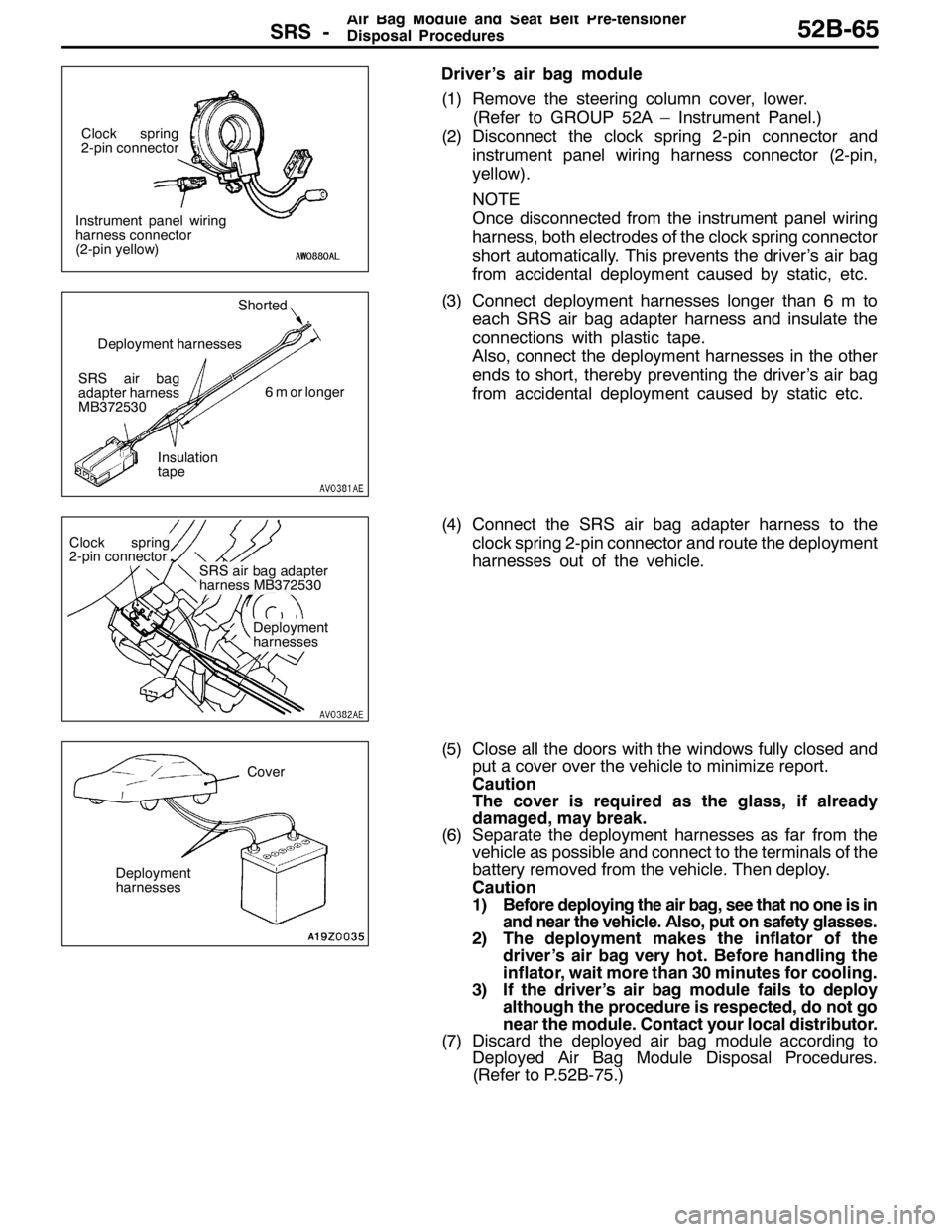
Driver’s air bag module
(1) Remove the steering column cover, lower.
(Refer to GROUP 52A – Instrument Panel.)
(2) Disconnect the clock spring 2-pin connector and
instrument panel wiring harness connector (2-pin,
yellow).
NOTE
Once disconnected from the instrument panel wiring
harness, both electrodes of the clock spring connector
short automatically. This prevents the driver’s air bag
from accidental deployment caused by static, etc.
(3) Connect deployment harnesses longer than 6 m to
each SRS air bag adapter harness and insulate the
connections with plastic tape.
Also, connect the deployment harnesses in the other
ends to short, thereby preventing the driver’s air bag
from accidental deployment caused by static etc.
(4) Connect the SRS air bag adapter harness to the
clock spring 2-pin connector and route the deployment
harnesses out of the vehicle.
(5) Close all the doors with the windows fully closed and
put a cover over the vehicle to minimize report.
Caution
The cover is required as the glass, if already
damaged, may break.
(6) Separate the deployment harnesses as far from the
vehicle as possible and connect to the terminals of the
battery removed from the vehicle. Then deploy.
Caution
1) Before deploying the air bag, see that no one is in
and near the vehicle. Also, put on safety glasses.
2) The deployment makes the inflator of the
driver’s air bag very hot. Before handling the
inflator, wait more than 30 minutes for cooling.
3) If the driver’s air bag module fails to deploy
although the procedure is respected, do not go
near the module. Contact your local distributor.
(7) Discard the deployed air bag module according to
Deployed Air Bag Module Disposal Procedures.
(Refer to P.52B-75.)
Instrument panel wiring
harness connector
(2-pin yellow)Clock spring
2-pin connector
SRS air bag
adapter harness
MB372530Shorted
6 m or longer
Insulation
tape Deployment harnesses
Clock spring
2-pin connector
SRS air bag adapter
harness MB372530
Deployment
harnesses
Cover
Deployment
harnesses
Page 1311 of 1449
SRS -AirBagModuleandSeatBeltPre-tensioner
Disposal Procedures52B-67
(6) Separate the deployment harnesses as far from the
vehicle as possible and connect to the terminals of the
battery removed from the vehicle. Then deploy.
Caution
1) Before deploying the air bag, see that no one is
in and near the vehicle. Also, put on safety
glasses.
2) The deployment makes the inflator of the front
passenger’s air bag very hot. Before handling
the inflator, wait more than 30 minutes for
cooling.
3) If the front passenger’s air bag module fails to
deploy although the procedure is respected,
do not go near the module. Contact your local
distributor.
(7) Discard the deployed air bag module according to
Deployed Air Bag Module Disposal Procedures.
(Refer to P.52B-75.)
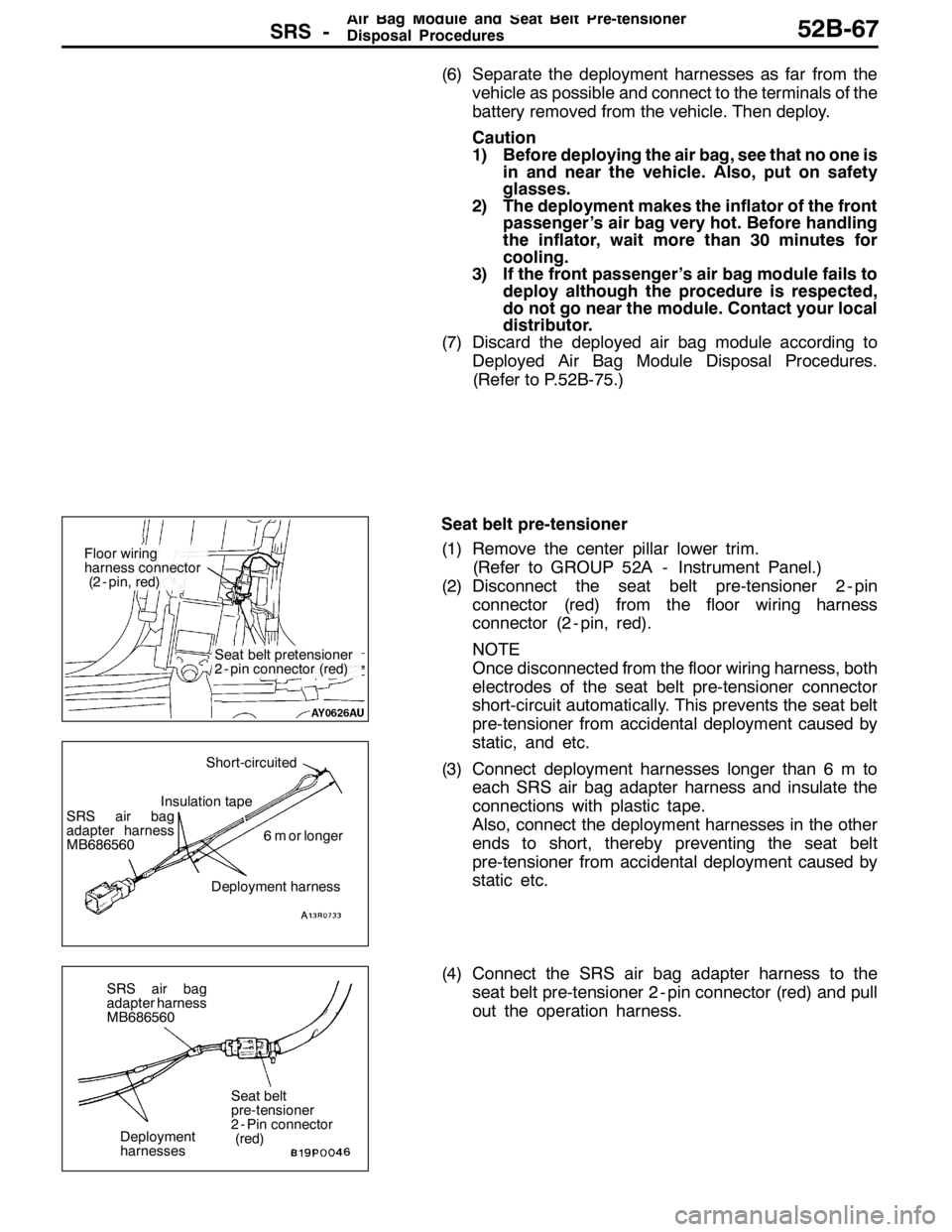
Seat belt pre-tensioner
(1) Remove the center pillar lower trim.
(Refer to GROUP 52A - Instrument Panel.)
(2) Disconnect the seat belt pre-tensioner 2 - pin
connector (red) from the floor wiring harness
connector (2 - pin, red).
NOTE
Once disconnected from the floor wiring harness, both
electrodes of the seat belt pre-tensioner connector
short-circuit automatically. This prevents the seat belt
pre-tensioner from accidental deployment caused by
static, and etc.
(3) Connect deployment harnesses longer than 6 m to
each SRS air bag adapter harness and insulate the
connections with plastic tape.
Also, connect the deployment harnesses in the other
ends to short, thereby preventing the seat belt
pre-tensioner from accidental deployment caused by
static etc.
(4) Connect the SRS air bag adapter harness to the
seat belt pre-tensioner 2 - pin connector (red) and pull
out the operation harness.
Seat belt pretensioner
2 - pin connector (red)
Floor wiring
harness connector
(2 - pin, red)
SRS air bag
adapter harness
MB686560
Insulation tapeShort-circuited
6 m or longer
Deployment harness
Deployment
harnesses SRS air bag
adapter harness
MB686560
Seat belt
pre-tensioner
2 - Pin connector
(red)
Page 1312 of 1449

SRS -AirBagModuleandSeatBeltPre-tensioner
Disposal Procedures52B-68
(5) Close all the doors with the windows fully closed and
put a cover over the vehicle to minimize report.
Caution
The cover is required as the glass, if already
damaged, may break.
(6) Separate the deployment harnesses as far from the
vehicle as possible and connect to the terminals of
the battery removed from the vehicle. Then deploy.
Caution
1) Before operating the seat belt pre-tensioner,
see that no one is in or near the vehicle.
2) The operation makes the insulator of the seat
belt pre-tensioner very hot. Before handling
the inflator, wait more than 30 minutes for
cooling.
3) If the seat belt pre-tensioner fails to operate
although the procedure is respected, do not go
near the seat belt pre-tensioner. Contact your
local distributor.
(7) Discard the operated seat belt pre-tensioner accord-
ing to Disposal Procedure. (Refer to P.52B-75.)
DEPLOYMENT OUTSIDE THE VEHICLE
Caution
1. Carry out air bag deployment or seat belt pre-tensioner
operation on large flat place at least 6 m away from any
object or person.
2. Avoid a strong wind weather when carrying out
deployment or operation outside the vehicle. Ignite the
air bag at a place upwind from the air bag module and
the seat belt pre-tensioner even in a breeze weather.
1. Disconnect the negative ( - ) and positive (+) battery cables
from the battery terminals, and then remove the battery
from the vehicle.
Caution
Wait at least 60 seconds before any further job after the
disconnection of the battery cables. (Refer to P.52B-3.)
2. Carry out deployment of the air bag module and operation
of the seat belt pre-tensioner according to the following
procedure.
Driver’s side air bag module
(1) Remove the driver’s air bag module from the vehicle.
(Refer to P.52B-52.)
Caution
Once disconnected, both electrodes of the driver’s air
bag module connector short automatically to prevent
accidental deployment caused by static etc. Still, in
consideration of the accidental deployment, store the
air bag module on flat place with deployment surface
facing up. Also, do not put anything on it.
Cover
Deployment
harnesses
Page 1314 of 1449

SRS -AirBagModuleandSeatBeltPre-tensioner
Disposal Procedures52B-70
(7) Separate the deployment harnesses as far from the
driver’s side air bag module as possible and connect
to the terminals of the battery removed from the
vehicle. Then deploy.
Caution
1) Before the deployment, see that no one is near
around the driver’s air bag module.
2) The deployment makes the inflator of the
driver’s air bag very hot. Before handling the
inflator, wait more than 30 minutes for cooling.
3) If the driver’s air bag module fails to deploy
although the procedure is respected, do not go
near the module. Contact your local
distributor.
(8) Discard the deployed air bag module as specified
in Deployed Air Bag Module Disposal Procedures.
(Refer to P.52B-75.)
Driver’s side air bag module
(1) Remove the steering wheel - air bag module assembly
from the vehicle. (Refer to P.52B-52.)
Caution
Once disconnected, both electrodes of the driver’s
air bag module connector short automatically to
prevent accidental deployment caused by static
etc. Still, in consideration of the accidental
deployment, store the air bag module on flat place
with deployment surface facing up. Also, do not
put anything on it.
(2) Prepare two deployment harnesses longer than 6 m
for deployment and connect the terminals in one end
to short-circuit. This is to prevent accidental
deployment caused by static etc.
(3) Touch the vehicle’s body with bare hands to discharge
static in you.
Caution
Never fail to do Step (3) in order to prevent
accidental deployment caused by static.
Deployment harnesses
Shorted Deployment harnesses
6 m or longer
Page 1315 of 1449

SRS -AirBagModuleandSeatBeltPre-tensioner
Disposal Procedures52B-71
(4) Release the secured connector of the steering
wheel - driver’s air bag module assembly to cut off
the connector from the harness with a nipper and
etc. Connect deployment harnesses to each of two
separated harnesses and cover the area with
insulation tape.
(5) Use a rope to tie the steering wheel - driver’s air bag
module assembly to secure old tyres with wheels.
(6) Route the deployment harness connected to driver’s
air bag module beneath old tyres with wheels. Then,
secure the steering wheel - driver’s air bag module
assembly with the deployment surface facing up.
(7) Place three old tyres without wheels on the tyre
secured with the driver’s air bag module.
(8) Separate the deployment harnesses as far from the
driver’s side air bag module as possible and connect
to the terminals of the battery removed from the
vehicle. Then deploy.
Caution
1) Before the deployment, see that no one is near
around the driver’s air bag module.
2) The deployment makes the inflator of the
driver’s air bag very hot. Before handling the
inflator, wait more than 30 minutes for cooling.
3) If the driver’s air bag module fails to deploy
although the procedure is respected, do not go
near the module. Contact your local
distributor.
(9) Discard the deployed air bag module as specified
in Deployed Air Bag Module Disposal Procedures.
(Refer to P.52B-75.)Deployment
harness
Short-circuited area Steering wheel - driver’s air bag
module assembly
Insulation tape
Steering wheel - driver’s air bag module assembly
Deployment
harness
Tyres without wheels
Deployment harnesses
Deployment harnesses
Page 1317 of 1449

SRS -AirBagModuleandSeatBeltPre-tensioner
Disposal Procedures52B-73
(6) Disconnect the deployment harnesses as far from
the front passenger’s air bag module as possible and
connect the harnesses to the battery removed from
the vehicle.
Caution
1) Before the deployment, see that no one is near
the front passenger’s air bag module.
2) The deployment makes the inflator of the front
passenger’s air bag very hot. Before handling
the inflator, wait more than 30 minutes for
cooling.
3) If the front passenger’s air bag module fails to
deploy although the procedure is respected,
do not go near the module. Contact your local
distributor.
(7) Discard the deployed air bag module as specified
in Deployed Air Bag Module Disposal Procedures.
(Refer to P.52B-75.)
Seat belt pre-tensioner
(1) Remove the seat belt with pre-tensioner from the
vehicle. (Refer to P.52B-61.)
Caution
Once disconnected, both electrodes of the seat
belt pre-tensioner are short-circuited
automatically to prevent accidental deployment
caused by static etc. Still, in consideration of the
accidental deployment, store the air bag module
on flat place with deployment surface facing up.
Also, do not put anything on it.
(2) Connect deployment harness 6 m or longer with the
SRS air bag adapter harness respectively. Insulate
the connection with tape.
Moreover, the ends of the operation harness should
be connected (short-circuited) to each other. Thus,
it prevents the seat belt pre-tensioner from accidental
deployment caused by static and etc.
Deployment harnesses
SRS air bag
adapter
harness
MR686560Shorted
6 m long
or more Insulation tape
Deployment
harnesses
Page 1318 of 1449

SRS -AirBagModuleandSeatBeltPre-tensioner
Disposal Procedures52B-74
(3) Route a thick wire through the holes in the seat belt
retractor bracket to secure at the top of the wheel
(convex part). (two locations)
(4) Connect the seat belt pre-tensioner connector to the
the SRS air bag adapter harness with the operation
harness attached.
(5) Pull out the seat belt outside the tyre.
Caution
Place the connector of the SRS air bag adapter
harness so that it is not clamped by the tyres at
deployment.
(6) Place an old tyre (without a wheel) on the tyre, which
the seat belt with pre-tensioner is secured on.
(7) Disconnect the deployment harness as far fromthe
seat belt pre-tensioner as possible and connect the
both terminals of the battery removed from the vehicle.
Then deploy.
Caution
1) Before the deployment, see that no one is near
the seat belt pre-tensioner.
2) Before handling the insulator, wait for a while
for cooling.
3) If the seat belt pre-tensioner fails to operate
although the procedure is respected, do not go
near the seat belt pre-tensioner. Contact your
local distributor.
(8) Discard the operated seat belt pre-tensioner
according to Disposal Procedure.(Refer to P.52B-75.)Seat belt pre-tensioner
Deployment harness
Old tyres without
wheels
Deployment harness
Page 1322 of 1449

54A-2
CHASSIS
ELECTRICAL
CONTENTS
BATTERY 4..............................
SERVICE SPECIFICATION 4....................
ON-VEHICLE SERVICE 4......................
Fluid Level and Specific Gravity Check 4........
Charging 4.................................
Battery Testing Procedure 5...................
IGNITION SWITCH AND IMMOBILIZER
SYSTEM 6...............................
SPECIAL TOOLS 6............................
TROUBLESHOOTING 6........................
IMMOBILIZER-ECU CHECK 10.................
IGNITION SWITCH 11..........................
COMBINATION METER 14................
SERVICE SPECIFICATIONS 14.................
SEALANT 14..................................
SPECIAL TOOLS 15...........................
TROUBLESHOOTING 15.......................
ON-VEHICLE SERVICE 19.....................Speedometer Check 19......................
Tachometer Check 20........................
Fuel Gauge Unit Check 20....................
Engine Coolant Temperature Gauge
Unit Check 21...............................
COMBINATION METER 22.....................
HEADLAMP ASSEMBLY 24...............
SERVICE SPECIFICATIONS 24.................
TROUBLESHOOTING 24.......................
ON-VEHICLE SERVICE 24.....................
Headlamp Aiming 24.........................
Headlamp Intensity Measurement 28...........
Headlamp Bulb(low beam)Replacement28 ....
Headlamp Bulb(high beam)Replacement29 ...
Position Lamp Bulb Replacement29 ...........
Front Turn Signal Lamp Bulb Replacement29 ...
Headlamp Auto Cut Adjustment Procedure29 ...
HeadlampAuto Cut Function Check 29.........
HEADLAMP ASSEMBLY 30....................
CONTINUED ON NEXT PAGE
Page 1324 of 1449
![MITSUBISHI LANCER EVOLUTION 2007 Service Repair Manual CHASSIS ELECTRICAL -BatteryCHASSIS ELECTRICAL -Battery54A-4
BATTERY
SERVICE SPECIFICATION
ItemSpecification
Specific gravity of the battery fluid1.220 - 1.290 [20_C]
ON-VEHICLE SERVICE
FLUID LEVEL AND](/img/19/57084/w960_57084-1323.png "MITSUBISHI LANCER EVOLUTION 2007 Service Repair Manual CHASSIS ELECTRICAL -BatteryCHASSIS ELECTRICAL -Battery54A-4
BATTERY
SERVICE SPECIFICATION
ItemSpecification
Specific gravity of the battery fluid1.220 - 1.290 [20_C]
ON-VEHICLE SERVICE
FLUID LEVEL AND")
CHASSIS ELECTRICAL -BatteryCHASSIS ELECTRICAL -Battery54A-4
BATTERY
SERVICE SPECIFICATION
ItemSpecification
Specific gravity of the battery fluid1.220 - 1.290 [20_C]
ON-VEHICLE SERVICE
FLUID LEVEL AND SPECIFIC GRAVITY CHECK
1. Inspect whether or not the battery fluid is between the
UPPER LEVEL and LOWER LEVEL marks.
Caution
(1) If the battery fluid is below the LOWER LEVEL,
the battery could explode in using.
(2) If the battery fluid is over the UPPER LEVEL,
leakage could result.
2. Use a hydrometer and thermometer to check the specific
gravity of the battery fluid.
Standard value: 1.220 - 1.290 [20_C]
The specific gravity of the battery fluid varies with the
temperature, so use the following formula to calculate
the specific gravity for 20_C. Use the calculated value
to determine whether or not the specific gravity is
satisfactory.
D20 = (t - 20)×0.0007 + Dt
D20: Specific gravity of the battery fluid calculated
for 20_C.
Dt: Actually measured specific gravity
t: Actually measured temperature
CHARGING
1. Remove the battery from the vehicle.
2. The normal charging current is a value in amperes which is 1/10th of the battery capacity. If the
battery needs to be charged rapidly because of reasons such as time limitations, the maximum charging
current for rapid charging is the battery capacity expressed as an ampere value.
Battery typeCapacity (5-hour rate)Normal charging currentRapid charging current
44B2034 A3.4 A34 A
3. Determine when charging is finished.
DWhen the specific gravity of the battery electrolyte is constantly within 1.250 - 1.290 for a
continuous period of one hour or more
DWhen the voltage per cell during charging is 2.5 - 2.8 V constantly for a continuous period
of one hour or more
Thermometer
HydrometerGood