check engine MITSUBISHI LANCER EVOLUTION 2007 Service Repair Manual
[x] Cancel search | Manufacturer: MITSUBISHI, Model Year: 2007, Model line: LANCER EVOLUTION, Model: MITSUBISHI LANCER EVOLUTION 2007Pages: 1449, PDF Size: 56.82 MB
Page 755 of 1449

ENGINE ELECTRICAL -Starting System16-23
REASSEMBLY SERVICE POINT
"AASTOP RING/SNAP RING INSTALLATION
Using a suitable pulling tool, pull overrunning clutch stop ring
over snap ring.
INSPECTION
COMMUTATOR CHECK
1. Place the armature in a pair of “V” blocks and check
the runout with a dial indicator.
Standard value: 0.05 mm
Limit: 0.1 mm
2. Measure the commutator outer diameter.
Standard value: 29.4 mm
Limit: 28.8 mm
3. Check the undercut depth between segments.
Standard value: 0.5 mm
Limit: 0.2 mm
BRUSH HOLDER CHECK
Confirm that the spring is activated when the brush is pressed
into the brush holder by hand.
Replace the brush holder if the spring is not activated.
Stop ringOverrunning
clutchStop ring
Snap ring
Undercut
Segment
Mica
Page 756 of 1449

ENGINE ELECTRICAL -Starting System16-24
OVERRUNNING CLUTCH CHECK
1. While holding clutch housing, rotate the pinion. Drive
pinion should rotate smoothly in one direction, but should
not rotate in opposite direction. If clutch does not function
properly, replace overrunning clutch assembly.
2. Inspect pinion for wear or burrs. If pinion is worn or burred,
replace overrunning clutch assembly. If pinion is damaged,
also inspect ring gear for wear or burrs.
FRONT AND REAR BRACKET BUSHING CHECK
Inspect bushing for wear or burrs. If bushing is worn or burred,
replace front bracket assembly or rear bracket assembly.
BRUSH REPLACEMENT
1. Check the surface contacting the commutator for
roughness and the brush length.
Limit value: 7.0 mm
2. If the limit is exceeded, replace the brush holder.
ARMATURE TEST
ARMATURE COIL SHORT-CIRCUIT TEST
1. Check that the armature coil is not grounded.
2. Place armature in a growler.
3. Hold a thin steel blade parallel and just above while rotating
armature slowly in growler. A shorted armature will cause
blade to vibrate and be attracted to the core. Replace
shorted armature.
ARMATURE COIL EARTH TEST
Check the insulation between each commutator segment and
armature coil core.
If there is no continuity, the insulation is in order.
Free
Lock
Length
Growler
Page 757 of 1449

ENGINE ELECTRICAL -Starting System16-25
ARMATURE COIL OPEN-CIRCUIT INSPECTION
Check the continuity between segments. If there is continuity,
the coil is in order.
MAGNETIC SWITCH
COIL DISCONNECTION TEST
DConfirm that there is continuity between the “M” terminal
and body A.
DIf there is no continuity, replace the magnetic switch.
CONTACT CONTACTING STATE CHECK
DConfirm that there is no continuity between the “B” terminal
and “M” terminal.
DIf there is continuity, replace the magnetic switch.
CONTACT CONTACTING STATE CHECK
DPress the end of the magnetic switch in with force, and
close the internal contact. Confirm that there is continuity
between the “B” terminal and “M” terminal in this state.
DIf there is no continuity, replace the magnetic switch.
“M” terminal A
“M” terminal “B” terminal
“M” terminal “B” terminal
Page 760 of 1449

ENGINE ELECTRICAL -Ignition System16-28
ON-VEHICLE SERVICE
IGNITION COIL (WITH BUILT-IN POWER
TRANSISTOR) CHECK
Check by the following procedure, and replace if there is
a malfunction.
SECONDARY COIL RESISTANCE CHECK
Measure the resistance between the high-voltage terminals
of the ignition coil.
Standard value: 8.5 - 11.5 kΩ
PRIMARY COIL AND POWER TRANSISTOR
CONTINUITY CHECK
NOTE
1. An analogue-type circuit tester should be used.
2. Connect the negative ( - ) prove of the circuit tester to
terminal 1.
Caution
This test must be performed quickly (in less than 10
seconds) to prevent coil from burning and power
transistor from breakage.
1.5V power across 2 - 3Continuity across 1 - 2
When energizedYe s
When not energizedNo
RESISTIVE CORD CHECK
Measure the resistance of the all spark plug cables.
1. Check cap and coating for cracks.
2. Measure resistance.
Limit: Max. 22 kΩ
Page 761 of 1449

ENGINE ELECTRICAL -Ignition System16-29
SPARK PLUG CHECK, CLEANING AND REPLACEMENT
SPARK PLUG GAP CHECK
Caution
1. Do not adjust the gap of the iridium plug.
2. Cleaning of the iridium plug could damage the tip of the electrode. Thus, if the plug must
be cleaned because of soot, etc., use a plug cleaner and clean within a short time of 20 seconds
or less to protect the electrode. Do not use a wire brush, etc.
3. Even when the functions of the iridium plug are normal, the electrode section may be blackened.
However, the adhered carbon has properties that easily burned off compared to the conventional
type, so there is no problem. Check the quality of the spark plug by checking the insulation
resistance.
Check the plug gap, and replace if the checked value is more than the limit value.
Standard value, limit value:
MakerModelStandard value (mm)Limit value (mm)
NGKIGR7A-G0.6 - 0.70.75
DENSOVW22PR-DA70.6 - 0.70.75
SPARK PLUG INSULATION RESISTANCE CHECK
Measure the insulation resistance of the spark plug, and
replace if the measured value is less than the limit value.
Limit value: 1 MΩ
CAMSHAFT POSITION SENSOR CHECK
Refer to GROUP 13A - Troubleshooting.
CRANK ANGLE SENSOR CHECK
Refer to GROUP 13A - Troubleshooting.
DETONATION SENSOR CHECK
Check the detonation sensor circuit if self-diagnosis code,
No. 31 is shown.
NOTE
For information concerning the self-diagnosis codes, refer
to GROUP 13A - Troubleshooting.
Page 762 of 1449

ENGINE ELECTRICAL -Ignition System16-30
WAVEFORM CHECK USING AN ANALYZER
Ignition Secondary Voltage Waveform Check
MEASUREMENT METHOD
1. Clamp the secondary pickup around the spark plug cable.
NOTE
(1) The peak ignition voltage will be reversed when the
spark cables No. 2 and No. 4, or No. 1 and No.
3 cylinders are clamped.
(2) Because of the two-cylinder simultaneous ignition
system, the waveforms for two cylinders in each group
appear during waveform observation (No. 1 cylinder
- No. 4 cylinder, No. 2 cylinder - No. 3 cylinder).
However, waveform observation is only applicable
for the cylinder with the spark plug cable clamped
by the secondary pickup.
(3) Identifying which cylinder waveform is displayed can
be difficult. For reference, remember that the
waveform of the cylinder attached to the secondary
pickup will be displayed as stable.
2. Clamp the spark plug cable with the trigger pickup.
NOTE
Clamp the trigger pickup to the same spark plug cable
clamped by the secondary pickup.
Page 771 of 1449

17-1
ENGINE AND
EMISSION
CONTROL
CONTENTS
ENGINE CONTROL SYSTEM 2.........
GENERAL INFORMATION 2................
SERVICE SPECIFICATIONS 2...............
ON-VEHICLE SERVICE 2...................
Accelerator Cable Check and
Adjustment 2................................
ACCELERATOR CABLE AND PEDAL 3......
EMISSION CONTROL SYSTEM 4......
GENERAL INFORMATION 4................
Emission Control Device Reference
Table 4.....................................
SERVICE SPECIFICATIONS 5..............
VACUUM HOSE 5..........................
Vacuum Hose Piping Diagram 5..............
Vacuum Circuit Diagram 6....................
Vacuum Hose Check 7......................
Vacuum Hose Installation 7..................
CRANKCASE EMISSION CONTROL
SYSTEM 8................................
General Information 8........................
System Diagram 8..........................
Component Location 9.......................
Positive Crankcase Ventilation System Check 9....
PCV Valve Check 9.........................
EVAPORATIVE EMISSION CONTROL
SYSTEM 10...............................
General Information 10.......................
System Diagram 10..........................
Component Location 10......................
Purge Control System Check 11...............
Purge Port Vacuum Check 11.................
Purge Control Solenoid Valve Check 12.........
Check Valve Check 12.......................
EXHAUST GAS RECIRCULATION (EGR)
SYSTEM 13...............................
General Information 13.......................
Operation 13................................
System Diagram 13..........................
Component Location 14......................
Exhaust Gas Recirculation (EGR) Control System
Check 14...................................
EGR Valve Check 15.........................
EGR Port Vacuum Check 15..................
EGR Control Solenoid Valve Check 16..........
EGR VALVE 17............................
CANISTER 18.............................
CATALYTIC CONVERTER 19................
General Information 19.......................
Page 772 of 1449
ENGINE AND EMISSION CONTROL -Engine Control System17-2
ENGINE CONTROL SYSTEM
GENERAL INFORMATION
A cable-type accelerator mechanism and a
suspended-type pedal have been adopted.
SERVICE SPECIFICATIONS
ItemsStandard value
Accelerator cable play mm1-2
Engineidlespeedr/min850±50Engineidle speed±/min850±50
ON-VEHICLE SERVICE
ACCELERATOR CABLE CHECK AND
ADJUSTMENT
1. Turn A/C and lamps OFF.
Inspect and adjust at no load.
2. Warm engine until stabilized at idle.
3. Confirm idle speed is at prescribed value.
Standard value: 850±50 r/min
4. Stop engine (ignition switch OFF).
5. Confirm there are no sharp bends in accelerator cable.
6. Check inner cable for correct slack.
Standard value: 1 - 2 mm
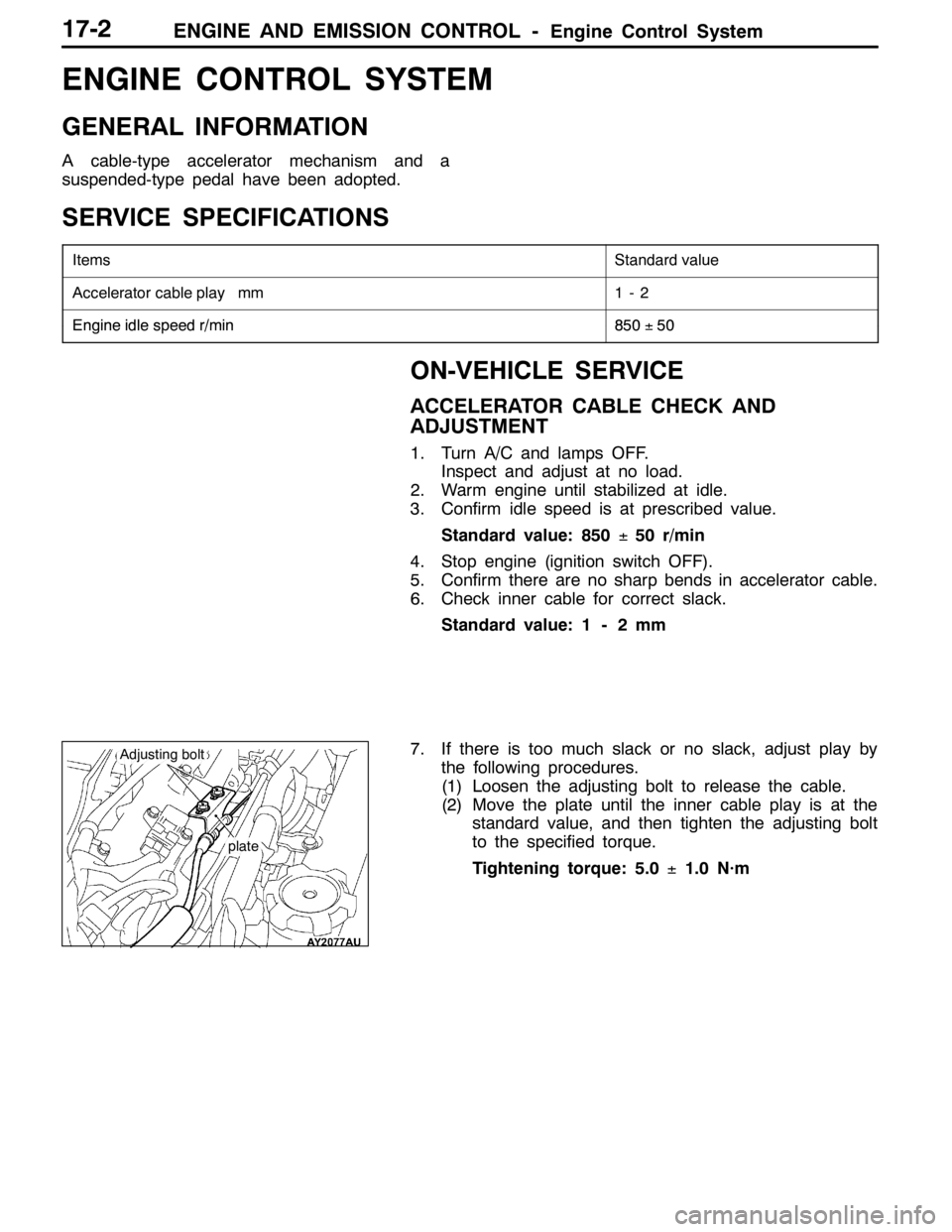
7. If there is too much slack or no slack, adjust play by
the following procedures.
(1) Loosen the adjusting bolt to release the cable.
(2) Move the plate until the inner cable play is at the
standard value, and then tighten the adjusting bolt
to the specified torque.
Tightening torque: 5.0±1.0 N·m
plate
Adjusting bolt
Page 774 of 1449

ENGINE AND EMISSION CONTROL -Emission Control System17-4
EMISSION CONTROL SYSTEM
GENERAL INFORMATION
The emission control system consists of the following subsystems:
DCrankcase emission control system
DEvaporative emission control system
DExhaust emission control system
ItemsNameSpecification
Crankcase emission
control systemPositive crankcase ventilation (PCV) valveVariable flow type
(Purpose: HC reduction)
Evaporative emission
control systemCanister
Purge control solenoid valve
Check valveEquipped
Duty cycle type solenoid valve
Equipped
(Purpose: HC reduction)
Exhaust emission
control systemAir-fuel ratio control device - MPI systemOxygen sensor feedback type
(Purpose: CO, HC, NOx reduction)
Exhaust gas recirculation system
DEGR valve
DEGR control solenoid valveEquipped
Single type
Duty cycle type solenoid valve
(Purpose: NOx reduction)
Catalytic converterMonolith type
(Purpose: CO, HC, NOx reduction)
EMISSION CONTROL DEVICE REFERENCE TABLE
Related partsCrankcase
emission
control
systemEvaporative
emission
control
systemAir/fuel
ratio
control
systemCatalytic
converterExhaust
gas
recirculation
systemReference
page
PCV valve×17-9
Purge control solenoid valve×17-12
Check valve×17-12
MPI system component××GROUP 13A
Catalytic converter×17-19
EGR valve×17-15
EGR control solenoid valve×17-16
Page 775 of 1449

ENGINE AND EMISSION CONTROL -Emission Control System17-5
SERVICE SPECIFICATIONS
ItemsStandard value
Purge control solenoid valve coil resistance (at 20_C)Ω30 - 34
EGR control solenoid valve coil resistance (at 20_C)Ω29 - 35
VACUUM HOSE
VACUUM HOSE PIPING DIAGRAM
Fuel
pressure
control
solenoid
valve
Oxygen
sensor
(front)
Check
valve
Fuel
pressure
regulator
PCV valve To
fuel tank
Oxygen sensor (rear) From
fuel pump
Air
inletEGR control
solenoid valve
Purge
control
solenoid
valveCanisterFrom
fuel tank
EGR
valve Injector
Three - way
catalytic converter A
P
E