check engine MITSUBISHI LANCER EVOLUTION 2007 Service Repair Manual
[x] Cancel search | Manufacturer: MITSUBISHI, Model Year: 2007, Model line: LANCER EVOLUTION, Model: MITSUBISHI LANCER EVOLUTION 2007Pages: 1449, PDF Size: 56.82 MB
Page 1063 of 1449

BASIC BRAKE SYSTEM -Disc Brake35A-21
INSTALLATION SERVICE POINT
"AADISC BRAKE ASSEMBLY INSTALLATION
1. In order to measure the brake drag force after pad
installation, measure the rotary-sliding resistance of the
hub by the following procedure with the pads removed.
(1) Withdraw the drive shaft. (Refer to GROUP 26, 27.)
(2) Attach the special tool to the front hub assembly as
shown in the illustration, and tighten it to the specified
torque.
Tightening torque:
245±29 N·m
(3) Use a spring balance to measure the rotary-sliding
resistance of the hub in the forward direction.
2. Install the caliper support to the knuckle, and then
assemble the pad and the clip to the caliper support.
Caution
Do not contaminate the friction surfaces of the pads
and brake discs by any oil or grease.
3. Clean the piston and insert it into the cylinder with the
special tool.
4. Be careful that the piston boot does not become caught,
when lowering the caliper assembly and install the guide
pin to the caliper.
5. Start the engine, and then depress the brake pedal two
or three times strongly. Then stop the engine.
6. Turn the brake disc forward 10 times.
7. Use a spring balance to measure the rotary-sliding
resistance of the hub in the forward direction.
8. Calculate the drag force of the disc brake [difference
between the values measured at steps 1 and 7].
Standard value:
51 N or less
9. If that drag force exceeds the standard value, disassemble
the piston assembly. Then check the piston for
contamination or rust, and confirm if the piston or the
piston seal is deteriorated, and if the slide pins slide
smoothly.
1. Find the drag force of the disc brake. (Refer to P.35A-13.)
Standard value: 69 N or less
2. If that drag force exceeds the standard value, disassemble
the piston assembly. Then check the piston for
contamination or rust, and confirm if the piston or the
piston seal is deteriorated.MB990998
Bolt
MB990998Bolt
MB990520
Page 1074 of 1449

ABS <4WD> -Special Tools/Troubleshooting35B-4
SPECIAL TOOLS
ToolNumberNameUse
MB991502MUT-IIsub
assemblyFor checking of ABS
(Diagnosis code display when using the
MUT-II)
MB991529Diagnosis code
check harnessFor checking of ABS
(Diagnosis code display when using the ABS
warning lamp)
MB991348Test harness setFor checking of G sensor
TROUBLESHOOTING
STANDARD FLOW OF DIAGNOSTIC TROUBLESHOOTING
Refer to GROUP 00 - How to Use Troubleshooting/Inspection Service Points.
NOTES WITH REGARD TO DIAGNOSIS
1. The phenomena listed in the following table are not abnormal.
PhenomenonExplanation of phenomenon
System check soundWhen starting the engine, a thudding sound can sometimes be heard coming from inside
the engine compartment, but this is because the system operation check is being
performed, and is not an abnormality.
ABS operation sound1. Sound of the motor inside the ABS hydraulic unit operation. (whine)
2. Sound is the generated along with vibration of the brake pedal. (scraping)
3. When ABS operates, sound is generated from the vehicle chassis due to repeated
brake application and release.
(Thump: suspension; squeak: tyres)
System check soundWhen depressing the brake pedal during driving, a shock is sometime felt.
2. For road surfaces such as snow-covered roads and gravel roads, the braking distance for vehicles
with ABS can sometimes be longer than that for other vehicles. Accordingly, advise the customer
to drive safely on such roads by lowering the vehicle speed and not being too overconfident.
3. Diagnosis detection condition can vary depending on the diagnosis code.
Make sure that checking requirements listed in the “Comment” are satisfied when checking the trouble
symptom again.
Page 1080 of 1449
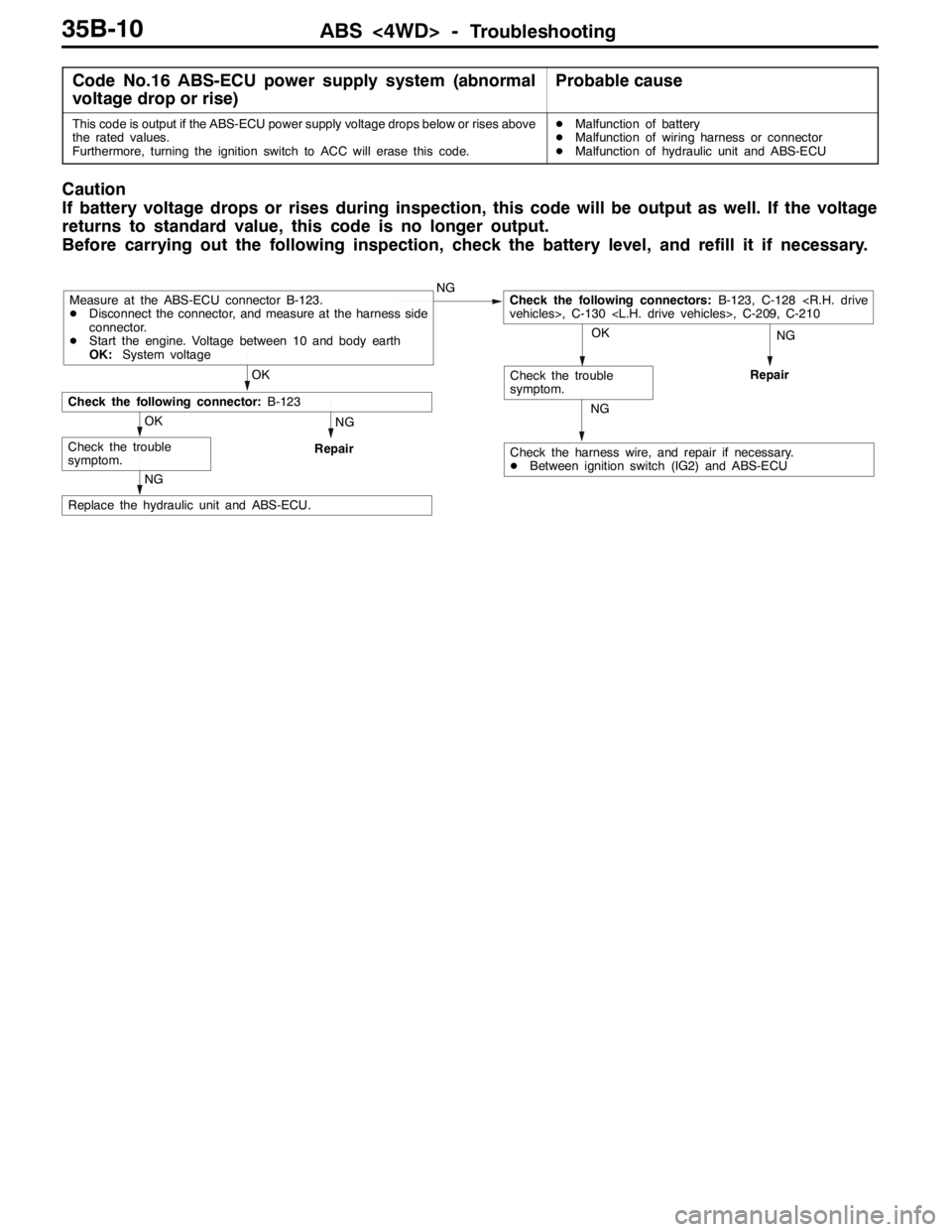
ABS <4WD> -Troubleshooting35B-10
Code No.16 ABS-ECU power supply system (abnormal
voltage drop or rise)Probable cause
This code is output if the ABS-ECU power supply voltage drops below or rises above
the rated values.
Furthermore, turning the ignition switch to ACC will erase this code.DMalfunction of battery
DMalfunction of wiring harness or connector
DMalfunction of hydraulic unit and ABS-ECU
Caution
If battery voltage drops or rises during inspection, this code will be output as well. If the voltage
returns to standard value, this code is no longer output.
Before carrying out the following inspection, check the battery level, and refill it if necessary.
NGNG
Repair
NG
Replace the hydraulic unit and ABS-ECU.
NG
Repair
Check the harness wire, and repair if necessary.
DBetween ignition switch (IG2) and ABS-ECU
OK
Check the trouble
symptom.
OK
Check the trouble
symptom.
OK
Check the following connector:B-123
NGCheck the following connectors:B-123, C-128
DDisconnect the connector, and measure at the harness side
connector.
DStart the engine. Voltage between 10 and body earth
OK:System voltage
Page 1085 of 1449

ABS <4WD> -Troubleshooting35B-15
INSPECTION CHART FOR TROUBLE SYMPTOMS
Trouble symptomsInspection procedure
No.Reference page
Communication between the MUT-IIand the whole system is not
possible.135B-16
Communication between the MUT-IIand the ABS-ECU is not possible.235B-17
When the ignition key is turned to “ON” (engine stopped), the ABS
warning lamp does not illuminate.335B-18
Even after the engine is started, the ABS warning lamp remains
illuminated.435B-18
In the inspection with MUT-II service data, the parking brake switch is not
turned ON or turn OFF.535B-19
The neutral position learning of the steering wheel sensor is not finished.635B-20
Faulty ABS operation735B-21
Caution
1. If steering movements are made when driving at high speed, or when driving on road surfaces
with low frictional resistance, or when passing over bumps, the ABS may operate even though
sudden braking is not being applied. Because of this, when getting information from the customer,
check if the problem occurred while driving under such conditions as these.
2. During ABS operation, the brake pedal may vibrate or may not be able to be depressed. Such
phenomena are due to intermittent changes in hydraulic pressure inside the brake line to prevent
the wheels from locking and is not an abnormality.
Page 1088 of 1449
ABS <4WD> -Troubleshooting35B-18
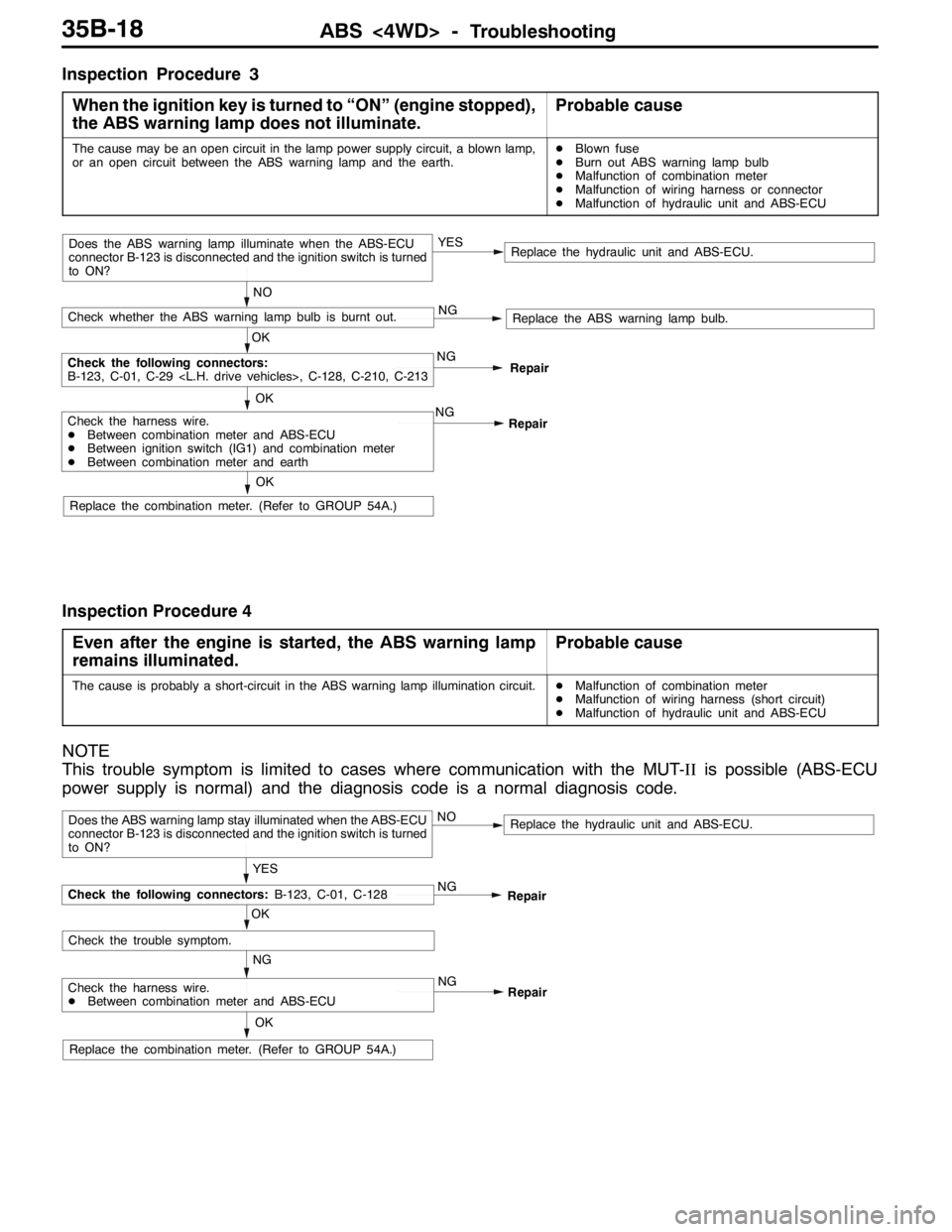
Inspection Procedure 3
When the ignition key is turned to “ON” (engine stopped),
the ABS warning lamp does not illuminate.
Probable cause
The cause may be an open circuit in the lamp power supply circuit, a blown lamp,
or an open circuit between the ABS warning lamp and the earth.DBlown fuse
DBurn out ABS warning lamp bulb
DMalfunction of combination meter
DMalfunction of wiring harness or connector
DMalfunction of hydraulic unit and ABS-ECU
NO
NG
Replace the ABS warning lamp bulb.
Check the harness wire.
DBetween combination meter and ABS-ECU
DBetween ignition switch (IG1) and combination meter
DBetween combination meter and earth
Replace the hydraulic unit and ABS-ECU.
OKNG
OK
Check the following connectors:
B-123, C-01, C-29
OK
Check whether the ABS warning lamp bulb is burnt out.
Does the ABS warning lamp illuminate when the ABS-ECU
connector B-123 is disconnected and the ignition switch is turned
to ON?YES
Repair
Replace the combination meter. (Refer to GROUP 54A.)NG
Repair
Inspection Procedure 4
Even after the engine is started, the ABS warning lamp
remains illuminated.
Probable cause
The cause is probably a short-circuit in the ABS warning lamp illumination circuit.DMalfunction of combination meter
DMalfunction of wiring harness (short circuit)
DMalfunction of hydraulic unit and ABS-ECU
NOTE
This trouble symptom is limited to cases where communication with the MUT-IIis possible (ABS-ECU
power supply is normal) and the diagnosis code is a normal diagnosis code.
YES
NG
Check the harness wire.
DBetween combination meter and ABS-ECU
Replace the hydraulic unit and ABS-ECU.
OK
NG
OK
Check the trouble symptom.
Does the ABS warning lamp stay illuminated when the ABS-ECU
connector B-123 is disconnected and the ignition switch is turned
to ON?NO
Repair
Replace the combination meter. (Refer to GROUP 54A.)NG
Repair
Check the following connectors:B-123, C-01, C-128
Page 1097 of 1449

ABS <4WD> -On-vehicle Service35B-27
4. Rotate the wheel to be measured at approximately 1/2 - 1
rotation per second, and check the output voltage using a
circuit tester or an oscilloscope.
Wheel speed
sensorFront
leftFront
rightRear
leftRear
right
Terminal No.222968
313079
Output voltage
When measuring with a circuit tester:
42 mV or more
When measuring with an oscilloscope:
120 mV p-p or more
5. The followings are suspected if the output voltage is lower
than the value described above. Check the wheel speed
sensor, and replace if necessary.
DToo large clearance between the pole piece of the
wheel speed sensor and ABS rotor
DFaulty wheel speed sensor
Inspecting Waveforms With An Oscilloscope
Use the following method to observe the output voltage
waveform from each wheel speed sensor with an oscilloscope.
DStart the engine, and rotate the front wheels by engaging
1st gear. Turn the rear wheels manually so that they
rotate at a constant speed.
NOTE
1. The waveform measurements can also be taken while
the vehicle is actually moving.
2. The output voltage will be small when the wheel speed
is low, and similarly it will be large when the wheel speed
is high.
Points In Waveform Measurement
SymptomProbable causesRemedy
Too small or zero waveform
amplitudeFaulty wheel speed sensorReplace sensor
Waveform amplitude fluctuates
excessivel
y(this is noproblem if
Axle hub eccentric or with large runoutReplace hub
excessively(thisisnoproblemif
the minimum amplitude is 100 mV
or more)Faulty ABS-ECU earthRepair
When turning by hand
When idling (5 - 6 km/h), 1st gear
10.0 ms/DIV 1 V/DIV
Page 1098 of 1449

ABS <4WD> -On-vehicle Service35B-28
SymptomRemedy Probable causes
Noisy or disturbed waveformOpen circuit in sensorReplace sensor
Open circuit in harnessCorrect harness
Incorrectly mounted wheel speed sensorMount correctly
ABS rotor with missing or damaged teethReplace ABS rotor
Caution
Because the wheel speed sensor cables move together with the front and rear suspension, they
vibrate greatly when driving over poor road surfaces. As a result, the sensor harnesses should also
be shaken when monitoring of output waveforms of the wheel speed sensors in order to simulate
conditions such as driving over poor road surfaces.
HYDRAULIC UNIT CHECK
1. Jack up the vehicle and support the vehicle with rigid racks placed at the specified jack-up points
or place the wheels which are checked on the rollers of the braking force tester.
Caution
(1) The roller of the braking force tester and the tyre should be dry during testing.
(2) When testing the front brakes, apply the parking brake, and when testing the rear brakes,
stop the front wheels by chocking them.
2. Turn the ignition key to the “LOCK” (OFF) position and set the MUT-II.
Caution
Turn the ignition key to the “LOCK” (OFF) position before connecting or disconnecting the
MUT-II.
3. After checking that the shift lever is in neutral, start the engine.
4. Use the MUT-IIto force-drive the actuator.
NOTE
(1) During the actuator test, the ABS warning lamp will illuminate and the anti-skid control will be
cancelled.
(2) When the ABS has been interrupted by the fail-safe function, the MUT-IIactuator testing cannot
be carried out.
5. Turn the wheel by hand and check the change in braking force when the brake pedal is depressed.
When using the braking force tester, depress the brake pedal until the braking force is at the following
values, and check that the braking force decreases when the actuator is force-driven.
Front wheel785 - 981 N
Rear wheel588 - 784 N
Page 1099 of 1449

ABS <4WD> -On-vehicle Service35B-29
The result should be as shown in the following diagram.
Approx. 0.05 seconds
Pedal operationDepressed
Released
Solenoid valve
positionIncrease in pressure
Steady pressure
Reduction in pressure
Checking the
brake forceLock
Drag force when the pedal is freeMUT-IIactuator test
(Item No. 01, 02, 03, 04) start
2 seconds
1 seconds
6. If the result of inspection is abnormal, correct according to the following “Diagnosis Table.”
Diagnosis Table
No.MUT-II
display
OperationJudgementProbable
cause
Remedy
display
NormalAbnormal
cause
01FR VALVE(1) Depress the brake
pedal to lock wheel.
(2) Using the MUT-II,
select the wheel to be
checkedandforcethe
Brake force
released for 3
seconds after
locking.Wheel does
not lock when
brake pedal
is depressed.Clogged
brake line
other than
hydraulic unitCheck and
clean brake
line.
02FL VALVEchecked and force the
actuator to operate.
(3) Check the brake force
for the selected wheel
using a brake force
ttbttith
Clogged
hydraulic
circuit in
hydraulic unitReplace
hydraulic unit
assembly.
03RR VALVE
g
tester or by rotating the
wheel by hand.Brake force is
not released.Incorrect
hydraulic unit
brake tube
connectionConnect
correctly.
04RL VALVEHydraulic unit
solenoid
valve not
functioning
correctlyReplace
hydraulic unit
assembly.
7. After checking, turn the ignition switch to the “LOCK” (OFF) position and then disconnect the MUT-II.
REMEDY FOR A FLAT BATTERY
When booster cables are used to start the engine when the
battery is completely flat and then the vehicle is immediately
driven without waiting for the battery to recharge itself to
some extent, the engine may misfire, and driving might not
be possible. This happens because ABS consumes a great
amount of current for its self-check function. If this happens,
recharge the battery fully.
Caution
The vehicle posture will be unstable during braking, so
do not drive the vehicle with the ABS-ECU connector
disconnected or with the ABS not operating for any other
reason.
Page 1121 of 1449

STEERING -On-vehicle Service37A-7
ON-VEHICLE SERVICE
STEERING WHEEL FREE PLAY CHECK
1. With engine running (hydraulic operation), set front wheels
straight ahead.
2. Measure the play on steering wheel circumference before
wheels start to move when slightly moving steering wheel
in both directions.
Limit: 30 mm or less
3. When play exceeds the limit, check for play on steering
shaft connection and steering linkage. Correct or replace.
4. If the free play still exceeds the limit value, set steering
wheel straight ahead with engine stopped. Load 5 N
towards steering wheel circumference and check play.
Standard value: 0 - 10 mm
5. If the play exceeds the standard value, remove steering
gear box and check total pinion torque. (Refer to
P.37A-17.)
STEERING ANGLE CHECK
1. Locate front wheels on turning radius gauge and measure
steering angle.
Standard value:
Inner wheel31_45’±1_30’
Outer wheel
2. When the angle is not within the standard value, the
toe-in is probably incorrect. Adjust the toe-in.
Standard value: 0±2mm
Adjust the toe-in by undoing the clip and lock nut, and
turning the left and right tie rod turnbuckles by the same
amount (in opposite directions).
3. Recheck the steering angle.
TIE ROD END BALL JOINT TURNING TORQUE
CHECK
1. Disconnect tie rod and knuckle with special tool.
Caution
(1) Loosen the nut of the special tool, but do not
remove it. If it is removed, the ball joint thread
may be damaged.
(2) Tie the special tool with a cord so as not to fall
off.
Clip
Lock nut
Cord
Ball jointNutMB990635,
MB991113 or
MB991406
Page 1122 of 1449

STEERING -On-vehicle Service37A-8
2. Move ball joint stud several times and install nut on stud.
Measure ball joint turning torque with special tool.
Standard value: 1.0 - 3.0 N·m
3. When the turning torque exceeds the standard value,
replace tie rod end.
4. When the turning torque is under the standard value,
check ball joint for end play or ratcheting. If none of these,
the joint is still serviceable.
STATIONARY STEERING EFFORT CHECK
1. With the vehicle stopped on a flat, paved surface, turn
the steering wheel to the straight ahead position.
2. Start the engine and set it to 1,000±100 r/min.
3. Attach a spring balance to the outer circumference of
the steering wheel and measure the steering force
required to turn the steering wheel from the straight ahead
position to the left and right (within a range of 0.9 turns).
Also check to be sure that there is no significant fluctuation
of the required steering force.
Standard value:
Steering effort32 N or less
Fluctuation allowance6.0 N or less
4. If the standard values are not met, check and adjust
the related parts.
CHECKING STEERING WHEEL RETURN TO
CENTRE
To make this test, conduct a road test and check as follows.
1. Make both gradual and sudden turns and check the
steering “feeling” to be sure that there is not difference
in the steering force required and the wheel return between
left and right turns.
2. At a speed of 35 km/h, turn the steering wheel 90_and
release the steering wheel after 1 or 2 seconds. If the
steering wheel then returns 70_or more, the return can
be judged to be satisfactory.
NOTE
There will be a momentary feeling or “heaviness” when
the wheel is turned quickly, but this is not abnormal. (This
is because the oil pump discharge amount is especially
apt to be insufficient during idling.)
DRIVE BELT TENSION CHECK
Refer to GROUP 11A - On-vehicle Service.
MB990326
70_70_