ignition MITSUBISHI LANCER EVOLUTION 2007 Service Repair Manual
[x] Cancel search | Manufacturer: MITSUBISHI, Model Year: 2007, Model line: LANCER EVOLUTION, Model: MITSUBISHI LANCER EVOLUTION 2007Pages: 1449, PDF Size: 56.82 MB
Page 1386 of 1449
SWS -Troubleshooting54B-22
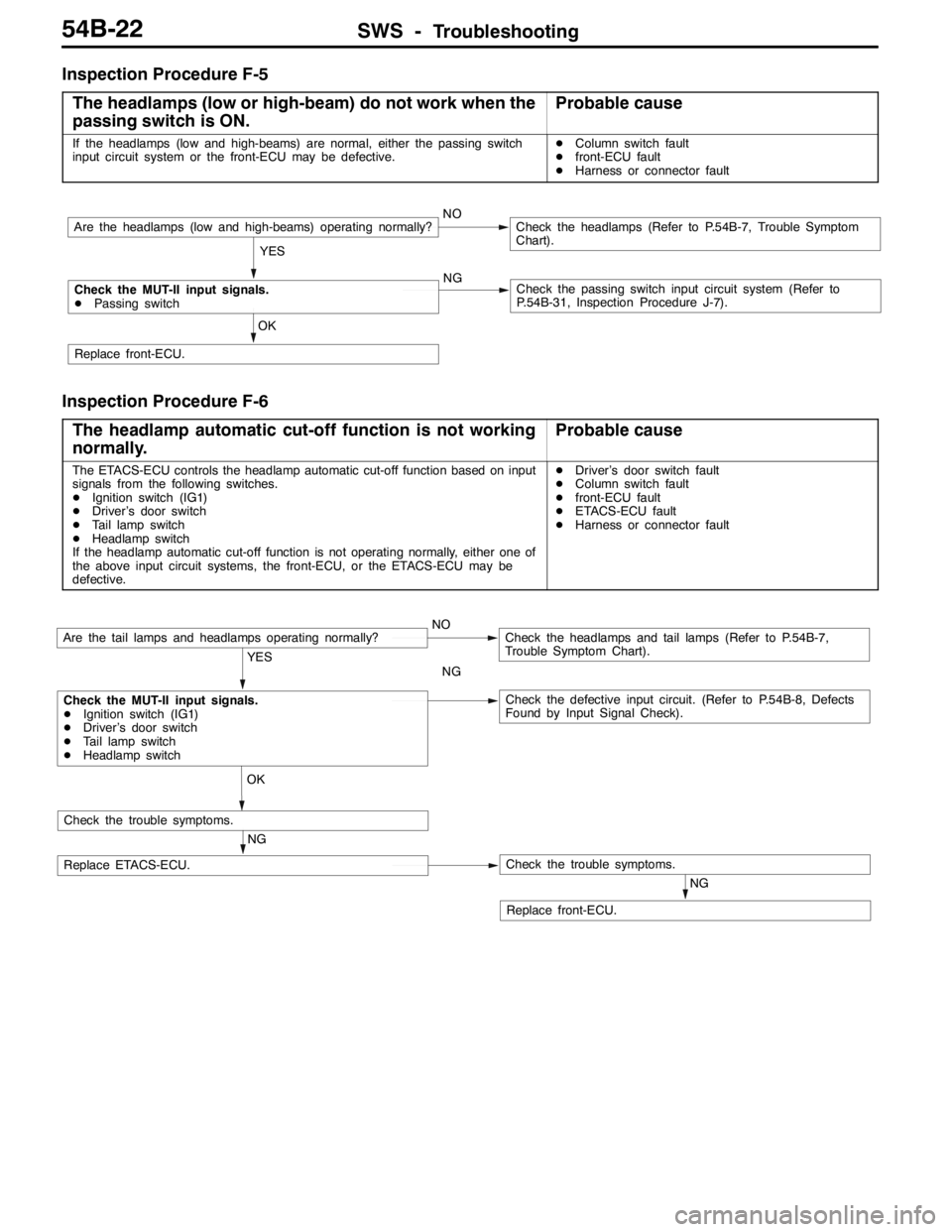
Inspection Procedure F-5
The headlamps (low or high-beam) do not work when the
passing switch is ON.
Probable cause
If the headlamps (low and high-beams) are normal, either the passing switch
input circuit system or the front-ECU may be defective.DColumn switch fault
Dfront-ECU fault
DHarness or connector fault
OK
Replace front-ECU.
YES
Check the MUT-II input signals.
DPassing switchNGCheck the passing switch input circuit system (Refer to
P.54B-31, Inspection Procedure J-7).
Are the headlamps (low and high-beams) operating normally?NOCheck the headlamps (Refer to P.54B-7, Trouble Symptom
Chart).
Inspection Procedure F-6
The headlamp automatic cut-off function is not working
normally.
Probable cause
The ETACS-ECU controls the headlamp automatic cut-off function based on input
signals from the following switches.
DIgnition switch (IG1)
DDriver’s door switch
DTail lamp switch
DHeadlamp switch
If the headlamp automatic cut-off function is not operating normally, either one of
the above input circuit systems, the front-ECU, or the ETACS-ECU may be
defective.DDriver’s door switch fault
DColumn switch fault
Dfront-ECU fault
DETACS-ECU fault
DHarness or connector fault
NG
Replace front-ECU.
NG
Replace ETACS-ECU.Check the trouble symptoms.
Check the trouble symptoms.
YES
NG
Check the defective input circuit. (Refer to P.54B-8, Defects
Found by Input Signal Check).
Are the tail lamps and headlamps operating normally?NOCheck the headlamps and tail lamps (Refer to P.54B-7,
Trouble Symptom Chart).
Check the MUT-II input signals.
DIgnition switch (IG1)
DDriver’s door switch
DTail lamp switch
DHeadlamp switch
OK
Page 1388 of 1449
SWS -TroubleshootingSWS -Troubleshooting54B-24
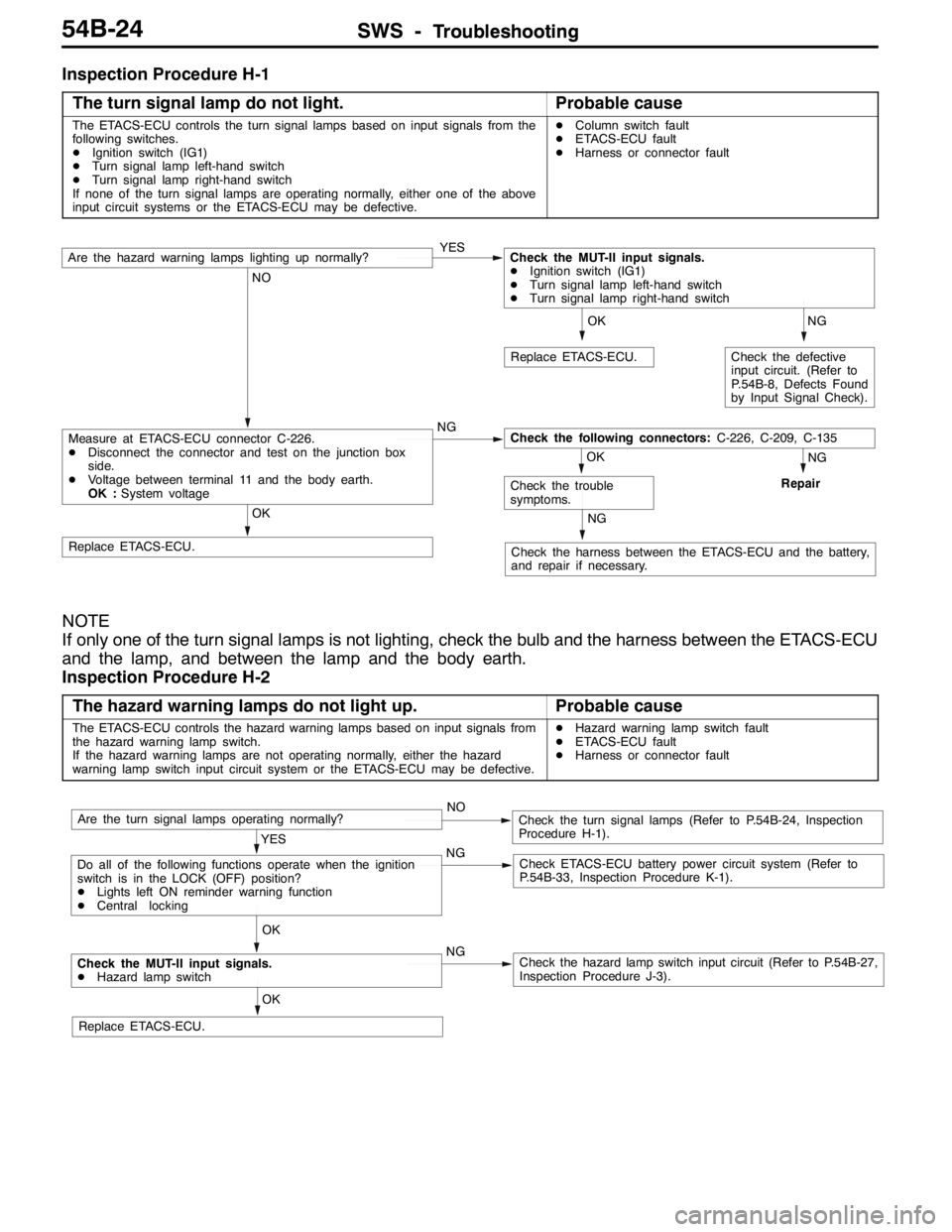
Inspection Procedure H-1
The turn signal lamp do not light.
Probable cause
The ETACS-ECU controls the turn signal lamps based on input signals from the
following switches.
DIgnition switch (IG1)
DTurn signal lamp left-hand switch
DTurn signal lamp right-hand switch
If none of the turn signal lamps are operating normally, either one of the above
input circuit systems or the ETACS-ECU may be defective.DColumn switch fault
DETACS-ECU fault
DHarness or connector fault
NG
Check the defective
input circuit. (Refer to
P.54B-8, Defects Found
by Input Signal Check).
OK
Replace ETACS-ECU.
NG
Repair
NG
Check the harness between the ETACS-ECU and the battery,
and repair if necessary.Replace ETACS-ECU.
OK
OK
Check the trouble
symptoms.
NO
Measure at ETACS-ECU connector C-226.
DDisconnect the connector and test on the junction box
side.
DVoltage between terminal 11 and the body earth.
OK :System voltageNGCheck the following connectors:C-226, C-209, C-135
Are the hazard warning lamps lighting up normally?YESCheck the MUT-II input signals.
DIgnition switch (IG1)
DTurn signal lamp left-hand switch
DTurn signal lamp right-hand switch
NOTE
If only one of the turn signal lamps is not lighting, check the bulb and the harness between the ETACS-ECU
and the lamp, and between the lamp and the body earth.
Inspection Procedure H-2
The hazard warning lamps do not light up.
Probable cause
The ETACS-ECU controls the hazard warning lamps based on input signals from
the hazard warning lamp switch.
If the hazard warning lamps are not operating normally, either the hazard
warning lamp switch input circuit system or the ETACS-ECU may be defective.DHazard warning lamp switch fault
DETACS-ECU fault
DHarness or connector fault
OK
Replace ETACS-ECU.
OK
Check the MUT-II input signals.
DHazard lamp switchNGCheck the hazard lamp switch input circuit (Refer to P.54B-27,
Inspection Procedure J-3).
YES
Do all of the following functions operate when the ignition
switch is in the LOCK (OFF) position?
DLights left ON reminder warning function
DCentral lockingNGCheck ETACS-ECU battery power circuit system (Refer to
P.54B-33, Inspection Procedure K-1).
Are the turn signal lamps operating normally?NOCheck the turn signal lamps (Refer to P.54B-24, Inspection
Procedure H-1).
Page 1389 of 1449
SWS -Troubleshooting54B-25
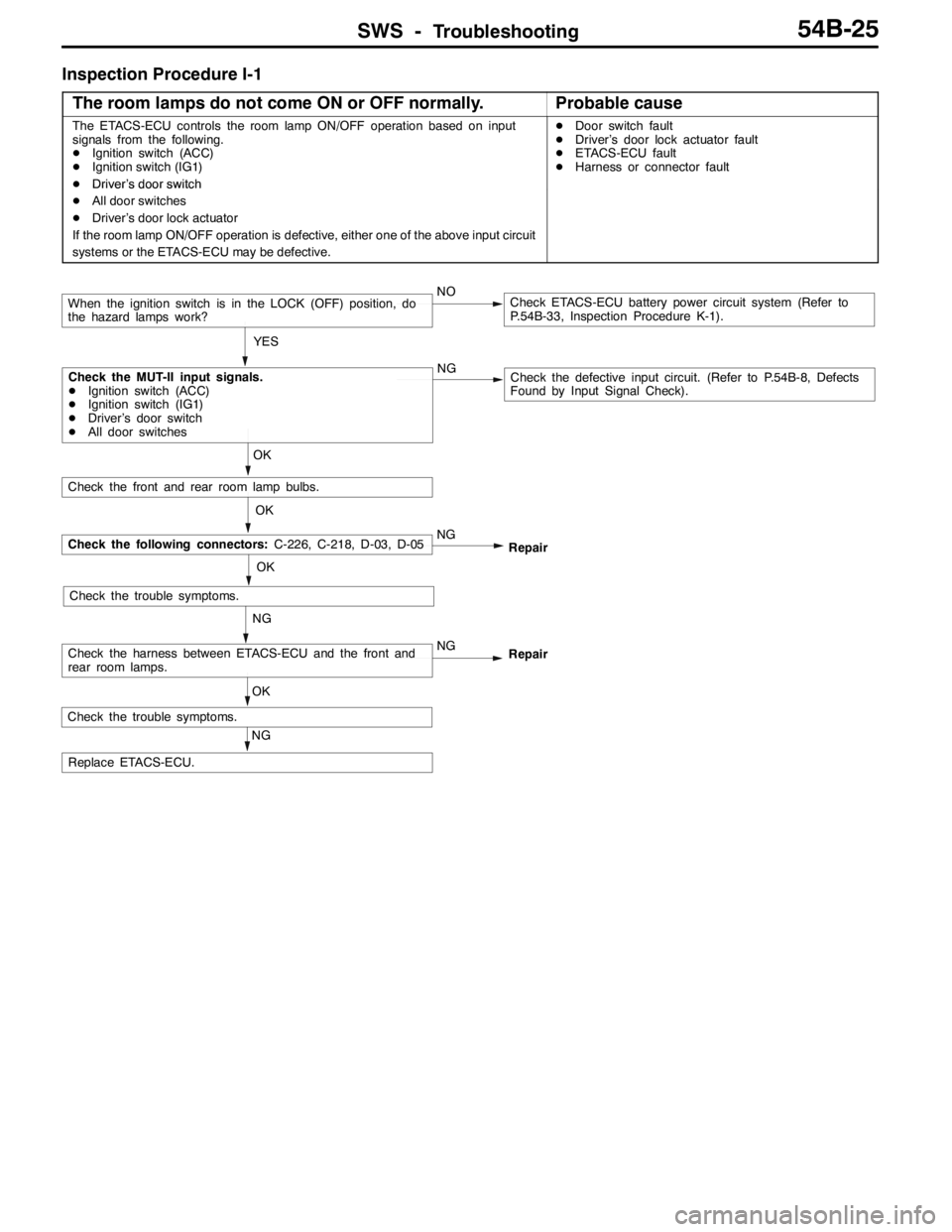
Inspection Procedure I-1
The room lamps do not come ON or OFF normally.
Probable cause
The ETACS-ECU controls the room lamp ON/OFF operation based on input
signals from the following.
DIgnition switch (ACC)
DIgnition switch (IG1)
DDriver’s door switchDDoor switch fault
DDriver’s door lock actuator fault
DETACS-ECU fault
DHarness or connector fault
DDriversdoorswitch
DAll door switches
DDriver’s door lock actuator
If the room lamp ON/OFF operation is defective, either one of the above input circuit
systems or the ETACS-ECU may be defective.
NGCheck the defective input circuit. (Refer to P.54B-8, Defects
Found by Input Signal Check).
OK
OK
NG
Check the trouble symptoms.
NG
RepairCheck the following connectors:C-226, C-218, D-03, D-05
NG
Repair
When the ignition switch is in the LOCK (OFF) position, do
the hazard lamps work?NOCheck ETACS-ECU battery power circuit system (Refer to
P.54B-33, Inspection Procedure K-1).
YES
Check the front and rear room lamp bulbs.
OK
Check the MUT-II input signals.
DIgnition switch (ACC)
DIgnition switch (IG1)
DDriver’s door switch
DAll door switches
NG
Replace ETACS-ECU.
OK
Check the trouble symptoms.
Check the harness between ETACS-ECU and the front and
rear room lamps.
Page 1390 of 1449
SWS -Troubleshooting54B-26
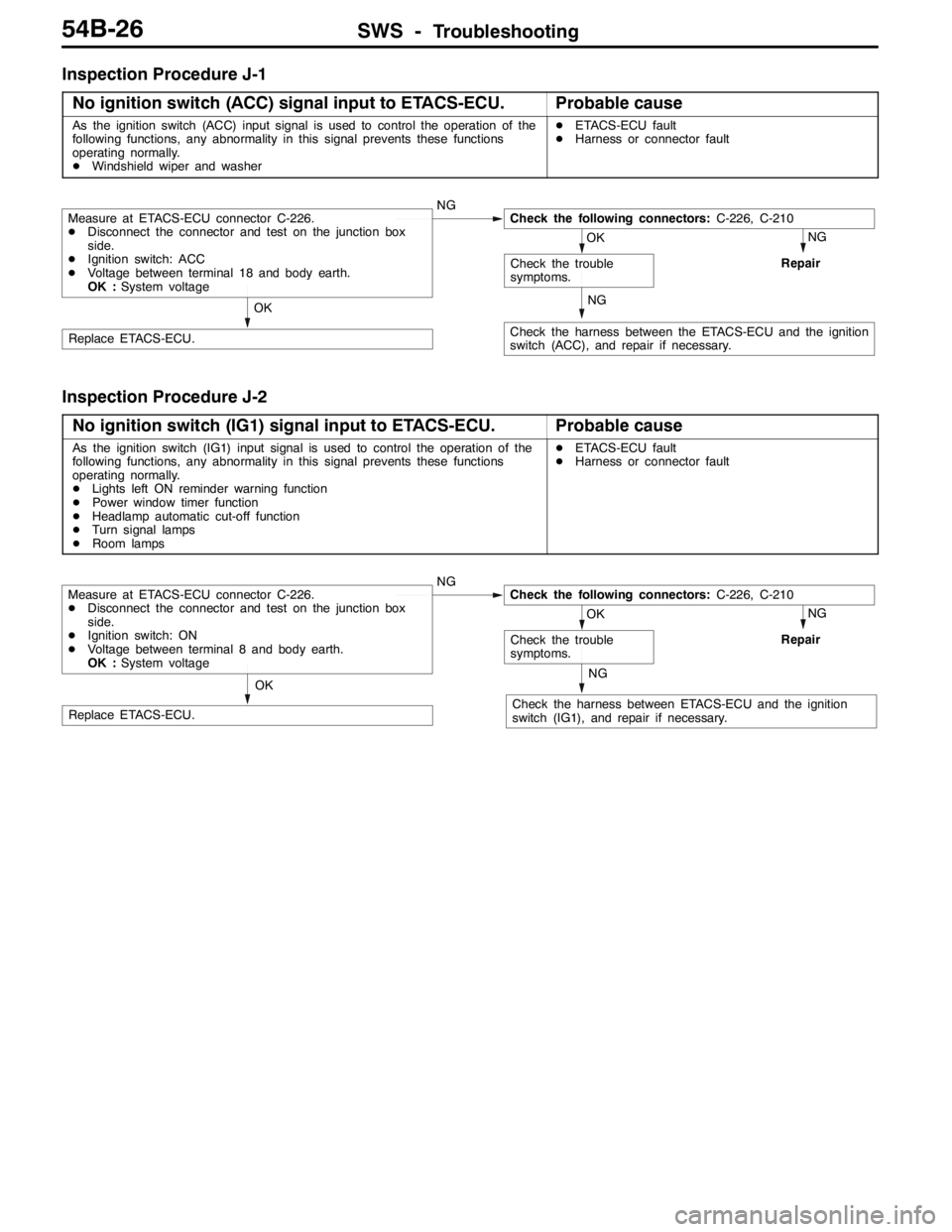
Inspection Procedure J-1
No ignition switch (ACC) signal input to ETACS-ECU.
Probable cause
As the ignition switch (ACC) input signal is used to control the operation of the
following functions, any abnormality in this signal prevents these functions
operating normally.
DWindshield wiper and washerDETACS-ECU fault
DHarness or connector fault
NG
Repair
NG
Check the harness between the ETACS-ECU and the ignition
switch (ACC), and repair if necessary.
OK
Replace ETACS-ECU.
OK
Check the trouble
symptoms.
Measure at ETACS-ECU connector C-226.
DDisconnect the connector and test on the junction box
side.
DIgnition switch: ACC
DVoltage between terminal 18 and body earth.
OK :System voltageNGCheck the following connectors:C-226, C-210
Inspection Procedure J-2
No ignition switch (IG1) signal input to ETACS-ECU.
Probable cause
As the ignition switch (IG1) input signal is used to control the operation of the
following functions, any abnormality in this signal prevents these functions
operating normally.
DLights left ON reminder warning function
DPower window timer function
DHeadlamp automatic cut-off function
DTurn signal lamps
DRoom lampsDETACS-ECU fault
DHarness or connector fault
NG
Repair
NG
Check the harness between ETACS-ECU and the ignition
switch (IG1), and repair if necessary.
OK
Replace ETACS-ECU.
OK
Check the trouble
symptoms.
Measure at ETACS-ECU connector C-226.
DDisconnect the connector and test on the junction box
side.
DIgnition switch: ON
DVoltage between terminal 8 and body earth.
OK :System voltageNGCheck the following connectors:C-226, C-210
Page 1395 of 1449
SWS -Troubleshooting54B-31
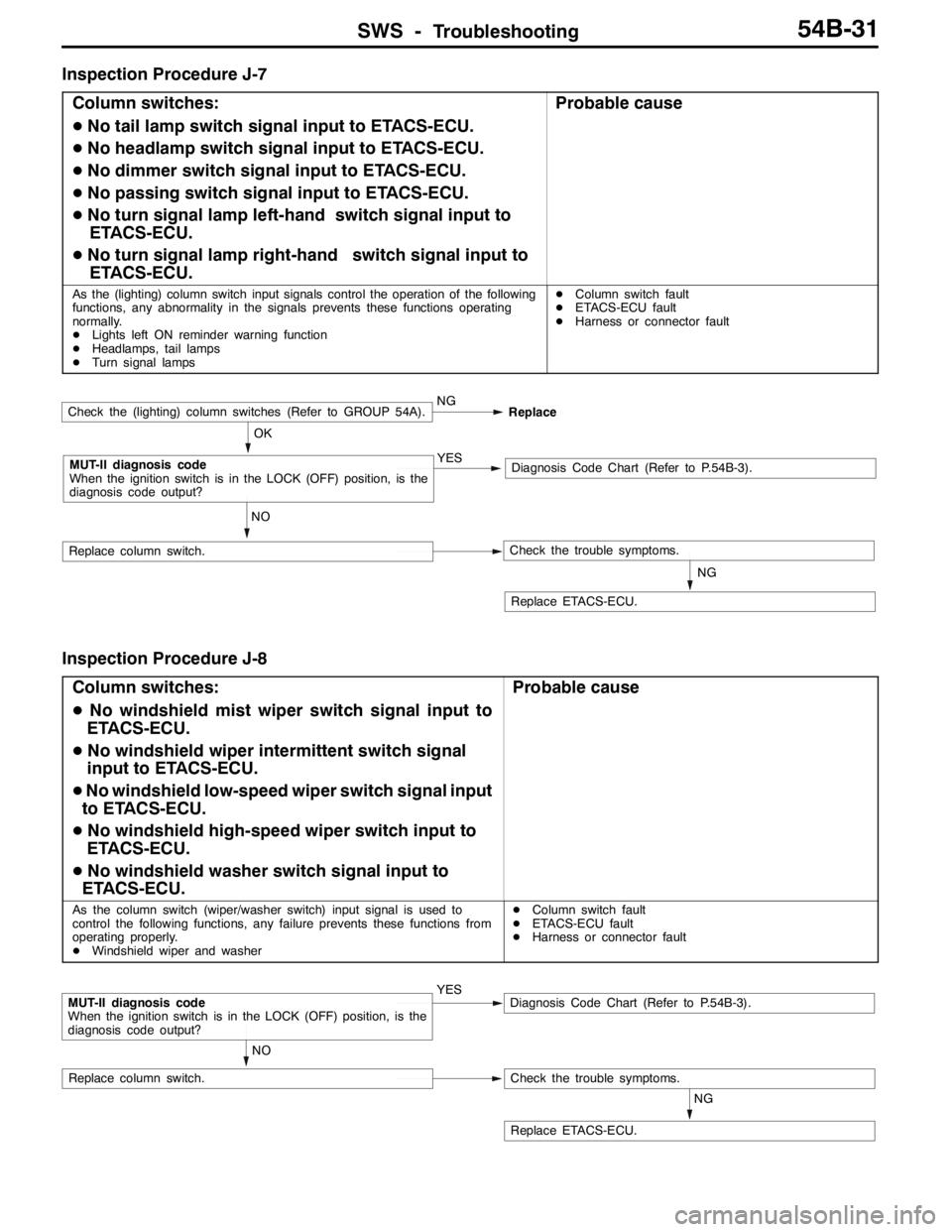
Inspection Procedure J-7
Column switches:
DNo tail lamp switch signal input to ETACS-ECU.
DNo headlamp switch signal input to ETACS-ECU.
DNo dimmer switch signal input to ETACS-ECU.
DNo passing switch signal input to ETACS-ECU.
DNo turn signal lamp left-hand switch signal input to
ETACS-ECU.
DNo turn signal lamp right-hand switch signal input to
ETACS-ECU.
Probable cause
As the (lighting) column switch input signals control the operation of the following
functions, any abnormality in the signals prevents these functions operating
normally.
DLights left ON reminder warning function
DHeadlamps, tail lamps
DTurn signal lampsDColumn switch fault
DETACS-ECU fault
DHarness or connector fault
NG
Replace ETACS-ECU.
NO
Replace column switch.Check the trouble symptoms.
OK
MUT-II diagnosis code
When the ignition switch is in the LOCK (OFF) position, is the
diagnosis code output?YESDiagnosis Code Chart (Refer to P.54B-3).
Check the (lighting) column switches (Refer to GROUP 54A).NG
Replace
Inspection Procedure J-8
Column switches:
DNo windshield mist wiper switch signal input to
ETACS-ECU.
DNo windshield wiper intermittent switch signal
input to ETACS-ECU.
DNo windshield low-speed wiper switch signal input
to ETACS-ECU.
DNo windshield high-speed wiper switch input to
ETACS-ECU.
DNo windshield washer switch signal input to
ETACS-ECU.
Probable cause
As the column switch (wiper/washer switch) input signal is used to
control the following functions, any failure prevents these functions from
operating properly.
DWindshield wiper and washerDColumn switch fault
DETACS-ECU fault
DHarness or connector fault
NG
Replace ETACS-ECU.
NO
Replace column switch.Check the trouble symptoms.
MUT-II diagnosis code
When the ignition switch is in the LOCK (OFF) position, is the
diagnosis code output?YESDiagnosis Code Chart (Refer to P.54B-3).
Page 1396 of 1449
SWS -Troubleshooting54B-32
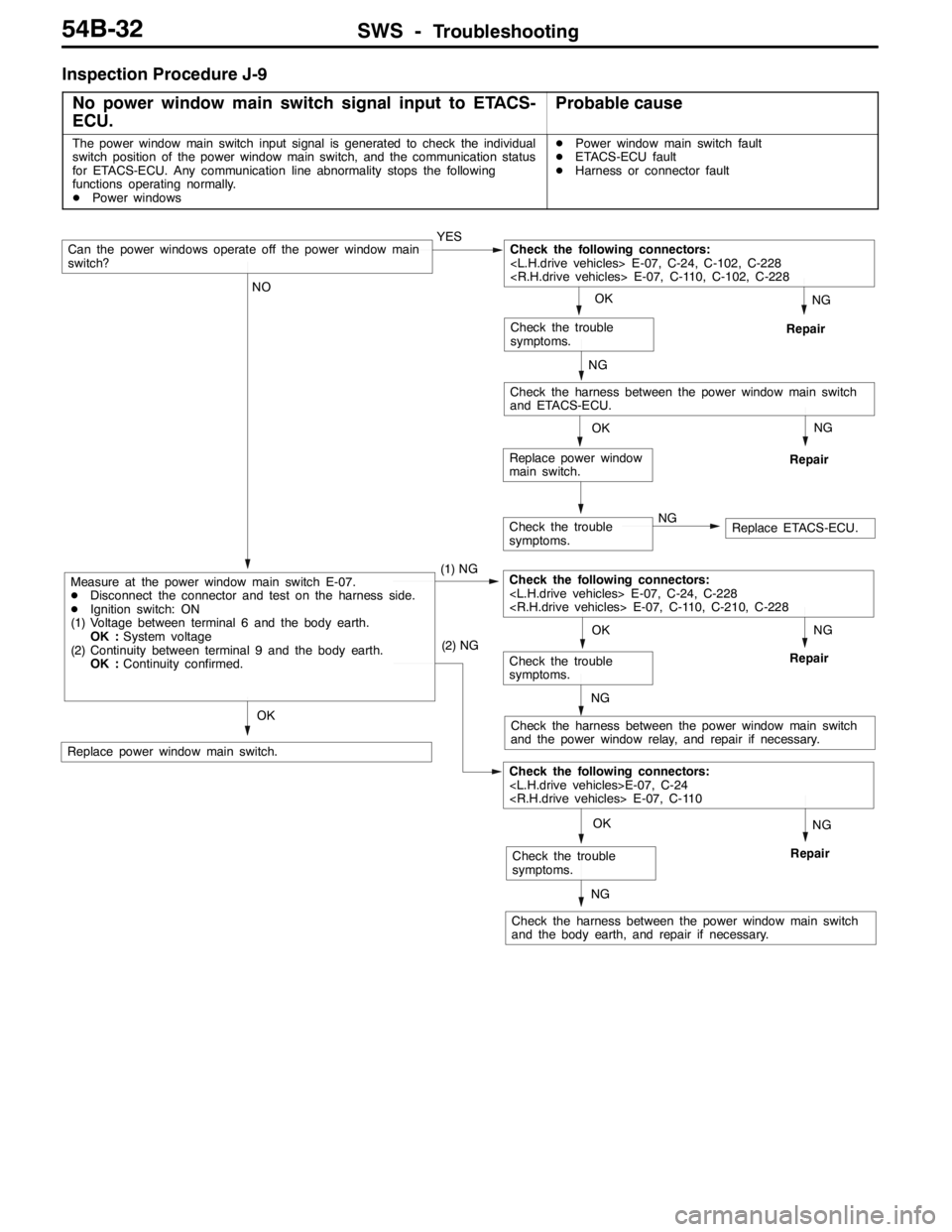
Inspection Procedure J-9
No power window main switch signal input to ETACS-
ECU.
Probable cause
The power window main switch input signal is generated to check the individual
switch position of the power window main switch, and the communication status
for ETACS-ECU. Any communication line abnormality stops the following
functions operating normally.
DPower windowsDPower window main switch fault
DETACS-ECU fault
DHarness or connector fault
Check the trouble
symptoms.NGReplace ETACS-ECU.
NG
Repair
NG
Repair
OK
Replace power window
main switch.
NG
Repair
NG
Check the harness between the power window main switch
and the power window relay, and repair if necessary.
NG
Repair
NG
Check the harness between the power window main switch
and the body earth, and repair if necessary.
OK
Replace power window main switch.
OK
Check the trouble
symptoms.
(2) NG
Check the following connectors:
OK
Check the trouble
symptoms.
NO
Measure at the power window main switch E-07.
DDisconnect the connector and test on the harness side.
DIgnition switch: ON
(1) Voltage between terminal 6 and the body earth.
OK :System voltage
(2) Continuity between terminal 9 and the body earth.
OK :Continuity confirmed.(1) NGCheck the following connectors:
NG
Check the harness between the power window main switch
and ETACS-ECU.
OK
Check the trouble
symptoms.
Can the power windows operate off the power window main
switch?YESCheck the following connectors:
Page 1397 of 1449
SWS -Troubleshooting54B-33
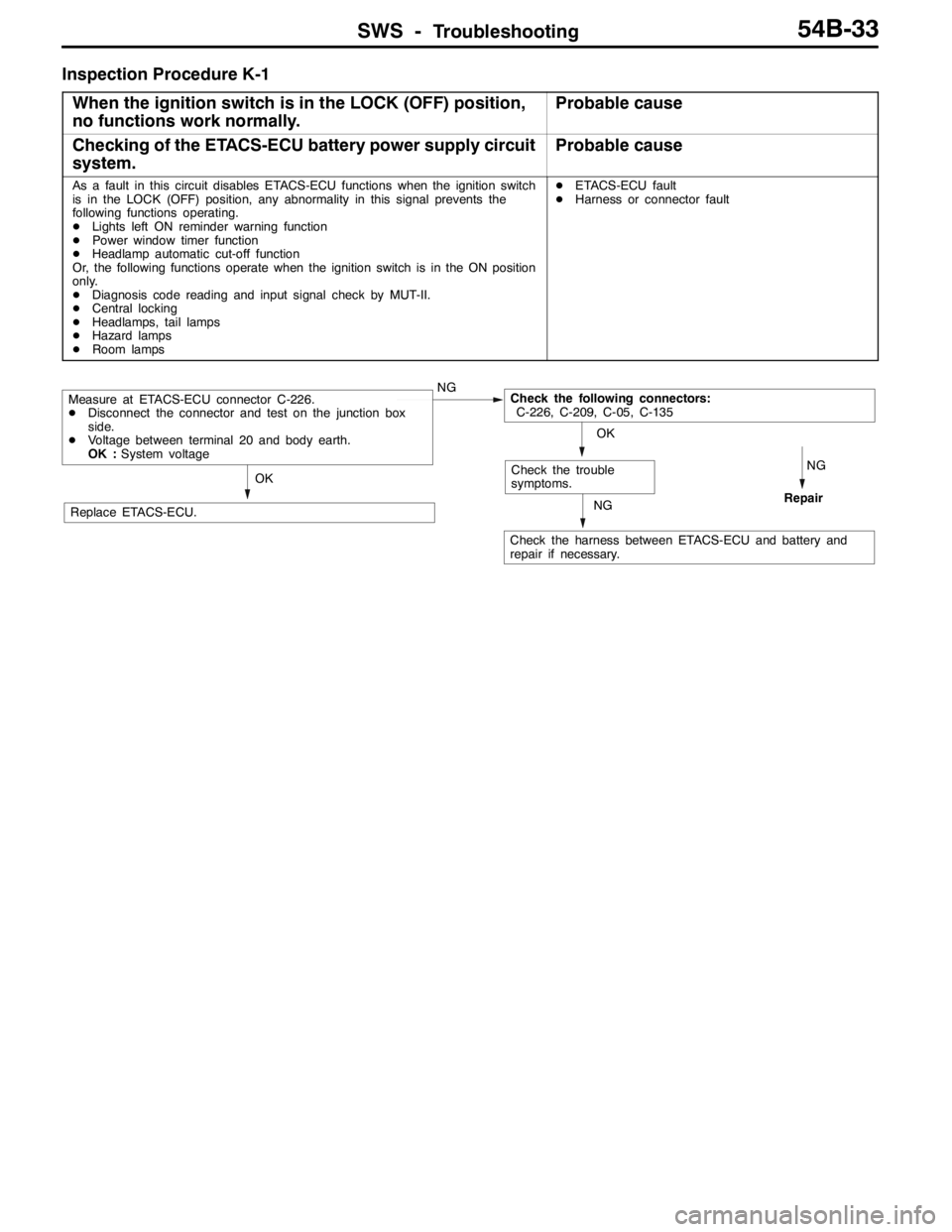
Inspection Procedure K-1
When the ignition switch is in the LOCK (OFF) position,
no functions work normally.
Probable cause
Checking of the ETACS-ECU battery power supply circuit
system.Probable cause
As a fault in this circuit disables ETACS-ECU functions when the ignition switch
is in the LOCK (OFF) position, any abnormality in this signal prevents the
following functions operating.
DLights left ON reminder warning function
DPower window timer function
DHeadlamp automatic cut-off function
Or, the following functions operate when the ignition switch is in the ON position
only.
DDiagnosis code reading and input signal check by MUT-II.
DCentral locking
DHeadlamps, tail lamps
DHazard lamps
DRoom lampsDETACS-ECU fault
DHarness or connector fault
NG
RepairNG
Check the harness between ETACS-ECU and battery and
repair if necessary.
OK
Replace ETACS-ECU.
OK
Check the trouble
symptoms.
Measure at ETACS-ECU connector C-226.
DDisconnect the connector and test on the junction box
side.
DVoltage between terminal 20 and body earth.
OK :System voltageNGCheck the following connectors:
C-226, C-209, C-05, C-135
Page 1398 of 1449

SWS -Troubleshooting54B-34
CHECKS AT ECU TERMINALS
ETACS-ECU
*
Y0795AU
NOTE
*See the list below for data on the ETACS-ECU terminal 1 - 20 connectors. As the ETACS-ECU connects
directly onto the junction box, the voltages cannot be measured.
Terminal
No.Check itemsChecking requirementsNormal condition
1Power window relay outputWhen power windows operating
normallySystem voltage
2Battery power supply (for central
locking)Any timeSystem voltage
3Earth (for ECU)Any time0V
4Ignition switch (ACC)Ignition switch: ACCSystem voltage
5Room lamp outputWhen room lamps ON2 V or below
6---
7Door switch inputWhen any one door switch ON (door
open)0V
8Ignition switch (IG1) power supplyIgnition switch: ONSystem voltage
9Right-hand turn signal lamp outputWhen right-hand turn signal lamp ONSystem voltage
10Driver’s door switch inputWhen driver’s door switch ON (door
open)0V
11Battery power supply (for hazard
lamps)Any timeSystem voltage
12Central locking (lock) outputWhen door lock actuator operating
(locking operation)System voltage
13Central locking (unlock) output (NOT
driver’s door)When door lock actuator operating
(unlocking)System voltage
14Left-hand turn signal lamp outputWhen left-hand turn signal lamp ONSystem voltage
15 - 17---
18Ignition switch (ACC) power supplyIgnition switch: ACCSystem voltage
19Battery power supply for interior lampWhen interior lamp ONSystem voltage
20Battery power supply (for ECU)Any timeSystem voltage
21Rear fog lamp switch inputWhen the rear fog lamp switch ON0V
22Central locking (unlock) output (for
driver’s door)When door lock actuator operating
(unlocking)System voltage
23---
24 - 32---
33Door lock key cylinder switch input
(unlock switch)When driver’s door lock unlocked0V
34Door lock key cylinder switch input
(lock switch)When driver’s door lock locked0V
Page 1399 of 1449

SWS -Troubleshooting54B-35
Terminal
No.Normal condition Checking requirements Check items
35Driver’s door lock actuator (locking
switch) inputWhen driver’s door lock locked0V
36Driver’s door lock actuator (unlocking
switch) inputWhen driver’s door lock unlocked0V
37, 38---
39Back-up lamp switch inputWhen shift lever in reverse positionSystem voltage
40---
51Diagnosis output/input check signal
outputDuring diagnosis output (when MUT-II
connected or diagnosis connector No. 1
grounded on the body.)0 - 12 V (pulse
signal)
When an input check is output0, 12 V (at input
signal change)
52Ignition switch (ACC) power supplyIgnition switch: ACCSystem voltage
53, 54---
55Hazard warning lamp switch inputHazard warning lamp switch: ON0V
56Earth (for sensors)Any time0V
57, 58---
59SWS communication lineAny time0 - 12 V (pulse
signal)
60---
61Battery power supplyAny timeSystem voltage
62---
63Vehicle speed signal inputWhen vehicle driven0 - 12 V (pulse
signal)
64 - 66---
67Diagnosis control inputWhen MUT-II connected0V
68SWS request signal outputAny time0 - 12 V (pulse
signal)
69Ignition key cylinder illumination lamp
outputWhen ignition key cylinder illumination
lamp ON2 V or below
70---
71 - 73---
74Rear fog lamp output
Page 1400 of 1449

SWS -Troubleshooting54B-36
COLUMN SWITCHES
Terminal
No.Check itemChecking requirementsNormal condition
1Battery power supplyAny timeSystem voltage
2SWS request signal inputAny time0 - 12 V (pulse
signal)
3SWS communication lineAny time0 - 12 V (pulse
signal)
4EarthAny time0V
5-7---
8Windshield wiper switch backup
outputWindshield wiper low or high-speed
switch: ON0V
9Ignition switch (IG1) power supplyIgnition switch: ONSystem voltage
10Headlamp switch backup outputHeadlamp switch: ON0V
FRONT-ECU
NOTE
See the list below for data on the front-ECU terminals. As the front-ECU connects directly onto the relay
box, the voltages cannot be measured.
Terminal
No.Check itemChecking requirementsNormal condition
1---
2Headlamp (high-beam) outputWhen headlamp (high-beam) ONSystem voltage
3, 4Battery power supply (for headlamps)Any timeSystem voltage
5Battery power supply (for tail lamps)Any timeSystem voltage
6Headlamp (low-beam) outputWhen headlamp (low-beam) ONSystem voltage
7Battery power supply (for ECU)Any timeSystem voltage
8Tail lamp outputWhen tail lamps ONSystem voltage
9-11---
21Windshield washer outputWhen windshield washer operatingSystem voltage
22SWS communication lineAny time0 - 12 V (pulse
signal)
23Windshield wiper automatic STOP
signal inputWhen windshield wiper operatingSystem voltage
24Ignition switch (ACC) power supplyIgnition switch: ACCSystem voltage
25Headlamp switch backup inputHeadlamp switch: ON0V
26Windshield wiper switch backup inputWindshield wiper low or high-speed
switch: ON0V
27Windshield wiper (low-speed) outputWhen windshield wiper operating (at
low-speed)System voltage
28Windshield wiper (high-speed) outputWhen windshield wiper operating (at
high-speed)System voltage