check engine light MITSUBISHI LANCER EVOLUTION 2007 Service Owner's Manual
[x] Cancel search | Manufacturer: MITSUBISHI, Model Year: 2007, Model line: LANCER EVOLUTION, Model: MITSUBISHI LANCER EVOLUTION 2007Pages: 1449, PDF Size: 56.82 MB
Page 1121 of 1449

STEERING -On-vehicle Service37A-7
ON-VEHICLE SERVICE
STEERING WHEEL FREE PLAY CHECK
1. With engine running (hydraulic operation), set front wheels
straight ahead.
2. Measure the play on steering wheel circumference before
wheels start to move when slightly moving steering wheel
in both directions.
Limit: 30 mm or less
3. When play exceeds the limit, check for play on steering
shaft connection and steering linkage. Correct or replace.
4. If the free play still exceeds the limit value, set steering
wheel straight ahead with engine stopped. Load 5 N
towards steering wheel circumference and check play.
Standard value: 0 - 10 mm
5. If the play exceeds the standard value, remove steering
gear box and check total pinion torque. (Refer to
P.37A-17.)
STEERING ANGLE CHECK
1. Locate front wheels on turning radius gauge and measure
steering angle.
Standard value:
Inner wheel31_45’±1_30’
Outer wheel
2. When the angle is not within the standard value, the
toe-in is probably incorrect. Adjust the toe-in.
Standard value: 0±2mm
Adjust the toe-in by undoing the clip and lock nut, and
turning the left and right tie rod turnbuckles by the same
amount (in opposite directions).
3. Recheck the steering angle.
TIE ROD END BALL JOINT TURNING TORQUE
CHECK
1. Disconnect tie rod and knuckle with special tool.
Caution
(1) Loosen the nut of the special tool, but do not
remove it. If it is removed, the ball joint thread
may be damaged.
(2) Tie the special tool with a cord so as not to fall
off.
Clip
Lock nut
Cord
Ball jointNutMB990635,
MB991113 or
MB991406
Page 1348 of 1449
CHASSIS ELECTRICAL -Headlamp Assembly54A-28
HEADLAMP INTENSITY MEASUREMENT
1. Using a photometer, and following its manufacture’s
instruction manual.
2. Maintain an engine speed of 2,000 r/min., with the battery
in the charging condition
3. Set the headlamps to high beam
4. Measure the headlamp centre intensity (a point of H line
and V line) and check to be sure that the limit value
is satisfied.
Limit:
High beam 30,000 cd or more per one headlamp
NOTE
1. There may be special local regulations pertaining to
headlamp intensity, be sure to make any adjustments
necessary to satisfy such regulations.
2. If an illuminometer is used to make the measurements,
convert its values to photometer values by using the
following formula.
I=Er
2Where:
I=intensity (cd)
E=illumination (lux)
r=distance (m) from headlamps to illuminometer
Caution
1. On the headlamp not yet adjusted, perform aiming
with connector removed and the lamps switched off,
if applicable. In addition, care should be taken to
prevent a change of optical axis when connector is
reconnected.
2. Plastic outer lens are equipped with headlamps. When
lens surface is covered with materials for not
penetrating light, headlamp operation time should be
within 3 minutes. In addition, masking such as taping
should not be performed.
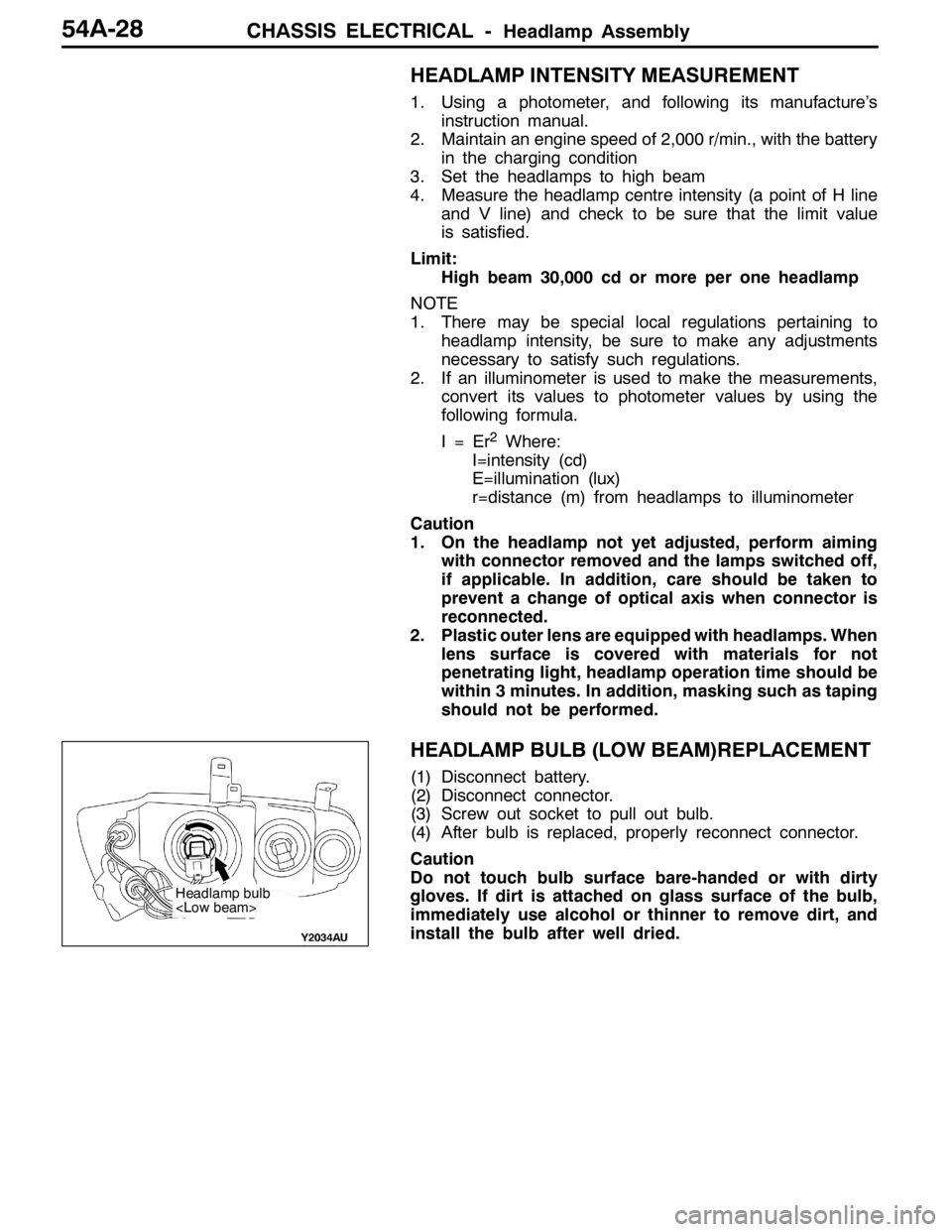
HEADLAMP BULB (LOW BEAM)REPLACEMENT
(1) Disconnect battery.
(2) Disconnect connector.
(3) Screw out socket to pull out bulb.
(4) After bulb is replaced, properly reconnect connector.
Caution
Do not touch bulb surface bare-handed or with dirty
gloves. If dirt is attached on glass surface of the bulb,
immediately use alcohol or thinner to remove dirt, and
install the bulb after well dried.
Headlamp bulb
Page 1414 of 1449

HEATER, AIR CONDITIONER AND VENTILATION-TroubleshootingHEATER, AIR CONDITIONER AND VENTILATION-Troubleshooting55-12
CHECK AT THE ENGINE-ECU TERMINAL
Terminal no.Check itemCheck whenNormal state
21Fan controller outputRadiator fan: ON0 - 0.3 Vp
Radiator fan: OFF0.7 V or more
22A/C compressor outputA/C compressor relay: OFF0Vpp
A/C compressor relay: ONBattery voltage
or temporarily
6V or more→
1V or less
24A/C-ECU input (A/C2)At A/C low loadBattery voltage
32Condenser fan motor relay (HI)Fan: OFF(engine coolant temperature:90_C
or lower)Battery voltage
Fan: ON(engine coolant tempera-
ture:105_C or lower)1V or more
34Condenser fan motor relay (LOW)Fan: OFF(engine coolant temperature:90_C
or lower)Battery voltage
Fan: ON(engine coolant tempera-
ture:105_C or lower)1V or more
45A/C-ECU input (A/C1)A/C ON (When dual pressure switch is ON)Battery voltage
CHECK AT THE A/C-ECU TERMINAL
Termi-
nal no.Check itemCheck whenNormal state
1Rear defogger switchDefogger switch: ON0Vgg
Defogger switch: OFFBattery voltage
2Inside/outside air changeover
dt(tidi)
When damper moved to inside circulation position0Vg
damper motor (outside air)When damper moved to outside air induction
positionBattery voltage
3Inside/outside air changeover
dt(i idi)
When damper moved to inside circulation positionBattery voltageg
damper motor (inside air)When damper moved to outside air induction
position0V
4Engine-ECU output (A/C1)When A/C OFF0Vgp()
A/C switch: ON, blower: ON (room temperature)Battery voltage
5Engine-ECU output (A/C2)At A/C low loadBattery voltagegp()
At A/C high load0V
6Illumination power supplyLighting switches: ONBattery voltage
7---
8Blower switch (LO)Blower switch: LOBattery voltage
Page 1415 of 1449

HEATER, AIR CONDITIONER AND VENTILATION-Troubleshooting55-13
Termi-
nal no.Normal state Check when Check item
9---
10Ignition switch (IG2) power supplyIgnition switch: ONBattery voltage
11Illumination earthAny time0V
12EarthAny time0V
13Air thermo sensorWhen temperature around sensor 25_C (1.5kΩ)2.2 V
14---
15---
16Air thermo sensor earthAny time0V
CHECK AT THE A/C-ECU TERMINAL
Termi-
nal no.Check itemCheck whenNormal state
1Engine-ECU output (A/C1)When A/C OFF0Vgp()
A/C switch: ON, blower: ON (room temperature)Battery voltage
2Engine-ECU output (A/C2)At A/C low loadBattery voltagegp()
At A/C high load0V
3EarthAny time0V
4Air thermo sensor earthAny time0V
5Illumination power supplyLighting switches: ONBattery voltage
6Air thermo sensorWhen temperature around sensor 25_C (1.5kΩ)2.2 V
7Ignition switch (IG2) power supplyIgnition switch: ONBattery voltage
8Blower switch (LO)Blower switch: LOBattery voltage
9Rear defogger switchDefogger switch: ON0Vgg
Defogger switch: OFFBattery voltage
10Inside/outside air changeover
dt(tidi)
When damper moved to inside circulation position0Vg
damper motor (outside air)When damper moved to outside air induction
positionBattery voltage
11Inside/outside air changeover
dt(i idi)
When damper moved to inside circulation positionBattery voltageg
damper motor (inside air)When damper moved to outside air induction
position0V
12Illumination earthAny time0V
Page 1441 of 1449
HEATER, AIR CONDITIONER AND VENTILATION-Compressor55-39
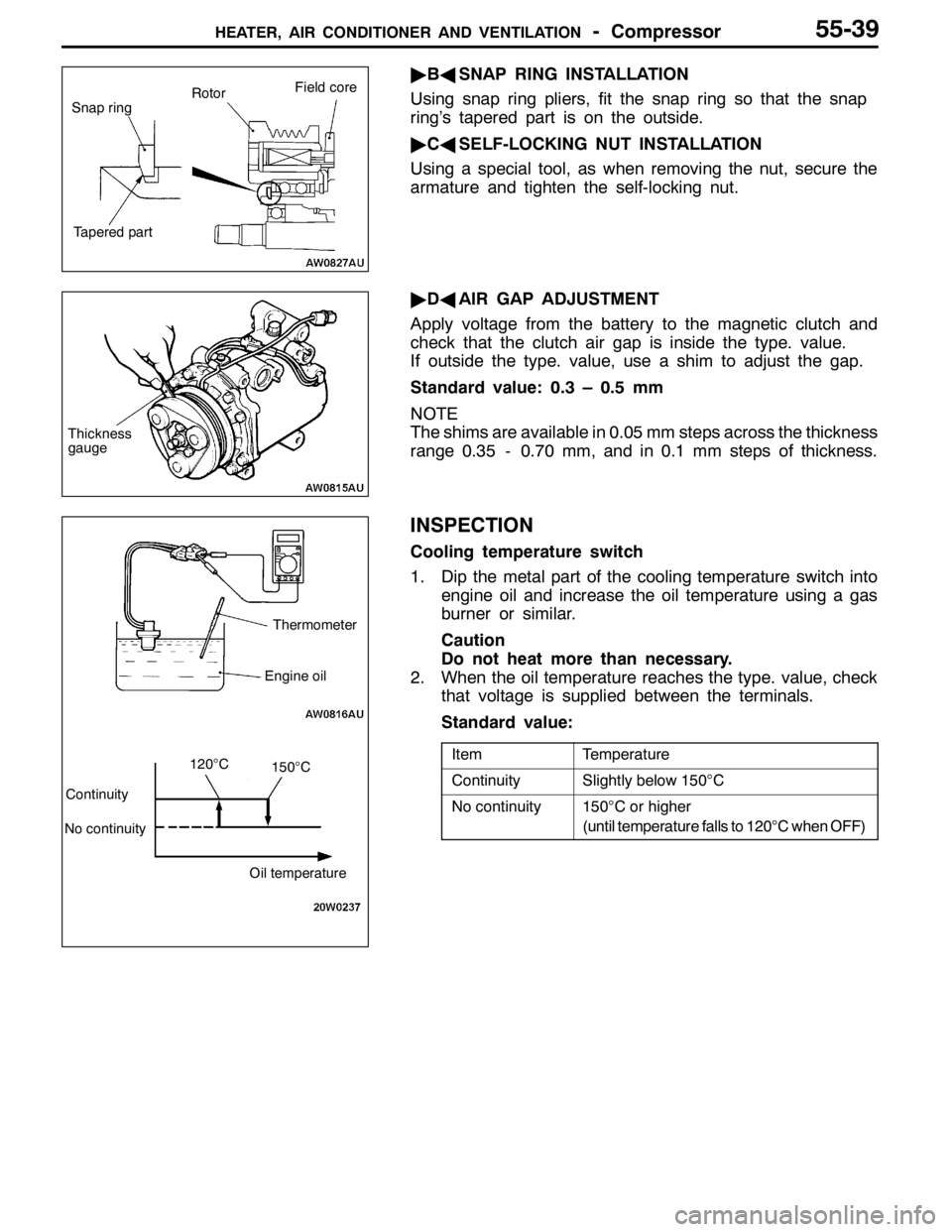
"BASNAP RING INSTALLATION
Using snap ring pliers, fit the snap ring so that the snap
ring’s tapered part is on the outside.
"CASELF-LOCKING NUT INSTALLATION
Using a special tool, as when removing the nut, secure the
armature and tighten the self-locking nut.
"DAAIR GAP ADJUSTMENT
Apply voltage from the battery to the magnetic clutch and
check that the clutch air gap is inside the type. value.
If outside the type. value, use a shim to adjust the gap.
Standard value: 0.3 – 0.5 mm
NOTE
The shims are available in 0.05 mm steps across the thickness
range 0.35 - 0.70 mm, and in 0.1 mm steps of thickness.
INSPECTION
Cooling temperature switch
1. Dip the metal part of the cooling temperature switch into
engine oil and increase the oil temperature using a gas
burner or similar.
Caution
Do not heat more than necessary.
2. When the oil temperature reaches the type. value, check
that voltage is supplied between the terminals.
Standard value:
ItemTemperature
ContinuitySlightly below 150°C
No continuity150°C or higher
(until temperature falls to 120°C when OFF)
Snap ringRotorField core
Tapered part
Thickness
gauge
Thermometer
Engine oil
Continuity
No continuity
Oil temperature
120°C150°C