steering MITSUBISHI LANCER EVOLUTION 2007 Service Owner's Manual
[x] Cancel search | Manufacturer: MITSUBISHI, Model Year: 2007, Model line: LANCER EVOLUTION, Model: MITSUBISHI LANCER EVOLUTION 2007Pages: 1449, PDF Size: 56.82 MB
Page 459 of 1449

ENGINE OVERHAUL -Specifications11B-5
MACHINING STANDARDS
Unit: mm
Items
Standard valueLimited value
Cylinder head, valve
Cylinder head
Oversize valve guide hole diameter
0.05 O.S.
0.25 O.S.
0.50 O.S.
Oversize valve seat hole diameter
Intake
0.3 O.S.
0.6 O.S.
Exhaust
0.3 O.S.
0.6 O.S.
12.05 - 12.07
12.25 - 12.27
12.50 - 12.52
35.30 - 35.33
35.60 - 35.63
33.30 - 33.33
33.60 - 33.63-
-
-
-
-
-
-
TIGHTENING TORQUE
ItemsTightening torque N·m
Alternator, ignition system
Oil level gauge guide bolt13±1
Water pump pulley bolt8.8±1.0
Alternator brace bolt (flange)23±3
Alternator brace bolt (washer)22±4
Alternator nut44±10
Crankshaft pulley bolt25±4
Center cover bolt3±0.5
Ignition coil bolt10±2
Spark plug25±5
Connector bracket bolt8.8±1.0
Timing belt
Timing belt cover bolt (flange)11±1
Timing belt cover bolt (washer)9±1
Power steering pump bracket bolt49±9
Tensioner pulley bolt49±6
Tensioner arm bolt21±4
Auto tensioner bolt23±3
Idler pulley bolt35±6
Crank angle sensor bolt8.8±1.0
Oil pump sprocket nut54±5
Crankshaft bolt162±5
Tensioner B bolt19±3
Counter balance shaft sprocket bolt46±3
Rocker cover bolt3.5±0.5
Engine support bracket bolt49±5
Page 467 of 1449

ENGINE OVERHAUL -Timing Belt11B-13
TIMING BELT
REMOVAL AND INSTALLATION
1
11±1N•m
2
3
4 56
7
8
910
11 1213
14 15
16 1718
192021 2223
2425
26
27
2829
30
313233
34
35
49±6N•m
21±4N•m
23±3N•m
11±1N•m11±1N•m
88±10 N•m
35±6N•m
54±5N•m 19±3N•m 46±3N•m 9±1N•m162±5N•m3.5±0.5 N•m
49±9N•m
8.8±1.0 N•m 49±5N•m
Removal steps
1. Timing belt front upper cover
2. Timing belt front center cover
3. Timing belt front lower cover
4. Power steering pump bracket
AA""MA5. Timing belt
"LA6. Tensioner pulley
7. Tensioner arm
"KA8. Auto tensioner
9. Idler pulley
10. Crank angle sensor
AB""JA11. Oil pump sprocket
AC""IA12. Crankshaft bolt
AD""IA13. Crankshaft sprocket
"IA14. Crankshaft sensing blade
15. Tensioner B
AE""HA16. Timing belt B
AF""GA17. Counter balance shaft sprocket
"FA18. SpacerAG""EA19. Crankshaft sprocket B
20. Crankshaft key
21. Breather hose
22. PCV hose
23. PCV valve
24. PCV valve gasket
25. Oil filler cap
"DA26. Rocker cover
"DA27. Rocker cover gasket A
28. Rocker cover gasket B
"CA29. Semi-circular packing
"BA30. Engine support bracket
AH""AA31. Camshaft sprocket bolt
32. Camshaft sprocket
33. Timing belt rear right cover
34. Timing belt rear left upper cover
35. Timing belt rear left lower cover
Page 536 of 1449

MPI -General Information13A-4
OTHER CONTROL FUNCTIONS
1. Fuel Pump Control
Turns the fuel pump relay ON so that current
is supplied to the fuel pump while the engine
is cranking or running.
2. A/C Relay Control
Turns the compressor clutch of the A/C
ON and OFF.3. Fan Motor Control
The revolutions of the radiator fan and
condenser fan are controlled in response to
the engine coolant temperature and vehicle
speed.
4. Purge Control Solenoid Valve Control
Refer to GROUP 17.
5. EGR Control Solenoid Valve Control
Refer to GROUP 17.
GENERAL SPECIFICATIONS
ItemsSpecifications
Throttle bodyThrottle bore mm60
Throttle position sensorVariable resistor type
Idle speed control servoStepper motor type
(Stepper motor type by-pass air control system with the
air volume limiter)
Engine-ECUIdentification No.E6T34874
SensorsAir flow sensorKarman vortex type
Barometric pressure sensorSemiconductor type
Intake air temperature sensorThermistor type
Engine coolant temperature sensorThermistor type
Oxygen sensorZirconia type
Vehicle speed sensorMagnetic resistive element type
Camshaft position sensorHall element type
Crank angle sensorHall element type
Detonation sensorPiezoelectric type
Power steering fluid pressure switchContact switch type
ActuatorsEngine control relay typeContact switch type
Fuel pump relay typeContact switch type
Injector type and numberElectromagnetic type, 4
Injector identification markMDL560
EGR control solenoid valveDuty cycle type solenoid valve
Purge control solenoid valveDuty cycle type solenoid valve
Fuel pressure control solenoid valveON/OFF type solenoid valve
Waste gate solenoid valveDuty cycle type solenoid valve
Secondary air control solenoid valveON/OFF type solenoid valve
Fuel pressure
regulatorRegulator pressure kPa294
Page 537 of 1449

MPI -General Information13A-5
MULTI-POINT FUEL INJECTION SYSTEM DIAGRAM
L1 Oxygen sensor (front)
L2 Oxygen sensor (rear)
L3 Air flow sensor
L4 Intake air temperature sensor
L5 Throttle position sensor
L6 Camshaft position sensor
L7 Crank angle sensor
L8 Barometric pressure sensor
L9 Engine coolant temperature sensor
L10 Detonation sensor
Engine-ECU
l1 Injector
l2 Idle speed control servo
l3 Fuel pressure control solenoid valve
l4 Waste gate solenoid valve
l5 EGR control solenoid valve
l6 Purge control solenoid valve
l7 Secondary air control solenoid valve
DPower supply
DIgnition switch IG
DIgnition switch ST
DVehicle speed sensor
DA/C switch
DA/C load signal
DTachometer
DPower steering fluid pressure switch
DAlternator FR terminal
DDiagnosis control terminal
DIntercooler water spray switch (automatic)
DIntercooler water spray switch (manual)DEngine control relay
DFuel pump relay 2, 3
DA/C relay
DIgnition coil
DFan controller
DCondenser fan relay (HI)
DCondenser fan relay (LOW)
DEngine warning lamp
DDiagnosis output
DAlternator G terminal
DIntercooler water spray relay
DIntercooler water spray lamp
L1 Oxygen
sensor
(front)
L4 Intake air
temperature
sensorL5 Throttle
position
sensor
L6 Camshaft
position sensorl1 Injector l2 Idle
speed
control
servo
l6 Purge
control
solenoid
valve
Three-way
catalytic converter Canister
Air
inletVacuum
tank
Fuel
pressure
reguratorFrom
fuel tank
To fuel tank
PCV valveFrom
fuel pump
Waste gate
actuatorL2 Oxygen sensor (rear) Check
valveBy-pass
valve
l5 EGR control
solenoid valve
l4 Waste gate
solenoid valve L8 Barometric
pressure
sensor
L3 Air flow
sensorl7 Secondary
air control
solenoid
valve
Secondary
air valvel3 Fuel pressure
control
solenoid valve
EGR
valve
L9 Engine coolant
temperature sensor
L7 Crank angle sensor
L10 Detonation sensor
Page 542 of 1449

MPI -TroubleshootingMPI -Troubleshooting13A-10
Code No. Diagnosis item
P0443Purge control solenoid valve system
P0500Vehicle speed sensor system
P0505Idle speed control system
P0551Power steering fluid pressure switch
P1104Waste gate solenoid valve system
P1105Fuel pressure control solenoid valve system
NOTE
If the engine warning lamp illuminates because of a malfunction of the engine-ECU, communication between
MUT-IIand the engine-ECU is impossible. In this case, the diagnosis code cannot be read.
METHOD OF READING AND ERASING DIAGNOSIS
CODES
Refer to GROUP 00 - How to Use Troubleshooting/Inspection
Service Points.
INSPECTION USING MUT-IIDATA LIST AND ACTUATOR
TESTING
1. Carry out inspection by means of the data list and the
actuator test function. If there is an abnormality, check
and repair the chassis harnesses and components.
2. After repairing, re-check using the MUT-IIand check that
the abnormal input and output have returned to normal
as a result of the repairs.
3. Erase the diagnosis code memory.
4. Remove the MUT-II, and then start the engine again and
carry out a road test to confirm that the problem has
disappeared.
Page 544 of 1449

MPI -Troubleshooting13A-12
INSPECTION CHART FOR DIAGNOSIS CODES
Code No.Diagnosis itemReference page
P0100Air flow sensor system13A-13
P0105Barometric pressure sensor system13A-15
P0110Intake air temprature sensor system13A-16
P0115Engine coolant temperature sensor system13A-19
P0120Throttle position sensor system13A-21
P0130Oxygen sensor (front) system13A-24
P0135Oxygen sensor heater (front) system13A-26
P0136Oxygen sensor (rear) system13A-27
P0141Oxygen sensor heater (rear) system13A-29
P0201No.1 injector system13A-30
P0202No.2 injector system13A-31
P0203No.3 injector system13A-32
P0204No.4 injector system13A-33
P0325Detonation sensor system13A-34
P0335Crank angle sensor system13A-35
P0340Camshaft position sensor system13A-37
P0403EGR control solenoid valve system13A-39
P0443Purge control solenoid valve system13A-41
P0500Vehicle speed sensor system13A-43
P0505Idle speed control system13A-44
P0551Power steering fluid pressure switch system13A-46
P1104Waste gate solenoid valve system13A-47
P1105Fuel pressure control valve system13A-48
P1500Alternator FR terminal system13A-49
P1603Battery backup line malfunction13A-50
P1610Immobilizer system13A-51
Page 576 of 1449

MPI -Troubleshooting13A-44
Code No. P0505 Idle speed control systemProbable cause
Range of Check
DVehicle speed has reached 1.5 Km/h at least once.
DUnder the closed loop idle speed control.
Set Conditions
DActual idle speed has continued to be higher than the target idle speed by 300
r/min or more for 10 seconds.
Range fo Check
DVehicle speed has reached 1.5 km/h at least once.
DDuring idle speed closed loop control.
DThe highest temperature at the last drive is 45_C or less.
DEngine coolant temperature is approximately 80_C or more.
DBattery voltage is 10 V or more.
DBarometric pressure is 76 kPa or higher.
DIntake air temperature is - 10_C or more.
Set Conitions
DActual idle speed has been minimum 200 r/min higher than the target idle speed
for 10 seconds.
Range of Check
DDuring idle speed closed loop control.
DEngine coolant temperature is approximately 80_C or higher.
DBattery voltage is 10 V or higher.
DPower steering switch is off.
DVolumetric efficiency is 40 % or lower.
DBarometric pressure is 76 kPa or higher.
DIntake air temperature is - 10_C or more.
Set Conitions
DActual idle speed has been minimum 100 r/min higher than the target idle speed
for 10 seconds.DMalfunction of idle speed control servo
DOpen or short circuit in the idle speed control servo
circuit or loose connector contact
DMalfunction of engine-ECU
Page 578 of 1449
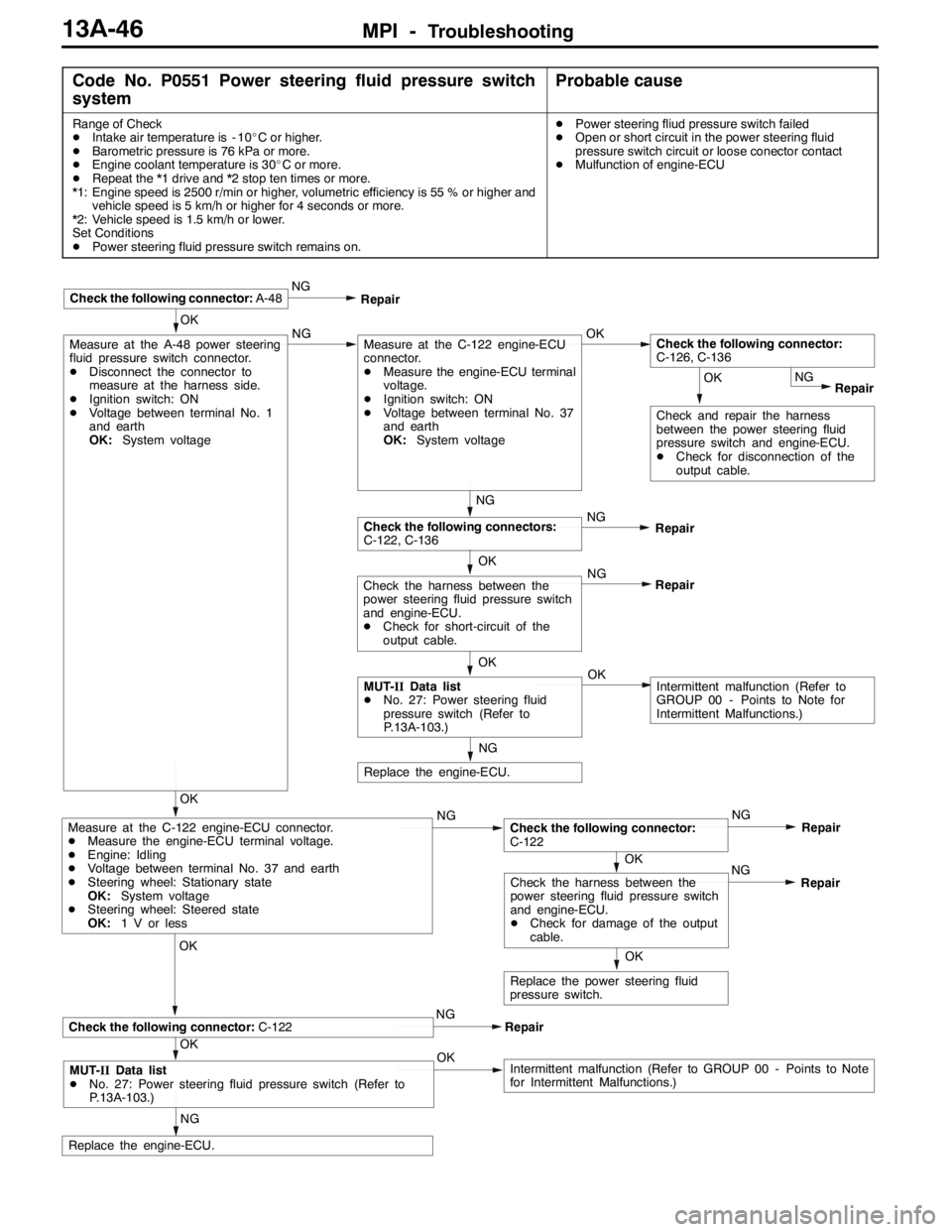
MPI -Troubleshooting13A-46
Code No. P0551 Power steering fluid pressure switch
systemProbable cause
Range of Check
DIntake air temperature is - 10_C or higher.
DBarometric pressure is 76 kPa or more.
DEngine coolant temperature is 30_C or more.
DRepeat the *1 drive and *2 stop ten times or more.
*1: Engine speed is 2500 r/min or higher, volumetric efficiency is 55 % or higher and
vehicle speed is 5 km/h or higher for 4 seconds or more.
*2: Vehicle speed is 1.5 km/h or lower.
Set Conditions
DPower steering fluid pressure switch remains on.DPower steering fliud pressure switch failed
DOpen or short circuit in the power steering fluid
pressure switch circuit or loose conector contact
DMulfunction of engine-ECU
NG
OKOK
NGCheck the following connectors:
C-122, C-136
NG
OKNG
OK
Check the harness between the
power steering fluid pressure switch
and engine-ECU.
DCheck for short-circuit of the
output cable.Repair Repair
OKIntermittent malfunction (Refer to GROUP 00 - Points to Note
for Intermittent Malfunctions.)
NG
OK
Measure at the A-48 power steering
fluid pressure switch connector.
DDisconnect the connector to
measure at the harness side.
DIgnition switch: ON
DVoltage between terminal No. 1
and earth
OK:System voltageNGMeasure at the C-122 engine-ECU
connector.
DMeasure the engine-ECU terminal
voltage.
DIgnition switch: ON
DVoltage between terminal No. 37
and earth
OK:System voltage
OK
NG
Replace the engine-ECU.
MUT-IIData list
DNo. 27: Power steering fluid pressure switch (Refer to
P.13A-103.)
OK
Check the following connector:A-48NG
Repair
NG
Repair OK
Check the following connector:
C-126, C-136
Check and repair the harness
between the power steering fluid
pressure switch and engine-ECU.
DCheck for disconnection of the
output cable.
Replace the engine-ECU.
OK
NG
MUT-IIData list
DNo. 27: Power steering fluid
pressure switch (Refer to
P.13A-103.)Intermittent malfunction (Refer to
GROUP 00 - Points to Note for
Intermittent Malfunctions.)
Measure at the C-122 engine-ECU connector.
DMeasure the engine-ECU terminal voltage.
DEngine: Idling
DVoltage between terminal No. 37 and earth
DSteering wheel: Stationary state
OK:System voltage
DSteering wheel: Steered state
OK:1 V or less
OK
Replace the power steering fluid
pressure switch.Repair
Check the following connector:
C-122NG
Repair
Check the following connector:C-122
Check the harness between the
power steering fluid pressure switch
and engine-ECU.
DCheck for damage of the output
cable.OK
Repair NG
Page 585 of 1449

MPI -Troubleshooting
Fig. 1
Vehicle
speedInitial ac-
celerator
pedal de-
pressionNormalHesitation
Sag
TimeFig. 2
Normal
Initial ac-
celerator
pedal de-
pression
IdlingStumble
Time Vehicle
speed
13A-53
PROBLEM SYMPTOMS TABLE (FOR YOUR INFORMATION)
ItemsSymptom
StartingWon’t startThe starter is used to crank the engine, but there is no combustion within the
cylinders, and the engine won’t start.
Fires up and diesThere is combustion within the cylinders, but then the engine soon stalls.
Hard startingEngine starts after cranking a while.
Idling
stability
HuntingEngine speed doesn’t remain constant; changes at idle.
stability
Rough idleUsually, a judgement can be based upon the movement of the tachometer
pointer, and the vibration transmitted to the steering wheel, shift lever, body, etc.
This is called rough idle.
Incorrect idle speedThe engine doesn’t idle at the usual correct speed.
Engine stall
(Die out)The engine stalls when the foot is taken from the accelerator pedal, regardless
of whether the vehicles is moving or not.
Engine stall
(Pass out)The engine stalls when the accelerator pedal is depressed or while it is being
used.
DrivingHesitation Sag“Hesitation” is the delay in response of the vehicle speed (engine speed) that
occurs when the accelerator is depressed in order to accelerate from the speed
at which the vehicle is now traveling, or a temporary drop in vehicle speed
(engine speed) during such acceleration.
Serious hesitation is called “sag”. (Refer to Fig. 1)
Poor accelerationPoor acceleration is inability to obtain an acceleration corresponding to the
degree of throttle opening, even though acceleration is smooth, or the inability
to reach maximum speed.
StumbleEngine speed increase is delayed when the accelerator pedal is initially
depressed for acceleration. (Refer to Fig. 2)
ShockThe feeling of a comparatively large impact or vibration when the engine is
accelerated or decelerated.
SurgeThis is repeated surging ahead during constant speed travel or during variable
speed travel.
KnockingA sharp sound like a hammer striking the cylinder walls during driving and which
adversely affects driving.
StoppingRun on
(“Dieseling”)The condition in which the engine continues to run after the ignition switch is
turned to “LOCK” (OFF) position. Also called “Dieseling”.
Page 595 of 1449
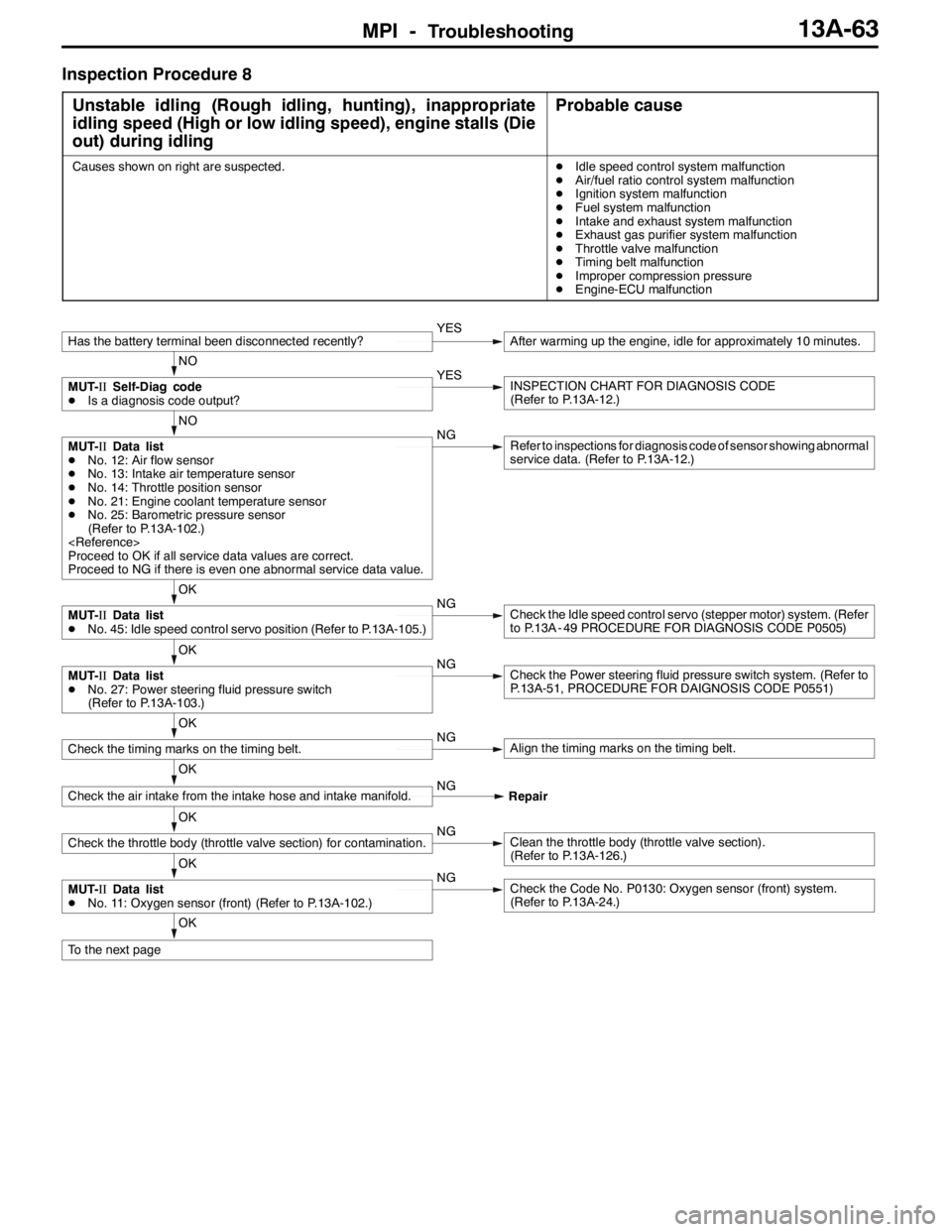
MPI -Troubleshooting13A-63
Inspection Procedure 8
Unstable idling (Rough idling, hunting), inappropriate
idling speed (High or low idling speed), engine stalls (Die
out) during idling
Probable cause
Causes shown on right are suspected.DIdle speed control system malfunction
DAir/fuel ratio control system malfunction
DIgnition system malfunction
DFuel system malfunction
DIntake and exhaust system malfunction
DExhaust gas purifier system malfunction
DThrottle valve malfunction
DTiming belt malfunction
DImproper compression pressure
DEngine-ECU malfunction
OK
To the next page
OK
MUT-IIData list
DNo. 11: Oxygen sensor (front) (Refer to P.13A-102.)NGCheck the Code No. P0130: Oxygen sensor (front) system.
(Refer to P.13A-24.)
OK
Check the throttle body (throttle valve section) for contamination.NGClean the throttle body (throttle valve section).
(Refer to P.13A-126.)
OK
Check the air intake from the intake hose and intake manifold.NG
Repair
OK
Check the timing marks on the timing belt.NGAlign the timing marks on the timing belt.
OK
MUT-IIData list
DNo. 27: Power steering fluid pressure switch
(Refer to P.13A-103.)NGCheck the Power steering fluid pressure switch system. (Refer to
P.13A-51, PROCEDURE FOR DAIGNOSIS CODE P0551)
OK
MUT-IIData list
DNo. 45: Idle speed control servo position (Refer to P.13A-105.)NGCheck the Idle speed control servo (stepper motor) system. (Refer
to P.13A - 49 PROCEDURE FOR DIAGNOSIS CODE P0505)
NO
MUT-IIData list
DNo. 12: Air flow sensor
DNo. 13: Intake air temperature sensor
DNo. 14: Throttle position sensor
DNo. 21: Engine coolant temperature sensor
DNo. 25: Barometric pressure sensor
(Refer to P.13A-102.)
Proceed to OK if all service data values are correct.
Proceed to NG if there is even one abnormal service data value.NGRefer to inspections for diagnosis code of sensor showing abnormal
service data. (Refer to P.13A-12.)
NO
MUT-IISelf-Diag code
DIs a diagnosis code output?YESINSPECTION CHART FOR DIAGNOSIS CODE
(Refer to P.13A-12.)
Has the battery terminal been disconnected recently?YESAfter warming up the engine, idle for approximately 10 minutes.