steering MITSUBISHI LANCER EVOLUTION 2007 Service Manual PDF
[x] Cancel search | Manufacturer: MITSUBISHI, Model Year: 2007, Model line: LANCER EVOLUTION, Model: MITSUBISHI LANCER EVOLUTION 2007Pages: 1449, PDF Size: 56.82 MB
Page 1029 of 1449

FRONT SUSPENSION -Service Specifications/Special Tools33A-3
SERVICE SPECIFICATIONS
ItemsStandard value
Toe-inAt the centre of tyre tread mm0±2
Toe-angle (per wheel)0_00’±05’
Toe-out angle on turns (inner wheel when outer wheel at 20_)22_00’±1_30’
Steering angleInner wheel31_45’±1_30’
Outer wheel (for reference)27_15’
Camber (Selectable from 2 options)-1_00’±30’* or - 2_00’±30’*
Caster3_55’±30’*
Kingpin inclination13_45’±1_30’
Lower arm ball joint rotation starting torque N·m0.5 - 3.4
Lower arm pillow ball bushing rotation starting torque N·m0.5 - 3.0
NOTE
*: difference between right and left wheels: less than 30’
SPECIAL TOOLS
ToolsNumberNameUse
B
A
A: MB991237
B: MB991238A: Spring
compressor
body
B: Arm setCoil spring compression
BAMB991680
A: MB991681
B: MB991682Wrench set
A: Wrench
B: SocketStrut assembly disassembly and reassembly
MB991006Preload socketLower arm ball joint rotation starting torque
measurement
MB990326Preload socketLower arm pillow ball bushing rotation starting
torque measurement
Page 1030 of 1449

FRONT SUSPENSION -Special Tools/On-vehicle Service33A-4
Tools UseName Number
MB990800Ball joint remover &
installerLower arm ball joint dust cover press-in
MB990651BarLower arm pillow ball bushing removal and
press-fitting
MB990816Bushing remover &
installer base
MB991576Base
MB990635,
MB991113 or
MB991406Steering linkage
pullerTie rod end and knuckle disconnection
ON-VEHICLE SERVICE
WHEEL ALIGNMENT CHECK AND
ADJUSTMENT
Measure the wheel alignment with the vehicle parked on a
level surface.
The front suspension, steering system, and wheels should be
serviced to normal condition prior to measurement of wheel
alignment.
TOE-IN
Standard value:
At the centre of tyre tread 0±2mm
Toe angle (per wheel) 0_00’±05’
1. Adjust the toe-in by undoing the clip and lock nut, and
turning the left and right tie rod turnbuckles by the same
amount (in opposite directions).
NOTE
The toe will move out as the left turnbuckle is turned
toward the front of the vehicle and the right turnbuckle
is turned toward the rear of the vehicle.
2. Install the clip and tighten the lock nut to the specified torque.
Clip
Lock nut
Page 1031 of 1449

FRONT SUSPENSION -On-vehicle Service33A-5
Tightening torque: 52±2 N·m
3. Confirm that the toe-in is at the standard value.
4. Use a turning radius gauge to check that the steering
angle is at the standard value.
Standard value:
Inner wheels31_45’±1_30’
Outer wheels (for reference)27_15’
TOE-OUT ANGLE ON TURNS
To check the steering linkage, especially after the vehicle
has been involved in an accident or if an accident is presumed,
it is advisable to check the toe-out angle on turns in addition
to the wheel alignment.
Conduct this test on the left turn as well as on the right turn.
Standard value:
ItemsSpecifications
Toe-out angle on turns
(inner wheel when outer wheel at 20_)22_00’±1_30’
CAMBER, CASTER AND KINGPIN INCLINATION
Standard value:
ItemsSpecifications
Camber
(Selectable from 2 options)-1_00’±30’* or - 2_00’±30’*
Caster3_55’±30’*
Kingpin inclination13_45’±1_30’
NOTE
1. *: difference between right and left wheels must be less
than 30’
2. Caster and kingpin inclination are preset at the factory
and cannot be adjusted.
SELECTION THE CAMBER
Select the camber by the installation direction of the allow
of the connecting bolt of the strut assembly and the knuckle.
D-1
_00’±30’: Install the bolt turning the allow to the direction
of vehicle inside.
D-2
_00’±30’: Install the bolt turning the allow to the direction
of vehicle outside.
BALL JOINT DUST COVER CHECK
1. Check the dust cover for cracks or damage by pushing
it with finger.
2. If the dust cover is cracked or damaged, replace the
lower arm assembly.
NOTE
Cracks or damage of the dust cover may cause damage
of the ball joint.
Page 1038 of 1449
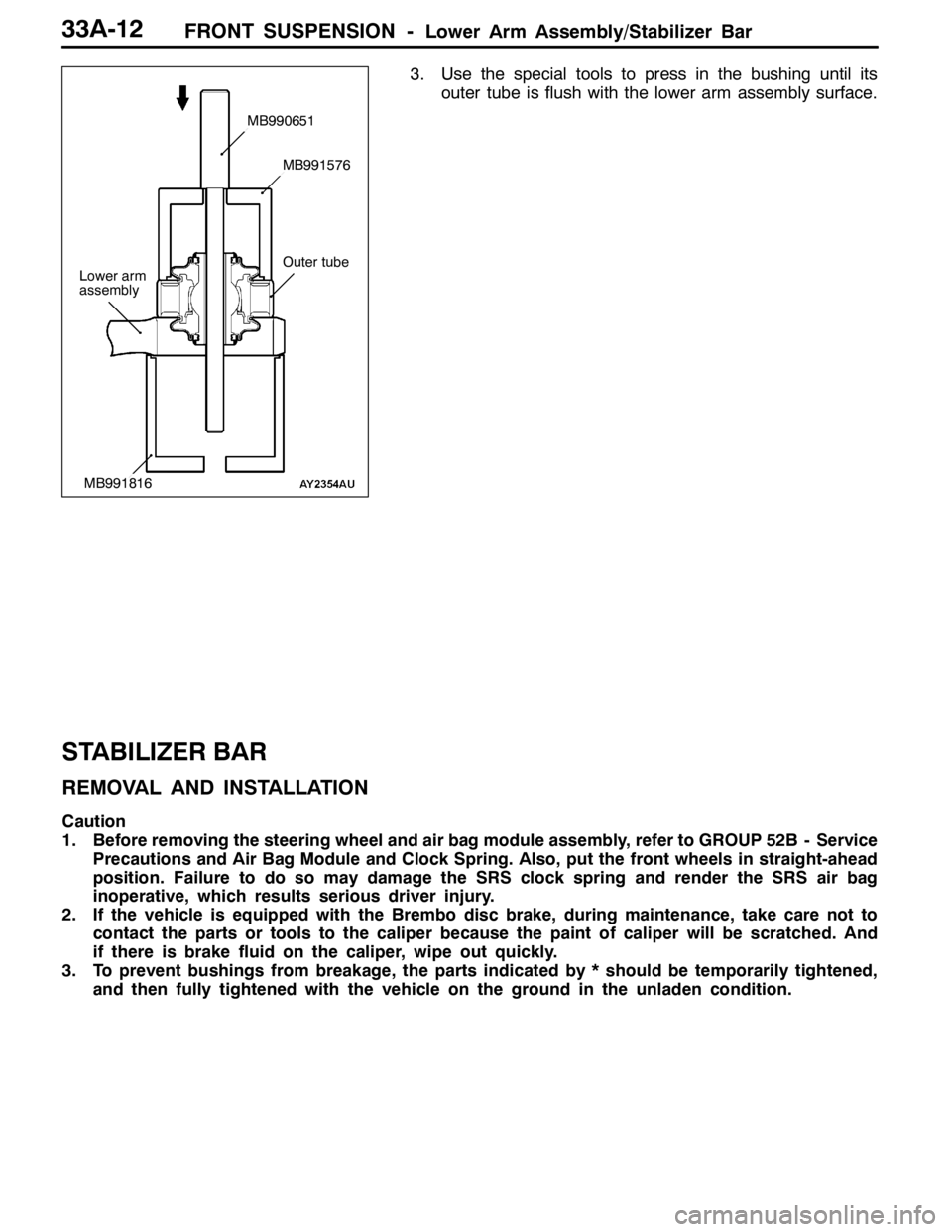
FRONT SUSPENSION -Lower Arm Assembly/Stabilizer Bar33A-12
3. Use the special tools to press in the bushing until its
outer tube is flush with the lower arm assembly surface.
STABILIZER BAR
REMOVAL AND INSTALLATION
Caution
1. Before removing the steering wheel and air bag module assembly, refer to GROUP 52B - Service
Precautions and Air Bag Module and Clock Spring. Also, put the front wheels in straight-ahead
position. Failure to do so may damage the SRS clock spring and render the SRS air bag
inoperative, which results serious driver injury.
2. If the vehicle is equipped with the Brembo disc brake, during maintenance, take care not to
contact the parts or tools to the caliper because the paint of caliper will be scratched. And
if there is brake fluid on the caliper, wipe out quickly.
3. To prevent bushings from breakage, the parts indicated by * should be temporarily tightened,
and then fully tightened with the vehicle on the ground in the unladen condition.
Lower arm
assembly
MB990651
MB991576
MB991816
Outer tube
Page 1039 of 1449
FRONT SUSPENSION -Stabilizer Bar33A-13
Pre-removal Operation
DSteering Wheel and Air Bag Module Assembly
Removal (Refer to GROUP 37A.)
DClock Spring Removal (Refer to GROUP 52B.)
DCrossmember Bar Removal (Refer to P.33A-15.)
DCentermember Removal (Refer to GROUP 32.)
DFront Exhaust Pipe Removal (Refer to GROUP 15.)Post-installation Operation
DFront Exhaust Pipe Installation (Refer to GROUP
15.)
DCentermember Installation (Refer to GROUP 32.)
DCrossmember Bar Installation (Refer to P.33A-15.)
DClock Spring Installation (Refer to GROUP 52B.)
DSteering Wheel and Air Bag Module Assembly
Installation (Refer to GROUP 37A.)
DCheck the Dust Cover for Cracks or Damage by
Pushing it with Finger.
DChecking Steering Wheel Position with Wheels
Straight Ahead
DFront Wheel Alignment Check and Adjustment
(Refer to P.33A-4.)
3
4
10
21±4N·m
51
1
2
25±5N·m
18±2N·m
108±10 N·m
52±7N·m*
49±10 N·m
167±9N·m
7
8
9
6
39±5N·m
39±5N·m
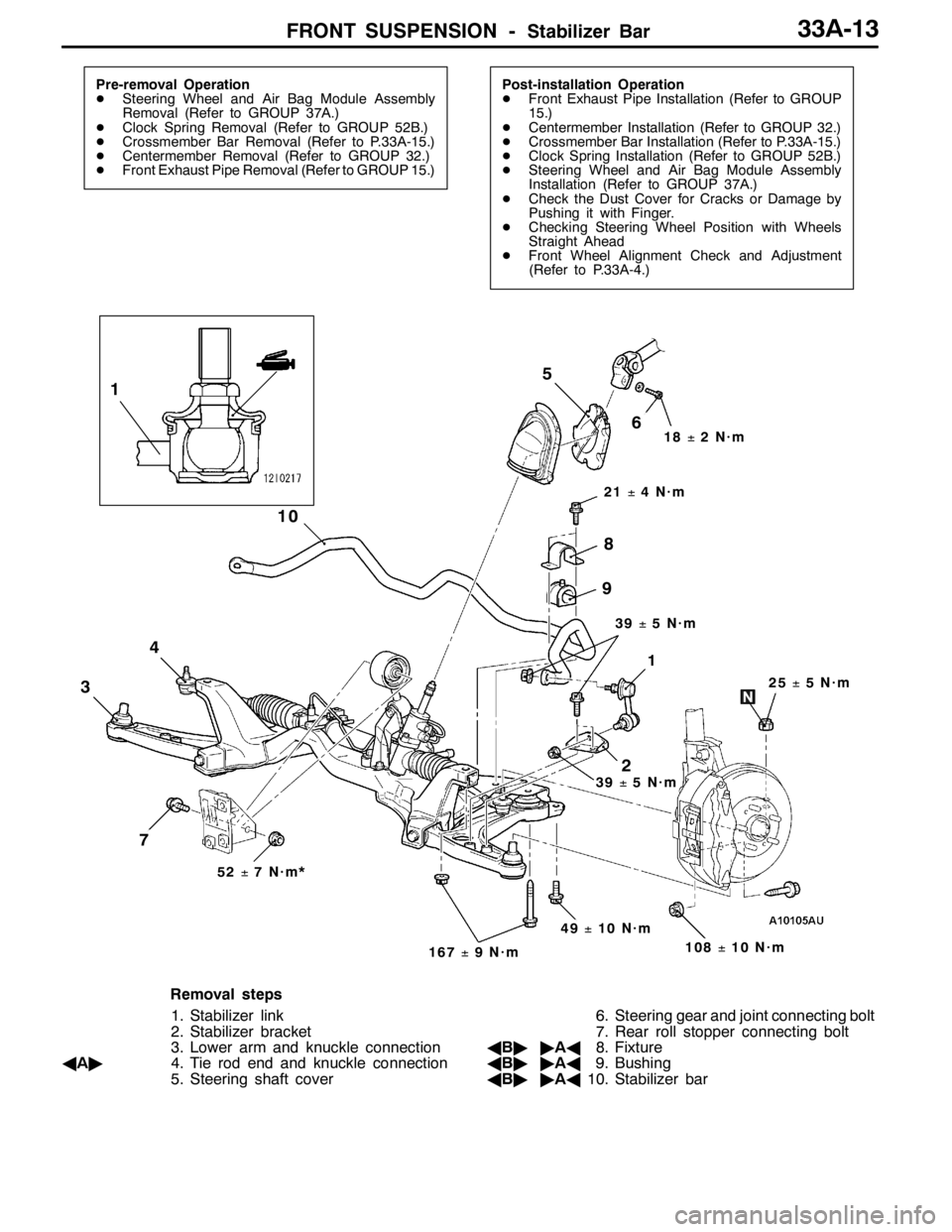
Removal steps
1. Stabilizer link
2. Stabilizer bracket
3. Lower arm and knuckle connection
AA"4. Tie rod end and knuckle connection
5. Steering shaft cover6. Steering gear and joint connecting bolt
7. Rear roll stopper connecting bolt
AB""AA8. Fixture
AB""AA9. Bushing
AB""AA10. Stabilizer bar
Page 1040 of 1449
FRONT SUSPENSION -Stabilizer Bar33A-14
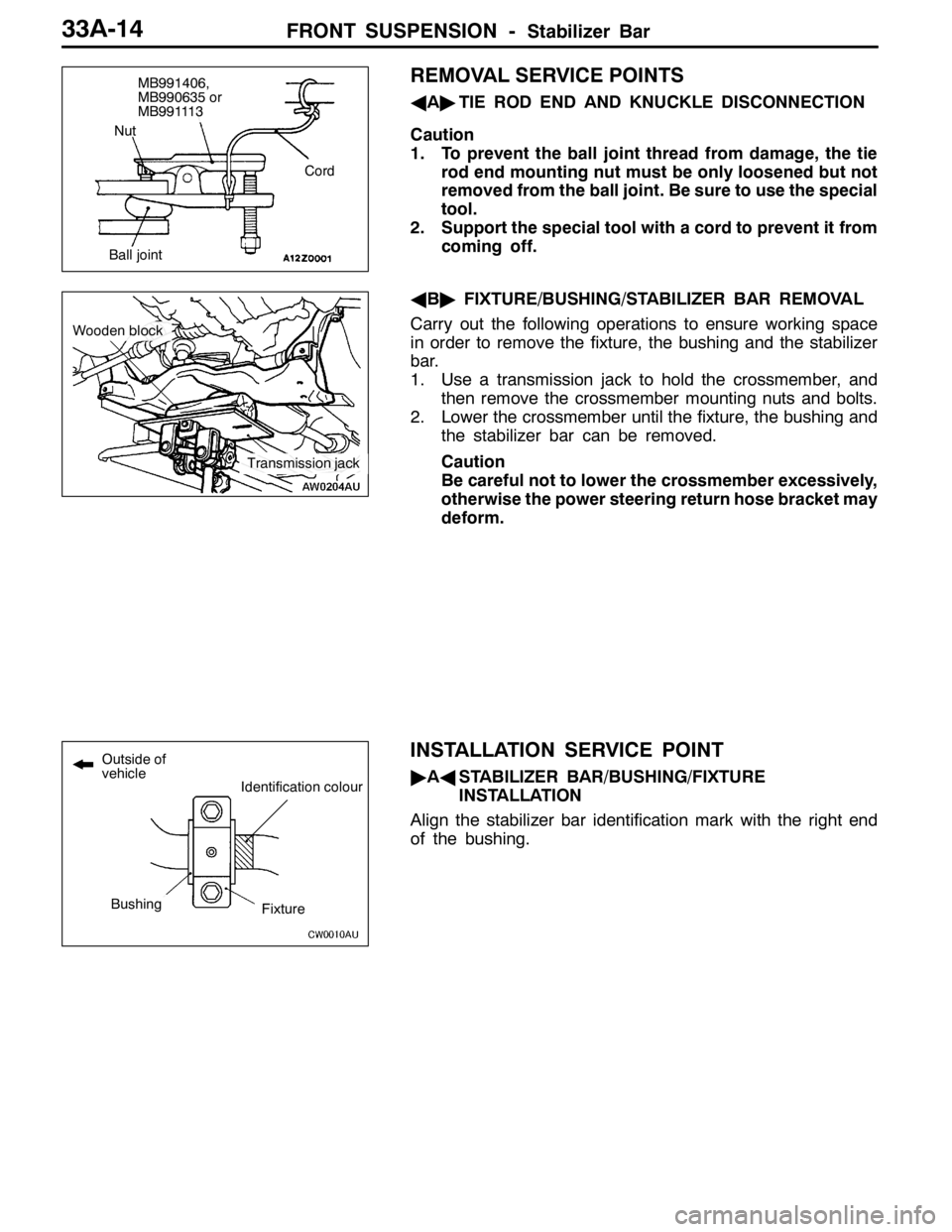
REMOVAL SERVICE POINTS
AA"TIE ROD END AND KNUCKLE DISCONNECTION
Caution
1. To prevent the ball joint thread from damage, the tie
rod end mounting nut must be only loosened but not
removed from the ball joint. Be sure to use the special
tool.
2. Support the special tool with a cord to prevent it from
coming off.
AB"FIXTURE/BUSHING/STABILIZER BAR REMOVAL
Carry out the following operations to ensure working space
in order to remove the fixture, the bushing and the stabilizer
bar.
1. Use a transmission jack to hold the crossmember, and
then remove the crossmember mounting nuts and bolts.
2. Lower the crossmember until the fixture, the bushing and
the stabilizer bar can be removed.
Caution
Be careful not to lower the crossmember excessively,
otherwise the power steering return hose bracket may
deform.
INSTALLATION SERVICE POINT
"AASTABILIZER BAR/BUSHING/FIXTURE
INSTALLATION
Align the stabilizer bar identification mark with the right end
of the bushing.
Cord
Ball jointNut
MB991406,
MB990635 or
MB991113
Transmission jack
Woodenblock
Identification colour
BushingFixture
Outside of
vehicle
Page 1071 of 1449

35B-1
ANTI-SKID
BRAKING SYSTEM
(ABS) <4WD>
CONTENTS
GENERAL INFORMATION 2..................
SERVICE SPECIFICATIONS 3.................
LUBRICANTS Refer to GROUP 35A..........
SEALANT Refer to GROUP 35A..............
SPECIAL TOOLS 4...........................
TROUBLESHOOTING 4.......................
ON-VEHICLE SERVICE 26....................
Brake Pedal Check and Adjustment
Refer to GROUP 35A ..........................
Brake Booster Operating Test
Refer to GROUP 35A ..........................
Check Valve Operation Check
Refer to GROUP 35A ..........................
Bleeding Refer to GROUP 35A..................
Brake Fluid Level Sensor Check
Refer to GROUP 35A ..........................
Disc Brake Pad Check and
Replacement Refer to GROUP 35A..............Disc Brake Rotor Check Refer to GROUP 35A...
Brake Disc Thickness Check
Refer to GROUP 35A ..........................
Brake Disc Run-out Check and Correction
Refer to GROUP 35A ..........................
Wheel Speed Sensor Output Voltage Check
26 ............................................
Hydraulic Unit Check 28........................
Remedy for a Flat Battery 29...................
BRAKE PEDAL Refer to GROUP 35A........
MASTER CYLINDER AND BRAKE
BOOSTER Refer to GROUP 35A............
DISC BRAKE Refer to GROUP 35A..........
HYDRAULIC UNIT AND ABS-ECU 30.........
WHEEL SPEED SENSOR 33..................
G SENSORS AND STEERING WHEEL
SENSOR 35..................................
Page 1072 of 1449

ABS <4WD> -General Information35B-2
GENERAL INFORMATION
ABS has been adopted as optional equipment in
RS-IIto maintain directional stability and steering
performance during sudden braking or braking on
slippery road surfaces.
The ABS control method is a 4-sensor, 4-channel
method which provides independent control for all
wheels.
Following system for Lancer EVOLUTION-VII has
been modified from Lancer EVOLUTION-VI Tommi
Makinen Edition.DBy adding lateral G sensor, longitudinal G
sensor and steering wheel sensor, optimized
ABS control at the time of cornering.
DBy inputting parking brake switch signal to
ABS-ECU with pulling parking brake lever, ABS
control has been optimized.
DABS-ECU outputs ABS signal to 4WD-ECU.
DG sensor (lateral), steering wheel sensor and
parking brake switch have been added to the
diagnosis and service data.
DABS-ECU connector has been changed.
EBD CONTROL
In ABS, electronic control method is used by which
the rear wheel brake hydraulic pressure during
braking is regulated by rear wheel control solenoid
valves in accordance with the vehicle’s rate of
deceleration and the front and rear wheel slippage
which are calculated from the each wheel speed
sensor’s signal. EBD control is a control system
which provides a high level of control for both vehicle
braking force and vehicle stability. The system has
the following features:
DBecause the system provides the optimum rear
wheel braking force regardless of the vehicleladen condition and the condition of the road
surface, the system reduces the required pedal
depression force, particularly when the vehicle
is heavily laden or driving on road surfaces
with high frictional coefficients.
DBecause the duty placed on the front brakes
has been reduced, the increases in pad
temperature can be controlled to improve the
wear resistance characteristics of the pad,
during front brakes applying.
DControl valves such as the proportioning valve
are no longer required.
SPECIFICATIONS
ItemSpecifications
ABS control method4-sensor, 4-channel
No. of ABS rotor teethFront43
Rear43
ABS speed sensorTypeMagnet coil typep
Gap between sensor and rotor mm0.85
Page 1073 of 1449

ABS <4WD> -General Information/Service Specifications35B-3
CONSTRUCTION DIAGRAM
Stop lamp
switch*Parking brake
switch
Diagnosis
connector*
Wheel speed sensorWheel speed sensor Hydraulic unit
assembly*
(integrated with
the ABS-ECU) ABS warning lamp
Lateral G sensor
Longitudinal G sensor Steering
wheel
sensor*
NOTE
For R.H. drive vehicles, only the position indicated by the * is symmetrical.
SERVICE SPECIFICATIONS
ItemsStandard value
Wheel speed sensor internal resistance kΩ1.24 - 1.64
Wheel speed sensor insulation resistance kΩ100 or more
Lateral G sensor/Longitudinal G
sensoroutputvoltageV
On stationary vehicle2.4 - 2.6
sensor outputvoltageV
With front mark downward3.4 - 3.6
Page 1078 of 1449

ABS <4WD> -Troubleshooting35B-8
Diagnosis code No.Reference page Inspection item
81Steering wheel sensor (ST-1) system (Open circuit or short circuit)35B-14
82Steering wheel sensor (ST-2) system (Open circuit or short circuit)
83Steering wheel sensor (ST-N) system (Open circuit or short circuit)
NOTE: diagnosis code No.16, 52, 63
1. Code No. 16 is cleared from the memory by turning the ignition switch to ACC position. When the system
is properly reset, this code is also cleared from the memory.
2. Code No. 52 and 63 are cleared from the memory by turning the ignition switch to ACC position.