service MITSUBISHI LANCER EVOLUTION 2007 Service Repair Manual
[x] Cancel search | Manufacturer: MITSUBISHI, Model Year: 2007, Model line: LANCER EVOLUTION, Model: MITSUBISHI LANCER EVOLUTION 2007Pages: 1449, PDF Size: 56.82 MB
Page 1306 of 1449

SRS -Seat Belt with Pre-tensioner52B-62
INSTALLATION SERVICE POINTS
"AAPRE-INSTALLATION INSPECTION
1. Pre-installation inspection must be carried out even when
installing a new seat belt with pre-tensioner. (Refer to
Inspections.)
Caution
If the seat belt with pre-tensioner is discarded, discard
it after operating the seat belt pre-tensioner according
to the specified procedure. (Refer to P.52B-64.)
2. Connect the negative ( - ) terminal of the battery.
3. Connect the MUT-II to the diagnosis connector (16 pin).
Caution
Connection and disconnection of the MUT-II must be
carried out after turning the ignition switch to the
LOCK (OFF) position.
4. Turn the ignition switch to ON position.
5. Check that there is no abnormality except for open circuit
in the seat belt pre-tensioner after reading diagnostic
codes.
6. Turn the ignition key to LOCK (OFF) position.
7. Release the negative ( - ) terminal cable of the battery
and wrap a tape around it for insulation.
Caution
Wait for at least 60 seconds after disconnecting the
negative ( - ) battery cable before starting any
operation. (Refer to P.52B-3.)
"BAPOST-INSTALLATION INSPECTION
1. Turn the ignition switch to the ON position.
2. Check that the SRS warning lamp illuminates for 6 to
8 seconds and goes out.
3. Carry out troubleshooting if the lamp does not go out.
(Refer to P.52B-6.)
SRS warning lamp
Page 1322 of 1449

54A-2
CHASSIS
ELECTRICAL
CONTENTS
BATTERY 4..............................
SERVICE SPECIFICATION 4....................
ON-VEHICLE SERVICE 4......................
Fluid Level and Specific Gravity Check 4........
Charging 4.................................
Battery Testing Procedure 5...................
IGNITION SWITCH AND IMMOBILIZER
SYSTEM 6...............................
SPECIAL TOOLS 6............................
TROUBLESHOOTING 6........................
IMMOBILIZER-ECU CHECK 10.................
IGNITION SWITCH 11..........................
COMBINATION METER 14................
SERVICE SPECIFICATIONS 14.................
SEALANT 14..................................
SPECIAL TOOLS 15...........................
TROUBLESHOOTING 15.......................
ON-VEHICLE SERVICE 19.....................Speedometer Check 19......................
Tachometer Check 20........................
Fuel Gauge Unit Check 20....................
Engine Coolant Temperature Gauge
Unit Check 21...............................
COMBINATION METER 22.....................
HEADLAMP ASSEMBLY 24...............
SERVICE SPECIFICATIONS 24.................
TROUBLESHOOTING 24.......................
ON-VEHICLE SERVICE 24.....................
Headlamp Aiming 24.........................
Headlamp Intensity Measurement 28...........
Headlamp Bulb(low beam)Replacement28 ....
Headlamp Bulb(high beam)Replacement29 ...
Position Lamp Bulb Replacement29 ...........
Front Turn Signal Lamp Bulb Replacement29 ...
Headlamp Auto Cut Adjustment Procedure29 ...
HeadlampAuto Cut Function Check 29.........
HEADLAMP ASSEMBLY 30....................
CONTINUED ON NEXT PAGE
Page 1323 of 1449

54A-3
SIDE TURN-SIGNAL LAMP 31............
SPECIAL TOOL 31............................
SIDE TURN-SIGNAL LAMP 31..................
ROOM LAMP 31.........................
TROUBLESHOOTING 31.......................
REAR COMBINATION LAMP 32...........
SPECIAL TOOL 32............................
TROUBLESHOOTING 32.......................
REAR COMBINATION LAMP 32................
HIGH-MOUNTED STOP LAMP 34.........
ON-VEHICLE SERVICE 34......................
High-mounted Stop Lamp Bulb Replacement 34.
HIGH-MOUNTED STOP LAMP 34................
LICENCE PLATE LAMP 35...............
ON-VEHICLE SERVICE 35.....................
License Plate Lamp Replacement 35...........
LICENCE PLATE LAMP 35.....................
HAZARD WARNING LAMP SWITCH 36....
SPECIAL TOOL 36............................
HAZARD WARNING LAMP SWITCH 36.........
HORN 37................................
CIGARETTE LIGHTER 37.................
COLUMN SWITCH 38....................
SPECIAL TOOL 38............................
COLUMN SWITCH 38..........................
CLOCK 40...............................
SPECIAL TOOL 40............................
CLOCK 40....................................
POLE ANTENNA 41......................
ROOF ANTENNA 42......................
DEFOGGER 42...........................
TROUBLESHOOTING 42......................
ON-VEHICLE SERVICE 43.....................
Printed Heater Check 43......................
Defogger Relay Continuity Check 43...........
DEFOGGER SWITCH 43.......................
Page 1324 of 1449
![MITSUBISHI LANCER EVOLUTION 2007 Service Repair Manual CHASSIS ELECTRICAL -BatteryCHASSIS ELECTRICAL -Battery54A-4
BATTERY
SERVICE SPECIFICATION
ItemSpecification
Specific gravity of the battery fluid1.220 - 1.290 [20_C]
ON-VEHICLE SERVICE
FLUID LEVEL AND](/img/19/57084/w960_57084-1323.png "MITSUBISHI LANCER EVOLUTION 2007 Service Repair Manual CHASSIS ELECTRICAL -BatteryCHASSIS ELECTRICAL -Battery54A-4
BATTERY
SERVICE SPECIFICATION
ItemSpecification
Specific gravity of the battery fluid1.220 - 1.290 [20_C]
ON-VEHICLE SERVICE
FLUID LEVEL AND")
CHASSIS ELECTRICAL -BatteryCHASSIS ELECTRICAL -Battery54A-4
BATTERY
SERVICE SPECIFICATION
ItemSpecification
Specific gravity of the battery fluid1.220 - 1.290 [20_C]
ON-VEHICLE SERVICE
FLUID LEVEL AND SPECIFIC GRAVITY CHECK
1. Inspect whether or not the battery fluid is between the
UPPER LEVEL and LOWER LEVEL marks.
Caution
(1) If the battery fluid is below the LOWER LEVEL,
the battery could explode in using.
(2) If the battery fluid is over the UPPER LEVEL,
leakage could result.
2. Use a hydrometer and thermometer to check the specific
gravity of the battery fluid.
Standard value: 1.220 - 1.290 [20_C]
The specific gravity of the battery fluid varies with the
temperature, so use the following formula to calculate
the specific gravity for 20_C. Use the calculated value
to determine whether or not the specific gravity is
satisfactory.
D20 = (t - 20)×0.0007 + Dt
D20: Specific gravity of the battery fluid calculated
for 20_C.
Dt: Actually measured specific gravity
t: Actually measured temperature
CHARGING
1. Remove the battery from the vehicle.
2. The normal charging current is a value in amperes which is 1/10th of the battery capacity. If the
battery needs to be charged rapidly because of reasons such as time limitations, the maximum charging
current for rapid charging is the battery capacity expressed as an ampere value.
Battery typeCapacity (5-hour rate)Normal charging currentRapid charging current
44B2034 A3.4 A34 A
3. Determine when charging is finished.
DWhen the specific gravity of the battery electrolyte is constantly within 1.250 - 1.290 for a
continuous period of one hour or more
DWhen the voltage per cell during charging is 2.5 - 2.8 V constantly for a continuous period
of one hour or more
Thermometer
HydrometerGood
Page 1326 of 1449

CHASSIS ELECTRICAL -Ignition Switch and Immobilizer System54A-6
IGNITION SWITCH AND IMMOBILIZER SYSTEM
SPECIAL TOOLS
ToolNumberNameUse
MB991502MUT-IISub as-
semblyChecking the immobilizer system
MB990784Ornament removerInstrument panel under cover and column
cover removal
TROUBLESHOOTING
IGNITION SWITCH
The ignition switch is controlled by the Smart Wiring System (SWS). For troubleshooting procedures,
refer to GROUP 54B.
IMMOBILIZER
STANDARD FLOW OF DIAGNOSIS TROUBLESHOOTING
Refer to GROUP 00 - How to Use Troubleshooting/Inspection Service Points.
DIAGNOSIS FUNCTION
READING DIAGNOSIS CODES
The diagnosis codes can be read using the MUT-IIor by using the Simple Check Diagnosis mode. (Refer
to GROUP 00 - How to Use Troubleshooting/Inspection Service Points.)
NOTE
Connect the MUT-IIto the 16-pin diagnosis connector (black).
DIAGNOSIS CODE MEMORY ERASING PROCEDURE
Refer to GROUP 00 - How to Use Troubleshooting/Inspection Service Points.
INSPECTION USING SIMPLE CHECK DIAGNOSIS MODE
1. Change to Simple Check Diagnosis mode and activate switch diagnosis mode. (Refer to GROUP
00 - How to Use Troubleshooting/Inspection Service Points.)
2. In this condition, the input signals for the following switches can be checked.
CHART CLASSIFIED BY DIAGNOSIS CODES
Code No.Diagnosis contentsReference page
11Problem related to communication with the ignition key54A-7
12Ignition key is not registered, or encrypted code from ignition key does not match.54A-7
Page 1331 of 1449

CHASSIS ELECTRICAL -Ignition Switch and Immobilizer System54A-11
IGNITION SWITCH
REMOVAL AND INSTALLATION
7
6
15 32
4
8
Removal steps
1. Lower column cover (Refer to GROUP
52A - Instrument Panel.)
2. Upper column cover (Refer to GROUP
52A - Instrument Panel.)
3. Steering Wheel (Refer to GROUP
37A.)
4. Clock spring column switch assembly
(Refer to GROUP 37A - Steering
Shaft.)AA"5. Steering lock cylinder
6. Ignition switch
7. Key reminder switch
8. Immobilizer-ECU
REMOVAL SERVICE POINT
AA"STEERING LOCK CYLINDER REMOVAL
1. Insert key into steering lock cylinder to turn ignition key
to “ACC” position.
2. Insert locking pin with small plus screwdriver, etc., and
remove steering lock cylinder.
Locking pin
Page 1334 of 1449

CHASSIS ELECTRICAL -Combination Meter54A-14
COMBINATION METER
Caution
Never remove pointer of combination meter. This may cause damage of combination meter.
SERVICE SPECIFICATIONS
ItemStandard valueLimit value
Indication range of speedometer km/hAt 40 km/h37 - 45–gp
At 80 km/h75 - 88–
At 120 km/h113 - 132–
At 160 km/h150 - 176–
Deflection of speedometer pointer (Vehicle speed: 35 km/h or more)–±3
Indication allowance of tachometer rpmEngine Speed: 700 rpm±70–p
Engine Speed: 2,000 rpm- 100 +150–
Engine Speed: 3,000 rpm- 100 +225–
Engine Speed: 4,000 rpm- 125 +275–
Engine Speed: 5,000 rpm- 125 +325–
Engine Speed: 6,000 rpm- 125 +375–
Engine Speed: 7,000 rpm- 100 +400–
Engine Speed: 8,000 rpm+400–
Basic resistance of fuel gauge unit
Mi(SUb)Ω
Position F2±1(2±1)–gg
Main (SUb)ΩPosition E41±1 (69±1)–
Float height of fuel gauge unit
Mi(SUb)
Position F33.3 (10.7)–ggg
Main (SUb) mmPosition E121.9 (138.6)–
Basic resistance of water temperature gauge unitΩ70_C104±13.5–
Internal resistance of combination meterΩTerminal No. 1 - 50233±3–
Terminal No. 1 - 51181±2–
SEALANT
ItemSpecified sealantRemark
Water temperature gauge unit3M ATD Part No.1215 or equivalentSemi-drying sealant
Page 1339 of 1449
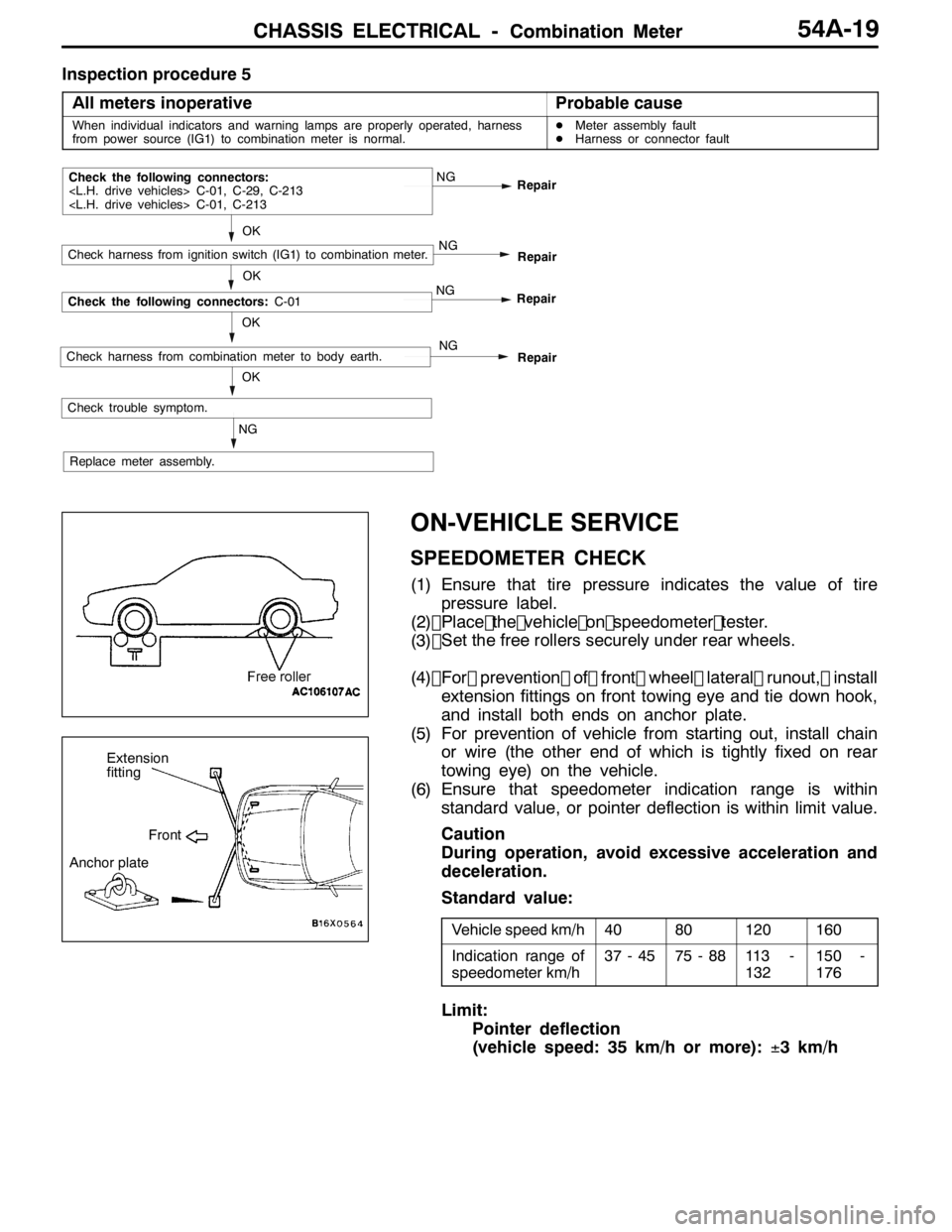
CHASSIS ELECTRICAL -Combination MeterCHASSIS ELECTRICAL -Combination Meter54A-19
Inspection procedure 5All meters inoperative
Probable cause
When individual indicators and warning lamps are properly operated, harness
from power source (IG1) to combination meter is normal.D Meter assembly fault
D Harness or connector fault
NG Repair
NG
OK
Check trouble symptom. Repair
OK
Check the following connectors:
NG
Check harness from ignition switch (IG1) to combination meter.
Replace meter assembly. Repair
NG
OK
Check the following connectors:
C-01
NG
RepairCheck harness from combination meter to body earth.
ON-VEHICLE SERVICE
SPEEDOMETER CHECK
(1) Ensure that tire pressure indicates the value of tirepressure label.
(2) Place the vehicle on speedometer teste r.
(3)
(4) For prevention of front wheel lateral runout, install
extension fittings on front towing eye and tie down hook,
and install both ends on anchor plate.
(5) For prevention of vehicle from starting out, install chain or wire (the other end of which is tightly fixed on rear
towing eye) on the vehicle.
(6) Ensure that speedometer indication range is within standard value, or pointer deflection is within limit value.
Caution
During operation, avoid excessive acceleration and
deceleration.
Standard value:
Vehicle speed km/h4080120160
Indication range of
speedometer km/h37 - 4575 - 8811 3 -
132150 -
176
Limit:
Pointer deflection
(vehicle speed: 35 km/h or more): ±3 km/h
Extension
fitting
Front
Anchor plate
OK
Set the free rollers securely under rear wheels.
Page 1341 of 1449

CHASSIS ELECTRICAL -Combination Meter54A-21
FLOAT HEIGHT OF FUEL GAUGE UNIT
When float is moved to contact float arm on stopper,
ensure that Position F (A) and E (B) are within standard
value.
Standard Value:
FloatPositionMainfuelgaugeunitSubfuelgaugeunitFloatPositionMainfuelgaugeunitSubfuelgaugeunit
Position F (A)33.3 mm10.7 mm
Position E (B)121.9 mm138.6 mm
ENGINE COOLANT TEMPERATURE GAUGE
UNIT CHECK
1. Drain coolant. (Refer to GROUP 14 - On-vehicle Service)
2. Remove water temperature gauge unit.
3. Put water temperature gauge unit into the hot water in
specified temperature, and ensure that basic resistance
is within standard value.
Standard value: 70_C 104±13.5Ω
Reference value:
TemperatureResistanceΩ
50_C230
60_C155
80_C73
4. After inspection, apply specified sealant at threads of
water temperature gauge unit, and tighten to the specified
torque.
Semi-drying sealant: 3M ATD Part No.1215 or
equivalent
5. Refill coolant. (Refer to GROUP 14 - On-vehicle Service.)
Main fuel gauge unit
Sub fuel gauge unit
A
B
A
B
ThermometerCircuit tester
11±1 N·m
Page 1344 of 1449

CHASSIS ELECTRICAL -Headlamp Assembly54A-24
HEADLAMP ASSEMBLY
SERVICE SPECIFICATIONS
ItemStandard valueLimit
Headlamp aimingLow beamVertical
direction120mm (0.69_) below hor-
izontal line (H)±0.29_
Horizontal
directionPosition at which the
startup point of 15_is
crossed with vertical line
(V)±0.5_
High beamVertical
directionThe center of high intensi-
ty zone is on the point of
intersection of line (H) and
line (V).- 0.5_of the point of
intersection of line (H)
Horizontal
directionThe center of high intensi-
ty zone is on the point of
intersection of line (V).±0.5_of the center of
line (V)
Measurement of headlamp illuminous intensity
(at high beam)–30,000 cd or more per
one headlamp
NOTES ON HEADLAMP ASSEMBLY:
Plastic outer lens are equipped with headlamp assembly. For handling, care should be taken for
the following items:
DHeadlamps should not be illuminated for more than 3 minutes with scratch preventive protectors,
etc. covered on them.
DMasking such as taping should not be attached on outer lens.
DOuter lens surface should not be rubbed with a sharp-edged tool, etc.
DSpecified wax remover should be used for insistently washing.
DAuthorized Mitsubishi Genuine bulbs should be used.
TROUBLESHOOTING
Headlamps are controlled smart wiring system (SWS). For troubleshooting, refer to GROUP 54B.
NOTE
When ETACS-ECU is defective, headlamps can be illuminated only in a low beam mode as fail-safe
function.
ON-VEHICLE SERVICE
HEADLAMP AIMING
PRE-AIMING INSTRUCTION
1. Inspect for badly rusted or faulty headlamp assemblies.
2. These conditions must be corrected before a satisfactory
adjustment can be made.
3. Inspect tyres inflation, and adjust if necessary.