ABS MITSUBISHI LANCER EVOLUTION 2007 Service Owner's Guide
[x] Cancel search | Manufacturer: MITSUBISHI, Model Year: 2007, Model line: LANCER EVOLUTION, Model: MITSUBISHI LANCER EVOLUTION 2007Pages: 1449, PDF Size: 56.82 MB
Page 376 of 1449

INDEX - In order of parts nameC-20
Wiring diagram
page Circuit diagram page Connector
No. Parts name
SSRS-ECUC-41B-249,251B-19,25
StarterB-18B-79B-11,15
StarterB-19B-79B-11,15
Steering wheel sensorC-230B-202,210,218,226,236,246B-23,29
Stop lamp switchC-103B-144,145,198,206,212,220,228,238B-20,26
TThrottle position sensorB-02B-89,97,215,223,231,241B-10,14
Trunk lid latch switchF-10B-119,123B-38,39
VVehicle speed sensorB-03B-92,100,150,154,197B-10,14
WWaste gate solenoid valveB-36B-91,99B-11,15
Wheel speed sensor (Front:LH)A-03B-203,211,217,225,233,243B-6,8
Wheel speed sensor (Front:RH)A-37B-203,211,217,225,233,243B-7,9
Wheel speed sensor (Rear:LH)
Wheel speed sensor (Rear:RH)
Windshield washer motorF-21B-186,190B-38,39
Windshield wiper motorB-01B-186,190B-10,14
Page 386 of 1449
GENERAL -How to Use Troubleshooting/Inspection Service Points00-8
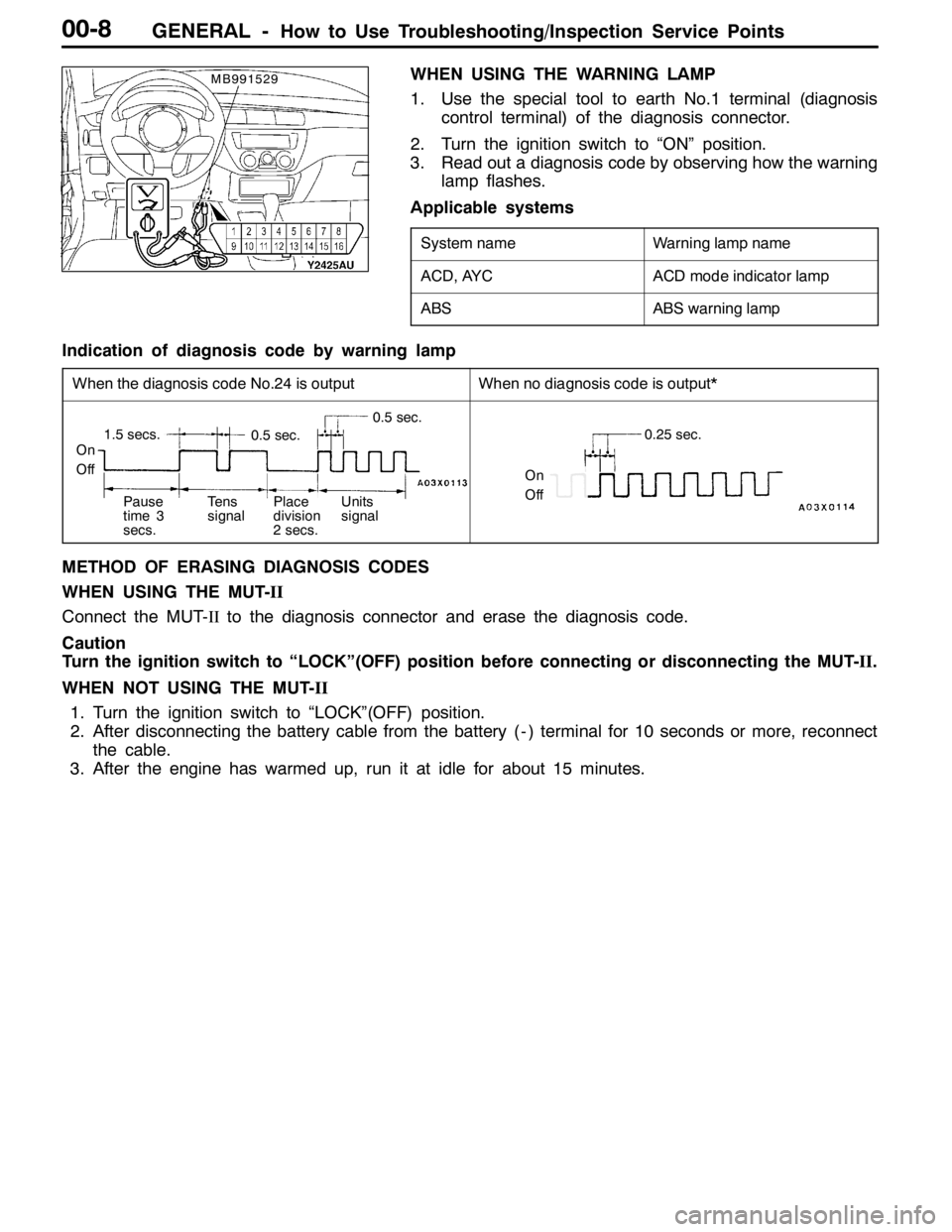
WHEN USING THE WARNING LAMP
1. Use the special tool to earth No.1 terminal (diagnosis
control terminal) of the diagnosis connector.
2. Turn the ignition switch to “ON” position.
3. Read out a diagnosis code by observing how the warning
lamp flashes.
Applicable systems
System nameWarning lamp name
ACD, AYCACD mode indicator lamp
ABSABS warning lamp
Indication of diagnosis code by warning lamp
When the diagnosis code No.24 is outputWhen no diagnosis code is output*
On
Off
1.5 secs.0.5 sec.
0.5 sec.
Pause
time 3
secs.Tens
signalPlace
division
2 secs.Units
signal
On
Off
0.25 sec.
METHOD OF ERASING DIAGNOSIS CODES
WHEN USING THE MUT-II
Connect the MUT-IIto the diagnosis connector and erase the diagnosis code.
Caution
Turn the ignition switch to “LOCK”(OFF) position before connecting or disconnecting the MUT-II.
WHEN NOT USING THE MUT-II
1. Turn the ignition switch to “LOCK”(OFF) position.
2. After disconnecting the battery cable from the battery ( - ) terminal for 10 seconds or more, reconnect
the cable.
3. After the engine has warmed up, run it at idle for about 15 minutes.
MB991529
Page 462 of 1449

ENGINE OVERHAUL -Specifications11B-8
SEALANTS
ItemSpecified sealantQuantity
Engine support bracket bolt3MTMAAD Part No. 8672 or equivalentAs required
Semi-circular packing3MTMAAD Part No. 8672 or equivalentAs required
Rocker cover3MTMAAD Part No. 8672 or equivalentAs required
Water outlet fittingMitsubishi Genuine Part No. MD970389 or
equivalentAs required
Engine coolant temperature gauge unit3MTMAAD Part No. 8672 or equivalentAs required
Engine coolant temperature sensor3MTMAAD Part No. 8672 or equivalentAs required
Cylinder head (camshaft bearing cap mounting
section)3MTMAAD Part No. 8672 or equivalentAs required
Cam position sensor supportMitsubishi Genuine Part No. MD970389 or
equivalentAs required
Oil pressure switch3MTMAAD Part No. 8672 or equivalentAs required
Oil panMitsubishi Genuine Part No. MD970389 or
equivalentAs required
Oil seal caseMitsubishi Genuine Part No. MD970389 or
equivalentAs required
FORM-IN-PLACE-GASKET
FIPG is used for several members of this engine. With this gasket, caution is required to the application
amount, application procedure and state of the application surface so that the performance is sufficiently
attained.
If sufficient gasket is not applied, leaks could occur, and if too much is applied, the gasket could protrude
and plug or restrict the oil and water flow passage. Thus, to prevent leaks from the joined sections,
it is absolutely necessary to evenly apply the correct amount.
The FIPG used for the engine parts reacts with moisture in the air and hardens so use it for the normal
metal flange parts.
DISASSEMBLY
The parts assembled with FIPG can be easily disassembled without special means. However, in some
cases, the sealant on the seams must be broken by lightly tapping with a wood hammer or similar tool.
A smooth and thin gasket scraper can be lightly tapped into the seams but in this case, take care not
to damage the seams.
The special tool oil pan remover (MD998727) is set for this purpose.
WASHING THE GASKET SURFACE
Completely remove all matters adhered on the gasket surfaces with a gasket scraper or wire brush.
Confirm that the FIPG application surface is smooth. There must be no grease or foreign matter on
the gasket surface.
Always remove the old FIPG that has entered the mounting holes and screw holes.
APPLICATION PROCEDURES
Apply an even coat of FIPG within the predetermined radius. Completely cover the areas around the
mounting holes. The FIPG can be wiped off if it has not hardened. Install at the set position while the
FIPG is still wet (within 15 minutes). When installing, maker sure that the FIPG does not get on areas
other than the required areas. After installing, do not subject the application areas to oil or water or
start the engine until the FIPG has sufficiently hardened (approx. one hour). The FIPG application procedures
differ according to the member, so follow the procedures given in this manual and apply the FIPG.
Page 654 of 1449

MPI -Troubleshooting13A-122
Wave Pattern Observation Points
Check that the standard wave pattern appears when the stepper motor is operating.
Point A: Presence or absence of induced electromotive force from the motor turning. (Refer to the abnormal
wave pattern.)
Contrast with standard wave patternProbable cause
Induced electromotive force does not appear or is extremely small.Motor is malfunctioning
Point B: Height of coil reverse electromotive force
Contrast with standard wave patternProbable cause
Coil reverse electromotive force does not appear or is extremely small.Short in the coil
Examples of Abnormal Wave Pattern
DExample 1
Cause of problem
Motor is malfunctioning. (Motor is not operating.)
Wave pattern characteristics
Induced electromotive force from the motor turning does
not appear.
DExample 2
Cause of problem
Open circuit in the line between the stepper motor and
the engine-ECU.
Wave pattern characteristics
Current is not supplied to the motor coil on the open
circuit side. (Voltage does not drop to 0 V.)
Furthermore, the induced electromotive force waveform
at the normal side is slightly different from the normal
waveform.
Open
circuit
side
Normal
side
Page 690 of 1449

ENGINE COOLING -GeneralInformation/
Service Specifications/Lubricant/Sealant14-2
GENERAL INFORMATION
The cooling system is designed to keep every part
of the engine at appropriate temperature in
whatever condition the engine may be operated.
The cooling method is of the water-cooled, pressure
forced circulation type in which the water pump
pressurizes coolant and circulates it throughout the
engine. If the coolant temperature exceeds the
prescribed temperature, the thermostat opens to
circulate the coolant through the radiator as well
so that the heat absorbed by the coolant may be
radiated into the air.The water pump is of the centrifugal type and is
driven by the drive belt from the crankshaft.
The radiator is the corrugated fin, down flow type.
The cooling fan is controlled by the radiator fan
controller and engine-ECU depend on driving
conditions.
ItemSpecification
Radiator performance kJ/h216,700
SERVICE SPECIFICATIONS
ItemsStandard valueLimit
Radiator cap opening pressure kPa93 - 12383
Range of coolant antifreeze concentration of radiator %30 - 60-
ThermostatValve opening temperature of thermostat_C80±1.5-
Full-opening temperature of thermostat_C93-
Valve lift (at 93_C) mm9.5 or more-
LUBRICANT
ItemSpecified coolantQuantity L
Engine coolantMITSUBISHI GENUINE COOLANT or equivalent6.0Enginecoolant
(including reserve tank)
MITSUBISHIGENUINECOOLANTorequivalent6.0
SEALANT
ItemSpecified sealantRemark
Cylinder block drain plug3M Nut Locking Part No. 4171 or equivalentDrying sealant
Page 700 of 1449

ENGINE COOLING -Thermostat14-12
INSTALLATION SERVICE POINTS
"AATHERMOSTAT INSTALLATION
Install the thermostat being careful not to fold over or scratch
the rubber ring.
Caution
Make absolutely sure that no oil is adhering to the rubber
ring of the thermostat. In addition, be careful not to fold
over or scratch the rubber ring when inserting. If the
rubber ring is damage, replace the thermostat.
"BARADIATOR UPPER HOSE CONNECTION
1. Insert each hose as far as the projection of the water
outlet fitting.
2. Align the mating marks on the radiator hose and hose
clamp, and then connect the radiator hose.
INSPECTION
THERMOSTAT CHECK
1. Immerse the thermostat in water, and heat the water while
stirring. Check the thermostat valve opening temperature.
Standard value:
Valve opening temperature: 80±1.5_C
2. Check that the amount of valve lift is at the standard value
when the water is at the full-opening temperature.
Standard value:
Full-opening temperature: 93_C
Amount of valve lift: 9.5 mm or more
NOTE
Measure the valve height when the thermostat is fully
closed, and use this measurement to calculate the valve
height when the thermostat is fully open.
Valve lift
Page 814 of 1449

MANUAL TRANSMISSION - Troubleshooting
INSPECTION CHART FOR DIAGNOSIS CODES
Diagnosis
code No.Diagnosis itemsReference page
12Power supply voltage (valve power supply) systemopen circuit or short-circuit22A-8
13Fail-safe relay system
21Wheel speed sensor
22Wheel speed sensor
23Wheel speed sensor
24Wheel speed sensor
25Wrong-diameter tire22A-11
26Wheel speed sensor (faulty output signal)22A-13
31Steering wheel sensor
32Steering wheel sensor
33fixed22A-16
34Steering wheel sensor
fixed22A-17
41TPS systemopen circuit or ground22A-18
42short-circuit22A-18
45Pressure sensor systemopen circuit or ground22A-19
46open earth22A-19
47abnormal power supply22A-20
51Longitudinal G sensor systemopen circuit or short-circuit22A-21
52defective sensor22A-22
56Lateral G sensor systemopen circuit or short-circuit22A-23
57defective sensor22A-24
61Stop lamp switch systemopen circuit22A-25
62ACD mode switch systemstuck22A-26
63Parking brake switch systemshort-circuit or not re-
turned to original position22A-27
65ABS monitor systemopen circuit or defective
ABS22A-28
71Proportional valve
GROUP27B
72Directional control valve
GROUP27B.
73Directional control valve
74Proportional valve
Page 817 of 1449
MANUAL TRANSMISSION - Troubleshooting
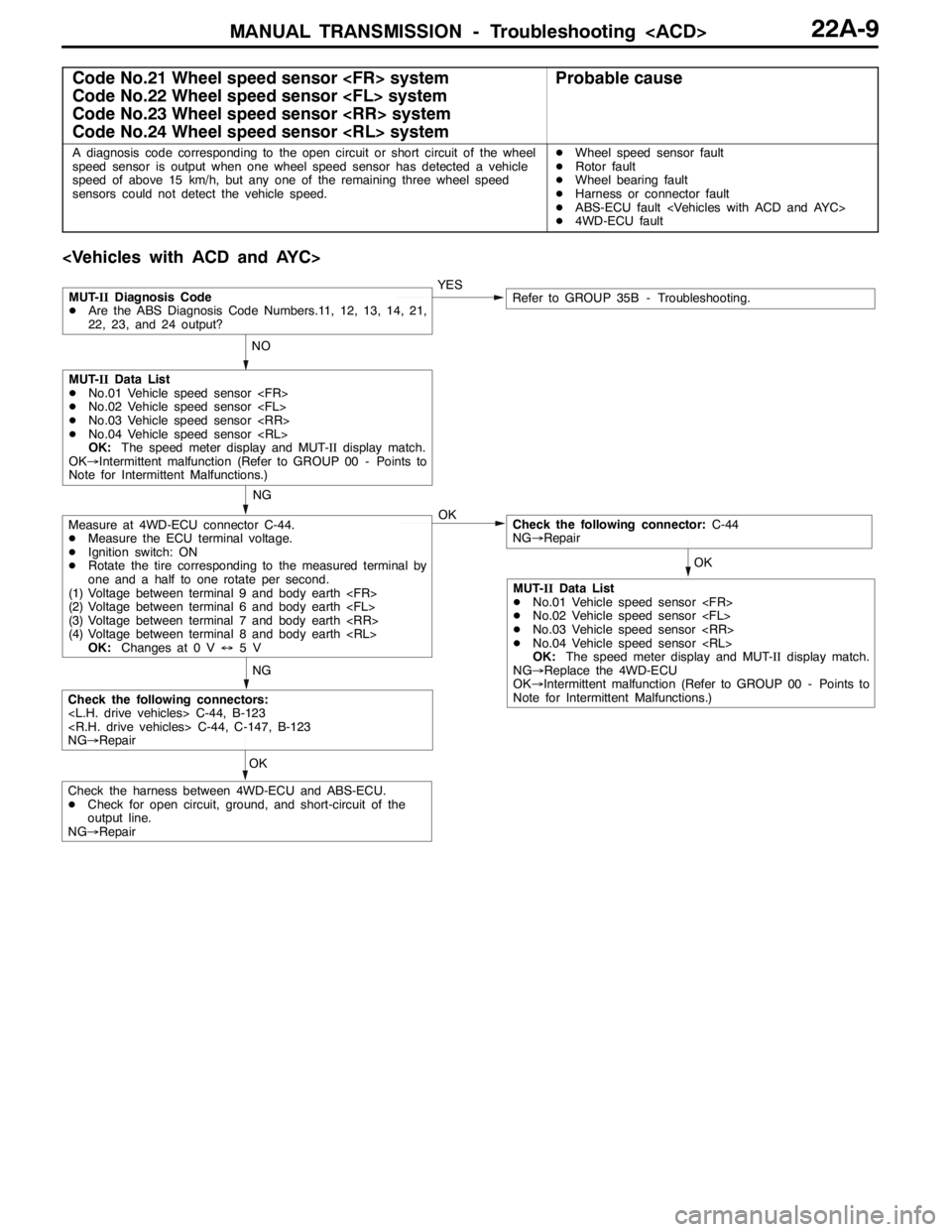
Code No.21 Wheel speed sensor
Code No.22 Wheel speed sensor
Code No.23 Wheel speed sensor
Code No.24 Wheel speed sensor
A diagnosis code corresponding to the open circuit or short circuit of the wheel
speed sensor is output when one wheel speed sensor has detected a vehicle
speed of above 15 km/h, but any one of the remaining three wheel speed
sensors could not detect the vehicle speed.DWheel speed sensor fault
DRotor fault
DWheel bearing fault
DHarness or connector fault
DABS-ECU fault
D4WD-ECU fault
OKNGYES
NO
OK
Measure at 4WD-ECU connector C-44.
DMeasure the ECU terminal voltage.
DIgnition switch: ON
DRotate the tire corresponding to the measured terminal by
one and a half to one rotate per second.
(1) Voltage between terminal 9 and body earth
(2) Voltage between terminal 6 and body earth
(3) Voltage between terminal 7 and body earth
(4) Voltage between terminal 8 and body earth
OK:Changes at 0 V↔5VCheck the following connector:C-44
NG→Repair
Check the following connectors:
NG→Repair
MUT-IIDiagnosis Code
DAre the ABS Diagnosis Code Numbers.11, 12, 13, 14, 21,
22, 23, and 24 output?Refer to GROUP 35B - Troubleshooting.
NG
MUT-IIData List
DNo.01 Vehicle speed sensor
DNo.02 Vehicle speed sensor
DNo.03 Vehicle speed sensor
DNo.04 Vehicle speed sensor
OK:The speed meter display and MUT-IIdisplay match.
OK→Intermittent malfunction (Refer to GROUP 00 - Points to
Note for Intermittent Malfunctions.)
OK
Check the harness between 4WD-ECU and ABS-ECU.
DCheck for open circuit, ground, and short-circuit of the
output line.
NG→Repair
MUT-IIData List
DNo.01 Vehicle speed sensor
DNo.02 Vehicle speed sensor
DNo.03 Vehicle speed sensor
DNo.04 Vehicle speed sensor
OK:The speed meter display and MUT-IIdisplay match.
NG→Replace the 4WD-ECU
OK→Intermittent malfunction (Refer to GROUP 00 - Points to
Note for Intermittent Malfunctions.)
Page 819 of 1449
MANUAL TRANSMISSION - Troubleshooting
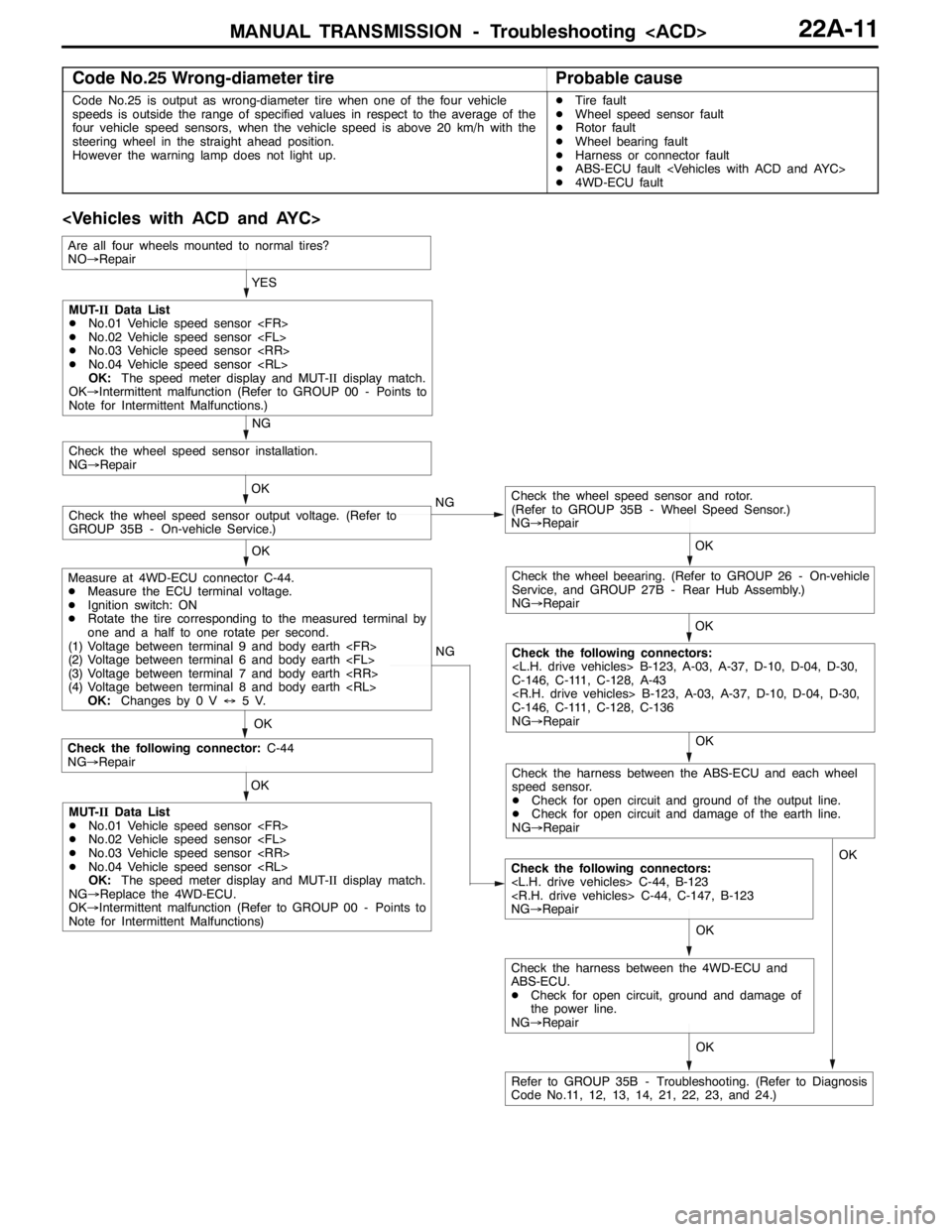
Code No.25 Wrong-diameter tireProbable cause
Code No.25 is output as wrong-diameter tire when one of the four vehicle
speeds is outside the range of specified values in respect to the average of the
four vehicle speed sensors, when the vehicle speed is above 20 km/h with the
steering wheel in the straight ahead position.
However the warning lamp does not light up.DTire fault
DWheel speed sensor fault
DRotor fault
DWheel bearing fault
DHarness or connector fault
DABS-ECU fault
D4WD-ECU fault
OK NG
OK
Check the following connector:C-44
NG→Repair
Check the following connectors:
NG→Repair OKYES
OK
OK
Check the wheel speed sensor and rotor.
(Refer to GROUP 35B - Wheel Speed Sensor.)
NG→Repair
Check the wheel speed sensor output voltage. (Refer to
GROUP 35B - On-vehicle Service.)OK
Check the wheel speed sensor installation.
NG→Repair
NG
OK
Check the wheel beearing. (Refer to GROUP 26 - On-vehicle
Service, and GROUP 27B - Rear Hub Assembly.)
NG→Repair
OK
Check the following connectors:
C-146, C-111, C-128, A-43
C-146, C-111, C-128, C-136
NG→Repair NG
MUT-IIData List
DNo.01 Vehicle speed sensor
DNo.02 Vehicle speed sensor
DNo.03 Vehicle speed sensor
DNo.04 Vehicle speed sensor
OK:The speed meter display and MUT-IIdisplay match.
OK→Intermittent malfunction (Refer to GROUP 00 - Points to
Note for Intermittent Malfunctions.)
Measure at 4WD-ECU connector C-44.
DMeasure the ECU terminal voltage.
DIgnition switch: ON
DRotate the tire corresponding to the measured terminal by
one and a half to one rotate per second.
(1) Voltage between terminal 9 and body earth
(2) Voltage between terminal 6 and body earth
(3) Voltage between terminal 7 and body earth
(4) Voltage between terminal 8 and body earth
OK:Changes by 0 V↔5V.
MUT-IIData List
DNo.01 Vehicle speed sensor
DNo.02 Vehicle speed sensor
DNo.03 Vehicle speed sensor
DNo.04 Vehicle speed sensor
OK:The speed meter display and MUT-IIdisplay match.
NG→Replace the 4WD-ECU.
OK→Intermittent malfunction (Refer to GROUP 00 - Points to
Note for Intermittent Malfunctions)
Refer to GROUP 35B - Troubleshooting. (Refer to Diagnosis
Code No.11, 12, 13, 14, 21, 22, 23, and 24.)
Are all four wheels mounted to normal tires?
NO→Repair
Check the harness between the ABS-ECU and each wheel
speed sensor.
DCheck for open circuit and ground of the output line.
DCheck for open circuit and damage of the earth line.
NG→Repair
OK
Check the harness between the 4WD-ECU and
ABS-ECU.
DCheck for open circuit, ground and damage of
the power line.
NG→RepairOK
Page 821 of 1449
MANUAL TRANSMISSION - Troubleshooting
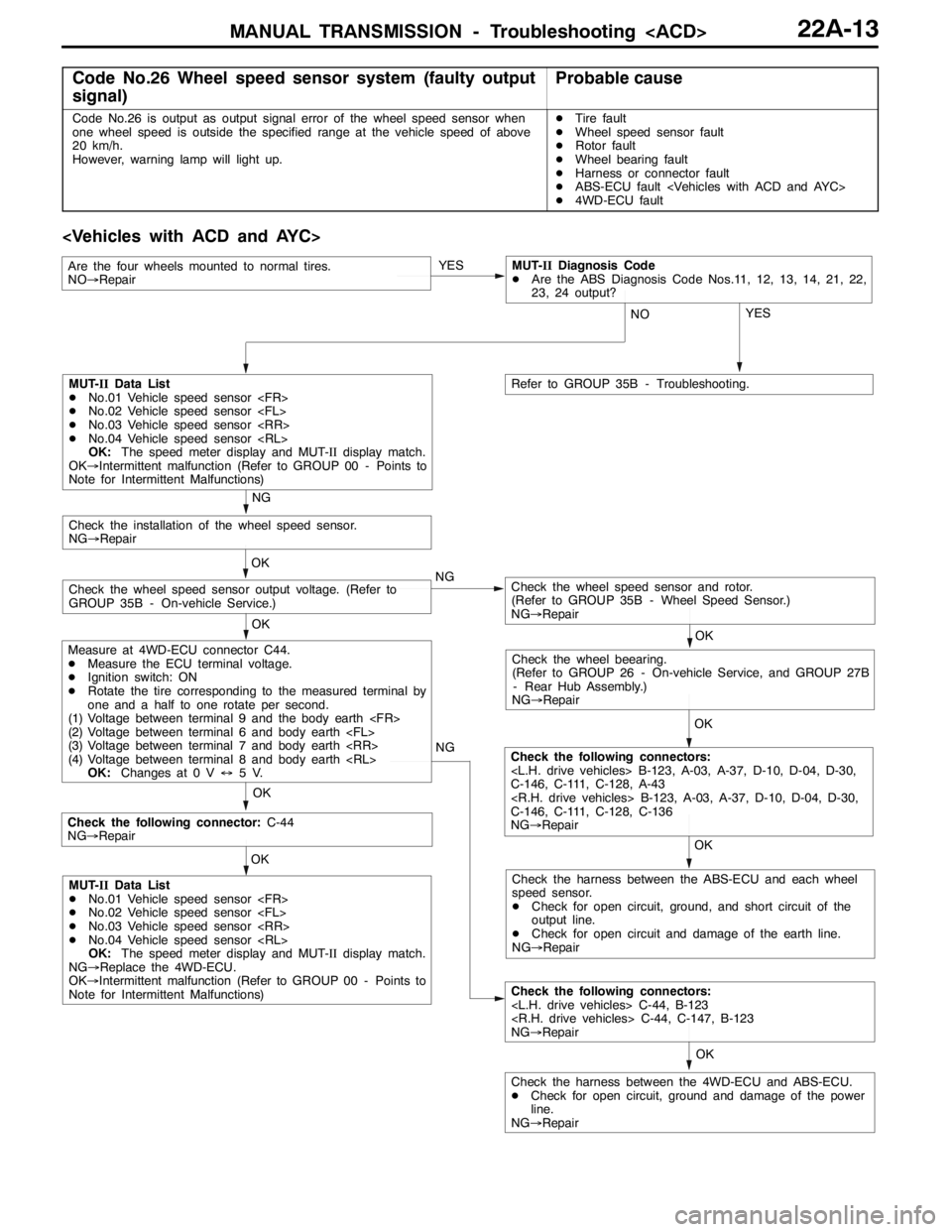
Code No.26 Wheel speed sensor system (faulty output
signal)Probable cause
Code No.26 is output as output signal error of the wheel speed sensor when
one wheel speed is outside the specified range at the vehicle speed of above
20 km/h.
However, warning lamp will light up.DTire fault
DWheel speed sensor fault
DRotor fault
DWheel bearing fault
DHarness or connector fault
DABS-ECU fault
D4WD-ECU fault
OK NG
OK
Check the following connector:C-44
NG→Repair
Check the following connectors:
NG→Repair OK
Check the harness between the 4WD-ECU and ABS-ECU.
DCheck for open circuit, ground and damage of the power
line.
NG→RepairYES
OK OK
Check the wheel speed sensor and rotor.
(Refer to GROUP 35B - Wheel Speed Sensor.)
NG→RepairCheck the wheel speed sensor output voltage. (Refer to
GROUP 35B - On-vehicle Service.)OK
Check the installation of the wheel speed sensor.
NG→Repair
NG
OK
Check the wheel beearing.
(Refer to GROUP 26 - On-vehicle Service, and GROUP 27B
- Rear Hub Assembly.)
NG→Repair
OK
Check the following connectors:
C-146, C-111, C-128, A-43
C-146, C-111, C-128, C-136
NG→Repair NG
MUT-IIData List
DNo.01 Vehicle speed sensor
DNo.02 Vehicle speed sensor
DNo.03 Vehicle speed sensor
DNo.04 Vehicle speed sensor
OK:The speed meter display and MUT-IIdisplay match.
OK→Intermittent malfunction (Refer to GROUP 00 - Points to
Note for Intermittent Malfunctions)
Measure at 4WD-ECU connector C44.
DMeasure the ECU terminal voltage.
DIgnition switch: ON
DRotate the tire corresponding to the measured terminal by
one and a half to one rotate per second.
(1) Voltage between terminal 9 and the body earth
(2) Voltage between terminal 6 and body earth
(3) Voltage between terminal 7 and body earth
(4) Voltage between terminal 8 and body earth
OK:Changes at 0 V↔5V.
MUT-IIData List
DNo.01 Vehicle speed sensor
DNo.02 Vehicle speed sensor
DNo.03 Vehicle speed sensor
DNo.04 Vehicle speed sensor
OK:The speed meter display and MUT-IIdisplay match.
NG→Replace the 4WD-ECU.
OK→Intermittent malfunction (Refer to GROUP 00 - Points to
Note for Intermittent Malfunctions)Check the harness between the ABS-ECU and each wheel
speed sensor.
DCheck for open circuit, ground, and short circuit of the
output line.
DCheck for open circuit and damage of the earth line.
NG→Repair YES
NO
Refer to GROUP 35B - Troubleshooting.
Are the four wheels mounted to normal tires.
NO→RepairMUT-IIDiagnosis Code
DAre the ABS Diagnosis Code Nos.11, 12, 13, 14, 21, 22,
23, 24 output?