ABS MITSUBISHI LANCER EVOLUTION 2007 Service Service Manual
[x] Cancel search | Manufacturer: MITSUBISHI, Model Year: 2007, Model line: LANCER EVOLUTION, Model: MITSUBISHI LANCER EVOLUTION 2007Pages: 1449, PDF Size: 56.82 MB
Page 823 of 1449
MANUAL TRANSMISSION - Troubleshooting
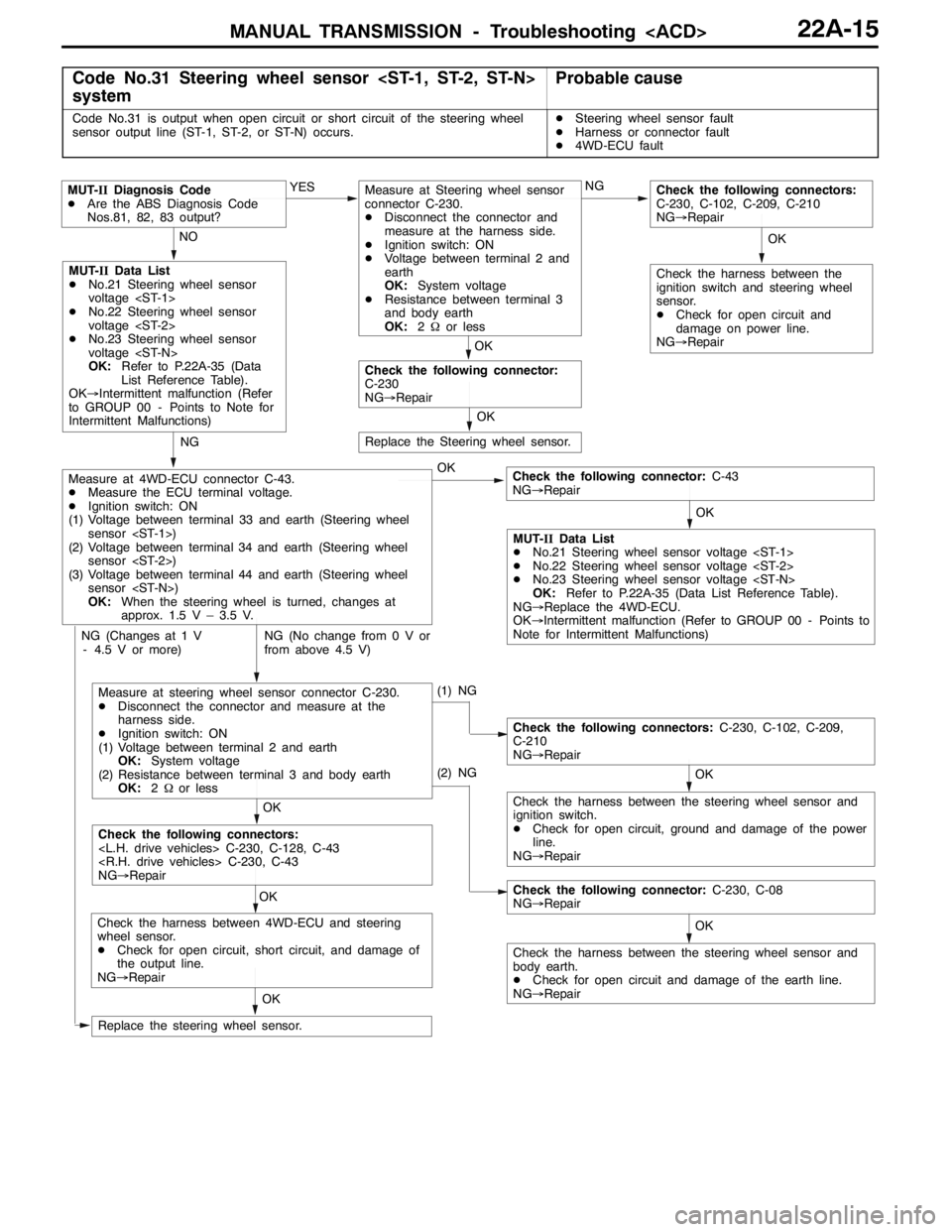
Code No.31 Steering wheel sensor
systemProbable cause
Code No.31 is output when open circuit or short circuit of the steering wheel
sensor output line (ST-1, ST-2, or ST-N) occurs.DSteering wheel sensor fault
DHarness or connector fault
D4WD-ECU fault
OK NG NO
OK
MUT-IIData List
DNo.21 Steering wheel sensor
voltage
DNo.22 Steering wheel sensor
voltage
DNo.23 Steering wheel sensor
voltage
OK:Refer to P.22A-35 (Data
List Reference Table).
OK→Intermittent malfunction (Refer
to GROUP 00 - Points to Note for
Intermittent Malfunctions)
Check the following connector:C-43
NG→Repair YES
MUT-IIDiagnosis Code
DAre the ABS Diagnosis Code
Nos.81, 82, 83 output?
MUT-IIData List
DNo.21 Steering wheel sensor voltage
DNo.22 Steering wheel sensor voltage
DNo.23 Steering wheel sensor voltage
OK:Refer to P.22A-35 (Data List Reference Table).
NG→Replace the 4WD-ECU.
OK→Intermittent malfunction (Refer to GROUP 00 - Points to
Note for Intermittent Malfunctions)
NG (No change from 0 V or
from above 4.5 V)
Measure at 4WD-ECU connector C-43.
DMeasure the ECU terminal voltage.
DIgnition switch: ON
(1) Voltage between terminal 33 and earth (Steering wheel
sensor
(2) Voltage between terminal34and earth (Steering wheel
sensor
(3) Voltage between terminal44 andearth (Steering wheel
sensor
OK:When the steering wheel is turned, changes at
approx. 1.5 V – 3.5 V.
(1) NG
NG (Changes at 1 V
- 4.5 V or more)
OK
Check the harness between the steering wheel sensor and
ignition switch.
DCheck for open circuit, ground and damage of the power
line.
NG→Repair
Check the following connectors:C-230, C-102, C-209,
C-210
NG→Repair
OKOK
Check the following connectors:
NG→Repair
OK
Check the harness between 4WD-ECU and steering
wheel sensor.
DCheck for open circuit, short circuit, and damage of
the output line.
NG→Repair
Replace the steering wheel sensor.
Replace the Steering wheel sensor.
OK
OK
Check the following connector:
C-230
NG→RepairNG
Measure at Steering wheel sensor
connector C-230.
DDisconnect the connector and
measure at the harness side.
DIgnition switch: ON
DVoltage between terminal 2 and
earth
OK:System voltage
DResistance between terminal 3
and body earth
OK:2Ωor less
OK
Check the following connectors:
C-230, C-102, C-209, C-210
NG→Repair
Check the harness between the
ignition switch and steering wheel
sensor.
DCheck for open circuit and
damage on power line.
NG→Repair
(2) NG
OK
Check the harness between the steering wheel sensor and
body earth.
DCheck for open circuit and damage of the earth line.
NG→Repair
Check the following connector:C-230, C-08
NG→Repair
Measure at steering wheel sensor connector C-230.
DDisconnect the connector and measure at the
harness side.
DIgnition switch: ON
(1) Voltage between terminal 2 and earth
OK:System voltage
(2) Resistance between terminal 3 and body earth
OK:2Ωor less
Page 829 of 1449
MANUAL TRANSMISSION - Troubleshooting
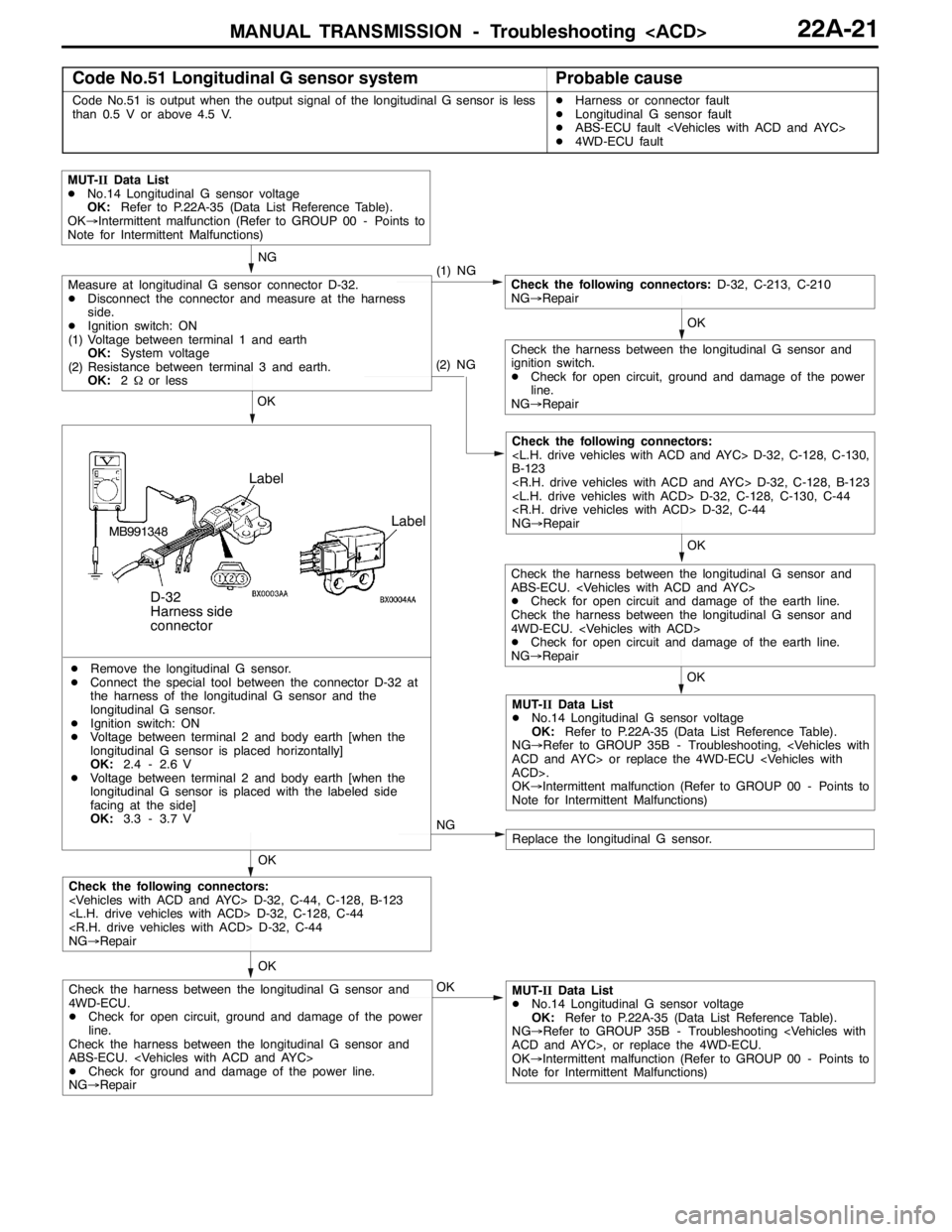
Code No.51 Longitudinal G sensor systemProbable cause
Code No.51 is output when the output signal of the longitudinal G sensor is less
than 0.5 V or above 4.5 V.DHarness or connector fault
DLongitudinal G sensor fault
DABS-ECU fault
D4WD-ECU fault
MB991348OK
OK
(1) NGNG
Check the following connectors:D-32, C-213, C-210
NG→Repair
MUT-IIData List
DNo.14 Longitudinal G sensor voltage
OK:Refer to P.22A-35 (Data List Reference Table).
OK→Intermittent malfunction (Refer to GROUP 00 - Points to
Note for Intermittent Malfunctions)
Check the harness between the longitudinal G sensor and
ignition switch.
DCheck for open circuit, ground and damage of the power
line.
NG→Repair
Measure at longitudinal G sensor connector D-32.
DDisconnect the connector and measure at the harness
side.
DIgnition switch: ON
(1) Voltage between terminal 1 and earth
OK:System voltage
(2) Resistance between terminal 3 and earth.
OK:2Ωor less
(2) NG
OK
Check the following connectors:
B-123
NG→Repair
OK
Check the harness between the longitudinal G sensor and
ABS-ECU.
DCheck for open circuit and damage of the earth line.
Check the harness between the longitudinal G sensor and
4WD-ECU.
DCheck for open circuit and damage of the earth line.
NG→Repair
MUT-IIData List
DNo.14 Longitudinal G sensor voltage
OK:Refer to P.22A-35 (Data List Reference Table).
NG→Refer to GROUP 35B - Troubleshooting,
OK→Intermittent malfunction (Refer to GROUP 00 - Points to
Note for Intermittent Malfunctions)
NG
DRemove the longitudinal G sensor.
DConnect the special tool between the connector D-32 at
the harness of the longitudinal G sensor and the
longitudinal G sensor.
DIgnition switch: ON
DVoltage between terminal 2 and body earth [when the
longitudinal G sensor is placed horizontally]
OK:2.4 - 2.6 V
DVoltage between terminal 2 and body earth [when the
longitudinal G sensor is placed with the labeled side
facing at the side]
OK:3.3 - 3.7 V
Label
D-32
Harness side
connector
Label
Replace the longitudinal G sensor.
OK
OK
Check the following connectors:
NG→Repair
OKMUT-IIData List
DNo.14 Longitudinal G sensor voltage
OK:Refer to P.22A-35 (Data List Reference Table).
NG→Refer to GROUP 35B - Troubleshooting
OK→Intermittent malfunction (Refer to GROUP 00 - Points to
Note for Intermittent Malfunctions)Check the harness between the longitudinal G sensor and
4WD-ECU.
DCheck for open circuit, ground and damage of the power
line.
Check the harness between the longitudinal G sensor and
ABS-ECU.
DCheck for ground and damage of the power line.
NG→Repair
Page 830 of 1449
MANUAL TRANSMISSION - Troubleshooting
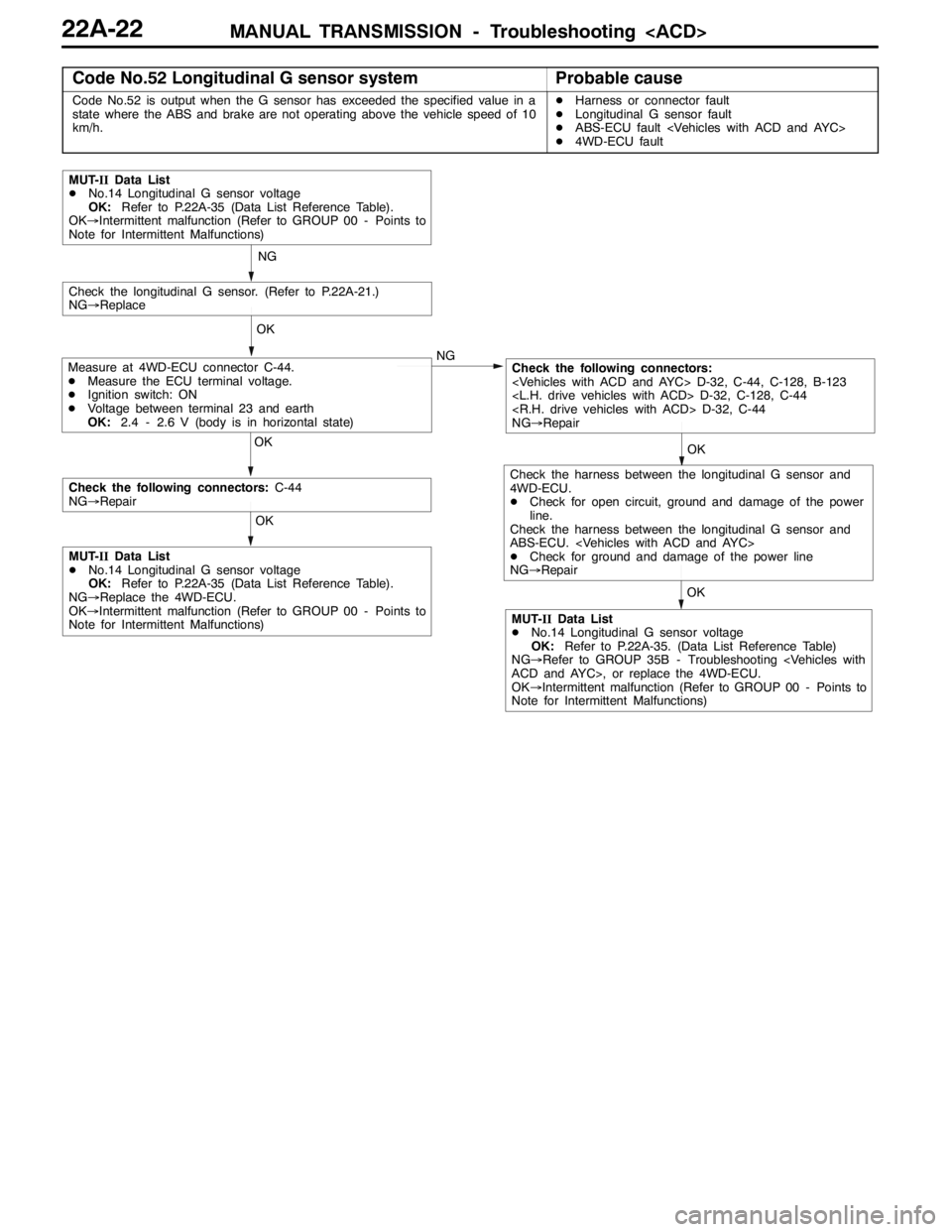
Code No.52 Longitudinal G sensor systemProbable cause
Code No.52 is output when the G sensor has exceeded the specified value in a
state where the ABS and brake are not operating above the vehicle speed of 10
km/h.DHarness or connector fault
DLongitudinal G sensor fault
DABS-ECU fault
D4WD-ECU fault
OK
NG
MUT-IIData List
DNo.14 Longitudinal G sensor voltage
OK:Refer to P.22A-35 (Data List Reference Table).
OK→Intermittent malfunction (Refer to GROUP 00 - Points to
Note for Intermittent Malfunctions)
OK
Check the following connectors:
NG→Repair NG
Check the longitudinal G sensor. (Refer to P.22A-21.)
NG→Replace
OK
MUT-IIData List
DNo.14 Longitudinal G sensor voltage
OK:Refer to P.22A-35. (Data List Reference Table)
NG→Refer to GROUP 35B - Troubleshooting
OK→Intermittent malfunction (Refer to GROUP 00 - Points to
Note for Intermittent Malfunctions)OK
Check the harness between the longitudinal G sensor and
4WD-ECU.
DCheck for open circuit, ground and damage of the power
line.
Check the harness between the longitudinal G sensor and
ABS-ECU.
DCheck for ground and damage of the power line
NG→Repair
Measure at 4WD-ECU connector C-44.
DMeasure the ECU terminal voltage.
DIgnition switch: ON
DVoltage between terminal 23 and earth
OK:2.4 - 2.6 V (body is in horizontal state)
OK
Check the following connectors:C-44
NG→Repair
MUT-IIData List
DNo.14 Longitudinal G sensor voltage
OK:Refer to P.22A-35 (Data List Reference Table).
NG→Replace the 4WD-ECU.
OK→Intermittent malfunction (Refer to GROUP 00 - Points to
Note for Intermittent Malfunctions)
Page 831 of 1449
MANUAL TRANSMISSION - Troubleshooting
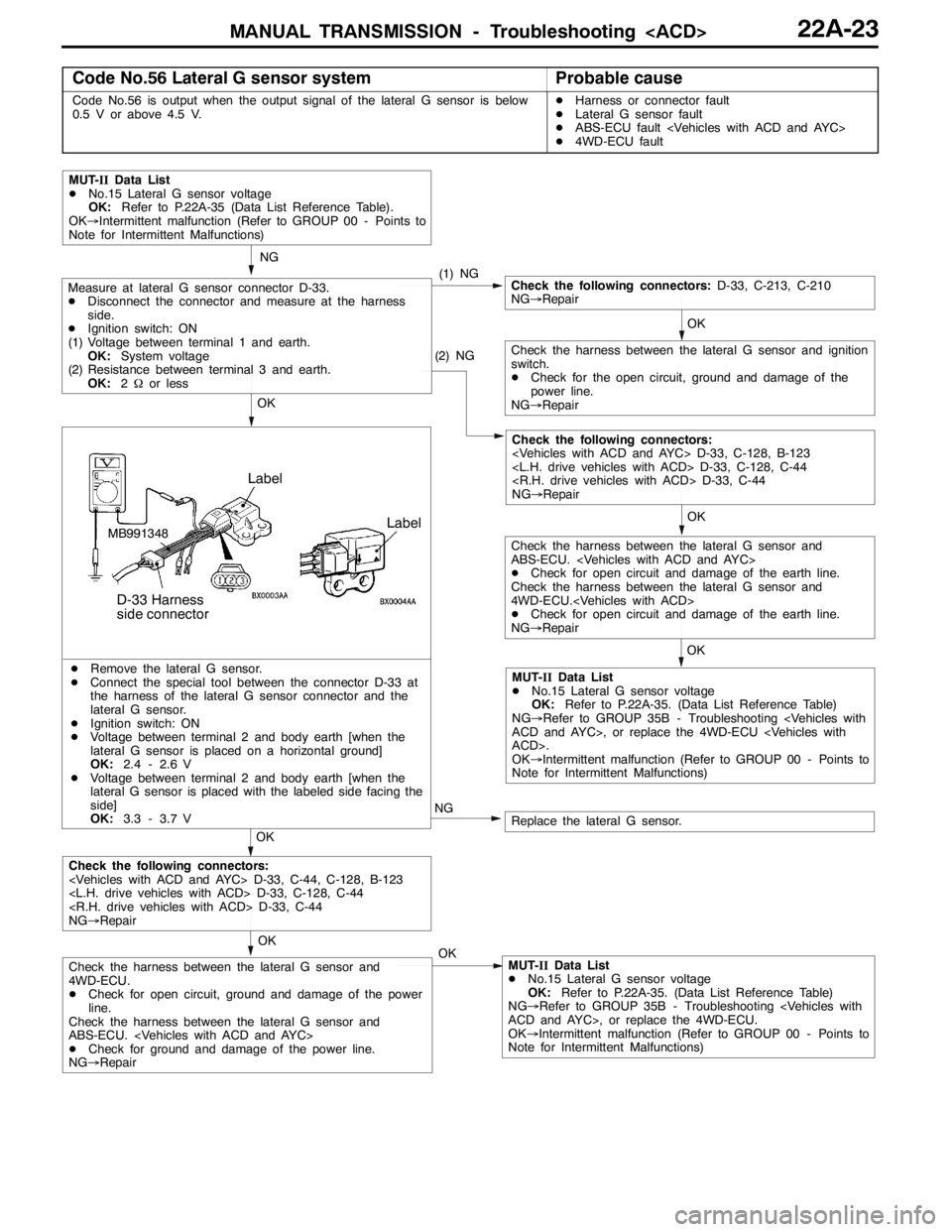
Code No.56 Lateral G sensor systemProbable cause
Code No.56 is output when the output signal of the lateral G sensor is below
0.5 V or above 4.5 V.DHarness or connector fault
DLateral G sensor fault
DABS-ECU fault
D4WD-ECU fault
OK
OK
(1) NG
NG
Check the following connectors:D-33, C-213, C-210
NG→Repair
MUT-IIData List
DNo.15 Lateral G sensor voltage
OK:Refer to P.22A-35 (Data List Reference Table).
OK→Intermittent malfunction (Refer to GROUP 00 - Points to
Note for Intermittent Malfunctions)
Check the harness between the lateral G sensor and ignition
switch.
DCheck for the open circuit, ground and damage of the
power line.
NG→Repair
Measure at lateral G sensor connector D-33.
DDisconnect the connector and measure at the harness
side.
DIgnition switch: ON
(1) Voltage between terminal 1 and earth.
OK:System voltage
(2) Resistance between terminal 3 and earth.
OK:2Ωor less
(2) NG
OK
Check the following connectors:
NG→Repair
OK
Check the harness between the lateral G sensor and
ABS-ECU.
DCheck for open circuit and damage of the earth line.
Check the harness between the lateral G sensor and
4WD-ECU.
DCheck for open circuit and damage of the earth line.
NG→Repair
MUT-IIData List
DNo.15 Lateral G sensor voltage
OK:Refer to P.22A-35. (Data List Reference Table)
NG→Refer to GROUP 35B - Troubleshooting
OK→Intermittent malfunction (Refer to GROUP 00 - Points to
Note for Intermittent Malfunctions)
NGDRemove the lateral G sensor.
DConnect the special tool between the connector D-33 at
the harness of the lateral G sensor connector and the
lateral G sensor.
DIgnition switch: ON
DVoltage between terminal 2 and body earth [when the
lateral G sensor is placed on a horizontal ground]
OK:2.4 - 2.6 V
DVoltage between terminal 2 and body earth [when the
lateral G sensor is placed with the labeled side facing the
side]
OK:3.3 - 3.7 V
Label
D-33 Harness
side connector
LabelMB991348
Replace the lateral G sensor.
OK
OK
Check the following connectors:
NG→Repair
OKMUT-IIData List
DNo.15 Lateral G sensor voltage
OK:Refer to P.22A-35. (Data List Reference Table)
NG→Refer to GROUP 35B - Troubleshooting
OK→Intermittent malfunction (Refer to GROUP 00 - Points to
Note for Intermittent Malfunctions)Check the harness between the lateral G sensor and
4WD-ECU.
DCheck for open circuit, ground and damage of the power
line.
Check the harness between the lateral G sensor and
ABS-ECU.
DCheck for ground and damage of the power line.
NG→Repair
Page 832 of 1449
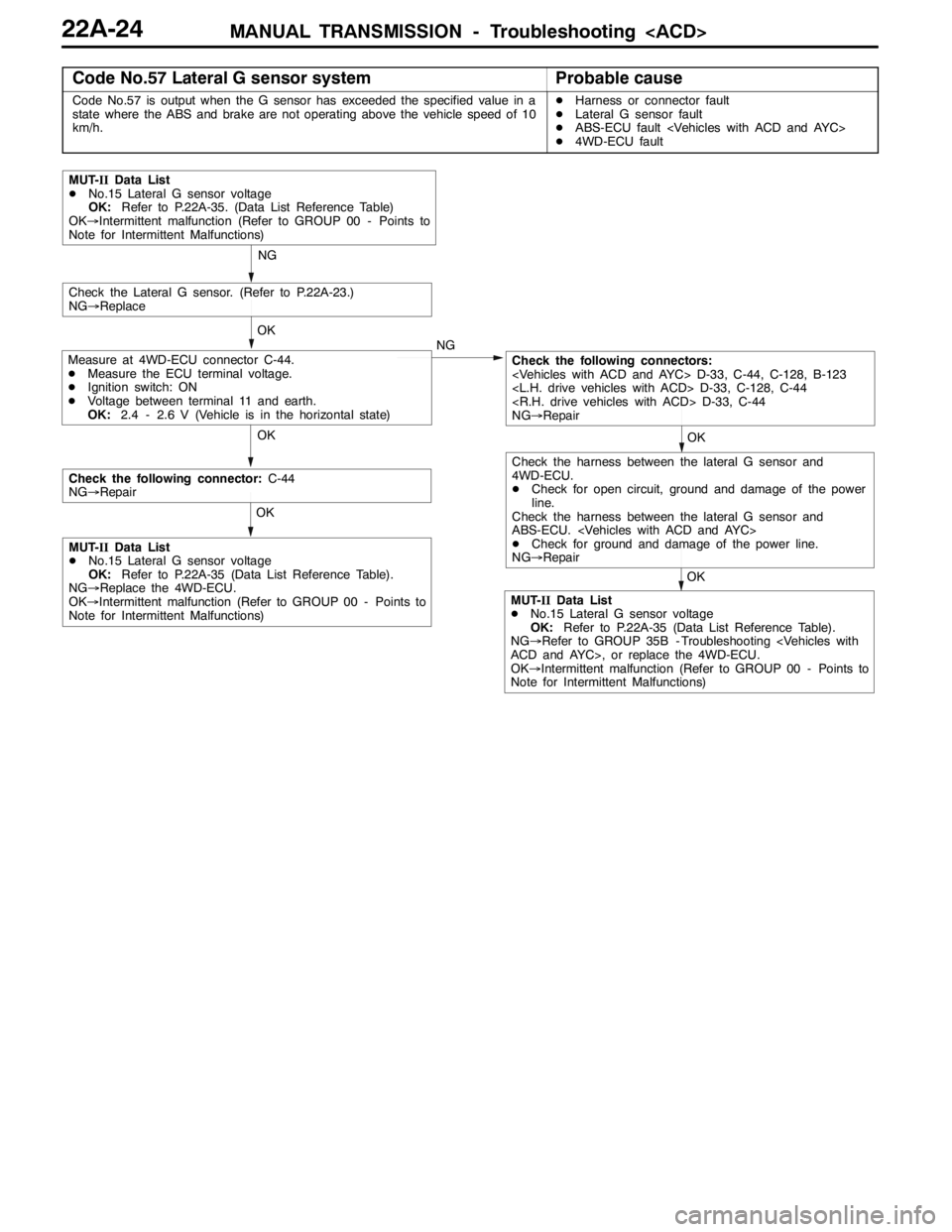
MANUAL TRANSMISSION - Troubleshooting
Code No.57 Lateral G sensor systemProbable cause
Code No.57 is output when the G sensor has exceeded the specified value in a
state where the ABS and brake are not operating above the vehicle speed of 10
km/h.DHarness or connector fault
DLateral G sensor fault
DABS-ECU fault
D4WD-ECU fault
OK
NG
MUT-IIData List
DNo.15 Lateral G sensor voltage
OK:Refer to P.22A-35. (Data List Reference Table)
OK→Intermittent malfunction (Refer to GROUP 00 - Points to
Note for Intermittent Malfunctions)
OK
Check the following connectors:
NG→Repair NG
Check the Lateral G sensor. (Refer to P.22A-23.)
NG→Replace
OK
MUT-IIData List
DNo.15 Lateral G sensor voltage
OK:Refer to P.22A-35 (Data List Reference Table).
NG→Refer to GROUP 35B - Troubleshooting
OK→Intermittent malfunction (Refer to GROUP 00 - Points to
Note for Intermittent Malfunctions)OK
Check the harness between the lateral G sensor and
4WD-ECU.
DCheck for open circuit, ground and damage of the power
line.
Check the harness between the lateral G sensor and
ABS-ECU.
DCheck for ground and damage of the power line.
NG→Repair
Measure at 4WD-ECU connector C-44.
DMeasure the ECU terminal voltage.
DIgnition switch: ON
DVoltage between terminal 11 and earth.
OK:2.4 - 2.6 V (Vehicle is in the horizontal state)
OK
Check the following connector:C-44
NG→Repair
MUT-IIData List
DNo.15 Lateral G sensor voltage
OK:Refer to P.22A-35 (Data List Reference Table).
NG→Replace the 4WD-ECU.
OK→Intermittent malfunction (Refer to GROUP 00 - Points to
Note for Intermittent Malfunctions)
Page 835 of 1449
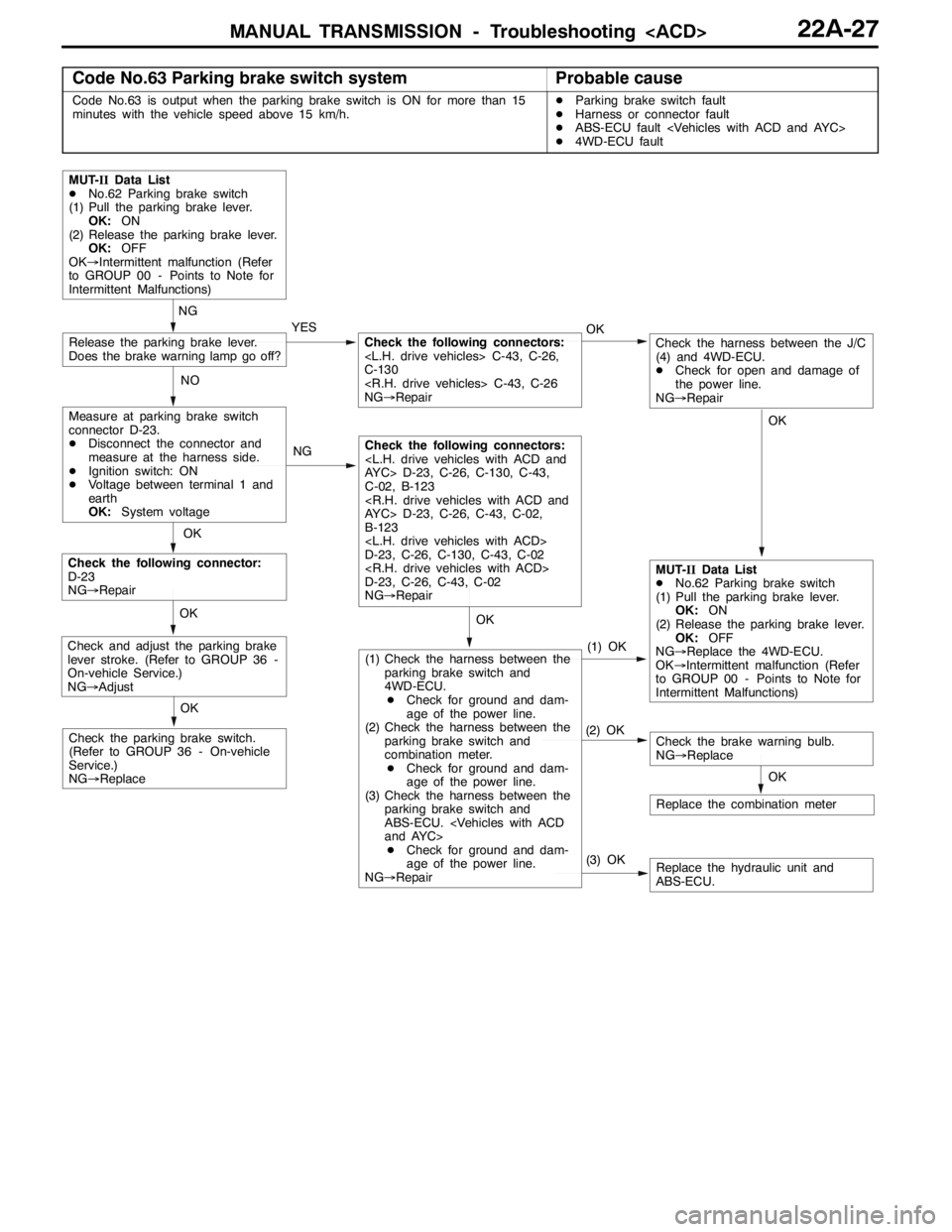
MANUAL TRANSMISSION - Troubleshooting
Code No.63 Parking brake switch systemProbable cause
Code No.63 is output when the parking brake switch is ON for more than 15
minutes with the vehicle speed above 15 km/h.DParking brake switch fault
DHarness or connector fault
DABS-ECU fault
D4WD-ECU fault
OK
NG
YES
NG
(3) OK(1) OKReplace the hydraulic unit and
ABS-ECU.
MUT-IIData List
DNo.62 Parking brake switch
(1) Pull the parking brake lever.
OK:ON
(2) Release the parking brake lever.
OK:OFF
OK→Intermittent malfunction (Refer
to GROUP 00 - Points to Note for
Intermittent Malfunctions)
Measure at parking brake switch
connector D-23.
DDisconnect the connector and
measure at the harness side.
DIgnition switch: ON
DVoltage between terminal 1 and
earth
OK:System voltage
Release the parking brake lever.
Does the brake warning lamp go off?
OK
Check the following connector:
D-23
NG→Repair
OK
Replace the combination meter
OK
Check the brake warning bulb.
NG→ReplaceCheck the parking brake switch.
(Refer to GROUP 36 - On-vehicle
Service.)
NG→Replace
OK
Check and adjust the parking brake
lever stroke. (Refer to GROUP 36 -
On-vehicle Service.)
NG→Adjust
MUT-IIData List
DNo.62 Parking brake switch
(1) Pull the parking brake lever.
OK:ON
(2) Release the parking brake lever.
OK:OFF
NG→Replace the 4WD-ECU.
OK→Intermittent malfunction (Refer
to GROUP 00 - Points to Note for
Intermittent Malfunctions) NOOK
Check the following connectors:
C-130
NG→Repair
Check the following connectors:
C-02, B-123
B-123
D-23, C-26, C-130, C-43, C-02
D-23, C-26, C-43, C-02
NG→Repair
(2) OK
(1) Check the harness between the
parking brake switch and
4WD-ECU.
DCheck for ground and dam-
age of the power line.
(2) Check the harness between the
parking brake switch and
combination meter.
DCheck for ground and dam-
age of the power line.
(3) Check the harness between the
parking brake switch and
ABS-ECU.
DCheck for ground and dam-
age of the power line.
NG→Repair
OK
Check the harness between the J/C
(4) and 4WD-ECU.
DCheck for open and damage of
the power line.
NG→Repair
Page 836 of 1449
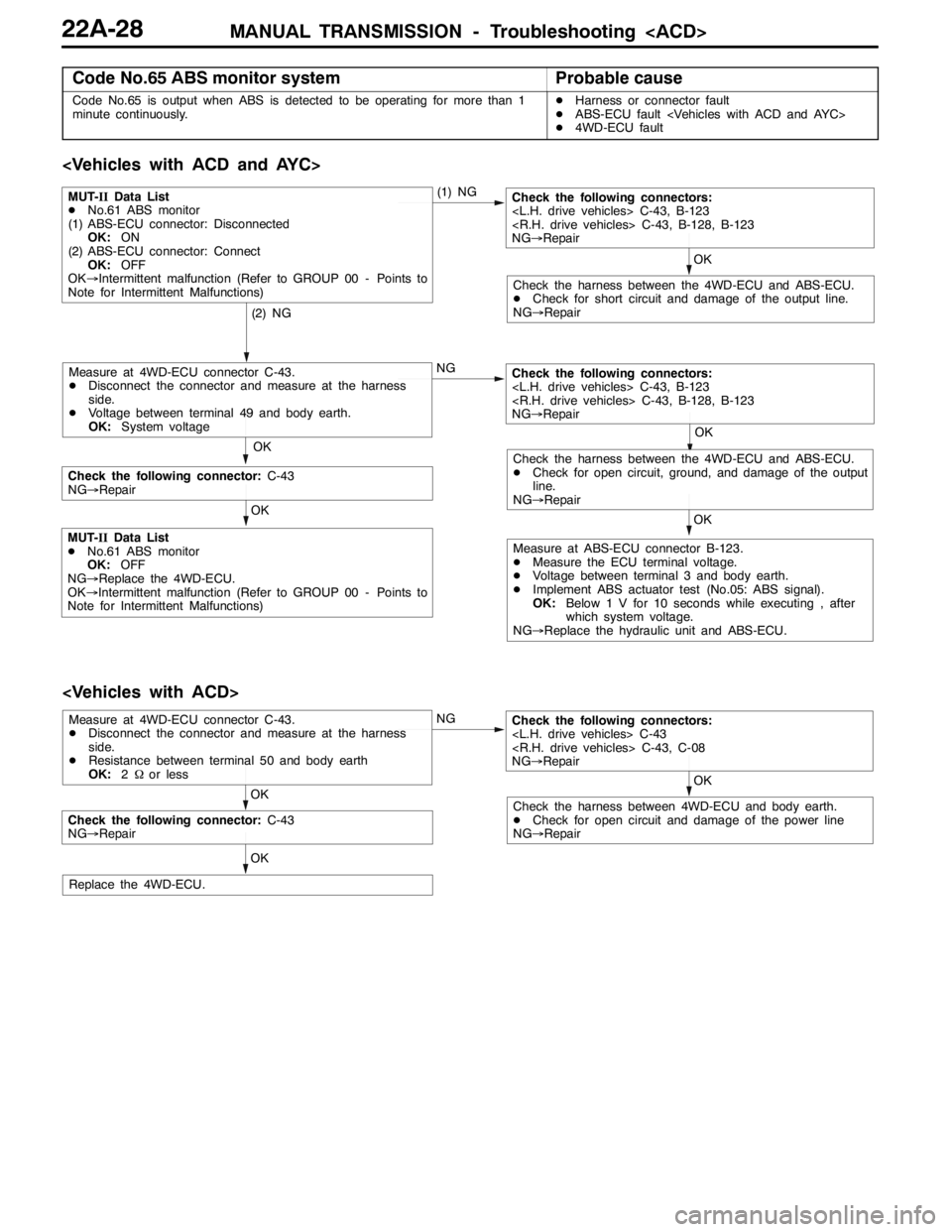
MANUAL TRANSMISSION - Troubleshooting
Code No.65 ABS monitor systemProbable cause
Code No.65 is output when ABS is detected to be operating for more than 1
minute continuously.DHarness or connector fault
DABS-ECU fault
D4WD-ECU fault
OK
(2) NG(1) NG
MUT-IIData List
DNo.61 ABS monitor
(1) ABS-ECU connector: Disconnected
OK:ON
(2) ABS-ECU connector: Connect
OK:OFF
OK→Intermittent malfunction (Refer to GROUP 00 - Points to
Note for Intermittent Malfunctions)
Check the following connectors:
NG→Repair
MUT-IIData List
DNo.61 ABS monitor
OK:OFF
NG→Replace the 4WD-ECU.
OK→Intermittent malfunction (Refer to GROUP 00 - Points to
Note for Intermittent Malfunctions)
OK
Check the following connectors:
NG→Repair
Check the harness between the 4WD-ECU and ABS-ECU.
DCheck for short circuit and damage of the output line.
NG→Repair
NG
OK
Measure at 4WD-ECU connector C-43.
DDisconnect the connector and measure at the harness
side.
DVoltage between terminal 49 and body earth.
OK:System voltage
OK
Check the harness between the 4WD-ECU and ABS-ECU.
DCheck for open circuit, ground, and damage of the output
line.
NG→Repair
Measure at ABS-ECU connector B-123.
DMeasure the ECU terminal voltage.
DVoltage between terminal 3 and body earth.
DImplement ABS actuator test (No.05: ABS signal).
OK:Below 1 V for 10 seconds while executing , after
which system voltage.
NG→Replace the hydraulic unit and ABS-ECU.
OK
Check the following connector:C-43
NG→Repair
OK
Check the following connectors:
NG→Repair
Check the harness between 4WD-ECU and body earth.
DCheck for open circuit and damage of the power line
NG→Repair
NG
OK
Measure at 4WD-ECU connector C-43.
DDisconnect the connector and measure at the harness
side.
DResistance between terminal 50 and body earth
OK:2Ωor less
OK
Replace the 4WD-ECU.
Check the following connector:C-43
NG→Repair
Page 844 of 1449

MANUAL TRANSMISSION - Troubleshooting
Item
no.Normal conditions Check condition Check item
19Pressure sensor power
supplyIgnition switch: ONApprox.5 V
20Valve power supplyIgnition switch: ONSystem voltage
21Steering wheel sensor
voltage
are displayed alter-
nately.
22Steering wheel sensor
voltage
are displayed alter-
nately.
23Steering wheel sensor
ltSTN
Ignition switch: ONSteering wheel: Neutral1-2Vg
voltage
g
Steering wheel: Turn2.5 - 4.5 V
51Idle switchIgnition switch: ONAccelerator pedal: Full
closedON
Accelerator pedal: PressOFF
52Steering wheel sensor
STN
Ignition switch: ONsteering wheel: NeutralONg
g
Steering wheel: Turn from
the neutral positionOFF
53Steering wheel sensor
played alternaltely.
54Steering wheel sensor
played alternately
55Steering wheel sensor
learning
tral position learning exe-
cutedON
Steering wheel sensor neu-
tral position learning unex-
ecutedOFF
56Stop lamp switchIgnition switch: ONBrake pedal: DepressONppg
Engine: StoppedBrake pedal: ReleaseOFF
57Motor monitorElectric pump motor is currently operatingON
Electric pump motor is currently not operatingOFF
58Oil pressure stateElectric pump motor is currently operatingLOWp
Electric pump motor is currently not operatingHIGH
59Directional valve
Ri ht
AYC clutch right side is currently operatingON
60Directional valve
Lft
AYC clutch left side is currently operatingON
61ABS monitorABS is currently operatingON
ABS is currently not operatingOFF
62Parking brake switchIgnition switch: ONParking brake lever: PullONgg
Engine:StoppedParking brake lever: Re-
leaseOFF
63ACD mode switchIgnition switch: ONACD mode switch: PressONg
Engine:StoppedACD mode switch: ReleaseOFF
Page 847 of 1449

MANUAL TRANSMISSION - Troubleshooting
Termi-
nal no.Normal state Check condition Check item
24*2Longitudinal G sensor
earth, lateral G sensor
earthAny time1 V or less
26ECU earthAny time1 V or less
31ECU backup power
supplyAny timeSystem voltage
32Pressure sensorIgnition switch: ON0.5 - 1.5 V
33Steering wheel sensor
4.5 V flushing
34Steering wheel sensor
4.5 V flushing
35Diagnosis data input/
output--
36Idle switchIgnition switch: ONAccelerator pedal: Full closed1 V or lessg
Accelerator pedal: Depress4.5 - 5.0 V
37Parking brake switchIgnition switch: ONParking brake lever: Pull1 V or lessgg
Parking brake lever: ReleaseSystem voltage
38Stop lamp switchIgnition switch: ONBrake pedal: DepressSystem voltageppg
Brake pedal: Release1 V or less
39TPSIgnition switch: ONAccelerator pedal: Full closed0.5 - 0.7 Vg
Accelerator pedal: Full throttle4.5 - 5.5 V
40ACD mode indicator
lamp
TARMAC0V
p
ACD mode indicator lamp position:
Except for aboveApprox. 10.5 V
42ECU earthAny time1 V or less
43Pressure sensor earthAny time1 V or less
44Steering wheel sensor
STN
Ignition switch: ONSteering wheel: Neutral1-2Vg
g
Steering wheel: Turn from the
neutral position2.5 - 4.5 V
46Diagnosis control--
47ACD mode switchIgnition switch: ONSwitch: PressSystem voltageg
Switch: Release0V
49*1ABS monitorWith ABS not activeSystem voltage
With ABS active1.5 V or less
50*2EarthAny time1 V or less
51ACD mode indicator
lamp
SNOW0V
p
ACD mode indicator lamp position:
Except for aboveApprox. 10.5 V
52ACD mode indicator
lamp
GRAVEL0V
p
ACD mode indicator lamp position:
Except for aboveApprox. 10.5 V
Page 853 of 1449
MANUAL TRANSMISSION - On-vehicle Service22A-45
Output voltage:
Above 70 mV when measured with the circuit
tester
Above 200 mVP-P when measured with the
oscilloscope
4. If the output voltage is lower than the above values, the
following reasons may be suspected. Check or replace
the wheel speed sensor.
DExcessive clearance between the ball piece of the
wheel speed sensor and ABS rotor
DWheel speed sensor faul
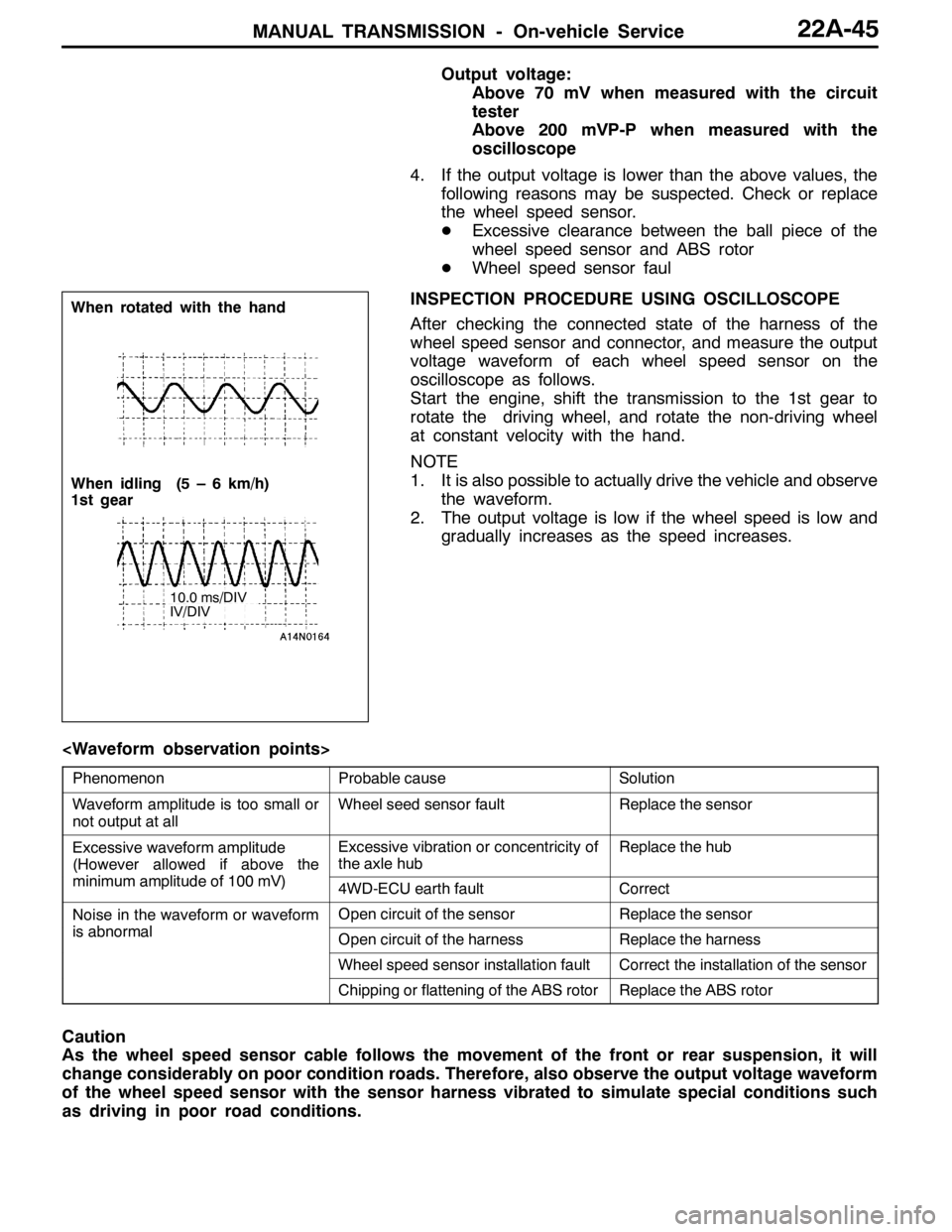
INSPECTION PROCEDURE USING OSCILLOSCOPE
After checking the connected state of the harness of the
wheel speed sensor and connector, and measure the output
voltage waveform of each wheel speed sensor on the
oscilloscope as follows.
Start the engine, shift the transmission to the 1st gear to
rotate the driving wheel, and rotate the non-driving wheel
at constant velocity with the hand.
NOTE
1. It is also possible to actually drive the vehicle and observe
the waveform.
2. The output voltage is low if the wheel speed is low and
gradually increases as the speed increases.
PhenomenonProbable causeSolution
Waveform amplitude is too small or
not output at allWheel seed sensor faultReplace the sensor
Excessive waveform amplitude
(However allowed if above the
iilit df100V)
Excessive vibration or concentricity of
the axle hubReplace the hub
(
minimum amplitude of 100 mV)4WD-ECU earth faultCorrect
Noise in the waveform or waveform
ibl
Open circuit of the sensorReplace the sensor
is abnormalOpen circuit of the harnessReplace the harness
Wheel speed sensor installation faultCorrect the installation of the sensor
Chipping or flattening of the ABS rotorReplace the ABS rotor
Caution
As the wheel speed sensor cable follows the movement of the front or rear suspension, it will
change considerably on poor condition roads. Therefore, also observe the output voltage waveform
of the wheel speed sensor with the sensor harness vibrated to simulate special conditions such
as driving in poor road conditions.
When rotated with the hand
When idling (5 – 6 km/h)
1st gear
10.0 ms/DIV
IV/DIV