lock MITSUBISHI MIRAGE 2017 6.G Service Manual
[x] Cancel search | Manufacturer: MITSUBISHI, Model Year: 2017, Model line: MIRAGE, Model: MITSUBISHI MIRAGE 2017 6.GPages: 305, PDF Size: 8.67 MB
Page 91 of 305
Manual window control (if so equipped) 5-28 Features and controls
5
N00510700021
N00510800370
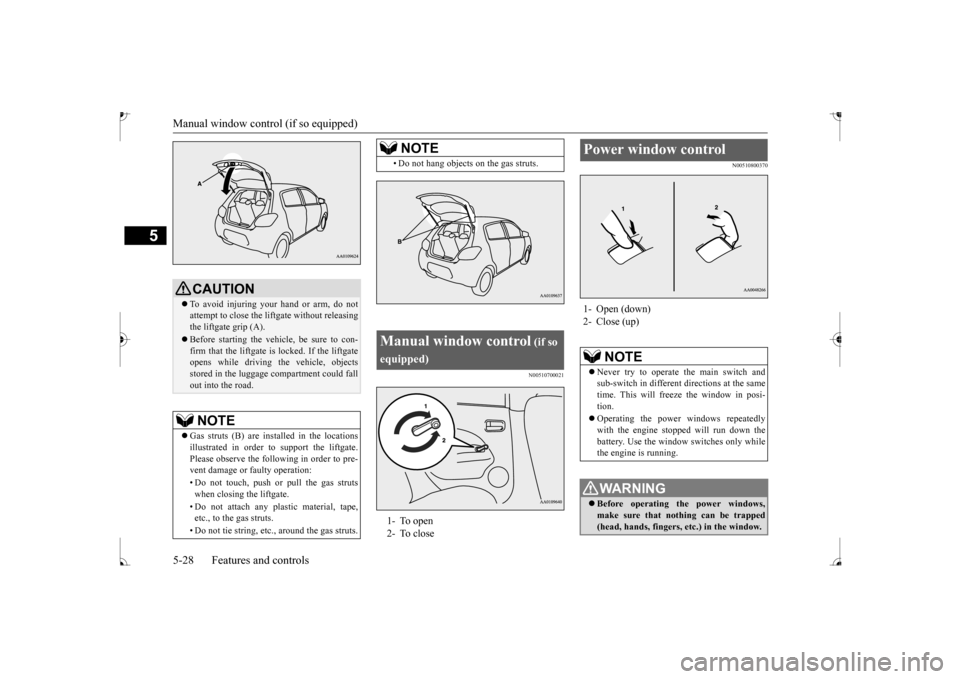
CAUTION To avoid injuring your hand or arm, do not attempt to close the lif
tgate without releasing
the liftgate grip (A). Before starting the vehi
cle, be sure to con-
firm that the liftgate is locked. If the liftgate opens while driving
the vehicle, objects
stored in the luggage compartment could fallout into the road.NOTE
Gas struts (B) are installed in the locations illustrated in order to
support the liftgate.
Please observe the following in order to pre- vent damage or
faulty operation:
• Do not touch, push or pull the gas struts when closing the liftgate. • Do not attach any pl
astic material, tape,
etc., to the gas struts. • Do not tie string, etc., around the gas struts.
• Do not hang objects on the gas struts.
Manual window control
(if so
equipped)1- To open 2- To close
NOTE
Power window control 1- Open (down)2- Close (up)
NOTE
Never try to operate the main switch and sub-switch in different
directions at the same
time. This will free
ze the window in posi-
tion. Operating the power windows repeatedly with the engine stopped will run down thebattery. Use the window
switches only while
the engine is running.WA R N I N G Before operating the power windows, make sure that nothing can be trapped (head, hands, fingers, etc.) in the window.
BK0235100US.book 28 ページ 2015年11月20日 金曜日 午後3時12分
Page 92 of 305
Power window control
Features and controls 5-29
5
N00548700130
The main switch located on the driver’s door can be used to opera
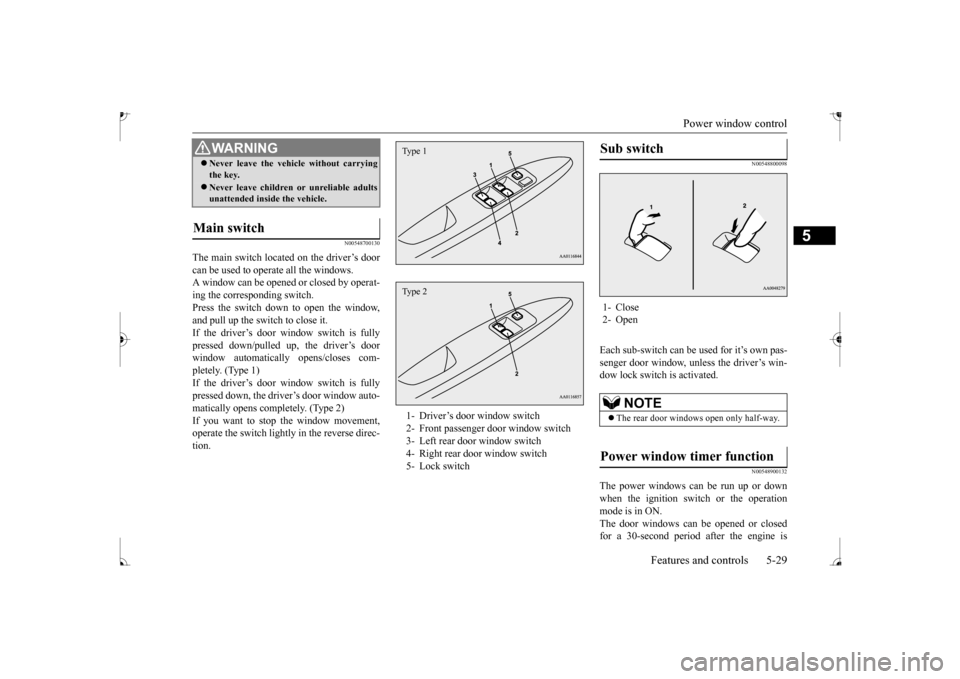
te all the windows.
A window can be opened
or closed by operat-
ing the corresponding switch. Press the switch down to open the window, and pull up the switch to close it.If the driver’s door window switch is fully pressed down/pulled up, the driver’s door window automatically opens/closes com-pletely. (Type 1) If the driver’s door window switch is fully pressed down, the driver’s door window auto-matically opens completely. (Type 2) If you want to stop the window movement, operate the switch lightly in the reverse direc-tion.
N00548800098
Each sub-switch can be used for it’s own pas-senger door window, unless the driver’s win-dow lock switch is activated.
N00548900132
The power windows can be run up or downwhen the ignition switch or the operationmode is in ON. The door windows can be opened or closed for a 30-second period after the engine is
Never leave the vehicle without carrying the key. Never leave children
or unreliable adults
unattended inside the vehicle.
Main switch
WA R N I N G
1- Driver’s door window switch 2- Front passenger door window switch3- Left rear door window switch 4- Right rear door window switch 5- Lock switchType 1Type 2
Sub switch 1- Close2- Open
NOTE
The rear door windows open only half-way.
Power window timer function
BK0235100US.book 29 ページ 2015年11月20日 金曜日 午後3時12分
Page 93 of 305
Power window control 5-30 Features and controls
5
stopped. However, once the driver’s door or the front passenger’s door is opened, thepower windows cannot be operated.
N00549000169
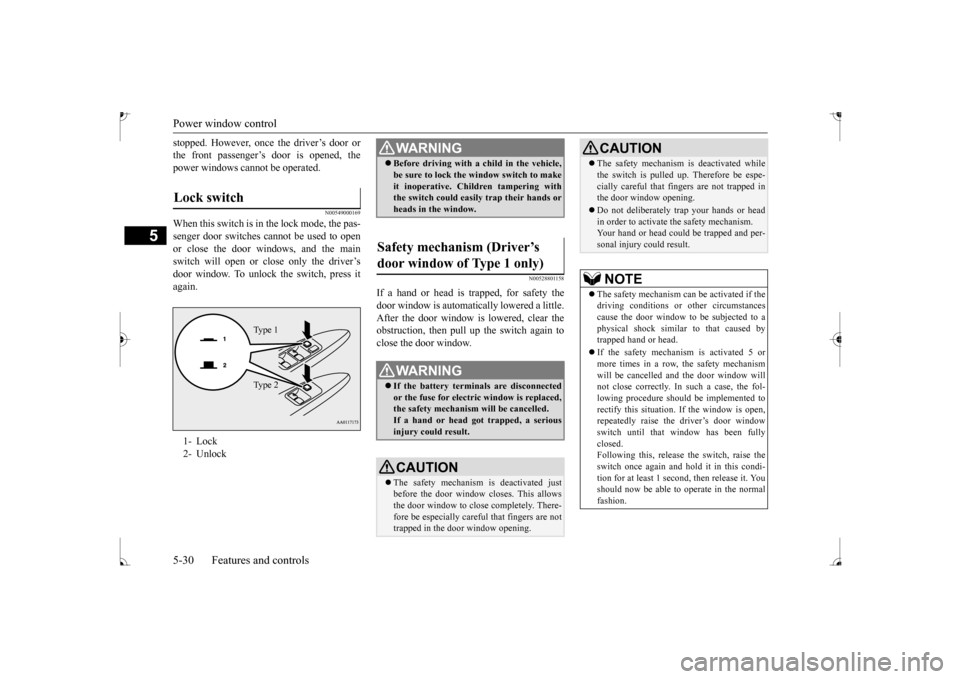
When this switch is in the lock mode, the pas-senger door switches cannot be used to open or close the door windows, and the main switch will open or
close only the driver’s
door window. To unlock the switch, press it again.
N00528801158
If a hand or head is trapped, for safety thedoor window is automati
cally lowered a little.
After the door window is
lowered, clear the
obstruction, then pull
up the switch again to
close the door window.
Lock switch 1- Lock2- Unlock
Ty p e 1 Ty p e 2
WA R N I N G Before driving with a child in the vehicle, be sure to lock the window switch to makeit inoperative. Children tampering withthe switch could easily trap their hands or heads in the window.
Safety mechanism (Driver’s door window of Type 1 only)
WA R N I N G If the battery terminals are disconnected or the fuse for electric window is replaced, the safety mechanism will be cancelled. If a hand or head got
trapped, a serious
injury could result.CAUTION The safety mechanism is deactivated just before the door window closes. This allows the door window to close completely. There- fore be especially care
ful that fingers are not
trapped in the door window opening.
The safety mechanism is deactivated while the switch is pulled up
. Therefore be espe-
cially careful that fi
ngers are not trapped in
the door window opening. Do not deliberately trap your hands or head in order to activate the safety mechanism. Your hand or head could be trapped and per- sonal injury could result.NOTE
The safety mechanism can be activated if the driving conditions or other circumstancescause the door window to be subjected to a physical shock
similar to that caused by
trapped hand or head. If the safety mechanism is activated 5 or more times in a row, the safety mechanismwill be cancelled a
nd the door window will
not close correctly. In such a case, the fol- lowing procedure should be implemented torectify this situation.
If the window is open,
repeatedly raise the driver’s door window switch until that wi
ndow has been fully
closed.Following this, release the switch, raise the switch once again and hold it in this condi- tion for at least 1 second, then release it. Youshould now be able to operate in the normal fashion.CAUTION
BK0235100US.book 30 ページ 2015年11月20日 金曜日 午後3時12分
Page 95 of 305
Steering wheel height adjustment 5-32 Features and controls
5
When parking on a hill, set the parking brake, and turn the front wheels toward the curb on a downhill, or away from
the curb on an uphill.
N00511500231
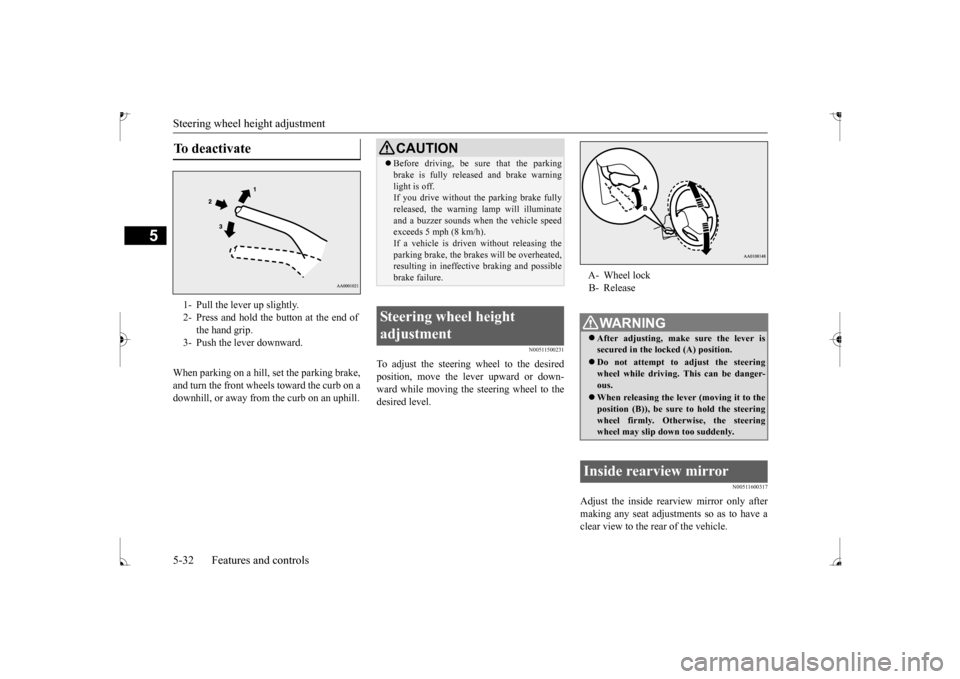
To adjust the steering wheel to the desired position, move the lever upward or down-ward while moving the steering wheel to the desired level.
N00511600317
Adjust the inside rearview mirror only after making any seat adjustme
nts so as to have a
clear view to the rear of the vehicle.
To deactivate 1- Pull the lever up slightly. 2- Press and hold the button at the end of
the hand grip.
3- Push the lever downward.
CAUTION Before driving, be sure that the parking brake is fully released and brake warninglight is off.If you drive without the parking brake fully released, the warning lamp will illuminate and a buzzer sounds when the vehicle speedexceeds 5 mph (8 km/h). If a vehicle is driven without releasing the parking brake, the brak
es will be overheated,
resulting in ineffective braking and possible brake failure.
Steering wheel height adjustment
A- Wheel lock B- ReleaseWA R N I N G After adjusting, make sure the lever is secured in the locked (A) position. Do not attempt to adjust the steering wheel while driving. This can be danger-ous. When releasing the leve
r (moving it to the
position (B)), be sure to hold the steering wheel firmly. Otherwise, the steering wheel may slip down too suddenly.
Inside rearview mirror
BK0235100US.book 32 ページ 2015年11月20日 金曜日 午後3時12分
Page 99 of 305
![MITSUBISHI MIRAGE 2017 6.G Service Manual Starting the engine 5-36 Features and controls
5
N00512601816
[For vehicles equipped with the Free-hand Advanced Security Transmitter (F.A.S.T.- key)]For information on operation for vehicles equipped](/img/19/7514/w960_7514-98.png "MITSUBISHI MIRAGE 2017 6.G Service Manual Starting the engine 5-36 Features and controls
5
N00512601816
[For vehicles equipped with the Free-hand Advanced Security Transmitter (F.A.S.T.- key)]For information on operation for vehicles equipped")
Starting the engine 5-36 Features and controls
5
N00512601816
[For vehicles equipped with the Free-hand Advanced Security Transmitter (F.A.S.T.- key)]For information on operation for vehicles equipped with the Free-hand Advanced Secu- rity Transmitter (F.A.S.T.-key), refer to“Free-hand Advanced Se
curity Transmitter
(F.A.S.T.-key): Starting and stopping the engine” on page 5-16. [Except for vehicles equipped with the Free-hand Advanced Security Transmit- ter (F.A.S.T.-key)] Do not operate the starter motor continu- ously for longer than 15 seconds as this could run the battery down or damage thestarter motor. If the engine does not start, turn the ignition switch back to the “OFF”
conds, and then try
again. Trying repeatedly with the engine or starter motor still turning will damage the starter mechanism. If the engine will not start because the bat- tery is weak or discharged, refer to “Jump-starting the engine” (on page 8-2)for instructions.
A longer warm up period will only con- sume extra fuel. The engine is warmed upenough for driving when the low coolant temperature indi
cator goes out.
Refer to “Low coolant temperature indi-cator” on page 5-71.
This model is equipped with an electronically controlled fuel injection system. This is a sys- tem that automatically controls fuel injection.
There is usually no need to depress the accel- erator pedal when starting the engine.The starter should not be run for more than 15 seconds at a time. To prevent battery drain, wait a few secondsbetween attempts to restart the engine. 1. Make sure all occupants are properly seated with seat belts fastened. 2. Insert the ignition key.3. Make sure the parking brake is applied. 4. Press and hold the brake pedal down with your right foot. 5. Press and hold the clutch pedal all the way down (manual transaxle). 6. On vehicles equippe
d with manual trans-
axle, place the gearshift lever in the “N” On vehicles equippe
d with continuously
variable transmission (CVT), make surethe selector lever is in the “P” (PARK) position.
Starting the engine Tips for starting
WA R N I N G Never run the engine in
a closed or poorly
ventilated area any longer than is neededto move your vehicle out of the area. Car- bon monoxide gas, which is odorless and extremely poisonous, could build up andcause serious injury or death.CAUTION Do not push-start the vehicle.Do not run the engine at high rpms or drive at high speeds until the engine has had a chance to warm up. Release the ignition sw
itch as soon as the
engine starts. Otherwise, the starter motorwill be damaged.
Starting the engine
NOTE
On vehicles equipped
with manual transaxle,
the starter will not ope
rate unless the clutch
pedal is fully depresse
d (Clutch interlock).
BK0235100US.book 36 ページ 2015年11月20日 金曜日 午後3時12分
Page 102 of 305
Continuously variable transmission (CVT) (if so equipped)
Features and controls 5-39
5
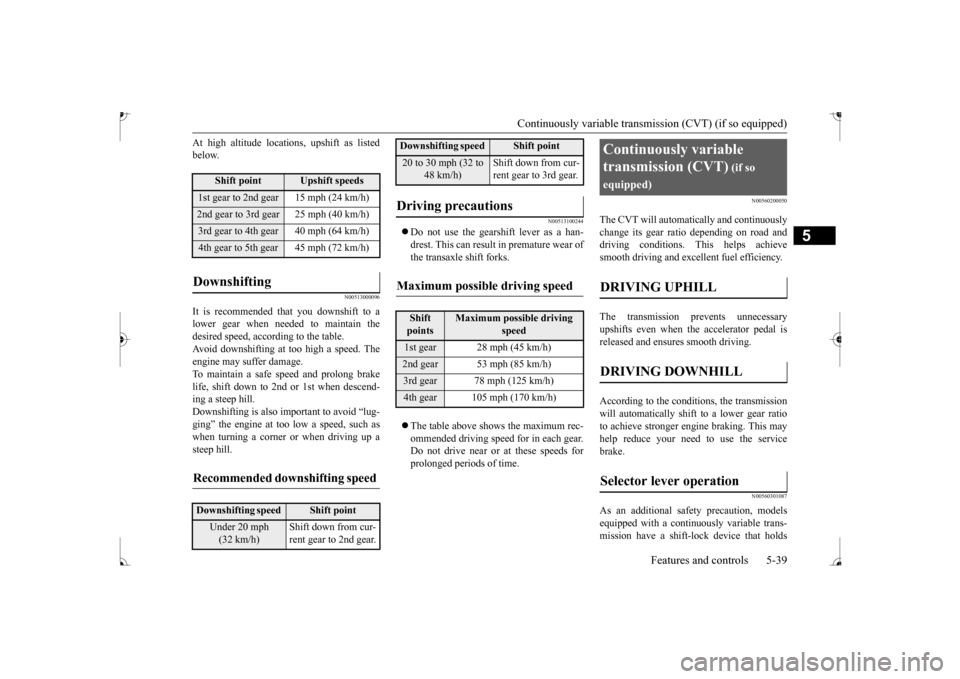
At high altitude locati
ons, upshift as listed
below.
N00513000096
It is recommended th
at you downshift to a
lower gear when needed to maintain the desired speed, according to the table. Avoid downshifting at
too high a speed. The
engine may suffer damage. To maintain a safe speed and prolong brake life, shift down to 2nd or 1st when descend-ing a steep hill. Downshifting is also important to avoid “lug- ging” the engine at too low a speed, such aswhen turning a corner or when driving up a steep hill.
N00513100244
Do not use the gearshift lever as a han- drest. This can result
in premature wear of
the transaxle shift forks. The table above shows the maximum rec- ommended driving speed for in each gear. Do not drive near or at these speeds forprolonged periods of time.
N00560200050
The CVT will automatically and continuouslychange its gear ratio depending on road anddriving conditions. This helps achieve smooth driving and excellent fuel efficiency. The transmission prevents unnecessary upshifts even when the accelerator pedal isreleased and ensures smooth driving. According to the conditions, the transmission will automatically shift to a lower gear ratio to achieve stronger engine braking. This may help reduce your need
to use the service
brake.
N00560301087
As an additional safe
ty precaution, models
equipped with a continuously variable trans- mission have a shift-lock device that holds
Shift point
Upshift speeds
1st gear to 2nd gear 15 mph (24 km/h)2nd gear to 3rd gear 25 mph (40 km/h)3rd gear to 4th gear 40 mph (64 km/h)4th gear to 5th gear 45 mph (72 km/h)Downshifting
Recommended downshifting speed
Downshifting speed
Shift point
Under 20 mph (32 km/h)
Shift down from cur- rent gear to 2nd gear.
20 to 30 mph (32 to
48 km/h)
Shift down from cur- rent gear to 3rd gear.
Driving precautions
Maximum possible driving speed
Shift points
Maximum possible driving
speed
1st gear 28 mph (45 km/h)2nd gear 53 mph (85 km/h)3rd gear 78 mph (125 km/h)4th gear 105 mph (170 km/h)Downshifting speed
Shift point
Continuously variable transmission (CVT)
(if so
equipped)DRIVING UPHILL
DRIVING DOWNHILL
Selector lever operation
BK0235100US.book 39 ページ 2015年11月20日 金曜日 午後3時12分
Page 103 of 305
Continuously variable transmission (CVT) (if so equipped) 5-40 Features and controls
5
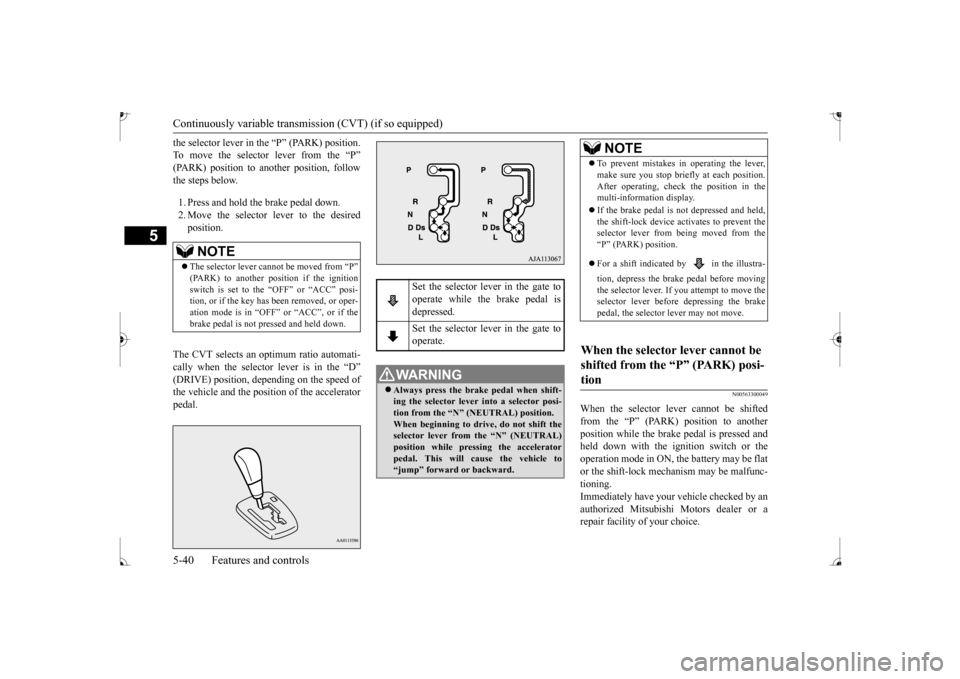
the selector lever in the “P” (PARK) position. To move the selector lever from the “P”
nother position, follow
the steps below. 1. Press and hold the brake pedal down. 2. Move the selector
lever to the desired
position.
The CVT selects an optimum ratio automati- cally when the selector lever is in the “D” the vehicle and the position of the acceleratorpedal.
N00563300049
When the selector lever cannot be shiftedfrom the “P” (PARK) position to another position while the brake pedal is pressed and held down with the ignition switch or theoperation mode in ON, th
e battery may be flat
or the shift-lock mechanism may be malfunc- tioning.Immediately have your
vehicle checked by an
authorized Mitsubishi Motors dealer or a repair facility of your choice.
NOTE
The selector lever cannot
be moved from “P” ition if the ignition
switch is set to the “OFF” or “ACC” posi- tion, or if the key has been removed, or oper-ation mode is in “OFF” brake pedal is not pressed and held down.
Set the selector lever in the gate to operate while the brake pedal is depressed. Set the selector lever in the gate to operate.
WA R N I N G Always press the brake pedal when shift- ing the selector lever into a selector posi- tion from the
Page 104 of 305
Continuously variable transmission (CVT) (if so equipped)
Features and controls 5-41
5
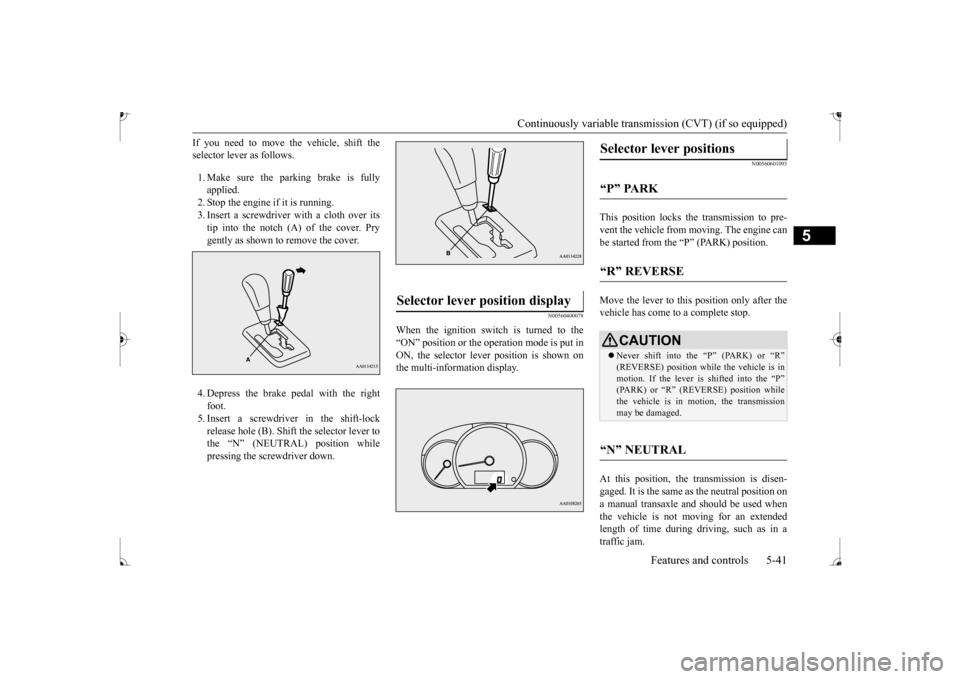
If you need to move the vehicle, shift the selector lever as follows. 1. Make sure the parking brake is fully applied. 2. Stop the engine if it is running. 3. Insert a screwdrive
r with a cloth over its
tip into the notch (A) of the cover. Pry gently as shown to remove the cover. 4. Depress the brake pe
dal with the right
foot. 5. Insert a screwdriver in the shift-lock release hole (B). Shift the selector lever tothe “N” (NEUTRAL) position while pressing the screwdriver down.
N00560400078
When the ignition switch is turned to the “ON” position or the ope
ration mode is put in
ON, the selector leve
r position is shown on
the multi-information display.
N00560601093
This position locks the transmission to pre- vent the vehicle from m
oving. The engine can
be started from the “P” (PARK) position. Move the lever to this position only after the vehicle has come to a complete stop. At this position, the
transmission is disen-
gaged. It is the same
as the neutral position on
a manual transaxle and should be used when the vehicle is not moving for an extended length of time during driving, such as in atraffic jam.
Selector lever position display
Selector lever positions
“P” PARK
“R” REVERSE
CAUTION Never shift into the “P” (PARK) or “R” motion. If the lever is shifted into the “P”the vehicle is in motion, the transmission may be damaged.
“N” NEUTRAL
BK0235100US.book 41 ページ 2015年11月20日 金曜日 午後3時12分
Page 110 of 305
Anti-lock braking system
Features and controls 5-47
5
If the brake pedal is depressed suddenly, the brakes will be applied with more force thanusual.
N00517900338
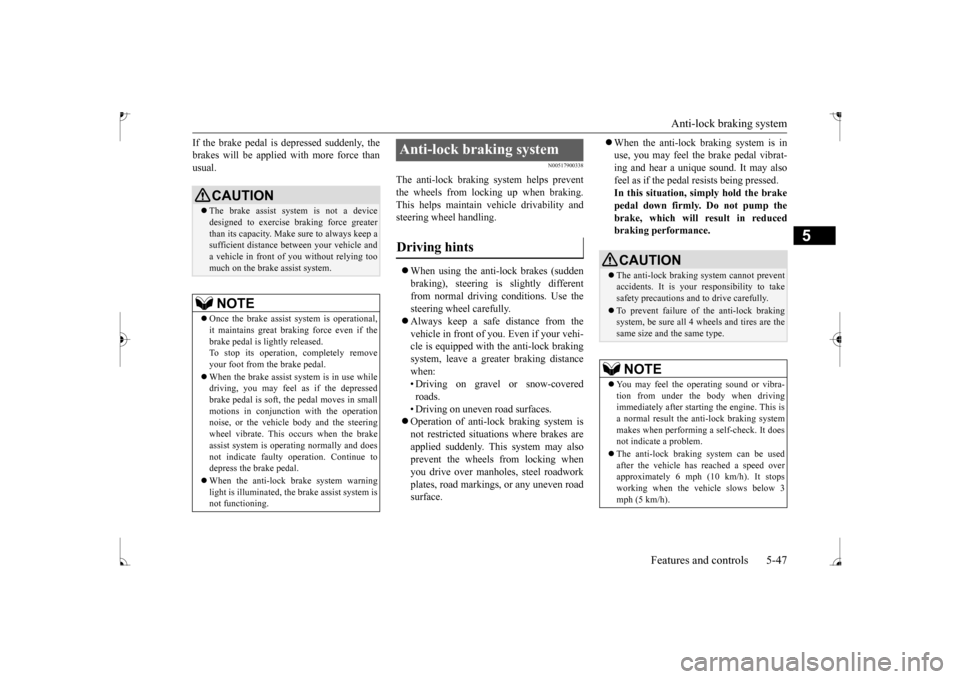
The anti-lock braking system helps prevent the wheels from locking up when braking. This helps maintain vehicle drivability andsteering wheel handling. When using the anti-lock brakes (sudden braking), steering is slightly different from normal driving conditions. Use the steering wheel carefully. Always keep a safe distance from the vehicle in front of you. Even if your vehi- cle is equipped with
the anti-lock braking
system, leave a greater braking distance when: • Driving on gravel or snow-coveredroads. • Driving on uneven road surfaces. Operation of anti-lock braking system is not restricted
situations where brakes are
applied suddenly. This system may also prevent the wheels from locking whenyou drive over manholes, steel roadwork plates, road markings
, or any uneven road
surface.
When the anti-lock braking system is in use, you may feel the brake pedal vibrat-ing and hear a unique sound. It may also feel as if the pedal
resists being pressed.
In this situation, si
mply hold the brake
pedal down firmly. Do not pump the brake, which will result in reduced braking performance.
CAUTION The brake assist system is not a device designed to exercise
braking force greater
than its capacity. Make sure to always keep a sufficient distance be
tween your vehicle and
a vehicle in front of
you without relying too
much on the brake assist system.NOTE
Once the brake assist system is operational, it maintains great braking force even if the brake pedal is lightly released.To stop its operation, completely remove your foot from the brake pedal. When the brake assist system is in use while driving, you may feel as if the depressed brake pedal is soft, the pedal moves in smallmotions in conjunction with the operation noise, or the vehicle body and the steering wheel vibrate. This occurs when the brakeassist system is ope
rating normally and does
not indicate faulty
operation. Continue to
depress the brake pedal. When the anti-lock brake system warning light is illuminated, the brake assist system is not functioning.
Anti-lock braking system Driving hints
CAUTION The anti-lock braking system cannot prevent accidents. It is your
responsibility to take
safety precautions a
nd to drive carefully.
To prevent failure of the anti-lock braking system, be sure all 4 wheels and tires are the same size and the same type.NOTE
You may feel the operating sound or vibra- tion from under the body when driving immediately after starting the engine. This is a normal result the anti-lock braking systemmakes when performing a self-check. It does not indicate a problem. The anti-lock braking system can be used after the vehicle has
reached a speed over
approximately 6 mph (10 km/h). It stops working when the vehicle slows below 3mph (5 km/h).
BK0235100US.book 47 ページ 2015年11月20日 金曜日 午後3時12分
Page 111 of 305
Anti-lock braking system 5-48 Features and controls
5
N00531600674
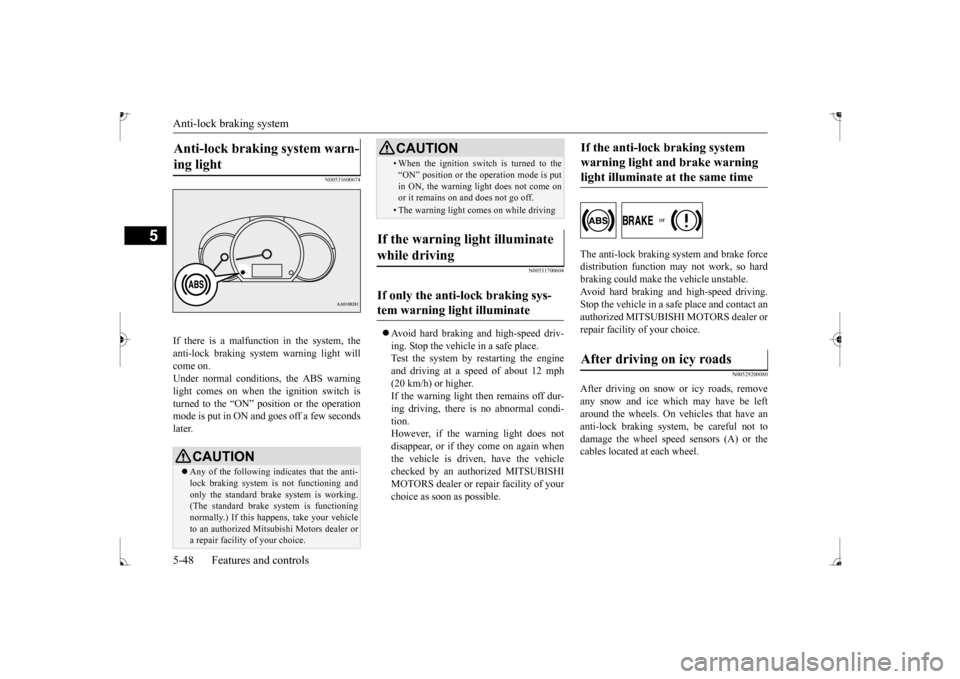
If there is a malfunction in the system, the anti-lock braking system warning light will come on.Under normal conditions, the ABS warning light comes on when the ignition switch is turned to the “ON” position or the operationmode is put in ON and goes off a few seconds later.
N00531700604
Avoid hard braking and high-speed driv- ing. Stop the vehicl
e in a safe place.
Test the system by restarting the engine and driving at a speed of about 12 mph (20 km/h) or higher.If the warning light then remains off dur- ing driving, there is no abnormal condi- tion.However, if the warning light does not disappear, or if they come on again when the vehicle is driven, have the vehiclechecked by an authorized MITSUBISHI MOTORS dealer or repair facility of your choice as soon as possible.
The anti-lock braking system and brake force distribution function ma
y not work, so hard
braking could make the vehicle unstable. Avoid hard braking and high-speed driving.Stop the vehicle in a safe place and contact an authorized MITSUBISHI MOTORS dealer or repair facility of your choice.
N00529200080
After driving on snow
or icy roads, remove
any snow and ice whic
h may have be left
around the wheels. On vehicles that have an anti-lock braking syst
em, be careful not to
damage the wheel spee
d sensors (A) or the
cables located at each wheel.
Anti-lock braking system warn- ing light
CAUTION Any of the following indicates that the anti- lock braking system is not functioning andonly the standard brake system is working. (The standard brake system is functioning normally.) If this happe
ns, take your vehicle
to an authorized Mits
ubishi Motors dealer or
a repair facility of your choice.
• When the ignition switch is turned to the “ON” position or the operation mode is putin ON, the warning li
ght does not come on
or it remains on and does not go off.• The warning light comes on while driving
If the warning light illuminate while driving If only the anti-lock braking sys- tem warning light illuminate
CAUTION
If the anti-lock braking system warning light and brake warning light illuminate at the same time After driving on icy roads
BK0235100US.book 48 ページ 2015年11月20日 金曜日 午後3時12分