PAG MITSUBISHI MIRAGE 2017 6.G Owners Manual
[x] Cancel search | Manufacturer: MITSUBISHI, Model Year: 2017, Model line: MIRAGE, Model: MITSUBISHI MIRAGE 2017 6.GPages: 307, PDF Size: 9.02 MB
Page 250 of 307
How to change a tire
For emergencies 8-11
8
N00850000175
Store the flat tire in the cargo area. Reverse the removing procedure when stor-ing the spare tire, jack, bar and wheel nut wrench. Refer to “To remove the spare tire” on page8-7 and “Jack and tools” on page 8-5.
N00849401248
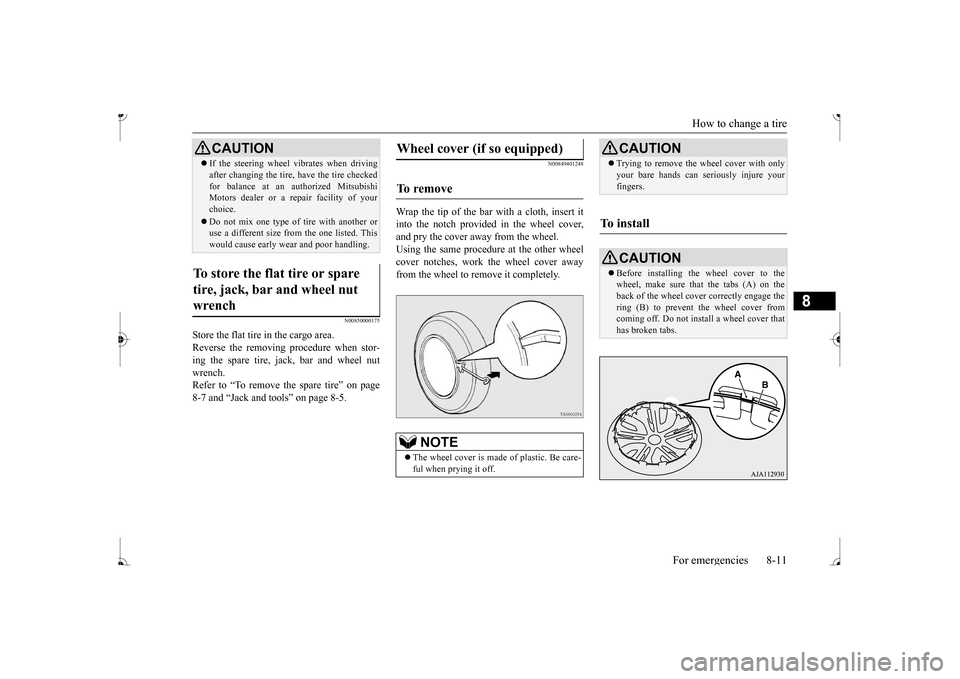
Wrap the tip of the bar with a cloth, insert itinto the notch provided in the wheel cover, and pry the cover away from the wheel. Using the same procedure at the other wheelcover notches, work the wheel cover away from the wheel to remove it completely.
If the steering wheel vibrates when driving after changing the tire, have the tire checkedfor balance at an authorized MitsubishiMotors dealer or a repair facility of your choice. Do not mix one type of tire with another or use a different size from the one listed. This would cause ea
rly wear and poor handling.
To store the flat tire or spare tire, jack, bar and wheel nut wrench
CAUTION
Wheel cover (if so equipped) To r e m o v e
NOTE
The wheel cover is made
of plastic. Be care-
ful when prying it off.
CAUTION Trying to remove the
wheel cover with only
your bare hands can seriously injure yourfingers.
To install
CAUTION Before installing the wheel cover to the wheel, make sure that the tabs (A) on the back of the wheel cove
r correctly engage the
ring (B) to prevent the wheel cover fromcoming off. Do not install a wheel cover that has broken tabs.
BK0236100US.book 11 ページ 2016年2月1日 月曜日 午前10時15分
Page 253 of 307
Operation under adverse driving conditions 8-14 For emergencies
8
Do not rev the engine or spin the wheels. Constant efforts to free a stuck vehicle cancause overheating and tr
ansaxle failure. Let
the engine idle for a few minutes to cool the transaxle before trying again.If your vehicle is still
stuck after several rock-
ing attempts, call for a commercial tow truck service.
When driving on a road covered with snow or ice, use snow tires. Tire chainscannot be used on your vehicle. There may be state or local regulations about using snow tires. Always check the regu-lations in your local area before using them. Refer to “Snow tires” on page 9-18 and “Tire chains” on page 9-18. Drive slowly. Do not make sudden starts or stops, sharp turns, or slam on the brakes. Allow extra distance
between your vehi-
cle and the vehicle in front of you, and avoid sudden braking. If a skid occurs when the accelerator pedal is depressed, take your foot off the pedal. Steer gently in the direction of theskid.
Your vehicle is equipped with an anti-lock braking system (ABS). Hold the brakepedal down firmly and keep it depressed. Do not pump the brake pedal which will result in reduced braking performance. After parking on snowy or icy roads, it may be difficult to move your vehicle due to the brake being frozen. Depress theaccelerator pedal little by little to move the vehicle when safe to do so. Drive as slow as possible when driving on bumpy, rutted roads or over potholes etc.
WA R N I N G When trying to rock
your vehicle out of a
stuck position, make sure that there are no people nearby. The
rocking motion can
make your vehicle suddenly lurch forwardor backward, and inju
re any bystanders.
On wet roads
CAUTIONAvoid flooded roads. Water is often deeper than it looks, and you
could be seriously hurt
by driving into flood water. When driving in rain, on water-covered roads, or through a car wash, water could get into the brake discs and make them fail tem-porarily. In such cases, lightly press the brake pedal to see if they are working prop- erly. If they are not, press the pedal lightlyseveral times while driving to dry the brake pads or linings, then check them again.
When driving in rain, a layer of water may form between the tires and the road surface(hydroplaning). This loosens your tires
Page 270 of 307
Tires
Vehicle care and maintenance 9-15
9
The traction grades, from highest to lowest, are AA, A, B and C. Those grades representthe tire’s ability to
stop on wet pavement as
measured under controlled conditions on specified government te
st surfaces of asphalt
and concrete. A tire marked C may have poor traction performance. The temperature grades are A (the highest), B and C, representing the ti
re’s resistance to the
generation of heat and it
s ability to dissipate
heat when tested un
der controlled conditions
on a specified indoor
laboratory test wheel.
Sustained high temperature can cause the material of the tire to
degenerate and reduce
tire life, and excessive temperature can lead to sudden tire failure. The grade C corre- sponds to a level of
performance which all
passenger car tires must
meet under the Fed-
eral Motor Vehicle Safety Standard No. 109. Grades B and A represent higher levels ofperformance on the laboratory test wheel than the minimum required by law.
N00939301984
Proper tire inflation pre
ssure is essential for
the safe and satisfac
tory operation of your
vehicle. The wrong tire pressure will cause problems in three major areas: Safety Too little pressure increases flexing in the tire and can cause tire failure. Too much pressure can cause a tire to lose its abilityto cushion shock. Objects on the road and potholes could then cause tire damage that may result in tire failure. Economy The wrong tire pressure can cause uneven wear patterns in the tire tread. These abnormal wear patterns will reduce the tread life, and the tire will have to bereplaced sooner. Too little pressure also
makes it harder for
the tire to roll, and this uses up more fuel. Ride comfort and vehicle stability The superior riding ex
perience built into
your vehicle partly depends on the correcttire pressure. Too much pressure gives an uncomfortable and ja
rring ride. Too little
pressure feels as if
your vehicle is slow to
respond. Unequal tire pressure
s can make steering
your vehicle uneven
and unpredictable.
The tire pressure for your vehicle under nor- mal driving conditions is listed on the placard attached to the driver’s door sill. (Refer to “Tire and loading information plac-ard” on page 11-3.)
The recommended infl
ation pressures under
normal driving conditions should be used forthe tires listed below. Tire pressures should be checked, and adjusted if necessary,
at least once a month.
Pressures should be checked more often whenever weather temperatures changeseverely, becaus
e tire pressures change with
outdoor temperatures. The pressures listed are always “cold inflation pressure”.Cold inflation pressure is measured after the vehicle has been parked
for at least three
hours or is driven less than 1 mile (1.6 km)after having been parked for three hours. Cold inflation pressure
must not go above the
maximum values molded into the tire side-wall. After driving se
veral miles, your tire
inflation pressure may increase 2 to 6 psi (14 to 41 kPa) from the cold inflation pressure.Do not let air out of the tires to get back to the
Traction TemperatureTire inflation pressures
Item
Tire size
Front
Rear
Normal tire
165/65R14
240 kPa, 35 psi
240 kPa, 35 psi
175/55R15
220 kPa, 32 psi
220 kPa, 32 psi
Compact spare wheel
T115/70D14 420 kPa, 60 psi
BK0236100US.book 15 ページ 2016年2月1日 月曜日 午前10時15分
Page 271 of 307
Tires 9-16 Vehicle care and maintenance
9
specified cold pressure, or your tires will be too low.Check your tires each time you refuel. If one tire looks lower than the others, check the pressure for all of them.You should also take the following safety pre- cautions: Keep your tires inflated to the recom- mended pressures. (See the tire and load-ing information placard attached to the driver’s door sill.) Stay within the recommended load limits. Make sure that the weight of any load in your vehicle is evenly distributed. Drive at safe speeds. After filling your tires to the correct pres- sure, check them for damage and airleaks. Be sure to reinstall the caps on the valve stems.
N00939601453
N00939701193
The following maintenance steps are recom- mended: Check tire pressures regularly. Have regular maintenance done on the wheel balance and front and rear suspen-sion alignment. Rotate your tires regul
arly as described in
the “Tire rotation” section on page 9-17.
N00939801240
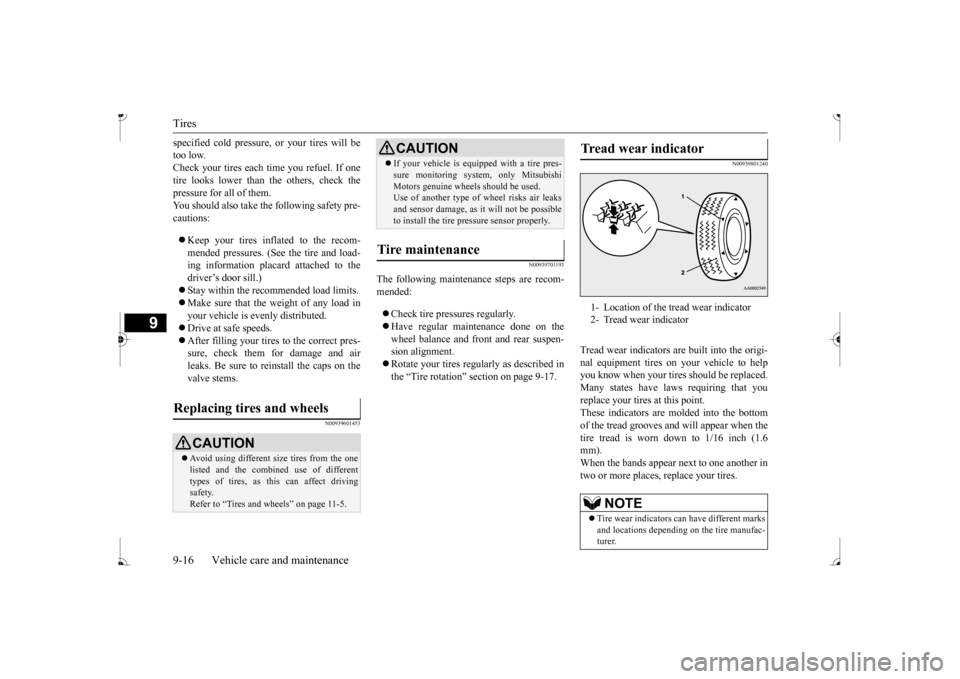
Tread wear indicators are built into the origi-nal equipment tires on your vehicle to helpyou know when your tires should be replaced. Many states have la
ws requiring that you
replace your tires at this point.These indicators are molded into the bottom of the tread grooves and will appear when the tire tread is worn down to 1/16 inch (1.6mm). When the bands appear next to one another in two or more places
, replace your tires.
Replacing tires and wheels
CAUTIONAvoid using different size tires from the one listed and the combined use of different types of tires, as this can affect driving safety.Refer to “Tires and wheels” on page 11-5.
If your vehicle is equipped with a tire pres- sure monitoring system, only MitsubishiMotors genuine wheels should be used.Use of another type of wheel risks air leaks and sensor damage, as it
will not be possible
to install the tire pressure sensor properly.
Tire maintenance
CAUTION
Tread wear indicator 1- Location of the tread wear indicator 2- Tread wear indicator
NOTE
Tire wear indicators ca
n have different marks
and locations depending
on the tire manufac-
turer.
BK0236100US.book 16 ページ 2016年2月1日 月曜日 午前10時15分
Page 275 of 307
General maintenance 9-20 Vehicle care and maintenance
9
N00940900228
Spark plugs must fire properly for good engine performance
and emission-control.
Do not reuse them by cleaning or regapping.Change them at the mileage listed in the “WARRANTY AND MAINTENANCE MANUAL”.
N00941000040
Check the hose surfaces for any heat and mechanical damage, hard and brittle rubber, cracking, tears, cuts and abrasions. Pay spe-cial attention to the hos
es closest to high heat
sources such as the exhaust manifold. Check all the hose connections
, such as clamps and
couplings, to make sure
they are secure and
that there are no leaks. If you see any wear or damage, replace the
hoses immediately.
N00950100050
Have the valve clearance checked at an authorized Mitsubishi Motors dealer at the mileage specified in the “WARRANTY AND MAINTENANCE MANUAL”.If the engine sounds abnormally loud, have adjustments made by an authorized Mitsubishi Motors dealer.
N00941300173
Check these regularly for damage or leaks in the fuel lines and connections. Check the fuel tank filler cap for dama
ge or looseness. Pay
special attention to the fuel lines closest to
high heat sources such
as the exhaust mani-
fold.
N00941400187
If the fuel-vapor vent line is clogged or dam-aged, the fuel-vapor mixture will escape, pol- luting the air. Have the system checked at an authorizedMitsubishi Motors dealer at the mileage spec- ified in the “WARRANTY AND MAINTE- NANCE MANUAL”.
N00941500292
The next pages list th
e maintenance service
recommended by Mitsubishi Motors Corpo-ration. In addition to the general maintenance that needs to be performed at the times listed,
NOTE
To meet government regulations and pro- mote cleaner air, your
vehicle is equipped
with an onboard dia
gnostic system (OBD).
The engine electronic control module that controls OBD functions stores various data (especially about th
e exhaust emissions).
This data will be erased if the battery cable is disconnected, which could make a rapid diagnosis difficult.
Do not disconnect the
battery cable when the engine malfunction indicator (“SERVICE ENGINE SOON” or “Check engine
light”) is ON.
Spark plugs
NOTE
Use the spark plugs listed under “Engine specifications” on page 11
-4 or plugs that are
exactly the same. Other plugs could cause engine damage, performance problems orradio noise.
Fuel hoses Intake valve clearance Fuel system (tank, pipe line and connection, and fuel tank filler cap)
WA R N I N G If you see a fuel leak
or if you smell fuel,
do not run the engine. Any spark (includ- ing from the ignition
), flame or smoking
material could cause an explosion or fire.Call an authorized Mitsubishi Motors dealer or a repair fa
cility of your choice
for assistance.
Evaporative emission control system (except evaporative emission canister) General maintenance
BK0236100US.book 20 ページ 2016年2月1日 月曜日 午前10時15分
Page 277 of 307
For cold and snowy weather 9-22 Vehicle care and maintenance
9
nism until all the movable surfaces are cov- ered.Also, put a light coat
of the same grease on
the safety catch wherever moving parts touch.
N00942600102
The ventilation slots in
front of the wind-
shield should be brushed clear after a heavysnowfall so that the operation of the heating and ventilation
systems will not be impaired.
To prevent freezing of the weatherstripping on the doors, engine hood, etc., they should be treated with silicone grease. It is a good idea to carry a shovel or a short- handled spade in the vehicle during the win- ter so that you can clear away snow if you getstranded. A small hand-brush for sweeping
snow off the vehicle a
nd a plastic scraper for
the windshield, side a
nd rear window are also
useful.
N00942700305
The fusible links will melt to prevent a fire ifa large current attempts to flow through cer- tain electrical systems. In case of a melted
fusible link, see your
authorized Mitsubishi Motors dealer or a repair facility of your choice for inspectionand replacement. For the fusible links, please refer to “Fuse load capacities” on page 9-23.
N00942800902
To prevent damage to the electrical systemfrom short-circuiting
or overloading, each
individual circuit
is equipped with a fuse. The
fuse blocks are located in the passenger com-partment and in the engine compartment. The fuse block in the
passenger compartment
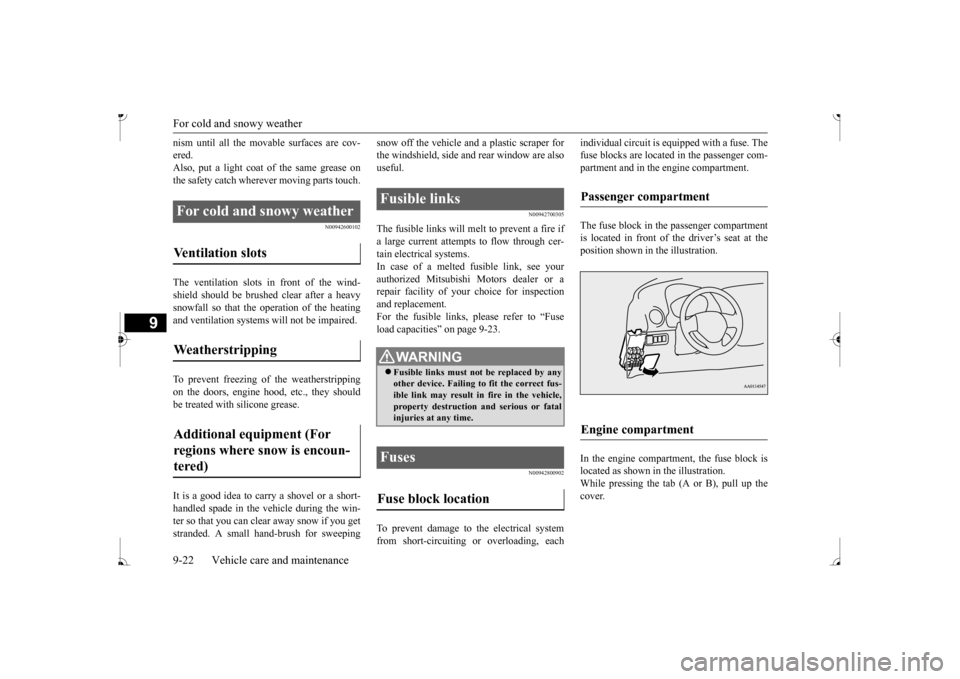
is located in front of the driver’s seat at the position shown in the illustration. In the engine compartment, the fuse block is located as shown in
the illustration.
While pressing the tab (A or B), pull up the cover.
For cold and snowy weather Ventilation slots Weatherstripping Additional equipment (For regions where snow is encoun- tered)
Fusible links
WA R N I N G Fusible links must not be replaced by any other device. Failing to fit the correct fus- ible link may result in fire in the vehicle,property destruction and serious or fatal injuries at any time.
Fuses Fuse block location
Passenger compartment Engine compartment
BK0236100US.book 22 ページ 2016年2月1日 月曜日 午前10時15分
Page 299 of 307
Vehicle weights 11-4 Specifications
11
N01147601985
GVWR: maximum total weight (load) limit specified for the vehicle GAWR: maximum weight (load) limit sp
ecified for the front or rear axle
Seating capacity: the maxi
mum number of occupants
N01147701579
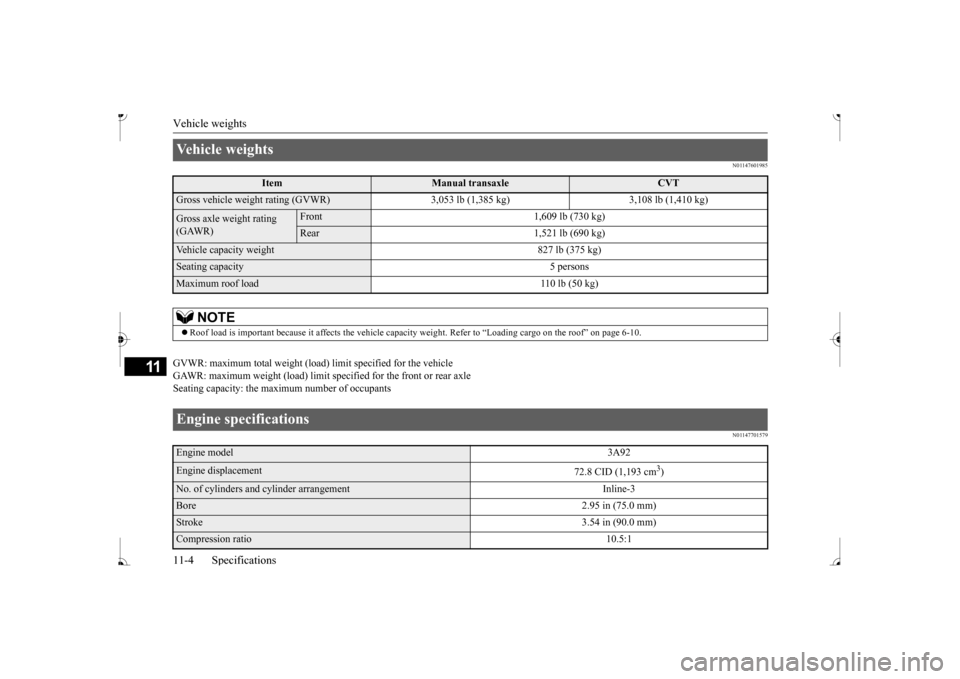
Ve h i c l e w e i g h t s
Item
Manual transaxle
CVT
Gross vehicle weight ra
ting (GVWR) 3,053 lb (1,385 kg) 3,108 lb (1,410 kg)
Gross axle weight rating (GAWR)
Front 1,609 lb (730 kg)
Seating capacity 5 personsMaximum roof load 110 lb (50 kg)
NOTE
Roof load is important because it affe
cts the vehicle capacity weight. Refer to
“Loading cargo on the roof” on page 6-10.
Engine specifications Engine model
3A92
Engine displacement
72.8 CID (1,193 cm
3)
No. of cylinders and cy
linder arrangement Inline-3
Bore
2.95 in (75.0 mm)
Stroke
3.54 in (90.0 mm)
Compression ratio
10.5:1
BK0236100US.book 4 ページ 2016年2月1日 月曜日 午前10時15分
Page 301 of 307

Capacity 11-6 Specifications
11
* : similar high quality ethylene
glycol based non-silicate, non-
amine, non-nitrate and non-borate
coolant with long life hybrid
organic acid tech-
nologyBrake As required Conforming to Brake fluid DOT3 or DOT4Hood lock release mechanism and safety catch A
s required Multipurpose type
grease NLGI Grade 2
Engine coolant {Includes .53 qt (0.5 L) in reserve tank}
Manual trans-axle
4.2 qt (4.0 L)
Mitsubishi Motors Genuine Supe
r Long Life Coolant Premium
or equivalent
*
CVT 4.8 qt (4.6 L)
Washer fluid 2.6 qt (2.5 L) —
Refer to the “Air con- ditioning label” on
page 11-2.
HFC-134a
Item
Capacity
Lubricants
BK0236100US.book 6 ページ 2016年2月1日 月曜日 午前10時15分