warning MITSUBISHI MONTERO 2000 Service User Guide
[x] Cancel search | Manufacturer: MITSUBISHI, Model Year: 2000, Model line: MONTERO, Model: MITSUBISHI MONTERO 2000Pages: 1839, PDF Size: 29.19 MB
Page 343 of 1839

Page 380 of 1839

Page 384 of 1839
Page 419 of 1839

Page 464 of 1839

15
DRIVE CYCLE
Performing the running test of the car using the following five drive cycle patterns makes it possible to
monitor all the diagnosis codes that are required for operation of the car in order to determine if the
applicable system is operating properly or not.
In other words, doing such a drive allows to regenerate any kind of trouble which involves illuminating the
Engine Warning Lamp (Check Engine Lamp) and to verify the repair procedure has eliminated the trouble
[the Engine Warning Lamp (Check Engine Lamp) is no longer illuminated].
Caution
Two technicians should always be in the vehicle when carrying out a test drive.
NOTE
Check that the diagnosis code is not output before traveling in the Drive cycle pattern. Erase the diagnosis
code if it has been output.
DRIVE CYCLE PATTERN LIST
PROCEDURE MONITOR ITEM DIAGNOSIS CODE
Catalytic converter monitor P04201
Heated oxygen sensor
2 Fuel trim monitor P0170
3 Feed back monitor P0125
4 Other monitor P0136, P0201, P0202, P0203, P0204, P0205,
P0206, P0300, P0301, P0302, P0303, P0304,
P0305, P0306, P0325
NOTE
The vehicle speed sensor (P0500) and the power steering fluid pressure switch (P0551) are used to
determine if the system is operating properly or not through use of the Data List function of the MUT-II.
2001 PAJERO/MONTERO WAGON Workshop Manual 6G74
GDI - Troubleshooting
www.WorkshopManuals.co.uk
Purchased from www.WorkshopManuals.co.uk
Page 472 of 1839

GDI -General/General Information/Troubleshooting13A-3
GENERAL
OUTLINE OF CHANGES
Due to the changes as shown below, the service procedures regarding the different description from
the previous version have been established.
DOn M/T, the engine-ECU has been changed as diagnosis code P1603 has been added.
DOn A/T, the engine-A/T-ECU has been changed as an on-board diagnosis system has been adopted.
The engine warning lamp control, the diagnosis function, the service data output and the actuator
test are basically the same as for M/T.
DOn A/T, an dual oxygen sensor has been adopted. This sensor is the same as for the previous
M/T.
GENERAL INFORMATION
GENERAL SPECIFICATIONS
ItemsSpecifications
Engine-ECU
E2T79278
Engine-A/T-ECU Identification No.E2T76292
E2T76293
TROUBLESHOOTING
DIAGNOSIS FUNCTION
ENGINE WARNING LAMP (CHECK ENGINE LAMP)
The following item has been added as diagnosis code P1603 has been added. The other items are
the same as before.
Engine warning lamp inspection items
Code No.Diagnosis item
P1603Battery backup line malfunction
INSPECTION CHART FOR DIAGNOSIS CODES
Diagnosis code P1603 has been added. The other codes are the same as for the previous M/T.
Code No.Diagnosis itemReference page
P1603Battery backup line malfunction13A-4
www.WorkshopManuals.co.uk
Purchased from www.WorkshopManuals.co.uk
Page 473 of 1839
GDI -TroubleshootingGDI -Troubleshooting13A-4
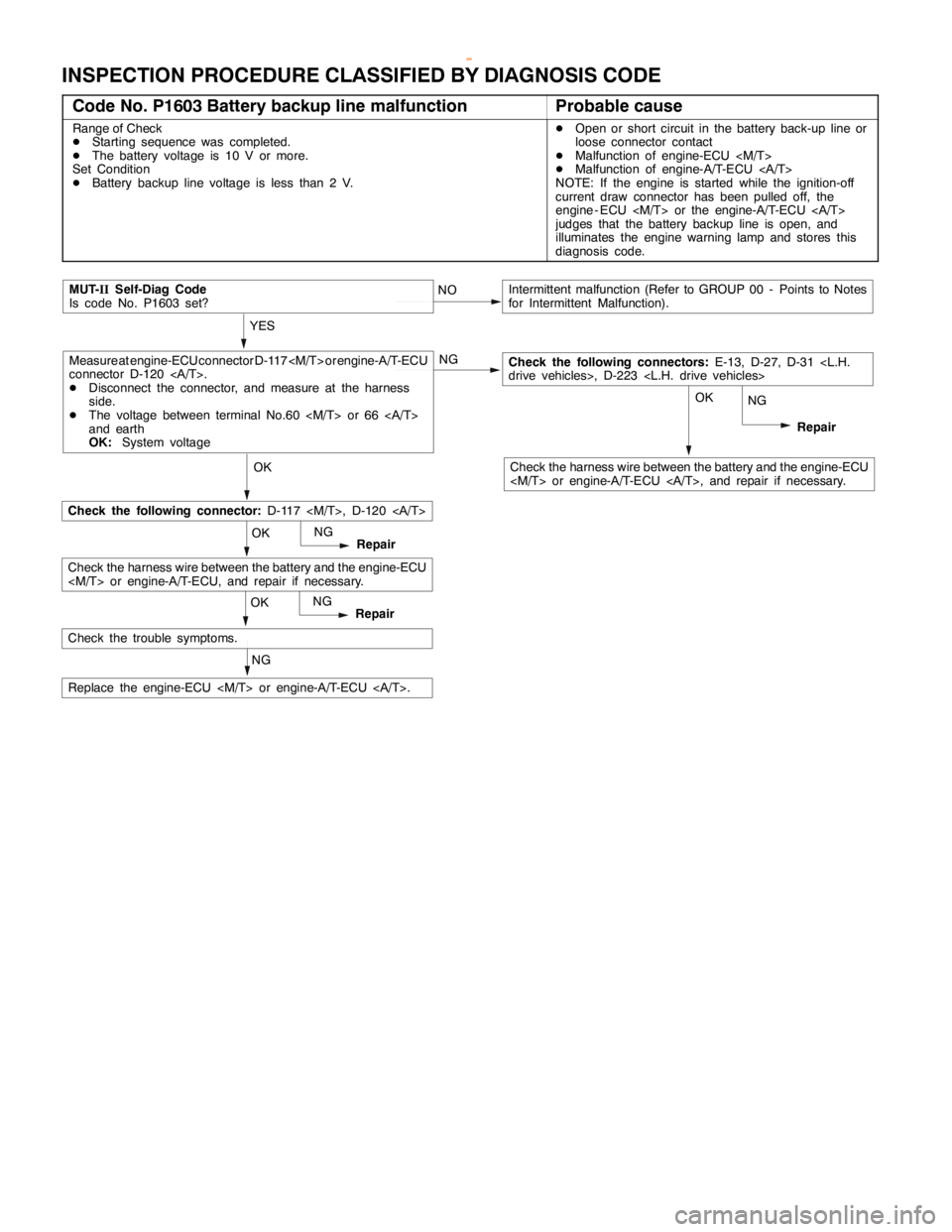
INSPECTION PROCEDURE CLASSIFIED BY DIAGNOSIS CODE
Code No. P1603 Battery backup line malfunctionProbable cause
Range of Check
DStarting sequence was completed.
DThe battery voltage is 10 V or more.
Set Condition
DBattery backup line voltage is less than 2 V.DOpen or short circuit in the battery back-up line or
loose connector contact
DMalfunction of engine-ECU
DMalfunction of engine-A/T-ECU
NOTE: If the engine is started while the ignition-off
current draw connector has been pulled off, the
engine - ECU
judges that the battery backup line is open, and
illuminates the engine warning lamp and stores this
diagnosis code.
NG
Replace the engine-ECU
Check the trouble symptoms.
OKNG
Repair
Check the harness wire between the battery and the engine-ECU
OKNG
Repair
Check the harness wire between the battery and the engine-ECU
OK
NG
Repair
MUT-IISelf-Diag Code
Is code No. P1603 set?
Check the following connector:D-117
Check the following connectors:E-13, D-27, D-31
connector D-120 .
DDisconnect the connector, and measure at the harness
side.
DThe voltage between terminal No.60
and earth
OK:System voltageNG
Intermittent malfunction (Refer to GROUP 00 - Points to Notes
for Intermittent Malfunction).
www.WorkshopManuals.co.uk
Purchased from www.WorkshopManuals.co.uk
Page 493 of 1839

DIESEL FUEL <4M4> -General Information13C-2
GENERAL INFORMATION
The electronically-controlled fuel injection system consists of sensors which detect the condition of the
diesel engine, an engine-ECU which controls the system based on signals from these sensors, and actuators
which operate according to control commands from the engine-ECU.
The engine-ECU carries out operations such as fuel injection rate control, fuel injection timing control
and idle up control. In addition, the engine-ECU is equipped with several self-diagnosis functions which
make troubleshooting easier in the event that a problem develops.
FUEL INJECTION RATE CONTROL
The fuel injection completion timing is controlled by means of a solenoid-type spill valve to ensure that
the optimum amount of fuel is supplied to the engine in accordance with gradual changes in the engine
running condition.
Before fuel injection starts, the solenoid-type spill valve is on (energized), so that the valve is closed.
As the plunger turns and rises, fuel is sent out under pressure, and when the fuel flow rate reaches
the target value for fuel injection, the solenoid-type spill valve turns off. When the solenoid-type spill
valve turns off, the fuel under high pressure inside the plunger is leaked out into the pump chamber
and fuel injection is completed.
FUEL INJECTION TIMING CONTROL
The position of the injection pump timer piston is controlled so that fuel injection is carried out at the
optimum timing in accordance with the engine running condition.
The timer piston position is determined by duty control of the timing control solenoid valve which is located
in the line between the high-pressure chamber and the low-pressure chamber of the timer piston.
The fuel injection timing is advanced by increasing the control duty of the timing control solenoid valve.
IDLE SPEED CONTROL
Controlling the fuel injection rate in accordance with the engine running condition maintains the idle speed
at the optimum condition.
SELF-DIAGNOSIS FUNCTION
DWhen an abnormality is detected in any of the sensors or actuators, the engine warning lamp illuminates
to warn the driver.
DWhen an abnormality is detected in any of the sensors or actuators, a diagnosis code number
corresponding to the problem which occurred is output.
DThe RAM data relating to the sensors and actuators which is stored in the engine-ECU can be read
using the MUT-II. In addition, the actuators can be force-driven under certain conditions.
OTHER CONTROL FUNCTIONS
1. Power Supply Control
When the ignition switch is turned to ON, the relay turns on and power is supplied to components
such as the timing control solenoid valve.
2. Intake Air Throttle Control
When the engine is idling after having warmed up, the throttle valve is half opened to restrict the
amount of intake air in order to reduce vibration and noise.
3. A/C Relay Control
Turns the compressor clutch of the A/C ON and OFF
4. Fan motor relay control
The radiator fan and condenser fan operating speeds are controlled in accordance with the engine
coolant temperature and the vehicle speed.
5. Glow Control
Refer to GROUP 16.
6. EGR Control
Refer to GROUP 17.
www.WorkshopManuals.co.uk
Purchased from www.WorkshopManuals.co.uk
Page 514 of 1839

DIESEL FUEL <4M4> -Troubleshooting13C-23
INSPECTION CHART FOR TROUBLE SYMPTOMS
Trouble SymptomInspection
procedure
No.Reference
page
No communication canNo communication can be established with all systems.113C-24
be established be-
tween MUT-IIand the
engine-ECU.No communication can be established only with the
engine-ECU.213C-24
Engine warning lamp
relatedImmediately after the ignition switch is “ON”, the engine
warning lamp does not turn on.313C-25
The engine warning lamp keeps on and does not turn off.413C-25
Starting performanceNo initial combustion (unable to start)513C-26
Starting performance is bad when the engine is cold (difficult to
start)613C-26
Starting performance is bad regardless of when the engine is
hot or cold (difficult to start)713C-26
Idling stability
(idling inoperative)Low idling speed when the engine is cold (improper idling
speed)813C-27
High idling speed (improper idling speed)913C-27
Low idling speed (improper idling speed)1013C-27
Idling instable (rough idling, hunting)1113C-28
Idling stabilityThe engine halts after running for a while.1213C-28
(idling sustainment in-
operative)The engine halts during idling.1313C-29
DriveabilityLack of output power1413C-29
Occurrence of abnormal knocking1513C-29
Abnormal black smoke1613C-30
Abnormal white smoke1713C-30
Hunting during driving1813C-31
www.WorkshopManuals.co.uk
Purchased from www.WorkshopManuals.co.uk
Page 516 of 1839
DIESEL FUEL <4M4> -Troubleshooting13C-25
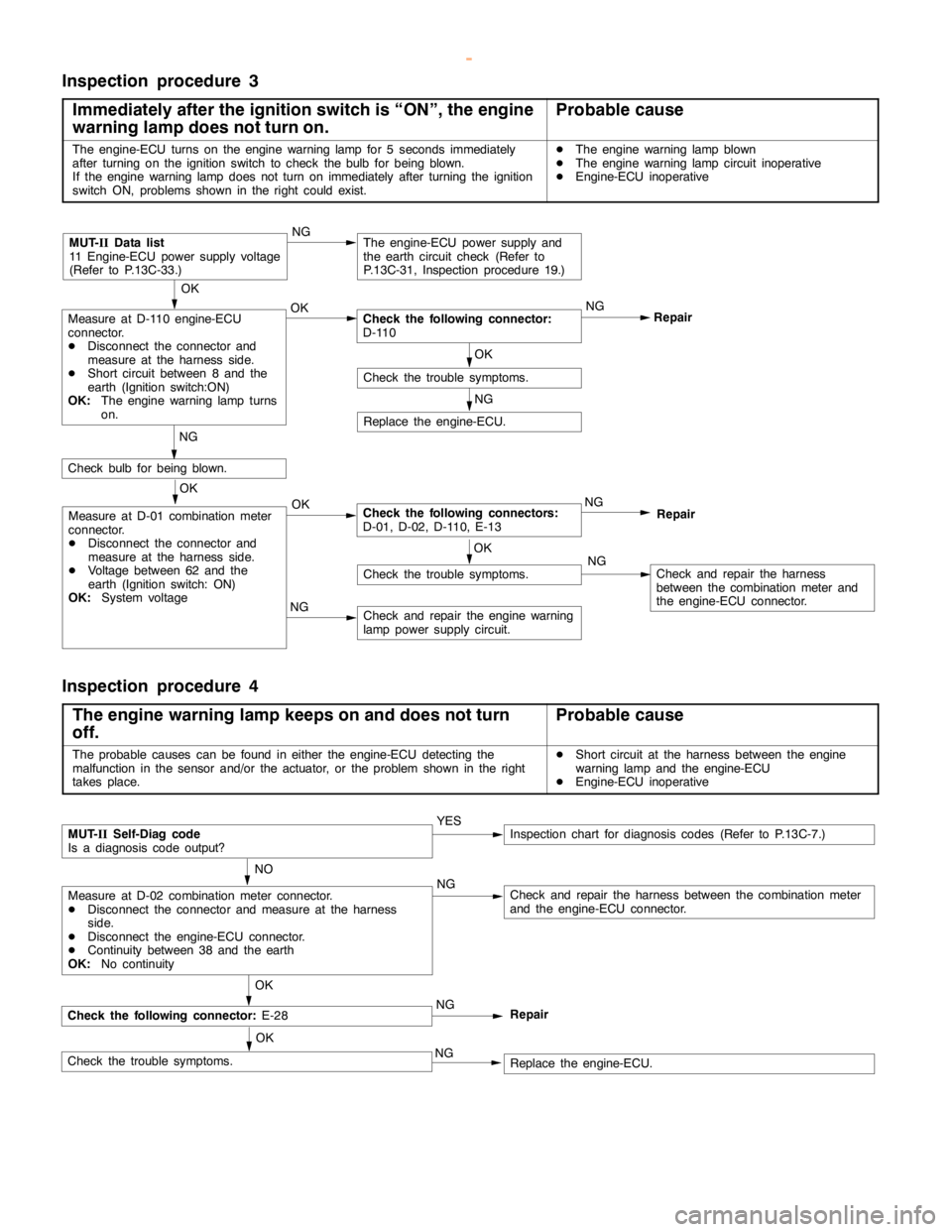
Inspection procedure 3
Immediately after the ignition switch is “ON”, the engine
warning lamp does not turn on.
Probable cause
The engine-ECU turns on theengine warning lamp for 5seconds immediately
after turning on the ignition switch to check thebulb for being blown.
If the engine warning lampdoes not turn on immediately after turning the ignition
switch ON, problems shown in the right could exist.DThe engine warning lamp blown
DThe engine warning lampcircuit inoperative
DEngine-ECU inoperative
NG
Replace the engine-ECU.
NG
Check and repair the harness
between the combination meter and
the engine-ECU connector.
NG
Check and repair theengine warning
lamppower supply circuit.
OK
Check the trouble symptoms.
OK
Measure at D-01 combination meter
connector.
DDisconnect the connector and
measure at the harness side.
DVoltage between 62 and the
earth (Ignition switch: ON)
OK:
System voltageOKCheck the following connectors:
D-01, D-02, D-110, E-13NG
Repair
NG
Checkbulb for being blown.
OK
Check the trouble symptoms.
OK
Measure at D-110 engine-ECU
connector.
DDisconnect the connector and
measure at the harness side.
DShort circuit between 8 and the
earth (Ignition switch:ON)
OK:
The engine warning lampturns
on.OKCheck the following connector:
D-110NG
Repair
MUT-
IIData list
11 Engine-ECU power supply voltage
(Refer to P.13C-33.)NGThe engine-ECU power supply and
the earth circuit check (Refer to
P.13C-31, Inspection procedure 19.)
Inspection procedure 4
The engine warning lamp keeps on and does not turn
off.
Probable cause
The probable causes can be found in either the engine-ECU detecting the
malfunction in the sensor and/or the actuator, or the problem shown in the right
takes place.DShort circuit at the harness between theengine
warning lamp and the engine-ECU
DEngine-ECU inoperative
Check the following connector:
E-28
NO
Measure at D-02 combination meter connector.
DDisconnect the connector and measure at the harness
side.
DDisconnect the engine-ECU connector.
DContinuity between 38 and the earth
OK:
No continuityNGCheck and repair the harness between the combination meter
and the engine-ECU connector.
OK
MUT-
IISelf-Diag code
Is a diagnosis code output?YESInspection chart for diagnosis codes (Refer to P.13C-7.)
Check the trouble symptoms.OKReplace the engine-ECU. NGNG
Repair
www.WorkshopManuals.co.uk
Purchased from www.WorkshopManuals.co.uk