warning MITSUBISHI MONTERO 2000 Service Repair Manual
[x] Cancel search | Manufacturer: MITSUBISHI, Model Year: 2000, Model line: MONTERO, Model: MITSUBISHI MONTERO 2000Pages: 1839, PDF Size: 29.19 MB
Page 36 of 1839

GENERAL -Supplemental Restraint System (SRS)00-35
SRS-ECU
Terminal No.Destination of harnessCorrective action
1, 2, 3, 4Instrument panel wiring harness®Front wiring harness®Front
impact sensorRepair or replace each wiring
harness
7Instrument panel wiring harness®EarthRepair or replace Instrument
8Instrument panel wiring harness®Combination meter
(SRS warning lamp)
panel wiring harness
9, 10Instrument panel wiring harness®Front passenger’s air bag
module
11 , 1 2Instrument panel wiring harness®Clock spring®Driver’s air bag
module)Repair or replace the Instrument
panel wiring harness. Replace
clock spring.
13Instrument panel wiring harness®Junction block (fuse No.8)Repair or replace Instrument
16Instrument panel wiring harness®Junction block (fuse No.6)
panel wiring harness.
20Instrument panel wiring harness®Diagnosis connector
21, 22Side air bag wiring harness®Side air bag module (L.H.)Repair or replace side air bag
23, 24Side air bag wiring harness®Side air bag module (R.H.)
wiring harness.
34, 35, 36Side air bag wiring harness®Floor wiring harness®Side impact
sensor (L.H.)Repair or each wiring harness.
40, 41, 42Side air bag wiring harness®Floor wiring harness®Side impact
sensor (R.H.)
6. Inspection of the SRS-ECU harness connector should be carried out by the following procedure.
Insert the special tool (probe, MB991222, in the harness set) into the connector from harness side
(rear side), and connect the tester to this probe. If any tool than specified is used, damage to the
harness and other components will result. Furthermore, measurement should not be carried out by
touching the probe directly against the terminals from the front of the connector. The terminals are
plated to increase their conductivity, so that if they are touched directly by the probe, the plating
may break, which will cause drops in reliability.
www.WorkshopManuals.co.uk
Purchased from www.WorkshopManuals.co.uk
Page 49 of 1839

GENERAL -Vehicle Identification00-1
GROUP 00
GENERAL
INSPECTION SERVICE POINTS
DIAGNOSIS FUNCTION
WHEN USING THE WARNING LAMP
The diagnosis code read-out function, which is available by means of the neutral position indicator lamp,
has been discontinued
VEHICLE IDENTIFICATION
MODELS
Model codeEngine modelTransmission modelFuel supply system
V64WMNDFL64D56 Intercooler Turbo
(2 477mL)
V5MT1 <5M/T>Injection
MNHFL6
(2,477mL)
V5M31 <5M/T>
MNHFR6
MNXFL6
MNXFR6
V68WMNDFL64M41-DOHC Intercool-
erTurbo(3 200mL)
V5M31 <5M/T>Electronically-con-
trolledhighpressure
MNHFL6
erTurbo(3,200mL)trolledhighpressure
fuel distribution
MNHFR6
MYHFL6V5A51 <5A/T>
MYHFR6
MNXFL6V5M31 <5M/T>
MNXFR6
MYXFL6V5A51 <5A/T>
MYXFR6
V65WMYHCL66G74 GDI (3,496 mL)V5A51 <5A/T>GDI
MYHCR6
MNXCL6V5M31 <5M/T>
MYXCL6V5A51 <5A/T>
MYXCR6
www.WorkshopManuals.co.uk
Purchased from www.WorkshopManuals.co.uk
Page 53 of 1839

GENERAL -Precautions Before Service00-5
PRECAUTIONS BEFORE SERVICE
SUPPLEMENTAL RESTRAINT SYSTEM (SRS), SEAT BELT WITH PRE-TENSIONER
1. Items to follow when servicing SRS
(1) Be sure to read GROUP 52B - Supplemental Restraint System (SRS).
For safe operations, please follow the directions and heed all warnings.
(2) Wait at least 60 seconds after disconnecting the battery cable before doing any further work.
The SRS system is designed to retain enough voltage to deploy the air bag even after the battery
has been disconnected. Serious injury may result from unintended air bag deployment if work
is done on the SRS system immediately after the battery cable is disconnected.
(3) Warning labels must be heeded when servicing or handling SRS components and seat belt with
pre-tensioner. Warning labels are located in the following locations.
DHood
DSun visor
DGlove box
DSRS-ECU
DSteering wheel
DSteering gearbox
DAir bag module (driver’s side and front passenger’s side)
DFront impact sensor
DClock spring
DSeat belt with pre-tensioner
DSide air bag module
DSide impact sensor
(4) Always use the designated special tools and test equipment.
(5) Store components removed from the SRS and seat belt with pre-tensioner in a clean and dry
place.
The air bag module and seat belt with pre-tensioner should be stored on a flat surface and
placed so that the pad surface is facing upward.
Do not place anything on top of it.
(6) Never attempt to disassemble or repair the SRS components (SRS-ECU, air bag module, clock
spring and side impact sensor) and seat belt with pre-tensioner.
(7) Whenever you finish servicing the SRS and seat belt with pre-tensioner, check the SRS warning
lamp operation to make sure that the system functions properly.
(8) Be sure to deploy the air bag and seat belt with pre-tensioner before disposing of the air bag
module and seat belt with pre-tensioner or disposing of a vehicle equipped with an air bag and
seat belt with pre-tensioner. (Refer to GROUP 52B - Air Bag Module and Seat Belt with Pre-tensioner
Disposal Procedures.)
2. Observe the following when carrying out operations on places where SRS components and seat
belt with pre-tensioner are installed, including operations not directly related to the SRS air bag and
seat belt with pre-tensioner.
(1) When removing or installing parts do not allow any impact or shock to the SRS components
and seat belt with pre-tensioner.
(2) SRS components and seat belt with pre-tensioner should not be subjected to heat, so remove
the SRS components and seat belt with pre-tensioner before drying or baking the vehicle after
painting.
DSRS-ECU, air bag module, clock spring, front and side impact sensors: 93_C or more
DSeat belt with pre-tensioner: 90_C or more
After re-installing them, check the SRS warning lamp operation to make sure that the system
functions properly.
www.WorkshopManuals.co.uk
Purchased from www.WorkshopManuals.co.uk
Page 203 of 1839

ENGINE LUBRICATION -General Information12-2
GENERAL INFORMATION
The lubrication method is a fully force-fed, full-flow
filtration type.An oil cooler with high cooling performance and
which is built into the crankcase has been adopted.
<4M4>
Items6G74D54M4
Oil pump typeTrochoid typeExternal gear typeExternal gear type
Drive methodCrankshaftCrankshaft gearCrankshaft gear
ENGINE OILS
Health Warning
Prolonged and repeated contact with mineral oil
will result in the removal of natural fats from the
skin, leading to dryness, irritation and dermatitis.
In addition, used engine oil contains potentiallyharmful contaminants which may cause skin cancer.
Adequate means of skin protection and washing
facilities must be provided.
Recommended Precautions
The most effective precaution is to adapt working
practices which prevent, as far as practicable, the
risk of skin contact with mineral oils, for example
by using enclosed systems for handling used engine
oil and by degreasing components, where
practicable, before handling them.
Other precautions:
DAvoid prolonged and repeated contact with oils,
particularly used engine oils.
DWear protective clothing, including impervious
gloves where practicable.
DAvoid contaminating clothes, particularly
underpants, with oil.
DDo not put oily rags in pockets, the use of
overalls without pockets will avoid this.
DDo not wear heavily soiled clothing and
oil-impregnated foot-wear. Overalls must be
cleaned regularly and kept separate from
personal clothing.DWhere there is a risk of eye contact, eye
protection should be worn, for example,
chemical goggles or face shields; in addition
an eye wash facility should be provided.
DObtain First Aid treatment immediately for open
cuts and wounds.
DWash regularly with soap and water to ensure
all oil is removed, especially before meals (skin
cleansers and nail brushes will help). After
cleaning, the application of preparations
containing lanolin to replace the natural skin
oils is advised.
DDo not use petrol, kerosine, diesel fuel, gas
oil, thinners or solvents for cleaning skin.
DUse barrier creams, applying them before each
work period, to help the removal of oil from
the skin after work.
DIf skin disorders develop, obtain medical advice
without delay.
www.WorkshopManuals.co.uk
Purchased from www.WorkshopManuals.co.uk
Page 218 of 1839

GDI -General Information13A-4
SELF-DIAGNOSIS FUNCTION
DWhen an abnormality is detected in one
of the sensors or actuators related to
emission control, the engine warning lamp
(check engine lamp) illuminates or flashes
as a warning to the driver.
DWhen an abnormality is detected in one
of the sensors or actuators, a diagnosis
code corresponding to the abnormality is
output.
DThe engine-ECU records the engine
operating condition when the diagnosis
code is set. This data is called “freezeframe” data.
This data can be read by using the MUT-II,
and can then be used in simulation tests
for troubleshooting.
DThe RAM data inside the engine-ECU
related to the sensors and actuators can
be read by means of the MUT-II. In addition,
the actuators can be force-driven under
certain circumstances.
OTHER CONTROL FUNCTIONS
1. Fuel Pump Control
Turns the fuel pump relay ON so that current
is supplied to the fuel pump while the engine
is cranking or running.
2. A/C Relay Control
Turns the compressor clutch of the A/C
ON and OFF.3. Purge Control Solenoid Valve Control
Refer to GROUP 17.
4. EGR Control Servo Control
Refer to GROUP 17.
GENERAL SPECIFICATIONS
ItemsSpecifications
Throttle bodyThrottle bore mm65
Throttle position sensorVariable resistor type
Throttle valve control servoBrushless DC-motor type
Engine-ECUIdentification model No.E2T79271
E2T79272
Engine-Identification model No.E2T76277
A/T-ECU
E2T76278
www.WorkshopManuals.co.uk
Purchased from www.WorkshopManuals.co.uk
Page 224 of 1839

GDI -Troubleshooting
Code No. Diagnosis item
P0206No.6 injector system
P0220LAccelerator pedal position sensor (1st channel) system
P0225LThrottle position sensor (2nd channel) system
P0300LIgnition coil (power transistor) system
P0301No.1 cylinder misfire detected.
P0302No.2 cylinder misfire detected.
P0303No.3 cylinder misfire detected.
P0304No.4 cylinder misfire detected.
P0305No.5 cylinder misfire detected.
P0306No.6 cylinder misfire detected.
P0335Crank angle sensor system
P0340Camshaft position sensor system
P0403EGR valve system
P0420Catalyst malfunction
P0443Purge control solenoid valve system
P1200Injector driver system
P1220LElectronic-controlled throttle valve system
P1221LThrottle valve position feedback system
P1222LThrottle control servo system
P1223LCommunication line system with throttle valve controller
P1225LAccelerator pedal position sensor (2nd channel) system
P1226LThrottle valve controller system
NOTE
1. If the engine warning lamp illuminates because of a malfunction of the engine-ECU, communication
between MUT-
IIand the engine-ECU is impossible. In this case, the diagnosis code cannot be read.
2. After the engine-ECU has detected a malfunction, the engine warning lamp illuminates when the
engine is next turned on and the same malfunction is re-detected. However, for items marked with
a“
L” in the diagnosis code number column, the engine warning lamp illuminates only on the first
detection of the malfunction.
If diagnosis code P0120, P0220, P0225 or P1225 is set, the engine warning lamp will flash. If the
1st and 2nd channels of the throttle postion sensor or the acccelerator pedal position sensor fail
at the same time, the engine warning lamp will also flash.
3. After the engine warning lamp illuminates, it will be switched off under the following conditions.
(1) When the engine-ECU monitored the power train malfunction three times* and met set condition
requirements, it detected no malfunction.
*: In this case, “one time” indicates from engine start to stop.
(2) For misfiring malfunction, when driving conditions (engine speed, engine coolant temperature,
etc.) are similar to those when the malfunction was first recorded.
www.WorkshopManuals.co.uk
Purchased from www.WorkshopManuals.co.uk
Page 228 of 1839

GDI -Troubleshooting
Malfunctioning item Control contents during malfunction
Accelerator pedal position sen-
sor (1st channel)1. Suspends lean burn operation.
2. Controls the throttle valve position by using signals from the accelerator pedal
position sensor (2nd channel). (However, this control is not applicable if the
voltage difference between the accelerator pedal position sensor (1st channel)
and accelerator pedal position sensor (2nd channel) is 1.0 V or higher.)
3. Also suspends the electronic-controlled throttle valve system when the
accelerator pedal position sensor (2nd channel) is defective.
Throttle position sensor (1st
channel)1. Suspends lean burn operation.
2.Controls throttle opening angle feedback by using signals from throttle position
sensor (2nd channel). (However, the controlling system is not applied when
the throttle position sensor (1st channel) and throttle position sensor (2nd
channel) combination output voltage is outside 4 - 6 V.)
3.Refrains from controlling the throttle opening angle feedback when throttle
position sensor (2nd channel) is also defective.
Electronic-controlled throttle
valve system1. Suspends the electronic controlled throttle valve system.
2. Suspends lean burn operation.
3. Suspends the idle speed feedback control.
Throttle valve position feed-
back1. Suspends the electronic controlled throttle valve system.
2. Suspends lean burn operation.
3. Suspends the engine speed feedback control.
However, if the throttle valve opening angle is significantly wide, this system carries
out the following controls.
1. Always cuts the fuel supply to three cylinders.
2. Cuts the fuel supply when the engine speed reaches 3,000 r/min or more.
Throttle control servo1. Suspends the electronic-controlled throttle valve system.
2. Suspends lean burn operation.
3. Suspends the engine speed feedback control.
Communication line between
the throttle valve controller and
the ECU1. Communication error between the throttle valve controller and the engine-ECU:
DSuspends lean burn operation.
DCuts the fuel supply when the engine speed reaches 3,000 r/min or
more.
DSuspends the cruise-control.
2. Communication error between the throttle valve controller and the engine-ECU:
DSuspends lean burn operation.
DCuts the fuel supply when the engine speed reaches 3,000 r/min or
more.
DSuspends the cruise-control.
DThe throttle valve controller controls the throttle valve opening angle by
using signals from accelerator pedal position sensor (2nd channel).
Throttle valve controller1. Suspends the electronic-controlled throttle valve system.
2. Suspends lean burn operation.
3. Suspends the engine speed feedback control.
NOTE
If the electronic-controlled throttle valve system is suspended, the engine warning lamp will illuminate.
www.WorkshopManuals.co.uk
Purchased from www.WorkshopManuals.co.uk
Page 286 of 1839

GDI -Troubleshooting
INSPECTION CHART FOR TROUBLE SYMPTOMS
Trouble symptomInspection
procedure
No.Reference page
CommunicationCommunication with all systems is not possible.113A-74
with MUT-IIis
impossible.
Communication with engine-ECU only is not possible.213A-75
Engine warning
lamp andThe engine warning lamp does not illuminate right after the
ignition switch is turned to the ON position.313A-76
related parts
The engine warning lamp remains illuminating and never goes
out.413A-76
StartingNo initial combustion (starting impossible)513A-77
Initial combustion but no complete combustion
(starting impossible)613A-79
Long time to start (improper starting)
Idling stabilityUnstable idling (Rough idling, hunting)713A-81
(Improper idling)
Idling speed is high. (Improper idling speed)813A-83
Idling speed is low. (Improper idling speed)
Idling stabilityWhen the engine is cold, it stalls at idling. (Die out)913A-84
(Engine stalls)
When the engine is hot, it stalls at idling. (Die out)1013A-85
The engine stalls when starting the car. (Pass out)1113A-87
The engine stalls when decelerating.1213A-88
DrivingHesitation, sag or stumble1313A-89
Poor acceleration
Surge
The feeling of impact or vibration when accelerating1413A-90
The feeling of impact or vibration when decelerating1513A-91
Knocking1613A-91
Dieseling1713A-91
Too high CO and HC concentration when idling1813A-92
Low alternator output voltage (approx. 12.3 V)1913A-94
Engine idle speed is incorrect while the A/C is on.2013A-94
A/C condenser fan is inoperative2113A-95
Clutch switch system malfunction2213A-96
GDI ECO indi-GDI ECO indicator lamp does not illuminate.2313A-96
cator lamp sys-
tem
GDI ECO indicator lamp remains illuminated and does not go off.2413A-97
www.WorkshopManuals.co.uk
Purchased from www.WorkshopManuals.co.uk
Page 290 of 1839
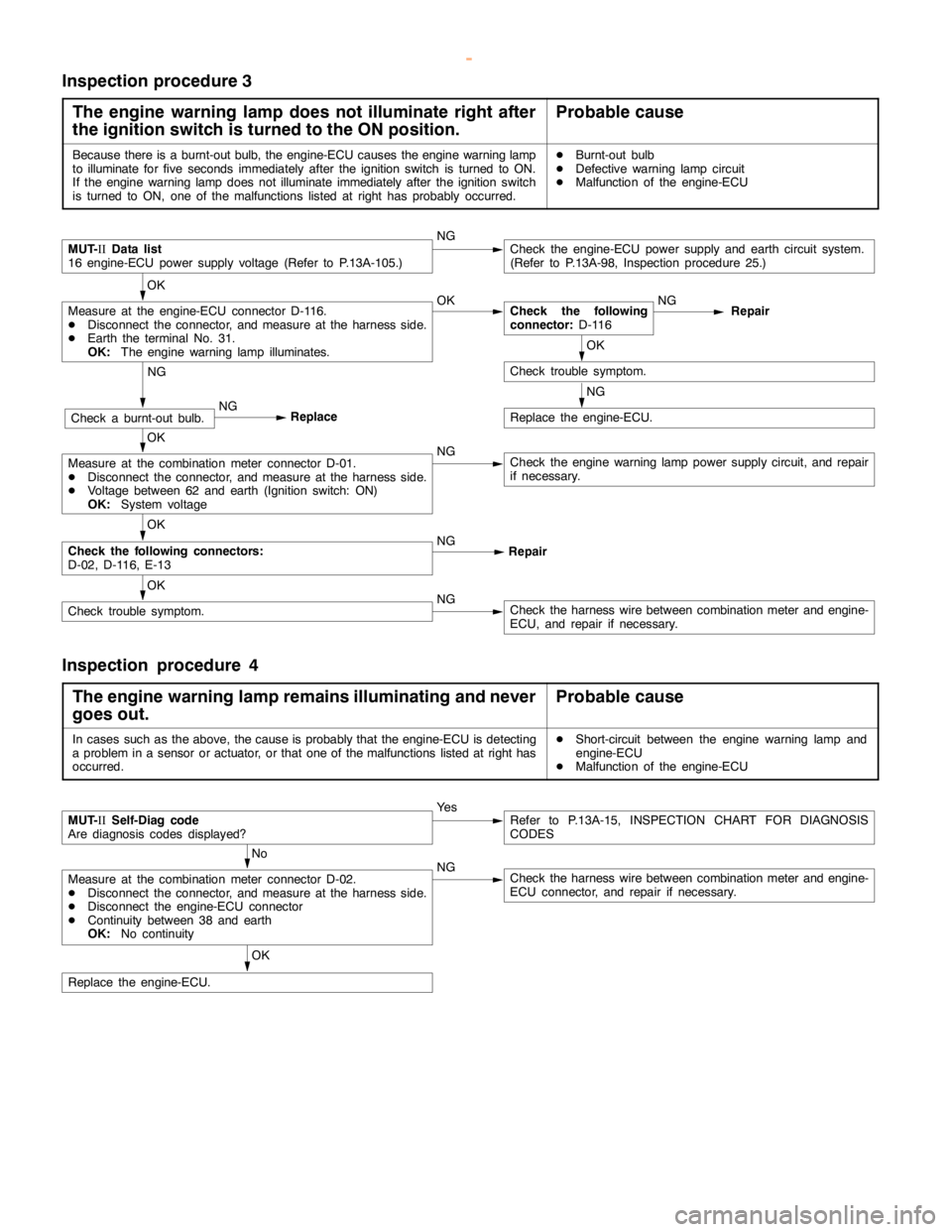
GDI -Troubleshooting
Inspection procedure 3
The engine warning lamp does not illuminate right after
the ignition switch is turned to the ON position.
Probable cause
Because there is a burnt-out bulb, the engine-ECU causes theengine warning lamp
to illuminate forfive seconds immediately after the ignition switch is turned to ON.
If the engine warning lampdoes notilluminate immediately after the ignitionswitch
is turned to ON, one of the malfunctions listed at right has probably occurred.DBurnt-out bulb
DDefective warninglampcircuit
DMalfunction of the engine-ECU
MUT-
IIData list
16 engine-ECU power supply voltage (Refer to P.13A-105.)NGCheck the engine-ECU power supply and earth circuit system.
(Refer to P.13A-98, Inspection procedure 25.)
OK
Measure at the engine-ECU connector D-116.
DDisconnect the connector, and measure at the harness side.
DEarth the terminal No. 31.
OK:
The engine warning lamp illuminates.OKCheck the following
connector:
D-116NG
Repair
OK
Check trouble symptom.
NG
Replace the engine-ECU.
NG
Check a burnt-out bulb.NG
Replace
OK
Measure at the combination meter connector D-01.
DDisconnect the connector, and measure at the harness side.
DVoltage between 62 and earth (Ignition switch: ON)
OK:
System voltageNGCheck theengine warning lamppower supply circuit, and repair
if necessary.
OK
Check the following connectors:
D-02, D-116, E-13NG
Repair
OK
Check trouble symptom.NGCheck the harness wire between combination meter and engine-
ECU, and repair if necessary.
Inspection procedure 4
The engine warning lamp remains illuminating and never
goes out.
Probable cause
In cases such as the above, the cause is probably that the engine-ECU is detecting
a problem in a sensor or actuator, or that one of the malfunctions listed at right has
occurred.DShort-circuit between the engine warning lamp and
engine-ECU
DMalfunction of the engine-ECU
MUT-
IISelf-Diag code
Are diagnosis codes displayed?Ye sRefer to P.13A-15, INSPECTION CHART FOR DIAGNOSIS
CODES
No
Measure at the combination meter connector D-02.
DDisconnect the connector, and measure at the harness side.
DDisconnect the engine-ECU connector
DContinuity between 38 and earth
OK:
No continuityNGCheck the harness wire between combination meter and engine-
ECU connector, and repair if necessary.
OK
Replace the engine-ECU.
www.WorkshopManuals.co.uk
Purchased from www.WorkshopManuals.co.uk
Page 326 of 1839

GDI -Troubleshooting
Terminal
No.Normal condition Check requirements (engine condition) Check item
16Purge control solenoid valveDEngine cool-Engine: stoppedSystem voltage
ant tempera-
ture:
80 - 95_C
DIgnition
switch: ON
Engine: Start the
engine, and then
increase engine
speed up to 3,500
r/min.Voltage decreases.
18Condenser fan relayCondenser fan is not operating.System voltage
Condenser fan is operating.0-3V
20Fuel pump relayIgnition switch:Engine: stoppedSystem voltage
ON
Engine: idling0-3V
21A/C relayDEngine: idlingSystem voltage, or changes
DA/C switch: OFF®ON
(Compressor is operating)from momentarily 6 V or
more to 0®3V
31Engine warning lampIgnition switch: OFF®ON0-3V®System voltage
(after several seconds)
41Sensor power supplyIgnition switch: ON4.5 - 5.5 V
42Power supply to accelerator
pedal position sensor (1st
channel)Ignition switch: ON4.5 - 5.5 V
43Crank angle sensorEngine: Cranking0.4 - 4.0 V
Engine: Idling1.5 - 2.5 V
44Engine coolant temperature
sensorIgnition switch:
ONEngine coolant
temperature: 0_C3.2 - 3.5 V
Engine coolant
temperature:
20_C2.3 - 2.9 V
Engine coolant
temperature:
40_C1.5 - 2.1 V
Engine coolant
temperature:
80_C0.4 - 1.0 V
45Engine ignition signalEngine: 3,000 r/min0.3 - 3.0 V
www.WorkshopManuals.co.uk
Purchased from www.WorkshopManuals.co.uk