warning MITSUBISHI MONTERO 2000 Service Owner's Manual
[x] Cancel search | Manufacturer: MITSUBISHI, Model Year: 2000, Model line: MONTERO, Model: MITSUBISHI MONTERO 2000Pages: 1839, PDF Size: 29.19 MB
Page 526 of 1839

DIESEL FUEL <4M4> -Troubleshooting13C-35
Item
No.Check itemInspection conditionsValue to be
determined
as normalCode No.
or inspec-
tion proce-
dure No.Reference
page
50Condenser
fan relayIgnition switch: ONA/C switch: OFF
(engine coolant tem-
perature at 109_Cor
higher)
A/C switch: ON
(engine coolant tem-
perature at 109_Cor
higher or no higher
than 109_C and the
vehicle speed at 60
km/h or slower)ON––
A/C switch: OFF
(engine coolant tem-
perature at 109_Cor
lower)
A/C switch: ON
(engine coolant tem-
perature at 109_Cor
lower or no higher than
109_C and the vehicle
speed at 60 km/h or
faster)OFF
52Glow plug
relayIgnition switch:
OFF®ONEngine coolant tem-
perature at 60_Cor
lowerON––
Engine coolant tem-OFF
perature at 60_Cor
higher
53Main throttleIgnition switch: ON (Engine stops)OFF––
solenoid
valveEngine: Idling after warming up the engineON
54Sub throttleEngine: Idling after warming up the engineOFF––
solenoid
valveEngine: Idling®Stop (within 3 seconds)ON
55EngineIgnition switch: OFF®ONON (For 5Procedure13C-25
warning
lampseconds)No. 3
56Glow lampIgnition switch:
OFF®ONThe engine coolant
temperature at 60_C
or lowerON––
The engine coolant
temperature at 60_C
or higherOFF
www.WorkshopManuals.co.uk
Purchased from www.WorkshopManuals.co.uk
Page 528 of 1839

DIESEL FUEL <4M4> -Troubleshooting13C-37
ACTUATOR TEST TABLE
Item
No.Check itemDrive Con-
tentsInspection
conditionsValue to be determined
as normalCode No.
or inspec-
tion proce-
dure No.Reference
page
02Glow plug relayTurning theIgnition switch:Battery charge is––
relay from
OFF to ON orONenergized to the glow
plug when the glow
from ON to
OFFplug relay is ON.
03A/C compressorTurning theIgnition switch:The A/C compressor––
relayrelay from
OFF to ON orONclutch makes an
audible sound.
from ON to
OFF
11Timing control
valveTurn the
timing control
valve to ONDIgnition
switch: ON
DEngine:
IdlingMakes an audible
soundCode
No.4313C-20
12Turn the
timing control
valve to OFF
Idling
DTimer piston
position
sensor:
Normal
15Glow lampTurn the glow
lamp on or offIgnition switch:
ONThe glow lamp turns
on––
16Warning lampTurn the
warning lamp
on or offIgnition switch:
ONThe warning lamp
turns onProcedure
No.3, 413C-25
22Condenser fan
relayTurning the
relay from
OFF to ON or
from ON to
OFFIgnition switch:
ONThe condenser fan
rotates.––
23Main throttle
solenoid valveTurn the
solenoid
valve from
OFF to ON or
from ON to
OFFDIgnition
switch: ON
DVehicle
speed:
0 km/h
DEngine
speed:
1,000 r/min
or lowerMakes an audible
soundCode
No.4113C-19
24Sub throttle
solenoid valveTurn the
solenoid
valve from
OFF to ON or
from ON to
OFFDIgnition
switch: ON
DVehicle
speed:
0 km/h
DEngine
speed:
1,000 r/min
or lowerMakes an audible
sound––
www.WorkshopManuals.co.uk
Purchased from www.WorkshopManuals.co.uk
Page 590 of 1839

13E-1
MITSUBISHI STABILITY
CONTROL
(MITSUBISHI SC)
CONTENTS
GENERAL INFORMATION 2................
SERVICE SPECIFICATIONS 4..............
SPECIAL TOOLS 4........................
TROUBLESHOOTING 5....................
ON-VEHICLE SERVICE 18.................
Operation Test of MITSUBISHI SC 18.........Wheel Speed Sensor (FR) Check 18..........
Vehicle Speed Sensor Check 18..............
SC-ECU* 19...............................
G SENSOR 20.............................
WHEEL SPEED SENSOR (FR) 20..........
VEHICLE SPEED SENSOR 20..............
WARNINGS REGARDING SERVICING OF SUPPLEMENTAL RESTRAINT SYSTEM (SRS) EQUIPPED VEHICLES
WARNING!
(1) Improper service or maintenance of any component of the SRS, or any SRS-related component, can lead to personal
injury or death to service personnel (from inadvertent firing of the air bag) or to the driver and passenger (from rendering
the SRS inoperative).
(2) Service or maintenance of any SRS component or SRS-related component must be performed only at an authorized
MITSUBISHI dealer.
(3) MITSUBISHI dealer personnel must thoroughly review this manual, and especially its GROUP 52B - Supplemental
Restraint System (SRS) before beginning any service or maintenance of any component of the SRS or any SRS-related
component.
NOTE
The SRS includes the following components: front impact sensors, SRS-ECU, SRS warning lamp, air bag module, clock spring and
interconnecting wiring. Other SRS-related components (that may have to be removed/installed in connection with SRS service or
maintenance) are indicated in the table of contents by an asterisk (*).
www.WorkshopManuals.co.uk
Purchased from www.WorkshopManuals.co.uk
Page 595 of 1839

MITSUBISHI SC-Troubleshooting13E-6
INSPECTION CHART FOR DIAGNOSIS CODES
Diagnosis
code No.Diagnosis itemSC warning lampReference page
27*1SC-ECU power supply system (abnormal voltage drop)Flashes13E-6
51*2Vehicle speed sensor wheel speed sensor system (output
signal abnormality)Flashes13E-7
52Vehicle speed sensor system (open circuit or short-circuit)Flashes13E-8
53*2Wheel speed sensor system (open circuit or short-circuit)Flashes13E-8
55*2G sensor systemFlashes13E-9
71Communication line between the engine-ECU or engine-
A/T-ECU and the systemFlashes13E-10
72Engine-ECU or Engine-A/T-ECU systemIlluminates13E-10
74*2Communication line between the A/T-ECU and the system
<4M4-A/T>Flashes13E-11
81*1The SC - ECU is controlling the system too longFlashes13E-11
NOTE
*1: Code No.27 and 81 are erased from the memory if the condition returns to normal.
*2: For code Nos.51, 53, 55 and 74, a diagnosis code will be set in ten seconds after a failure is detected.
INSPECTION PROCEDURE FOR DIAGNOSIS CODE
Code No. 27 SC-ECU power supply system (abnormal
voltage drop)Probable cause
This diagnosis code will be set if the SC-ECU power supply voltage drops below
a certain level.DMalfunction of battery
DMalfunction of harness or connector
DMalfunction of the SC-ECU
Caution
If the system voltage drops during inspection, this code will be output to indicate a current problem.
And correct problem diagnosis will not be possible. Before carrying out the following procedure,
check the battery and recharge it if necessary.
www.WorkshopManuals.co.uk
Purchased from www.WorkshopManuals.co.uk
Page 601 of 1839
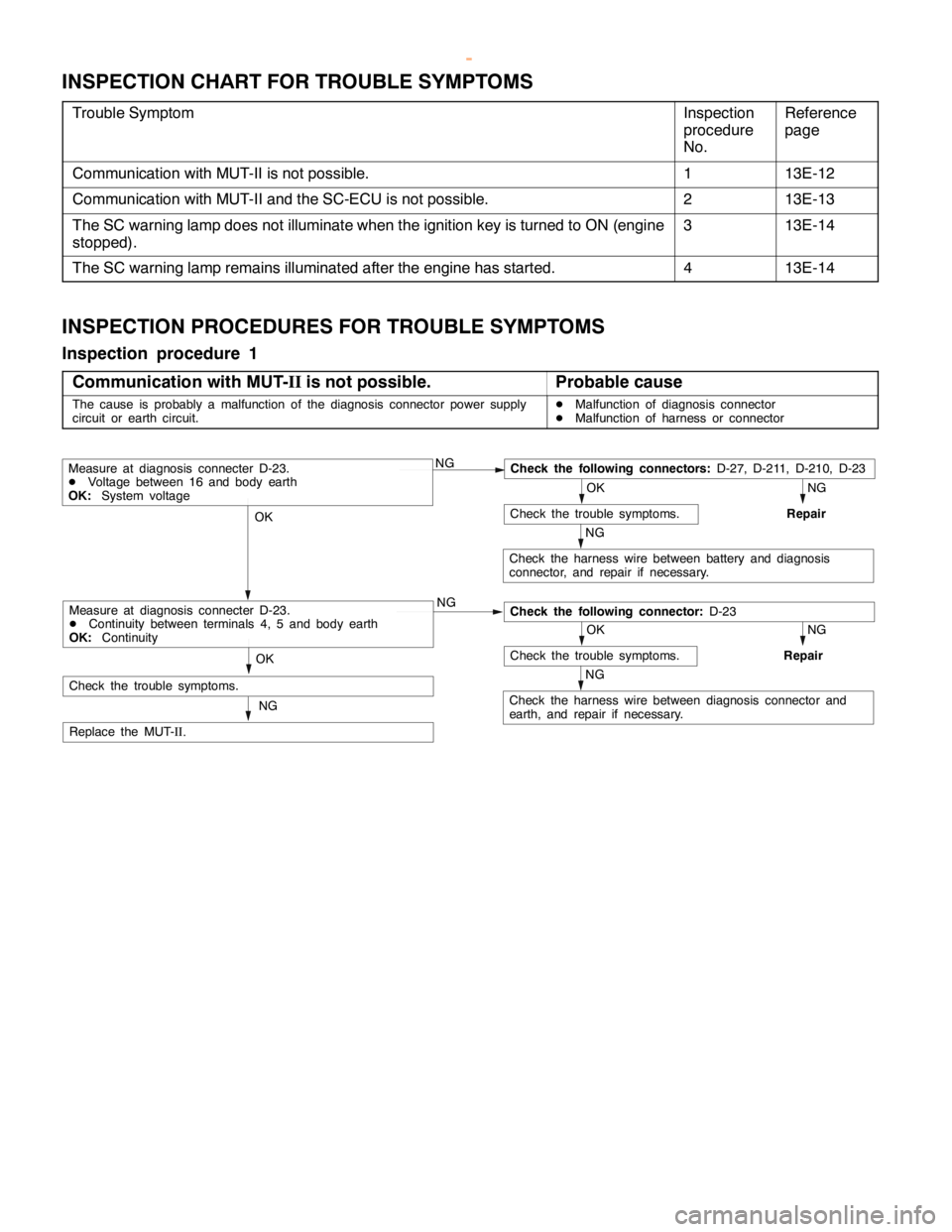
MITSUBISHI SC-Troubleshooting13E-12
INSPECTION CHART FOR TROUBLE SYMPTOMS
Trouble SymptomInspection
procedure
No.Reference
page
Communication with MUT-II is not possible.113E-12
Communication with MUT-II and the SC-ECU is not possible.213E-13
The SC warning lamp does not illuminate when the ignition key is turned to ON (engine
stopped).313E-14
The SC warning lamp remains illuminated after the engine has started.413E-14
INSPECTION PROCEDURES FOR TROUBLE SYMPTOMS
Inspection procedure 1
Communication with MUT-
IIis not possible.
Probable cause
The cause is probably a malfunction of the diagnosis connector power supply
circuit or earth circuit.DMalfunction of diagnosis connector
DMalfunction of harness or connector
NGCheck the following connectors:
D-27, D-211, D-210, D-23
NG
Repair
OK
Check the trouble symptoms.
NG
Check the harness wire between battery and diagnosis
connector, and repair if necessary.
OK
NG
NG
Repair
OK
Check the trouble symptoms.
NG
Check the harness wire between diagnosis connector and
earth, and repair if necessary.
OK
NG
Replace the MUT-
II.
Measure at diagnosis connecter D-23.
DVoltage between 16 and body earth
OK:
System voltage
Check the following connector:
D-23Measure at diagnosis connecter D-23.
DContinuity between terminals 4, 5 and body earth
OK:
Continuity
Check the trouble symptoms.
www.WorkshopManuals.co.uk
Purchased from www.WorkshopManuals.co.uk
Page 603 of 1839
MITSUBISHI SC-Troubleshooting13E-14
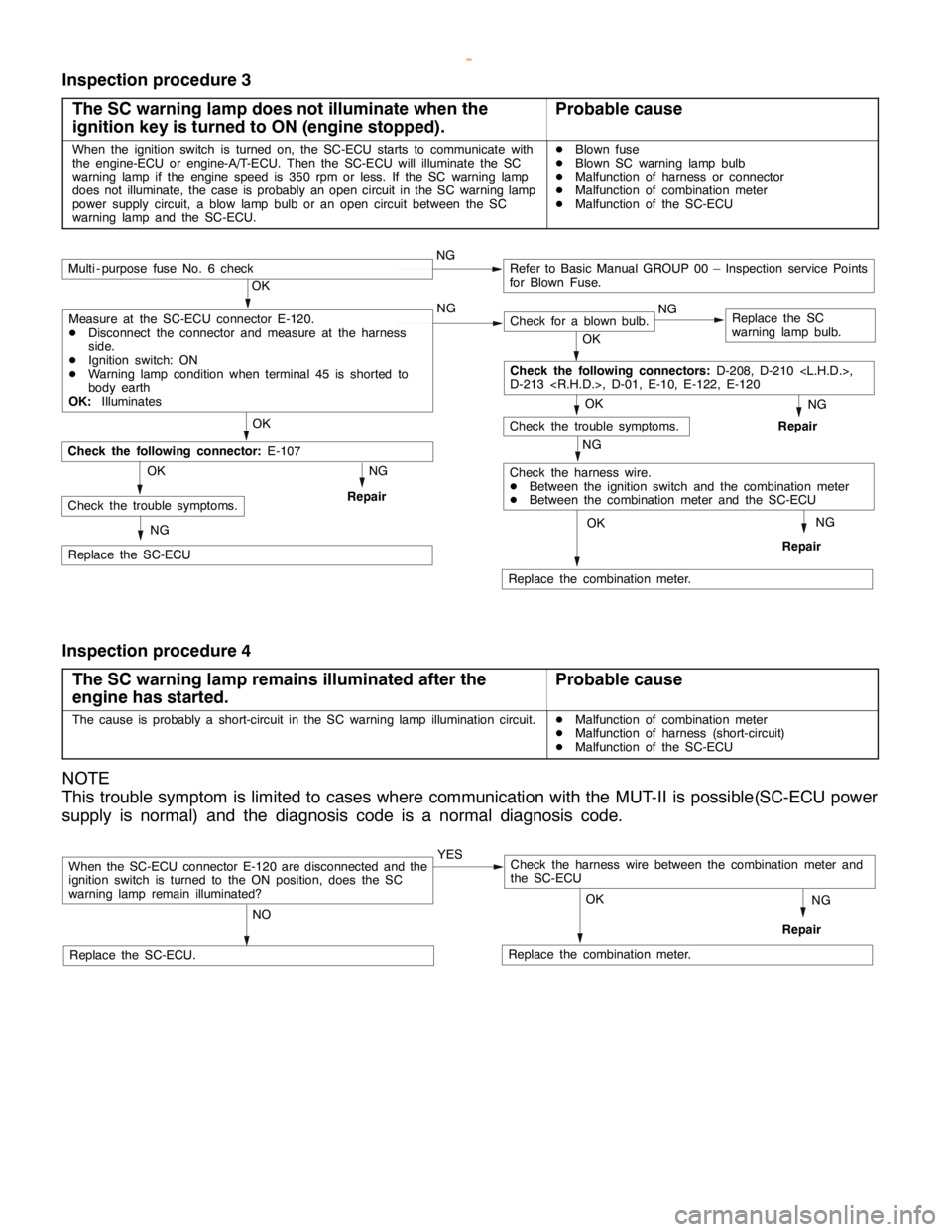
Inspection procedure 3
The SC warning lamp does not illuminate when the
ignition key is turned to ON (engine stopped).
Probable cause
When the ignition switch is turned on, the SC-ECU starts to communicate with
the engine-ECU or engine-A/T-ECU. Then the SC-ECU will illuminate the SC
warning lamp if the engine speed is 350 rpm or less. If the SC warning lamp
does not illuminate, the case is probably an open circuit in the SC warning lamp
power supply circuit, a blow lamp bulb or an open circuit between the SC
warning lamp and the SC-ECU.DBlown fuse
DBlown SC warning lamp bulb
DMalfunction of harness or connector
DMalfunction of combination meter
DMalfunction of the SC-ECU
NG
Replace the combination meter.
NG
Repair
OK
NG
Check for a blown bulb.Replace the SC
warning lamp bulb.
OK
NG
Repair
OK
Check the trouble symptoms.
Multi - purpose fuse No. 6 checkNGRefer to Basic Manual GROUP 00 – Inspection service Points
for Blown Fuse.
NG
Check the harness wire.
DBetween the ignition switch and the combination meter
DBetween the combination meter and the SC-ECU
OK
OK
Replace the SC-ECU
Check the following connector:
E-107
NG
RepairCheck the trouble symptoms.OK
NG
Check the following connectors:
D-208, D-210
D-213
Measure at the SC-ECU connector E-120.
DDisconnect the connector and measure at the harness
side.
DIgnition switch: ON
DWarning lamp condition when terminal 45 is shorted to
body earth
OK:
Illuminates
Inspection procedure 4
The SC warning lamp remains illuminated after the
engine has started.
Probable cause
The cause is probably a short-circuit in the SC warning lamp illumination circuit.DMalfunction of combination meter
DMalfunction of harness (short-circuit)
DMalfunction of the SC-ECU
NOTE
This trouble symptom is limited to cases where communication with the MUT-II is possible(SC-ECU power
supply is normal) and the diagnosis code is a normal diagnosis code.
When the SC-ECU connector E-120 are disconnected and the
ignition switch is turned to the ON position, does the SC
warning lamp remain illuminated?YES
NO
Replace the SC-ECU.Replace the combination meter.
NG
Repair
OK
Check the harness wire between the combination meter and
the SC-ECU
www.WorkshopManuals.co.uk
Purchased from www.WorkshopManuals.co.uk
Page 612 of 1839

DIESEL FUEL <4D5-stepIII>-General/General Information13E-2
GENERAL
OUTLINE OF CHANGE
An electronically-controlled injection pump has been added in order to comply with Regulation STEP
III. Due to this, the following service procedures have been added.
GENERAL INFORMATION
The electronically-controlled fuel injection system consists of sensors which detect the condition of the
diesel engine, an engine-ECU which controls the system based on signals from these sensors, and actuators
which operate according to control commands from the engine-ECU.
The engine-ECU carries out operations such as fuel injection rate control, fuel injection timing control
and idle up control. In addition, the engine-ECU is equipped with several self-diagnosis functions which
make troubleshooting easier in the event that a problem develops.
FUEL INJECTION RATE CONTROL
The fuel injection completion timing is controlled by means of a solenoid-type spill valve to ensure that
the optimum amount of fuel is supplied to the engine in accordance with gradual changes in the engine
running condition.
Before fuel injection starts, the solenoid-type spill valve is on (energized), so that the valve is closed.
As the plunger turns and rises, fuel is sent out under pressure, and when the fuel flow rate reaches
the target value for fuel injection, the solenoid-type spill valve turns off. When the solenoid-type spill
valve turns off, the fuel under high pressure inside the plunger is leaked out into the pump chamber
and fuel injection is completed.
FUEL INJECTION TIMING CONTROL
The position of the injection pump timer piston is controlled so that fuel injection is carried out at the
optimum timing in accordance with the engine running condition.
The timer piston position is determined by duty control of the timing control solenoid valve which is located
in the line between the high-pressure chamber and the low-pressure chamber of the timer piston.
The fuel injection timing is advanced by increasing the control duty of the timing control solenoid valve.
IDLE SPEED CONTROL
Controlling the fuel injection rate in accordance with the engine running condition maintains the idle speed
at the optimum condition.
SELF-DIAGNOSIS FUNCTION
DWhen an abnormality is detected in any of the sensors or actuators, the engine warning lamp illuminates
to warn the driver.
DWhen an abnormality is detected in any of the sensors or actuators, a diagnosis code number
corresponding to the problem which occurred is output.
DThe RAM data relating to the sensors and actuators which is stored in the engine-ECU can be read
using the MUT-II. In addition, the actuators can be force-driven under certain conditions.
OTHER CONTROL FUNCTIONS
1. Power Supply Control
When the ignition switch is turned to ON, the relay turns on and power is supplied to components
such as the timing control solenoid valve.
2. Intake Air Throttle Control
When the engine-ECU detects an abnormality in any of the sensors or actuators, the throttle valve
is half opened to restrict the amount of intake air in order to prevent the vehicle from running away.
3. A/C Relay Control
Turns the compressor clutch of the A/C ON and OFF
4. Condenser Fan Motor Relay Control
Controls the condenser fan motor relay based on the A/C switch, engine coolant temperature and
vehicle speed input signals.
5. Glow Control
Refer to GROUP 16.
6. EGR Control
Refer to GROUP 17.
www.WorkshopManuals.co.uk
Purchased from www.WorkshopManuals.co.uk
Page 638 of 1839

DIESEL FUEL <4D5-stepIII>-Troubleshooting13E-28
INSPECTION CHART FOR TROUBLE SYMPTOMS
Trouble SymptomInspection
procedure
No.Reference
page
No communication can
beestablishedbe
No communication can be established with all systems.113E-29
beestablishedbe-
tween MUT-IIand the
engine-ECU.
No communication can be established only with the
engine-ECU.213E-29
Engine warning lamp
relatedImmediately after the ignition switch is “ON”, the engine
warning lamp does not turn on.313E-30
The engine warning lamp keeps on and does not turn off.413E-30
Starting performanceNo initial combustion (unable to start)513E-31
Starting performance is bad when the engine is cold (difficult to
start)613E-31
Starting performance is bad regardless of when the engine is
hot or cold (difficult to start)713E-32
Idling stability
(idling inoperative)Low idling speed when the engine is cold (improper idling
speed)813E-32
High idling speed (improper idling speed)913E-32
Low idling speed (improper idling speed)1013E-33
Idling instable (rough idling, hunting)1113E-33
Idling stability
(idlingsustainmentin
The engine halts after running for a while.1213E-33
(idling sustainmentin-
operative)
The engine halts during idling.1313E-34
DriveabilityLack of output power1413E-34
Occurrence of abnormal knocking1513E-34
Abnormal black smoke1613E-35
Abnormal white smoke1713E-35
Hunting during driving1813E-35
A/C condenser fan malfunction1913E-36
www.WorkshopManuals.co.uk
Purchased from www.WorkshopManuals.co.uk
Page 640 of 1839
DIESEL FUEL <4D5-stepIII>-Troubleshooting13E-30
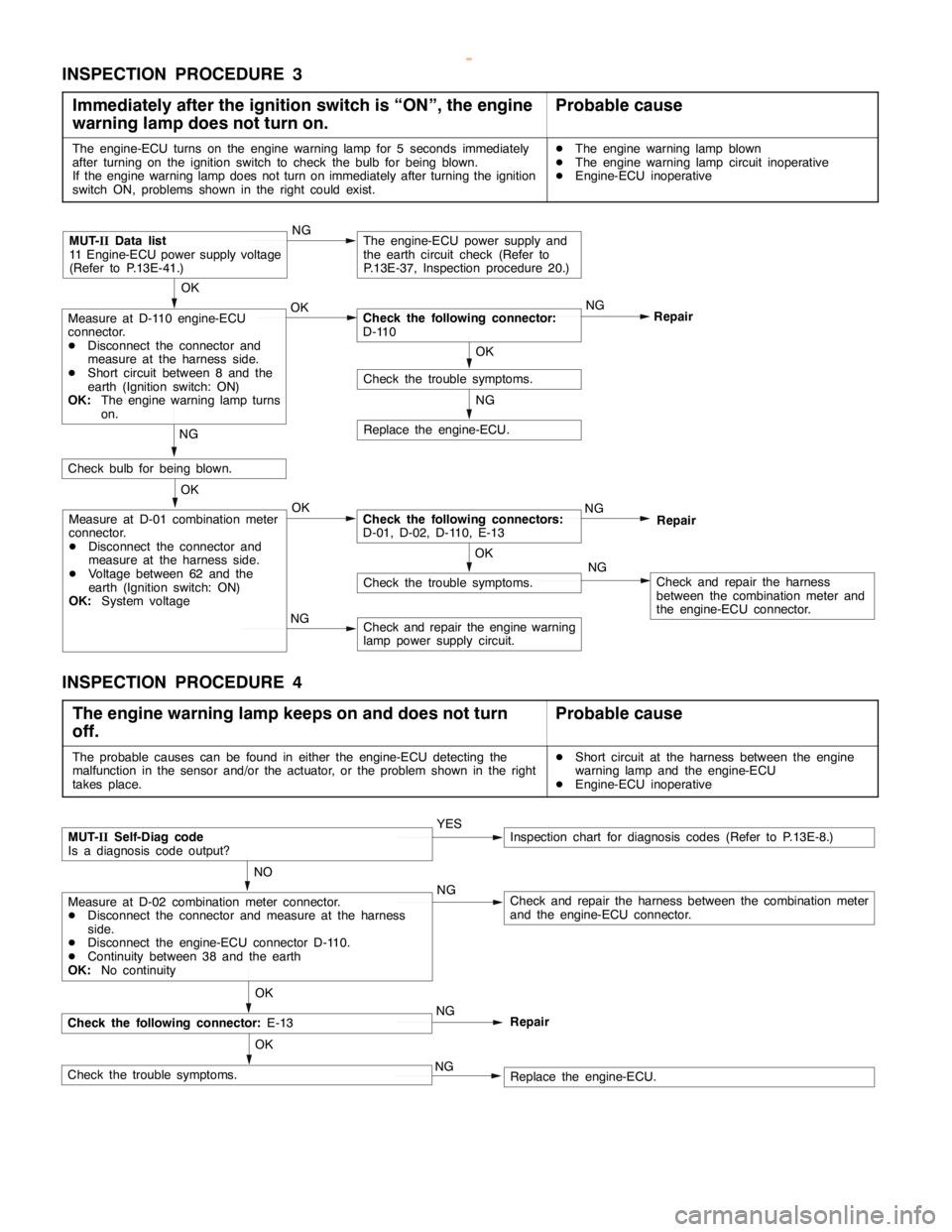
INSPECTION PROCEDURE 3
Immediately after the ignition switch is “ON”, the engine
warning lamp does not turn on.
Probable cause
The engine-ECU turns on the engine warning lamp for 5 seconds immediately
after turning on the ignition switch to check the bulb for being blown.
If the engine warning lamp does not turn on immediately after turning the ignition
switch ON, problems shown in the right could exist.DThe engine warning lamp blown
DThe engine warning lamp circuit inoperative
DEngine-ECU inoperative
NG
Replace the engine-ECU.
NG
Check and repair the harness
between the combination meter and
the engine-ECU connector.
NG
Check and repair the engine warning
lamp power supply circuit.
OK
Check the trouble symptoms.
OK
Measure at D-01 combination meter
connector.
DDisconnect the connector and
measure at the harness side.
DVoltage between 62 and the
earth (Ignition switch: ON)
OK:System voltageOKCheck the following connectors:
D-01, D-02, D-110, E-13NG
Repair
NG
Check bulb for being blown.
OK
Check the trouble symptoms.
OK
Measure at D-110 engine-ECU
connector.
DDisconnect the connector and
measure at the harness side.
DShort circuit between 8 and the
earth (Ignition switch: ON)
OK:The engine warning lamp turns
on.OKCheck the following connector:
D-110NG
Repair
MUT-IIData list
11 Engine-ECU power supply voltage
(Refer to P.13E-41.)NGThe engine-ECU power supply and
the earth circuit check (Refer to
P.13E-37, Inspection procedure 20.)
INSPECTION PROCEDURE 4
The engine warning lamp keeps on and does not turn
off.
Probable cause
The probable causes can be found in either the engine-ECU detecting the
malfunction in the sensor and/or the actuator, or the problem shown in the right
takes place.DShort circuit at the harness between the engine
warning lamp and the engine-ECU
DEngine-ECU inoperative
Check the following connector:E-13
NO
Measure at D-02 combination meter connector.
DDisconnect the connector and measure at the harness
side.
DDisconnect the engine-ECU connector D-110.
DContinuity between 38 and the earth
OK:No continuityNGCheck and repair the harness between the combination meter
and the engine-ECU connector.
OK
MUT-IISelf-Diag code
Is a diagnosis code output?YESInspection chart for diagnosis codes (Refer to P.13E-8.)
Check the trouble symptoms.OKReplace the engine-ECU. NGNG
Repair
www.WorkshopManuals.co.uk
Purchased from www.WorkshopManuals.co.uk
Page 653 of 1839

DIESEL FUEL <4D5-stepIII>-Troubleshooting13E-43
Item
No.Check itemInspection conditionsValue to be
determined
as normalCode No.
or inspec-
tion proce-
dure No.Reference
page
50Condenser
fan relayIgnition switch: ONA/C switch: OFF
(engine coolant
temperature at 102_C
or higher)
A/C switch: ON
(engine coolant
temperature at 102_C
or higher, or outside
temperature at 15_C
or higher)ONProcedure
No. 1913E-36
Condenser
fan relayIgnition switch: ONA/C switch: OFF
(engine coolant
temperature at 95_C
or lower)
A/C switch: ON
(engine coolant
temperature at 95_Cor
lower, or outside
temperature at 15_C
or lower)OFF
52Glow plug
relayDIgnition switch:
ONRelay not drivenOFFProcedure
No. 2413E-39
relayON
DSelect actuator
test item No. 02.Relay is forcibly drivenON
No.24
53Throttle
solenoid
Ignition switch: ON (Engine stops)OFFCode No.
41
13E-20
solenoid
valveEngine: main sensor or actuator is failedON41
55Engine
warningDIgnition switch:
ON
S
Engine warning lamp
offOFFProcedure
No. 313E-30
g
lampDSelect actuator
test item No. 16.Engine warning lamp is
forced onON
56Glow lampDIgnition switch:
ONGlow lamp offOFF––
ON
DSelect actuator
test item No. 15.Glow lamp is forced onON
60Fuel cut
relay
DIgnition switch: ON
DSelectactuator
Relay not drivenOFFProcedure
No21
13E-37
relayDSelectactuator
test item No. 27.Relay is forcibly drivenONNo.21
62AT/MT
switchIgnition switch: ONVehicles with M/TM/T––
73EGR control
solenoidEngine: After warming
up the engineIdling under no load
(stable condition)OFFProcedure
No. 2213E-38
valve No. 1
pg
Engine is suddenly
raced (EGR amount
decreasing)OFF
Engine is suddenly
raced (EGR amount
increasing)ON (momen-
tarily)
74EGR control
lid
Engine: After warming
hi
Idling (stable condition)ONProcedure
N
13E-38
solenoid
valve No. 2
gg
up the engineWhen engine is sud-
denly raced (EGR
amount decreasing)OFF (mo-
mentarily)No. 23
When engine is sud-
denly raced (EGR
amount increasing)ON
www.WorkshopManuals.co.uk
Purchased from www.WorkshopManuals.co.uk