At mode MITSUBISHI MONTERO 2000 Service Owner's Manual
[x] Cancel search | Manufacturer: MITSUBISHI, Model Year: 2000, Model line: MONTERO, Model: MITSUBISHI MONTERO 2000Pages: 1839, PDF Size: 29.19 MB
Page 215 of 1839

GASOLINE DIRECT
INJECTION (GDI)
Click on the applicable bookmark to selected the required model year.
www.WorkshopManuals.co.uk
Purchased from www.WorkshopManuals.co.uk
Page 217 of 1839

GDI -General Information13A-3
GENERAL INFORMATION
The Gasoline Direct Injection System consists
of sensors which detect the engine conditions,
the engine-ECU
which controls the system based on
signals from these sensors, and actuators
which operate under the control of the
engine-ECU
carries out activities such as fuel injection
control, idle speed control and ignition timing
control. In addition, the engine-ECU
engine-A/T-ECU is equipped with several
diagnosis modes which simplify troubleshooting
when a problem develops.
FUEL INJECTION CONTROL
The injector drive times and injector timing are
controlled so that the optimum air/fuel mixture
is supplied to the engine to correspond to the
continually-changing engine operation condi-
tions.
A single injector for each cylinder is mounted
at the cylinder head. The fuel is sent under
pressure from the fuel tank to the fuel pressure
regulator (low pressure) by the fuel pump (low
pressure). The pressure is regulated by the
fuel pressure regulator (low pressure) and the
fuel regulated is then sent to the fuel pump
(high pressure). The fuel under increased
pressure generated by the fuel pump (high
pressure) is then regulated by the fuel pressure
regulator (high pressure) and is then distributed
to each of the injectors via the delivery pipes.Fuel injection is normally carried out once for
each cylinder for every two rotations of the
crankshaft. The firing order is 1-2-3-4-5-6. This
is called sequential fuel injection.
When the engine is cold or under a severe
load, the “open-loop” control keeps the air/fuel
ratio at a richer than usual level to maintain
driveability. When the engine is under low or
medium loads, the air/fuel ratio becomes leaner
to reduce fuel consumption. When the engine
is running at medium or high loads after having
warmed up, the “closed-loop” control uses the
signal from the oxygen sensor to keep the
air/fuel ratio at the optimum theoretical level.
THROTTLE VALVE OPENING ANGLE CONTROL
This system controls throttle valve opening
angle electronically. The engine-ECU
or engine-A/T-ECU determines how
deeply the accelerator pedal is depressed by
means of the accelerator position sensor (APS).
Then the engine-ECU
throttle valve opening angle to the throttle valve
controller. The throttle valve control servo
operates the throttle valve so that it reaches
the target opening angle.
IDLE SPEED CONTROL
This system maintains engine idle speed at
a predetermined condition by controlling the
air flow that passes through the throttle valve
according to engine idling condition and engine
loads at idling.
The engine-ECU
operates the throttle valve control servoso that engine speed is maintained within a
map value. The map value is predetermined
according to engine coolant temperature and
air-conditioning load.
IGNITION TIMING CONTROL
The power transistor located in the ignition
primary circuit turns ON and OFF to control
the primary current flow to the ignition coil. This
controls the ignition timing in order to provide
the optimum ignition timing with respect to the
engine operating conditions. The ignition timingis determined by the engine-ECU
engine-A/T-ECU from the engine speed,
intake air volume, engine coolant temperature,
atmospheric pressure and injection timing
(intake stroke or compression stroke).
www.WorkshopManuals.co.uk
Purchased from www.WorkshopManuals.co.uk
Page 218 of 1839

GDI -General Information13A-4
SELF-DIAGNOSIS FUNCTION
DWhen an abnormality is detected in one
of the sensors or actuators related to
emission control, the engine warning lamp
(check engine lamp) illuminates or flashes
as a warning to the driver.
DWhen an abnormality is detected in one
of the sensors or actuators, a diagnosis
code corresponding to the abnormality is
output.
DThe engine-ECU records the engine
operating condition when the diagnosis
code is set. This data is called “freezeframe” data.
This data can be read by using the MUT-II,
and can then be used in simulation tests
for troubleshooting.
DThe RAM data inside the engine-ECU
related to the sensors and actuators can
be read by means of the MUT-II. In addition,
the actuators can be force-driven under
certain circumstances.
OTHER CONTROL FUNCTIONS
1. Fuel Pump Control
Turns the fuel pump relay ON so that current
is supplied to the fuel pump while the engine
is cranking or running.
2. A/C Relay Control
Turns the compressor clutch of the A/C
ON and OFF.3. Purge Control Solenoid Valve Control
Refer to GROUP 17.
4. EGR Control Servo Control
Refer to GROUP 17.
GENERAL SPECIFICATIONS
ItemsSpecifications
Throttle bodyThrottle bore mm65
Throttle position sensorVariable resistor type
Throttle valve control servoBrushless DC-motor type
Engine-ECUIdentification model No.E2T79271
E2T79272
Engine-Identification model No.E2T76277
A/T-ECU
E2T76278
www.WorkshopManuals.co.uk
Purchased from www.WorkshopManuals.co.uk
Page 225 of 1839

GDI -Troubleshooting
4. Sensor 1 indicates the sensor mounted at a position closest to the engine, and sensor 2 indicates
the sensor mounted at the position second closest to the engine.
METHOD OF READING AND ERASING DIAGNOSIS
CODES
Refer to GROUP 00 - How to Use Troubleshooting/Inspection
Service Points.
DIAGNOSIS USING DIAGNOSIS 2 MODE
1. Switch the diagnosis mode of the engine control unit
to DIAGNOSIS 2 mode using the MUT-II.
2. Carry out a road test.
3. Take a reading of the diagnosis code and repair the
problem location.
4. Turn the ignition switch to OFF and then back to ON
again.
NOTE
By turning the ignition switch to OFF, the ENGINE-ECU will
switch the diagnosis mode from DIAGNOSIS 2 mode to
DIAGNOSIS 1 mode.
5. Erase the diagnosis codes.
INSPECTION USING MUT-II
DATA LIST AND
ACTUATOR TESTING
1. Carry out inspection by means of the data list and the
actuator test function. If there is an abnormality, check
and repair the chassis harnesses and components.
2. After repairing, re-check using the MUT-IIand check that
the abnormal input and output have returned to normal
as a result of the repairs.
3. Erase the diagnosis code memory.
4. Remove the MUT-II, and then start the engine again and
carry out a road test to confirm that the problem has
disappeared.
www.WorkshopManuals.co.uk
Purchased from www.WorkshopManuals.co.uk
Page 323 of 1839

GDI -Troubleshooting
Item
No.Reference
page Inspection
procedure
No. Normal condition Requirements Check items
77Accelerator
pedal positionIgnition switch: ONRelease the accel-
erator pedal.985 - 1085 mVCode
No.P122513A-68
sensor (2nd
channel)
Depress the accel-
erator pedal gradu-
ally.Increases in re-
sponse to the ped-
al depression
stroke.
Depress the accel-
erator pedal fully.4,000 mV or more
78Accelerator
pedal positionIgnition switch: ONRelease the accel-
erator pedal.985 - 1085 mVCode
No.P022013A-50
sensor (1st
channel) *3Depress the accel-
erator pedal gradu-
ally.Increases in re-
sponse to pedal
depression stroke.
Depress the accel-
erator pedal fully.4,200 - 4,800 mV
79Throttle posi-
tion sensorDEngine coolant
temperature:Release the accel-
erator pedal.400 - 800 mVCode
No.012013A-25
(1st channel)80 - 95_C
DIgnition switch:
ON (Engine
stopped)
Depress the accel-
erator pedal gradu-
ally.Increases in re-
sponse to pedal
depression stroke.
4,600 - 5,200 mV4,200 - 4,800 mV
Engine: AfterNo load450 - 1,000 mV
warm-up, idling
A/C switch: OFF®
ONIncreases by 100 -
600 mV.
99Fuel injection
modeEngine: After warm
upIdling (after four
minutes or more
have passed since
engine start)Lean compression--
2,500 r/minStoichiometric
metric feedback
Sudden racing after
idle positionOpen loop
www.WorkshopManuals.co.uk
Purchased from www.WorkshopManuals.co.uk
Page 324 of 1839

GDI -Troubleshooting
ACTUATOR TEST REFERENCE TABLE
Item
No.Inspection
itemDrive contentsInspection contentsNormal conditionInspection
procedure
No.Reference
page
01InjectorsCut fuel to No. 1
injectorEngine:
After havingIdling condition
becomes differentCode No.
P020113A-38
02Cut fuel to No. 2
injector
warmed up/Engine
is idling
(Cut the fuel supply(becomes unsta-
ble).
Code No.
P020213A-40
03Cut fuel to No. 3
injectorto each injector in
turn and check
cylinders whichCode No.
P020313A-42
04Cut fuel to No. 4
injectordon’t affect idling.)Code No.
P020413A-44
05Cut fuel to No. 5
injectorCode No.
P020513A-46
06Cut fuel to No. 6
injectorCode No.
P020613A-48
07Fuel pump
(low pressure)Fuel pump
operates and
fuel is recirculated.Ignition switch: ONSound of opera-
tion is heard.Procedure
No. 2913A-101
08Purge
control
solenoid valveSolenoid valve
turns from OFF to
ON.Ignition switch: ONSound of opera-
tion can be heard
when solenoid
valve is
driven.Code No.
P044313A-62
17Basic ignition
timingSet the engine-
ECU to ignition
timing adjustment
modeIdling after engine
warm up5_BTDC--
21Condenser fanDrive the fan motorIgnition switch: ONThe fan motor
operatesProcedure
No.2113A-95
34Electronic-
controlled
throttle valve
systemStop the throttle
control servo.Ignition switch: ONThrottle valve is
opened slightly.Code No.
P122013A-64
www.WorkshopManuals.co.uk
Purchased from www.WorkshopManuals.co.uk
Page 341 of 1839

Page 409 of 1839
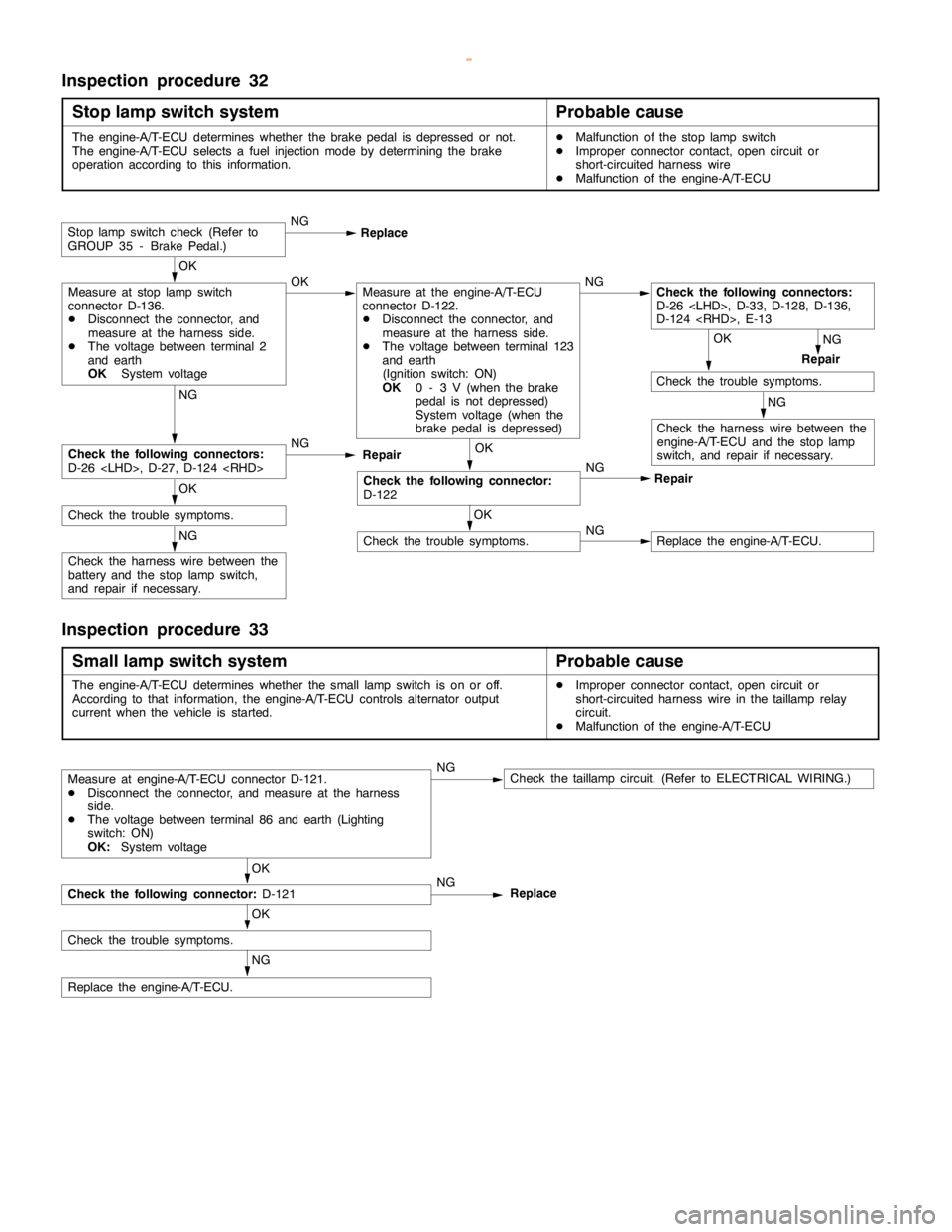
Page 416 of 1839

Page 475 of 1839

GDI -Troubleshooting13A-6
Item
No.Refer-
ence
page Inspec-
tion pro-
cedure
No. Normal condition Inspection contents Inspection
item
81LLearned
valueEngine: Warm, 2,500 r/min without any load
(during closed loop lambda control)- 10 - 10 %Code
No.
P017013A-34*
82LClosed loop
controlEngine: Warm, 2,500 r/min without any load
(during closed loop lambda control)- 25 - 25 %Code
No.
P017013A-34*
87LEngine loadEngine: After having
warmed upIdling (more than 4
minutes later after
the engine has
started)20 - 40 %--
2,500 r/min10 - 30 %
8ALThrottle
position
sensor(1st
DEngine: After hav-
ing warmed up
DIgnitionswitch:ON
Release the
accelerator pedal.0 - 20 %Code
No.
P0120
13A-25*
sensor(1st
channel)
(throttle
valve angle)DIgnition switch:ON
(Engine: stopped)Depress the
accelerator pedal.Increase in
proportion to the
pedal strokeP0120
Depress the
accelerator pedal
fully.80 - 100 %
NOTE
L: will not displayed if service data is selected on the check mode.
*: Refer to the 2001 PAJERO Workshop Manual (Pub.No. PWJE0001)
www.WorkshopManuals.co.uk
Purchased from www.WorkshopManuals.co.uk