MOTOR MITSUBISHI MONTERO 2000 Service Owner's Manual
[x] Cancel search | Manufacturer: MITSUBISHI, Model Year: 2000, Model line: MONTERO, Model: MITSUBISHI MONTERO 2000Pages: 1839, PDF Size: 29.19 MB
Page 1213 of 1839

BASIC BRAKE SYSTEM -Service Specifications35A-5
SERVICE SPECIFICATIONS
ItemsStandard valueLimit
Brake pedal heightL.H. drive vehicles192 - 195-
mm
R.H. drive vehicles187 - 190-
Brake pedal play mm3-8-
Brake pedal to floorboard clearance when the brake pedal is depressed mm90 or more-
Hydraulic brake
booster (HBB)Pump motor
operation timeWhen power supply system brake fluid
pressure is not applied20 - 80-
When power supply system brake fluid
pressure is applied2-11-
Hydraulic pressurePedal depressionFront0.6 or more-
during no vacuum
operation testforce: 100 N
Rear0-
MPa
Pedal depressionFront4.5 or more-
force: 500 N
Rear0-
Hydraulic pressurePedal depressionFront3.0 - 4.0-
during vacuum op-
eration test
MPa
force: 100 N
Rear3.3 - 4.3-
Pedal depressionFront8.0 - 10.0-
force: 200 N
Rear8.0 - 10.0-
Pedal depressionFront14.0 - 18.0-
force: 400 N
Rear14.0 - 18.0-
Pedal depressionFront15.0 - 19.0-
force: 500 N
Rear15.0 - 19.0-
Clearance between brake booster push rod and primary piston6G70.5 - 0.9-
mm
4D5, 4M40.8 - 1.2-
Load sensing propor-When load sensing spring length is 133Short wheelbase4.9 - 5.9 (9.8)-
tioning valve output
fluid pressure (Inputmm (when unladen)
Long wheelbase5.9 - 6.9 (9.8)-
fluid pressure) MPa
9.0 - 11.0
(16.7)-
Long wheelbase9.3 - 10.3 (9.8)-
11.4 - 13.4
(16.7)-
Load sensing spring length
www.WorkshopManuals.co.uk
Purchased from www.WorkshopManuals.co.uk
Page 1217 of 1839
BASIC BRAKE SYSTEM -Troubleshooting35A-9
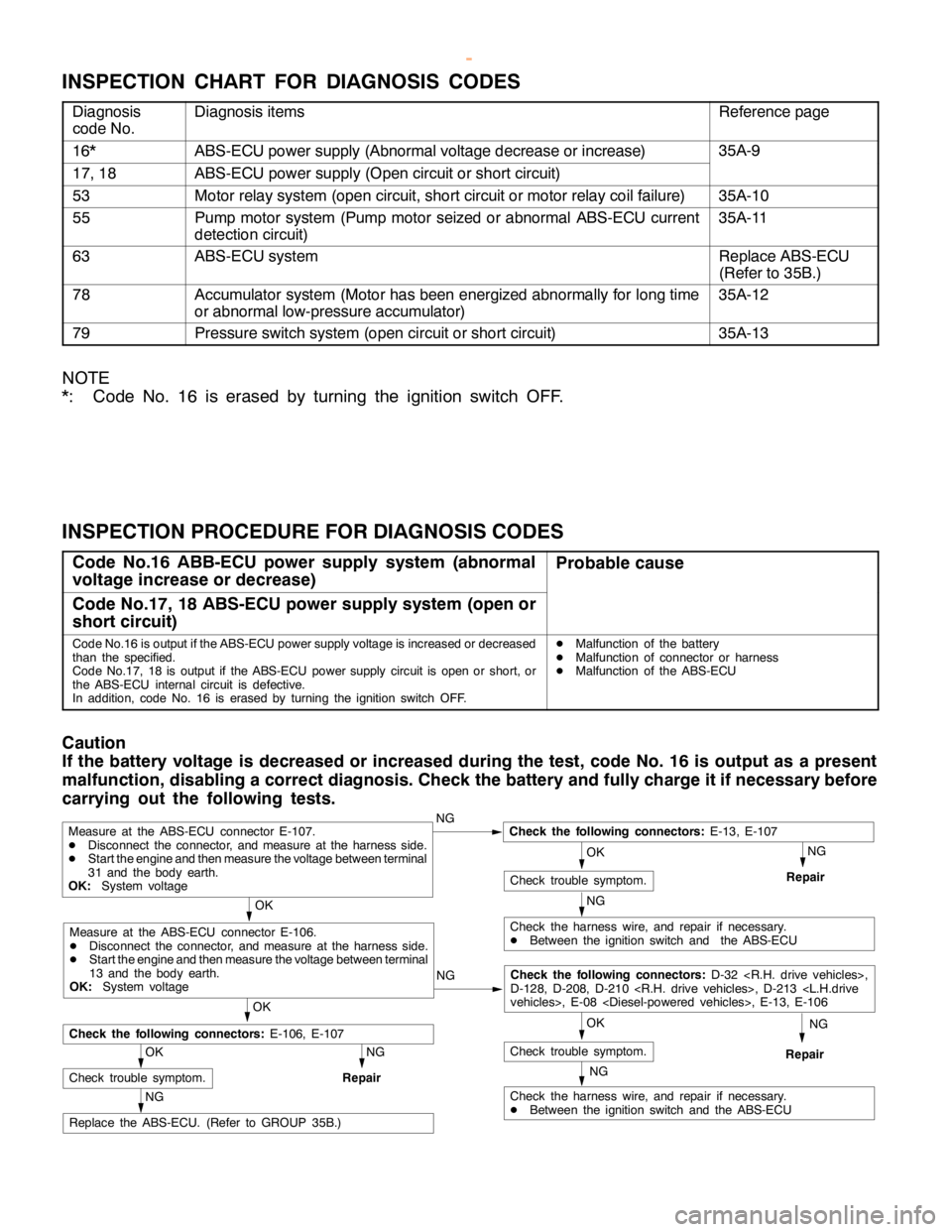
INSPECTION CHART FOR DIAGNOSIS CODES
Diagnosis
code No.Diagnosis itemsReference page
16*ABS-ECU power supply (Abnormal voltage decrease or increase)35A-9
17, 18ABS-ECU power supply (Open circuit or short circuit)
53Motor relay system (open circuit, short circuit or motor relay coil failure)35A-10
55Pump motor system (Pump motor seized or abnormal ABS-ECU current
detection circuit)35A-11
63ABS-ECU systemReplace ABS-ECU
(Refer to 35B.)
78Accumulator system (Motor has been energized abnormally for long time
or abnormal low-pressure accumulator)35A-12
79Pressure switch system (open circuit or short circuit)35A-13
NOTE
*: Code No. 16 is erased by turning the ignition switch OFF.
INSPECTION PROCEDURE FOR DIAGNOSIS CODES
Code No.16 ABB-ECU power supply system (abnormal
voltage increase or decrease)Probable cause
Code No.17, 18 ABS-ECU power supply system (open or
short circuit)
Code No.16 is output if the ABS-ECU power supply voltage is increased or decreased
than the specified.
Code No.17, 18 is output if the ABS-ECU power supply circuit isopen orshort, or
the ABS-ECU internal circuit is defective.
In addition, code No. 16 is erased by turning the ignition switch OFF.DMalfunction of the battery
DMalfunction of connector or harness
DMalfunction of the ABS-ECU
Caution
If the battery voltage is decreased or increased during the test, code No. 16 is output as a present
malfunction, disabling a correct diagnosis. Check the battery and fully charge it if necessary before
carrying out the following tests.
NG
NG
OK
NG
Replace the ABS-ECU. (Refer to GROUP 35B.)
OK
Check trouble symptom.
NG
Repair
NG
Check the harness wire, and repair if necessary.
DBetween the ignition switch and the ABS-ECU
OK
Check trouble symptom.
Measure at the ABS-ECU connector E-107.
DDisconnect the connector, and measure at the harness side.
DStart theengine and then measure the voltage between terminal
31 and the body earth.
OK:System voltageNGCheck the following connectors:E-13, E-107
Repair
OK
Check the following connectors:E-106, E-107
NG
Check the harness wire, and repair if necessary.
DBetween the ignition switch and the ABS-ECU
OK
Check trouble symptom.
Measure at the ABS-ECU connector E-106.
DDisconnect the connector, and measure at the harness side.
DStart theengine and then measure the voltage between terminal
13 and the body earth.
OK:System voltageNG
Check the following connectors:D-32
D-128, D-208, D-210
Repair
www.WorkshopManuals.co.uk
Purchased from www.WorkshopManuals.co.uk
Page 1218 of 1839
BASIC BRAKE SYSTEM -Troubleshooting35A-10
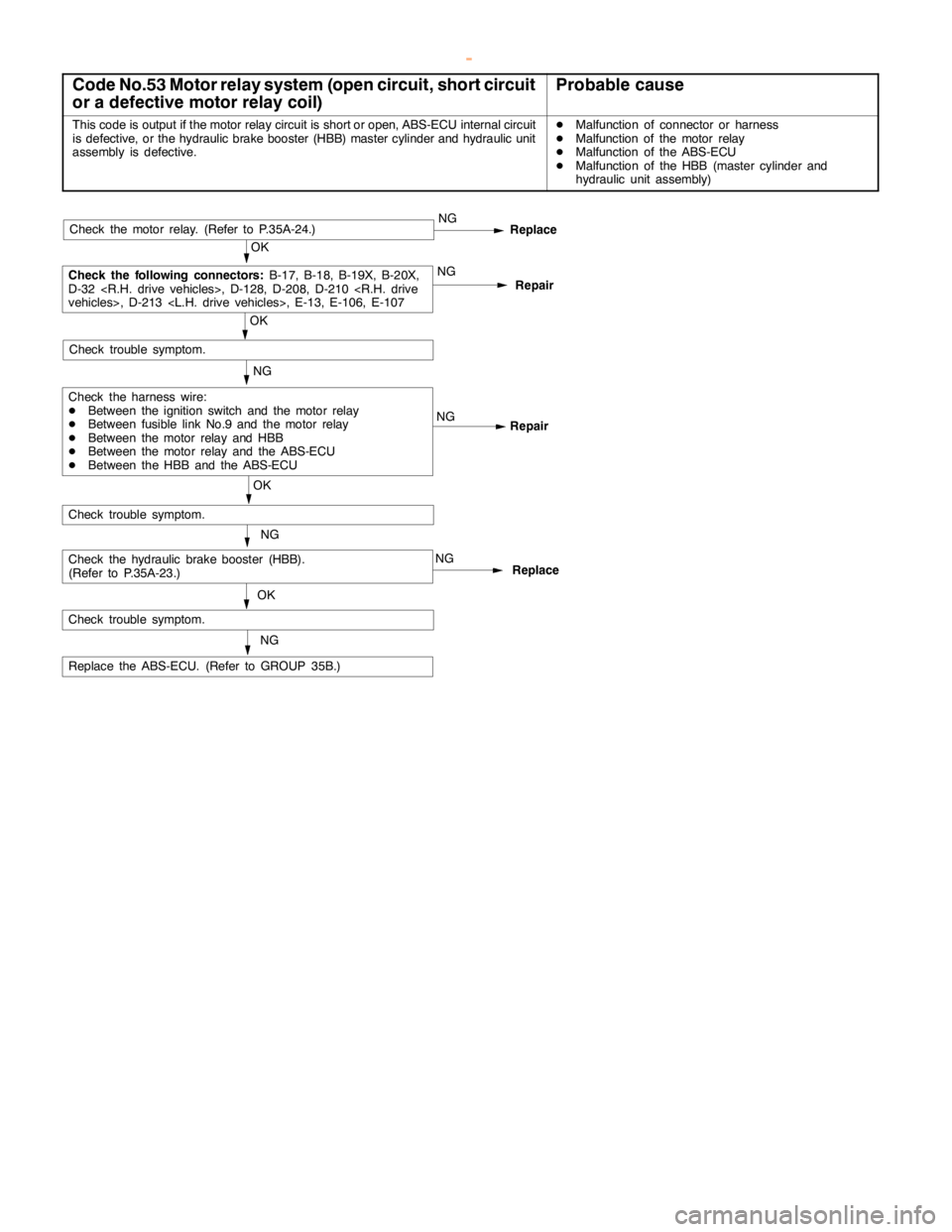
Code No.53 Motor relay system (open circuit, short circuit
or a defective motor relay coil)Probable cause
This code is output if the motor relay circuit is short or open, ABS-ECU internal circuit
is defective, or the hydraulic brake booster (HBB) master cylinder and hydraulic unit
assembly is defective.DMalfunction of connector or harness
DMalfunction of the motor relay
DMalfunction of the ABS-ECU
DMalfunction of the HBB (master cylinder and
hydraulic unit assembly)
NG
Replace the ABS-ECU. (Refer to GROUP 35B.)NG
Repair
NG
OK
Check trouble symptom.
Repair NGNG
OK
Check trouble symptom.
Replace
OK
Check the following connectors:
B-17, B-18, B-19X, B-20X,
D-32
Check the harness wire:
DBetween the ignition switch and the motor relay
DBetween fusible link No.9 and the motor relay
DBetween the motor relay and HBB
DBetween the motor relay and the ABS-ECU
DBetween the HBB and the ABS-ECU
Check trouble symptom.
NG
NG
Replace
OK
Check the motor relay. (Refer to P.35A-24.)
Check the hydraulic brake booster (HBB).
(Refer to P.35A-23.)
www.WorkshopManuals.co.uk
Purchased from www.WorkshopManuals.co.uk
Page 1219 of 1839
BASIC BRAKE SYSTEM -Troubleshooting35A-11
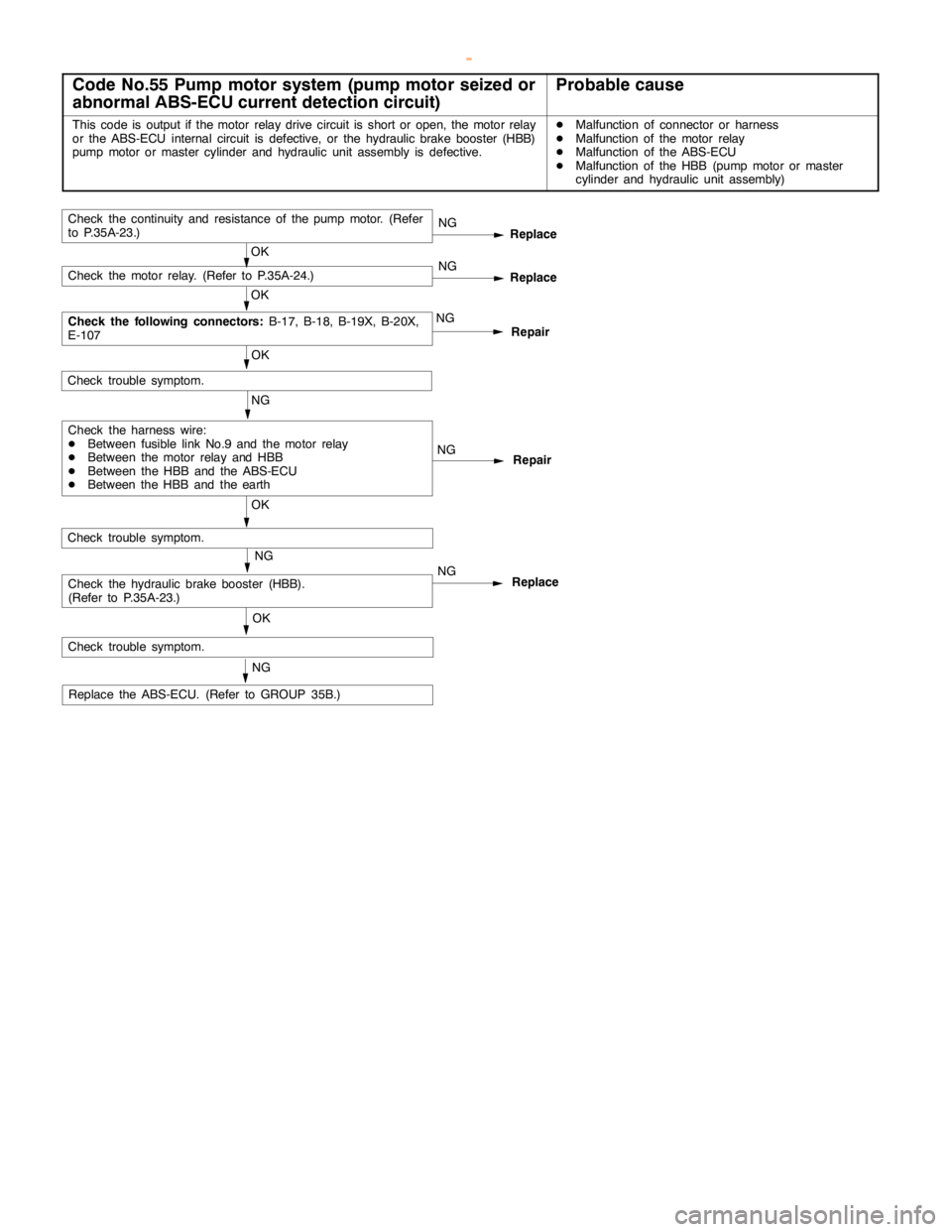
Code No.55 Pump motor system (pump motor seized or
abnormal ABS-ECU current detection circuit)Probable cause
This code is output if the motor relay drive circuit is short or open, the motor relay
or the ABS-ECU internal circuit is defective, or the hydraulic brake booster (HBB)
pump motor ormaster cylinder and hydraulic unit assembly is defective.DMalfunction of connector or harness
DMalfunction of the motor relay
DMalfunction of the ABS-ECU
DMalfunction of the HBB (pump motor or master
cylinder and hydraulic unit assembly)
NG
Repair
NG
OK
Check trouble symptom.
Repair NGNG
OK
Check trouble symptom.
Replace
OK
Check the following connectors:
B-17, B-18, B-19X, B-20X,
E-107
Check the harness wire:
DBetween fusible link No.9 and the motor relay
DBetween the motor relay and HBB
DBetween the HBB and the ABS-ECU
DBetween the HBB and the earthNG
Check the motor relay. (Refer to P.35A-24.)
NG
Replace the ABS-ECU. (Refer to GROUP 35B.)
Check trouble symptom.
NG
OKCheck the hydraulic brake booster (HBB).
(Refer to P.35A-23.)Replace NG
Replace
OKCheck the continuity and resistance of thepump motor.(Refer
to P.35A-23.)
www.WorkshopManuals.co.uk
Purchased from www.WorkshopManuals.co.uk
Page 1220 of 1839
BASIC BRAKE SYSTEM -Troubleshooting35A-12
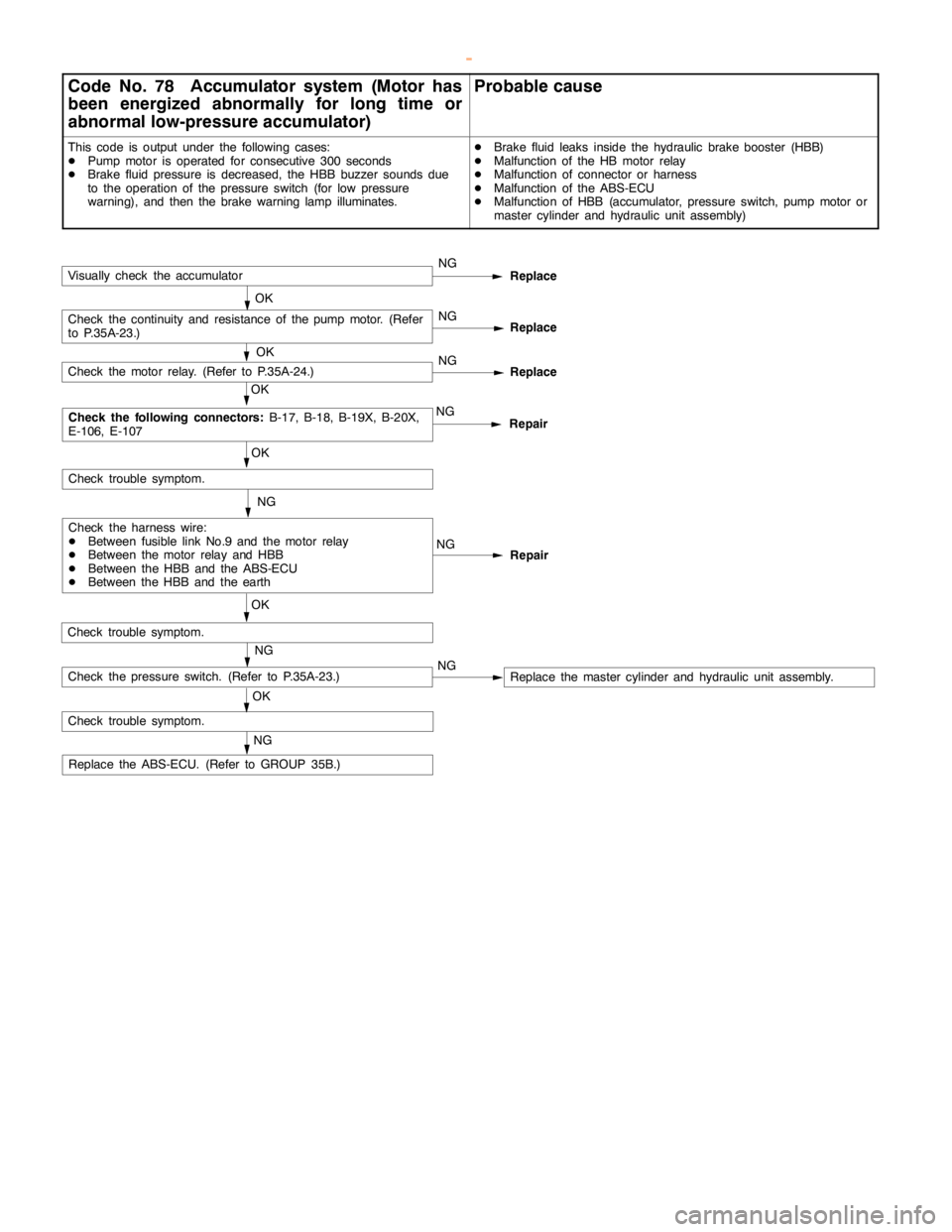
Code No. 78 Accumulator system (Motor has
been energized abnormally for long time or
abnormal low-pressure accumulator)Probable cause
This code is output under the following cases:
DPump motor is operated for consecutive 300 seconds
DBrake fluid pressure is decreased, the HBB buzzer sounds due
to the operation of the pressure switch (for low pressure
warning), and then the brake warninglamp illuminates.DBrake fluid leaks inside the hydraulic brake booster (HBB)
DMalfunction of the HB motor relay
DMalfunction of connector or harness
DMalfunction of the ABS-ECU
DMalfunction of HBB (accumulator, pressure switch,pump motor or
master cylinder and hydraulic unit assembly)
NG
Repair
NG
OK
Check trouble symptom.
Repair NGNG
OK
Check trouble symptom.
Replace
OK
Check the following connectors:
B-17, B-18, B-19X, B-20X,
E-106, E-107
Check the harness wire:
DBetween fusible link No.9 and the motor relay
DBetween the motor relay and HBB
DBetween the HBB and the ABS-ECU
DBetween the HBB and the earthNG
Check the motor relay. (Refer to P.35A-24.)
NG
Replace the ABS-ECU. (Refer to GROUP 35B.)
Check trouble symptom.
NG
OKCheck the pressure switch. (Refer to P.35A-23.)NG
Replace
OKCheck the continuity and resistance of thepump motor.(Refer
to P.35A-23.)NG
Replace
OKVisually check the accumulator
Replace the master cylinder and hydraulic unit assembly.
www.WorkshopManuals.co.uk
Purchased from www.WorkshopManuals.co.uk
Page 1224 of 1839
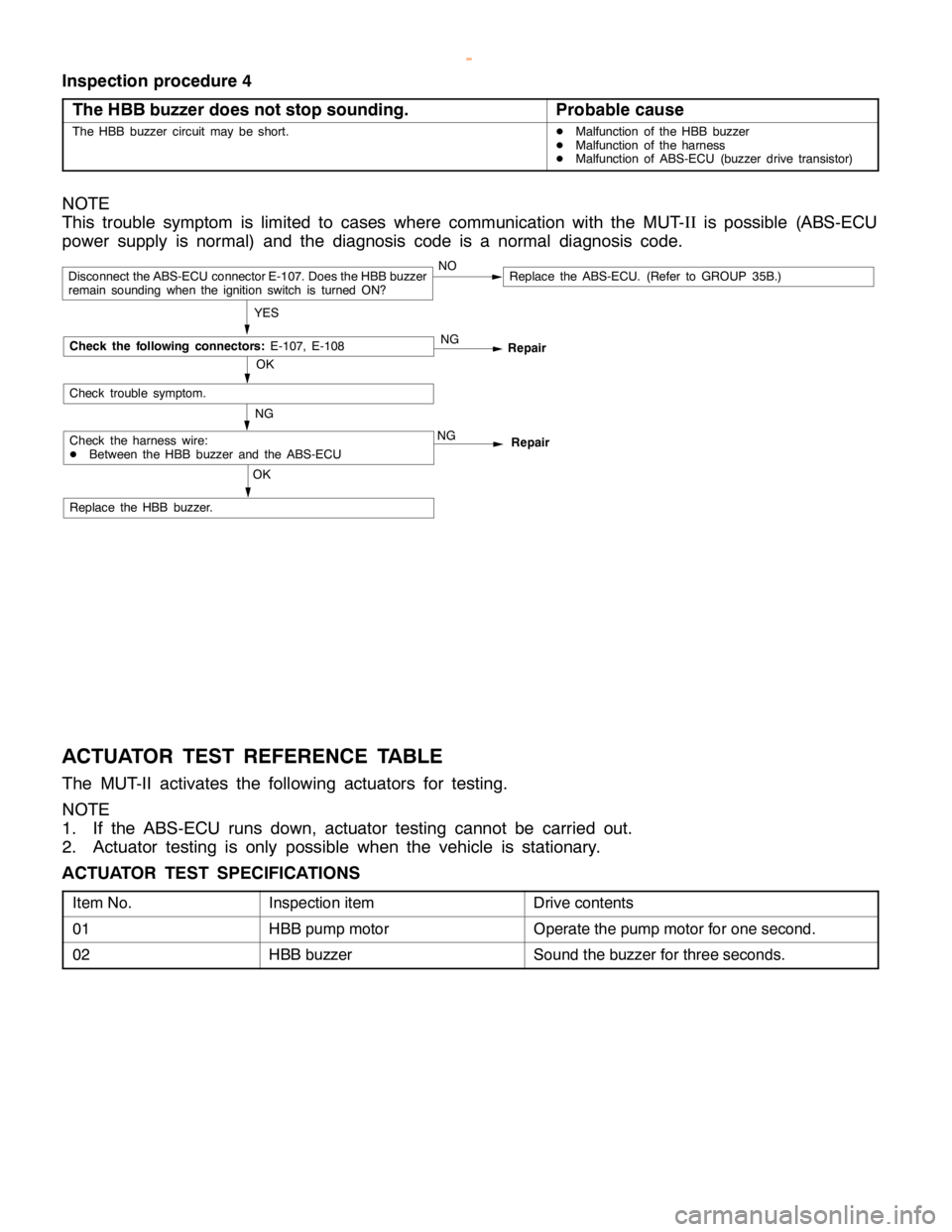
BASIC BRAKE SYSTEM -Troubleshooting35A-16
Inspection procedure 4
The HBB buzzer does not stop sounding.
Probable cause
The HBB buzzer circuit may be short.DMalfunction of the HBB buzzer
DMalfunction of the harness
DMalfunction of ABS-ECU (buzzer drive transistor)
NOTE
This trouble symptom is limited to cases where communication with the MUT-II
is possible (ABS-ECU
power supply is normal) and the diagnosis code is a normal diagnosis code.
OK
Repair NG
Repair
Replace the HBB buzzer.
OK
NG
YES
Replace the ABS-ECU. (Refer to GROUP 35B.)NODisconnect the ABS-ECU connector E-107. Does the HBB buzzer
remain sounding when the ignition switch is turned ON?
Check trouble symptom.
Check the harness wire:
DBetween the HBB buzzer and the ABS-ECUNG
Check the following connectors:
E-107, E-108
ACTUATOR TEST REFERENCE TABLE
The MUT-II activates the following actuators for testing.
NOTE
1. If the ABS-ECU runs down, actuator testing cannot be carried out.
2. Actuator testing is only possible when the vehicle is stationary.
ACTUATOR TEST SPECIFICATIONS
Item No.Inspection itemDrive contents
01HBB pump motorOperate the pump motor for one second.
02HBB buzzerSound the buzzer for three seconds.
www.WorkshopManuals.co.uk
Purchased from www.WorkshopManuals.co.uk
Page 1235 of 1839

BASIC BRAKE SYSTEM -On-vehicle ServiceBASIC BRAKE SYSTEM -On-vehicle Service35A-27
BLEEDING
Caution
Specified brake fluid: DOT3 or DOT4
1. Always use the specified brake fluid. Avoid using
a mixture of the specified brake fluid and other fluid.
2. Maintain the fluid reservoir level between the MIN
and MAX marks during the air bleeding.
3. Do not depress the brake pedal hard during the air
bleeding (normal air bleeding) to prevent the pump
motor from operating frequently.
4. After the air bleeding, check that the brake dragging
does not become stronger.
5. If the pedal is depressed with the reservoir cap
removed, the brake fluid may overflow. Do not depress
the brake pedal while the fluid is being added.
NORMAL AIR BLEEDING
After the front brake or the rear brake is removed and installed,
some fluid may remain in the hydraulic brake booster (HBB)
reservoir. In this case, bleed air from the brake caliper.
HBB SYSTEM AIR BLEEDING
If all the brake fluid inside the reservoir is drained due to
the removal and installation of the HBB, bleed air as follows:
Air bleeding from front brake system
1. Turn the ignition switch to the LOCK (OFF) position. Bleed
air from the front brake calipers (right and left) by pumping
the brake pedal.
Pump motor operation
2. Turn the ignition switch ON, and operate the pump motor.
If the pump motor is running free, supply the brake fluid
into the pump motor by depressing the brake pedal three
or four times.
Air bleeding from accumulator system
3. After the pump motor stopped, depress the brake pedal
three or four times with the ignition switch ON. Then
observe the brake fluid in the reservoir. If the brake fluid
looks whitish, wait for a few minutes until it becomes
clear.
4. Repeat step 3 until the brake fluid becomes clear.
www.WorkshopManuals.co.uk
Purchased from www.WorkshopManuals.co.uk
Page 1264 of 1839

35B-1
ANTI-SKID
BRAKING SYSTEM
(ABS) <4WD>
CONTENTS
GENERAL INFORMATION 2..................
SERVICE SPECIFICATIONS 4.................
LUBRICANT Refer to GROUP 35A...........
SEALANTS Refer to GROUP 35A............
SPECIAL TOOLS 4..........................
TROUBLESHOOTING 4.......................
ON-VEHICLE SERVICE 27...................
Wheel Speed Sensor Output Voltage
Measurement 27...............................
ABS Valve Relay Continuity Check 28...........
Hydraulic Brake Booster (HBB) - Hydraulic Unit
Check 29......................................
Solenoid Valve Check 30.......................
When the Battery is Flat 31....................
Brake Pedal Check and Adjustment
Refer to GROUP 35A ..........................
Hydraulic Brake Booster (HBB) Operation Check
Refer to GROUP 35A ..........................
Hydraulic Brake Booster (HBB) Check
Refer to GROUP 35A ..........................Motor Relay Continuity Check
Refer to GROUP 35A ..........................
Bleeding Refer to GROUP 35A..................
Brake Fluid Level Sensor Check
Refer to GROUP 35A ..........................
Disc Brake Pad Check and Replacement
Refer to GROUP 35A ..........................
Brake Disc Thickness Check
Refer to GROUP 35A ..........................
Brake Disc Runout Check and Correction
Refer to GROUP 35A ..........................BRAKE PEDAL Refer to GROUP 35A........
HYDRAULIC BRAKE BOOSTER (HBB)
Refer to GROUP 35A ........................
HBB BUZZER Refer to GROUP 35A..........
FRONT DISC BRAKE Refer to GROUP 35A..
REAR DISC BRAKE Refer to GROUP 35A....
ABS-ECU 32................................
WHEEL SPEED SENSOR 33.................
G-SENSOR 36..............................
www.WorkshopManuals.co.uk
Purchased from www.WorkshopManuals.co.uk
Page 1353 of 1839

42-1
BODY
CONTENTS
HOOD3 ....................................
FENDER5 ..................................
FUEL FILLER DOOR6 .....................
WINDOW GLASS8 .........................
ADHESIVES 8.............................
SPECIAL TOOL 8.........................
WINDOW REPAIR 8.......................
WINDSHIELD 10..........................
QUARTER WINDOW GLASS 14...........
BACK DOOR GLASS 16..................
DOORS18 .................................
SERVICE SPECIFICATIONS 18............
SEALANT 18.............................
SPECIAL TOOLS 18......................
TROUBLESHOOTING 19..................ON-VEHICLE SERVICE 19................
Door Fit Adjustment 19.................
Door Window Glass Adjustment 19......
Defective Power Window Adjustment and
Replacement
20 .........................
Power Window Safety Mechanism Check 20..
Door Outside Handle Play Check 21.....
Power Window Operation Current
Check 21..............................
Circuit Breaker (Incorporated in the Power
Window Motor) Check 21...............
Door Inside Handle Play Check and
Adjustment 21..........................
DOOR ASSEMBLY 22.....................
DOOR TRIM AND WATERPROOF
FILM 24..................................
DOOR GLASS AND REGULATOR 30......
DOOR HANDLE AND LATCH 33..........
WINDOW GLASS RUNCHANNEL AND
DOOR OPENING WEATHERSTRIP 36.....
BACK DOOR39 ...........................
SERVICE SPECIFICATION 39.............
SEALANT 39.............................
SPECIAL TOOL 39.......................
TROUBLESHOOTING 39..................
CONTINUED ON NEXT PAGE
www.WorkshopManuals.co.uk
Purchased from www.WorkshopManuals.co.uk
Page 1402 of 1839

BODY -SunroofBODY -Sunroof42-50
"
BA
SUNROOF MOTOR ASSEMBLY INSTALLATION
1. Install the roof lid glass assembly and the sunroof motor
assembly with the sunroof motor assembly in the
fully-closed position.
2. Connect the sunroof motor assembly harness connector
and the sunroof switch harness connector to the vehicle
wiring harness connector.
3. Operate the sunroof and check that it operates correctly.
1. Install the roof lid glass assembly and the sunroof motor
assembly with the sunroof motor assembly in the
fully-closed position.
2. Connect the sunroof motor assembly harness connector
and the sunroof switch harness connector to the vehicle
wiring harness connector.
3. Operate the sunroof switch to slide the roof lid glass
to the fully-open position, and then tilt it up in steps of
30 mm to the fully-open position and then keep pressing
the switch for 3 seconds or more.
4. Operate the sunroof switch (CLOSE) using the one-touch
function to slide the roof lid glass to the fully-closed
position.
5. Operate the sunroof switch (OPEN) using the one-touch
function to slide the roof lid glass to the fully-open position.
6. Operate the sunroof switch (CLOSE) using the one-touch
function to slide the roof lid glass to the fully-closed
position.
7. Press the tilt - up switch to operate the sunroof and check
that learning is complete.
NOTE
(1) During initialisation (learning mode), use only the
CLOSE/DOWN switch to move the roof lid glass from
the fully-closed position to the fully tilted open position.
During initialisation, the TILT UP switch will not work
when pressed. Furthermore, the sunroof-ECU will stop
running in learning mode as soon as the roof lid glass
is tilted up.
(2) When the clamping prevention mechanism is
cancelled, the operation is the same as when the
roof lid glass operates 30 mm at a time.
www.WorkshopManuals.co.uk
Purchased from www.WorkshopManuals.co.uk