tire type MITSUBISHI OUTLANDER 2014 3.G Owner's Manual
[x] Cancel search | Manufacturer: MITSUBISHI, Model Year: 2014, Model line: OUTLANDER, Model: MITSUBISHI OUTLANDER 2014 3.GPages: 451, PDF Size: 49.08 MB
Page 403 of 451
Tires
Vehicle care and maintenance 9-19
9
Keep your tires inflated to the recom- mended pressures. (See the tire and load-ing information placard attached to the driver’s door sill.) Stay within the recommended load limits. Make sure that the weight of any load in your vehicle is evenly distributed. Drive at safe speeds. After filling your tires to the correct pres- sure, check them for damage and air leaks. Be sure to reinstall the caps on the valve stems.
N00939600241
N00939700141
The following maintenance steps are recom- mended: Check tire pressures regularly. Have regular maintenance done on the wheel balance and front
and rear suspen-
sion alignment. Rotate your tires regularly as described in the “Tire rotation” se
ction on page 9-20.
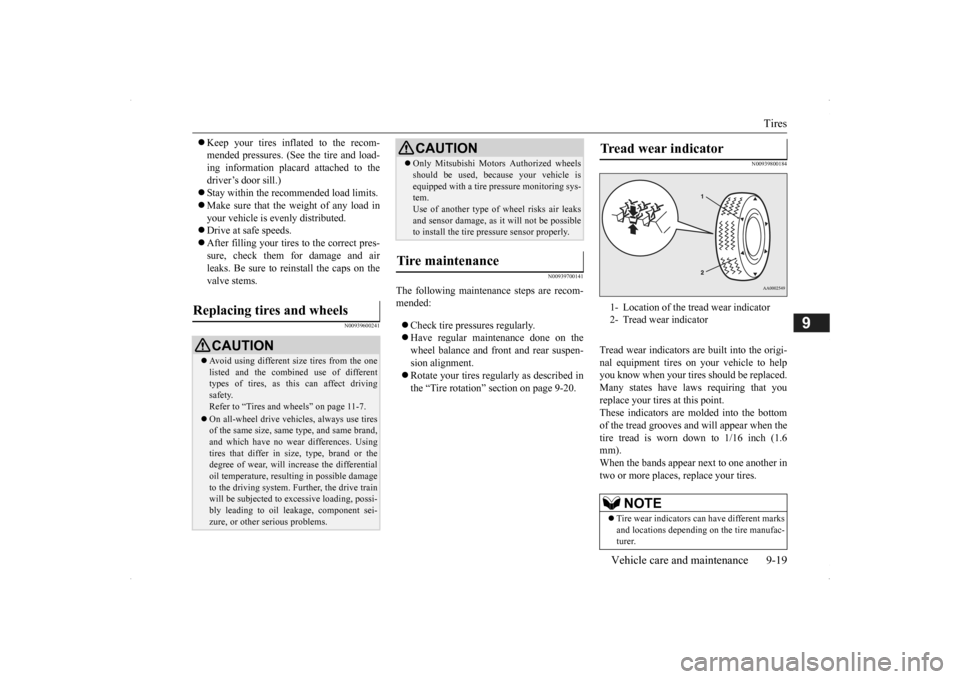
N00939800184
Tread wear indicators ar
e built into the origi-
nal equipment tires on
your vehicle to help
you know when your tires should be replaced. Many states have la
ws requiring that you
replace your tires at this point.These indicators are molded into the bottom of the tread grooves and will appear when the tire tread is worn down to 1/16 inch (1.6mm). When the bands appear next to one another in two or more places
, replace your tires.
Replacing tires and wheels
CAUTIONAvoid using different size tires from the one listed and the combined use of different types of tires, as this can affect driving safety.Refer to “Tires and wheels” on page 11-7. On all-wheel drive vehi
cles, always use tires
of the same size, same
type, and same brand,
and which have no wear differences. Using tires that differ in si
ze, type, brand or the
degree of wear, will increase the differential oil temperature, resulting in possible damage to the driving system. Further, the drive trainwill be subjected to ex
cessive loading, possi-
bly leading to oil leakage, component sei- zure, or other serious problems.
Only Mitsubishi Motors Authorized wheels should be used, beca
use your vehicle is
equipped with a tire pr
essure monitoring sys-
tem. Use of another type of
wheel risks air leaks
and sensor damage, as
it will not be possible
to install the tire pressure sensor properly.
Tire maintenance
CAUTION
Tread wear indicator 1- Location of the tread wear indicator 2- Tread wear indicator
NOTE
Tire wear indicators ca
n have different marks
and locations dependi
ng on the tire manufac-
turer.
BK0200500US.book 19 ページ 2013年2月12日 火曜日 午前9時46分
Page 404 of 451
Tires 9-20 Vehicle care and maintenance
9
N00939901528
To even out the wear on your tires and make them last longer, Mitsubishi Motors Corpora- tion recommends that y
ou rotate your tires at
the mileage listed in the “WARRANTY AND MAINTENANCE MANUAL”. However, the timing for tire rotation mayvary according to your vehicle condition, road surface conditions, and your own per- sonal driving habits. Any time you notice unusual wear, rotate your tires as soon as pos- sible. When rotating tires, check for uneven wear, damage, and wheel alignment. Abnormal wear is usually caused by a wrong tire pres- sure, wheels that ar
e not aligned properly,
wheels that are out-of-balance, or severe braking. Check with an author
ized Mitsubishi Motors
dealer or a repair facility of your choice to find out the reason for uneven tread wear. The first tire rotation is the most important one. It will allow all your
tires to wear evenly.
N00940000320
In some areas of the country, snow tires are required for winter driving. If snow tires are required in your area, you must choose snowtires of the same size
and type as the original
tires provided with your vehicle. Snow tires should also be installe
d on all four wheels.
Otherwise your safety and vehicle handling can be reduced. Even where laws may permit it, snow tiresshould not be operated
at sustained speeds
over 75 mph (120 km/h).
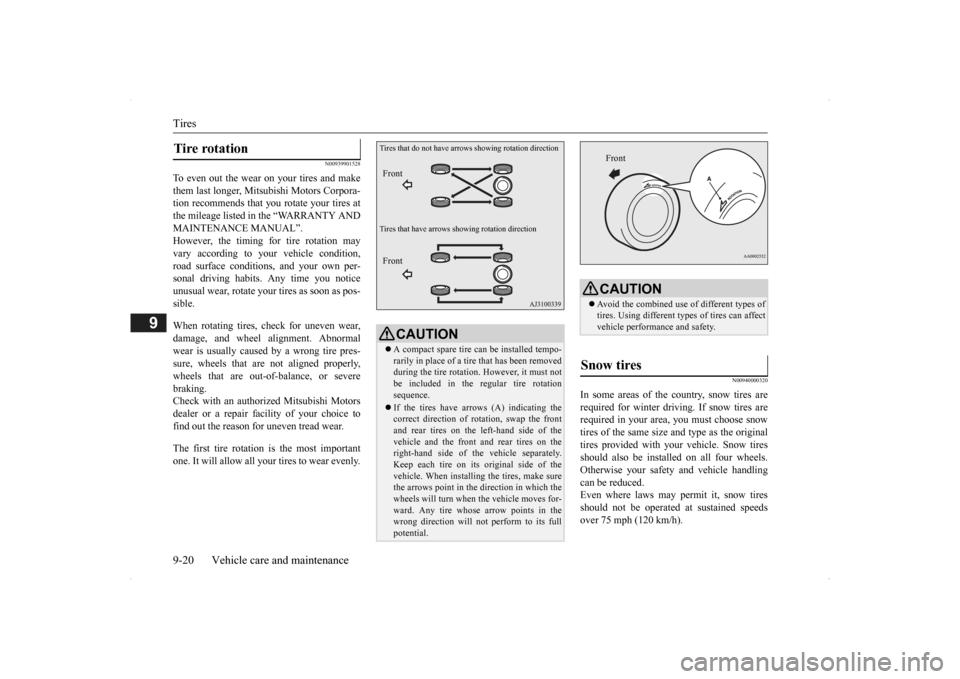
Tire rotation
CAUTION A compact spare tire can be installed tempo- rarily in place of a tire
that has been removed
during the tire rotation. However, it must notbe included in the regular tire rotation sequence. If the tires have arrows (A) indicating the correct direction of ro
tation, swap the front
and rear tires on the le
ft-hand side of the
vehicle and the front
and rear tires on the
right-hand side of th
e vehicle separately.
Keep each tire on its original side of the vehicle. When installing the tires, make surethe arrows point in the
direction in which the
wheels will turn when the vehicle moves for- ward. Any tire whose arrow points in thewrong direction will not
perform to its full
potential.
Tires that do not have arrows showing rotation direction Tires that have arrows s
howing rotation direction
Front Front
CAUTION Avoid the combined use of different types of tires. Using different t
ypes of tires can affect
vehicle performance and safety.
Snow tires
Front
BK0200500US.book 20 ページ 2013年2月12日 火曜日 午前9時46分
Page 405 of 451
Brake pedal free play
Vehicle care and maintenance 9-21
9
N00940101139 N00940300293
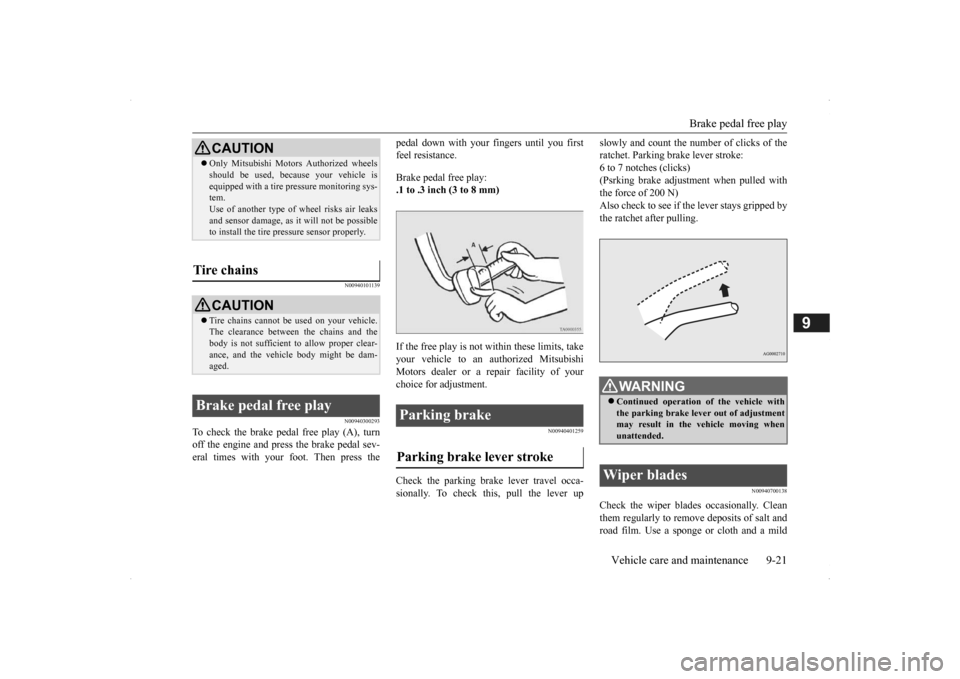
To check the brake pedal free play (A), turn off the engine and press the brake pedal sev- eral times with your
foot. Then press the
pedal down with your fingers until you first feel resistance. Brake pedal free play: .1 to .3 inch (3 to 8 mm) If the free play is not within these limits, take your vehicle to an authorized Mitsubishi Motors dealer or a repair facility of your choice for adjustment.
N00940401259
Check the parking brake lever travel occa- sionally. To check this, pull the lever up
slowly and count the number of clicks of the ratchet. Parking br
ake lever stroke:
6 to 7 notches (clicks) (Psrking brake adjustment when pulled with the force of 200 N)Also check to see if the lever stays gripped by the ratchet after pulling.
N00940700138
Check the wiper blades occasionally. Clean them regularly to rem
ove deposits of salt and
road film. Use a sponge or cloth and a mild
CAUTION Only Mitsubishi Motors Authorized wheels should be used, beca
use your vehicle is
equipped with a tire pr
essure monitoring sys-
tem. Use of another type of wheel risks air leaks and sensor damage, as it
will not be possible
to install the tire pressure sensor properly.
Tire chains
CAUTION Tire chains cannot be used on your vehicle. The clearance between the chains and the body is not sufficient
to allow proper clear-
ance, and the vehicle body might be dam- aged.
Brake pedal free play
Parking brake Parking brake lever stroke
WA R N I N G Continued operation
of the vehicle with
the parking brake leve
r out of adjustment
may result in the vehicle moving when unattended.
Wiper blades
BK0200500US.book 21 ページ 2013年2月12日 火曜日 午前9時46分
Page 407 of 451
General maintenance
Vehicle care and maintenance 9-23
9
N00950100050
Have the valve clea
rance checked at an
authorized Mitsubishi Motors dealer at the mileage specified in the “WARRANTY ANDMAINTENANCE MANUAL”. If the engine sounds abnormally loud, have adjustments made by an authorizedMitsubishi Motors dealer.
N00941300173
Check these regularly for damage or leaks inthe fuel lines and connections. Check the fuel tank filler cap for dama
ge or looseness. Pay
special attention to the fuel lines closest tohigh heat sources such
as the exhaust mani-
fold.
N00941400187
If the fuel-vapor vent line is clogged or dam- aged, the fuel-vapor mixture will escape, pol- luting the air. Have the system checked at an authorizedMitsubishi Motors dealer at the mileage spec- ified in the “WARRANTY AND MAINTE- NANCE MANUAL”.
N00941501299
The next pages list th
e maintenance service
recommended by Mitsubishi Motors Corpo- ration. In addition to the general maintenance that needs to be performed at the times listed,there are other parts which do not usually need regular maintenance. But, if any of these parts stops working prop-erly, your vehicle performance could suffer. Have these items checked if you notice a problem with them. If you have any questions, see your autho- rized Mitsubishi Motors
dealer for assistance.
N00941600059
Good brakes are essential for safe driving. Check the brake pads for wear. For good braking performance, replace the brake padswith the same type pa
ds as the originals.
N00941700076
Brake hoses and tubing should be checked for: Severe surface cracki
ng, scuffing or worn
spots. If the fabric casing of the hose isshowing through any cracks or worn spots in the rubber hose cover, the hose should be replaced. The brakes can fail if thehose wears through. Improper installation may cause twisting, or wheel, tire or
chassis interference.
N00941800093
Check the following parts for damage and grease leaks: Ball joint boots of the suspension and steering linkage Bellows on both ends of the drive shaft
Intake valve clearance Fuel system (tank, pipe line and connection, and fuel tank filler cap)
WA R N I N G If you see a fuel leak
or if you smell fuel,
do not run the engine. Any spark (includ-ing from the ignition
), flame or smoking
material could cause an explosion or fire. Call an authorized Mitsubishi Motorsdealer or a repair fa
cility of your choice
for assistance.
Evaporative emission control system (except evaporative emission canister) General maintenance
Disc brake pads Brake hoses Ball joint, steering linkage seals, drive shaft boots
BK0200500US.book 23 ページ 2013年2月12日 火曜日 午前9時46分
Page 446 of 451
Alphabetical index 12-4
12
Multi information display - Type 1
.....
5-121
Multi information display - Type 2
.....
5-140
O
Octane rating
........................................
3-2
Oil
Engine oil
......................................
11-7
Rear axle oil
...................................
11-7
Transfer oil
....................................
11-7
Operation under adverse driving conditions
...
8-16 Outside rearview mirrors
.....................
5-55
Overheating
.........................................
8-4
P
Parking
................................................
6-6
Parking brake
.................................
5-52
Parking lights
Bulb capacity
.................................
9-30
Replacement
..................................
9-35
Polishing
............................................
9-42
Power brakes
......................................
5-85
Power liftgate
.....................................
5-37
Power outlet
.....................................
5-211
Power windows
..................................
5-48
Puncture (Tire changing)
.......................
8-6
R
Radiator cap
........................................
9-9
Radio
.................................................
7-15
General information
about your radio 7-48
Reading lights
Bulb capacity
..................................
9-32
Rear axle oil
..............................
9-12
, 11-7
Rear combination lights
Bulb capacity
..................................
9-30
Replacement
...................................
9-37
Rear side-marker lights
Bulb capacity
..................................
9-30
Rear turn signal light
Bulb capacity
..................................
9-30
Replacement
...................................
9-37
Rear-view camera
.............................
5-118
Rearview mirror
Inside rearview mirror
.....................
5-54
Outside rearview mirrors
.................
5-55
Replacement of light bulbs
...................
9-29
Replacing tires and wheels
...................
9-19
Reporting Safety Defects
.....................
10-2
Roof antenna
......................................
7-47
S
Safe driving techniques
.........................
6-4
S-AWC (Super-All Wheel Control)
......
5-78
Seat belt
.............................................
4-17
Adjustable seat belt shoulder anchor
.4-23
Child restraint systems
....................
4-25
Front passenger seat belt warning light
.....
4-22Maintenance and inspection
.............
4-33
Seat belt extender
...........................
4-24
Seat belt force limitter
.....................
4-25
Seat belt pr
e-tensioners
...................
4-24
Seat belt use
during pregnancy
.........
4-24
Seats
....................................................
4-2
Arm rest
..........................................
4-9
Front seats
.......................................
4-4
Head restraints
...............................
4-10
Heated seat
......................................
4-7
Making a cargo area
........................
4-12
Making a flat seat
...........................
4-16
Seat arrangement
..............................
4-3
Seats and restraint systems
................
4-4
Second row seats
..............................
4-8
Third row seats
...............................
4-10
Service brake
......................................
5-84
Service precautions
...............................
9-2
Side turn-signal light
Bulb capacity
.................................
9-30
Snow tires
..........................................
9-20
Spark plugs
........................................
9-22
Starting the engine
.....................
5-23
, 5-58
Steering
Steering wheel height and reach adjustment
BK0200500US.book 4 ページ 2013年2月12日 火曜日 午前9時46分