belt MITSUBISHI OUTLANDER 2014 3.G Owner's Guide
[x] Cancel search | Manufacturer: MITSUBISHI, Model Year: 2014, Model line: OUTLANDER, Model: MITSUBISHI OUTLANDER 2014 3.GPages: 451, PDF Size: 49.08 MB
Page 65 of 451
Supplemental Restraint System (SRS) - airbag
Seat and restraint systems 4-37
4
The main purpose of an EDR is to record, in certain crash or near
crash-like situations,
such as an airbag deployment or hitting a road obstacle, data that
will assist in under-
standing how a vehicl
e’s systems performed.
The EDR is designed to record data related to vehicle dynamics and safety systems for a short period of time,
typically 30 seconds or
less. The EDR in this vehicle is designed to record such data as: How various systems
in your vehicle were
operating; Whether or not the driver and front pas- senger safety belts we
re buckled/fastened;
How far (if at all) the driver was depress- ing the accelerator and/or brake pedal; and, How fast the vehicle was traveling.
These data can help provide a better under- standing of the circumstances in which crashes and injuries occur.
To read data recorded by an EDR, special equipment is required, and access to the vehi- cle or the EDR is needed. In addition to thevehicle manufacturer, ot
her parties, such as
law enforcement, that have the special equip- ment, can read the information if they haveaccess to the vehicle or the EDR.
N00417900177
The driver’s seat position sensor is attachedto the seat rail and provides the airbag control unit with information on the seat’s fore-aft position. The airbag control unit controlsdeployment of the driver’s front airbag in accordance with the information it receives from this sensor.If there is a problem involving the driver’s seat position sensor, the SRS warning light in
the instrument panel will come on. Refer to “SRS warning light/dis
play” on page 4-39.
N00418001374
The passenger’s seat oc
cupant classification
sensor system is attach
ed to the front passen-
ger seat cushion and provides the airbag con-trol unit with information regarding the occupant on the front passenger seat. The air-
NOTE
EDR data are recorded by your vehicle only if a non-trivial crash si
tuation occurs; no data
are recorded by the EDR under normal driv-ing conditions and no personal data (e.g., name, gender, age, a
nd crash location) are
recorded. However, ot
her parties, such as
law enforcement, could combine the EDR data with the type of
personally identifying
data routinely acquire
d during a crash inves-
tigation.
Driver’s seat position sensor
WA R N I N G If the SRS warning light or warning dis- play comes on, have the vehicle inspected by an authorized Mitsubishi Motors dealer as soon as possible. Please observe the following instructions to ensure that the driver’s seat positionsensor can operate correctly.• Adjust the seat to the correct position,and sit well back
against the seatback.
Refer to “Front seats” on page 4-4.• Do not recline the seatback more thannecessary when driving.• Do not place metallic objects or luggageunder the front seat.
If the vehicle is involved in a severe impact, have the SRS sensors inspected by an authorized
Mitsubishi Motors dealer as
soon as possible.
Passenger’s seat occupant clas- sification sensor system
BK0200500US.book 37 ページ 2013年2月12日 火曜日 午前9時46分
Page 66 of 451
Supplemental Restraint System (SRS) - airbag 4-38 Seat and restraint systems
4
bag control unit controls deployment of the passenger’s front airbag in accordance withthe information it receives from this system. The passenger’s front airbag will not deploy in an impact when the system senses no occu-pant on the front passenger’s seat or a child in a child restraint system. In this case, the pas- senger airbag off indi
cator will come on.
Refer to “Passenger’s ai
rbag off indicator” on
page 4-38. If there is a problem involving the passen- ger’s seat occupant cl
assification sensor sys-
tem, the SRS warning light in the instrumentpanel will come on. Refer to “SRS warning light/display” on page 4-39.
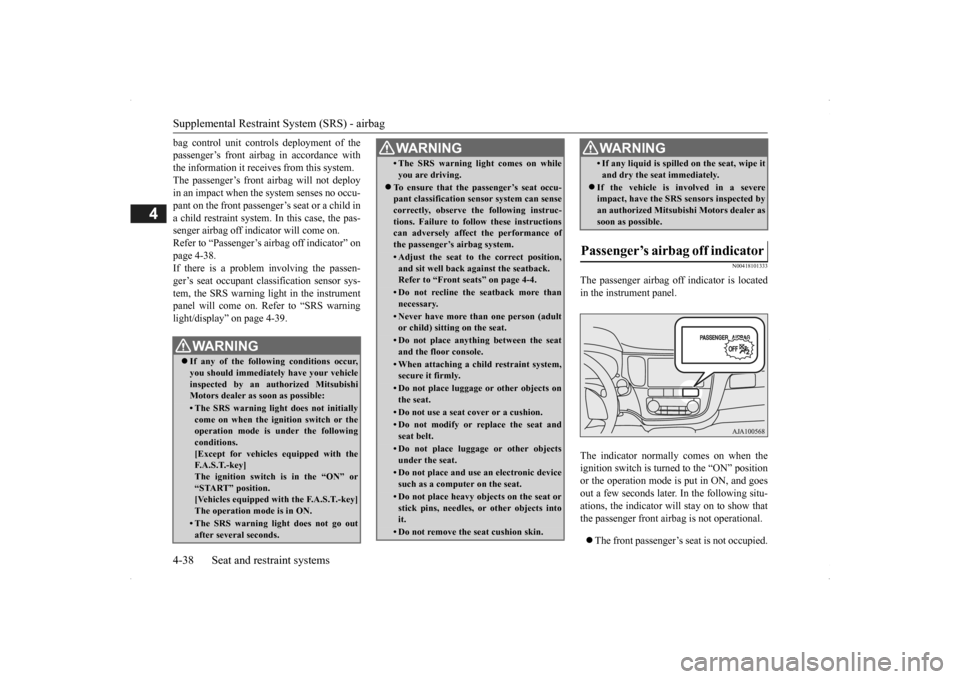
N00418101333
The passenger airbag off indicator is located in the instrument panel. The indicator normally comes on when the ignition switch is turned to the “ON” position or the operation mode is put in ON, and goes out a few seconds later.
In the following situ-
ations, the indicator will stay on to show that the passenger front airb
ag is not operational.
The front passenger’s seat is not occupied.
WA R N I N GIf any of the follow
ing conditions occur,
you should immediatel
y have your vehicle
inspected by an au
thorized Mitsubishi
Motors dealer as soon as possible:• The SRS warning light does not initiallycome on when the ignition switch or the operation mode is under the followingconditions. [Except for vehicles equipped with the F. A . S . T. - k e y ]The ignition switch is in the “ON” or “START” position. [Vehicles equipped with the F.A.S.T.-key]The operation mode is in ON.• The SRS warning light does not go outafter several seconds.
• The SRS warning li
ght comes on while
you are driving.
To ensure that the passenger’s seat occu- pant classification sensor system can sense correctly, observe the following instruc-tions. Failure to follow these instructions can adversely affect
the performance of
the passenger’s airbag system.• Adjust the seat to the correct position,and sit well back
against the seatback.
Refer to “Front seats” on page 4-4.• Do not recline the seatback more thannecessary.• Never have more th
an one person (adult
or child) sitting on the seat.• Do not place anything between the seatand the floor console.• When attaching a child restraint system,secure it firmly.• Do not place luggage or other objects onthe seat.• Do not use a seat cover or a cushion.• Do not modify or re
place the seat and
seat belt.• Do not place luggage or other objectsunder the seat.• Do not place and use
an electronic device
such as a computer on the seat.• Do not place heavy obje
cts on the seat or
stick pins, needles, or other objects intoit.• Do not remove the seat cushion skin.WA R N I N G
• If any liquid is spilled on the seat, wipe itand dry the seat immediately.
If the vehicle is involved in a severe impact, have the SRS sensors inspected by an authorized
Mitsubishi Motors dealer as
soon as possible.
Passenger’s airbag off indicator
WA R N I N G
BK0200500US.book 38 ページ 2013年2月12日 火曜日 午前9時46分
Page 67 of 451
Supplemental Restraint System (SRS) - airbag
Seat and restraint systems 4-39
4
The system senses that a child is using a child restraint system
on the front passen-
ger’s seat.
When the passenger’s se
at occupant classifi-
cation sensor system sense there is a person seated in the front passenger’s seat, the indi-cator goes out to show that the passenger’s front airbag is operational.
N00408301589
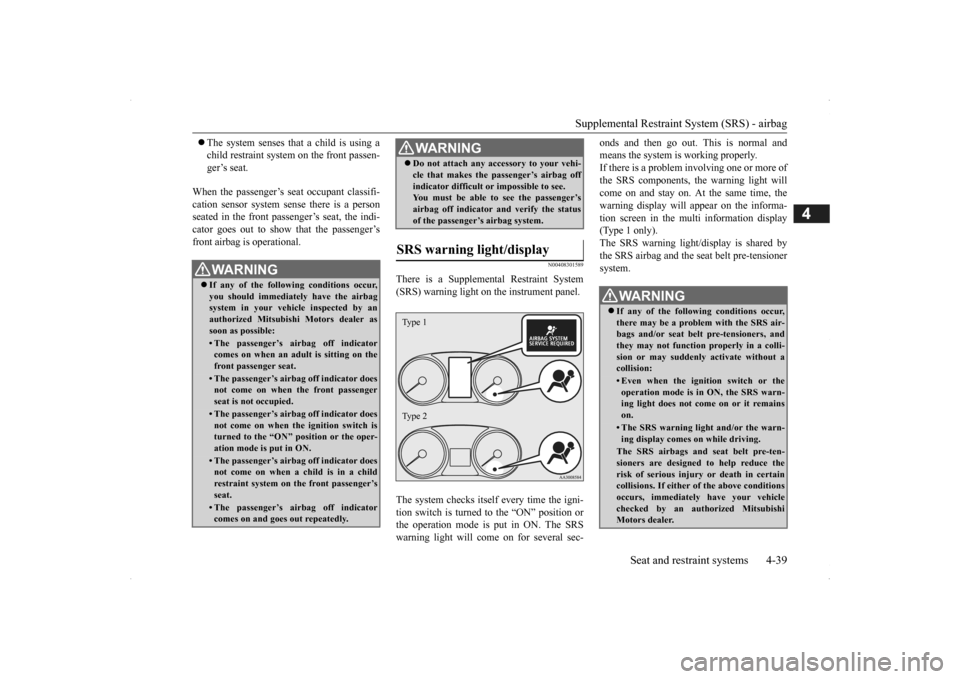
There is a Supplemen
tal Restraint System
(SRS) warning light on the instrument panel. The system checks itself every time the igni- tion switch is turned to the “ON” position orthe operation mode is put in ON. The SRS warning light will come on for several sec-
onds and then go out. This is normal and means the system is working properly.If there is a problem
involving one or more of
the SRS components, the warning light will come on and stay on. At
the same time, the
warning display will appear on the informa- tion screen in the multi information display (Type 1 only).The SRS warning light/display is shared by the SRS airbag and the se
at belt pre-tensioner
system.
WA R N I N G If any of the following conditions occur, you should immediat
ely have the airbag
system in your vehicle inspected by anauthorized Mitsubishi
Motors dealer as
soon as possible:• The passenger’s airbag off indicatorcomes on when an adul
t is sitting on the
front passenger seat.• The passenger’s airbag off indicator doesnot come on when the front passengerseat is not occupied.• The passenger’s airbag off indicator doesnot come on when the ignition switch is turned to the “ON” position or the oper- ation mode is put in ON.• The passenger’s airbag off indicator doesnot come on when a
child is in a child
restraint system on the front passenger’s seat.• The passenger’s airbag off indicatorcomes on and goes out repeatedly.
Do not attach any accessory to your vehi- cle that makes the passenger’s airbag offindicator difficult or
impossible to see.
You must be able to see the passenger’s airbag off indicator an
d verify the status
of the passenger’s airbag system.
SRS warning light/display
WA R N I N G
Type 1 Type 2
WA R N I N G If any of the following conditions occur, there may be a problem with the SRS air- bags and/or seat belt
pre-tensioners, and
they may not function
properly in a colli-
sion or may suddenly
activate without a
collision:•Even when the igniti
on switch or the
operation mode is in ON, the SRS warn- ing light does not come on or it remainson.• The SRS warning light and/or the warn-ing display comes
on while driving.
The SRS airbags and
seat belt pre-ten-
sioners are designed to help reduce the risk of serious injury
or death in certain
collisions. If either of the above conditionsoccurs, immediately
have your vehicle
checked by an auth
orized Mitsubishi
Motors dealer.
BK0200500US.book 39 ページ 2013年2月12日 火曜日 午前9時46分
Page 69 of 451
Supplemental Restraint System (SRS) - airbag
Seat and restraint systems 4-41
4
N00408001616
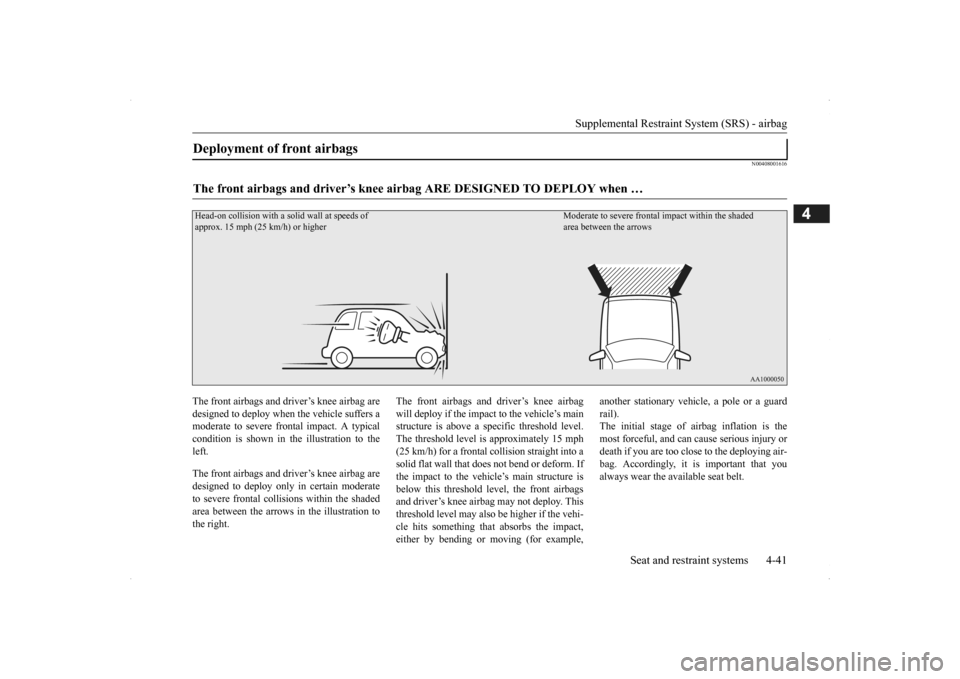
The front airbags and driver’s knee airbag are designed to deploy when
the vehicle suffers a
moderate to severe fro
ntal impact. A typical
condition is shown in th
e illustration to the
left. The front airbags and driver’s knee airbag are designed to deploy only in certain moderateto severe frontal collisions within the shaded area between the arrows in the illustration to the right.
The front airbags and driver’s knee airbag will deploy if the impact to the vehicle’s main structure is above a sp
ecific threshold level.
The threshold level is
approximately 15 mph
(25 km/h) for a frontal collision straight into a solid flat wall that does not bend or deform. Ifthe impact to the vehicle’s main structure is below this threshold le
vel, the front airbags
and driver’s knee airbag may not deploy. Thisthreshold level may also
be higher if the vehi-
cle hits something that absorbs the impact, either by bending or moving (for example,
another stationary vehi
cle, a pole or a guard
rail). The initial stage of airbag inflation is themost forceful, and can
cause serious injury or
death if you are too clos
e to the deploying air-
bag. Accordingly, it
is important that you
always wear the available seat belt.
Deployment of front airbags The front airbags and driver’s knee airb
ag ARE DESIGNED TO DEPLOY when …
Head-on collision with a solid wall at speeds of approx. 15 mph (25 km/h) or higher
Moderate to severe frontal
impact within the shaded
area between the arrows
BK0200500US.book 41 ページ 2013年2月12日 火曜日 午前9時46分
Page 70 of 451
Supplemental Restraint System (SRS) - airbag 4-42 Seat and restraint systems
4
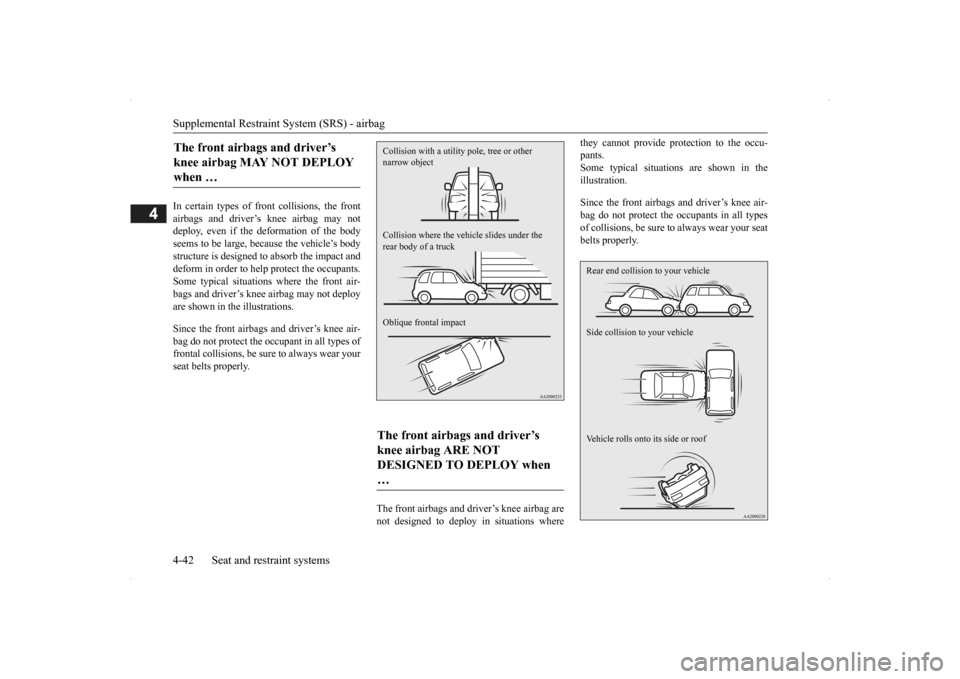
In certain types of front collisions, the front airbags and driver’s knee airbag may notdeploy, even if the deformation of the body seems to be large, because the vehicle’s body structure is designed to
absorb the impact and
deform in order to help
protect the occupants.
Some typical situations where the front air- bags and driver’s knee airbag may not deploy are shown in the illustrations. Since the front airbags and driver’s knee air- bag do not protect the oc
cupant in all types of
frontal collisions, be su
re to always wear your
seat belts properly.
The front airbags and driver’s knee airbag are not designed to deploy in situations where
they cannot provide protection to the occu- pants.Some typical situations are shown in the illustration. Since the front airbags and driver’s knee air- bag do not protect the oc
cupants in all types
of collisions, be sure
to always wear your seat
belts properly.
The front airbags and driver’s knee airbag MAY NOT DEPLOY when …
The front airbags and driver’s knee airbag ARE NOT DESIGNED TO DEPLOY when … Collision with a utility pole, tree or other narrow object Collision where the vehi
cle slides under the
rear body of a truck Oblique frontal impact
Rear end collision to your vehicle Side collision to your vehicle Vehicle rolls onto its side or roof
BK0200500US.book 42 ページ 2013年2月12日 火曜日 午前9時46分
Page 71 of 451
Supplemental Restraint System (SRS) - airbag
Seat and restraint systems 4-43
4
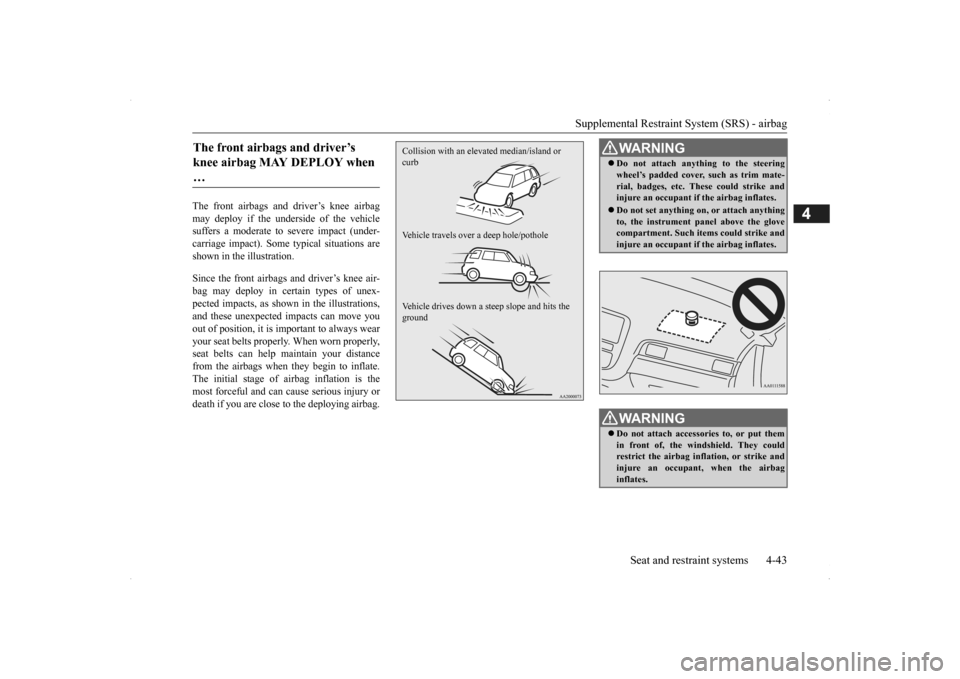
The front airbags and driver’s knee airbag may deploy if the underside of the vehiclesuffers a moderate to
severe impact (under-
carriage impact). Some typical situations are shown in the illustration. Since the front airbags and driver’s knee air- bag may deploy in ce
rtain types of unex-
pected impacts, as show
n in the illustrations,
and these unexpected impacts can move you out of position, it is
important to always wear
your seat belts properly. When worn properly,seat belts can help maintain your distance from the airbags when they begin to inflate. The initial stage of airbag inflation is themost forceful and can cause serious injury or death if you are close to the deploying airbag.The front airbags and driver’s knee airbag MAY DEPLOY when …
Collision with an elevat
ed median/island or
curb Vehicle travels over a deep hole/pothole Vehicle drives down a steep slope and hits the ground
WA R N I N G Do not attach anything to the steering wheel’s padded cover, such as trim mate-rial, badges, etc. These could strike andinjure an occupant if
the airbag inflates.
Do not set anything on, or attach anything to, the instrument
panel above the glove
compartment. Such items could strike and injure an occupant if
the airbag inflates.
WA R N I N GDo not attach accessories to, or put them in front of, the wind
shield. They could
restrict the airbag infl
ation, or strike and
injure an occupant, when the airbag inflates.
BK0200500US.book 43 ページ 2013年2月12日 火曜日 午前9時46分
Page 74 of 451
Supplemental Restraint System (SRS) - airbag 4-46 Seat and restraint systems
4
N00408201546
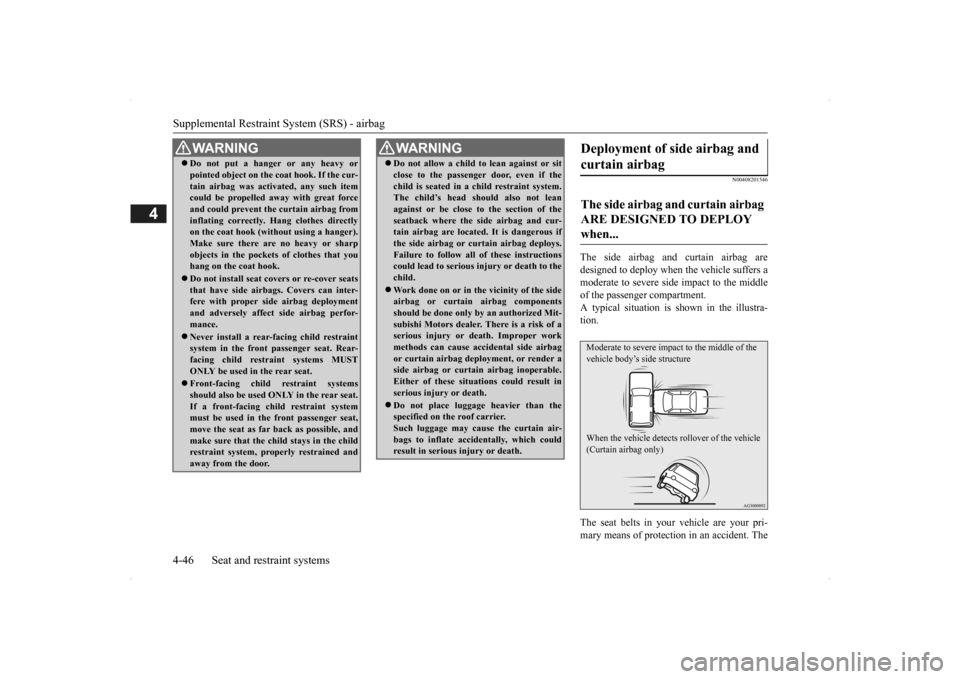
The side airbag and curtain airbag are designed to deploy when the vehicle suffers a moderate to seve
re side impact to the middle
of the passenger compartment.A typical situation is shown in the illustra- tion. The seat belts in your vehicle are your pri- mary means of protection in an accident. The
WA R N I N G Do not put a hanger or any heavy or pointed object on the coat hook. If the cur-tain airbag was activated, any such itemcould be propelled aw
ay with great force
and could prevent th
e curtain airbag from
inflating correctly. Hang clothes directlyon the coat hook (without using a hanger). Make sure there are no heavy or sharp objects in the pocket
s of clothes that you
hang on the coat hook. Do not install seat cove
rs or re-cover seats
that have side airbag
s. Covers can inter-
fere with proper si
de airbag deployment
and adversely affect
side airbag perfor-
mance. Never install a rear-facing child restraint system in the front passenger seat. Rear- facing child restraint systems MUST ONLY be used in the rear seat. Front-facing child restraint systems should also be used ON
LY in the rear seat.
If a front-facing child restraint system must be used in the front passenger seat, move the seat as far back as possible, andmake sure that the child stays in the child restraint system, properly restrained and away from the door.
Do not allow a child to lean against or sit close to the passenger door, even if thechild is seated in a child restraint system.The child’s head should also not lean against or be close to the section of the seatback where the side airbag and cur-tain airbag are located. It is dangerous if the side airbag or cu
rtain airbag deploys.
Failure to follow all of these instructionscould lead to serious in
jury or death to the
child. Work done on or in th
e vicinity of the side
airbag or curtain
airbag components
should be done only
by an authorized Mit-
subishi Motors dealer. There is a risk of a serious injury or death. Improper work methods can cause acci
dental side airbag
or curtain airbag depl
oyment, or render a
side airbag or curtai
n airbag inoperable.
Either of these situations could result inserious injury or death. Do not place luggage
heavier than the
specified on the roof carrier. Such luggage may caus
e the curtain air-
bags to inflate acci
dentally, which could
result in serious injury or death.WA R N I N G
Deployment of side airbag and curtain airbag The side airbag and curtain airbag ARE DESIGNED TO DEPLOY when... Moderate to severe impact to the middle of the vehicle body’s side structure When the vehicle detects rollover of the vehicle (Curtain airbag only)
BK0200500US.book 46 ページ 2013年2月12日 火曜日 午前9時46分
Page 75 of 451
Supplemental Restraint System (SRS) - airbag
Seat and restraint systems 4-47
4
SRS side airbags and curtain airbags are designed to provide
additional protection.
Therefore, for your safety and the safety of all occupants, be sure to always wear your seat belts properly. In certain types of side
collisions, the side air-
bag and curtain airbag
may not deploy, even
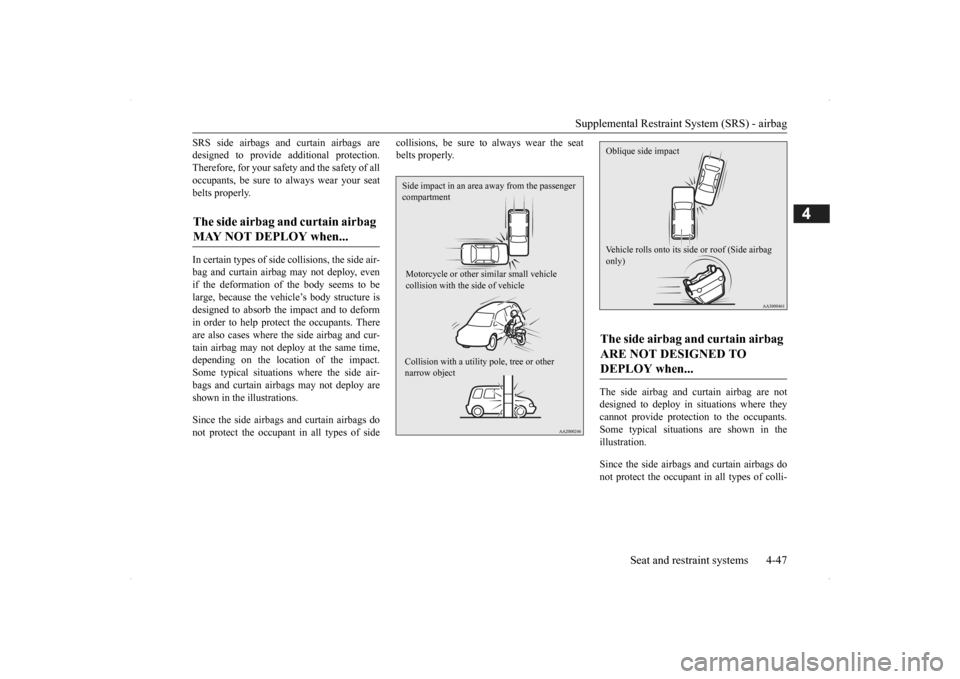
if the deformation of the body seems to be large, because the vehicle’s body structure is designed to absorb the impact and to deform in order to help protect the occupants. Thereare also cases where the side airbag and cur- tain airbag may not deploy at the same time, depending on the location of the impact.Some typical situations
where the side air-
bags and curtain airb
ags may not deploy are
shown in the illustrations. Since the side airbags and curtain airbags do not protect the occupant
in all types of side
collisions, be sure to
always wear the seat
belts properly.
The side airbag and curtain airbag are not designed to deploy in situations where they cannot provide protec
tion to the occupants.
Some typical situations are shown in theillustration. Since the side airbags and curtain airbags do not protect the occupant in all types of colli-
The side airbag and curtain airbag MAY NOT DEPLOY when...
Side impact in an area away from the passenger compartment Motorcycle or other similar small vehicle collision with the side of vehicle Collision with a utility pole, tree or other narrow object
The side airbag and curtain airbag ARE NOT DESIGNED TO DEPLOY when... Oblique side impact Vehicle rolls onto its side or roof (Side airbag only)
BK0200500US.book 47 ページ 2013年2月12日 火曜日 午前9時46分
Page 76 of 451
Supplemental Restraint System (SRS) - airbag 4-48 Seat and restraint systems
4
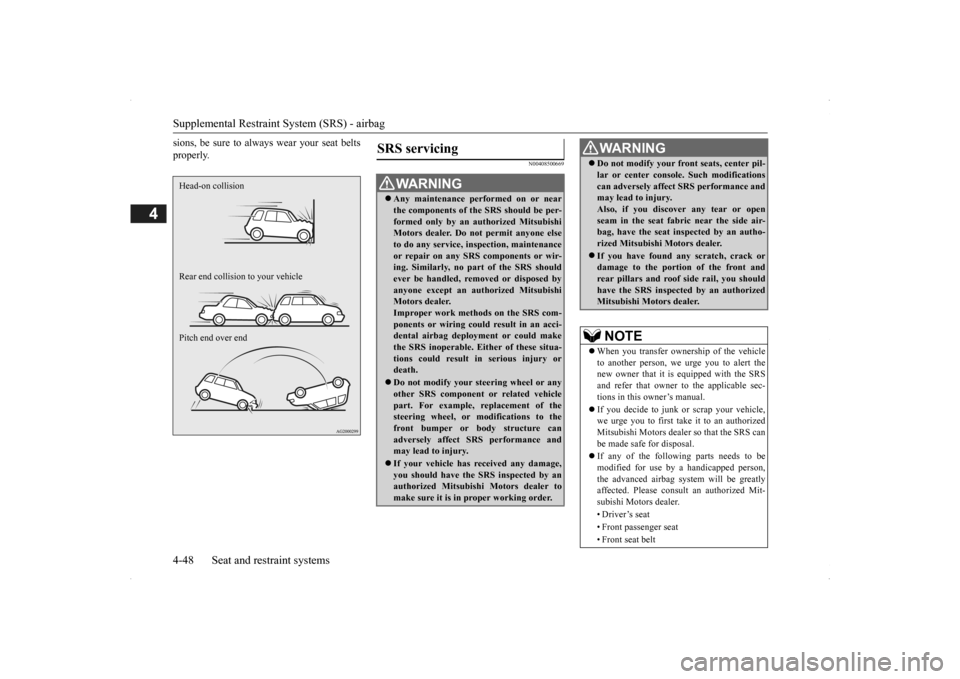
sions, be sure to always
wear your seat belts
properly.
N00408500669
Head-on collision Rear end collision to your vehicle Pitch end over end
SRS servicing
WA R N I N G Any maintenance performed on or near the components of the SRS should be per-formed only by an
authorized Mitsubishi
Motors dealer. Do not permit anyone else to do any service, inspection, maintenanceor repair on any SR
S components or wir-
ing. Similarly, no part of the SRS should ever be handled, removed or disposed byanyone except an au
thorized Mitsubishi
Motors dealer. Improper work meth
ods on the SRS com-
ponents or wiring could result in an acci- dental airbag deployment or could make the SRS inoperable. Ei
ther of these situa-
tions could result in serious injury or death. Do not modify your steering wheel or any other SRS component or related vehicle part. For example, replacement of thesteering wheel, or modifications to the front bumper or body structure can adversely affect SR
S performance and
may lead to injury. If your vehicle has received any damage, you should have the
SRS inspected by an
authorized Mitsubishi
Motors dealer to
make sure it is in proper working order.
Do not modify your front seats, center pil- lar or center console. Such modificationscan adversely affect
SRS performance and
may lead to injury. Also, if you discove
r any tear or open
seam in the seat fabr
ic near the side air-
bag, have the seat in
spected by an autho-
rized Mitsubishi Motors dealer. If you have found an
y scratch, crack or
damage to the portion of the front and rear pillars and roof
side rail, you should
have the SRS inspected by an authorized Mitsubishi Motors dealer.NOTE
When you transfer ownership of the vehicle to another person, we
urge you to alert the
new owner that it is
equipped with the SRS
and refer that owner to the applicable sec- tions in this owner’s manual. If you decide to junk or
scrap your vehicle,
we urge you to first take it to an authorized Mitsubishi Motors dealer so that the SRS canbe made safe for disposal. If any of the following parts needs to be modified for use by a handicapped person,the advanced airbag system will be greatly affected. Please consult an authorized Mit- subishi Motors dealer. • Driver’s seat • Front passenger seat • Front seat beltWA R N I N G
BK0200500US.book 48 ページ 2013年2月12日 火曜日 午前9時46分
Page 101 of 451
Free-hand Advanced Securi
ty Transmitter (F.A.S.T.-key) (if so equipped)
Features and controls 5-23
5
N00514601285
The operation mode can be in any mode to start the engine.
The starter motor will be turning for up to approximately 15 seconds if the engineswitch is released at once. Pressing the engine switch again while the starter motor is still turning will stop the startermotor. The starter motor will be turning for up to approximately 30 se
conds while the
engine switch is pressed. If the engine does not start, wait for a while and then attempt to start the engine again. Trying repeatedly with the engine or starter motor still turning will damagethe starter mechanism. If the engine will not start because the bat- tery is weak or discharged, refer to“Jump-starting the engine” on page 8-2 for instructions. A longer warm up period will only con- sume extra fuel. The engine is warmed up enough for driv- ing when the bar graph of engine coolanttemperature display starts to move or the low coolant temperature indicator goes out. Refer to “Engine
coolant temperature
display” on page 5-128 or “Low coolant temperature indica
tor” on page 5-166.
Your vehicle is equipped with an electroni- cally controlled fuel injection system. This system automatically controls fuel injection.There is no need to depress the accelerator pedal when starting the engine. To prevent battery drai
n, wait a few seconds
between attempts to restart the engine. 1. Make sure all occupants are properly seated with seat belts fastened. 2. Make sure the parking brake is applied.3. Press and hold the brake pedal down with your right foot.
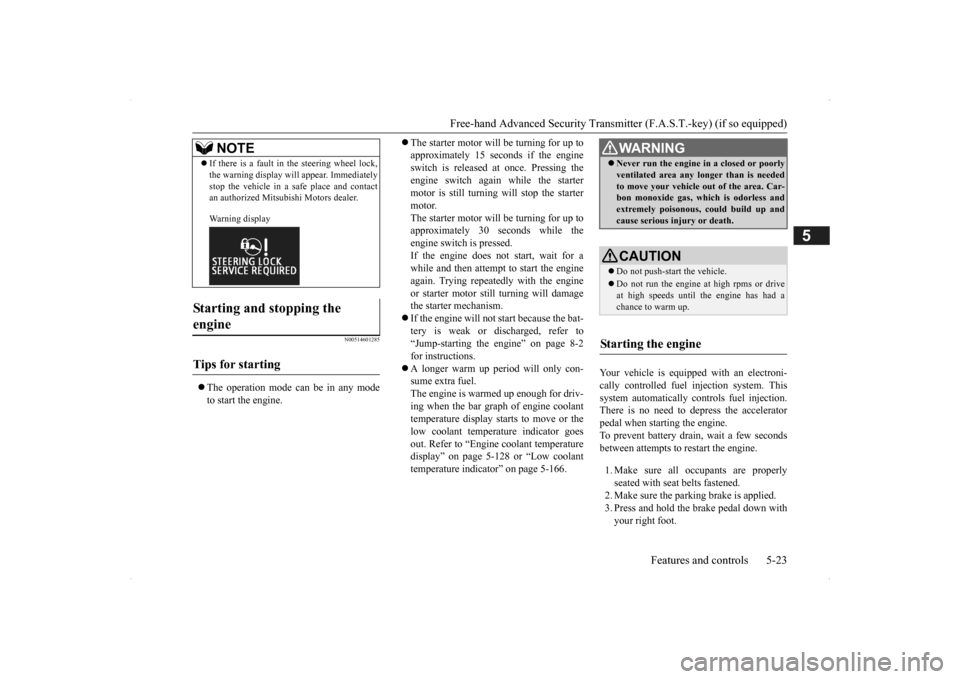
If there is a fault in the steering wheel lock, the warning display will
appear. Immediately
stop the vehicle in a sa
fe place and contact
an authorized Mitsubishi Motors dealer. Warning display
Starting and stopping the engine
Tips for starting
NOTE
WA R N I N G Never run the engine in
a closed or poorly
ventilated area any lo
nger than is needed
to move your vehicle out of the area. Car-bon monoxide gas, whic
h is odorless and
extremely poisonous, could build up and cause serious injury or death.CAUTION Do not push-start the vehicle.Do not run the engine at high rpms or drive at high speeds until the engine has had achance to warm up.
Starting the engine
BK0200500US.book 23 ページ 2013年2月12日 火曜日 午前9時46分