belt MITSUBISHI OUTLANDER 2014 3.G Owner's Manual
[x] Cancel search | Manufacturer: MITSUBISHI, Model Year: 2014, Model line: OUTLANDER, Model: MITSUBISHI OUTLANDER 2014 3.GPages: 451, PDF Size: 49.08 MB
Page 52 of 451
Child restraint systems
Seat and restraint systems 4-25
4
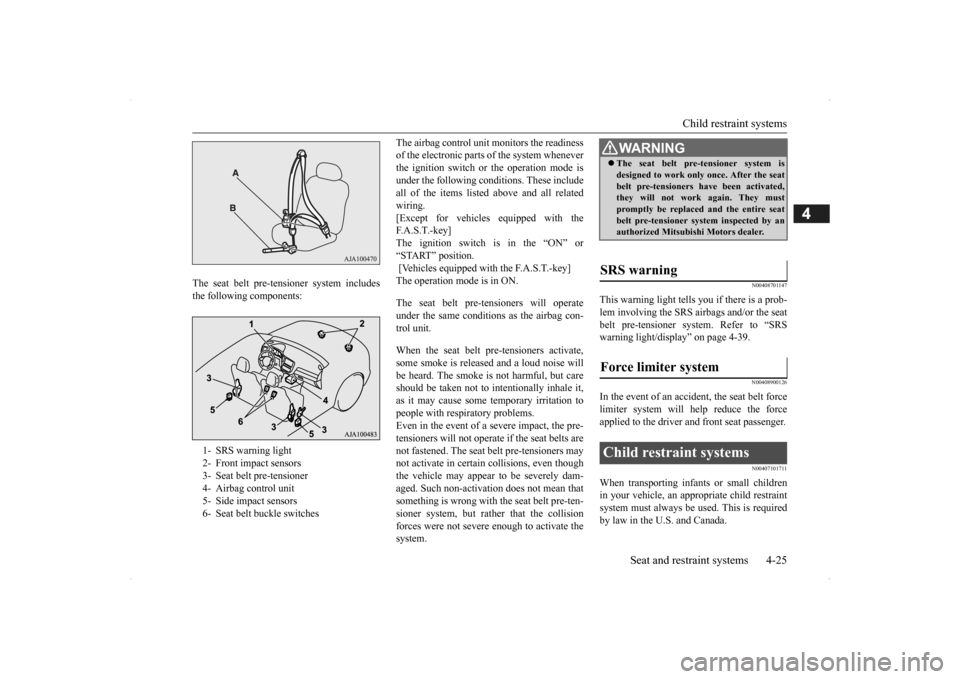
The seat belt pre-tensioner system includes the following components:
The airbag control unit
monitors the readiness
of the electronic parts of the system wheneverthe ignition switch or the operation mode is under the following conditions. These include all of the item
s listed above a
nd all related
wiring. [Except for vehicles equipped with the F. A . S . T. - k e y ]The ignition switch is in the “ON” or “START” position. [Vehicles equipped with the F.A.S.T.-key] The operation mode is in ON. The seat belt pre-tens
ioners will operate
under the same conditions
as the airbag con-
trol unit. When the seat belt pre-tensioners activate, some smoke is released
and a loud noise will
be heard. The smoke is
not harmful, but care
should be taken not to in
tentionally inhale it,
as it may cause some
temporary irritation to
people with respiratory problems.Even in the event of a severe impact, the pre- tensioners will
not operate if the seat belts are
not fastened. The seat be
lt pre-tensioners may
not activate in certai
n collisions, even though
the vehicle may appear
to be severely dam-
aged. Such non-activation does not mean thatsomething is wrong with the seat belt pre-ten- sioner system, but rather that the collision forces were not severe
enough to activate the
system.
N00408701147
This warning light tells you if there is a prob-lem involving the SRS airbags and/or the seat belt pre-tensioner system. Refer to “SRS warning light/display” on page 4-39.
N00408900126
In the event of an accident, the seat belt forcelimiter system will help reduce the forceapplied to the driver a
nd front seat passenger.
N00407101711
When transporting infants or small children in your vehicle, an appr
opriate child restraint
system must always be
used. This is required
by law in the U.S. and Canada.
1- SRS warning light 2- Front impact sensors 3- Seat belt
pre-tensioner
4- Airbag control unit 5- Side impact sensors 6- Seat belt
buckle switches
WA R N I N GThe seat belt pre-tensioner system is designed to work only
once. After the seat
belt pre-tensioners have been activated,they will not work again. They must promptly be replaced and the entire seat belt pre-tensioner system inspected by anauthorized Mitsubis
hi Motors dealer.
SRS warning Force limiter system Child restraint systems
BK0200500US.book 25 ページ 2013年2月12日 火曜日 午前9時46分
Page 53 of 451
Child restraint systems 4-26 Seat and restraint systems
4
Child restraint systems specifically designed for infants and small children are offered byseveral manufacturers
. Choose only a child
restraint system with a label certifying that it complies with Federal Motor Vehicle SafetyStandard 213 (FMVSS 213) or Motor Vehicle Restraint Systems and Booster Cushions Safety Regulations (RSSR). Look for themanufacturer’s statement of compliance on the box and child restraint system itself. The child restraint system should be appropri- ate for your child’s we
ight and height, and
should properly fit you
r vehicle’s seat.
For detailed information,
refer to the instruc-
tion manual accompanying the child restraint system. All children should be
properly restrained in
a restraint device that
offers the maximum
protection for their size and age. Be sure to check local, state, or provincial requirements for child size and age that mayvary from the recommendations listed below. Children less than 1 year old and children less than 20 pounds (9 kg) MUST ride in a rear-facing child safety seat that MUSTONLY be used in the second row seat.
Children older than 1 year of age and who weigh less than 40 pounds (18 kg) or whoare less than 40 inches (100 cm) tall must be in a forward-facing restraint used only in the rear seat. Children who weigh more than 40 pounds (18 kg) or who are more than 40 inches (100 cm) tall, regardless of age, shoulduse a suitable child seat or a booster seat (including a booster cushion) in the rear seat until the vehicl
e’s lap-and-shoulder
belt fits them properly.
Guidelines for child restraint system selection
WA R N I N G All children must be seated in the rear seat, and properly restrained.Accident statistics
show that children of
all sizes and ages are safer when properly restrained in the rear seat, rather than inthe front seat. Be sure to select a child restraint system that is appropriate not only for the child’s size and age but also for your vehicle. Some child restraint systems may not fityour vehicle properly.
Any child who is too large to use a child restraint system should ride in the rearseat and wear the la
p-and-shoulder belt
properly. The shoulder belt must be posi- tioned over the shou
lder and across the
chest, not across their neck, and with thelap belt positioned low on the child’s hips, not across their stomach. If necessary, a booster seat (includi
ng a booster cushion)
should be used to help achieve a proper seat belt fit. Follow the booster seat (including a booster cushion) manufac-turer’s instructions. Only use a booster seat (including a booster cushion) that is certified as complying with Federal MotorVehicle Safety Standards or Motor Vehicle Restraint Systems and Booster Cushions Safety Regulations. WA R N I N G
BK0200500US.book 26 ページ 2013年2月12日 火曜日 午前9時46分
Page 54 of 451
Child restraint systems
Seat and restraint systems 4-27
4
WA R N I N G Never hold an infant
or child in your arms
or on your lap when ri
ding in this vehicle,
even when you are wearing your seat belt.Never place any part of the seat belt you are wearing around an
infant or child.
Failure to follow these simple instructionscreates a risk of serious injury or death to your child in the even
t of an accident or
sudden stop.
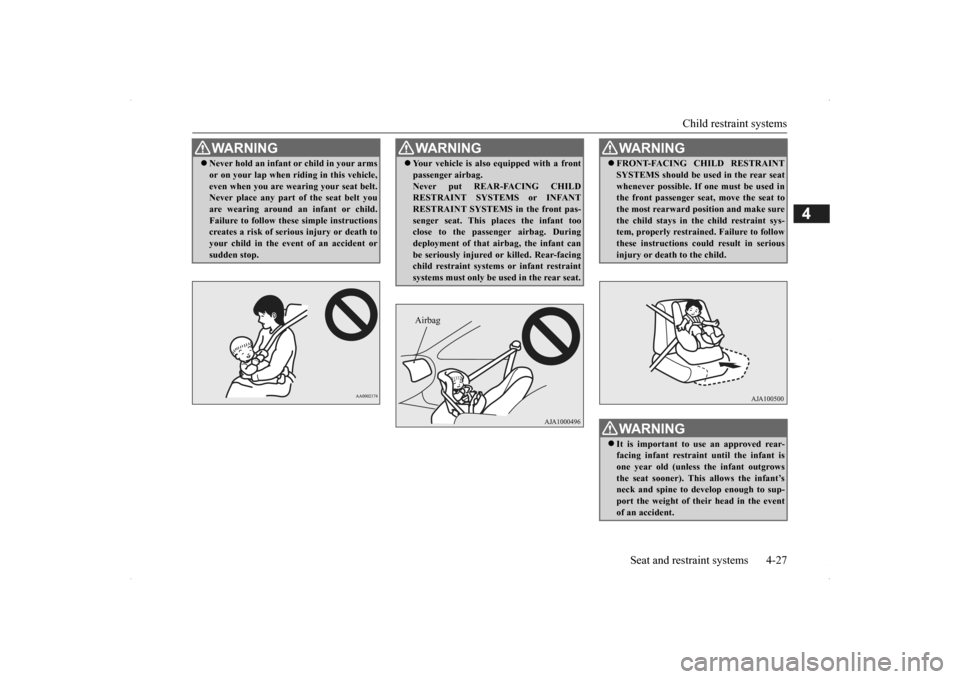
WA R N I N G Your vehicle is also
equipped with a front
passenger airbag.Never put REAR-FACING CHILDRESTRAINT SYSTEMS or INFANT RESTRAINT SYSTEMS in the front pas- senger seat. This places the infant tooclose to the passenger airbag. During deployment of that airbag, the infant can be seriously injured
or killed.
Rear-facing
child restraint systems or infant restraint systems must only be used in the rear seat.Airbag
WA R N I N G FRONT-FACING CHILD RESTRAINT SYSTEMS should be used in the rear seatwhenever possible. If one must be used inthe front passenger seat, move the seat to the most rearward position and make sure the child stays in the child restraint sys-tem, properly restrained. Failure to follow these instructions could result in serious injury or death to the child.WA R N I N G It is important to use an approved rear- facing infant restraint until the infant is one year old (unless
the infant outgrows
the seat sooner). This
allows the infant’s
neck and spine to de
velop enough to sup-
port the weight of their head in the eventof an accident.
BK0200500US.book 27 ページ 2013年2月12日 火曜日 午前9時46分
Page 55 of 451
Child restraint systems 4-28 Seat and restraint systems
4
N00418801167
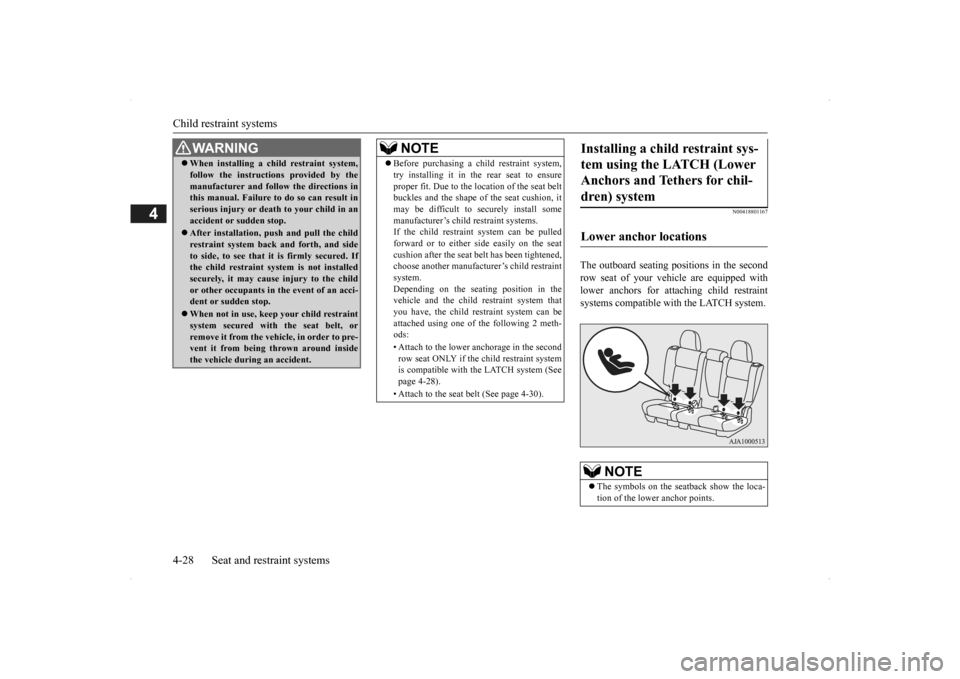
The outboard seating pos
itions in the second
row seat of your vehi
cle are equipped with
lower anchors for attaching child restraint systems compatible with the LATCH system.
When installing a child restraint system, follow the instructions provided by themanufacturer and follow the directions inthis manual. Failure to do so can result in serious injury or deat
h to your child in an
accident or
sudden stop.
After installation, push
and pull the child
restraint system back and forth, and sideto side, to see that it is firmly secured. If the child restraint system is not installed securely, it may cause injury to the childor other occupants in
the event of an acci-
dent or sudden stop. When not in use, keep your child restraint system secured with the seat belt, or remove it from the vehi
cle, in order to pre-
vent it from being
thrown around inside
the vehicle during an accident.WA R N I N G
NOTE
Before purchasing a child restraint system, try installing it in the rear seat to ensureproper fit. Due to the location of the seat beltbuckles and the shape of the seat cushion, it may be difficult to
securely install some
manufacturer’s child restraint systems.If the child restraint system can be pulled forward or to either side easily on the seat cushion after the seat be
lt has been tightened,
choose another ma
nufacturer’s child restraint
system. Depending on the seating position in thevehicle and the child restraint system that you have, the child restraint system can be attached using one of the following 2 meth-ods: • Attach to the lower anchorage in the second row seat ONLY if the child restraint system is compatible with the LATCH system (See page 4-28). • Attach to the seat
belt (See page 4-30).
Installing a child restraint sys- tem using the LATCH (Lower Anchors and Tethers for chil- dren) system Lower anchor locations
NOTE
The symbols on the seatback show the loca- tion of the lower anchor points.
BK0200500US.book 28 ページ 2013年2月12日 火曜日 午前9時46分
Page 57 of 451
Child restraint systems 4-30 Seat and restraint systems
4
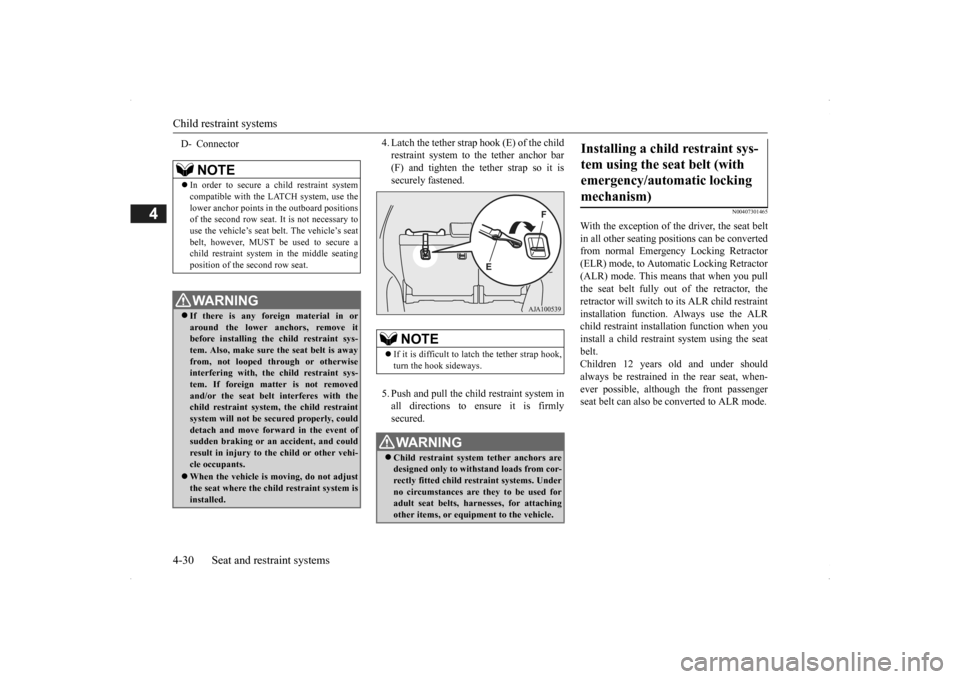
4. Latch the tether strap hook (E) of the child restraint system to the tether anchor bar(F) and tighten the tether strap so it is securely fastened. 5. Push and pull the child restraint system in all directions to en
sure it is firmly
secured.
N00407301465
With the exception of the driver, the seat belt in all other seating po
sitions can be converted
from normal Emergency Locking Retractor(ELR) mode, to Automatic Locking Retractor (ALR) mode. This mean
s that when you pull
the seat belt fully out of the retractor, the retractor will switch to its ALR child restraint installation function.
Always use the ALR
child restraint instal
lation function when you
install a child restraint system using the seat belt.Children 12 years old and under should always be restrained in the rear seat, when- ever possible, although the front passengerseat belt can also be
converted to ALR mode.
D- Connector
NOTE
In order to secure a child restraint system compatible with the LATCH system, use thelower anchor points in the outboard positions of the second row seat.
It is not necessary to
use the vehicle’s seat
belt. The vehicle’s seat
belt, however, MUST be
used to secure a
child restraint system in the middle seating position of the second row seat.WA R N I N G If there is any foreign material in or around the lower anchors, remove it before installing the child restraint sys- tem. Also, make sure the seat belt is awayfrom, not looped through or otherwise interfering with, the child restraint sys- tem. If foreign matter is not removedand/or the seat belt
interferes with the
child restraint system, the child restraint system will not be secured properly, coulddetach and move forward in the event of sudden braking or an
accident, and could
result in injury to the child or other vehi-cle occupants. When the vehicle is
moving, do not adjust
the seat where the child restraint system isinstalled.
NOTE
If it is difficult to
latch the tether strap hook,
turn the hook sideways.WA R N I N G Child restraint system tether anchors are designed only to with
stand loads from cor-
rectly fitted child restraint systems. Underno circumstances are they to be used for adult seat belts, harnesses, for attaching other items, or equipment to the vehicle.
Installing a child restraint sys- tem using the seat belt (with emergency/auto
matic locking
mechanism)
BK0200500US.book 30 ページ 2013年2月12日 火曜日 午前9時46分
Page 58 of 451
Child restraint systems
Seat and restraint systems 4-31
4
1. Place the child restraint system in the rear seating position.
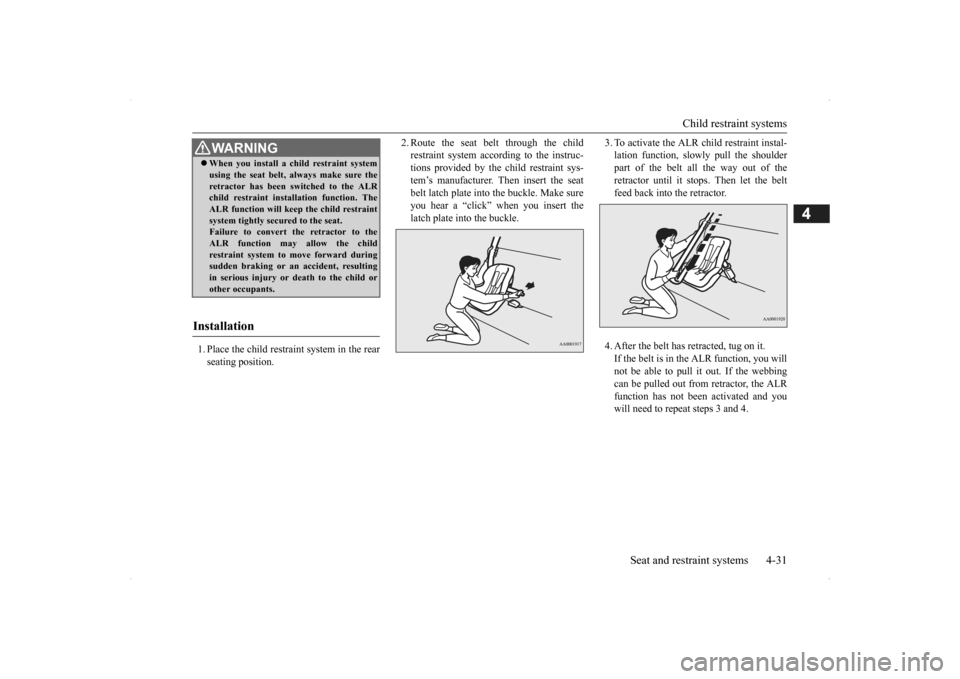
2. Route the seat belt through the child restraint system according to the instruc-tions provided by the child restraint sys- tem’s manufacturer. Then insert the seat belt latch plate into
the buckle. Make sure
you hear a “click” when you insert the latch plate into the buckle.
3. To activate the ALR child restraint instal- lation function, slow
ly pull the shoulder
part of the belt all the way out of the retractor until it stops. Then let the belt feed back into the retractor. 4. After the belt has retracted, tug on it. If the belt is in the ALR function, you will not be able to pull it out. If the webbingcan be pulled out from retractor, the ALR function has not been activated and you will need to repeat steps 3 and 4.
WA R N I N G When you install a child restraint system using the seat belt, al
ways make sure the
retractor has been switched to the ALRchild restraint installation function. The ALR function will keep the child restraint system tightly secured to the seat.Failure to convert the retractor to the ALR function may allow the child restraint system to move forward duringsudden braking
or an accide
nt, resulting
in serious injury or
death to the child or
other occupants.
Installation
BK0200500US.book 31 ページ 2013年2月12日 火曜日 午前9時46分
Page 59 of 451
Child restraint systems 4-32 Seat and restraint systems
4
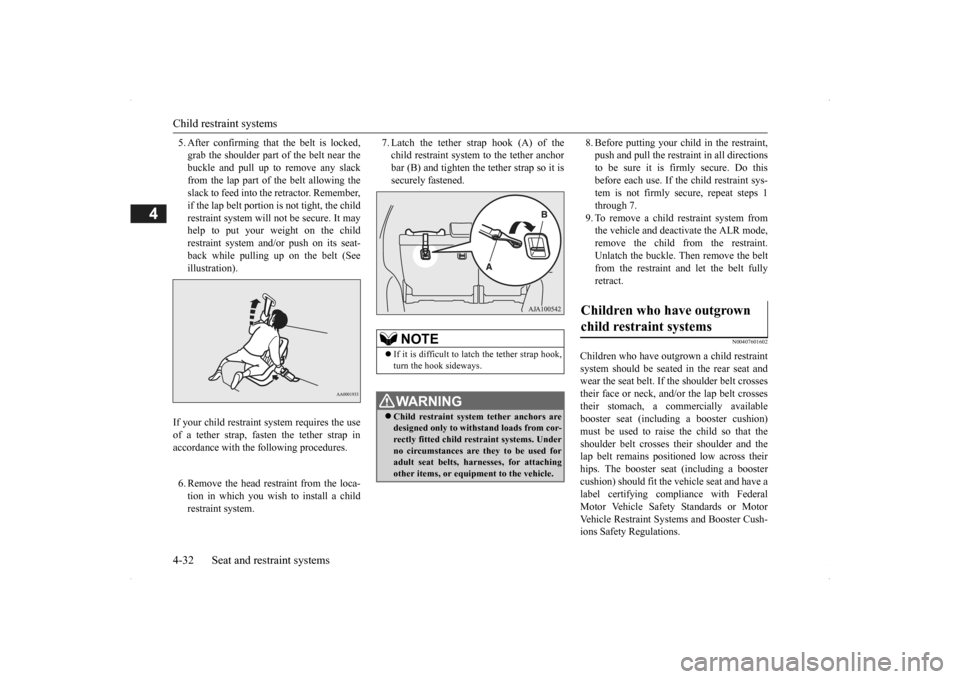
5. After confirming that the belt is locked, grab the shoulder part of the belt near thebuckle and pull up to remove any slack from the lap part of the belt allowing the slack to feed into the retractor. Remember,if the lap belt portion is not tight, the child restraint system will
not be secure. It may
help to put your weight on the childrestraint system and/or push on its seat- back while pulling up on the belt (See illustration). 6. Remove the head restraint from the loca- tion in which you wish to install a childrestraint system.
7. Latch the tether strap hook (A) of the child restraint system to the tether anchorbar (B) and tighten the tether strap so it is securely fastened.
8. Before putting your child in the restraint, push and pull the restraint in all directionsto be sure it is firmly secure. Do this before each use. If
the child restraint sys-
tem is not firmly se
cure, repeat steps 1
through 7. 9. To remove a child restraint system from the vehicle and deactivate the ALR mode,remove the child from the restraint. Unlatch the buckle. Then remove the belt from the restraint and let the belt fully retract.
N00407601602
Children who have outgrown a child restraint system should be
seated in the rear seat and
wear the seat belt. If the shoulder belt crosses their face or neck, and/or the lap belt crosses their stomach, a commercially availablebooster seat (includi
ng a booster cushion)
must be used to raise the child so that the shoulder belt crosses their shoulder and thelap belt remains positioned low across their hips. The booster seat (including a booster cushion) should fit the vehicle seat and have alabel certifying compliance with Federal Motor Vehicle Safety Standards or Motor Vehicle Restraint Systems and Booster Cush-ions Safety Regulations.
If your child restraint system requires the use of a tether strap, fasten the tether strap in accordance with the following procedures.
NOTE
If it is difficult to
latch the tether strap hook,
turn the hook sideways.WA R N I N G Child restraint system tether anchors are designed only to with
stand loads from cor-
rectly fitted child restraint systems. Underno circumstances are they to be used for adult seat belts, harnesses, for attaching other items, or equipment to the vehicle.
Children who have outgrown child restraint systems
BK0200500US.book 32 ページ 2013年2月12日 火曜日 午前9時46分
Page 61 of 451
Maintenance and inspection of seat belts
Seat and restraint systems 4-33
4
N00407000221
The seat belt webbing
may be cleaned with
mild soap or detergent solution. Do not use an organic solvent. Allow the belts to dry in theshade. Do not allow them to retract until com- pletely dry. Do not attempt to bleach or re- dye the belts. The color may rub off and thewebbing strength may be affected. Regularly check your se
at belt buckles and
their release mechanisms
for positive engage-
ment and release of the
latch plate. Check the
retractors for automatic locking when in the Automatic Locking Retractor function. The entire seat belt assembly should be replaced if the webbing shows any obvious cuts, tears, increase in thickness in any sec- tion of the webbing from broken fibers, orsevere fading from sunl
ight. All of these con-
ditions indicate a we
akening of the belt,
which may adversely affect seat belt perfor-mance in an accident.
N00407701717
This vehicle is equippe
d with a Supplemental
Restraint System (SRS), which includes air- bags for the driver and passengers. The SRS front airbags are designed to supple- ment the primary protection of the driver and
front passenger seat
belt systems by provid-
ing those occupants wi
th protection against
head and chest injuries
in certain moderate to
severe frontal collisions. The SRS front air- bags, together with sens
ors at the front of the
vehicle and sensors attached to the front seats, form an advanced airbag system. The SRS side airbags and the curtain airbags are also designed to supplement the seat belts.The SRS side airbags provide the driver and front passenger with protection against chest injuries by deploying the bag on the side impacted in moderate
to severe side impact
collisions. The SRS curtain airbags providethe driver and passengers on the front seat and second row outboard seat with protection against head injuries
by deploying a bag on
the side impacted in moderate to severe side impact collisions a
nd by deploying both bags
when a rollover is detected. The SRS airbags are NOT a substitute for use of the seat belts. For maximum protection in all types of accident
s, seat belts must
ALWAYS be worn by everyone who drives orrides in this vehicle
(with infants and small
children in an appropriate child restraint sys- tem in the rear seat, and older children buck-led in the rear seat). Refer to “Child restraint systems” on page 4-25.
WA R N I N G Any child who is t
oo small to properly
wear a seat belt must be properlyrestrained in an appropriate childrestraint system, to reduce their risk of serious injury or de
ath in an accident.
A child should never be left unattended in, or unsupervised around, your vehicle. When you leave the ve
hicle, always take
the child out as well. Children can die from heat stroke if left or trapped inside the vehicle, especially on hot days. Keep your vehicle locked when not in use. Keep your vehicle ke
ys away from chil-
dren.
Maintenance and inspection of seat belts
WA R N I N G Do not attempt to repair or replace any part of the seat belt assemblies. This workshould be done by an authorized Mitsubishi Motors deal
er. Failure to have
an authorized Mitsub
ishi Motors dealer
perform the work could reduce the effec- tiveness of the belts and could result in a serious injury or de
ath in an
accident.
Supplemental Restraint Sys- tem (SRS) - airbag
BK0200500US.book 33 ページ 2013年2月12日 火曜日 午前9時46分
Page 62 of 451
Supplemental Restraint System (SRS) - airbag 4-34 Seat and restraint systems
4
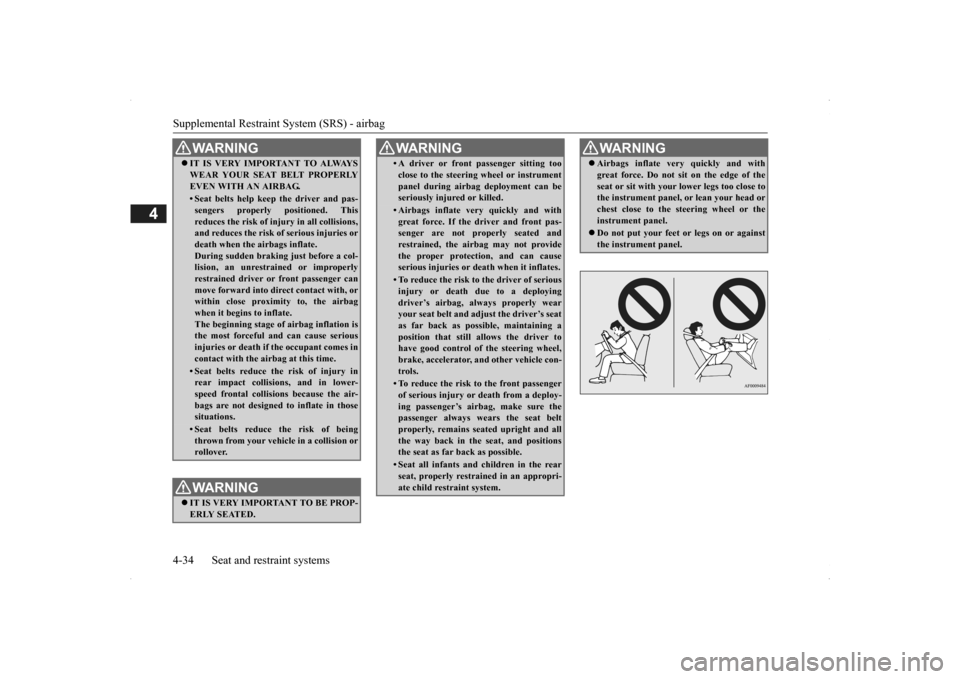
WA R N I N G IT IS VERY IMPORTANT TO ALWAYS WEAR YOUR SEAT BELT PROPERLYEVEN WITH AN AIRBAG.• Seat belts help keep the driver and pas-sengers properly positioned. Thisreduces the risk of injury in all collisions, and reduces the risk of serious injuries or death when the airbags inflate.During sudden brakin
g just before a col-
lision, an unrestra
ined or improperly
restrained driver or front passenger canmove forward into di
rect contact with, or
within close proximity to, the airbag when it begins to inflate.The beginning stage of
airbag inflation is
the most forceful and can cause serious injuries or death if the occupant comes incontact with the ai
rbag at this time.
• Seat belts reduce the risk of injury in rear impact collisions, and in lower- speed frontal collisions because the air- bags are not designed
to inflate in those
situations.• Seat belts reduce the risk of beingthrown from your vehi
cle in a collision or
rollover.WA R N I N G IT IS VERY IMPORTANT TO BE PROP- ERLY SEATED.
• A driver or front passenger sitting too close to the steering wheel or instrumentpanel during airbag deployment can beseriously injure
d or killed.
• Airbags inflate ve
ry quickly and with
great force. If the driver and front pas- senger are not properly seated and restrained, the airbag may not providethe proper protection, and can cause serious injuries or death when it inflates.• To reduce the risk to the driver of seriousinjury or death due to a deploying driver’s airbag, al
ways properly wear
your seat belt and ad
just the driver’s seat
as far back as possible, maintaining a position that still
allows the driver to
have good control of the steering wheel, brake, accelerator,
and other vehicle con-
trols.• To reduce the risk to the front passengerof serious injury or death from a deploy-ing passenger’s airbag, make sure the passenger always we
ars the seat belt
properly, remains seat
ed upright and all
the way back in the seat, and positions the seat as far back as possible.• Seat all infants and children in the rearseat, properly restrain
ed in an appropri-
ate child restraint system.WA R N I N G
WA R N I N G Airbags inflate very
quickly and with
great force. Do not sit on the edge of theseat or sit with your
lower legs too close to
the instrument panel,
or lean your head or
chest close to the steering wheel or the instrument panel. Do not put your feet or
legs on or against
the instrument panel.
BK0200500US.book 34 ページ 2013年2月12日 火曜日 午前9時46分
Page 63 of 451
Supplemental Restraint System (SRS) - airbag
Seat and restraint systems 4-35
4
WA R N I N G Infants and small children should never ride unrestrained,
or lean against the
instrument panel. They should never rideheld in your arms or on your lap. They can be seriously inju
red or killed in an
accident, especially when the airbagsinflate. Seat all infants and children in the rear seat, properly re
strained in an appro-
priate child restraint system. Refer to“Child restraint syst
ems” on page 4-25.
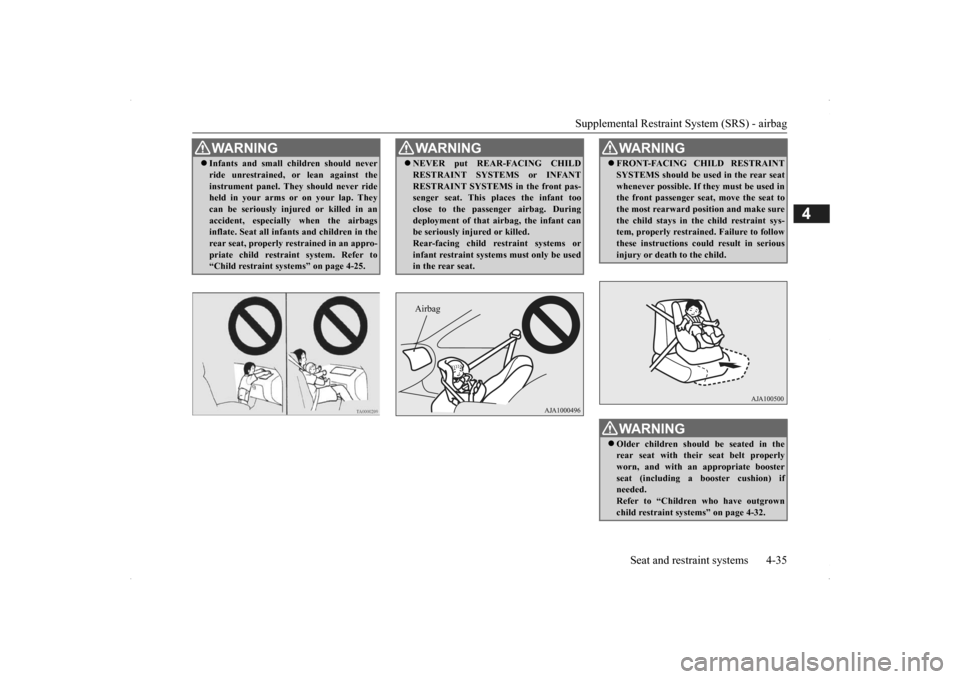
WA R N I N GNEVER put REAR-FACING CHILD RESTRAINT SYSTEMS or INFANTRESTRAINT SYSTEMS in the front pas-senger seat. This places the infant too close to the passenger airbag. During deployment of that airbag, the infant canbe seriously inju
red or killed.
Rear-facing child restraint systems or infant restraint systems must only be usedin the rear seat.Airbag
WA R N I N G FRONT-FACING CHILD RESTRAINT SYSTEMS should be used in the rear seatwhenever possible. If they must be used inthe front passenger seat, move the seat to the most rearward position and make sure the child stays in the child restraint sys-tem, properly restrained. Failure to follow these instructions could result in serious injury or death to the child.WA R N I N G Older children should be seated in the rear seat with their seat belt properly worn, and with an
appropriate booster
seat (including a
booster cushion) if
needed. Refer to “Children
who have outgrown
child restraint syst
ems” on page 4-32.
BK0200500US.book 35 ページ 2013年2月12日 火曜日 午前9時46分