roof MITSUBISHI OUTLANDER 2014 3.G Owners Manual
[x] Cancel search | Manufacturer: MITSUBISHI, Model Year: 2014, Model line: OUTLANDER, Model: MITSUBISHI OUTLANDER 2014 3.GPages: 451, PDF Size: 49.08 MB
Page 6 of 451
Interior
Overview 1-4
1
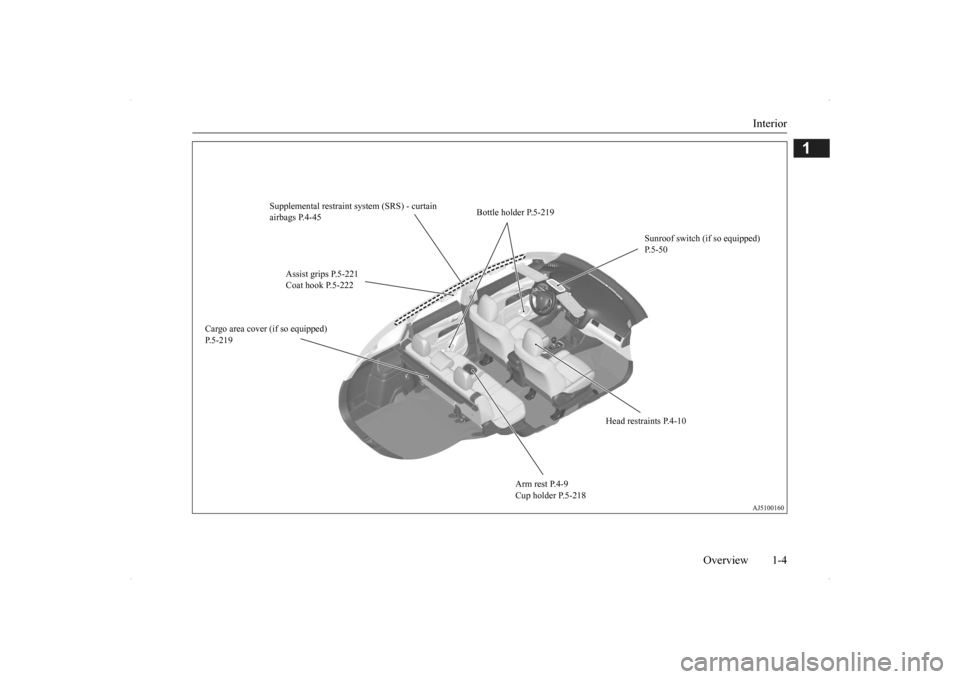
Assist grips P.5-221 Coat hook P.5-222
Bottle holder P.5-219
Sunroof switch (if so equipped) P.5-50
Head restraints P.4-10
Arm rest P.4-9 Cup holder P.5-218
Cargo area cover (if so equipped) P.5-219
Supplemental restraint system (SRS) - curtain airbags P.4-45
BK0200500US.book 4 ページ 2013年2月12日 火曜日 午前9時46分
Page 8 of 451
Outside (Front)
Overview 1-6
1
N00100602388
Outside (Front)
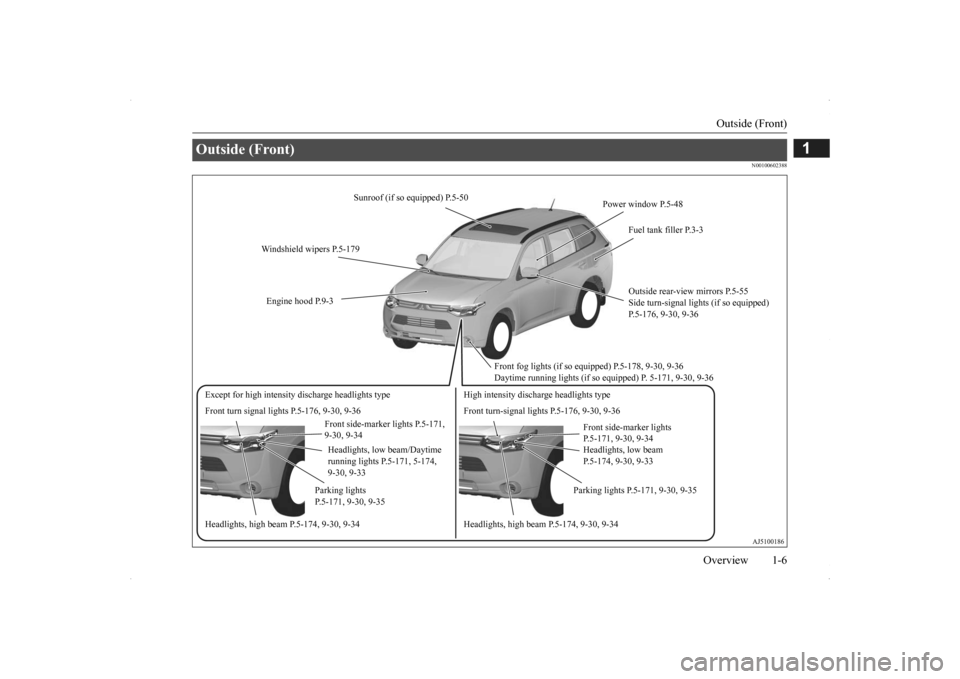
Sunroof (if so equipped) P.5-50
Windshield wipers P.5-179 Engine hood P.9-3
Front fog lights (if so equipped) P.5-178, 9-30, 9-36 Daytime running lights (if so equipped) P. 5-171, 9-30, 9-36
Outside rear-view mirrors P.5-55 Side turn-signal lights (if so equipped) P.5-176, 9-30, 9-36 Fuel tank filler P.3-3
Power window P.5-48
Front turn-signal lights P.5-176, 9-30, 9-36
Front turn signal lights P.5-176, 9-30, 9-36
Headlights, low beam P.5-174, 9-30, 9-33 Parking lights P.5-171, 9-30, 9-35
Headlights, low beam/Daytime running lights P.5-171, 5-174,9-30, 9-33
Parking lights P.5-171, 9-30, 9-35
Headlights, high beam P.5-174, 9-30, 9-34 Headlights, high beam P.5-174, 9-30, 9-34 Except for high intensity discharge headlights
type High intensity discharge headlights type
Front side-marker lights P.5-171, 9-30, 9-34
Front side-marker lights P.5-171, 9-30, 9-34
BK0200500US.book 6 ページ 2013年2月12日 火曜日 午前9時46分
Page 70 of 451
Supplemental Restraint System (SRS) - airbag 4-42 Seat and restraint systems
4
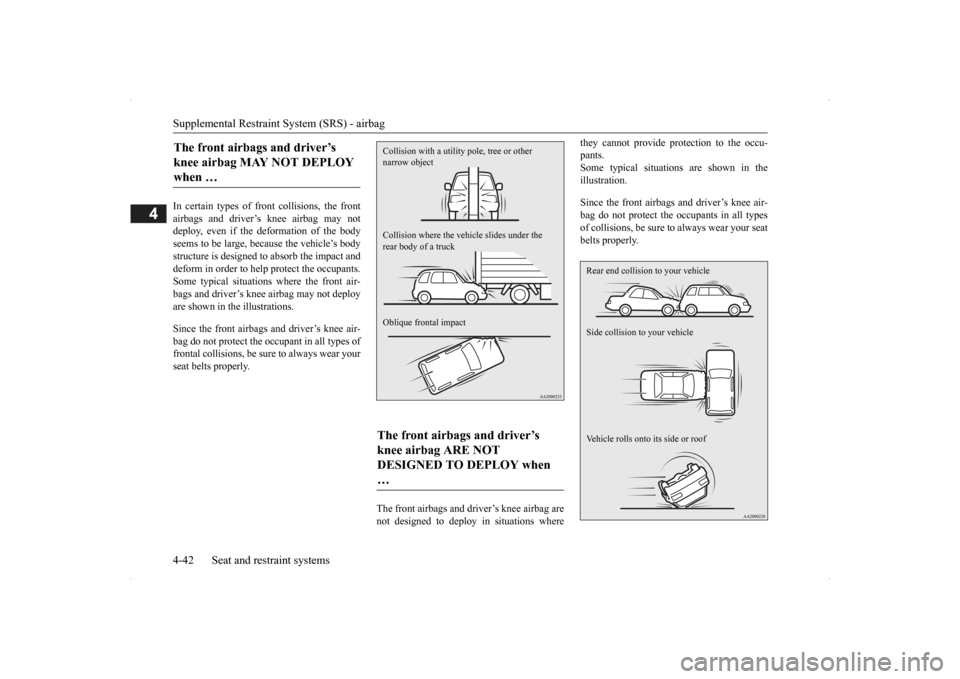
In certain types of front collisions, the front airbags and driver’s knee airbag may notdeploy, even if the deformation of the body seems to be large, because the vehicle’s body structure is designed to
absorb the impact and
deform in order to help
protect the occupants.
Some typical situations where the front air- bags and driver’s knee airbag may not deploy are shown in the illustrations. Since the front airbags and driver’s knee air- bag do not protect the oc
cupant in all types of
frontal collisions, be su
re to always wear your
seat belts properly.
The front airbags and driver’s knee airbag are not designed to deploy in situations where
they cannot provide protection to the occu- pants.Some typical situations are shown in the illustration. Since the front airbags and driver’s knee air- bag do not protect the oc
cupants in all types
of collisions, be sure
to always wear your seat
belts properly.
The front airbags and driver’s knee airbag MAY NOT DEPLOY when …
The front airbags and driver’s knee airbag ARE NOT DESIGNED TO DEPLOY when … Collision with a utility pole, tree or other narrow object Collision where the vehi
cle slides under the
rear body of a truck Oblique frontal impact
Rear end collision to your vehicle Side collision to your vehicle Vehicle rolls onto its side or roof
BK0200500US.book 42 ページ 2013年2月12日 火曜日 午前9時46分
Page 73 of 451
Supplemental Restraint System (SRS) - airbag
Seat and restraint systems 4-45
4
N00419201227
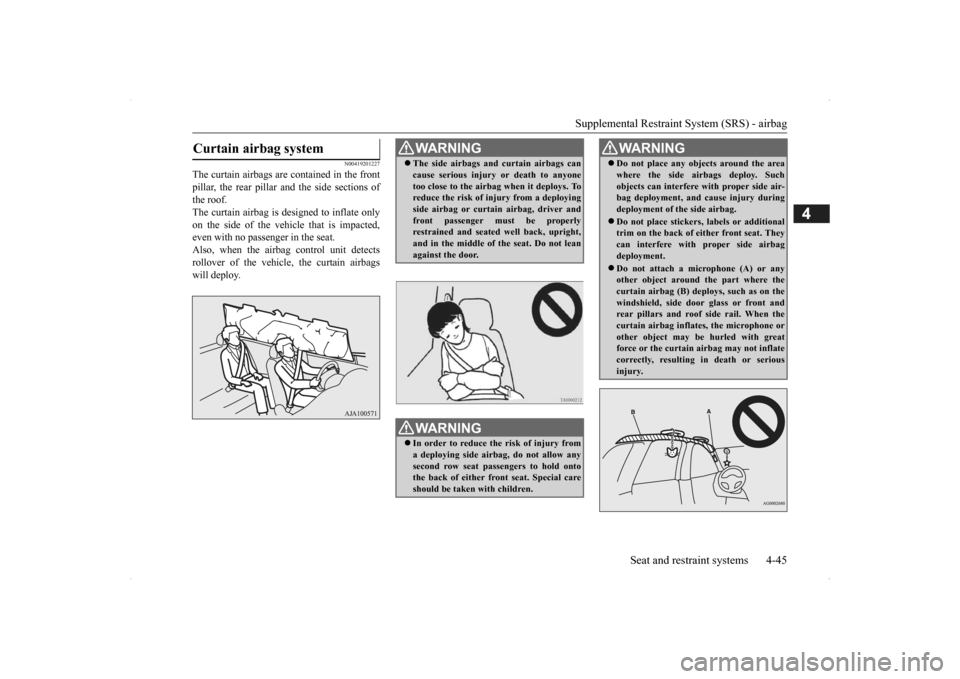
The curtain airbags are contained in the front pillar, the rear pillar and the side sections of the roof.The curtain airbag is designed to inflate only on the side of the ve
hicle that is impacted,
even with no passenger in the seat.Also, when the airbag control unit detects rollover of the vehicle, the curtain airbags will deploy.Curtain airbag system
WA R N I N G The side airbags and
curtain airbags can
cause serious injury
or death to anyone
too close to the airb
ag when it deploys. To
reduce the risk of in
jury from a deploying
side airbag or curtai
n airbag, dr
iver and
front passenger must be properlyrestrained and seated well back, upright, and in the middle of
the seat. Do not lean
against the door.WA R N I N G In order to reduce the risk of injury from a deploying side airb
ag, do not allow any
second row seat passengers to hold onto the back of either front seat. Special careshould be taken with children.
Do not place any objects around the area where the side airbags deploy. Suchobjects can interfere with proper side air-bag deployment, and
cause injury during
deployment of the side airbag. Do not place stickers, labels or additional trim on the back of either front seat. They can interfere with proper side airbagdeployment. Do not attach a microphone (A) or any other object around the part where the curtain airbag (B) depl
oys, such as on the
windshield, side door glass or front andrear pillars and roof
side rail. When the
curtain airbag inflates
, the microphone or
other object may be
hurled with great
force or the curtain airbag may not inflate correctly, resulting in death or serious injury.WA R N I N G
BK0200500US.book 45 ページ 2013年2月12日 火曜日 午前9時46分
Page 74 of 451
Supplemental Restraint System (SRS) - airbag 4-46 Seat and restraint systems
4
N00408201546
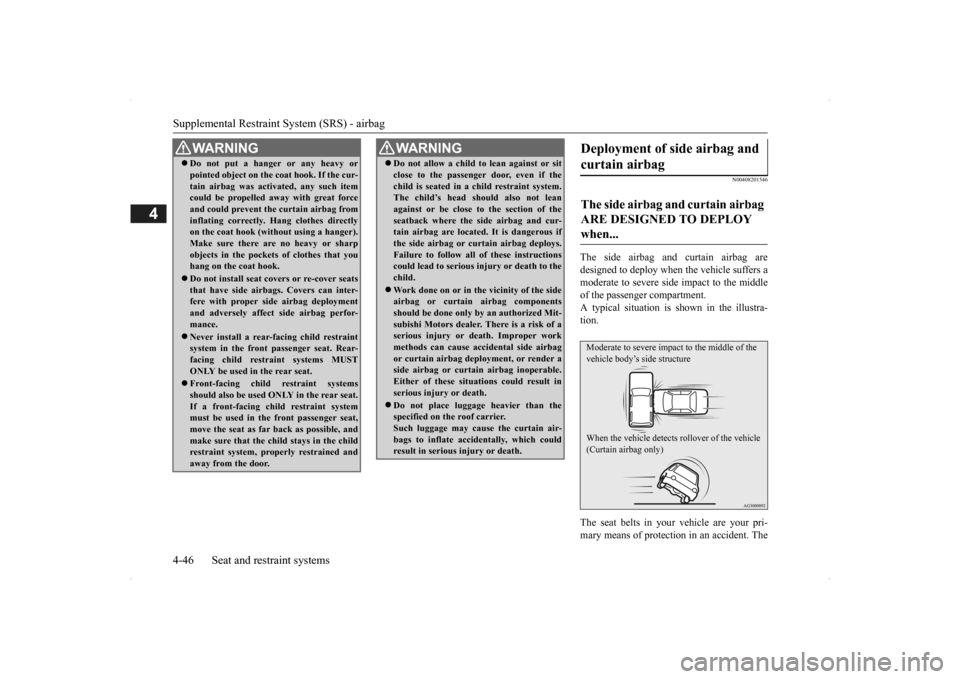
The side airbag and curtain airbag are designed to deploy when the vehicle suffers a moderate to seve
re side impact to the middle
of the passenger compartment.A typical situation is shown in the illustra- tion. The seat belts in your vehicle are your pri- mary means of protection in an accident. The
WA R N I N G Do not put a hanger or any heavy or pointed object on the coat hook. If the cur-tain airbag was activated, any such itemcould be propelled aw
ay with great force
and could prevent th
e curtain airbag from
inflating correctly. Hang clothes directlyon the coat hook (without using a hanger). Make sure there are no heavy or sharp objects in the pocket
s of clothes that you
hang on the coat hook. Do not install seat cove
rs or re-cover seats
that have side airbag
s. Covers can inter-
fere with proper si
de airbag deployment
and adversely affect
side airbag perfor-
mance. Never install a rear-facing child restraint system in the front passenger seat. Rear- facing child restraint systems MUST ONLY be used in the rear seat. Front-facing child restraint systems should also be used ON
LY in the rear seat.
If a front-facing child restraint system must be used in the front passenger seat, move the seat as far back as possible, andmake sure that the child stays in the child restraint system, properly restrained and away from the door.
Do not allow a child to lean against or sit close to the passenger door, even if thechild is seated in a child restraint system.The child’s head should also not lean against or be close to the section of the seatback where the side airbag and cur-tain airbag are located. It is dangerous if the side airbag or cu
rtain airbag deploys.
Failure to follow all of these instructionscould lead to serious in
jury or death to the
child. Work done on or in th
e vicinity of the side
airbag or curtain
airbag components
should be done only
by an authorized Mit-
subishi Motors dealer. There is a risk of a serious injury or death. Improper work methods can cause acci
dental side airbag
or curtain airbag depl
oyment, or render a
side airbag or curtai
n airbag inoperable.
Either of these situations could result inserious injury or death. Do not place luggage
heavier than the
specified on the roof carrier. Such luggage may caus
e the curtain air-
bags to inflate acci
dentally, which could
result in serious injury or death.WA R N I N G
Deployment of side airbag and curtain airbag The side airbag and curtain airbag ARE DESIGNED TO DEPLOY when... Moderate to severe impact to the middle of the vehicle body’s side structure When the vehicle detects rollover of the vehicle (Curtain airbag only)
BK0200500US.book 46 ページ 2013年2月12日 火曜日 午前9時46分
Page 75 of 451
Supplemental Restraint System (SRS) - airbag
Seat and restraint systems 4-47
4
SRS side airbags and curtain airbags are designed to provide
additional protection.
Therefore, for your safety and the safety of all occupants, be sure to always wear your seat belts properly. In certain types of side
collisions, the side air-
bag and curtain airbag
may not deploy, even
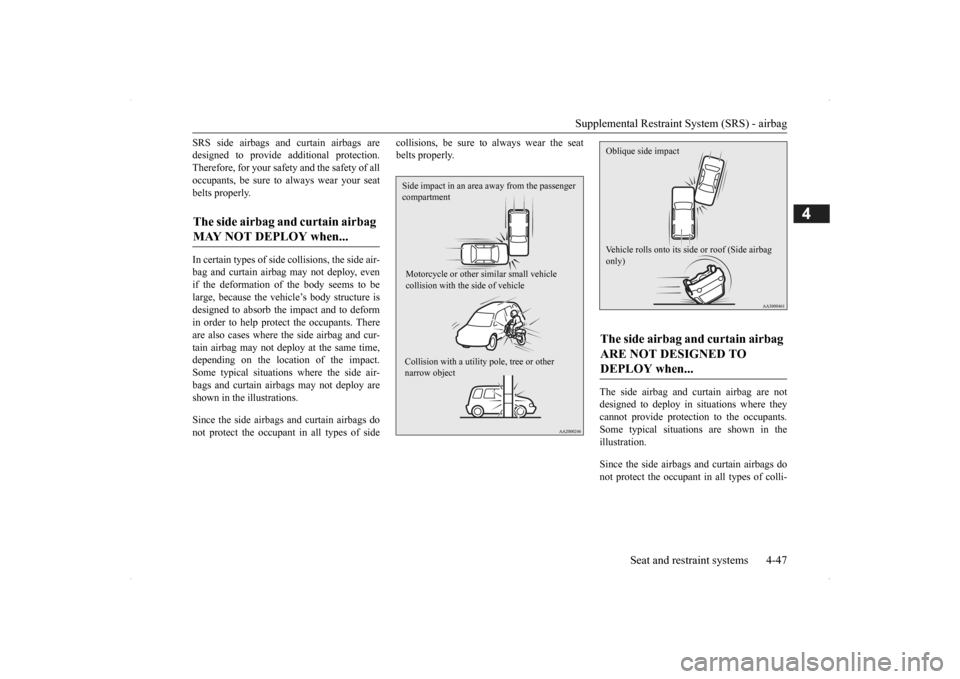
if the deformation of the body seems to be large, because the vehicle’s body structure is designed to absorb the impact and to deform in order to help protect the occupants. Thereare also cases where the side airbag and cur- tain airbag may not deploy at the same time, depending on the location of the impact.Some typical situations
where the side air-
bags and curtain airb
ags may not deploy are
shown in the illustrations. Since the side airbags and curtain airbags do not protect the occupant
in all types of side
collisions, be sure to
always wear the seat
belts properly.
The side airbag and curtain airbag are not designed to deploy in situations where they cannot provide protec
tion to the occupants.
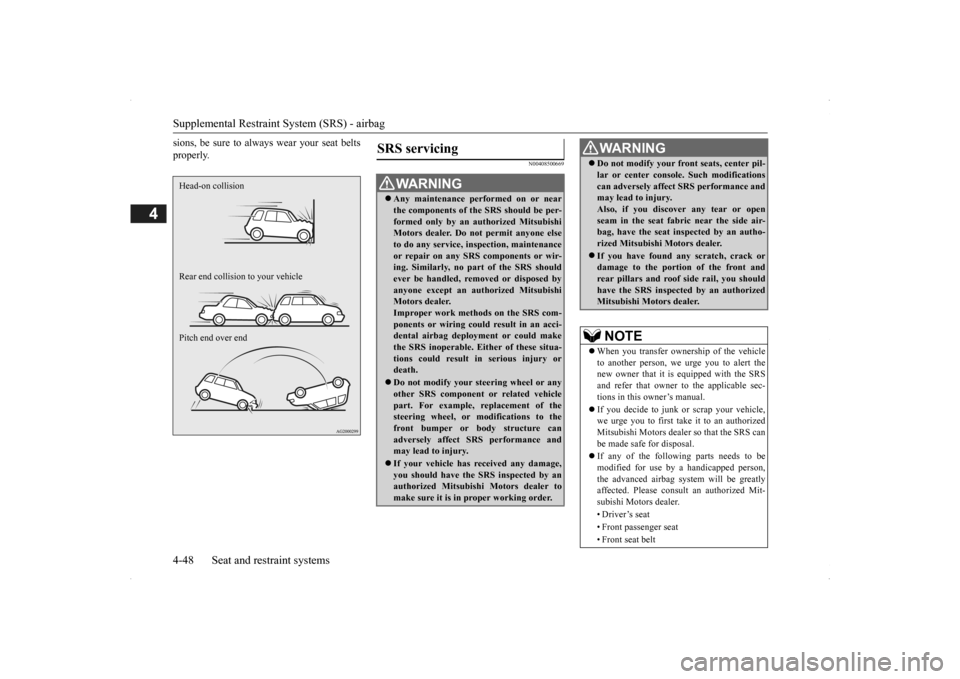
Some typical situations are shown in theillustration. Since the side airbags and curtain airbags do not protect the occupant in all types of colli-
The side airbag and curtain airbag MAY NOT DEPLOY when...
Side impact in an area away from the passenger compartment Motorcycle or other similar small vehicle collision with the side of vehicle Collision with a utility pole, tree or other narrow object
The side airbag and curtain airbag ARE NOT DESIGNED TO DEPLOY when... Oblique side impact Vehicle rolls onto its side or roof (Side airbag only)
BK0200500US.book 47 ページ 2013年2月12日 火曜日 午前9時46分
Page 76 of 451
Supplemental Restraint System (SRS) - airbag 4-48 Seat and restraint systems
4
sions, be sure to always
wear your seat belts
properly.
N00408500669
Head-on collision Rear end collision to your vehicle Pitch end over end
SRS servicing
WA R N I N G Any maintenance performed on or near the components of the SRS should be per-formed only by an
authorized Mitsubishi
Motors dealer. Do not permit anyone else to do any service, inspection, maintenanceor repair on any SR
S components or wir-
ing. Similarly, no part of the SRS should ever be handled, removed or disposed byanyone except an au
thorized Mitsubishi
Motors dealer. Improper work meth
ods on the SRS com-
ponents or wiring could result in an acci- dental airbag deployment or could make the SRS inoperable. Ei
ther of these situa-
tions could result in serious injury or death. Do not modify your steering wheel or any other SRS component or related vehicle part. For example, replacement of thesteering wheel, or modifications to the front bumper or body structure can adversely affect SR
S performance and
may lead to injury. If your vehicle has received any damage, you should have the
SRS inspected by an
authorized Mitsubishi
Motors dealer to
make sure it is in proper working order.
Do not modify your front seats, center pil- lar or center console. Such modificationscan adversely affect
SRS performance and
may lead to injury. Also, if you discove
r any tear or open
seam in the seat fabr
ic near the side air-
bag, have the seat in
spected by an autho-
rized Mitsubishi Motors dealer. If you have found an
y scratch, crack or
damage to the portion of the front and rear pillars and roof
side rail, you should
have the SRS inspected by an authorized Mitsubishi Motors dealer.NOTE
When you transfer ownership of the vehicle to another person, we
urge you to alert the
new owner that it is
equipped with the SRS
and refer that owner to the applicable sec- tions in this owner’s manual. If you decide to junk or
scrap your vehicle,
we urge you to first take it to an authorized Mitsubishi Motors dealer so that the SRS canbe made safe for disposal. If any of the following parts needs to be modified for use by a handicapped person,the advanced airbag system will be greatly affected. Please consult an authorized Mit- subishi Motors dealer. • Driver’s seat • Front passenger seat • Front seat beltWA R N I N G
BK0200500US.book 48 ページ 2013年2月12日 火曜日 午前9時46分
Page 79 of 451
5
Features and controlsBreak-in recommendations ...............................................................5-3 Keys ..................................................................................................5-3 Electronic immobilizer (Anti-theft starting system) .........................5-4Keyless entry system (if so equipped) ..............................................5-7 Free-hand Advanced Security Tr
ansmitter (F.A.S.T.-key) (if so
equipped).....................................................................................5-12Door locks.......................................................................................5-32 Power door locks .......
...........
...........
...........
...........
...........
.........
.....5-34
Child safety locks for rear door ...........
...........
.........
.........
.........
.....5-35
Liftgate (except for vehi
cles equipped with the
power liftgate) .....5-35
Power liftgate (if so equipped) .......................................................5-37 Inside liftgate release .....................................................................5-43Theft-alarm system .........................................................................5-44 Power window control ....................................................................5-48 Sunroof (if so equipped) .................................................................5-50Parking brake ..................................................................................5-52 Steering wheel height and reach adjustment...................................5-53 Inside rearview mirror ....................................................................5-54Outside rearview mirrors ................................................................5-55 Ignition switch ................................................................................5-56 Steering wheel lock (if so equipped) ..............................................5-58Starting the engine ..........................................................................5-58 Automatic transaxle (if so equipped)..............................................5-60 Continuously variable transmission
(CVT) (if so equipped)..........5-68
Electronically controlled
4WD system (if so equipped).................5-75
S-AWC (Super-All Wheel Control) (if
so equipped) .....................5-78
4-wheel drive operation ..................................................................5-81Inspection and maintenance followi
ng rough road operation.........5-83
Cautions on the handling of 4-wheel dr
ive vehicles ...................... 5-83
Service brake .................................................................................. 5-84 Hill start assist (if so equipped) ...................................................... 5-85Brake assist system ......................................................................... 5-86 Anti-lock braking system ............................................................... 5-87 Electric power steering system (EPS) ............................................ 5-89Active stability control (ASC) ........................................................ 5-90 Cruise control ................................................................................. 5-92 Adaptive Cruise Control System (ACC) (if so equipped) .............. 5-96Forward Collision Mitigation System
(FCM) (if so equipped) .... 5-107
Lane Departure Warning System (LDW
) (if so equipped)........... 5-111
Tire pressure monitoring system .................................................. 5-114Rear-view camera (if so equipped)............................................... 5-118 Instrument cluster ......................................................................... 5-120 Multi Information display - Type 1 .............................................. 5-121Multi Information display - Type 2 .............................................. 5-140 Indicator light, warning light, and
information screen display list
(multi information display - Type 1) ....................................... 5-148Indicator and warning light package
(multi information display - Type
2) ............................................................................................... 5-165 Indicators ...................................................................................... 5-166Warning lights............................................................................... 5-167 Information screen display (Vehicle equipped with the multi informa- tion display - Type 1) ............................................................... 5-169Combination headlights and dimmer switch ............................... 5-171 Headlight leveling switch (if so equipped)................................... 5-176 Turn signal lever ........................................................................... 5-176Hazard warning flasher switch ..................................................... 5-177
BK0200500US.book 1 ページ 2013年2月12日 火曜日 午前9時46分
Page 123 of 451
Theft-alarm system
Features and controls 5-45
5
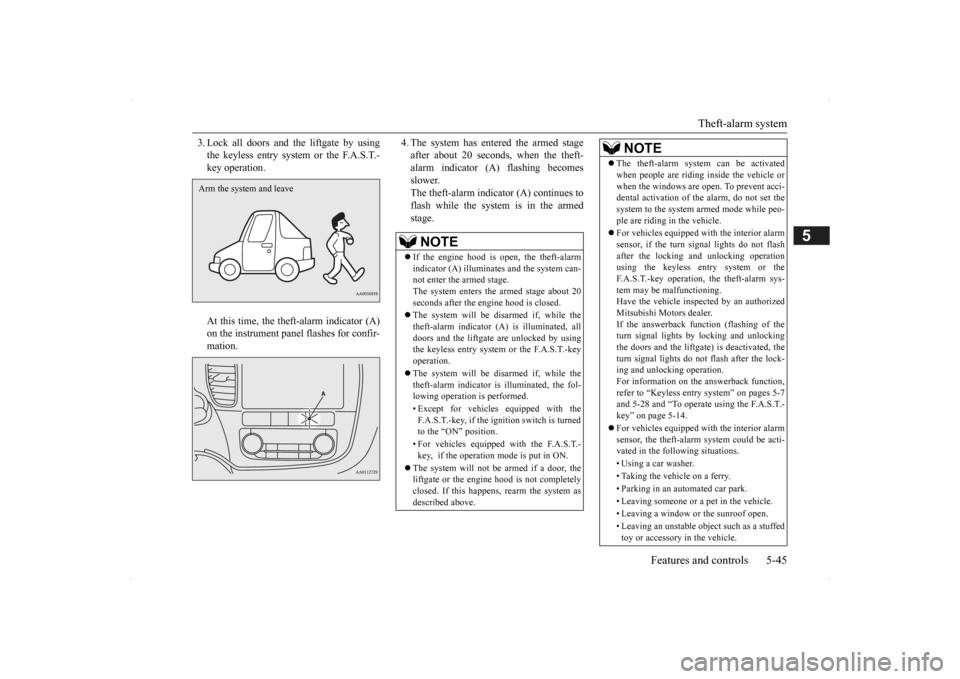
3. Lock all doors and the liftgate by using the keyless entry system or the F.A.S.T.-key operation. At this time, the theft-alarm indicator (A) on the instrument panel flashes for confir-mation.
4. The system has entered the armed stage after about 20 seconds, when the theft-alarm indicator (A) flashing becomes slower. The theft-alarm indicator (A) continues toflash while the system is in the armed stage.
Arm the system and leave
NOTE
If the engine hood is open, the theft-alarm indicator (A) illuminates and the system can-not enter the armed stage. The system enters the armed stage about 20 seconds after the e
ngine hood is closed.
The system will be disarmed if, while the theft-alarm indicator (A) is illuminated, alldoors and the liftgate are unlocked by using the keyless entry system or the F.A.S.T.-key operation. The system will be disarmed if, while the theft-alarm indicator is illuminated, the fol-lowing operation is performed. • Except for vehicles equipped with the F.A.S.T.-key, if the ignition switch is turned to the “ON” position. • For vehicles equippe
d with the F.A.S.T.-
key, if the operation mode is put in ON.
The system will not be armed if a door, the liftgate or the engine
hood is not completely
closed. If this happens, rearm the system asdescribed above.
The theft-alarm system can be activated when people are riding inside the vehicle orwhen the windows are open. To prevent acci-dental activati
on of the alarm, do not set the
system to the system armed mode while peo- ple are riding in the vehicle. For vehicles equipped wi
th the interior alarm
sensor, if the turn si
gnal lights do not flash
after the locking and unlocking operation using the keyless entry system or the F.A.S.T.-key operation, the theft-alarm sys-tem may be malfunctioning. Have the vehicle insp
ected by an authorized
Mitsubishi Motors dealer.If the answerback function (flashing of the turn signal lights by locking and unlocking the doors and the liftgate
) is deactivated, the
turn signal lights do not flash after the lock- ing and unlocking operation. For information on the answerback function,refer to “Keyless entry system” on pages 5-7 and 5-28 and “To operate using the F.A.S.T.- key” on page 5-14. For vehicles equipped wi
th the interior alarm
sensor, the theft-alarm
system could be acti-
vated in the following situations. • Using a car washer.• Taking the vehicle on a ferry. • Parking in an automated car park. • Leaving someone or a pet in the vehicle.• Leaving a window or the sunroof open. • Leaving an unstable object such as a stuffed toy or accessory in the vehicle.NOTE
BK0200500US.book 45 ページ 2013年2月12日 火曜日 午前9時46分
Page 128 of 451
Sunroof (if so equipped) 5-50 Features and controls
5
N00528801129
If a hand or head is trapped, for safety the door window is automati
cally lowered a little.
After the obstruction is removed, pull up the switch again to close the door window.
N00551400014
Wind buffeting can be de
scribed as the per-
ception of pressure on the ears or a boomingor rumbling sound. Your
vehicle may exhibit
wind buffeting when driving with one or both rear door windows down or partially opened.This is a normal occurrence that can be mini- mized. If the buffeting
occurs with the rear
door windows open, open the front door win- dows as well as the rear door windows to minimize the condition.
N00511001682
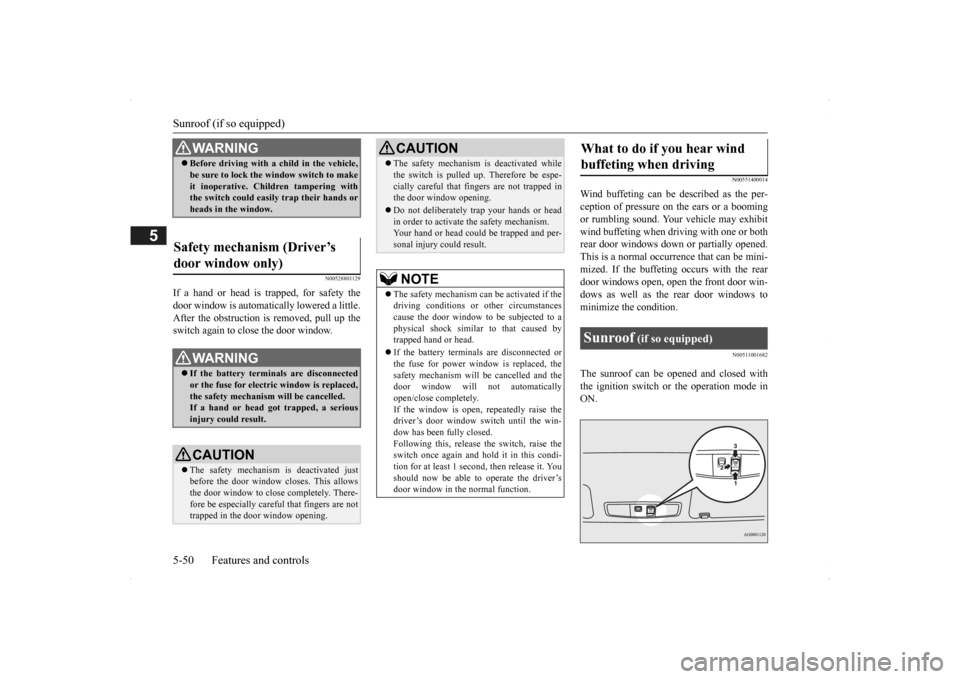
The sunroof can be opened and closed withthe ignition switch or the operation mode in ON.
WA R N I N G Before driving with a child in the vehicle, be sure to lock the window switch to makeit inoperative. Children tampering withthe switch could easily trap their hands or heads in the window.
Safety mechanism (Driver’s door window only)
WA R N I N G If the battery terminals are disconnected or the fuse for electric window is replaced, the safety mechanism will be cancelled.If a hand or head got
trapped, a serious
injury could result.CAUTION The safety mechanism is deactivated just before the door window closes. This allows the door window to close completely. There-fore be especially careful that fingers are not trapped in the door window opening.
The safety mechanism is deactivated while the switch is pulled up.
Therefore be espe-
cially careful that fi
ngers are not trapped in
the door window opening. Do not deliberately tr
ap your hands or head
in order to activate the safety mechanism. Your hand or head coul
d be trapped and per-
sonal injury could result.NOTE
The safety mechanism can be activated if the driving conditions or
other circumstances
cause the door window to be subjected to a physical shock similar to that caused by trapped hand or head. If the battery termin
als are disc
onnected or
the fuse for power window is replaced, thesafety mechanism will be cancelled and the door window will not
automatically
open/close completely.If the window is open,
repeatedly raise the
driver’s door window switch until the win- dow has been fully closed.Following this, release the switch, raise theswitch once again and hol
d it in this condi-
tion for at least 1 second,
then release it. You
should now be able to operate the driver’sdoor window in the normal function.CAUTION
What to do if you hear wind buffeting when driving Sunroof
(if so equipped)
BK0200500US.book 50 ページ 2013年2月12日 火曜日 午前9時46分