gas type MITSUBISHI OUTLANDER SPORT 2014 3.G Owners Manual
[x] Cancel search | Manufacturer: MITSUBISHI, Model Year: 2014, Model line: OUTLANDER SPORT, Model: MITSUBISHI OUTLANDER SPORT 2014 3.GPages: 384, PDF Size: 46.94 MB
Page 17 of 384
Fuel selection 3-2 General information
3
N00301001919
Your vehicle is designed to use unleaded gas- oline only. It is equipped with a fuel tankfiller pipe especially designed to accept only a small diameter unleaded gasoline dispens- ing nozzle. In the United States, fuel suppliers are required by law to add detergents to their gas-
oline to minimize fuel-injector fouling and minimize intake-valve deposits. Detergent gasoline helps keep your engine in tune and your emission-control system working prop-erly. Your vehicle is designed to operate on unleaded gasoline having a minimum octanenumber of 87 [(MON+RON)/2] or 91 RON. Gasoline sold at some service stations con- tains oxygenates such as ethanol, although the oxygenates may not be identified by those names. Oxygenates are required in someareas of the country. Such fuel can be used in your vehicle. A mixture of up to 10% ethanol (grain alco- hol) and 90% unleaded gasoline may be used in your vehicle, provided the octane numberis at least as high as that recommended for unleaded gasoline.
Do not operate your vehicle on gasoline con- taining methanol (wood alcohol). Using thistype of alcohol could adversely affect the vehicle’s performance and damage critical parts of the vehicle’s fuel system. Many areas of the country require the use of cleaner burning fuel referred to as “Reformu- lated Gasoline”.Reformulated gasoline contains oxygenates and is specially blended to reduce vehicle emissions and improve air quality.Mitsubishi Motors Cor
poration strongly sup-
ports the use of reformulated gasoline. Prop- erly blended reformulated gasoline has noadverse effect on vehicle performance or the durability of engine and fuel system. MMT is a manganese-containing metallic additive that is blended into some gasolinesto increase the octane number. Mitsubishi Motors Corporation recommends using gaso- lines without MMT.
Fuel selection
WA R N I N G Gasoline is highly flammable and explo- sive. You could be burned, seriouslyinjured or killed when handling it. When- ever you refuel your vehicle, stop the engine and keep flames, sparks, andsmoking materials away from the vehicle. Always handle fuel in well-ventilated out- door areas.CAUTION Using leaded gasoline in your vehicle will damage the engine, catalytic converter, and the oxygen sensors. Also, using leaded gaso-line is illegal, and will void your warranty coverage of the engine, catalytic converter, and oxygen sensors.
Gasoline detergent additives
Octane requirement Oxygenated gasoline Ethanol (Gasohol)
Methanol Reformulated gasoline MMT (methylcyclopentadienyl manganese tricarbonyl)
BK0202700US.bo
ok 2 ページ 2013年3月28日 木曜日 午前11時54分
Page 157 of 384
Multi-information display 5-94 Features and controls
5
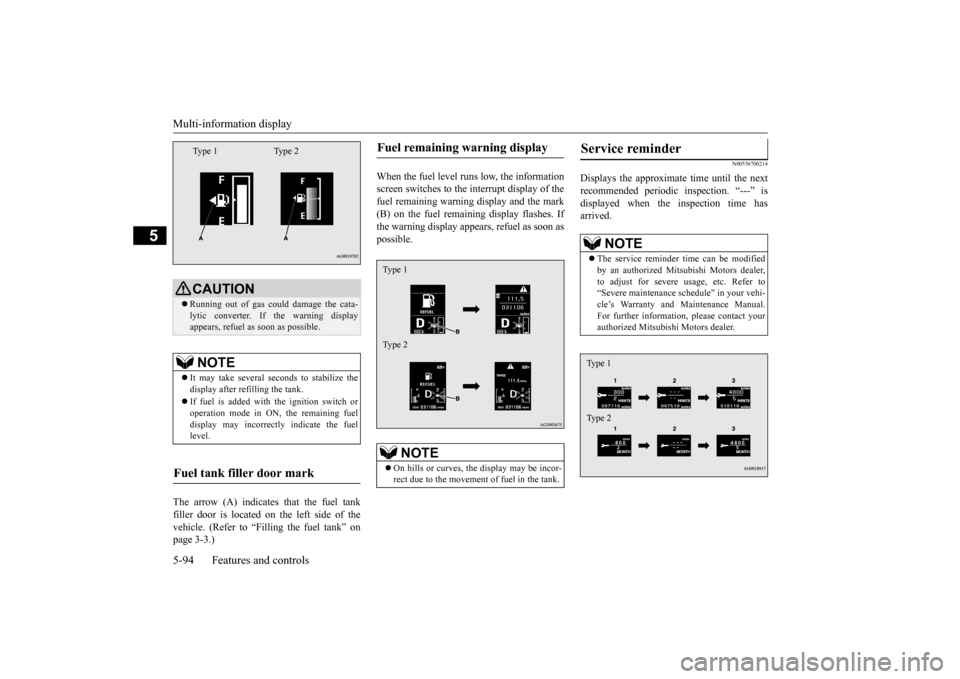
The arrow (A) indicates that the fuel tank filler door is located on the left side of thevehicle. (Refer to “F
illing the fuel tank” on
page 3-3.)
When the fuel level runs low, the information screen switches to the interrupt display of thefuel remaining warning display and the mark (B) on the fuel remaining display flashes. If the warning display appears, refuel as soon aspossible.
N00556700214
Displays the approximate time until the nextrecommended periodic inspection. “---” isdisplayed when the inspection time has arrived.
CAUTION Running out of gas could damage the cata- lytic converter. If the warning display appears, refuel as soon as possible.NOTE
It may take several seconds to stabilize the display after refilling the tank. If fuel is added with the ignition switch or operation mode in ON, the remaining fuel display may incorrectly indicate the fuellevel.
Fuel tank filler door mark
Type 1 Type 2
Fuel remaining warning display
NOTE
On hills or curves, the display may be incor- rect due to the movement of fuel in the tank.Type 1 Type 2
Service reminder
NOTE
The service reminder time can be modified by an authorized Mitsubishi Motors dealer, to adjust for severe usage, etc. Refer to “Severe maintenance schedule” in your vehi-cle’s Warranty and Maintenance Manual. For further information, please contact your authorized Mitsubishi Motors dealer.Type 1 Type 2
BK0202700US.bo
ok 94 ページ 2013年3月28日 木曜日 午前11時54分
Page 324 of 384
Engine hood
Vehicle care and maintenance 9-3
9
To reduce the possibility of catalytic con- verter damage: Use UNLEADED GASOLINE ONLY of the type of recommended in “Fuel selec- tion”. Do not drive with an extremely low fuel level. Running out of gas could damage the catalytic converter. Do not try to start the engine by pushing or towing the vehicle. If the battery is weak or run down, use jumper cables to properly start the engine.
Do not idle the engine with any spark plug wires disconnected or removed, such as when performing diagnostic tests. Do not idle the engine for a long time if it is idling roughly or otherwise obviously malfunctioning. To prevent the catalytic converter from being damaged from unburned gas, do not race the engine when stopping the engine. Stop driving the vehicle if you think the performance is noticeably low, or theengine has a malfunction such as with the ignition, etc. If you
are not able to stop
driving immediately, slow down and drivefor only a short time. Have your vehicle checked at an authorized Mitsubishi Motors dealer or a repair facility of yourchoice as soon as possible. In unusual situations involving major engine problems, a burning odor mayindicate severe and abnormal catalytic converter overheating. If this occurs, stop in a safe place, shut the engine off and letthe vehicle cool. Once the engine is cool, immediately take your vehicle to a dealer or a repair facility of your choice for ser-vice.
N00937500477
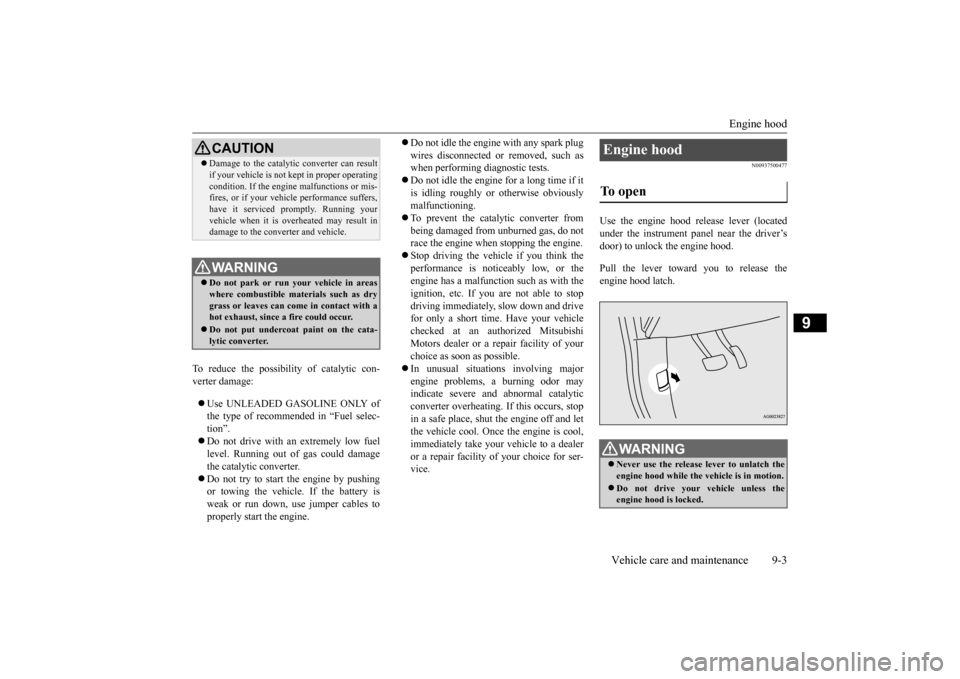
Use the engine hood release lever (locatedunder the instrument panel near the driver’sdoor) to unlock the engine hood. Pull the lever toward you to release the engine hood latch.
CAUTION Damage to the catalytic converter can result if your vehicle is not kept in proper operating condition. If the engine malfunctions or mis- fires, or if your vehicle performance suffers, have it serviced promptly. Running yourvehicle when it is overheated may result in damage to the converter and vehicle.WA R N I N G Do not park or run your vehicle in areas where combustible materials such as dry grass or leaves can come in contact with a hot exhaust, since a fire could occur. Do not put undercoat paint on the cata- lytic converter.
Engine hood To open
WA R N I N G Never use the release lever to unlatch the engine hood while the vehicle is in motion. Do not drive your vehicle unless the engine hood is locked.
BK0202700US.bo
ok 3 ページ 2013年3月28日 木曜日 午前11時54分
Page 344 of 384
General maintenance
Vehicle care and maintenance 9-23
9
there are other parts which do not usually need regular maintenance. But, if any of these parts stops working prop- erly, your vehicle performance could suffer.Have these items checked if you notice a problem with them. See your authorized Mitsubishi Motors dealer for assistance, if you have any questions.
N00941600059
Good brakes are essential for safe driving. Check the brake pads for wear. For good braking performance, replace the brake padswith the same type pads as the originals.
N00941700076
Brake hoses and tubing should be checkedfor: Severe surface cracking, scuffing or worn spots. If the fabric casing of the hose is showing through any cracks or worn spotsin the rubber hose cover, the hose should be replaced. The brakes can fail if the hose wears through. Improper installation may cause twisting, or wheel, tire or chassis interference.
N00941800077
Check the following parts for damage and grease leaks: Ball joint boots of the front suspension and steering linkage Bellows on both ends of the drive shaft
N00942200094
The best way to keep carbon monoxide gas from entering inside your vehicle is to have the engine exhaust system properly serviced. Have a competent mechanic inspect the com-plete exhaust system and nearby body areas for broken, damaged, deteriorated, or mispo- sitioned parts if you notice any of the follow-ing: A change in the sound of the exhaust sys- tem The smell of exhaust fumes inside the vehicle
The underside or rear of the vehicle is damaged
Also check the exhaust system each time the vehicle is raised for lubrication, oil changes, or required service. Any open seams or looseconnections could let dangerous exhaust fumes seep into the luggage compartment and passenger compartments. Check for holes or exhaust gas leaks caused by corrosion or damage. Check the joints and connections for looseness or exhaust gas leaks. Check the rubber hangers and brackets for damage.
N00942500101
The hood lock release mechanism and hood safety catch should be checked, cleaned, and oiled when needed for easy movement and tostop rust and wear. Use Multipurpose Grease NLGI Grade 2 sparingly for all sliding parts of the hood latch and release lever. Work thegrease into the hood lock mechanism until all the movable surfaces are covered.
Disc brake pads Brake hoses
Ball joint, steering linkage seals and drive shaft boots Exhaust system
WA R N I N G Carbon monoxide gas from your vehicle’s exhaust is poisonous. Breathing these fumes can cause unconsciousness or death.
Check for any of the following conditions: Hood lock release mechanism and safety catch
BK0202700US.bo
ok 23 ページ 2013年3月28日 木曜日 午前11時54分