height MITSUBISHI OUTLANDER SPORT 2014 3.G Owners Manual
[x] Cancel search | Manufacturer: MITSUBISHI, Model Year: 2014, Model line: OUTLANDER SPORT, Model: MITSUBISHI OUTLANDER SPORT 2014 3.GPages: 384, PDF Size: 46.94 MB
Page 23 of 384
Seats 4-2 Seat and restraint systems
4
N00408401522
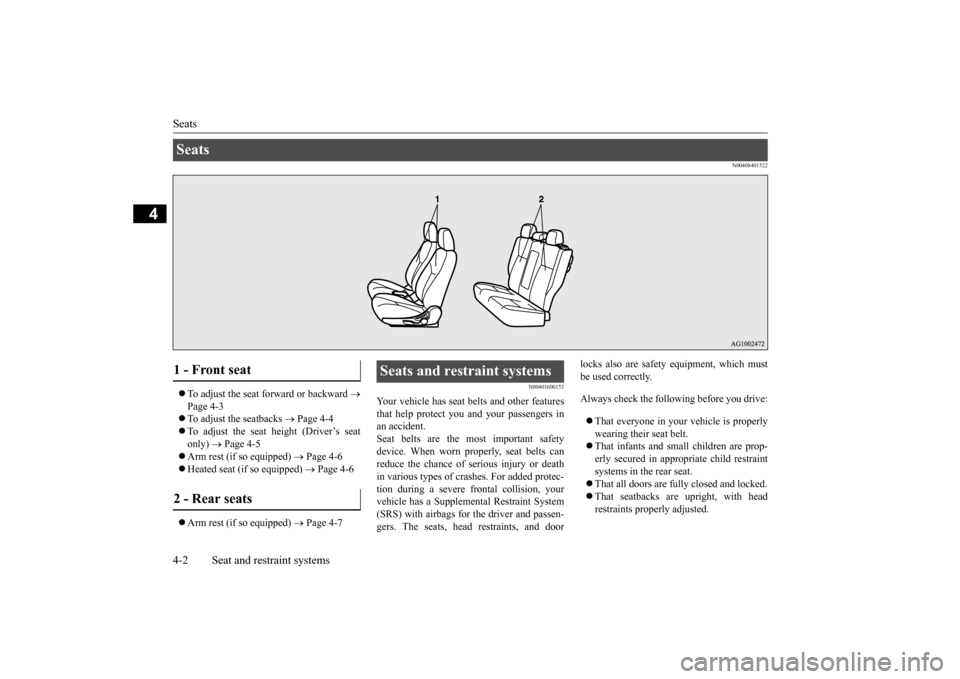
To adjust the seat forward or backward
Page 4-3 To adjust the seatbacks
Page 4-4
To adjust the seat height (Driver’s seat only)
Page 4-5
Arm rest (if so equipped)
Page 4-6
Heated seat (if so equipped)
Page 4-6
Arm rest (if so equipped)
Page 4-7
N00401600153
Your vehicle has seat belts and other features that help protect you and your passengers in an accident. Seat belts are the most important safetydevice. When worn properly, seat belts can reduce the chance of serious injury or death in various types of crashes. For added protec-tion during a severe frontal collision, your vehicle has a Supplemental Restraint System (SRS) with airbags for the driver and passen-gers. The seats, head restraints, and door
locks also are safety equipment, which must be used correctly. Always check the following before you drive: That everyone in your vehicle is properly wearing their seat belt. That infants and small children are prop- erly secured in appropriate child restraint systems in the rear seat. That all doors are fully closed and locked. That seatbacks are upright, with head restraints properly adjusted.
Seats 1 - Front seat 2 - Rear seats
Seats and restraint systems
BK0202700US.bo
ok 2 ページ 2013年3月28日 木曜日 午前11時54分
Page 26 of 384
Front seats
Seat and restraint systems 4-5
4
N00402100197
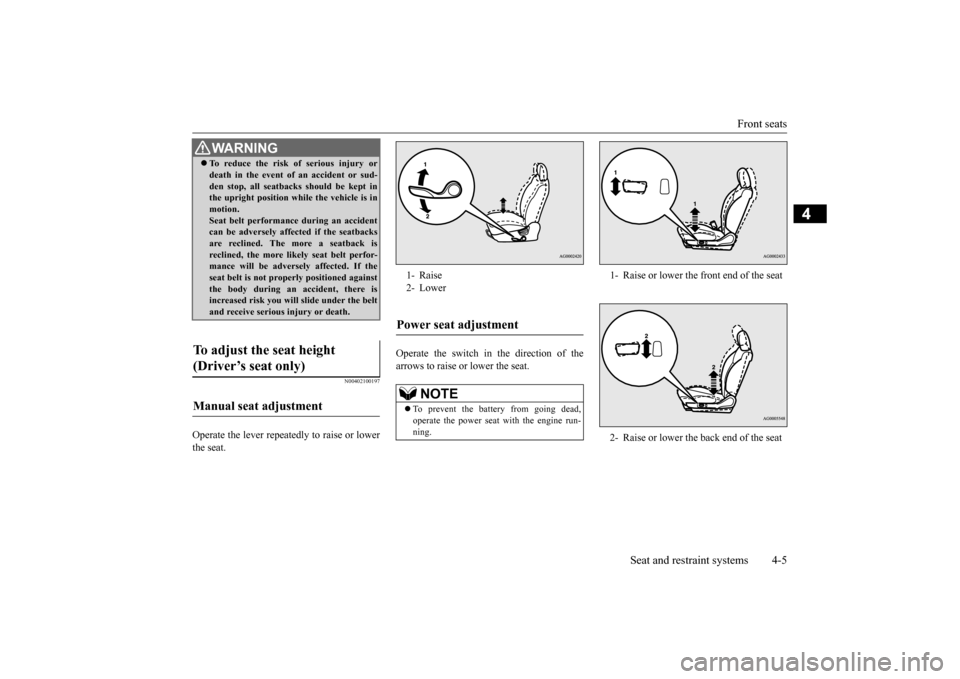
Operate the lever repeatedly to raise or lower the seat.
Operate the switch in the direction of the arrows to raise or lower the seat.
WA R N I N G To reduce the risk of serious injury or death in the event of an accident or sud- den stop, all seatbacks should be kept in the upright position while the vehicle is in motion.Seat belt performance during an accident can be adversely affected if the seatbacks are reclined. The more a seatback isreclined, the more likely seat belt perfor- mance will be adversely affected. If the seat belt is not properly positioned againstthe body during an accident, there is increased risk you will slide under the belt and receive serious injury or death.
To adjust the seat height (Driver’s seat only) Manual seat adjustment
1- Raise 2- LowerPower seat adjustment
NOTE
To prevent the battery from going dead, operate the power seat with the engine run- ning.
1- Raise or lower the front end of the seat 2- Raise or lower the back end of the seat
BK0202700US.bo
ok 5 ページ 2013年3月28日 木曜日 午前11時54分
Page 28 of 384
Rear seats
Seat and restraint systems 4-7
4
N00402500191 N00403000308
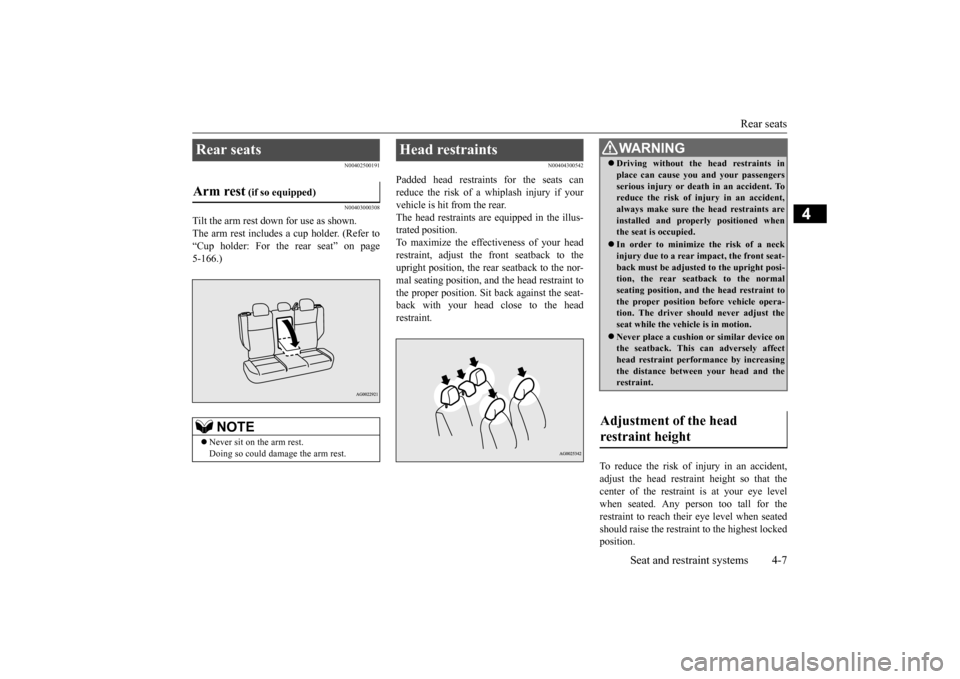
Tilt the arm rest down for use as shown. The arm rest includes a cup holder. (Refer to“Cup holder: For the rear seat” on page 5-166.)
N00404300542
Padded head restraints for the seats can reduce the risk of a whiplash injury if yourvehicle is hit from the rear. The head restraints are equipped in the illus- trated position.To maximize the effectiveness of your head restraint, adjust the front seatback to the upright position, the rear seatback to the nor-mal seating position, and the head restraint tothe proper position. Sit
back against the seat-
back with your head close to the head restraint.
To reduce the risk of injury in an accident, adjust the head restraint height so that thecenter of the restraint is at your eye level when seated. Any person too tall for the restraint to reach their eye level when seatedshould raise the restraint to the highest locked position.
Rear seats Arm rest
(if so equipped)
NOTE
Never sit on the arm rest. Doing so could damage the arm rest.
Head restraints
WA R N I N G Driving without the head restraints in place can cause you and your passengers serious injury or death in an accident. To reduce the risk of injury in an accident, always make sure the head restraints areinstalled and properly positioned when the seat is occupied. In order to minimize the risk of a neck injury due to a rear impact, the front seat- back must be adjusted to the upright posi-tion, the rear seatback to the normal seating position, and the head restraint to the proper position before vehicle opera-tion. The driver should never adjust the seat while the vehicle is in motion. Never place a cushion or similar device on the seatback. This can adversely affect head restraint performance by increasingthe distance between your head and the restraint.
Adjustment of the head restraint height
BK0202700US.bo
ok 7 ページ 2013年3月28日 木曜日 午前11時54分
Page 29 of 384
Head restraints 4-8 Seat and restraint systems
4
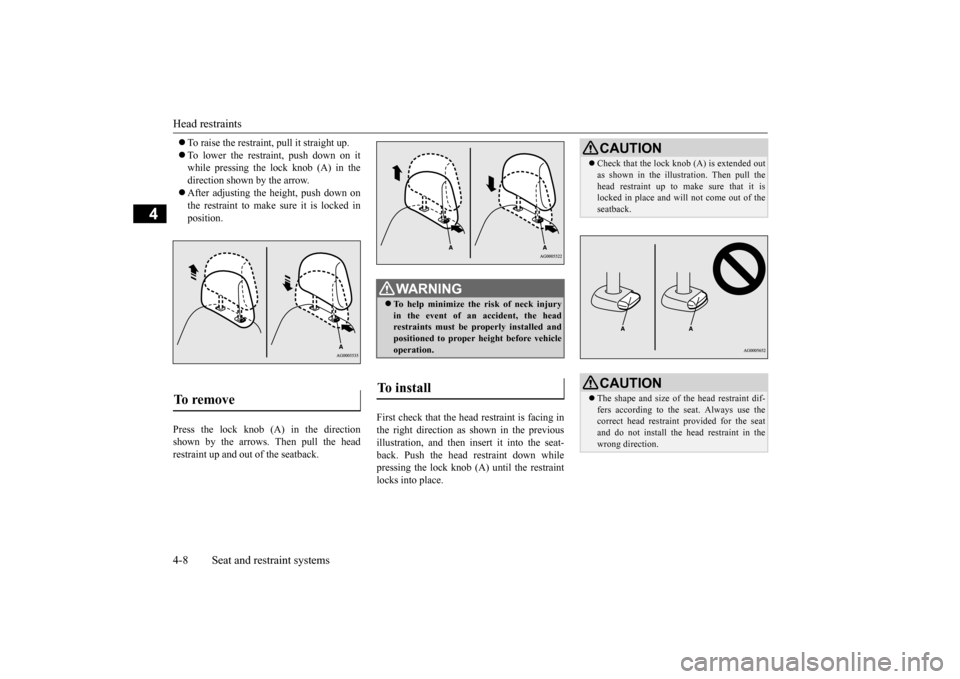
To raise the restraint, pull it straight up. To lower the restraint, push down on it while pressing the lock knob (A) in the direction shown by the arrow. After adjusting the height, push down on the restraint to make sure it is locked in position.
Press the lock knob (A) in the direction shown by the arrows. Then pull the head restraint up and out of the seatback.
First check that the head restraint is facing in the right direction as shown in the previous illustration, and then insert it into the seat-back. Push the head restraint down while pressing the lock knob (A) until the restraint locks into place.
To remove
WA R N I N G To help minimize the risk of neck injury in the event of an accident, the head restraints must be properly installed andpositioned to proper height before vehicle operation.
To install
CAUTION Check that the lock knob (A) is extended out as shown in the illustration. Then pull the head restraint up to make sure that it is locked in place and will not come out of the seatback.CAUTION The shape and size of the head restraint dif- fers according to the seat. Always use the correct head restraint provided for the seatand do not install the head restraint in the wrong direction.
BK0202700US.bo
ok 8 ページ 2013年3月28日 木曜日 午前11時54分
Page 39 of 384
Child restraint systems 4-18 Seat and restraint systems
4
The seat belt pre-tensioners will operate under the same conditions as the airbag con- trol unit. When the seat belt pre-tensioners activate, some smoke is released and a loud noise willbe heard. The smoke is not harmful, but care should be taken not to intentionally inhale it, as it may cause some temporary irritation topeople with respiratory problems. Even in the event of a severe impact, the pre- tensioners will not operate if the seat belts arenot fastened. The seat belt pre-tensioners maynot activate in certain
collisions, even though
the vehicle may appear to be severely dam- aged. Such non-activation does not mean thatsomething is wrong with the seat belt pre-ten- sioner system, but rather that the collision forces were not severe enough to activate thesystem.
N00408700081
This warning light tells you if there is a prob-lem involving the SRS airbags and the seatbelt pre-tensioner system. Refer to “SRS warning light/display” on page 4-32.
N00408900126
In the event of an accident, the seat belt force limiter system will help reduce the force applied to the driver and front seat passenger.
N00407100701
When transporting infants or small childrenin your vehicle, an appropriate child restraint system must always be used. This is requiredby law in the U.S. and Canada. Child restraint systems specifically designed for infants and small children are offered byseveral manufacturers. Choose only a child restraint system with a label certifying that it complies with Federal Motor Vehicle SafetyStandard 213 (FMVSS 213) or Motor Vehicle Restraint Systems and Booster Cushions Safety Regulations (RSSR). Look for themanufacturer’s statement of compliance on the box and child restraint system itself.
The child restraint system should be appropri- ate for your child’s weight and height, and should properly fit your vehicle’s seat. For detail information, refer to the instructionmanual accompanying the child restraint sys- tem. All children should be properly restrained in a restraint device that offers the maximum protection for their size and age.Be sure to check local, state, or provincial requirements for child size and age that may vary from the recommendations listed below. Children less than 1 year old and children less than 20 pounds (9 kg) MUST ride in a rear-facing child safety seat that MUST ONLY be used in the rear seat. Children older than 1
year of age and who
weigh less than 40 pounds (18 kg) or who are less than 40 inches (100 cm) tall mustbe in a forward-facing restraint used only in the rear seat.
WA R N I N G The seat belt pre-tensioner system is designed to work only once. After the seat belt pre-tensioners have been activated, they will not work again. They must promptly be replaced and the entire seat belt pre-tensioner system inspected by anauthorized Mitsubishi Motors dealer.
SRS warning Force limiter system Child restraint systems
Guidelines for child restraint system selection
BK0202700US.bo
ok 18 ページ 2013年3月28日 木曜日 午前11時54分
Page 64 of 384
5
Features and controlsBreak-in recommendation
s ...............................................................5-3
Keys .....................................................
.............................................5-3
Electronic immobilizer (Anti-theft starting system) .........................5-4 Keyless entry system (if so equipped) ..............................................5-7Free-hand Advanced Security Tran
smitter (F.A.S.T.-key) (if so
equipped)................................
..................................................... 5-11
Door locks........................
...............................................................5-28
Power door locks .............
...............................................................5-30
Child safety locks for r
ear door ....................
..................................5-31
Liftgate.......................................
.....................................................5-32
Inside liftgate releas
e ..............................................
........................5-33
Theft-alarm system ..........
...............................................................5-33
Power window control
............................................
........................5-36
Sunshade (if so equi
pped)..............................................................5-39
Parking brake ...................
...............................................................5-40
Steering wheel height and reach adjustment...................................5-41Inside rearview mirro
r ............................................
........................5-41
Outside rearview mirr
ors ................................................................5-43
Ignition switch .................
...............................................................5-44
Starting the engine .
.................................................
........................5-45
Manual transaxle (if so equipped) .................................................5-47 Continuously variable transmission
(CVT) (if so equipped).........5-49
Electronically controlled 4WD system (if so equipped)................5-554-wheel drive operation
..........................................
........................5-58
Inspection and maintenance following rough road operation.........5-60 Cautions on the handling of 4-wheel drive vehicles.......................5-60Service brake ...................
...............................................................5-61
Hill start assist........
.................................................
........................5-62
Brake assist system
................................................
......................... 5-64
Anti-lock braking syst
em ......................................
......................... 5-64
Electric power steering syst
em (EPS) ........................................... 5-66
Active stability control
(ASC) .....................
................................... 5-67
Cruise control (if so eq
uipped) ....................................................... 5-70
Tire pressure monitoring
system .................................................... 5-75
Rear-view camera (if so
equipped)..............
................................... 5-79
Instrument cluster .
.................................................
......................... 5-81
Multi-information disp
lay .....................................
......................... 5-82
Indicator light, warning light, and information screen display list
.................................................................
................................. 5-104
Indicators ..................................
.................................................... 5-116
Warning lights...........................
.................................................... 5-117
Information screen disp
lay .......................................................... 5-118
Combination headlights and dimmer switch ............................... 5-120 Headlight leveling switch (if so equipped).................................. 5-125Turn signal lever ...
.................................................
....................... 5-126
Hazard warning flasher
switch ..................................................... 5-127
Front fog light switch (if
so equipped) ........................................ 5-127
Wiper and washer swit
ch ......................................
....................... 5-127
Electric rear window def
ogger switch .......................................... 5-132
Horn switch ..............................
.................................................... 5-133
Link System (if so equi
pped) .....................
................................. 5-133
Bluetooth
® 2.0 interface (if so
equipped)..................................... 5-134
USB input terminal (if so
equipped) ........................................... 5-155
Sun visors .................................
.................................................... 5-158
12 V power outlets..........
.................................................
............. 5-159
Interior lights ..................
.................................................
............. 5-159
BK0202700US.bo
ok 1 ページ 2013年3月28日 木曜日 午前11時54分
Page 104 of 384
Steering wheel height and reach adjustment
Features and controls 5-41
5
N00511500228
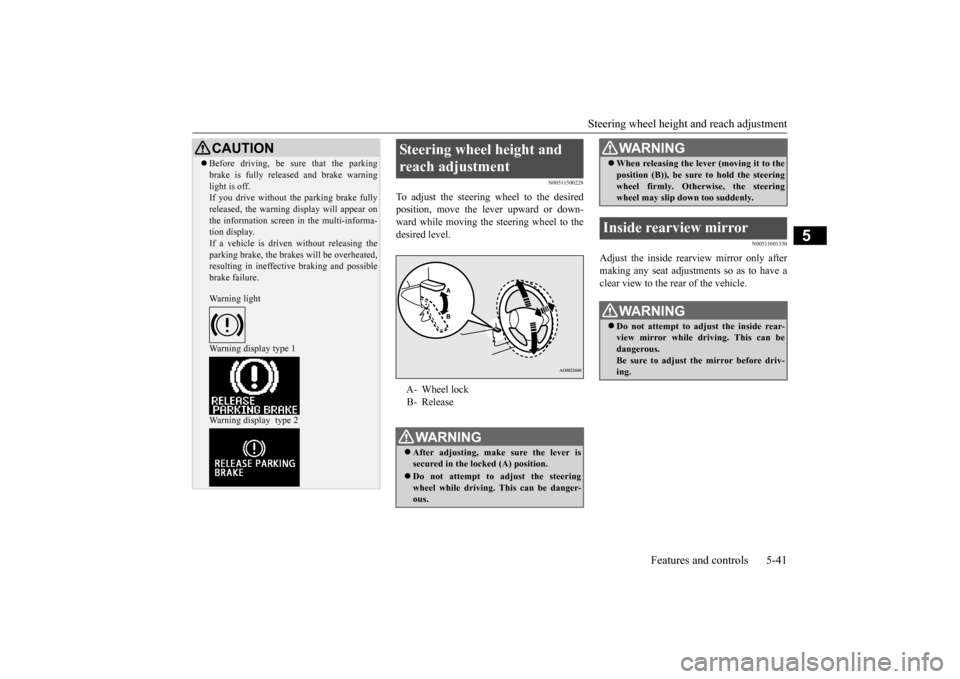
To adjust the steering wheel to the desired position, move the lever upward or down-ward while moving the steering wheel to the desired level.
N00511601330
Adjust the inside rearview mirror only after making any seat adjustments so as to have a clear view to the rear of the vehicle.
CAUTION Before driving, be sure that the parking brake is fully released and brake warning light is off. If you drive without the parking brake fully released, the warning display will appear onthe information screen in the multi-informa- tion display. If a vehicle is driven without releasing theparking brake, the brakes will be overheated, resulting in ineffective braking and possible brake failure. Warning light Warning display type 1 Warning display type 2
Steering wheel height and reach adjustment A- Wheel lock B- ReleaseWA R N I N G After adjusting, make sure the lever is secured in the locked (A) position. Do not attempt to adjust the steering wheel while driving. This can be danger-ous.
When releasing the lever (moving it to the position (B)), be sure to hold the steering wheel firmly. Otherwise, the steering wheel may slip down too suddenly.
Inside rearview mirror
WA R N I N G Do not attempt to adjust the inside rear- view mirror while driving. This can bedangerous. Be sure to adjust the mirror before driv- ing.WA R N I N G
BK0202700US.bo
ok 41 ページ 2013年3月28日 木曜日 午前11時54分
Page 335 of 384
Tires 9-14 Vehicle care and maintenance
9
• The outward facing sidewall of an asym- metrical tire that has a particular side that must always face outward when mounted on a vehicle.
Passenger car tire: a tire intended for use on passenger cars, multipurpose passen- ger vehicles, and trucks, that have a grossvehicle weight rating (GVWR) of 10,000 pounds or less. Light truck (LT) tire: a tire designated by its manufacturer as primarily intended foruse on lightweight trucks or multipurpose passenger vehicles. Tread: portion of a tire that comes into contact with the road. Tread rib: a tread section running circum- ferentially around a tire. Tread separation: pulling away of the tread from the tire carcass. Carcass: the tire structure, except tread and sidewall rubber which, when inflated, bears the load. Sidewall: portion of a tire between the tread and bead. Section width: the linear distance between the exteriors of the sidewalls of aninflated tire, excluding elevations due to labeling, decoration, or protective bands. Bead: the part of the tire that is made of steel wires, wrapped or reinforced by ply cords and that is shaped to fit the rim.
Ply: a layer of rubber-coated parallel cords. Cord: the strands forming the plies in the tire. Rim: a metal support for a tire or a tire and tube assembly upon which the tire beads are seated. Rim diameter: nominal diameter of the bead seat. Groove: the space between two adjacent tread ribs.
EXAMPLE: P215/65R15
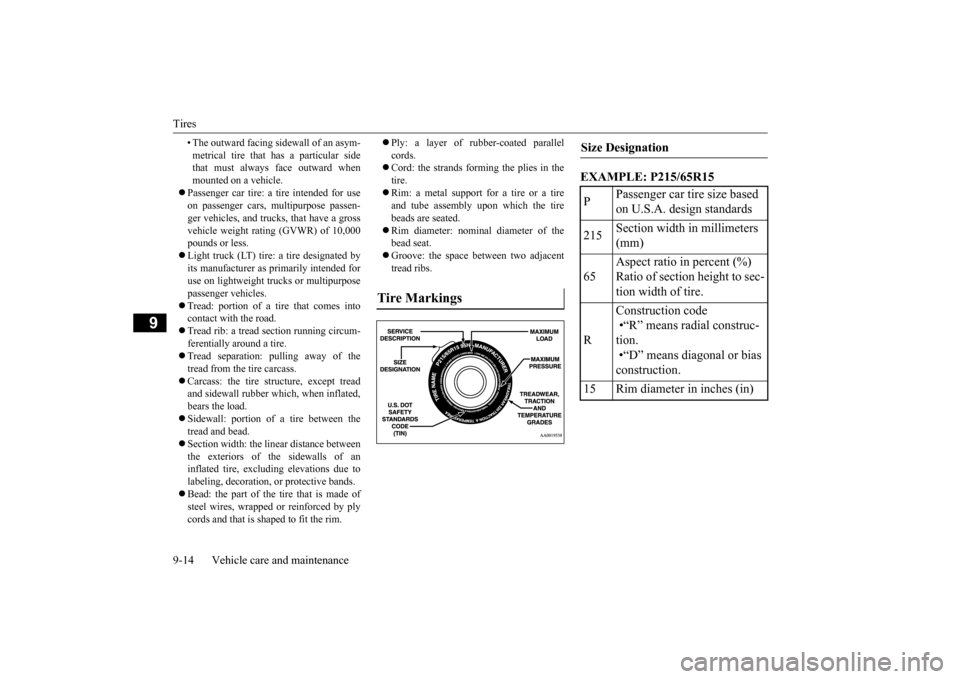
Tire Markings
Size Designation P
Passenger car tire size based on U.S.A. design standards
215
Section width in millimeters (mm)
65
Aspect ratio in percent (%) Ratio of section height to sec- tion width of tire.
R
Construction code •“R” means radial construc-tion. •“D” means diagonal or bias construction.
15 Rim diameter in inches (in)
BK0202700US.bo
ok 14 ページ 2013年3月28日 木曜日 午前11時54分
Page 374 of 384
Vehicle dimensions
Specifications 11-3
11
N01148200167
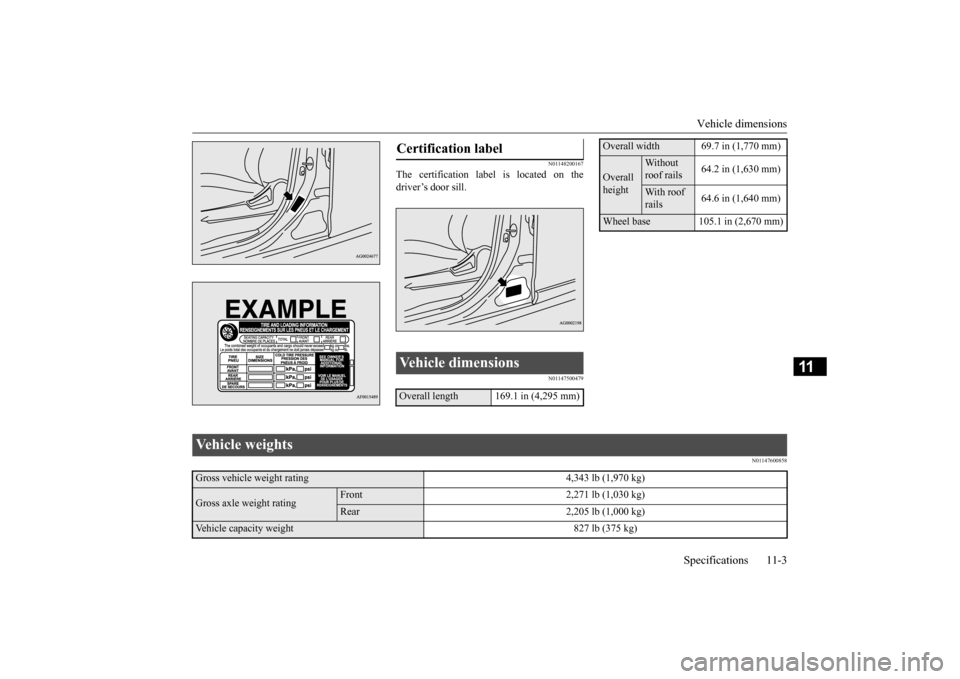
The certification label is located on the driver’s door sill.
N01147500479
N01147600858
Certification label Vehicle dimensions Overall length 169.1 in (4,295 mm)
Overall width 69.7 in (1,770 mm)Overall height
Without roof rails
64.2 in (1,630 mm)
With roof rails
64.6 in (1,640 mm)
Wheel base 105.1 in (2,670 mm)
Vehicle weights Gross vehicle weight rating 4,343 lb (1,970 kg)Gross axle weight rating
Front 2,271 lb (1,030 kg)Rear 2,205 lb (1,000 kg)
Vehicle capacity weight 827 lb (375 kg)
BK0202700US.bo
ok 3 ページ 2013年3月28日 木曜日 午前11時54分
Page 381 of 384
Alphabetical index 12-4
12
Operation under adverse driving conditions
...
8-14 Outside rearview mirrors
.....................
5-43
Overheating
......................
...................
8-4
P
Parking
.........................
.......................
6-6
Parking brake break-in
....................
9-21
Parking brake lever stroke
...............
9-21
Parking brake
....................
.................
5-40
Parking lights
Bulb capacity
................
.................
9-29
Replacement
.................
.................
9-33
Polishing
.......................
.....................
9-41
Power brakes
.....................
.................
5-62
Power outlet
..................
...................
5-159
Power steering
Fluid
........................
.....................
11-5
Power windows
.................
.................
5-36
Puncture (Tire changing)
.......................
8-6
R
Radio
General information about your radio 7-59
Reading lights
Bulb capacity
................
.................
9-30
Rear axle oil
...............
...............
9-11
, 11-5
Rear combination lights
Bulb capacity
..................
................
9-29
Replacement
...................
................
9-36
Rear side-marker lights
Bulb capacity
..................
................
9-29
Replacement
...................
................
9-36
Rear turn signal light
Bulb capacity
..................
................
9-29
Replacement
...................
................
9-36
Rear-view camera
...............
................
5-79
Rearview mirror
Inside rearview mirror
.....................
5-41
Outside rearview mirrors
.................
5-43
Replacement of light bulbs
...................
9-29
Replacing tires and wheels
...................
9-18
Reporting Safety Defects
.....................
10-2
S
Safe driving techniques
.........................
6-4
Seat belt
......................
.......................
4-11
Adjustable seat belt shoulder anchor
.4-16
Child restraint systems
.....................
4-18
Front passenger seat belt warning light
.....
4-16 Maintenance and inspection
.............
4-25
Seat belt extender
............................
4-16
Seat belt force limitter
.....................
4-18
Seat belt pre-tensioners
....................
4-17
Seat belt use during pregnancy
.........
4-17
Seats
..........................
..........................
4-2
Arm rest
.......................
...................
4-7
Front seats
....................
...................
4-3
Head restraints
.................
................
4-7
Heated seat
...................
...................
4-6
Seats and restraint systems
................
4-2
Service brake
.....................
.................
5-61
Service precautions
...............
................
9-2
Side turn signal light
Bulb capacity
................
.................
9-29
Snow tires
.....................
.....................
9-20
Spark plugs
...................
.....................
9-22
Starting the engine
..............................
5-45
Steering
Power steering fluid
........................
11-5
Steering wheel height and reach adjustment 5-41
Stop lights
Bulb capacity
................
.................
9-29
Replacement
.................
.................
9-36
Storage spaces
...................
...............
5-163
Sun visors
.....................
...................
5-158
Sunshade
......................
.....................
5-39
Supplemental Restraint System
............
4-26
How the Supplemental Restraint System works
.....................
.....................
4-28
Maintenance service
.......................
4-41
BK0202700US.bo
ok 4 ページ 2013年3月28日 木曜日 午前11時54分