service MITSUBISHI PAJERO IV 2011 User Guide
[x] Cancel search | Manufacturer: MITSUBISHI, Model Year: 2011, Model line: PAJERO IV, Model: MITSUBISHI PAJERO IV 2011Pages: 377, PDF Size: 29.43 MB
Page 60 of 377
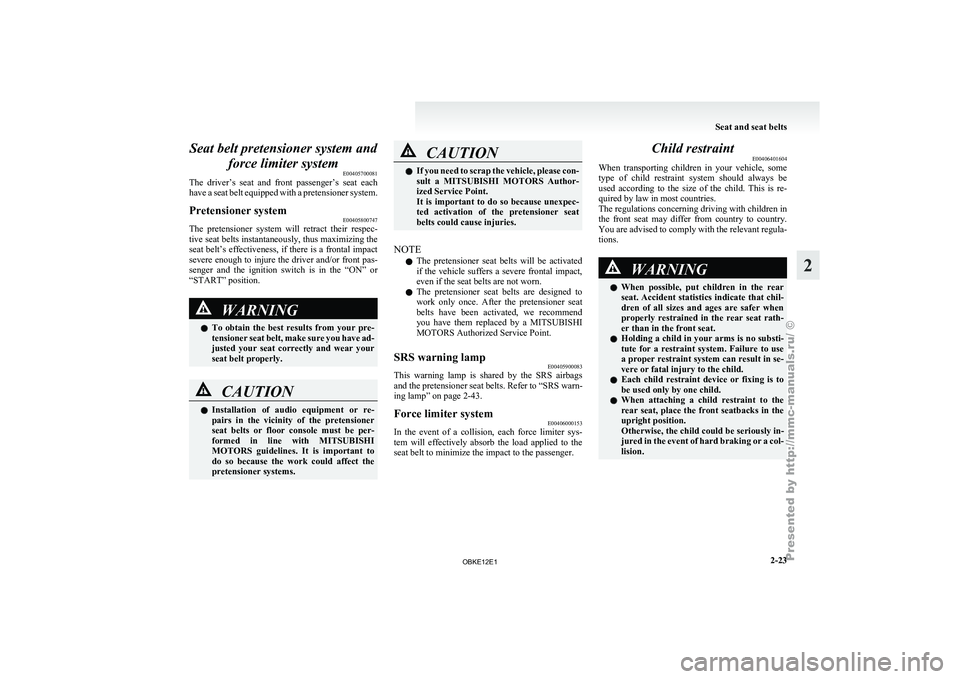
Seat belt pretensioner system and
force limiter system E00405700081
The driver’s seat
and front passenger’s seat each
have a seat belt equipped with a pretensioner system.
Pretensioner system E00405800747
The pretensioner system will retract their respec-
tive seat belts
instantaneously, thus maximizing the
seat belt’s effectiveness, if there is a frontal impact
severe enough to injure the driver and/or front pas-
senger and the ignition switch is in the “ON” or
“START” position. WARNING
l To obtain
the
best results from your pre-
tensioner seat belt, make sure you have ad-
justed your seat correctly and wear your
seat belt properly. CAUTION
l
Installation of
audio
equipment or re-
pairs in the vicinity of the pretensioner
seat belts or floor console must be per-
formed in line with MITSUBISHI
MOTORS guidelines. It is important to
do so because the work could affect the
pretensioner systems. CAUTION
l
If you need
to scrap the vehicle, please con-
sult a MITSUBISHI MOTORS Author-
ized Service Point.
It is important to do so because unexpec-
ted activation of the pretensioner seat
belts could cause injuries.
NOTE l The
pretensioner seat
belts will be activated
if the vehicle suffers a severe frontal impact,
even if the seat belts are not worn.
l The pretensioner seat belts are designed to
work only once. After the pretensioner seat
belts have been activated, we recommend
you have them replaced by a MITSUBISHI
MOTORS Authorized Service Point.
SRS warning lamp E00405900083
This warning lamp is shared by the SRS airbags
and the pretensioner
seat belts. Refer to “SRS warn-
ing lamp” on page 2-43.
Force limiter system E00406000153
In the event of a collision, each force limiter sys-
tem will effectively
absorb the load applied to the
seat belt to minimize the impact to the passenger. Child restraint
E00406401604
When transporting children
in your vehicle, some
type of child restraint system should always be
used according to the size of the child. This is re-
quired by law in most countries.
The regulations concerning driving with children in
the front seat may differ from country to country.
You are advised to comply with the relevant regula-
tions. WARNING
l When possible,
put
children in the rear
seat. Accident statistics indicate that chil-
dren of all sizes and ages are safer when
properly restrained in the rear seat rath-
er than in the front seat.
l Holding a child in your arms is no substi-
tute for a restraint system. Failure to use
a proper restraint system can result in se-
vere or fatal injury to the child.
l Each child restraint device or fixing is to
be used only by one child.
l When attaching a child restraint to the
rear seat, place the front seatbacks in the
upright position.
Otherwise, the child could be seriously in-
jured in the event of hard braking or a col-
lision. Seat and seat belts
2-23 2
OBKE12E1
Page 64 of 377
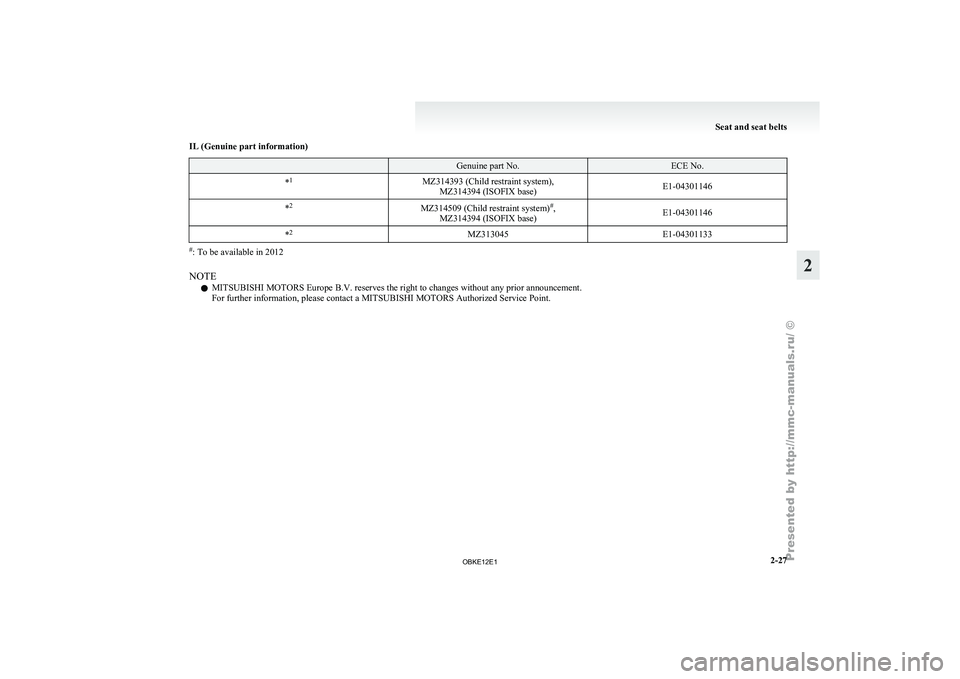
IL (Genuine part information)
Genuine part No. ECE No.
* 1
MZ314393 (Child restraint system),
MZ314394 (ISOFIX base) E1-04301146
* 2
MZ314509 (Child restraint system)#
,
MZ314394 (ISOFIX base) E1-04301146
* 2
MZ313045 E1-04301133#
: To be available in 2012
NOTE l MITSUBISHI MOTORS Europe B.V. reserves the right to changes without any prior announcement.
For further information, please contact a MITSUBISHI MOTORS
Authorized Service Point. Seat and seat belts
2-27 2
OBKE12E1
Page 66 of 377
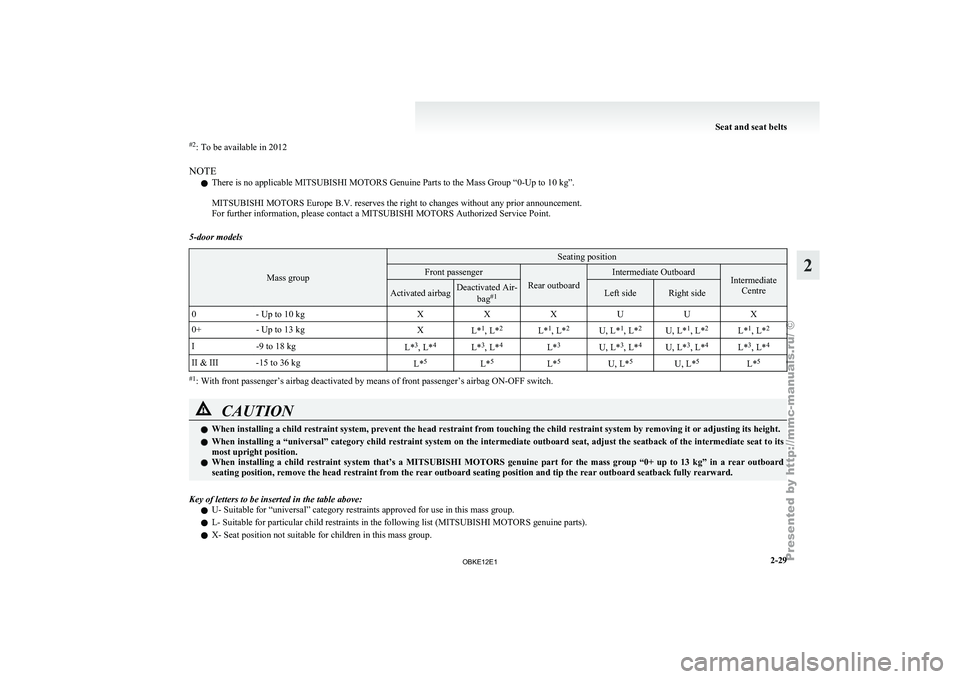
#2
: To be available in 2012
NOTE l There is no applicable MITSUBISHI MOTORS
Genuine Parts to the Mass Group “0-Up to 10 kg”.
MITSUBISHI MOTORS
Europe B.V. reserves the right to changes without any prior announcement.
For further information, please contact a MITSUBISHI MOTORS Authorized Service Point.
5-door models Mass group Seating position
Front passenger
Rear outboard Intermediate Outboard
Intermediate
Centre Activated airbag Deactivated Air-
bag#1 Left side Right side
0 - Up to 10 kg XXXUUX
0+ - Up to 13 kg
XL*1
, L* 2
L*1
, L* 2
U, L*1
, L* 2
U, L*1
, L* 2
L*1
, L* 2
I -9 to 18 kg
L*3
, L* 4
L*3
, L* 4
L*3
U, L*3
, L* 4
U, L*3
, L* 4
L*3
, L* 4
II & III -15 to 36 kg L*5
L*5
L*5
U, L*5
U, L*5
L*5 #1
: With front passenger’s airbag deactivated by means of front passenger’s airbag ON-OFF switch. CAUTION
l
When installing a child restraint system, prevent the head restraint from touching the child restraint system by removing it or adjusting its height.
l When installing
a
“universal” category child restraint system on the intermediate outboard seat, adjust the seatback of the intermediate seat to its
most upright position.
l When installing a child restraint system that’s a MITSUBISHI MOTORS genuine part for the mass group “0+ up to 13 kg” in a rear outboard
seating position, remove the head restraint from the rear outboard seating position and tip the rear outboard seatback fully rearward.
Key of letters to be inserted in the table above: l U- Suitable for “universal” category restraints approved for use in this mass group.
l L- Suitable for particular child restraints in the following list (
MITSUBISHI MOTORS genuine parts).
l X- Seat position not suitable for children in this mass group. Seat and seat belts
2-29 2
OBKE12E1
Page 67 of 377
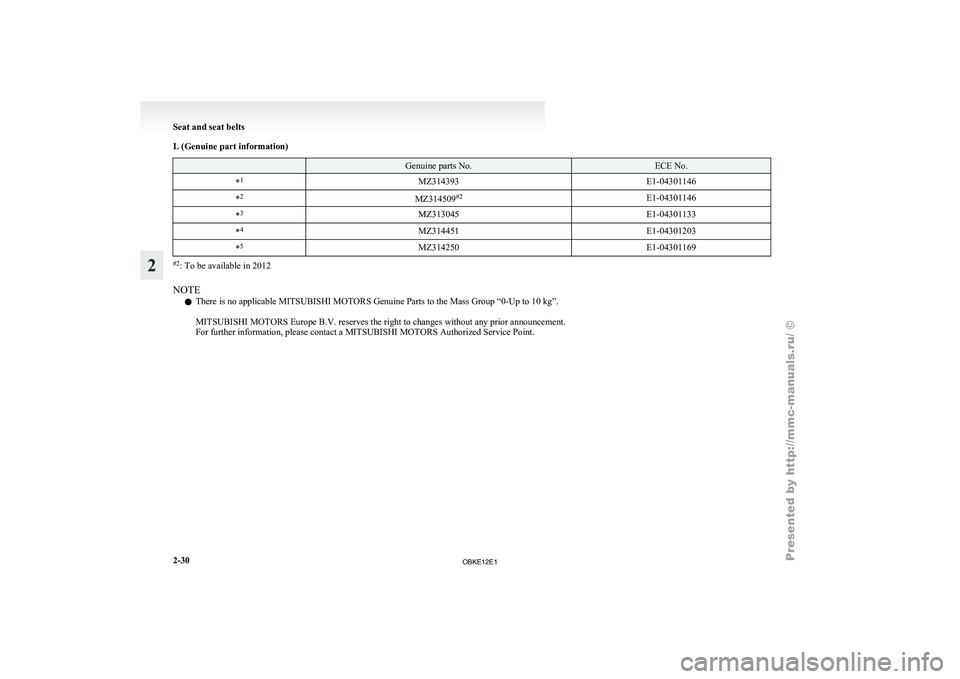
L (Genuine part information)
Genuine parts No. ECE No.
* 1
MZ314393 E1-04301146
* 2
MZ314509#2
E1-04301146
* 3
MZ313045 E1-04301133
* 4
MZ314451 E1-04301203
* 5
MZ314250 E1-04301169#2
: To be available in 2012
NOTE l There is no applicable
MITSUBISHI MOTORS Genuine Parts to the Mass Group “0-Up to 10 kg”.
MITSUBISHI MOTORS
Europe B.V. reserves the right to changes without any prior announcement.
For further information, please contact a MITSUBISHI MOTORS Authorized Service Point. Seat and seat belts
2-30
2
OBKE12E1
Page 70 of 377
WARNING
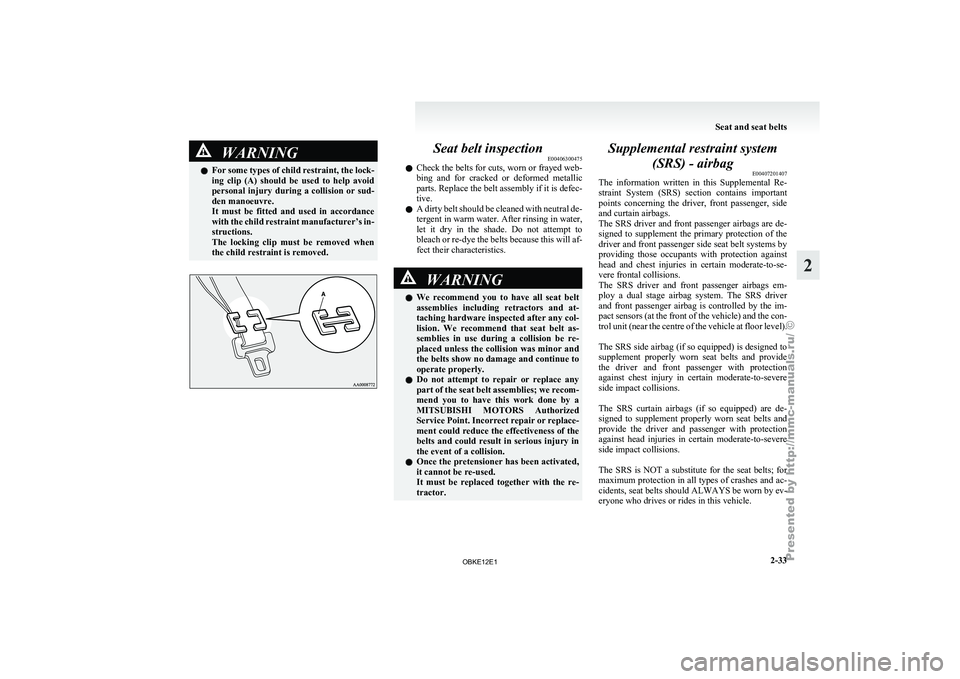
l For some types of child restraint, the lock-
ing clip (A) should be used to help avoid
personal injury during a collision or sud-
den manoeuvre.
It must be fitted and used in accordance
with the child restraint manufacturer’s in-
structions.
The locking clip must be removed when
the child restraint is removed. Seat belt inspection
E00406300475
l Check the
belts
for cuts, worn or frayed web-
bing and for cracked or deformed metallic
parts. Replace the belt assembly if it is defec-
tive.
l A dirty belt should be cleaned with neutral de-
tergent in warm water. After rinsing in water,
let it dry in the shade. Do not attempt to
bleach or re-dye the belts because this will af-
fect their characteristics. WARNING
l We recommend
you
to have all seat belt
assemblies including retractors and at-
taching hardware inspected after any col-
lision. We recommend that seat belt as-
semblies in use during a collision be re-
placed unless the collision was minor and
the belts show no damage and continue to
operate properly.
l Do not attempt to repair or replace any
part of the seat belt assemblies; we recom-
mend you to have this work done by a
MITSUBISHI MOTORS Authorized
Service Point. Incorrect repair or replace-
ment could reduce the effectiveness of the
belts and could result in serious injury in
the event of a collision.
l Once the pretensioner has been activated,
it cannot be re-used.
It must be replaced together with the re-
tractor. Supplemental restraint system
(SRS) - airbag E00407201407
The information written
in this Supplemental Re-
straint System (SRS) section contains important
points concerning the driver, front passenger, side
and curtain airbags.
The SRS driver and front passenger airbags are de-
signed to supplement the primary protection of the
driver and front passenger side seat belt systems by
providing those occupants with protection against
head and chest injuries in certain moderate-to-se-
vere frontal collisions.
The SRS driver and front passenger airbags em-
ploy a dual stage airbag system. The SRS driver
and front passenger airbag is controlled by the im-
pact sensors (at the front of the vehicle) and the con-
trol unit (near the centre of the vehicle at floor level).
The SRS side airbag (if so equipped) is designed to
supplement properly worn seat belts and provide
the driver and front passenger with protection
against chest injury in certain moderate-to-severe
side impact collisions.
The SRS curtain airbags (if so equipped) are de-
signed to supplement properly worn seat belts and
provide the driver and passenger with protection
against head injuries in certain moderate-to-severe
side impact collisions.
The SRS is NOT a substitute for the seat belts; for
maximum protection in all types of crashes and ac-
cidents, seat belts should ALWAYS be worn by ev-
eryone who drives or rides in this vehicle. Seat and seat belts
2-33 2
OBKE12E1
Page 74 of 377
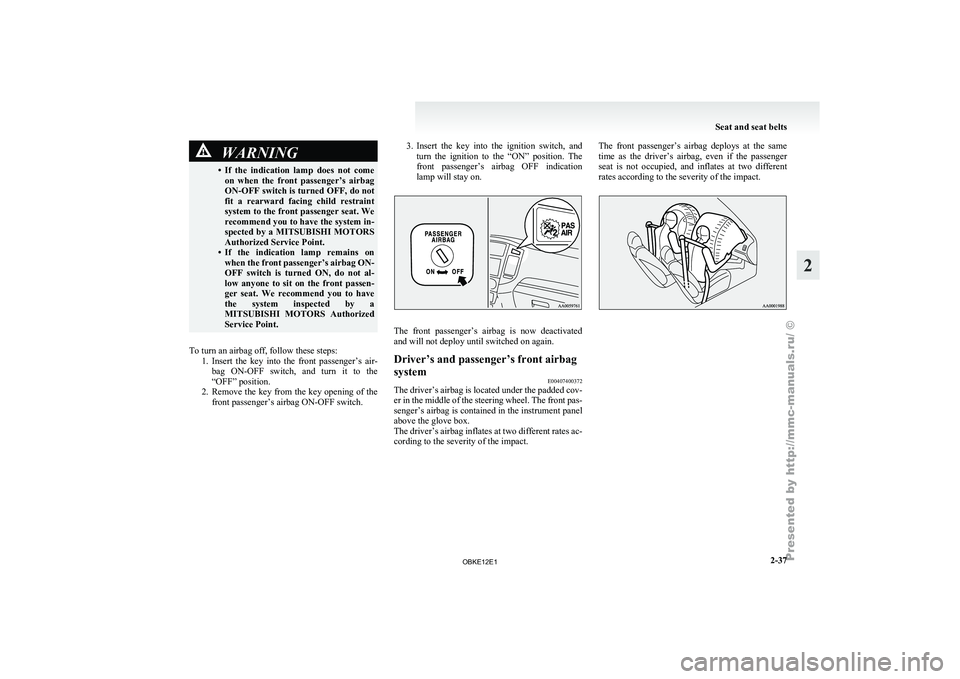
WARNING
• If the indication lamp does not come on when
the front passenger’s airbag
ON-OFF switch is turned OFF, do not
fit a rearward facing child restraint
system to the front passenger seat. We
recommend you to have the system in-
spected by a MITSUBISHI MOTORS
Authorized Service Point.
• If the indication lamp remains on when the front passenger’s airbag ON-
OFF switch is turned ON, do not al-
low anyone to sit on the front passen-
ger seat. We recommend you to have
the system inspected by a
MITSUBISHI MOTORS Authorized
Service Point.
To turn an airbag off, follow these steps: 1. Insert the key
into the front passenger’s air-
bag ON-OFF switch, and turn it to the
“OFF” position.
2. Remove the key from the key opening of the front passenger’s airbag ON-OFF switch. 3. Insert
the key into the ignition switch, and
turn the
ignition to the “ON” position. The
front passenger’s airbag OFF indication
lamp will stay on. The front passenger’s airbag is now deactivated
and will not deploy until switched on again.
Driver’s and passenger’s front airbag
system
E00407400372
The driver’s airbag is located under the padded cov-
er in the
middle of the steering wheel. The front pas-
senger’s airbag is contained in the instrument panel
above the glove box.
The driver’s airbag inflates at two different rates ac-
cording to the severity of the impact. The front passenger’s airbag deploys at the same
time as
the
driver’s airbag, even if the passenger
seat is not occupied, and inflates at two different
rates according to the severity of the impact. Seat and seat belts
2-37 2
OBKE12E1
Page 77 of 377
WARNING
l Right after the airbag inflation, several
airbag system components will be hot. Do
not touch them; you could be burned.
l The airbag system is designed to work on-
ly once. Once the airbags have deployed,
they will not work again. They must
promptly be replaced, and we recom-
mend you to have the entire airbag sys-
tem inspected by a MITSUBISHI
MOTORS Authorized Service Point.
Side airbag system* E00407600198
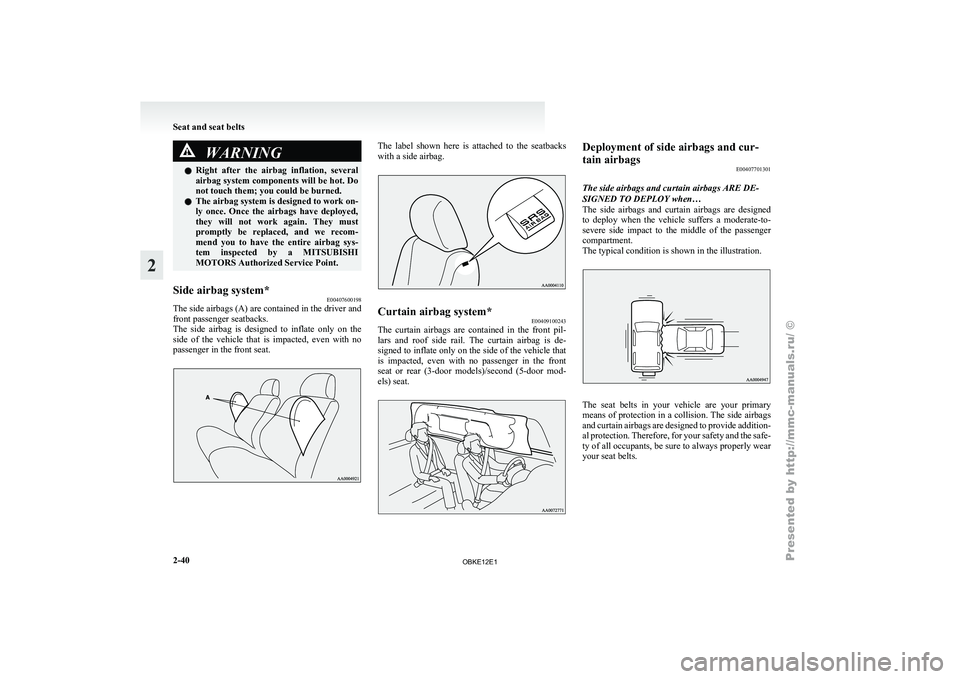
The side airbags (A) are contained in the driver and
front passenger seatbacks.
The side airbag
is designed to inflate only on the
side of the vehicle that is impacted, even with no
passenger in the front seat. The label shown here is attached to the seatbacks
with a side airbag.
Curtain airbag system*
E00409100243
The curtain airbags are contained in the front pil-
lars and roof
side rail. The curtain airbag is de-
signed to inflate only on the side of the vehicle that
is impacted, even with no passenger in the front
seat or rear (3-door models)/second (5-door mod-
els) seat. Deployment of side airbags and cur-
tain airbags
E00407701301
The side airbags and curtain airbags ARE DE-
SIGNED TO DEPLOY when…
The side airbags
and curtain airbags are designed
to deploy when the vehicle suffers a moderate-to-
severe side impact to the middle of the passenger
compartment.
The typical condition is shown in the illustration. The seat belts in your vehicle are your primary
means of
protection
in a collision. The side airbags
and curtain airbags are designed to provide addition-
al protection. Therefore, for your safety and the safe-
ty of all occupants, be sure to always properly wear
your seat belts. Seat and seat belts
2-40
2
OBKE12E1
Page 79 of 377
WARNING
l The side airbags and curtain airbags are
designed to supplement the driver and pas-
senger seat belts in certain side impacts.
Seat belts should always be worn proper-
ly, and the driver and passenger should
sit well back and upright without leaning
against the window or door.
l The side airbag and curtain airbag inflate
with great force. The driver and passen-
ger should not put their arms out of the
window, and should not lean against the
door, in order to reduce the risk of seri-
ous or possible fatal injury from the de-
ploying side airbag and curtain airbag. WARNING
l Do not
allow
any rear seat occupant to
hold onto the seatback of either front
seat, in order to reduce the risk of injury
from a deploying side airbag. Special
care should be taken with children. WARNING
l Do not place
any objects near or in front
of the seatback of either front seat. They
could interfere with proper side airbag in-
flation, and also could cause injury if
thrown free by side airbag deployment.
l Do not place stickers, labels or additional
trim on the seatback of either front seat.
They could interfere with proper side air-
bag inflation.
l Do not install seat covers on seats with
side airbags. Do not re-cover the seats
with side airbags. They could interfere
with proper side airbag inflation.
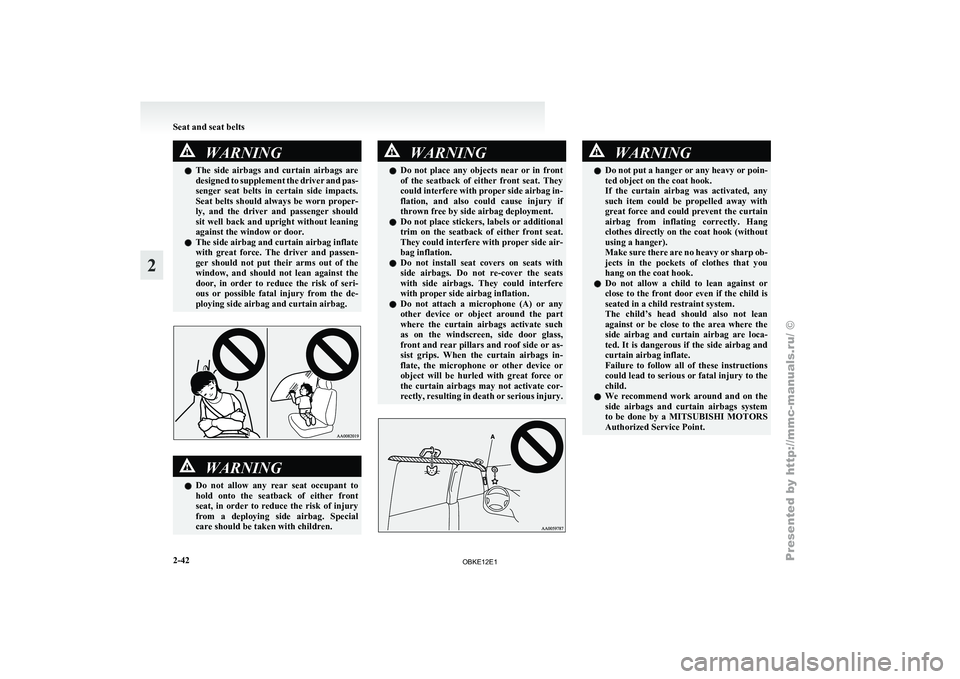
l Do not attach a microphone (A) or any
other device or object around the part
where the curtain airbags activate such
as on the windscreen, side door glass,
front and rear pillars and roof side or as-
sist grips. When the curtain airbags in-
flate, the microphone or other device or
object will be hurled with great force or
the curtain airbags may not activate cor-
rectly, resulting in death or serious injury. WARNING
l Do not put a hanger or any heavy or poin-
ted object on the coat hook.
If the curtain airbag was activated, any
such item could be propelled away with
great force and could prevent the curtain
airbag from inflating correctly. Hang
clothes directly on the coat hook (without
using a hanger).
Make sure there are no heavy or sharp ob-
jects in the pockets of clothes that you
hang on the coat hook.
l Do not allow a child to lean against or
close to the front door even if the child is
seated in a child restraint system.
The child’s head should also not lean
against or be close to the area where the
side airbag and curtain airbag are loca-
ted. It is dangerous if the side airbag and
curtain airbag inflate.
Failure to follow all of these instructions
could lead to serious or fatal injury to the
child.
l We recommend work around and on the
side airbags and curtain airbags system
to be done by a MITSUBISHI MOTORS
Authorized Service Point. Seat and seat belts
2-42
2
OBKE12E1
Page 80 of 377
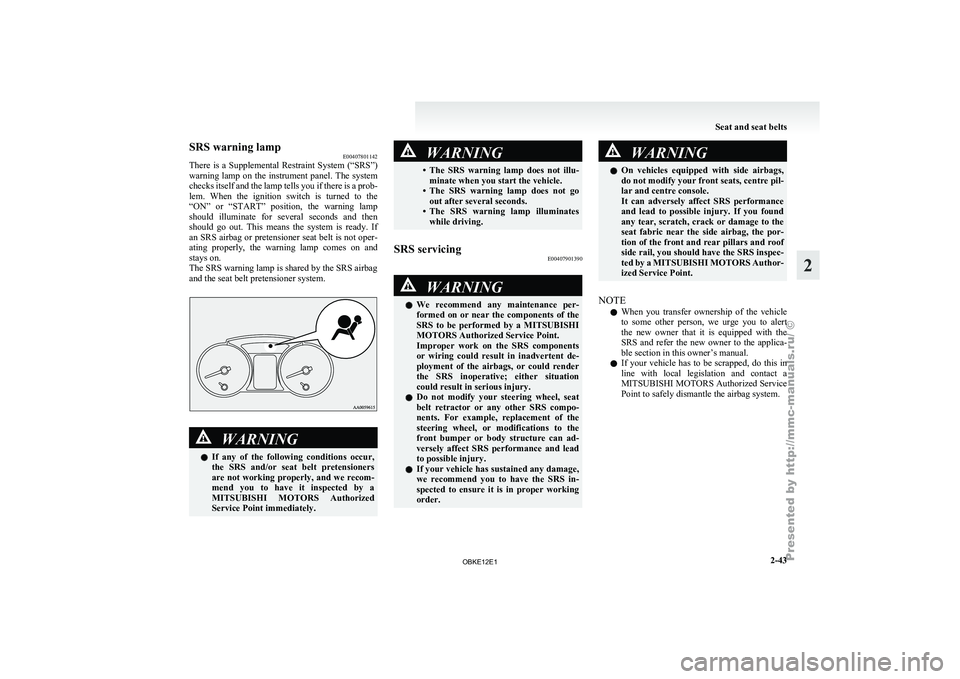
SRS warning lamp
E00407801142
There is a
Supplemental Restraint System (“SRS”)
warning lamp on the instrument panel. The system
checks itself and the lamp tells you if there is a prob-
lem. When the ignition switch is turned to the
“ON” or “START” position, the warning lamp
should illuminate for several seconds and then
should go out. This means the system is ready. If
an SRS airbag or pretensioner seat belt is not oper-
ating properly, the warning lamp comes on and
stays on.
The SRS warning lamp is shared by the SRS airbag
and the seat belt pretensioner system. WARNING
l If any of
the following conditions occur,
the SRS and/or seat belt pretensioners
are not working properly, and we recom-
mend you to have it inspected by a
MITSUBISHI MOTORS Authorized
Service Point immediately. WARNING
• The SRS warning lamp does not illu- minate when you start the vehicle.
• The
SRS warning lamp does not go
out after several seconds.
• The SRS warning lamp illuminates while driving.
SRS servicing E00407901390 WARNING
l We recommend
any
maintenance per-
formed on or near the components of the
SRS to be performed by a MITSUBISHI
MOTORS Authorized Service Point.
Improper work on the SRS components
or wiring could result in inadvertent de-
ployment of the airbags, or could render
the SRS inoperative; either situation
could result in serious injury.
l Do not modify your steering wheel, seat
belt retractor or any other SRS compo-
nents. For example, replacement of the
steering wheel, or modifications to the
front bumper or body structure can ad-
versely affect SRS performance and lead
to possible injury.
l If your vehicle has sustained any damage,
we recommend you to have the SRS in-
spected to ensure it is in proper working
order. WARNING
l On vehicles equipped
with side airbags,
do not modify your front seats, centre pil-
lar and centre console.
It can adversely affect SRS performance
and lead to possible injury. If you found
any tear, scratch, crack or damage to the
seat fabric near the side airbag, the por-
tion of the front and rear pillars and roof
side rail, you should have the SRS inspec-
ted by a MITSUBISHI MOTORS Author-
ized Service Point.
NOTE l When
you transfer
ownership of the vehicle
to some other person, we urge you to alert
the new owner that it is equipped with the
SRS and refer the new owner to the applica-
ble section in this owner’s manual.
l If your vehicle has to be scrapped, do this in
line with local legislation and contact a
MITSUBISHI MOTORS Authorized Service
Point to safely dismantle the airbag system. Seat and seat belts
2-43 2
OBKE12E1
Page 83 of 377
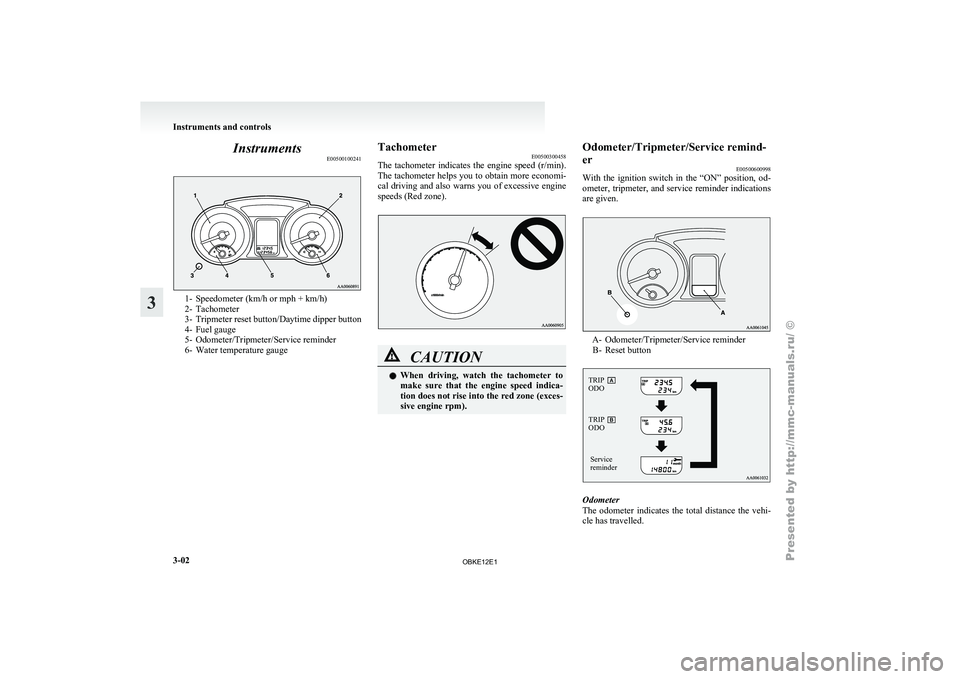
Instruments
E005001002411- Speedometer (km/h or mph + km/h)
2- Tachometer
3-
Tripmeter
reset button/Daytime dipper button
4- Fuel gauge
5- Odometer/Tripmeter/Service reminder
6- Water temperature gauge Tachometer
E00500300458
The tachometer indicates
the engine speed (r/min).
The tachometer helps you to obtain more economi-
cal driving and also warns you of excessive engine
speeds (Red zone). CAUTION
l
When driving, watch
the tachometer to
make sure that the engine speed indica-
tion does not rise into the red zone (exces-
sive engine rpm). Odometer/Tripmeter/Service remind-
er
E00500600998
With the ignition
switch in the “ON” position, od-
ometer, tripmeter, and service reminder indications
are given. A- Odometer/Tripmeter/Service reminder
B- Reset button
TRIP
ODO
Service
reminder
TRIP
ODO Odometer
The
odometer indicates
the total distance the vehi-
cle has travelled. Instruments and controls
3-02
3
OBKE12E1