service MITSUBISHI PAJERO IV 2011 Repair Manual
[x] Cancel search | Manufacturer: MITSUBISHI, Model Year: 2011, Model line: PAJERO IV, Model: MITSUBISHI PAJERO IV 2011Pages: 377, PDF Size: 29.43 MB
Page 321 of 377
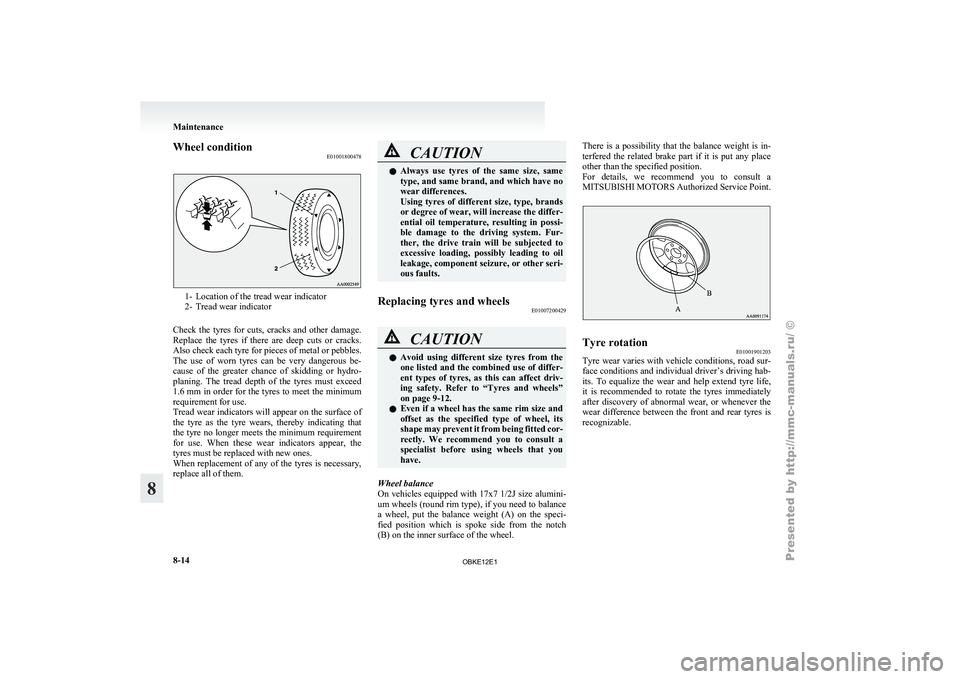
Wheel condition
E010018004781- Location of the tread wear indicator
2- Tread wear indicator
Check the
tyres for cuts, cracks and other damage.
Replace the tyres if there are deep cuts or cracks.
Also check each tyre for pieces of metal or pebbles.
The use of worn tyres can be very dangerous be-
cause of the greater chance of skidding or hydro-
planing. The tread depth of the tyres must exceed
1.6 mm in order for the tyres to meet the minimum
requirement for use.
Tread wear indicators will appear on the surface of
the tyre as the tyre wears, thereby indicating that
the tyre no longer meets the minimum requirement
for use. When these wear indicators appear, the
tyres must be replaced with new ones.
When replacement of any of the tyres is necessary,
replace all of them. CAUTION
l
Always use tyres
of the same size, same
type, and same brand, and which have no
wear differences.
Using tyres of different size, type, brands
or degree of wear, will increase the differ-
ential oil temperature, resulting in possi-
ble damage to the driving system. Fur-
ther, the drive train will be subjected to
excessive loading, possibly leading to oil
leakage, component seizure, or other seri-
ous faults.
Replacing tyres and wheels E01007200429 CAUTION
l
Avoid using different
size tyres from the
one listed and the combined use of differ-
ent types of tyres, as this can affect driv-
ing safety. Refer to “Tyres and wheels”
on page 9-12.
l Even if a wheel has the same rim size and
offset as the specified type of wheel, its
shape may prevent it from being fitted cor-
rectly. We recommend you to consult a
specialist before using wheels that you
have.
Wheel balance
On vehicles equipped
with 17x7 1/2J size alumini-
um wheels (round rim type), if you need to balance
a wheel, put the balance weight (A) on the speci-
fied position which is spoke side from the notch
(B) on the inner surface of the wheel. There is a possibility that the balance weight is in-
terfered the
related
brake part if it is put any place
other than the specified position.
For details, we recommend you to consult a
MITSUBISHI MOTORS Authorized Service Point. Tyre rotation
E01001901203
Tyre wear varies with vehicle conditions, road sur-
face conditions and
individual driver’s driving hab-
its. To equalize the wear and help extend tyre life,
it is recommended to rotate the tyres immediately
after discovery of abnormal wear, or whenever the
wear difference between the front and rear tyres is
recognizable. Maintenance
8-14
8
OBKE12E1
Page 323 of 377
![MITSUBISHI PAJERO IV 2011 Repair Manual Tyre size Wheel size Max. chain
height[mm]
265/65R17 112H
265/65R17 112S 17 x 7 1/2 J
22
265/60R18 110H 18 x 7 1/2 JThe speed limit for tyre chain is 50 km/h (30 mph)
and
remove
the tyre chains a](/img/19/58151/w960_58151-322.png "MITSUBISHI PAJERO IV 2011 Repair Manual Tyre size Wheel size Max. chain
height[mm]
265/65R17 112H
265/65R17 112S 17 x 7 1/2 J
22
265/60R18 110H 18 x 7 1/2 JThe speed limit for tyre chain is 50 km/h (30 mph)
and
remove
the tyre chains a")
Tyre size Wheel size Max. chain
height[mm]
265/65R17 112H
265/65R17 112S 17 x 7 1/2 J
22
265/60R18 110H 18 x 7 1/2 JThe speed limit for tyre chain is 50 km/h (30 mph)
and
remove
the tyre chains as soon as possible on
snow free roads. CAUTION
l
As your vehicle is equipped with anti-lock
brake system
(ABS),
in order to ensure
that the anti-lock brake system (ABS)
will operate correctly in situations where
tyre chains have been fitted, drive in
“4H”, “4HLc” or “4LLc”.
l Practice fitting the chains before you
need them.
Don’t expect help from other people in
the cold.
l Choose a clear straight stretch of road
where you can pull over and still be seen
while you are fitting the chains.
l Do not fit chains before you need them.
This will wear out your tyres and the
road surface.
l After driving around 100-300 metres,
stop and retighten the chains. CAUTION
l
Drive carefully and
do not exceed
50 km/h (30 mph). Remember, fitting
chains is not going to stop accidents from
happening.
l When tyre chains are installed, take care
that they do not damage the disc wheel or
body.
l An aluminium wheel can be damaged by
a tyre chain while driving. When fitting a
tyre chain on an aluminium wheel, take
care that any part of the chain and fitting
cannot be brought into contact with the
wheel.
l When installing or removing the tyre
chains, take care that hands and other
parts of your body are not injured by the
sharp edges of the vehicle body.
NOTE l The
laws and
regulations concerning the use
of tyre chains vary. Always follow local laws
and regulations.
In most countries, it is prohibited by law to
use tyre chains on roads without snow. Parking brake break-in
E01008300010
Break-in the parking
brake linings whenever the
brake performance of the parking brake is insuffi-
cient or whenever the parking brake linings and/or
discs are replaced, in order to assure the best brake
performance.
This procedure is described in the vehicle service
manual and can be carried out by a MITSUBISHI
MOTORS Authorized Service Point. Maintenance
8-16
8
OBKE12E1
Page 330 of 377
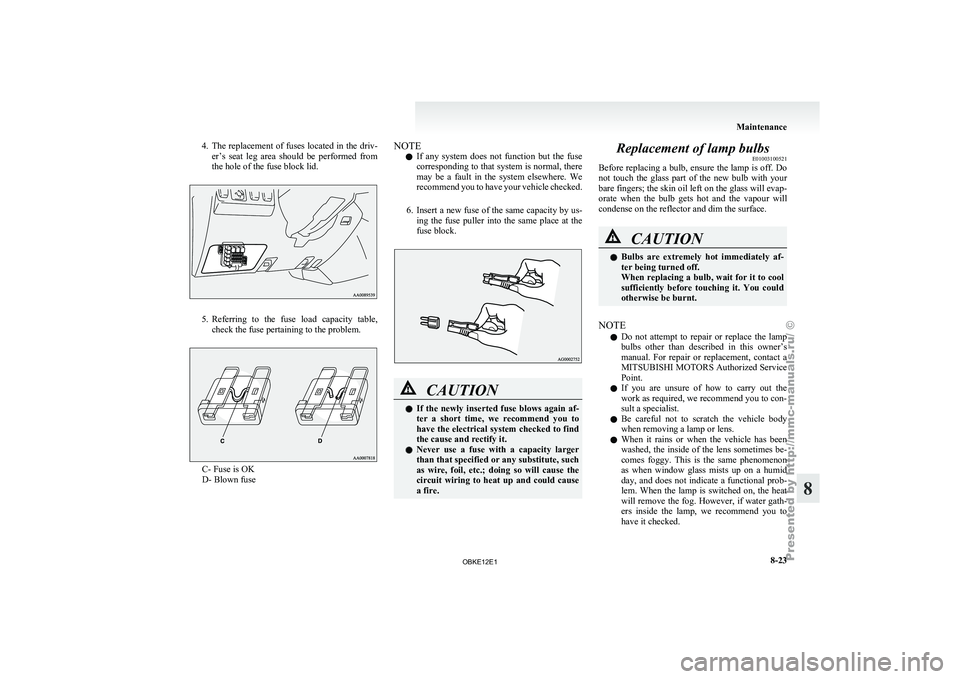
4. The replacement of fuses located in the driv-
er’s seat leg area should be performed from
the hole of the fuse block lid. 5. Referring to
the
fuse load capacity table,
check the fuse pertaining to the problem. C- Fuse is OK
D- Blown fuse NOTE
l If any
system
does not function but the fuse
corresponding to that system is normal, there
may be a fault in the system elsewhere. We
recommend you to have your vehicle checked.
6. Insert a new fuse of the same capacity by us- ing the fuse puller into the same place at the
fuse block. CAUTION
l
If the
newly
inserted fuse blows again af-
ter a short time, we recommend you to
have the electrical system checked to find
the cause and rectify it.
l Never use a fuse with a capacity larger
than that specified or any substitute, such
as wire, foil, etc.; doing so will cause the
circuit wiring to heat up and could cause
a fire. Replacement of lamp bulbs
E01003100521
Before replacing a
bulb, ensure the lamp is off. Do
not touch the glass part of the new bulb with your
bare fingers; the skin oil left on the glass will evap-
orate when the bulb gets hot and the vapour will
condense on the reflector and dim the surface. CAUTION
l
Bulbs are
extremely
hot immediately af-
ter being turned off.
When replacing a bulb, wait for it to cool
sufficiently before touching it. You could
otherwise be burnt.
NOTE l Do
not attempt
to repair or replace the lamp
bulbs other than described in this owner’s
manual. For repair or replacement, contact a
MITSUBISHI MOTORS Authorized Service
Point.
l If you are unsure of how to carry out the
work as required, we recommend you to con-
sult a specialist.
l Be careful not to scratch the vehicle body
when removing a lamp or lens.
l When it rains or when the vehicle has been
washed, the inside of the lens sometimes be-
comes foggy. This is the same phenomenon
as when window glass mists up on a humid
day, and does not indicate a functional prob-
lem. When the lamp is switched on, the heat
will remove the fog. However, if water gath-
ers inside the lamp, we recommend you to
have it checked. Maintenance
8-23 8
OBKE12E1
Page 331 of 377
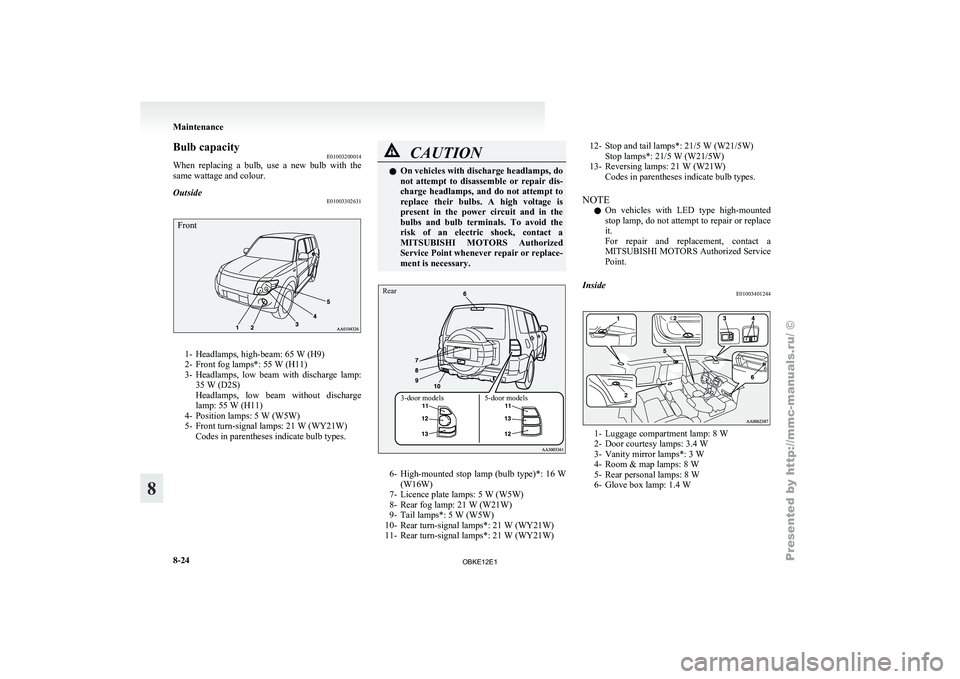
Bulb capacity
E01003200014
When replacing a
bulb, use a new bulb with the
same wattage and colour.
Outside E01003302631
Front1- Headlamps, high-beam: 65 W (H9)
2- Front fog lamps*: 55 W (H11)
3-
Headlamps,
low beam with discharge lamp:
35 W (D2S)
Headlamps, low beam without discharge
lamp: 55 W (H11)
4- Position lamps: 5 W (W5W)
5- Front turn-signal lamps: 21 W (WY21W) Codes in parentheses indicate bulb types. CAUTION
l
On vehicles with discharge headlamps, do
not attempt to
disassemble or repair dis-
charge headlamps, and do not attempt to
replace their bulbs. A high voltage is
present in the power circuit and in the
bulbs and bulb terminals. To avoid the
risk of an electric shock, contact a
MITSUBISHI MOTORS Authorized
Service Point whenever repair or replace-
ment is necessary.
3-door models 5-door models
Rear
6- High-mounted stop
lamp
(bulb type)*: 16 W
(W16W)
7- Licence plate lamps: 5 W (W5W)
8- Rear fog lamp: 21 W (W21W)
9- Tail lamps*: 5 W (W5W)
10- Rear turn-signal lamps*: 21 W (WY21W)
11- Rear turn-signal lamps*: 21 W (WY21W) 12- Stop and tail lamps*: 21/5 W (W21/5W)
Stop lamps*: 21/5 W (W21/5W)
13- Reversing lamps: 21 W (W21W) Codes in parentheses indicate bulb types.
NOTE l On
vehicles
with LED type high-mounted
stop lamp, do not attempt to repair or replace
it.
For repair and replacement, contact a
MITSUBISHI MOTORS Authorized Service
Point.
Inside E01003401244 1- Luggage compartment lamp: 8 W
2- Door courtesy lamps: 3.4 W
3-
Vanity mirror lamps*:
3 W
4- Room & map lamps: 8 W
5- Rear personal lamps: 8 W
6- Glove box lamp: 1.4 W Maintenance
8-24
8
OBKE12E1
Page 351 of 377
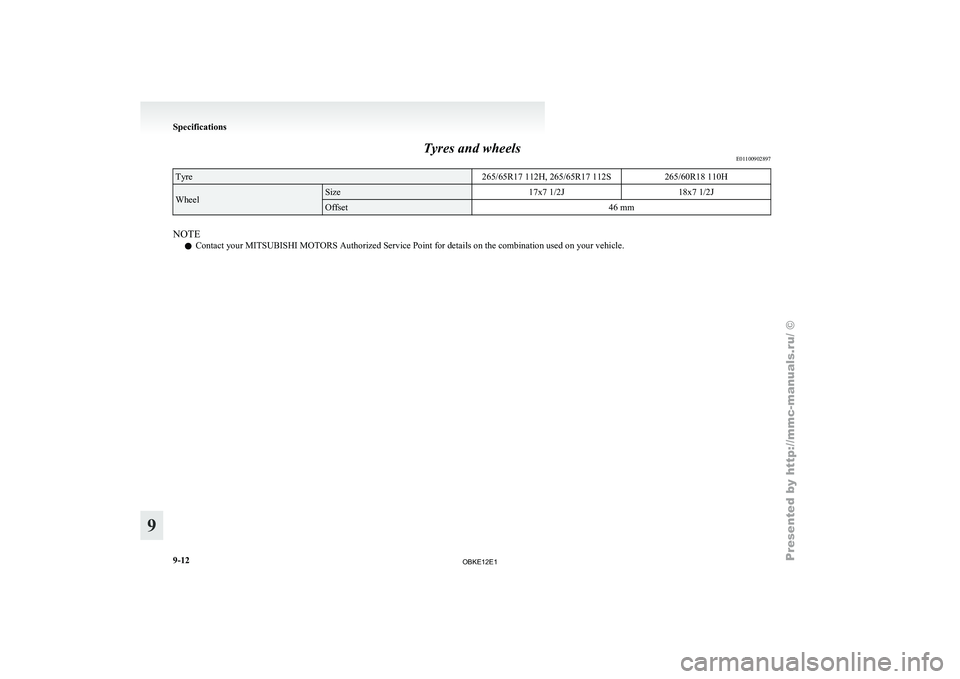
Tyres and wheels
E01100902897Tyre
265/65R17 112H, 265/65R17 112S265/60R18 110HWheel Size
17x7 1/2J18x7 1/2J Offset
46 mmNOTE
l Contact your MITSUBISHI MOTORS Authorized Service Point for details on the combination used on your vehicle. Specifications
9-12
9
OBKE12E1
Page 361 of 377
Seat belt 2-20
Adjustable seat belt anchor 2-21Child restraint 2-23
Force limiter system 2-23
Inspection 2-33
Pregnant women restraint
2-22
Pretensioner system 2-23
Rear/second, third seat belt storage 2-22
Seat belt reminder/warning lamp 2-21
Seats Adjustment 2-05
Armrest 2-08,2-10
Front seats 2-05
Head restraints 2-11
Heated seats 2-08
Lumbar support 2-07
Making a flat seat 2-18
Making a luggage area 2-12
Rear seats 2-09
Seat arrangement 2-03
Second seats 2-09
Third seat 2-11
Security alarm system 1-10
Service precaution 8-02
Service reminder 3-02,3-03
Side airbag system 2-40
Side box 5-93
Snow tyres 8-15
Spark plug 9-11
Specifications 9-02
Starting 4-14
Steering Power steering fluid 8-10,9-15
Power steering system 4-41
Steering wheel height adjustment 4-08
Steering wheel lock 4-13
Steering wheel remote control switch 5-57
Stop lamps Bulb capacity 8-24 Replacement 8-27
Storage spaces 5-91
Sun visors 5-84
Sunglasses holder 5-94
Sunroof 1-17 Lock switch 1-18
Safety mechanism 1-18
Sunshade 1-19
Super select 4WD II 4-24
Supplemental restraint system 2-33 How the Supplemental Restraint System
works 2-34
Servicing 2-43
Warning lamp 2-43
T Tachometer 3-02
Tail lamps
Bulb capacity 8-24
Replacement 8-27
Tank capacity
03
Third seat 2-11
Tools 6-07 Storage 6-07
Towing 6-15
Trailer towing 4-57
Transfer oil 9-15
Transmission Automatic transmission 4-19
Manual transmission 4-16
Tripmeter 3-02
Turn-signal indication lamps 3-08
Turn-signal lever 3-35
Tyres 8-12 How to change a tyre 6-09
Inflation pressures 8-13
Rotation 8-14
Size (tyre and wheel) 9-12 Snow tyres 8-15
Spare wheel information 6-09
Tyre chains 8-15
U USB input terminal 5-82
Used engine
oils
safety instructions and disposal in-
formation 06
V Vanity mirror 5-84
Vanity mirror lamps
Bulb capacity 8-24
Replacement 8-31
Vehicle care precautions
7-02
Vehicle dimensions 9-04
Vehicle identification number 9-02
Vehicle identification number plate 9-02
Vehicle information code plate 9-02
Vehicle labeling 9-02
Vehicle performance 9-06
Vehicle weight 9-07
Ventilators 5-02
W Warning lamps 3-09
Washer
Fluid 8-07,9-15
Switch 3-37,3-41
Washing 7-03
Water temperature gauge 3-05
Waxing 7-04
Weatherstripping 8-19
Weight 9-07
Wheel condition
8-14
Wheel Alphabetical index
4
OBKE12E1