oil level MITSUBISHI SHOGUN 2016 Owner's Manual (in English)
[x] Cancel search | Manufacturer: MITSUBISHI, Model Year: 2016, Model line: SHOGUN, Model: MITSUBISHI SHOGUN 2016Pages: 404, PDF Size: 18.95 MB
Page 97 of 404
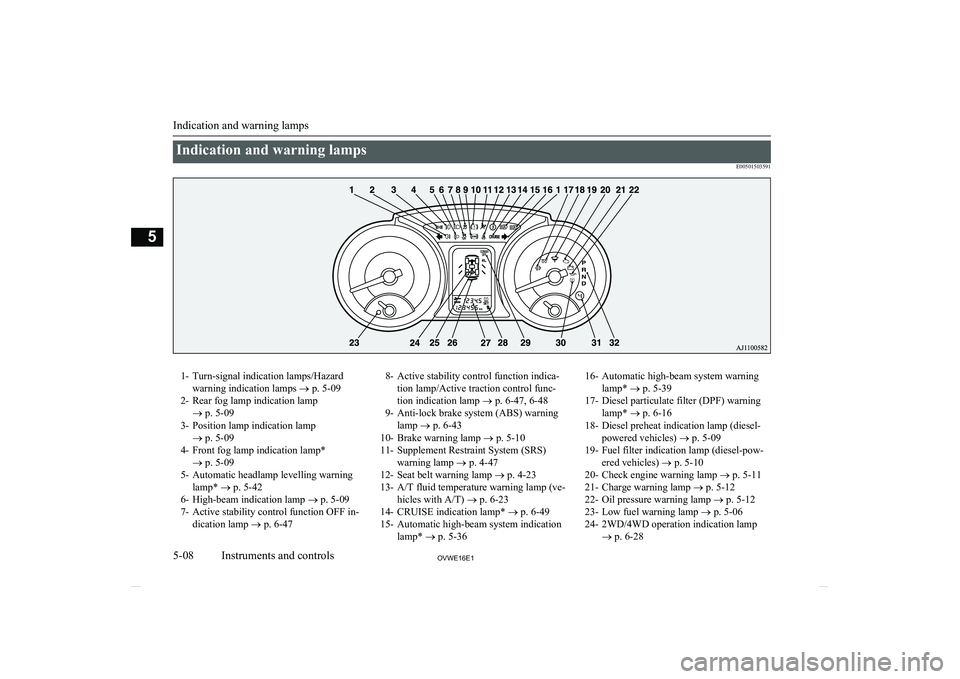
Indication and warning lampsE005015035911- Turn-signal indication lamps/Hazardwarning indication lamps ® p. 5-09
2- Rear fog lamp indication lamp ® p. 5-09
3- Position lamp indication lamp ® p. 5-09
4- Front fog lamp indication lamp* ® p. 5-09
5- Automatic headlamp levelling warning lamp* ® p. 5-42
6- High-beam indication lamp ® p. 5-09
7- Active stability control function OFF in- dication lamp ® p. 6-478- Active stability control function indica-
tion lamp/Active traction control func-
tion indication lamp ® p. 6-47, 6-48
9- Anti-lock brake system (ABS) warning lamp ® p. 6-43
10- Brake warning lamp ® p. 5-10
11- Supplement Restraint System (SRS) warning lamp ® p. 4-47
12- Seat belt warning lamp ® p. 4-23
13- A/T fluid temperature warning lamp (ve- hicles with A/T) ® p. 6-23
14- CRUISE indication lamp* ® p. 6-49
15- Automatic high-beam system indication lamp* ® p. 5-3616- Automatic high-beam system warning
lamp* ® p. 5-39
17- Diesel particulate filter (DPF) warning lamp* ® p. 6-16
18- Diesel preheat indication lamp (diesel- powered vehicles) ® p. 5-09
19- Fuel filter indication lamp (diesel-pow- ered vehicles) ® p. 5-10
20- Check engine warning lamp ® p. 5-11
21- Charge warning lamp ® p. 5-12
22- Oil pressure warning lamp ® p. 5-12
23- Low fuel warning lamp ® p. 5-06
24- 2WD/4WD operation indication lamp ® p. 6-28
Indication and warning lamps
5-08OVWE16E1Instruments and controls5
Page 101 of 404
NOTElThe engine electronic control module ac-
commodating the onboard diagnostic system has various fault data (especially about the
exhaust emission) stored.
This data will be erased if a battery cable is
disconnected which will make a rapid diag- nosis difficult. Do not disconnect a batterycable when the check engine warning lamp
is ON.Charge warning display
E00502700472
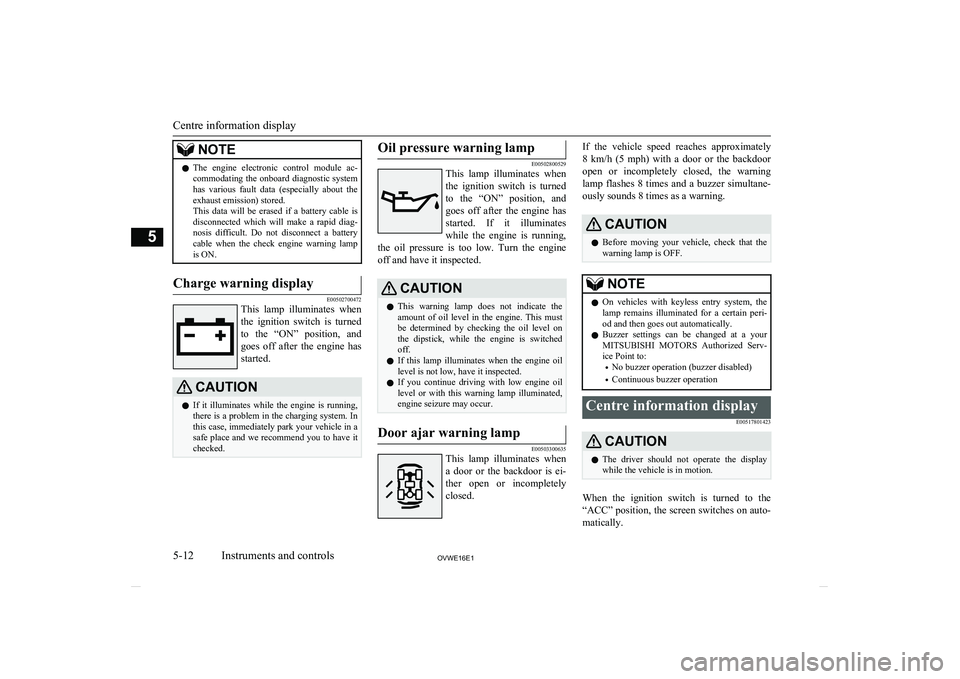
This lamp illuminates when
the ignition switch is turnedto the “ON” position, and goes off after the engine has
started.
CAUTIONl If it illuminates while the engine is running,
there is a problem in the charging system. In
this case, immediately park your vehicle in a safe place and we recommend you to have it checked.Oil pressure warning lamp
E00502800529
This lamp illuminates when
the ignition switch is turnedto the “ON” position, and goes off after the engine has
started. If it illuminates
while the engine is running,
the oil pressure is too low. Turn the engine off and have it inspected.
CAUTIONl This warning lamp does not indicate the
amount of oil level in the engine. This must
be determined by checking the oil level on the dipstick, while the engine is switched off.
l If this lamp illuminates when the engine oil
level is not low, have it inspected.
l If you continue driving with low engine oil
level or with this warning lamp illuminated,
engine seizure may occur.Door ajar warning lamp
E00503300635
This lamp illuminates when
a door or the backdoor is ei-
ther open or incompletely closed.
If the vehicle speed reaches approximately
8 km/h (5 mph) with a door or the backdoor open or incompletely closed, the warning
lamp flashes 8 times and a buzzer simultane- ously sounds 8 times as a warning.CAUTIONl Before moving your vehicle, check that the
warning lamp is OFF.NOTEl On vehicles with keyless entry system, the
lamp remains illuminated for a certain peri-
od and then goes out automatically.
l Buzzer settings can be changed at a your
MITSUBISHI MOTORS Authorized Serv-
ice Point to:
• No buzzer operation (buzzer disabled)
• Continuous buzzer operationCentre information display
E00517801423CAUTIONlThe driver should not operate the display
while the vehicle is in motion.
When the ignition switch is turned to the
“ACC” position, the screen switches on auto- matically.
Centre information display
5-12OVWE16E1Instruments and controls5
Page 177 of 404
•Check the brake system and, if neces-
sary, have it serviced.
• Check the engine, transmission, trans-
fer, and differential oil or grease level and turbidity. If the oil or grease is
milky, it indicates water contamina-
tion. Replace it with new oil or grease.
• Grease the propeller shaft.
• Check the inside of the vehicle. If in-
gress of water is found, dry the carpet
etc.
• Inspect the headlamps. If the head-
lamp bulb is flooded with water, we
recommend you to have it drained.Cautions on handling of 4-
wheel drive vehicles E00606800401
Tyres and wheels
Since the driving torque can be applied to the
4 wheels, the performance of the vehicle when operating in 4-wheel drive is greatly af- fected by the condition of the tyres.
Pay close attention to the tyres.
l Install specified tyres on all wheels. Re-
fer to “Tyres and wheels” on page
11-11.
l Be sure to fit all 4 tyres and wheels of
the same size and type.
When replacement of any of the tyres or
wheels is necessary, replace all of them.
l All tyres should be rotated whenever the
wear difference between the front and
rear tyres is recognizable.
Good vehicle performance cannot be expec- ted if there is a difference in wear between
tyres. Refer to “Tyre rotation” on page 10-15.
l Check the tyre inflation pressure regular-
ly.
l If the tyre inflation pressure is inappro-
priate, the transfer gear may make some
noise and shock while changing the drive mode.CAUTIONl Always use tyres of the same size, same
type, and same brand, and which have no wear differences. Using tyres which differ in
size, type, brand or the degree of wear will
cause excessive loading, resulting in possi- ble damage to the drive system.Towing
If towing is necessary, we recommend you to
have it done by your MITSUBISHI
MOTORS Authorized Service Point or a
commercial tow truck service.
In the following cases, transport the vehicle
using a tow truck.
l The engine runs but the vehicle does not
move or abnormal noise is produced.
l Inspection of the vehicle’s underside re-
veals that oil or some other fluid is leak- ing.
Only when you cannot receive a towing serv- ice from a MITSUBISHI MOTORS Author-
ized Service Point or commercial tow truck
service, tow your vehicle carefully in accord- ance with the instructions given in “Towing”
on page 8-16.Cautions on handling of 4-wheel drive vehicles
6-38OVWE16E1Starting and driving6
Page 204 of 404
NOTElTo prevent wind noise or reduction in fuel
economy, remove the roof carrier when not
in use.
l Before using an automatic car wash, remove
the roof carrier.
l Be sure that adequate clearance is main-
tained for raising the sunroof (if so equip-
ped) when installing a roof carrier.Trailer towing
E00610000550
In order to tow a trailer with your vehicle,
when having a trailer towing device mounted that meets all relevant regulations in your
area, consult a MITSUBISHI MOTORS Au-
thorized Service Point.
The regulations concerning the towing of a
trailer may differ from country to country. You are advised to obey the regulations in
each area.
CAUTIONl Danger of Accident!
A towing bar should be fitted according to MITSUBISHI MOTORS guidelines.
When you are going to tow a trailer, move
the transfer shift lever to “4H” position.
Selecting the “2H” drive may increase the differential oil temperature, resulting in pos-sible damage to the driving system.
Further, the drive train will be subjected to
excessive loading possibly leading to oil leakage, component seizure, or other serious faults.
Maximum towable weight with
brake and maximum trailer- nose weight
Never exceed the maximum towable weight
with brake and the maximum trailer-nose weight as listed in the specifications. (Referto “Vehicle weight” on page 11-07 .)
If you tow a trailer at an altitude of more than
1,000 m above sea-level, reduce your weight
by 10 % of the gross combination weight for
every increase of 1,000 m above sea-level, as the engine output is lowered owing to de-
crease in atmospheric pressure.
Towing bar mounting specifi-
cations
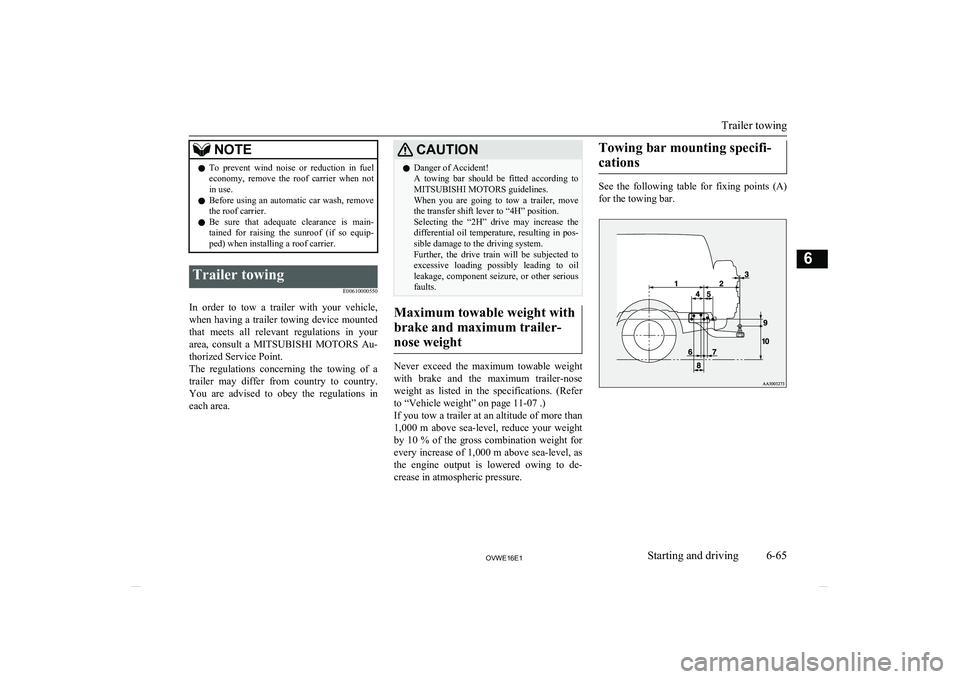
See the following table for fixing points (A) for the towing bar.
Trailer towing
6-65OVWE16E1Starting and driving6
Page 300 of 404
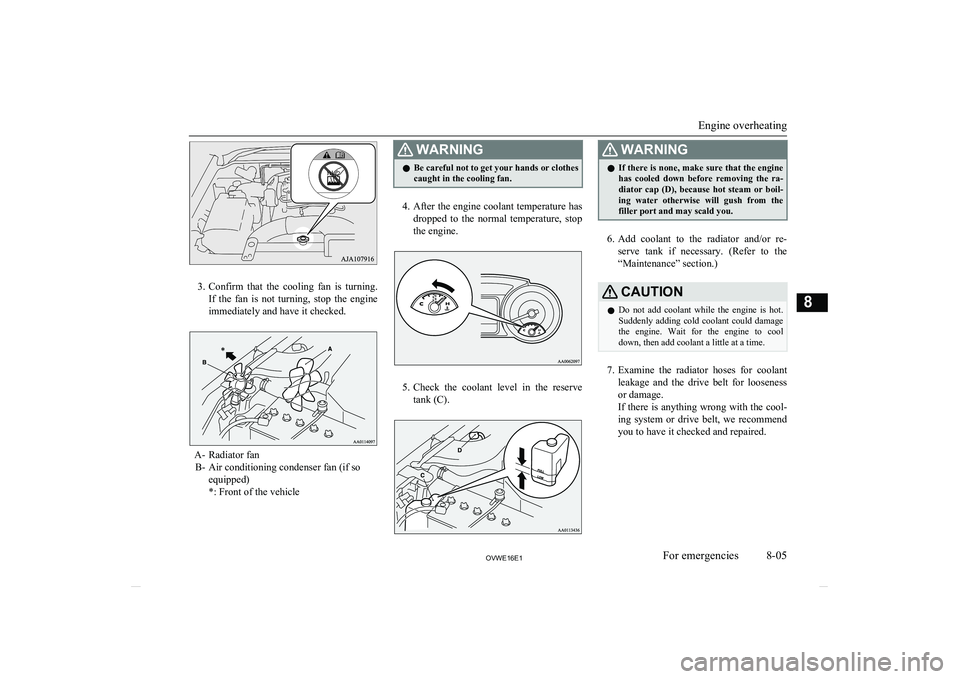
3.Confirm that the cooling fan is turning.
If the fan is not turning, stop the engine
immediately and have it checked.
A- Radiator fan B- Air conditioning condenser fan (if so equipped)
*: Front of the vehicle
WARNINGl Be careful not to get your hands or clothes
caught in the cooling fan.
4. After the engine coolant temperature has
dropped to the normal temperature, stop the engine.
5. Check the coolant level in the reserve
tank (C).
WARNINGl If there is none, make sure that the engine
has cooled down before removing the ra-
diator cap (D), because hot steam or boil- ing water otherwise will gush from the filler port and may scald you.
6. Add coolant to the radiator and/or re-
serve tank if necessary. (Refer to the
“Maintenance” section.)
CAUTIONl Do not add coolant while the engine is hot.
Suddenly adding cold coolant could damage
the engine. Wait for the engine to cool
down, then add coolant a little at a time.
7. Examine the radiator hoses for coolant
leakage and the drive belt for looseness
or damage.
If there is anything wrong with the cool-
ing system or drive belt, we recommend
you to have it checked and repaired.
Engine overheating
8-05OVWE16E1For emergencies8
Page 327 of 404
CAUTIONlNote that the support bar may disengage the
bonnet if the open bonnet is lifted by astrong wind.
l After inserting the support bar into the slot,
make sure the bar supports the bonnet se-
curely from falling down on to your head or body.
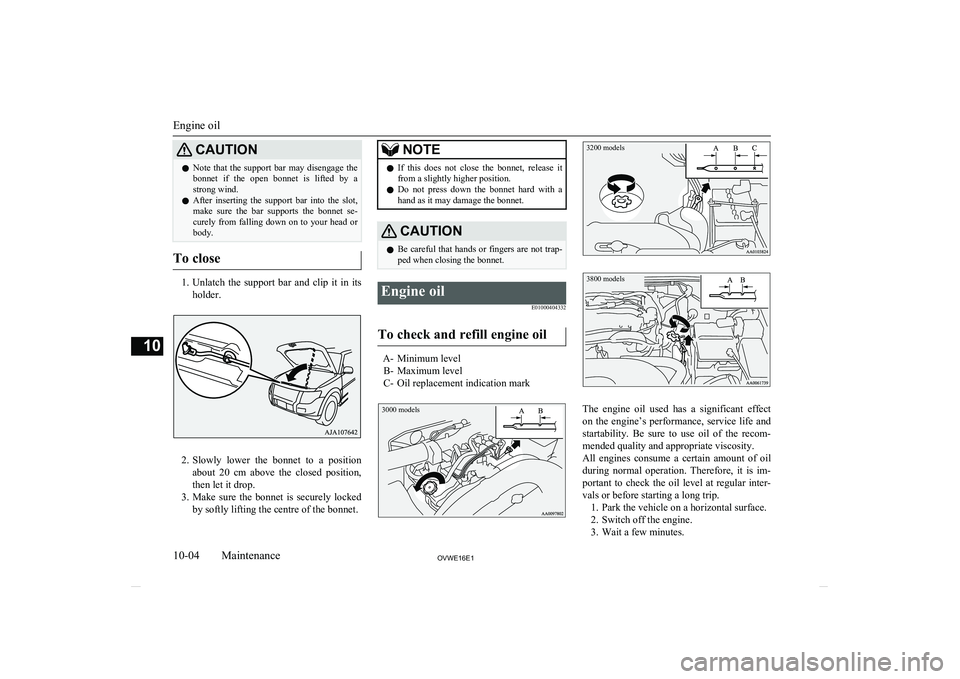
To close
1. Unlatch the support bar and clip it in its
holder.
2. Slowly lower the bonnet to a position
about 20 cm above the closed position,
then let it drop.
3. Make sure the bonnet is securely locked
by softly lifting the centre of the bonnet.
NOTEl If this does not close the bonnet, release it
from a slightly higher position.
l Do not press down the bonnet hard with a
hand as it may damage the bonnet.CAUTIONl Be careful that hands or fingers are not trap-
ped when closing the bonnet.Engine oil
E01000404332
To check and refill engine oil
A- Minimum levelB- Maximum level
C- Oil replacement indication mark
3000 models3200 models3800 models
The engine oil used has a significant effect on the engine’s performance, service life and
startability. Be sure to use oil of the recom-
mended quality and appropriate viscosity.
All engines consume a certain amount of oil during normal operation. Therefore, it is im-portant to check the oil level at regular inter-
vals or before starting a long trip. 1. Park the vehicle on a horizontal surface.
2. Switch off the engine.
3. Wait a few minutes.
Engine oil
10-04OVWE16E1Maintenance10
Page 328 of 404
4.Remove the dipstick and wipe it with a
clean cloth.
5. Reinsert the dipstick as far as it goes.
6. Remove the dipstick and read the oil lev- el, which should always be within the
range indicated.
7. If the oil level is below the specified
limit, remove the cap located on the cyl-inder head cover and add enough oil to
raise the level to within the specified
range. Do not overfill to avoid engine
damage. Be sure to use the specified en-
gine oil and do not mix various types of oil.
8. After adding oil, close the cap securely.
9. Confirm the oil level by repeating step 4
to 6.
Use only the recommended oils with an ACEA or API classification as specified inthis manual.NOTEl For 3200 models, check or refill the oil ac-
cording to the following manner.
• When the oil level is checked in step 6
above, check it on a low side of the dip-
stick because it is different in appearance
of oil level in the two sides of the dip-
stick.
• On vehicles without diesel particulate fil-
ter (DPF), the oil level should be within the range (A) to (B) on the dipstick.NOTE• On vehicles with DPF, the oil level should
be within the range (A) to (C) (oil re-
placement indication mark) on the dip- stick.
If the oil level is beyond the oil replace-
ment indication mark (C), replace the oil as soon as possible.
Then, the oil should be refilled to the
maximum level (B).
• On vehicles with DPF, the engine oil will
increase due to a little fuel getting mixed in the engine oil when the DPF regener-
ates to burn away the PM (particulate
matter). However, it does not indicate a malfunction.
l The engine oil will deteriorate rapidly if the
vehicle is subjected to severe conditions, re- quiring earlier oil replacement. Please referto the maintenance schedule.
l For handling of used engine oils, refer to
page 2-05.Selection of engine oil
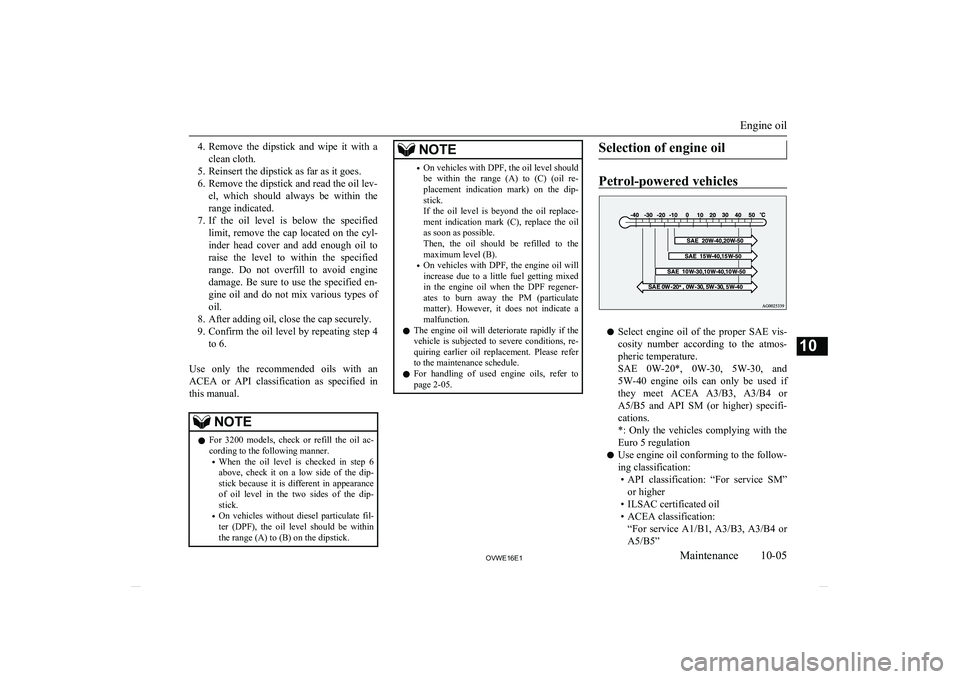
Petrol-powered vehicles
l Select engine oil of the proper SAE vis-
cosity number according to the atmos- pheric temperature.
SAE 0W-20*, 0W-30, 5W-30, and 5W-40 engine oils can only be used if
they meet ACEA A3/B3, A3/B4 or
A5/B5 and API SM (or higher) specifi-
cations.
*: Only the vehicles complying with the Euro 5 regulation
l Use engine oil conforming to the follow-
ing classification: • API classification: “For service SM”
or higher
• ILSAC certificated oil
• ACEA classification: “For service A1/B1, A3/B3 , A3/B4 or
A5/B5”
Engine oil
10-05OVWE16E1Maintenance10
Page 329 of 404
NOTElUse of additives is not recommended since
they may reduce the effectiveness of addi-
tives already included in the engine oil. It may result in failure of the mechanical as-
sembly.
Diesel-powered vehicles
Vehicles without diesel particulate filter
(DPF)
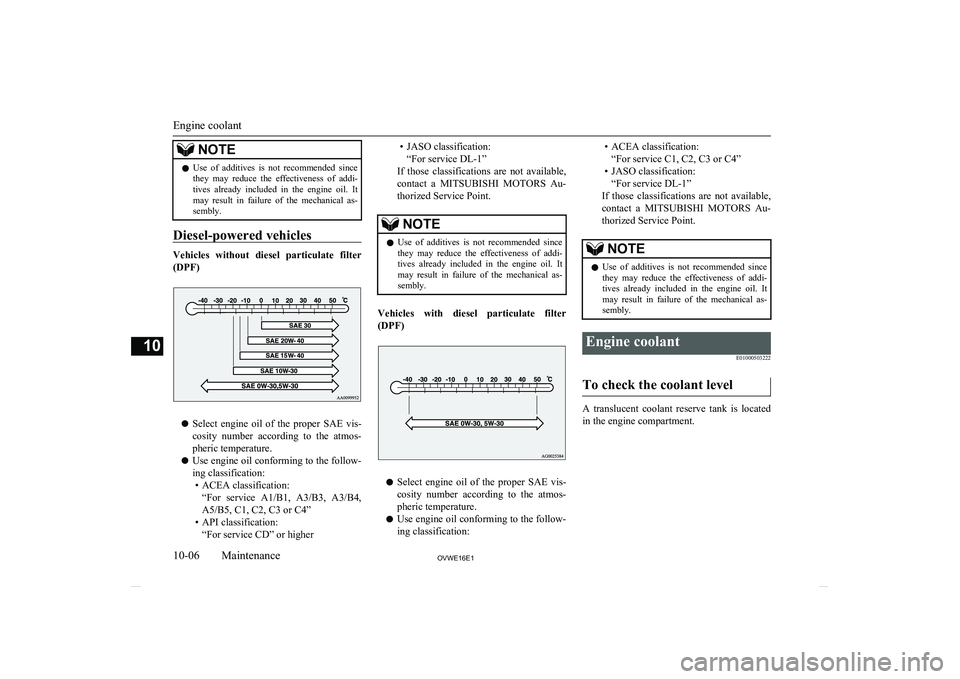
l Select engine oil of the proper SAE vis-
cosity number according to the atmos-pheric temperature.
l Use engine oil conforming to the follow-
ing classification: • ACEA classification: “For service A1/B1, A3/B3 , A3/B4,
A5/B5, C1, C2, C3 or C4”
• API classification: “For service CD” or higher
• JASO classification:
“For service DL-1”
If those classifications are not available, contact a MITSUBISHI MOTORS Au-
thorized Service Point.NOTEl Use of additives is not recommended since
they may reduce the effectiveness of addi-
tives already included in the engine oil. It may result in failure of the mechanical as-
sembly.
Vehicles with diesel particulate filter
(DPF)
l Select engine oil of the proper SAE vis-
cosity number according to the atmos-pheric temperature.
l Use engine oil conforming to the follow-
ing classification:
• ACEA classification:
“For service C1, C2, C3 or C4”
• JASO classification: “For service DL-1”
If those classifications are not available,
contact a MITSUBISHI MOTORS Au-
thorized Service Point.NOTEl Use of additives is not recommended since
they may reduce the effectiveness of addi-
tives already included in the engine oil. It may result in failure of the mechanical as-
sembly.Engine coolant
E01000503222
To check the coolant level
A translucent coolant reserve tank is locatedin the engine compartment.
Engine coolant
10-06OVWE16E1Maintenance10
Page 375 of 404
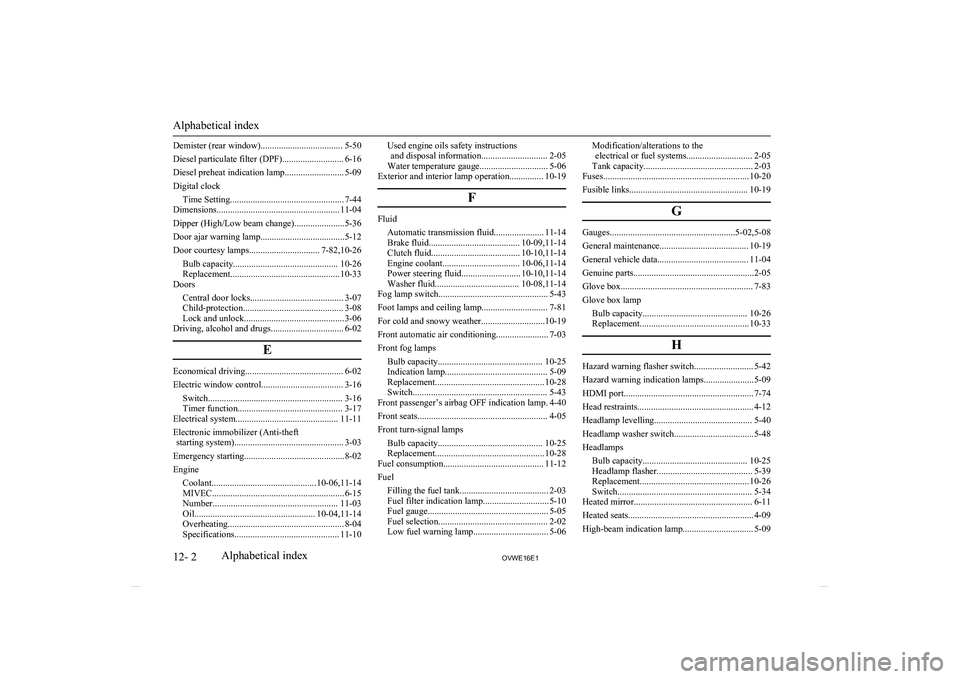
Demister (rear window).................................... 5-50
Diesel particulate filter (DPF)........................... 6-16
Diesel preheat indication lamp.......................... 5-09
Digital clock Time Setting.................................................. 7-44
Dimensions...................................................... 11-04
Dipper (High/Low beam change)......................5-36
Door ajar warning lamp.....................................5-12
Door courtesy lamps............................... 7-82,10-26 Bulb capacity.............................................. 10-26
Replacement................................................ 10-33
Doors
Central door locks......................................... 3-07
Child-protection............................................ 3-08
Lock and unlock............................................ 3-06
Driving, alcohol and drugs................................ 6-02
E
Economical driving........................................... 6-02
Electric window control.................................... 3-16 Switch........................................................... 3-16
Timer function.............................................. 3-17
Electrical system............................................. 11-11
Electronic immobilizer (Anti-theft starting system)................................................ 3-03
Emergency starting............................................8-02
Engine Coolant..............................................10-06,11-14MIVEC.......................................................... 6-15
Number....................................................... 11-03
Oil..................................................... 10-04,11-14
Overheating................................................... 8-04
Specifications.............................................. 11-10
Used engine oils safety instructions and disposal information............................. 2-05
Water temperature gauge.............................. 5-06
Exterior and interior lamp operation............... 10-19
F
FluidAutomatic transmission fluid...................... 11-14
Brake fluid........................................ 10-09,11-14
Clutch fluid....................................... 10-10,11-14
Engine coolant.................................. 10-06,11-14
Power steering fluid.......................... 10-10,11-14
Washer fluid..................................... 10-08,11-14
Fog lamp switch................................................ 5-43
Foot lamps and ceiling lamp............................. 7-81
For cold and snowy weather............................10-19
Front automatic air conditioning....................... 7-03
Front fog lamps Bulb capacity.............................................. 10-25
Indication lamp............................................. 5-09
Replacement................................................ 10-28
Switch........................................................... 5-43
Front passenger’s airbag OFF indication lamp. 4-40
Front seats......................................................... 4-05
Front turn-signal lamps
Bulb capacity.............................................. 10-25
Replacement................................................ 10-28
Fuel consumption............................................ 11-12
Fuel Filling the fuel tank....................................... 2-03Fuel filter indication lamp............................. 5-10
Fuel gauge..................................................... 5-05 Fuel selection................................................ 2-02
Low fuel warning lamp................................. 5-06
Modification/alterations to the electrical or fuel systems............................. 2-05
Tank capacity................................................ 2-03
Fuses................................................................ 10-20
Fusible links.................................................... 10-19
G
Gauges.......................................................5-02,5-08
General maintenance....................................... 10-19
General vehicle data........................................ 11-04
Genuine parts.....................................................2-05
Glove box.......................................................... 7-83
Glove box lamp Bulb capacity.............................................. 10-26
Replacement................................................ 10-33
H
Hazard warning flasher switch.......................... 5-42
Hazard warning indication lamps......................5-09
HDMI port......................................................... 7-74
Head restraints................................................... 4-12
Headlamp levelling........................................... 5-40
Headlamp washer switch...................................5-48
Headlamps Bulb capacity.............................................. 10-25
Headlamp flasher.......................................... 5-39 Replacement................................................ 10-26
Switch........................................................... 5-34
Heated mirror.................................................... 6-11
Heated seats....................................................... 4-09
High-beam indication lamp............................... 5-09
Alphabetical index
12- 2 OVWE16E1Alphabetical index