engine MITSUBISHI SPYDER 1990 Service User Guide
[x] Cancel search | Manufacturer: MITSUBISHI, Model Year: 1990, Model line: SPYDER, Model: MITSUBISHI SPYDER 1990Pages: 2103, PDF Size: 68.98 MB
Page 36 of 2103
Lubrication and
GENERAL Lubricants and Lubricant Capacities Table
Use of fuels containing alcohol is not recommended
unless the nature of the blend can be determined
as being satisfactory.
Gasohol
A mixture of 10% ethanol (grain alcohol)
and 90% unleaded gasoline may be used in your
car.
If problems are experienced as a result
of using gasohol, it is recommended that the car
be operated on gasoline.
Methanol Do not use gasolines containing
methanol (wood alcohol). Use of this type of alcohol
can result in vehicle performance deterioration and
damage critical parts in the fuel system compo-
nents. Fuel system damage and performance prob-
lems, resulting from the use of gasolines containin g
methanol, may not be covered by the new car war-
ranty.
Gasolines containing
Ether)
Unleaded gasoline containing 15% or
may be used in car. Fuel containing MTBE
over 15% vol. may cause reduced engine perfor-
mance and produce vapor lock or hard starting.
MATERIALS
TO FUEL
Indiscriminate use of fuel system -cleaning’
should be avoided. Many of these materials in-
tended for gum and varnish removal
highly active solvents or similar ingredients that
can be harmful to gasket and diaphragm materials
used in fuel system component
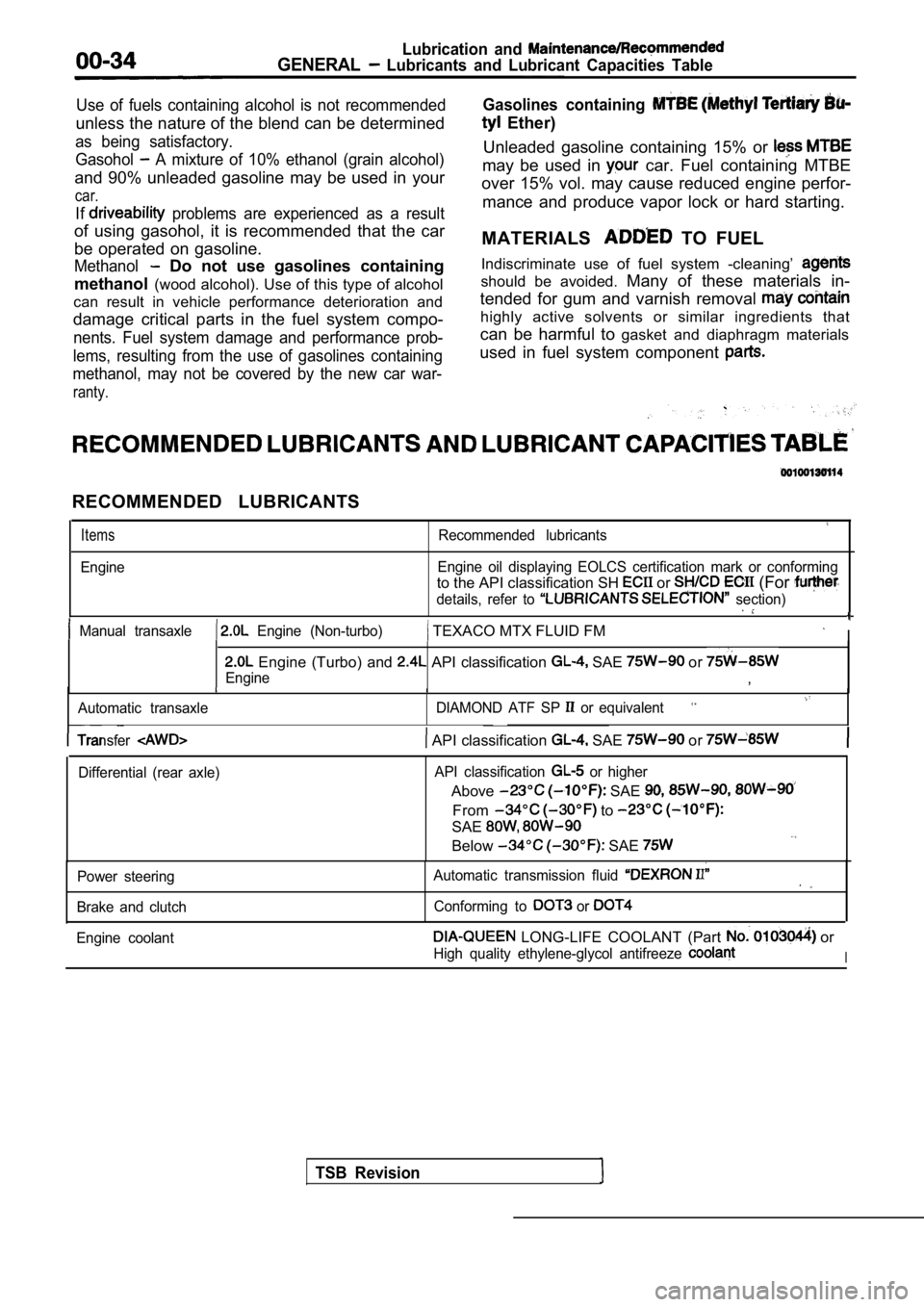
RECOMMENDED LUBRICANTS
Items
Engine
Recommended lubricants
Engine oil displaying EOLCS certification mark or c onforming
to the API classification SH or (For
details, refer to section)
Manual transaxle Engine (Non-turbo) TEXACO MTX FLUID FM I
Engine (Turbo) and API classification SAE or
Engine,
Automatic transaxle DIAMOND ATF SP or equivalent
TSB Revision
Transfer API classification SAE or
Differential (rear axle)API classification or higher
Above SAE
From to
SAE
Below SAE
Power steering
Brake and clutch Automatic transmission fluid
Conforming to or
Engine coolant LONG-LIFE COOLANT (Part or
High quality ethylene-glycol antifreeze I
Page 37 of 2103
GENERAL Recommended Lubricants and Lubricant Table
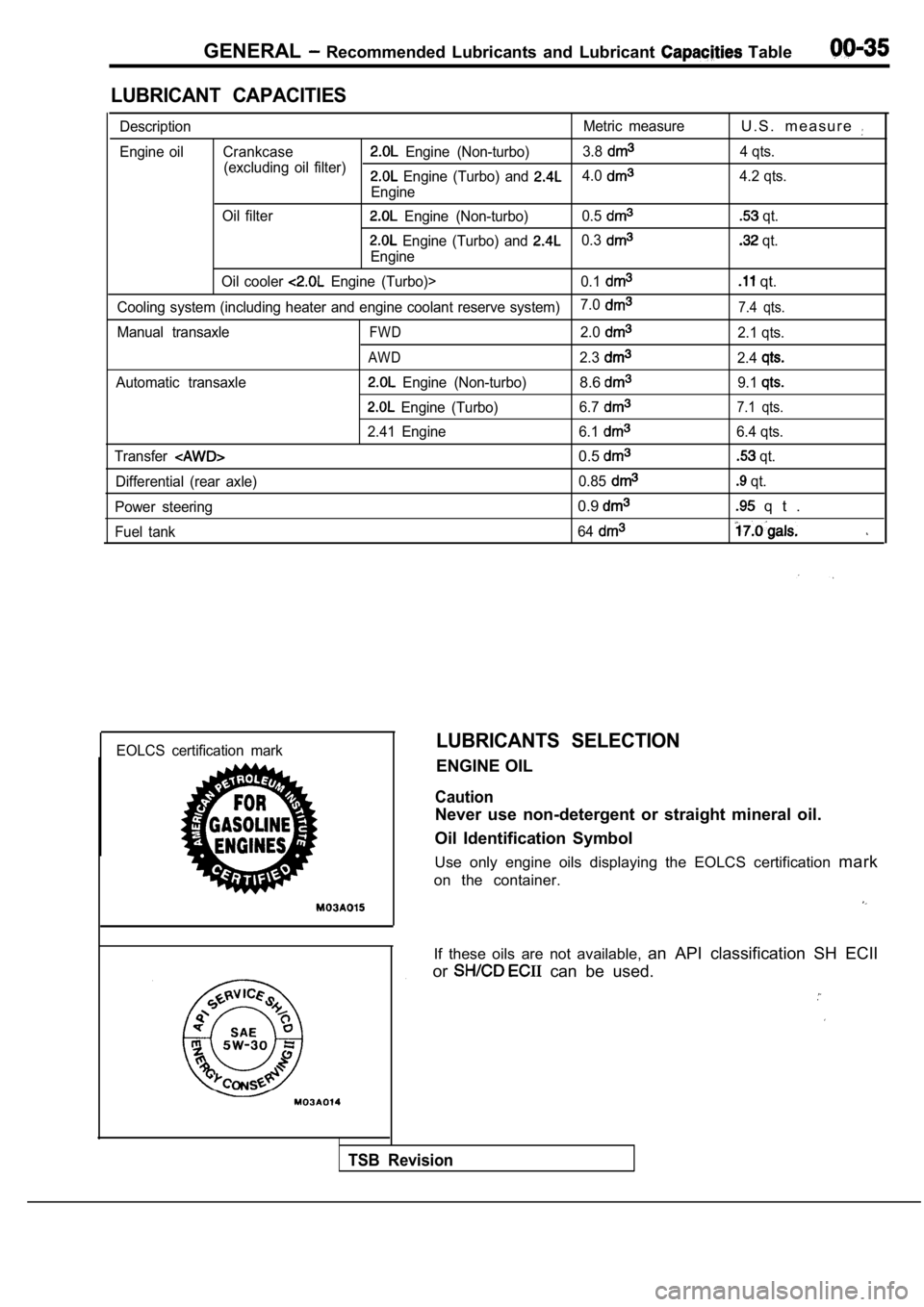
LUBRICANT CAPACITIES
DescriptionMetric measureU . S . m e a s u r e
Engine oil Crankcase Engine (Non-turbo)3.8
(excluding oil filter) 4 qts. Engine (Turbo) and 4.0
Engine4.2 qts.
Oil filter
Engine (Non-turbo) 0.5 qt.
Engine (Turbo) and 0.3
Engine
qt.
Oil cooler
Engine (Turbo)> 0.1 qt.
Cooling system (including heater and engine coolant reserve system)7.07.4 qts.
Manual transaxleFWD2.02.1 qts.
AWD2.32.4
Automatic transaxle Engine (Non-turbo)8.69.1
Engine (Turbo)
6.77.1 qts.
2.41 Engine 6.16.4 qts.
Transfer
0.5 qt.
Differential (rear axle) 0.85
qt.
Power steering
0.9 q t .
Fuel tank 64
EOLCS certification markLUBRICANTS SELECTION
ENGINE OIL
Caution
Never use non-detergent or straight mineral oil.
Oil Identification Symbol
Use only engine oils displaying the EOLCS certifica tion mark
on the container.
If these oils are not available, an API classification SH ECII
or
can be used.
TSB Revision
Page 38 of 2103
GENERAL Recommended Lubricants and Capacities
Non-turbo
I
EngineI PREFERRED
Turbo
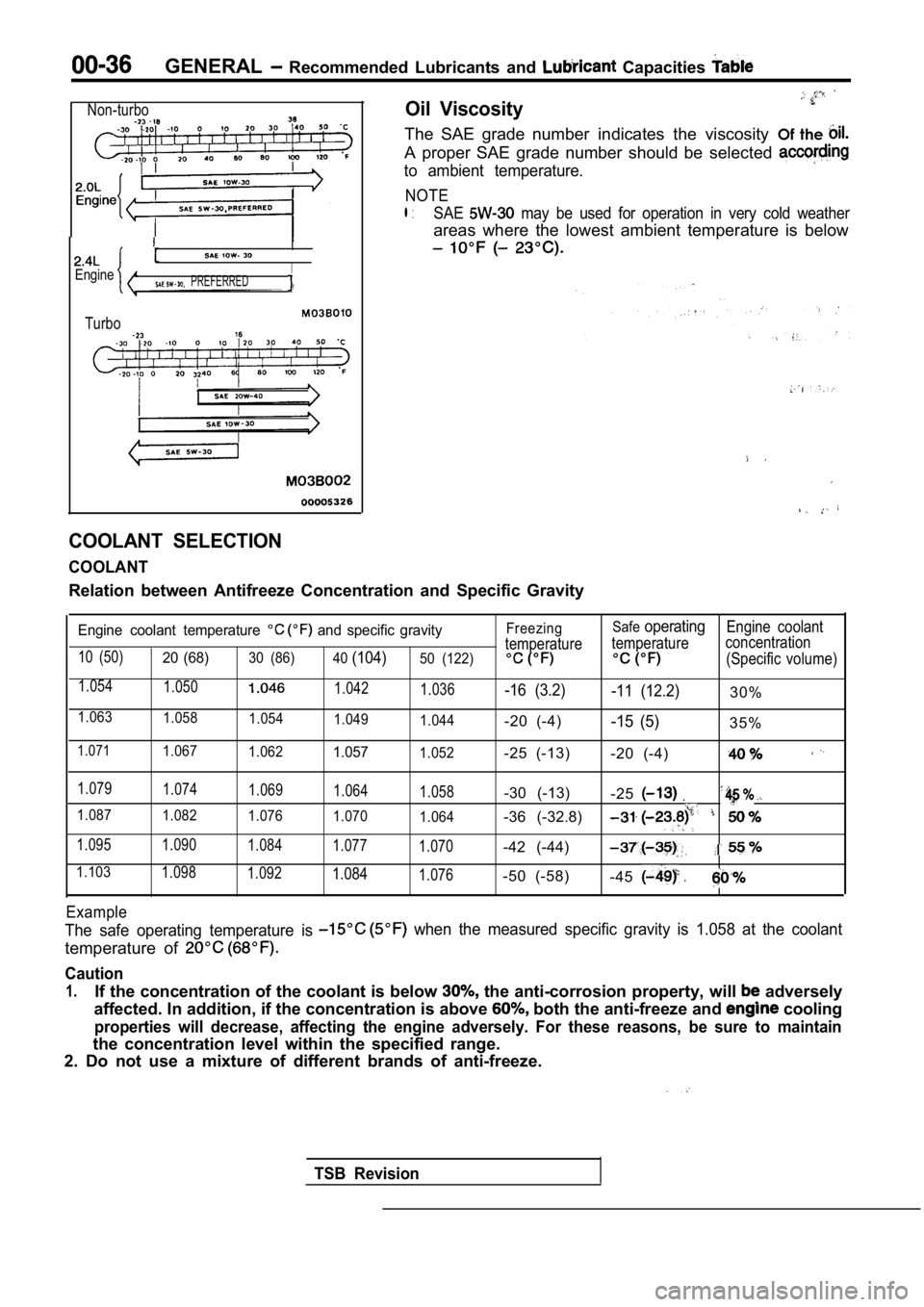
Oil Viscosity
The SAE grade number indicates the viscosity Of the
A proper SAE grade number should be selected
to ambient temperature.
NOTE
l :SAE may be used for operation in very cold weather
areas where the lowest ambient temperature is below
COOLANT SELECTION
COOLANT
Relation between Antifreeze Concentration and Speci fic Gravity
Engine coolant temperature and specific gravity
10 (50)20 (68)30 (86)
40(104)50 (122)
1.054
1.0501.042
1.036
1.0631.058 1.0541.049
1.044
1.0711.0671.0621.0571.052 Freezing
Safe
operatingEngine coolant
temperature temperature concentration
(Specific volume)
-16 (3.2)
-11 (12.2)30%
-20 (-4)
-15 (5)35%
-25 (-13) -20 (-4)
1.079
1.074 1.0691.064
1.058-30 (-13)-25
1.0871.082 1.0761.070
1.064-36 (-32.8)
1.095 1.090 1.0841.077
1.070-42 (-44)
1.1031.0981.0921.0841.076-50 (-58)-45
Example
The safe operating temperature is when the measured specific gravity is 1.058 at the coolant
temperature of
Caution
1.If the concentration of the coolant is below the anti-corrosion property, will adversely
affected. In addition, if the concentration is abov e
both the anti-freeze and cooling
properties will decrease, affecting the engine adve rsely. For these reasons, be sure to maintain
the concentration level within the specified range.
2. Do not use a mixture of different brands of anti -freeze.
TSB Revision
Page 41 of 2103
GENERAL Maintenance Service
Engine (Non-turbo)>
Engine (Turbo)>
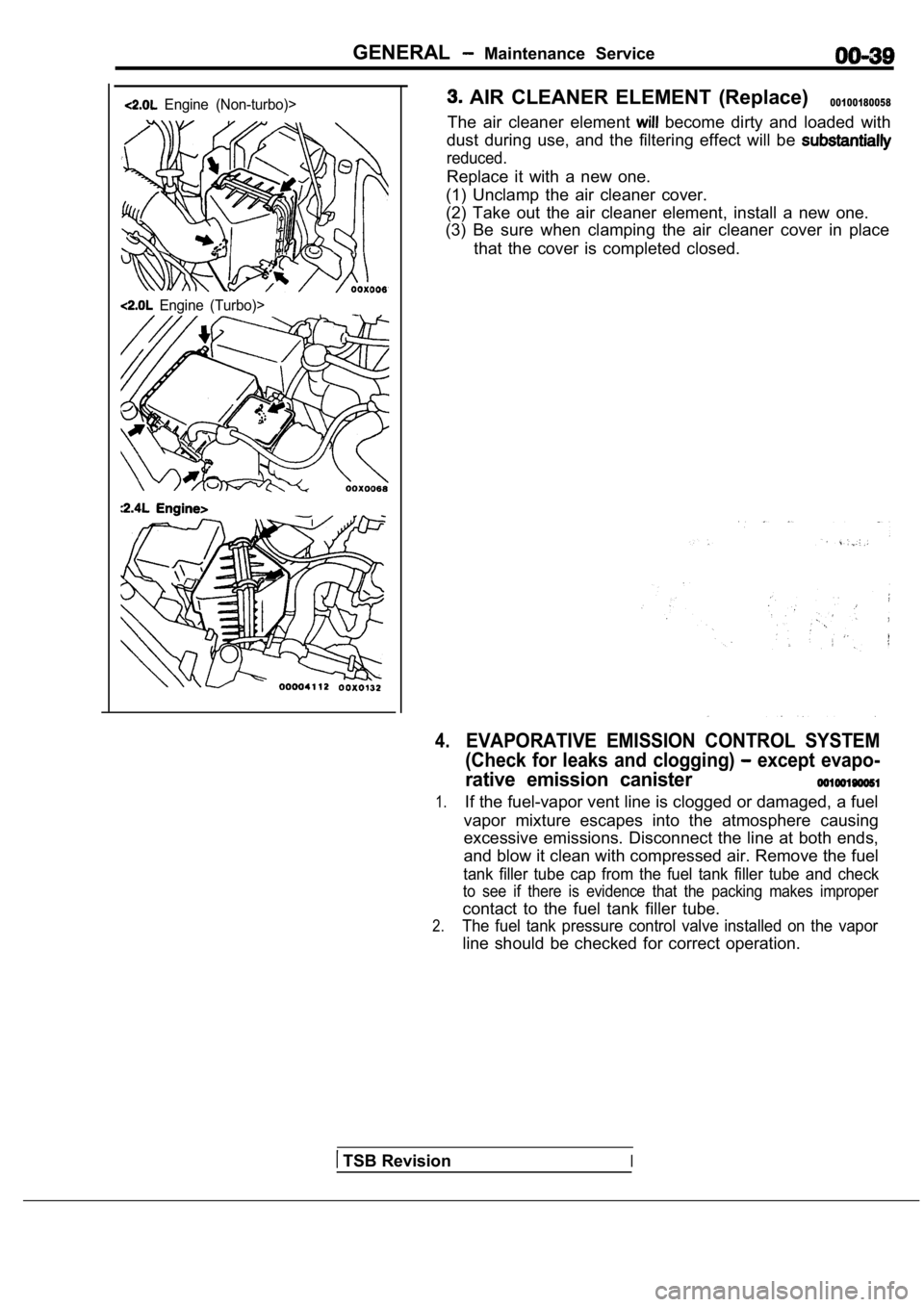
AIR CLEANER ELEMENT (Replace)00100180058
The air cleaner element become dirty and loaded with
dust during use, and the filtering effect will be
reduced.
Replace it with a new one.
(1) Unclamp the air cleaner cover.
(2) Take out the air cleaner element, install a new one.
(3) Be sure when clamping the air cleaner cover in place
that the cover is completed closed.
4.EVAPORATIVE EMISSION CONTROL SYSTEM
(Check for leaks and clogging)
except evapo-
rative emission canister
1.If the fuel-vapor vent line is clogged or damaged, a fuel
vapor mixture escapes into the atmosphere causing
excessive emissions. Disconnect the line at both en ds,
and blow it clean with compressed air. Remove the f uel
tank filler tube cap from the fuel tank filler tube and check
to see if there is evidence that the packing makes improper
contact to the fuel tank filler tube.
2.The fuel tank pressure control valve installed on the vapor
line should be checked for correct operation.
TSB RevisionI
Page 42 of 2103
GENERAL Maintenance
Incorrect Correct
5. SPARK PLUGS
1.Spark plugs must spark properly to assure proper engine
performance and reduce exhaust emission
Therefore, they should be periodically with new
ones.
2. The new plugs should be checked gap.
Spark plug gap:, . .
Engine (Turbo)>’
mm
Engine (Non-turbo)> ,
1.22-1.35 mm
in.)
Engine> .
in.)
3. Install the spark plug and tighten to the
Tightening torque:
Engine (Turbo) and Engine>
25 Nm (18
E n g i n e ( N o n - t u r b o ) >
28 Nm (20
6. IGNITION CABLES (Replace)
The ignition cables should. be replaced periodicall y with new
ones. After replacing, make sure that the ignition cables are
routed properly and fully seated.
NOTE
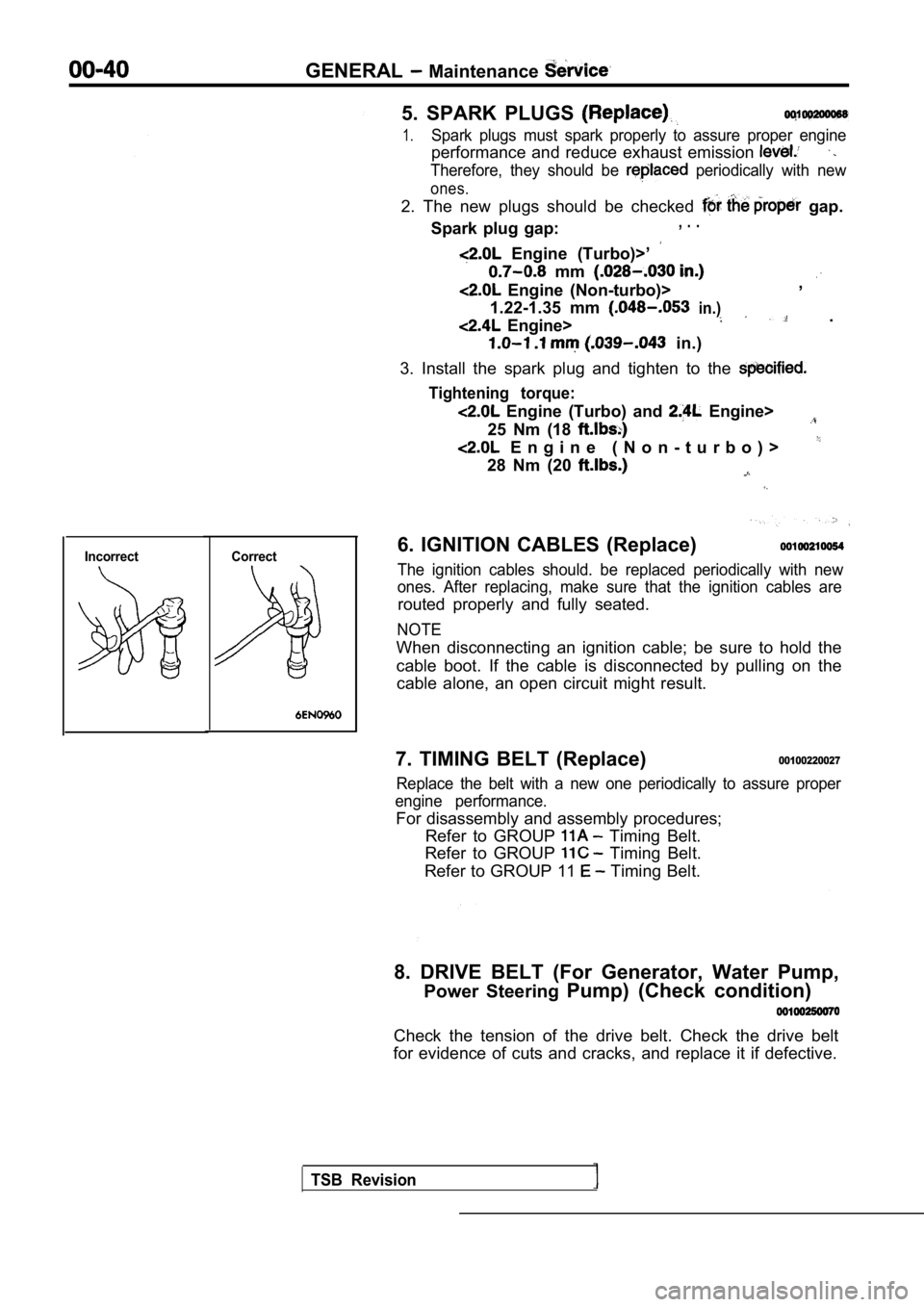
When disconnecting an ignition cable; be sure to ho ld the
cable boot. If the cable is disconnected by pulling on the
cable alone, an open circuit might result.
7. TIMING BELT (Replace)
00100220027
Replace the belt with a new one periodically to ass ure proper
engine performance.
For disassembly and assembly procedures; Refer to GROUP
Timing Belt.
Refer to GROUP
Timing Belt.
Refer to GROUP 11
Timing Belt.
8. DRIVE BELT (For Generator, Water Pump, Power Steering Pump) (Check condition)
Check the tension of the drive belt. Check the driv e belt
for evidence of cuts and cracks, and replace it if defective.
TSB Revision
Page 43 of 2103
GENERAL Maintenance
Generator pulley
Crankshaft
Water pump
pump
GENERATOR AND WATER PUMP DRIVE
CHECK
Engine (Turbo) and Engine>
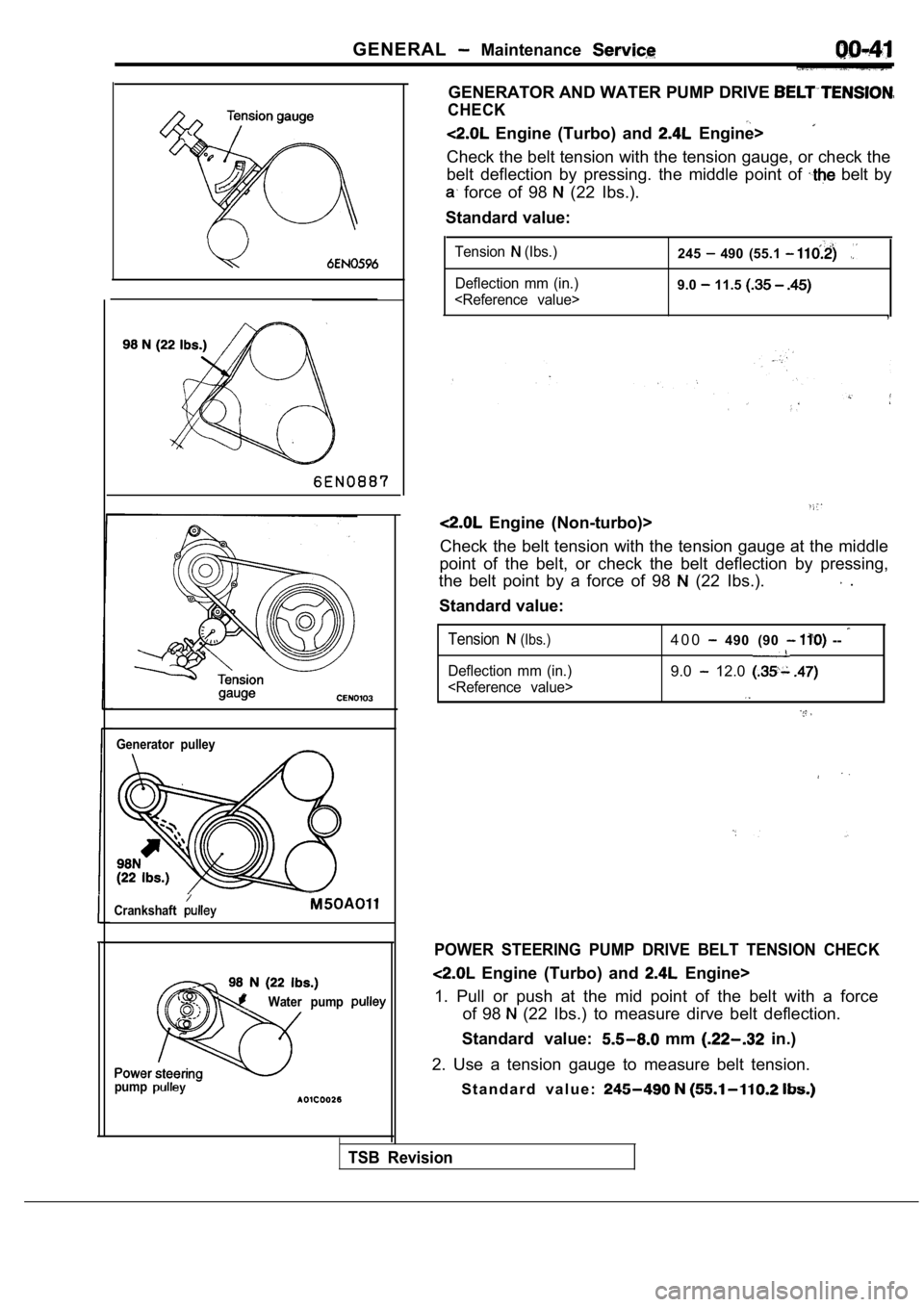
Check the belt tension with the tension gauge, or c heck the
belt deflection by pressing. the middle point of
belt by
force of 98 (22 Ibs.).
Standard value:
Tension (Ibs.)
Deflection mm (in.)
9.0 11.5
,
Engine (Non-turbo)>
Check the belt tension with the tension gauge at th e middle
point of the belt, or check the belt deflection by pressing,
the belt point by a force of 98
(22 Ibs.). .
Standard value:
Tension (Ibs.)
Deflection mm (in.)
4 0 0 490 (90 --
9.0 12.0
POWER STEERING PUMP DRIVE BELT TENSION CHECK
Engine (Turbo) and Engine>
1. Pull or push at the mid point of the belt with a force
of 98
(22 Ibs.) to measure dirve belt deflection.
Standard value:
mm in.)
2. Use a tension gauge to measure belt tension. S t a n d a r d v a l u e :
TSB Revision
Page 44 of 2103
GENERALMaintenanceService
Drain
Oil pan side
Engine
Engine (Turbo) and
TSB Revision
Engine (Non-turbo)>
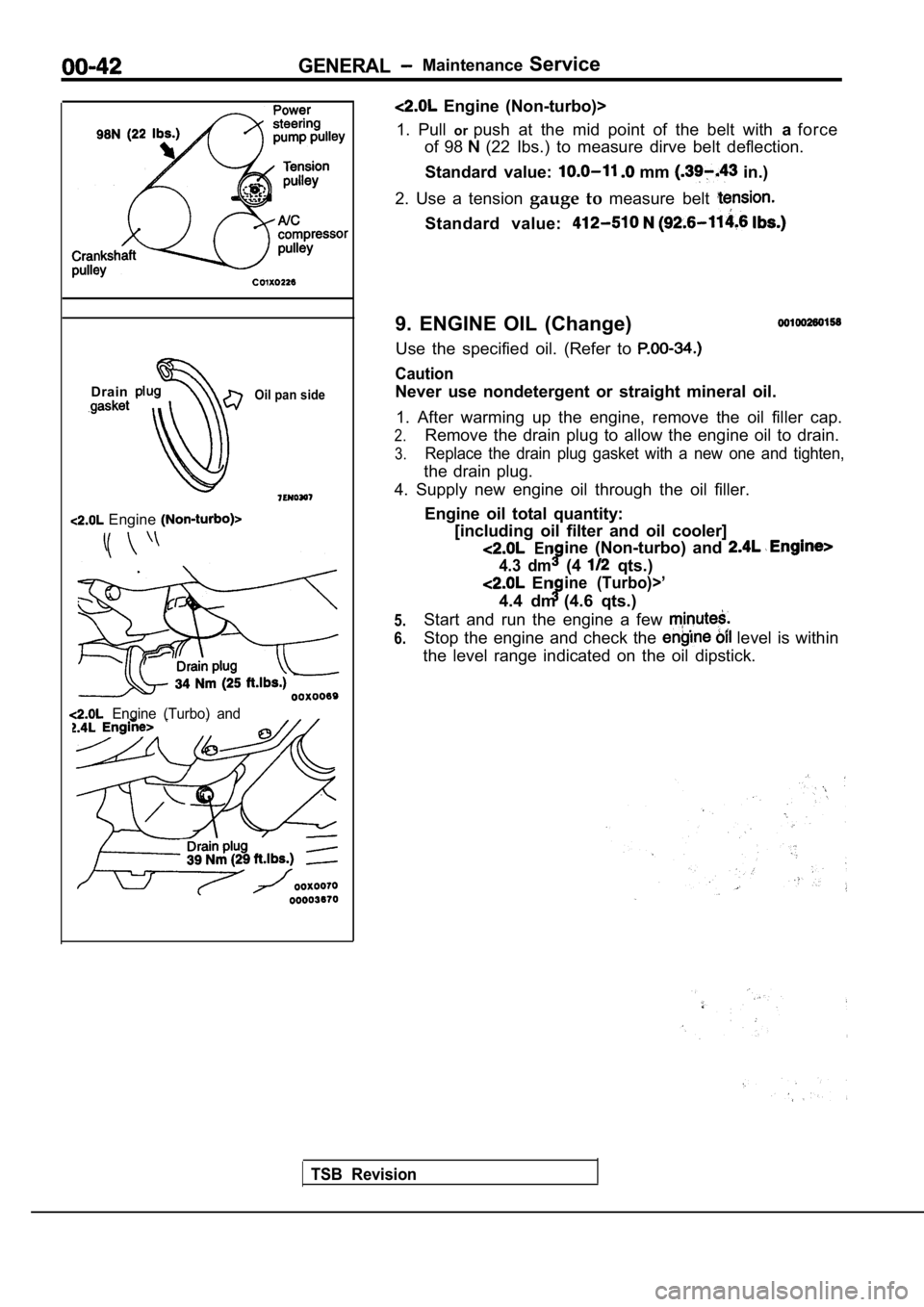
1. Pull orpush at the mid point of the belt with aforce
of 98
(22 Ibs.) to measure dirve belt deflection.
Standard value:
mm in.)
2. Use a tension gauge to measure belt
Standard value:
9. ENGINE OIL (Change)
Use the specified oil. (Refer to
Caution
Never use nondetergent or straight mineral oil.
1. After warming up the engine, remove the oil fill er cap.
2.Remove the drain plug to allow the engine oil to drain.
3.Replace the drain plug gasket with a new one and ti ghten,
the drain plug.
4. Supply new engine oil through the oil filler.
Engine oil total quantity:[including oil filter and oil cooler]
Enine (Non-turbo) and
4.3 dm(4 qts.)
Enine (Turbo)>’
4.4 dm (4.6 qts.)
Start and run the engine a few
Stop the engine and check the level is within
the level range indicated on the oil dipstick.
5.
6.
Page 45 of 2103
GENERAL Maintenance Service
Engine (Non-turbo)>
Engine (Turbo) and Engine>
10. ENGINE OIL FILTER (Replace)
The quality of replacement filters varies considerably.
high quality filters should be used to assure efficient
service.
Genuine oil filters are capable of a pressure,
of 1,765
(256 psi). These high’ quality filters are highly
recommended. The followings part are available as f ollows.
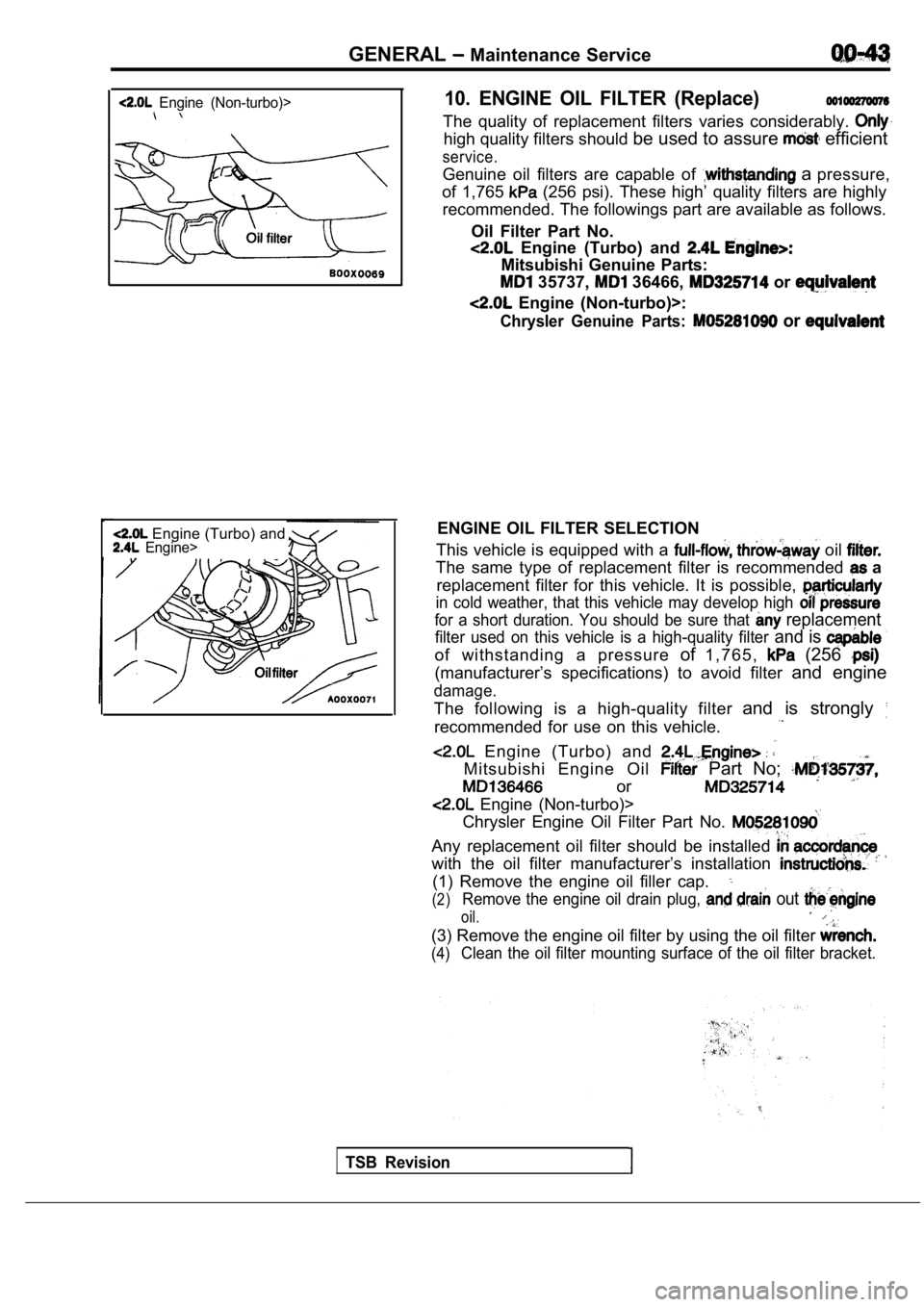
Oil Filter Part No.
Engine (Turbo) and
Mitsubishi Genuine Parts:
35737, 36466, or
Engine (Non-turbo)>:
Chrysler Genuine Parts: or
ENGINE OIL FILTER SELECTION
This vehicle is equipped with a
oil
The same type of replacement filter is recommended a
replacement filter for this vehicle. It is possible ,
in cold weather, that this vehicle may develop high
for a short duration. You should be sure that replacement
filter used on this vehicle is a high-quality filter and is
of withstanding a pressure of1 , 7 6 5 , (256
(manufacturer’s specifications) to avoid filter and engine
damage.
The following is a high-quality filter and is strongly
recommended for use on this vehicle.
Engine (Turbo) and
Mitsubishi Engine Oil Part No;
or
Engine (Non-turbo)>
Chrysler Engine Oil Filter Part No.
Any replacement oil filter should be installed
with the oil filter manufacturer’s installation
(1) Remove the engine oil filler cap.
(2)Remove the engine oil drain plug, out
oil.
(3) Remove the engine oil filter by using the oil f ilter
(4)Clean the oil filter mounting surface of the oil filter bracket.
TSB Revision
Page 46 of 2103
GENERAL
Oil level
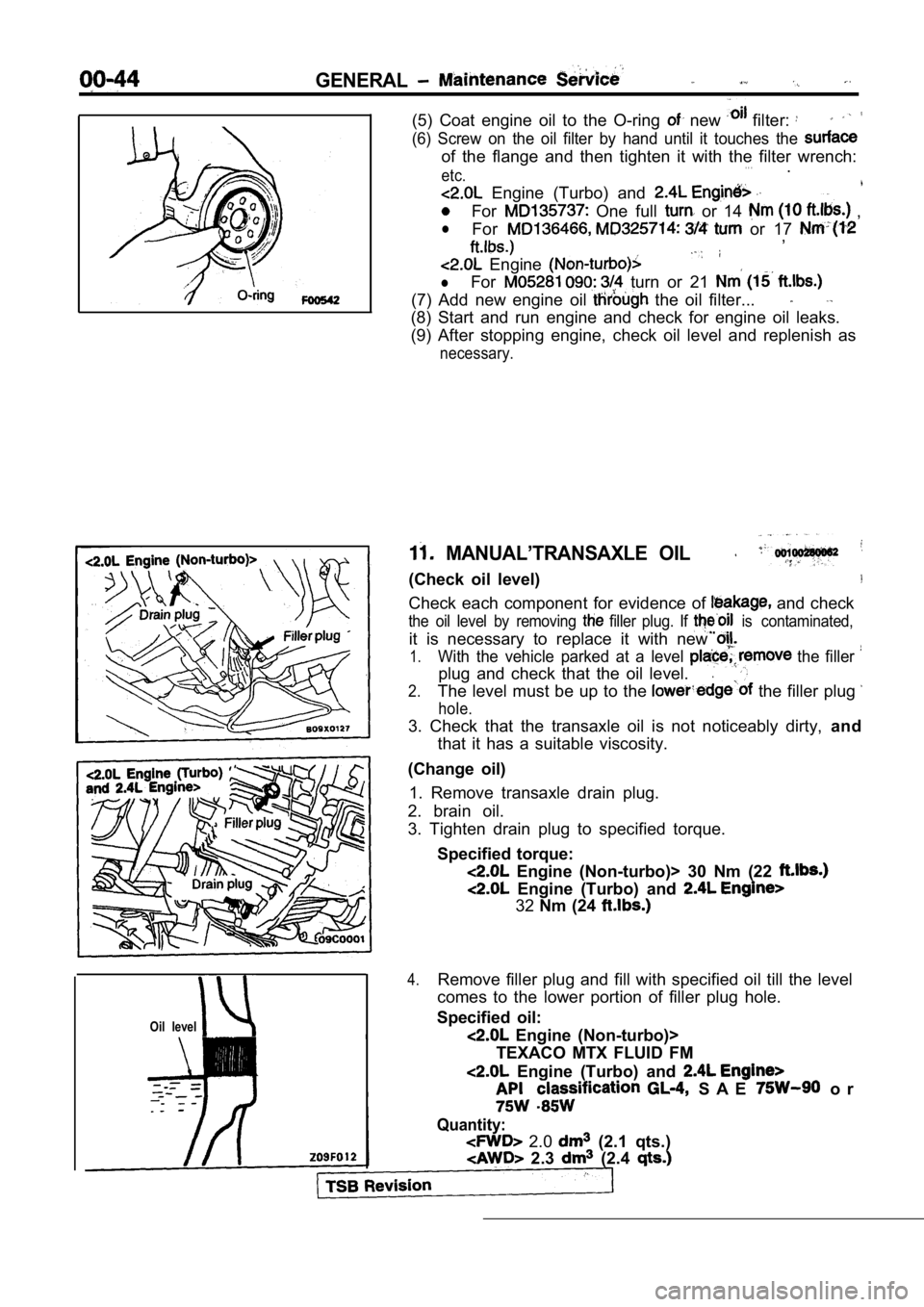
(5) Coat engine oil to the O-ring new filter:
(6) Screw on the oil filter by hand until it touches the
of the flange and then tighten it with the filter w rench:. . .etc..
Engine (Turbo) and
For One full or 14 ,
lFor or 17 ,
Engine
lFor turn or 21
(7) Add new engine oil the oil filter...
(8) Start and run engine and check for engine oil l eaks.
(9) After stopping engine, check oil level and repl enish as
necessary.
MANUAL’TRANSAXLE OIL
(Check oil level)
Check each component for evidence of and check
the oil level by removing filler plug. If is contaminated,
it is necessary to replace it with new
1.With the vehicle parked at a level the filler
plug and check that the oil level..
2.The level must be up to the the filler plug
hole.
3. Check that the transaxle oil is not noticeably d irty, and
that it has a suitable viscosity.
(Change oil) 1. Remove transaxle drain plug.
2. brain oil.
3. Tighten drain plug to specified torque.
Specified torque:
Engine (Non-turbo)> 30 Nm (22
Engine (Turbo) and
32Nm (24
4.Remove filler plug and fill with specified oil till the level
comes to the lower portion of filler plug hole.
Specified oil:
Engine (Non-turbo)>
TEXACO MTX FLUID FM
Engine (Turbo) and
S A E o r
Quantity:
2.0 (2.1 qts.)
2.3 (2.4
Page 47 of 2103
GENERAL Maintenance, Service
5. Tighten filler plug to specified torque.
Specified torque:
Engine (Non-turbo)>30 Nm (22
Engine (Turbo) and Engine>
32 Nm (24
12. AUTOMATIC TRANSAXLE FLUID
(Check ‘fluid level)
Engine (Non-turbo)>
1. Position the vehicle on a level surface.
2. Start engine and allow to idle in PARK for at le ast 60
seconds. The warmer the transaxle fluid, the more
accurate the reading.
3.While sitting in driver seat, apply brakes and plac e gear
selector in each position. Return gear selector to PARK.
4. Raise hood and remove transaxle fluid level indi cator
(dipstick) and wipe clean with a suitable shop towe l.
5.
dipstick and verify it is seated in fill tube.
Caution
Do not overfill automatic transaxle, leakage or dam age
can result.
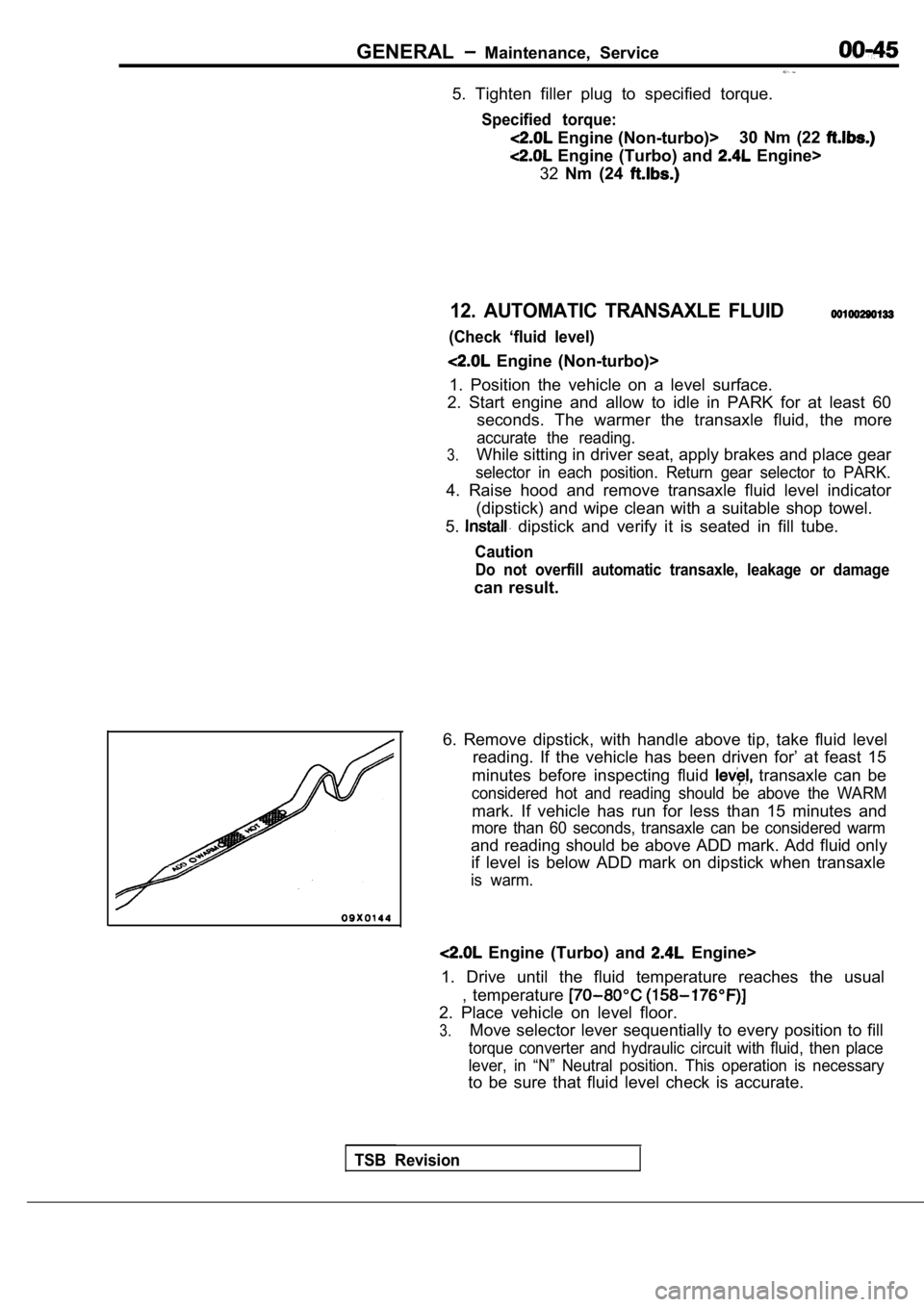
6. Remove dipstick, with handle above tip, take flu id level
reading. If the vehicle has been driven for’ at fea st 15
minutes before inspecting fluid
transaxle can be
considered hot and reading should be above the WARM
mark. If vehicle has run for less than 15 minutes a nd
more than 60 seconds, transaxle can be considered w arm
and reading should be above ADD mark. Add fluid onl y
if level is below ADD mark on dipstick when transax le
is warm.
Engine (Turbo) and Engine>
1. Drive until the fluid temperature reaches the us ual
, temperature
2. Place vehicle on level floor.
3.Move selector lever sequentially to every position to fill
torque converter and hydraulic circuit with fluid, then place
lever, in “N” Neutral position. This operation is n ecessary
to be sure that fluid level check is accurate.
TSB Revision