fuel pressure NISSAN 300ZX 1984 Z31 Engine Fuel And Emission Control System Workshop Manual
[x] Cancel search | Manufacturer: NISSAN, Model Year: 1984, Model line: 300ZX, Model: NISSAN 300ZX 1984 Z31Pages: 79, PDF Size: 2.15 MB
Page 1 of 79

ENGINE FUEL &
- EMISSION - CONTROL SYSTEM
SECTION EFaEC
CONTENTS
PRECAUTIONS ..
COMPONENT PARTS LOCATION
ECCS DIAGRAM
. . .
ECCS CHART ..
ECC.S WIRING DIAGRAM . . ..
FUEL FLOW SYSTEM DESCRIPTION .
AIR FLOW SYSTEM DESCRIPTION ....
E C C S. DESCRIPTION . . . . ...
DIAGNOSTIC PROCEDURE . ..
SE LF-D I AGNOSIS ..
..
.. ..
..
..
..
...
ELECTRONfC CONTROL SYSTEM INSPECTION
MIXTURE RATIO FEEDBACK SYSTEM INSPECTION
. ,
FUEL SYSTEM INSPECTION
TURBOCHARGER
. ... ..
INJECTOR COOLING FAN (VG30ET) .
PRESSURE REGULATOR CONTROL
CRANKCASE EMISSION CONTROL SYSTEM
. . . .
EXHAUST EMISSION CONTROL SYSTEM . . ...
EVAPORATIVE EMISSION CONTROL SYSTEM . . .
SERVICE DATA AND SPECIFICATIONS (S DS). . . . . . .
. . EF&EC- 2
. EF&EC- 3
EF & EC- 4
EF&EC- 6
EF&EC- 8
.. EF & EC-10
EF
& EC-11
, EF&EC-13
EF
& EC-28
EF
& EC-35
EF
& EC43
EF & EC-60
EF
& EC-63
EF
& EC-66
EF
& EC-69
EF
& EC-72
. . EF & EC-74
EF
& EC-75
, EF&EC-76
EF & EC-79
Page 2 of 79
PRECAUTIONS
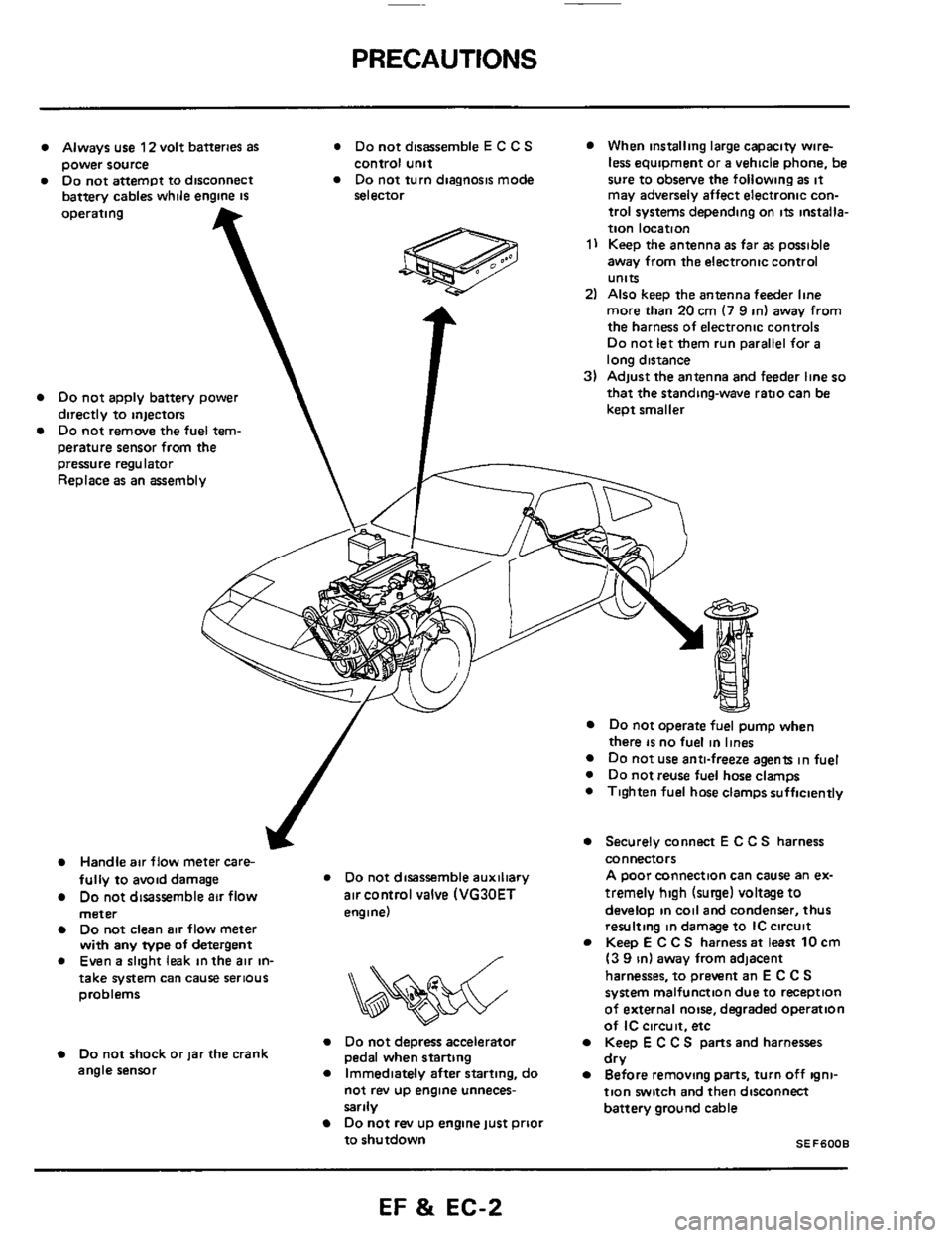
Always use 12 volt batteries as * Do not disassemble E C C S When installing large capacity wire-
Do not attempt to disconnect Do not turn diagnosis mode sure to obsetve the following as it power source
battery cables while engine
IS
control unit
selector less equipment or a vehicle phone, be
may adversely affect electronic con-
operating
Do not apply battery power
directly to injectors
Do not remove the fuel tem-
perature sensor from
the T
pressure regulator
Replace as an assembly
trol systems depending on its installa-
tion location
1) Keep the antenna as far as possible
away from the electronic control
units
2) Also keep the antenna feeder line
more than
20 cm (7 9 in) away from
the harness of electronic controls
Do not let them run parallel for a
long distance
3) Adjust the antenna and feeder line so
that the standing-wave ratio can be
keot smaller
J
Handle air flow meter care-
fully to avoid damage * Do not disassemble auxiliary
Do not disassemble air flow air control valve (VG30ET
meter engine)
Do not clean air flow meter
with any type of detergent
0 Even a slight leak in the air in- /
&&%$$?&
take system can cause serious
problems
Do not depress accelerator Do not shock or jar the crank
angle sensor
Immediately after starting, do
pedal when starting
not rev
up engine unneces-
sarily
Do not rev up engine just prioi
to shutdown
Do not operate fuel pump when
there is no fuel in lines Do not use anti-freeze agents in fuel
0 Do not reuse fuel hose clamps
0 Tighten fuel hose clamps sufficiently
Securely connect E C C S harness
connectors
A poor connection can cause an ex-
tremely
high (surge) voltage to
develop in coil and condenser, thus
resulting in damage to IC circuit
Keep
E C C S harness at least 10 cm
(3 9 in) away from adjacent
harnesses, to prevent an
E C C S
system malfunction due to reception
of external noise, degraded operation
of
IC circuit. etc
Keep E C C S parts and harnesses
Before removing parts, turn off igni-
tion switch and then disconnect
battery ground cable dry
SEF6008
EF & EC-2
Page 10 of 79
FUEL FLOW SYSTEM DESCRIPTION
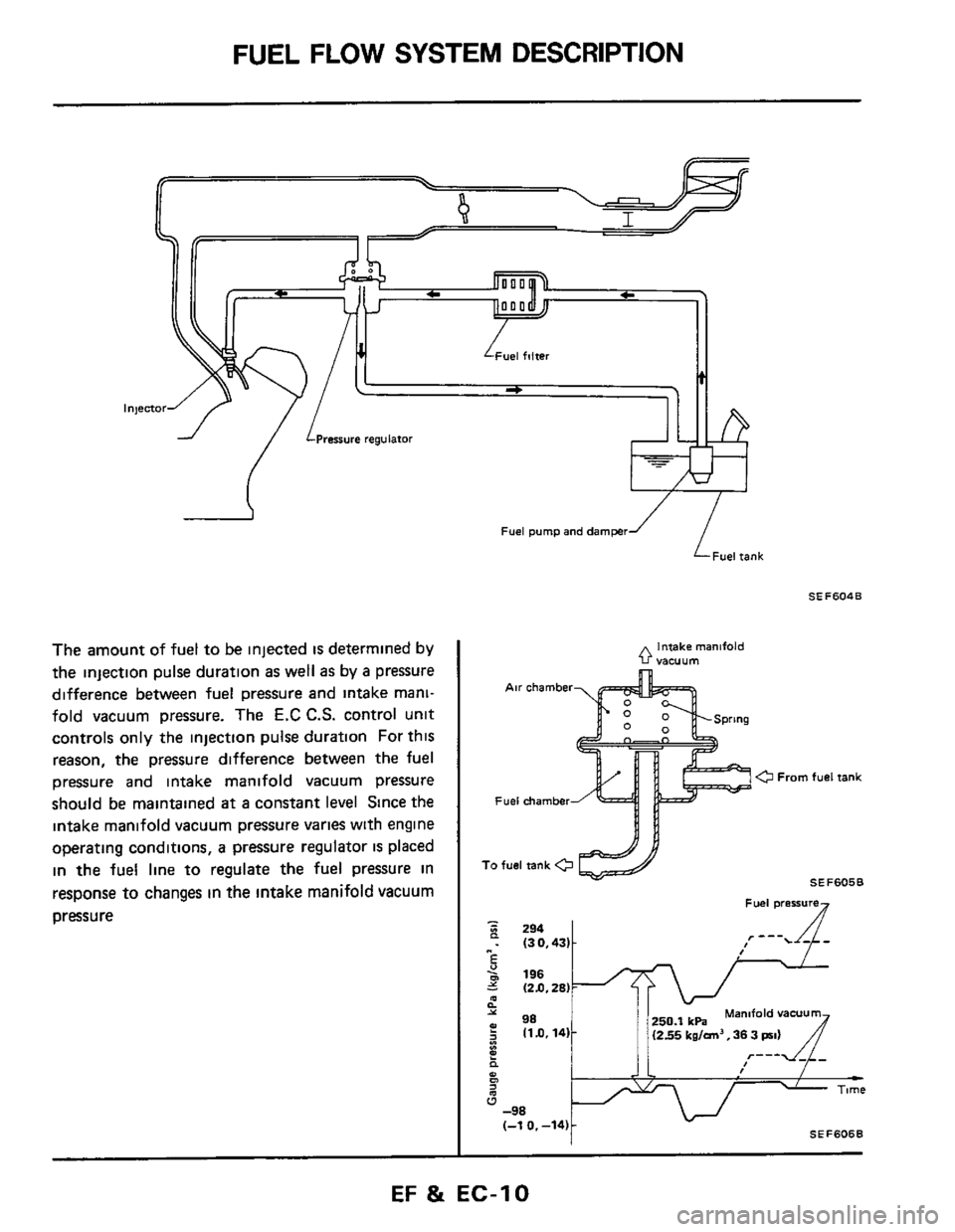
The amount of fuel to be injected is determined by
the injection pulse duration
as well as by a pressure
difference between fuel pressure and intake mani-
fold vacuum pressure. The
E.C C.S. control unit
controls only the injection pulse duration For this
reason,
the pressure difference between the fuel
pressure and intake manifold vacuum pressure
should be maintained
at a constant level Since the
intake manifold vacuum pressure varies with engine
operating conditions,
a pressure regulator IS placed
in the fuel line to regulate the fuel pressure in
response to changes
in the intake manifold vacuum
pressure
Fuel pump and damper
’ iFueirank
SEF604B
intake manifold 0 vacuum
a From fuel tank
Fuel chamber
SEF605B
Fuel presswe
EF & EC-10
Page 17 of 79
E. C. C. S. DESCRIPTION
E.C.C.S. Corn
FUEL TEMPERATURE SENSOR
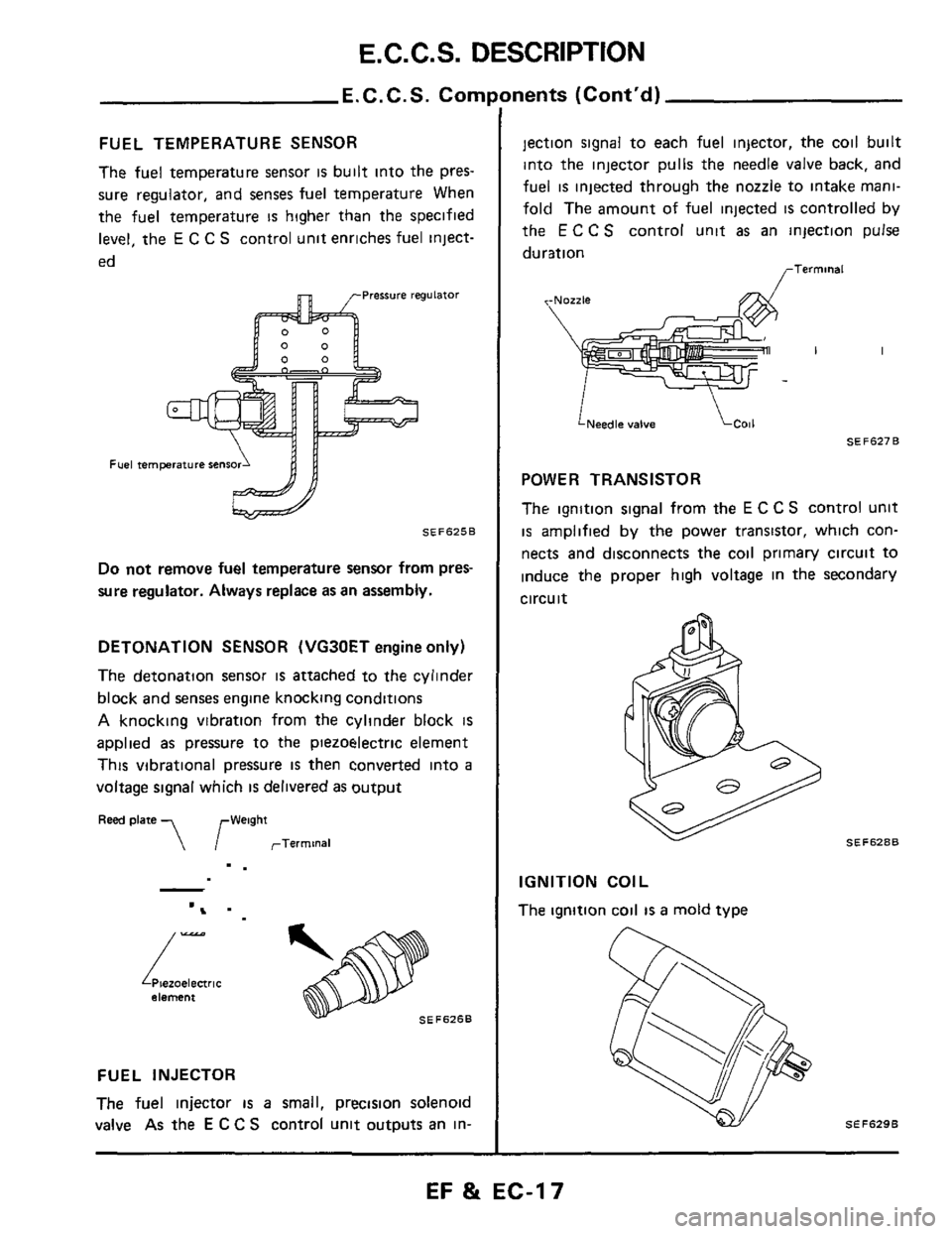
The fuel temperature sensor is built into the pres-
sure regulator, and senses fuel temperature When
the fuel temperature
IS higher than the specified
level, the
E C C S control unit enriches fuel inject-
ed
Pressure regulator
Fuel temprature $ens
SEF625B
Do not remove fuel temperature sensor from pres-
sure regulator. Always replace as
an assembly.
DETONATION SENSOR (VG30ET engine only)
The detonation sensor
is attached to the cylinder
block and senses engine knocking conditions
A knocking vibration from the cylinder block is
applied as pressure to the piezoelectric element
This vibrational pressure
IS then converted into a
voltage signal which is delivered as output
Reed plate ,, ,-Weight
rTerminal
-.
Piezoelectric element
SEFSZSB
/-
FUEL INJECTOR
The
fuel injector is a small, precision solenoid
valve As the
E C C S control unit outputs an in-
lnents (Cont’d)
jection signal to each fuel injector, the coil built
into the injector pulls the needle valve back, and
fuel
is injected through the nozzle to intake mani-
fold The amount of fuel injected
is controlled by
the
E C C S control unit as an injection pulse
duration
<-Nozzle
LNeedle valve
SEF627B
POWER TRANSISTOR
The ignition signal from the
E C C S control unit
is amplified by the power transistor, which con-
nects and disconnects the coil primary circuit to
induce the proper high voltage in the secondary
circuit
SEFSZBB
IGNITION COIL
The ignition coil
IS a mold type
EF & EC-17
Page 63 of 79
FUEL SYSTEM INSPECTION
Releasing Fuel Pressure
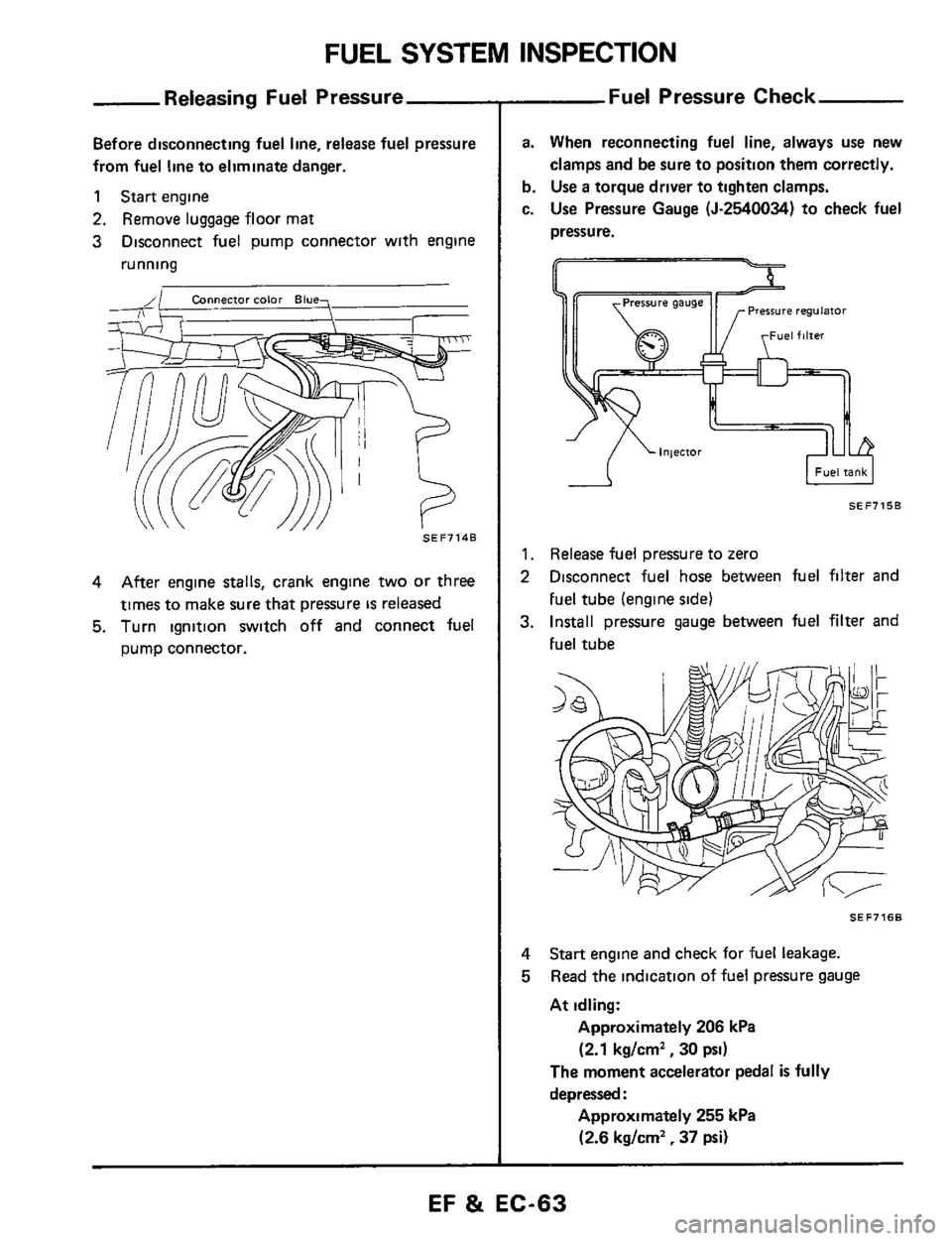
Before disconnecting fuel line, release fuel pressure
from fuel line to eliminate danger.
1 Start engine
2. Remove luggage floor mat
3 Disconnect fuel pump connector with engine
running
SEF7148
4 After engine stalls, crank engine two or three
times to make sure that pressure
IS released
5. Turn ignition switch off and connect fuel
pump connector.
--Fuel Pressure Check
a. When reconnecting fuel line, always use new
clamps and be sure to position them correctly.
b. Use a torque driver to tighten clamps.
c.
Use Pressure Gauge (5-2540034) to check fuel
pressure.
I Fuel tank I -A
SEF7158
1. Release fuel pressure to zero
2 Disconnect fuel hose between fuel filter and
Fuel tube (engine side1
3. Install pressure gauge between fuel filter and
Fuel tube
SEF7168
4
5
Start engine and check for fuel leakage.
Read the indication of fuel pressure gauge
At idling:
Approximately 206 kPa
(2.1 kg/cm2, 30 psi)
The moment accelerator pedal is fully
depressed
:
Approximately 255 kPa
(2.6 kg/cm2, 37 psi)
EF & EC-63
Page 64 of 79
FUEL SYSTEM INSPECTION
Fuel Pressure Check (Cont'd)
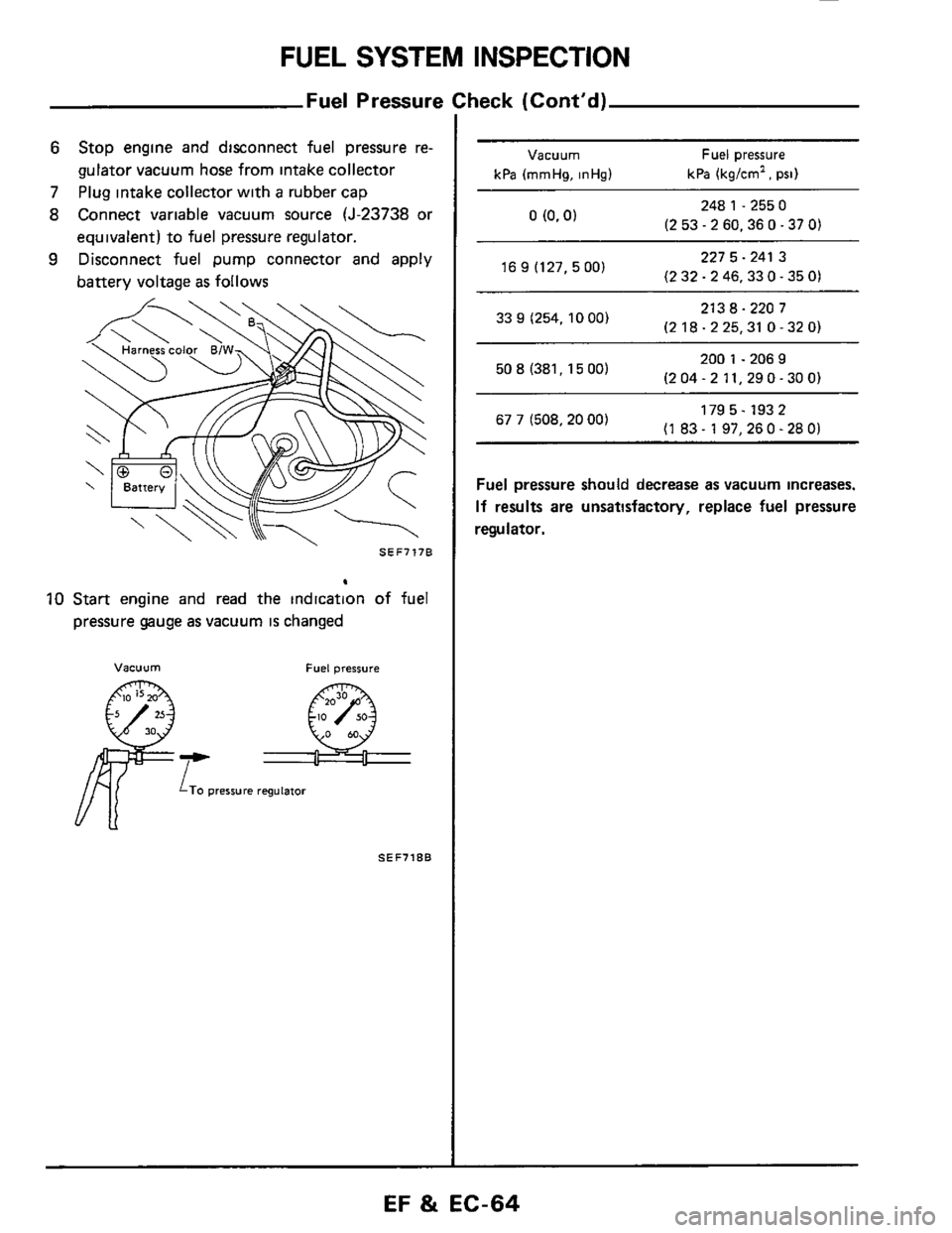
6 Stop engine and disconnect fuel pressure re-
gulator vacuum hose from intake collector
7
Plug intake collector with a rubber cap
8 Connect variable vacuum source (J-23738 or
equivalent) to fuel pressure regulator.
9 Disconnect fuel pump connector and apply
battery voltage
as follows
SEF717B
10 Start engine and read the indication of fuel
pressure gauge as vacuum is changed
Vacuum Fuel prerrure
SEF718B
Vacuum Fuel pressure
kPa (mmHg, inHg) kPa (kg/cm2, psi1
0 (0.01 248 1 .255 0
(2 53
- 2 60.36 0.37 01
227 5.241 3
(2 32.2 46,330.35
01 16 9 (127, 5 00)
213 8.220 7
(2 18.2 25,31 0 - 32 01 33 9 (254. 10 001
200 1 - 206 9
(2 04
- 2 11.29 0- 30 01 50 8 (381,15 00)
179 5. 193 2
(1 83-197.260-280) 67 7 (508.20 00)
Fuel pressure should decrease as vacuum increases.
If results are unsatisfactory, replace fuel pressure
regulator.
EF 8t EC-64
Page 65 of 79
FUEL SYSTEM INSPECTION
Injector Removi
1
2
Air duct E G R tube
Accelerator wire Harness clamps
Blow-by hoses Harness connectors
Air regulator hose Intakecollector cover
3 Disconnect fuel hoses
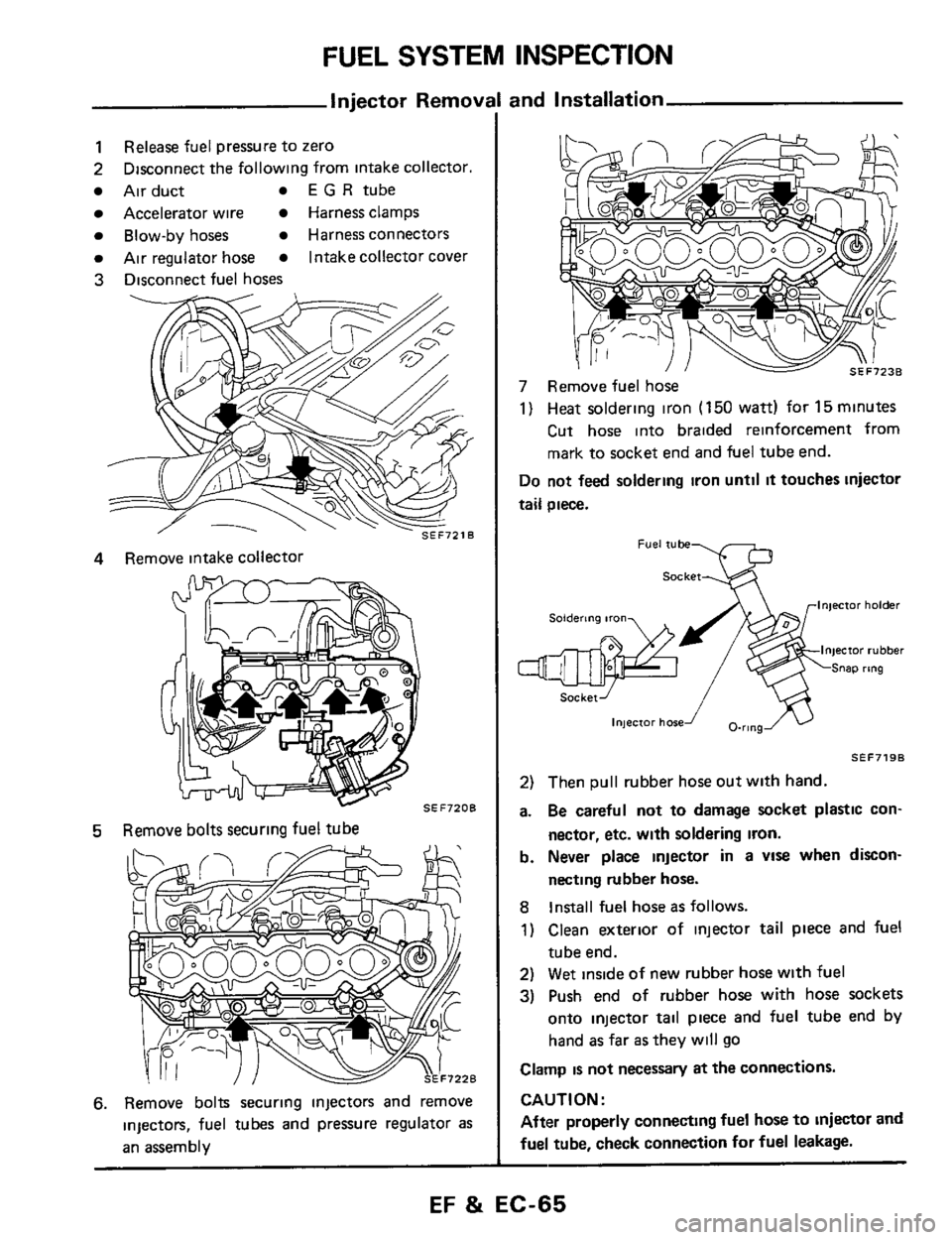
Release fuel pressure to zero
Disconnect the following from intake collector.
4 Remove intake collector
5 Remove bolts securing fuel tube
6. Remove bolts securing injectors and remove
injecton, fuel tubes and pressure regulator
as
an assembly
and installation
7 Remove fuel hose
1) Heat soldering iron (150 watt) for 15minutes
Cut hose into braided reinforcement from
mark to socket end and
fuel tube end.
Do not feed soldermg iron until it touches injector
tail piece.
Socket
Fuel tube
Injector holder Soldering iron
InjeCtor rubber
Snap rtng
injector hosef O-ring
SEF719B
2) Then pull rubber hose out with hand.
a.
Be careful not to damage socket plastic con-
nector, etc. with soldering
iron.
b. Never place injector in a VIS when dixon-
necting rubber hose.
8
Install fuel hose as follows.
1) Clean exterior of injector
tail piece and fuel
tube end.
2) Wet inside of new rubber hose with fuel
3) Push end of rubber hose with hose sockets
onto injector tail piece and fuel tube end by
hand
as far as they will go
Clamp is not necessary at the connections.
CAUTION:
After properly connecting fuel hose
to injector and
fuel tube, check connection
for fuel leakage.
EF & EC-65
Page 77 of 79
EVAPORATIVE EMISSION CONTROL SYSTEM
VAPOR VENT LINE
AN
Fuel check valve
SEC306A
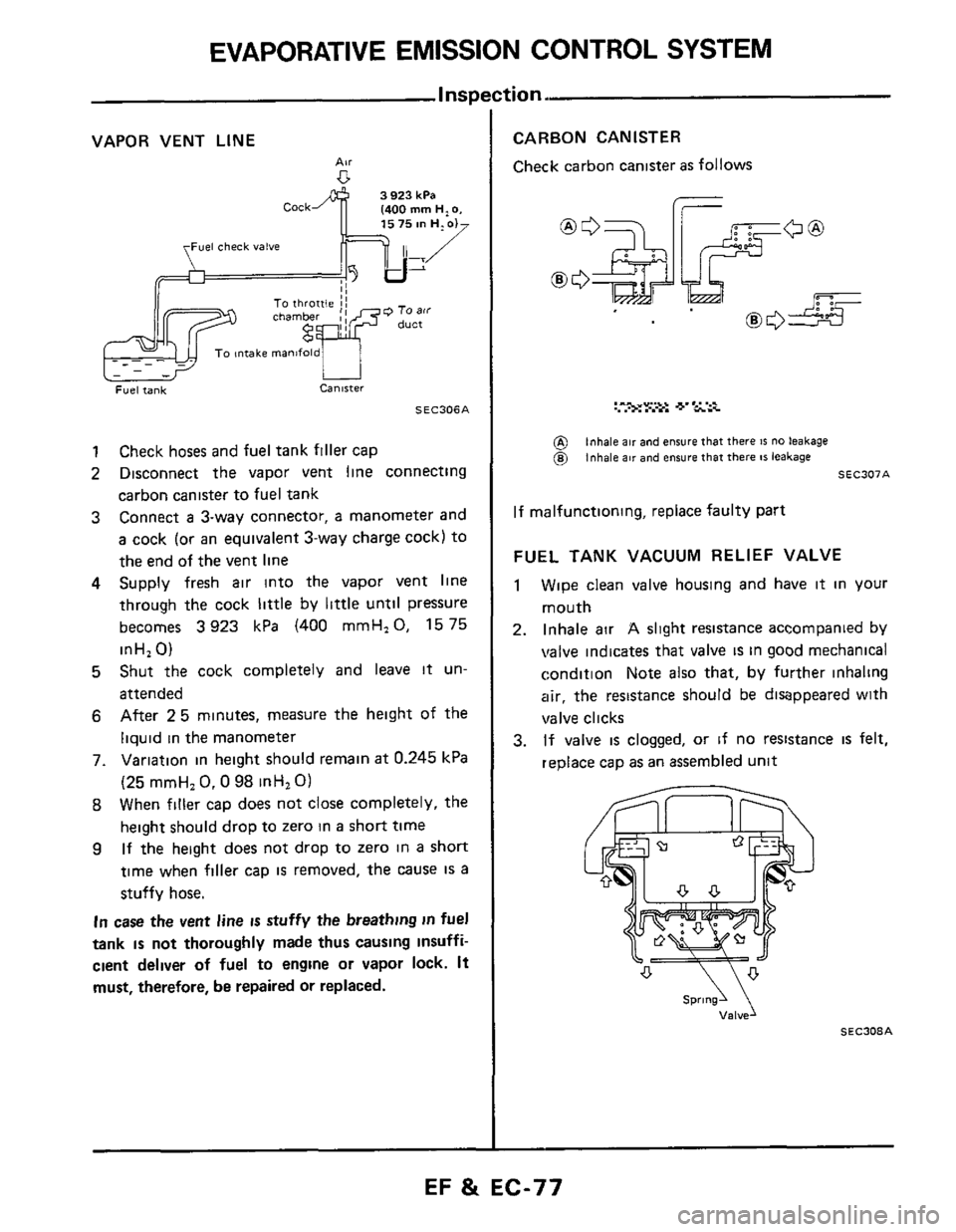
1 Check hoses and fuel tank filler cap
2 Disconnect the vapor vent line connecting
carbon canister to fuel tank
3 Connect a 3-way connector, a manometer and
a cock (or an equivalent 3-way charge cock) to
the end of the vent line
4 Supply fresh air into the vapor vent line
through the cock
little by little untll pressure
becomes
3923 kPa (400 mmH,O, 1575
inH,
0)
5 Shut the cock completely and leave it un-
attended
6 After 25 minutes, measure the height of the
liquid
in the manometer
7. Variation in height should remain
at 0.245 kPa
(25 mmH,
0.0 98 inHl 0)
8 When filler cap does not close completely, the
height should drop to zero in
a short time
9 If the height does not drop to zero in a short
time when filler cap is removed, the cause IS a
stuffy hose.
In case the vent line is stuffy the breathing in fuel
tank
is not thoroughly made thus causing insuffi-
cient deliver of fuel to engine or vapor lock. It
must, therefore, be repaired or replaced.
tion.
CARBON CANISTER
Check carbon canister as follows
I-
UL
@ @)
inhale air and ensure that there IS no leakage inhale air and ensure that there 81 leakage
SEC307A
If malfunctioning, replace faulty part
FUEL TANK VACUUM RELIEF VALVE
1 Wipe clean valve housing and have it in your
mouth
2. Inhale air A slight resistance accompanied by
valve indicates that valve is in good mechanical
condition Note also that, by further inhaling
air, the resistance should be disappeared with
valve clicks
3. If valve is clogged, or if no resistance is felt,
replace cap
as an assembled unit
SEC308A
EF & EC-77
Page 79 of 79
SERVICE DATA AND SPECIFICATIONS (S.D.S.)
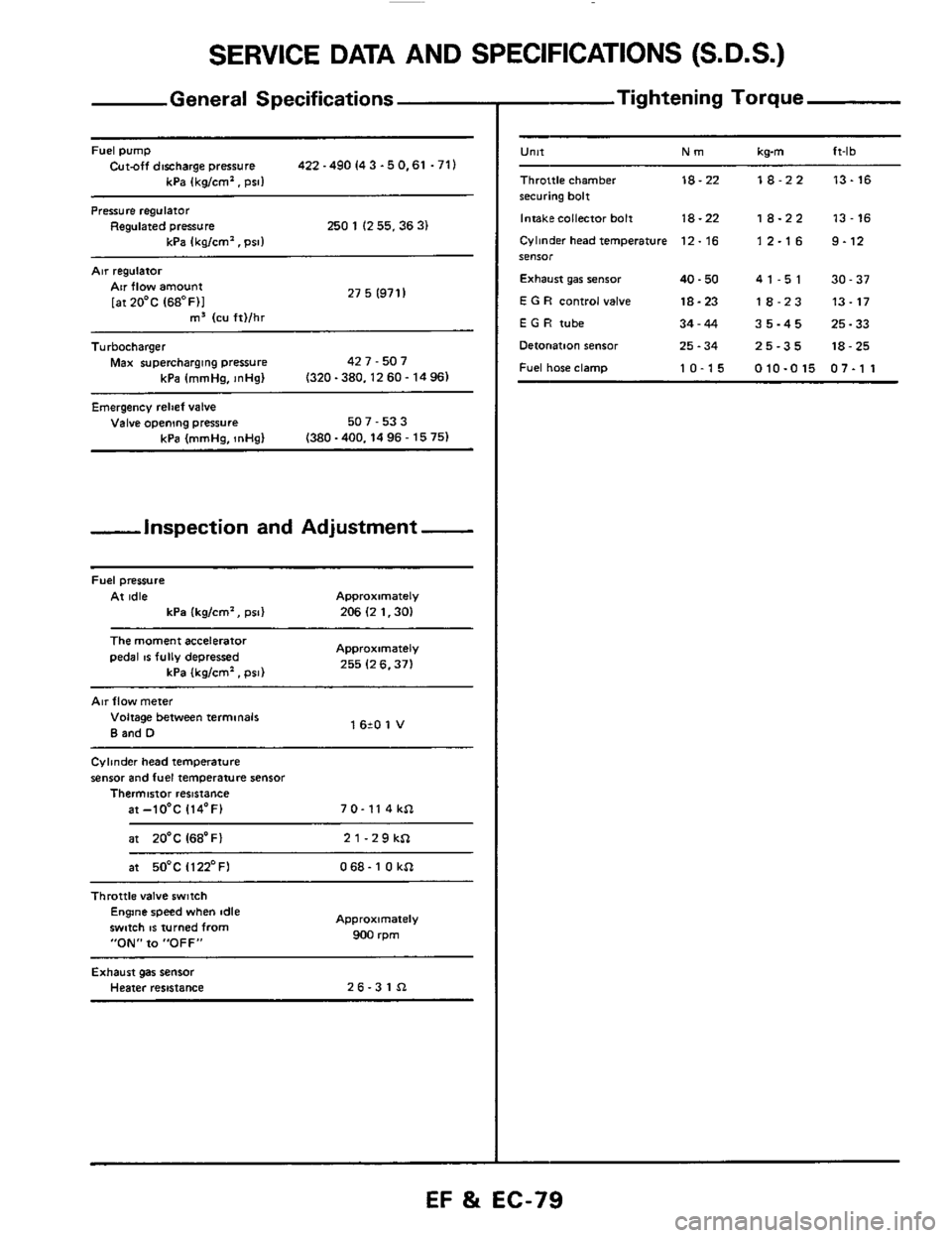
General Specifications
Fuel pump Cut-off discharge pressure 422 -490 I4 3 -5 0.61 .71)
kPa (kg/cm'. psi1
Pressure regulator Regulated pressure 250 1 (2 55.36 3) kPa Ikalcm'. Dsll
Air regulatoi
27 5 (971 I Air flow amount
[atZO'C (68OF)I m3 (cu ft)/hr ~~
Turbocharger
Max supercharging pressure 42 7 - 507
kPa (mmHa.
InHal (320-380.1260-1496)
Emergency relief valve Valve opening pressure 507 - 53 3
(380 -400.14 96 - 15 75) kPa (mmHg, InHg)
-inspection and Adjustment -
Fuel pressure
At idle Approximately
kPa (kg/cm', psi) 206 (2 1.30)
The moment accelerator
pedal IS fully depressed Approximately
255 (2 6.371 kPa (kglcm'. psi)
Air flow meter
Voltage between terminals
B and D 1 620 1 V
Cylinder head temperature
sensor and fuel temperature sensor Thermistor resistance
at-lO'C 114'F) 7 0- 11 4 kSl
at 20'C I68'Fl 21-29kSl
at 50°C Il22'FI 068- 1 0 kSl ~~~~
Throttle
valve switch Engine speed when idle
swmh
IS turned from
"ON" to "OFF"
Approximately
900 rpm
Exhaust gas sensor Heater resistance 26-31Sl
- Tightening Torque
-
U"lt Nm kwn ft-lb
Throttle chamber 18-22 18-22 13-16 securing bolt
Intakecollector bolt
18-22 18-22 13-16
Cylinder head temperature 12. 16 1 2.1 6 9.12 SeIlSOr
Exhaust gar senior 40.50 41-51 30-37
E G R control valve 18-23 18-23 13-17
E G H tube 34-44 35-45 25-33
Detonation sensor 25.34 25-35 18-25
Fuel hose clamp 10-15 010-015 07-1 1
EF %i EC-79