ESP NISSAN ALMERA 2001 Owner's Manual
[x] Cancel search | Manufacturer: NISSAN, Model Year: 2001, Model line: ALMERA, Model: NISSAN ALMERA 2001Pages: 2898, PDF Size: 60.76 MB
Page 254 of 2898
SAT322GC
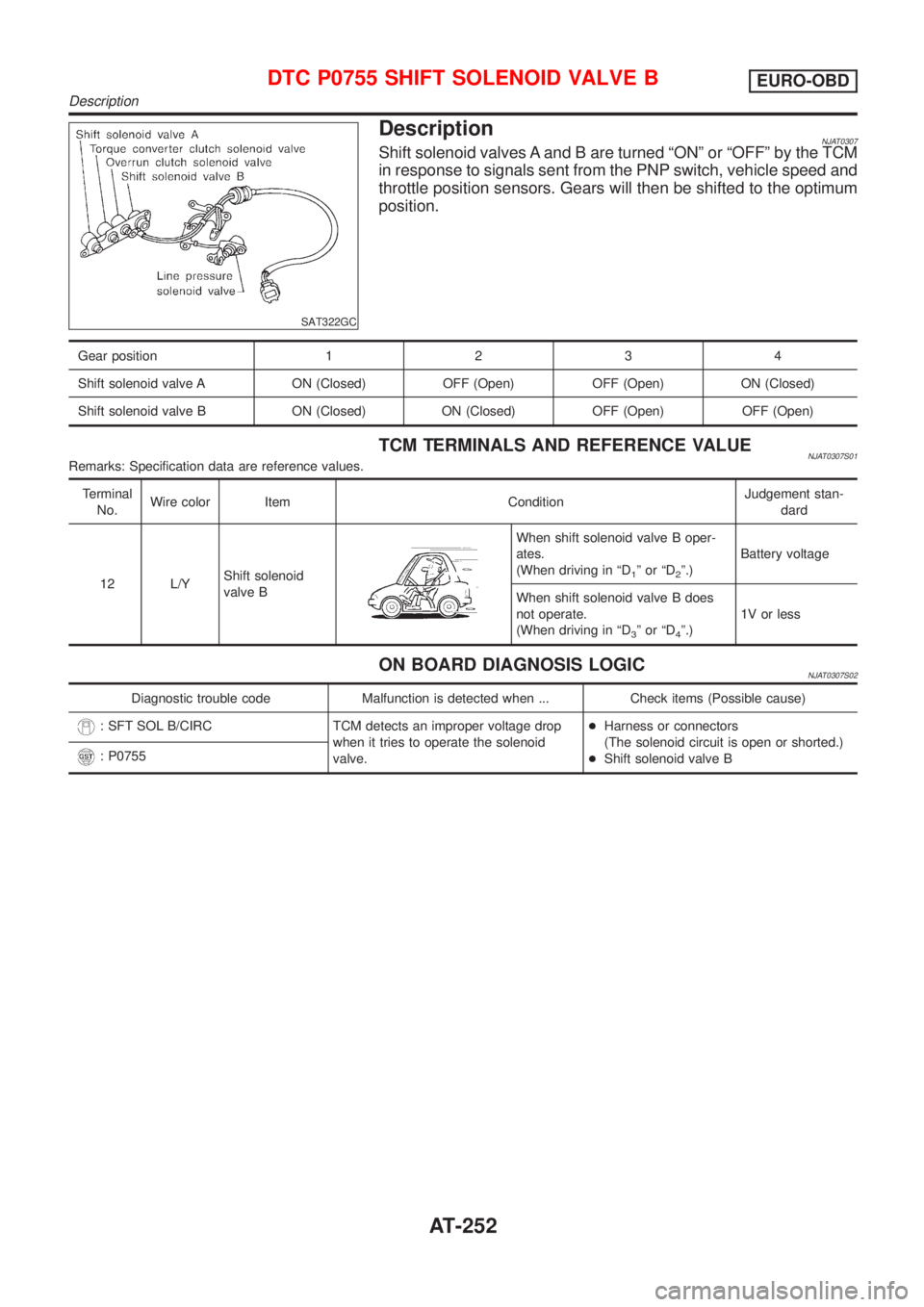
DescriptionNJAT0307Shift solenoid valves A and B are turned ªONº or ªOFFº by the TCM
in response to signals sent from the PNP switch, vehicle speed and
throttle position sensors. Gears will then be shifted to the optimum
position.
Gear position1234
Shift solenoid valve A ON (Closed) OFF (Open) OFF (Open) ON (Closed)
Shift solenoid valve B ON (Closed) ON (Closed) OFF (Open) OFF (Open)
TCM TERMINALS AND REFERENCE VALUENJAT0307S01Remarks: Specification data are reference values.
Terminal
No.Wire color Item ConditionJudgement stan-
dard
12 L/YShift solenoid
valve B
When shift solenoid valve B oper-
ates.
(When driving in ªD
1ºorªD2º.)Battery voltage
When shift solenoid valve B does
not operate.
(When driving in ªD
3ºorªD4º.)1V or less
ON BOARD DIAGNOSIS LOGICNJAT0307S02
Diagnostic trouble code Malfunction is detected when ... Check items (Possible cause)
: SFT SOL B/CIRC TCM detects an improper voltage drop
when it tries to operate the solenoid
valve.+Harness or connectors
(The solenoid circuit is open or shorted.)
+Shift solenoid valve B
: P0755
DTC P0755 SHIFT SOLENOID VALVE BEURO-OBD
Description
AT-252
Page 260 of 2898
SAT004K
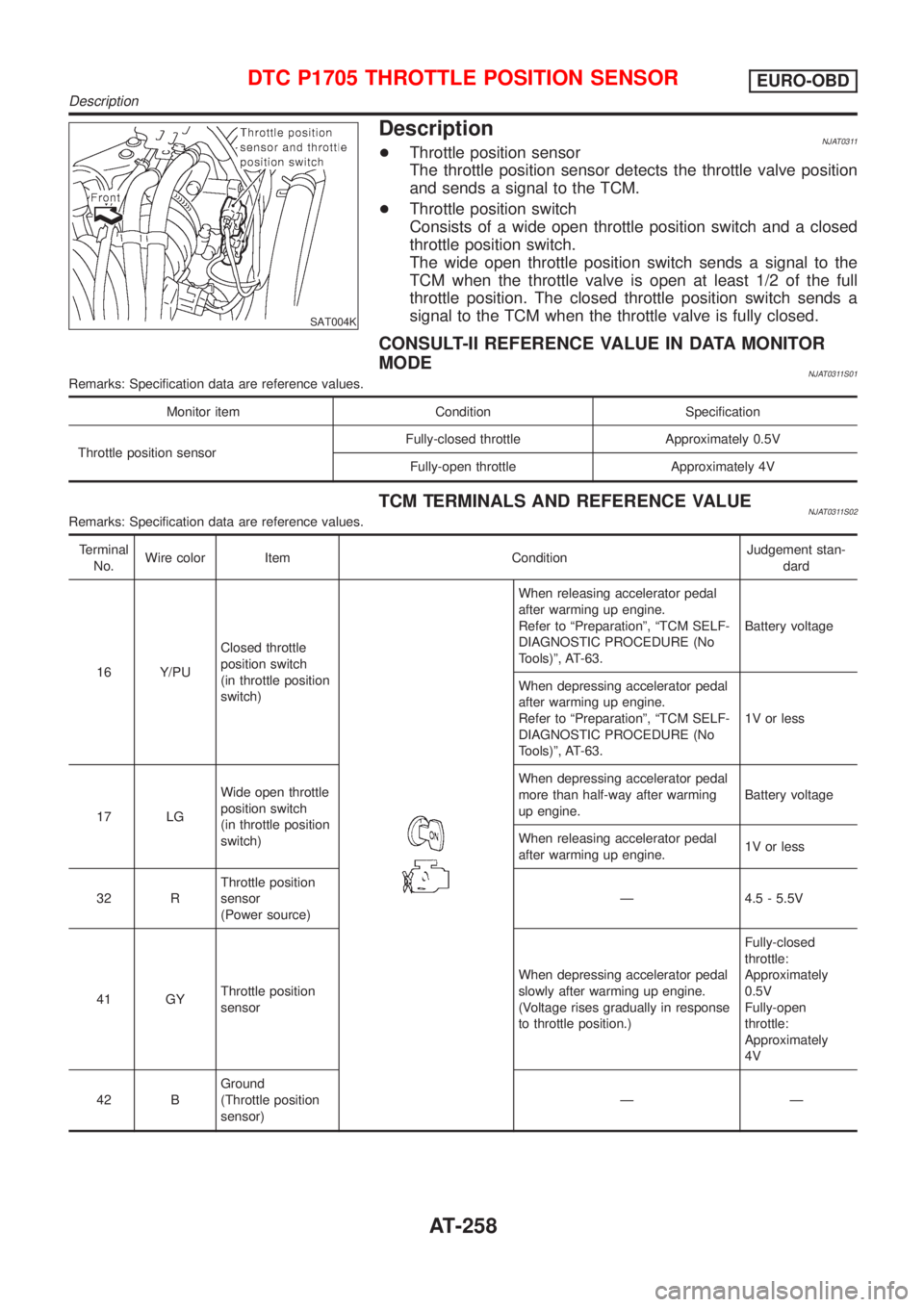
DescriptionNJAT0311+Throttle position sensor
The throttle position sensor detects the throttle valve position
and sends a signal to the TCM.
+Throttle position switch
Consists of a wide open throttle position switch and a closed
throttle position switch.
The wide open throttle position switch sends a signal to the
TCM when the throttle valve is open at least 1/2 of the full
throttle position. The closed throttle position switch sends a
signal to the TCM when the throttle valve is fully closed.
CONSULT-II REFERENCE VALUE IN DATA MONITOR
MODE
NJAT0311S01Remarks: Specification data are reference values.
Monitor item Condition Specification
Throttle position sensorFully-closed throttle Approximately 0.5V
Fully-open throttle Approximately 4V
TCM TERMINALS AND REFERENCE VALUENJAT0311S02Remarks: Specification data are reference values.
Terminal
No.Wire color Item ConditionJudgement stan-
dard
16 Y/PUClosed throttle
position switch
(in throttle position
switch)
When releasing accelerator pedal
after warming up engine.
Refer to ªPreparationº, ªTCM SELF-
DIAGNOSTIC PROCEDURE (No
Tools)º, AT-63.Battery voltage
When depressing accelerator pedal
after warming up engine.
Refer to ªPreparationº, ªTCM SELF-
DIAGNOSTIC PROCEDURE (No
Tools)º, AT-63.1V or less
17 LGWide open throttle
position switch
(in throttle position
switch)When depressing accelerator pedal
more than half-way after warming
up engine.Battery voltage
When releasing accelerator pedal
after warming up engine.1V or less
32 RThrottle position
sensor
(Power source)Ð 4.5 - 5.5V
41 GYThrottle position
sensorWhen depressing accelerator pedal
slowly after warming up engine.
(Voltage rises gradually in response
to throttle position.)Fully-closed
throttle:
Approximately
0.5V
Fully-open
throttle:
Approximately
4V
42 BGround
(Throttle position
sensor)ÐÐ
DTC P1705 THROTTLE POSITION SENSOREURO-OBD
Description
AT-258
Page 266 of 2898
3 CHECK INPUT SIGNAL (WITHOUT CONSULT-II)
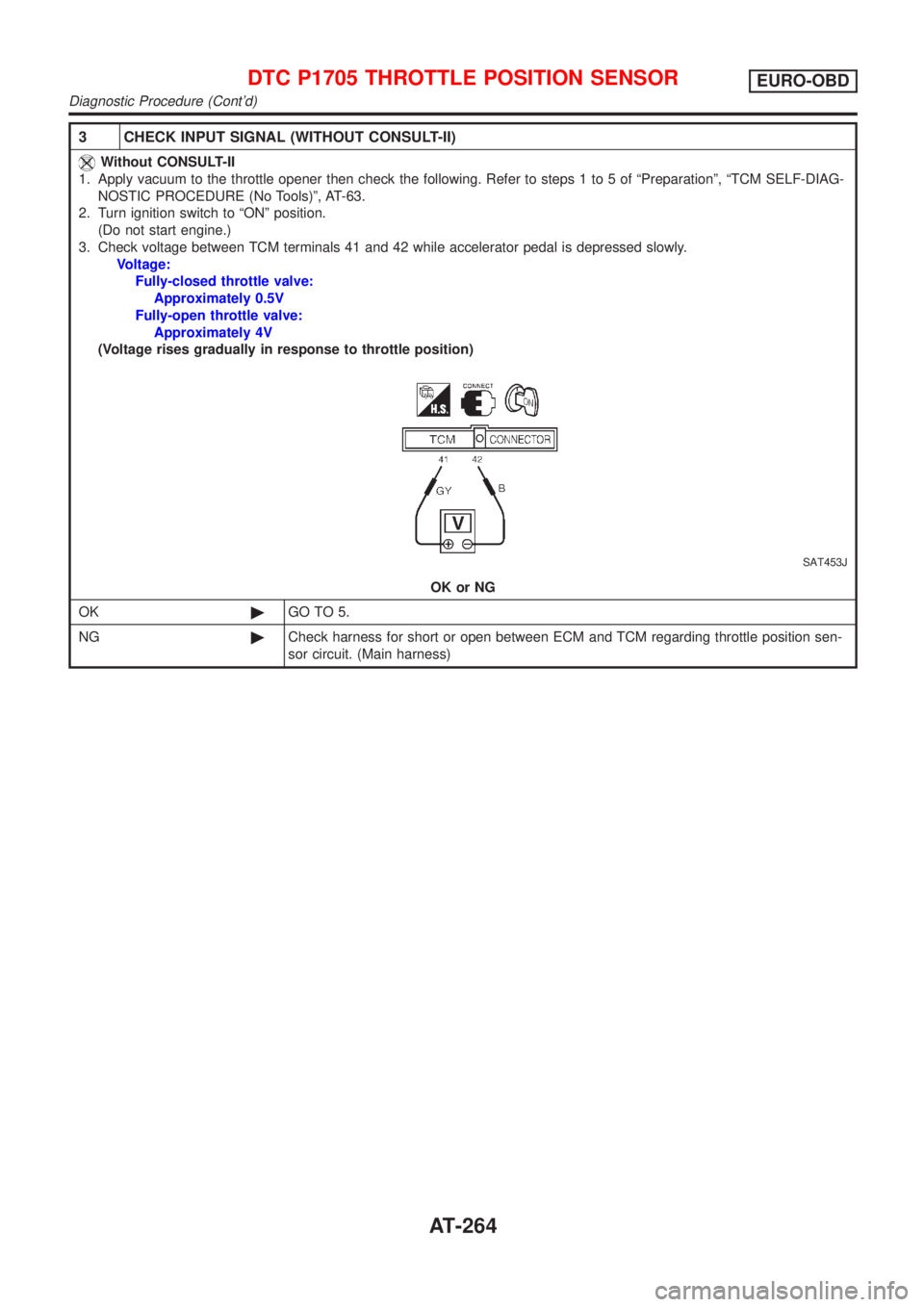
Without CONSULT-II
1. Apply vacuum to the throttle opener then check the following. Refer to steps 1 to 5 of ªPreparationº, ªTCM SELF-DIAG-
NOSTIC PROCEDURE (No Tools)º, AT-63.
2. Turn ignition switch to ªONº position.
(Do not start engine.)
3. Check voltage between TCM terminals 41 and 42 while accelerator pedal is depressed slowly.
Voltage:
Fully-closed throttle valve:
Approximately 0.5V
Fully-open throttle valve:
Approximately 4V
(Voltage rises gradually in response to throttle position)
SAT453J
OK or NG
OK©GO TO 5.
NG©Check harness for short or open between ECM and TCM regarding throttle position sen-
sor circuit. (Main harness)
DTC P1705 THROTTLE POSITION SENSOREURO-OBD
Diagnostic Procedure (Cont'd)
AT-264
Page 270 of 2898
SAT322GC
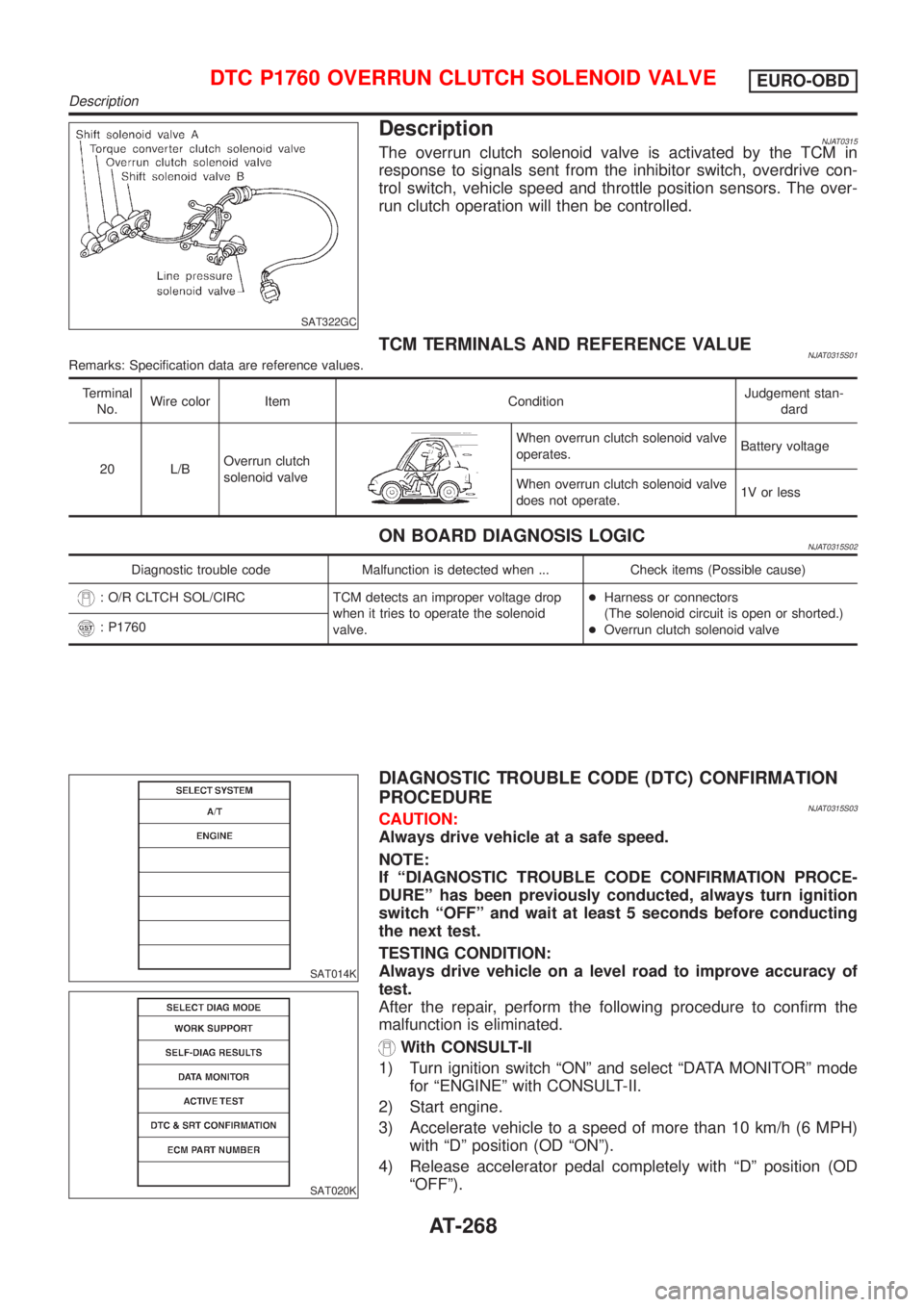
DescriptionNJAT0315The overrun clutch solenoid valve is activated by the TCM in
response to signals sent from the inhibitor switch, overdrive con-
trol switch, vehicle speed and throttle position sensors. The over-
run clutch operation will then be controlled.
TCM TERMINALS AND REFERENCE VALUENJAT0315S01Remarks: Specification data are reference values.
Terminal
No.Wire color Item ConditionJudgement stan-
dard
20 L/BOverrun clutch
solenoid valve
When overrun clutch solenoid valve
operates.Battery voltage
When overrun clutch solenoid valve
does not operate.1V or less
ON BOARD DIAGNOSIS LOGICNJAT0315S02
Diagnostic trouble code Malfunction is detected when ... Check items (Possible cause)
: O/R CLTCH SOL/CIRC TCM detects an improper voltage drop
when it tries to operate the solenoid
valve.+Harness or connectors
(The solenoid circuit is open or shorted.)
+Overrun clutch solenoid valve
: P1760
SAT014K
SAT020K
DIAGNOSTIC TROUBLE CODE (DTC) CONFIRMATION
PROCEDURE
NJAT0315S03CAUTION:
Always drive vehicle at a safe speed.
NOTE:
If ªDIAGNOSTIC TROUBLE CODE CONFIRMATION PROCE-
DUREº has been previously conducted, always turn ignition
switch ªOFFº and wait at least 5 seconds before conducting
the next test.
TESTING CONDITION:
Always drive vehicle on a level road to improve accuracy of
test.
After the repair, perform the following procedure to confirm the
malfunction is eliminated.
With CONSULT-II
1) Turn ignition switch ªONº and select ªDATA MONITORº mode
for ªENGINEº with CONSULT-II.
2) Start engine.
3) Accelerate vehicle to a speed of more than 10 km/h (6 MPH)
with ªDº position (OD ªONº).
4) Release accelerator pedal completely with ªDº position (OD
ªOFFº).
DTC P1760 OVERRUN CLUTCH SOLENOID VALVEEURO-OBD
Description
AT-268
Page 399 of 2898
Control Valve Upper Body
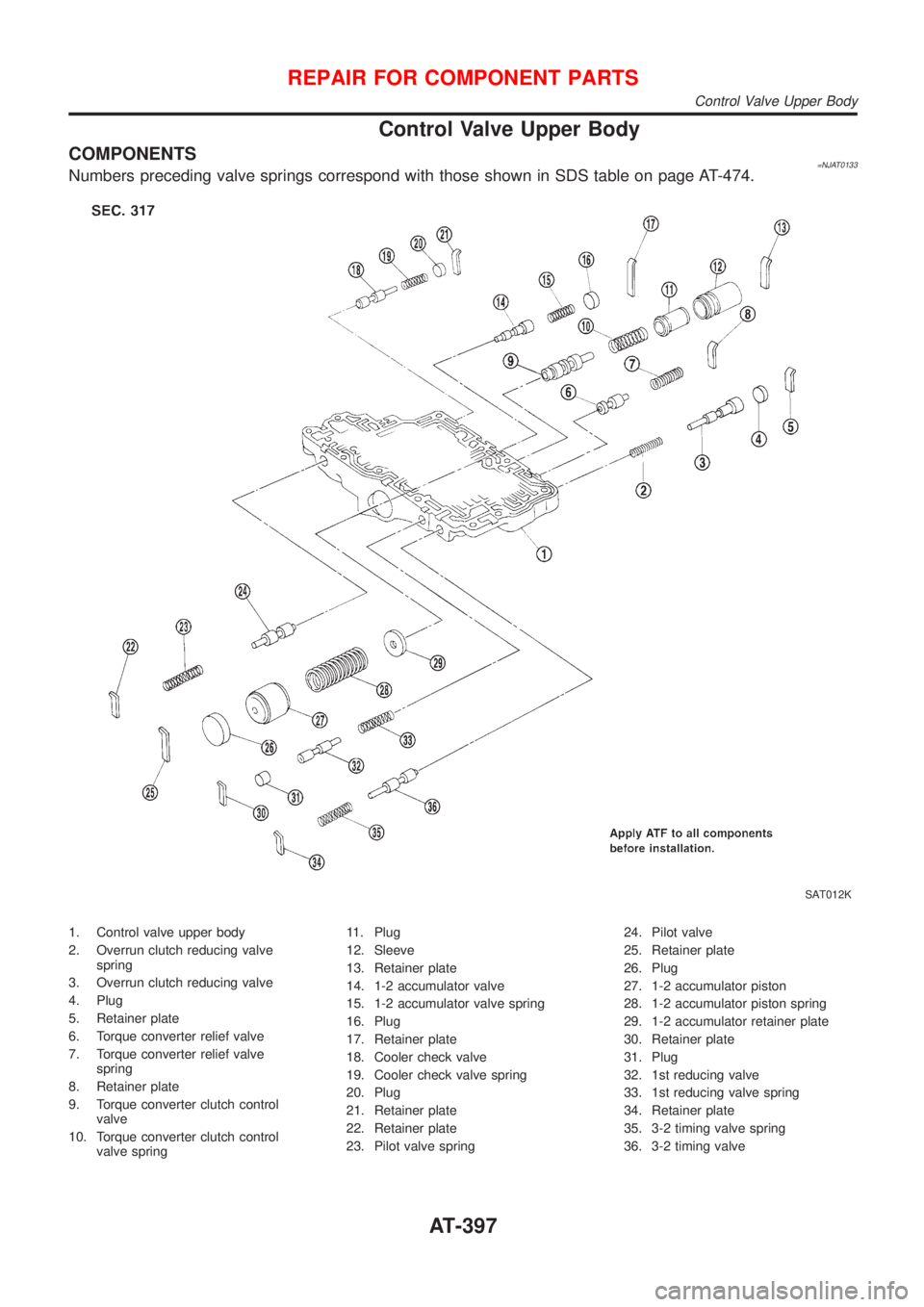
COMPONENTS=NJAT0133Numbers preceding valve springs correspond with those shown in SDS table on page AT-474.
SAT012K
1. Control valve upper body
2. Overrun clutch reducing valve
spring
3. Overrun clutch reducing valve
4. Plug
5. Retainer plate
6. Torque converter relief valve
7. Torque converter relief valve
spring
8. Retainer plate
9. Torque converter clutch control
valve
10. Torque converter clutch control
valve spring11. Plug
12. Sleeve
13. Retainer plate
14. 1-2 accumulator valve
15. 1-2 accumulator valve spring
16. Plug
17. Retainer plate
18. Cooler check valve
19. Cooler check valve spring
20. Plug
21. Retainer plate
22. Retainer plate
23. Pilot valve spring24. Pilot valve
25. Retainer plate
26. Plug
27. 1-2 accumulator piston
28. 1-2 accumulator piston spring
29. 1-2 accumulator retainer plate
30. Retainer plate
31. Plug
32. 1st reducing valve
33. 1st reducing valve spring
34. Retainer plate
35. 3-2 timing valve spring
36. 3-2 timing valve
REPAIR FOR COMPONENT PARTS
Control Valve Upper Body
AT-397
Page 403 of 2898
Control Valve Lower Body
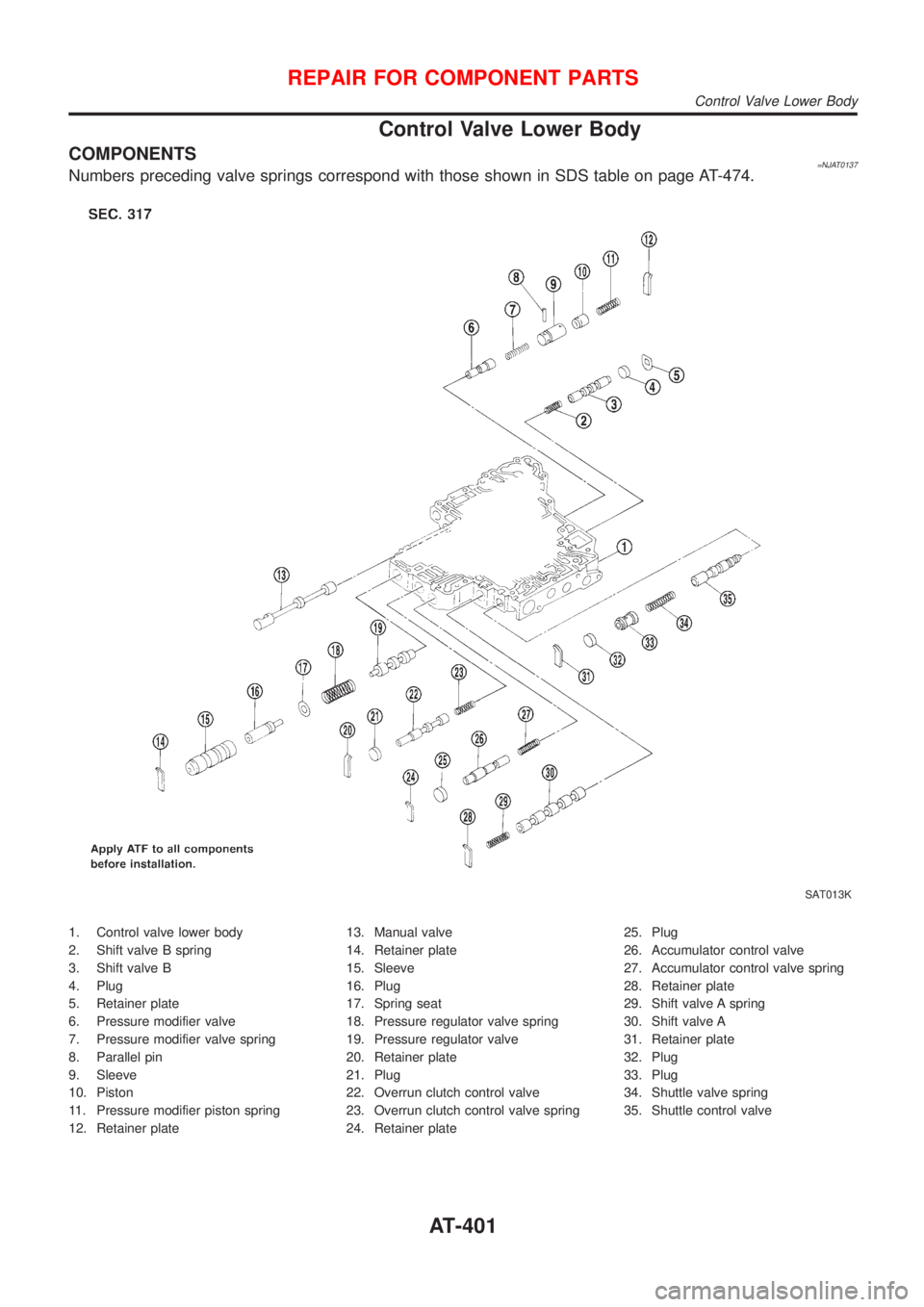
COMPONENTS=NJAT0137Numbers preceding valve springs correspond with those shown in SDS table on page AT-474.
SAT013K
1. Control valve lower body
2. Shift valve B spring
3. Shift valve B
4. Plug
5. Retainer plate
6. Pressure modifier valve
7. Pressure modifier valve spring
8. Parallel pin
9. Sleeve
10. Piston
11. Pressure modifier piston spring
12. Retainer plate13. Manual valve
14. Retainer plate
15. Sleeve
16. Plug
17. Spring seat
18. Pressure regulator valve spring
19. Pressure regulator valve
20. Retainer plate
21. Plug
22. Overrun clutch control valve
23. Overrun clutch control valve spring
24. Retainer plate25. Plug
26. Accumulator control valve
27. Accumulator control valve spring
28. Retainer plate
29. Shift valve A spring
30. Shift valve A
31. Retainer plate
32. Plug
33. Plug
34. Shuttle valve spring
35. Shuttle control valve
REPAIR FOR COMPONENT PARTS
Control Valve Lower Body
AT-401
Page 539 of 2898
RemovalNJBR0123
SBR631E
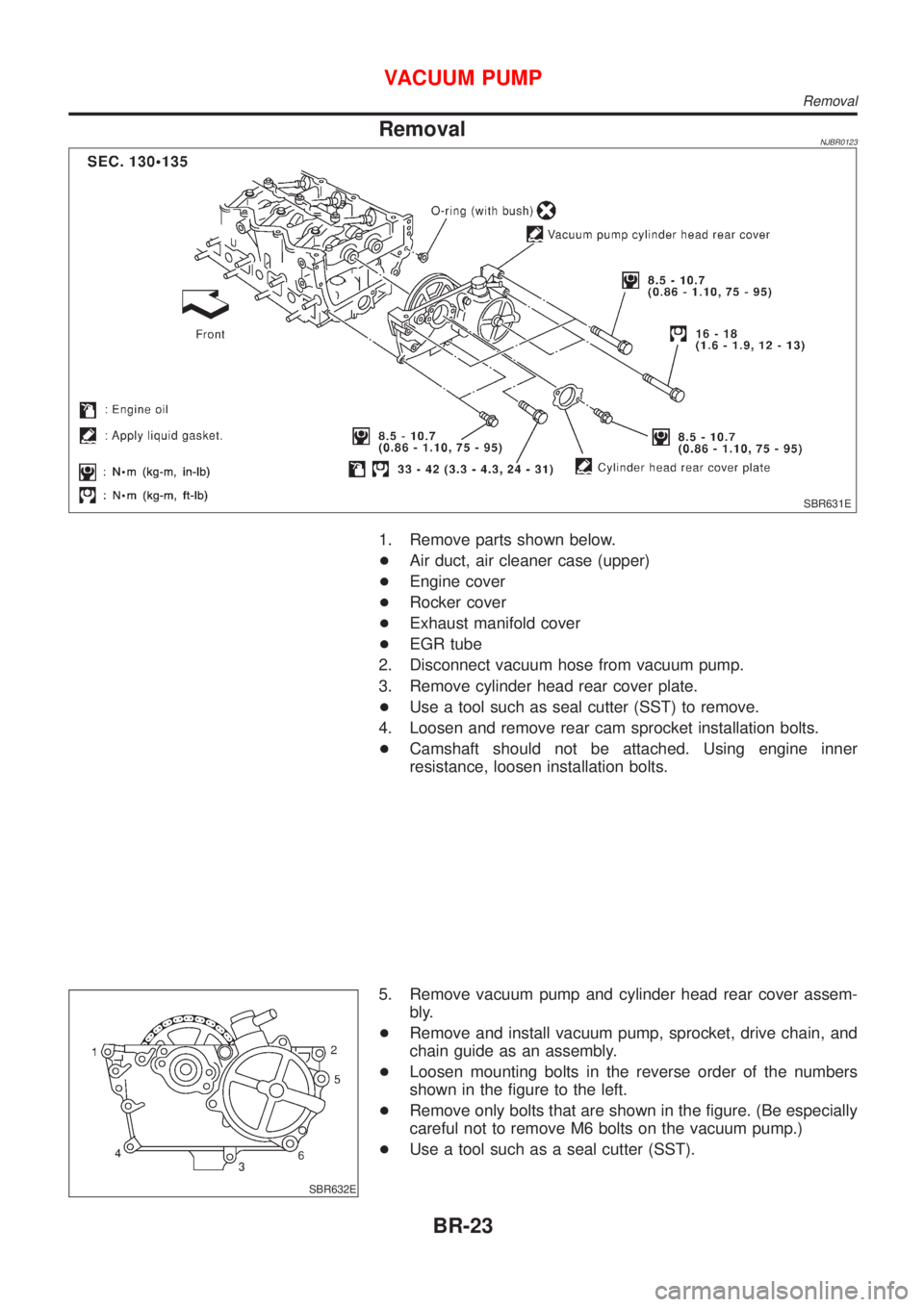
1. Remove parts shown below.
+Air duct, air cleaner case (upper)
+Engine cover
+Rocker cover
+Exhaust manifold cover
+EGR tube
2. Disconnect vacuum hose from vacuum pump.
3. Remove cylinder head rear cover plate.
+Use a tool such as seal cutter (SST) to remove.
4. Loosen and remove rear cam sprocket installation bolts.
+Camshaft should not be attached. Using engine inner
resistance, loosen installation bolts.
SBR632E
5. Remove vacuum pump and cylinder head rear cover assem-
bly.
+Remove and install vacuum pump, sprocket, drive chain, and
chain guide as an assembly.
+Loosen mounting bolts in the reverse order of the numbers
shown in the figure to the left.
+Remove only bolts that are shown in the figure. (Be especially
careful not to remove M6 bolts on the vacuum pump.)
+Use a tool such as a seal cutter (SST).
VACUUM PUMP
Removal
BR-23
Page 587 of 2898
SEF233G
SEF234G
How to Perform Trouble Diagnoses for Quick
and Accurate Repair
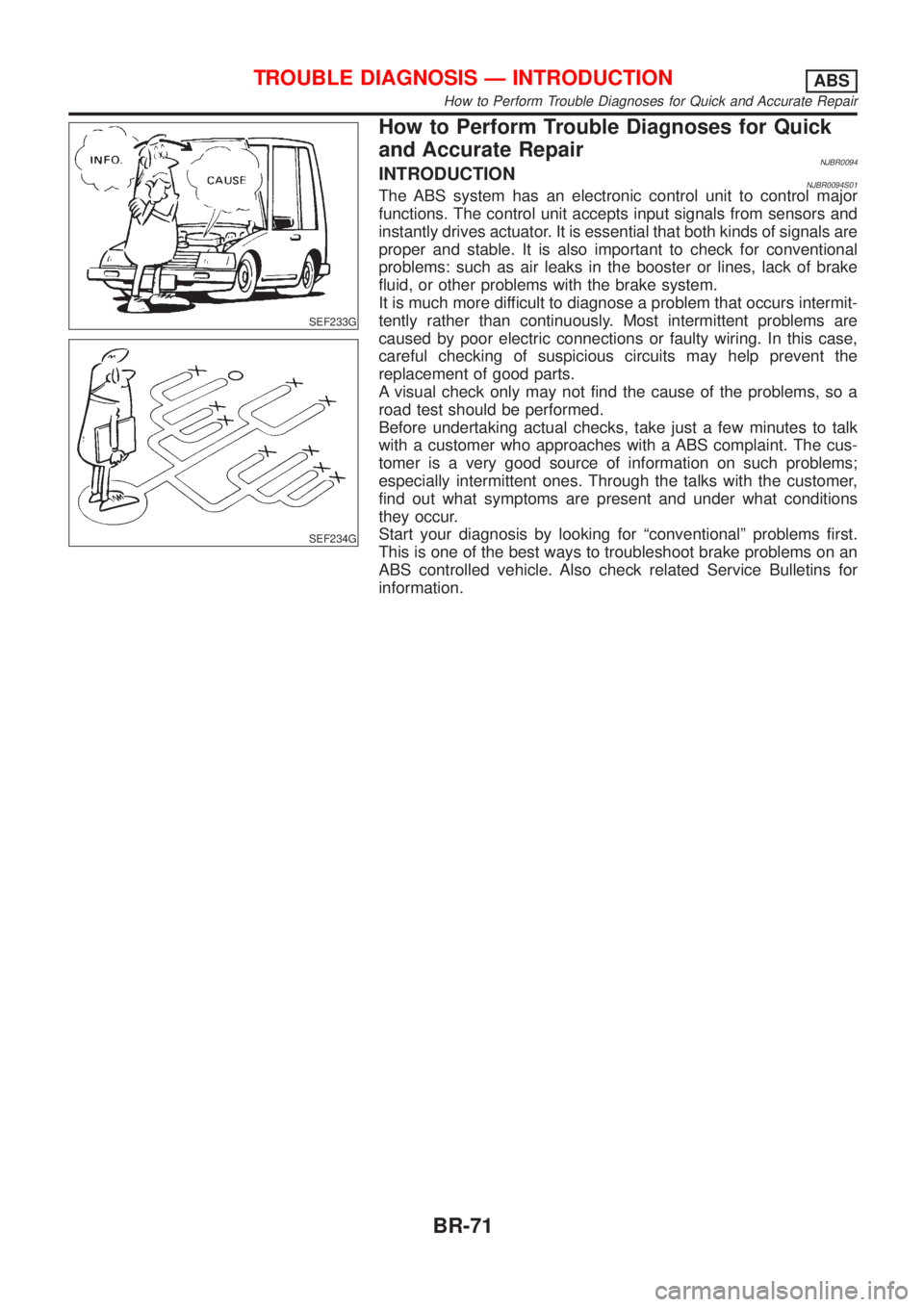
NJBR0094INTRODUCTIONNJBR0094S01The ABS system has an electronic control unit to control major
functions. The control unit accepts input signals from sensors and
instantly drives actuator. It is essential that both kinds of signals are
proper and stable. It is also important to check for conventional
problems: such as air leaks in the booster or lines, lack of brake
fluid, or other problems with the brake system.
It is much more difficult to diagnose a problem that occurs intermit-
tently rather than continuously. Most intermittent problems are
caused by poor electric connections or faulty wiring. In this case,
careful checking of suspicious circuits may help prevent the
replacement of good parts.
A visual check only may not find the cause of the problems, so a
road test should be performed.
Before undertaking actual checks, take just a few minutes to talk
with a customer who approaches with a ABS complaint. The cus-
tomer is a very good source of information on such problems;
especially intermittent ones. Through the talks with the customer,
find out what symptoms are present and under what conditions
they occur.
Start your diagnosis by looking for ªconventionalº problems first.
This is one of the best ways to troubleshoot brake problems on an
ABS controlled vehicle. Also check related Service Bulletins for
information.
TROUBLE DIAGNOSIS Ð INTRODUCTIONABS
How to Perform Trouble Diagnoses for Quick and Accurate Repair
BR-71
Page 622 of 2898
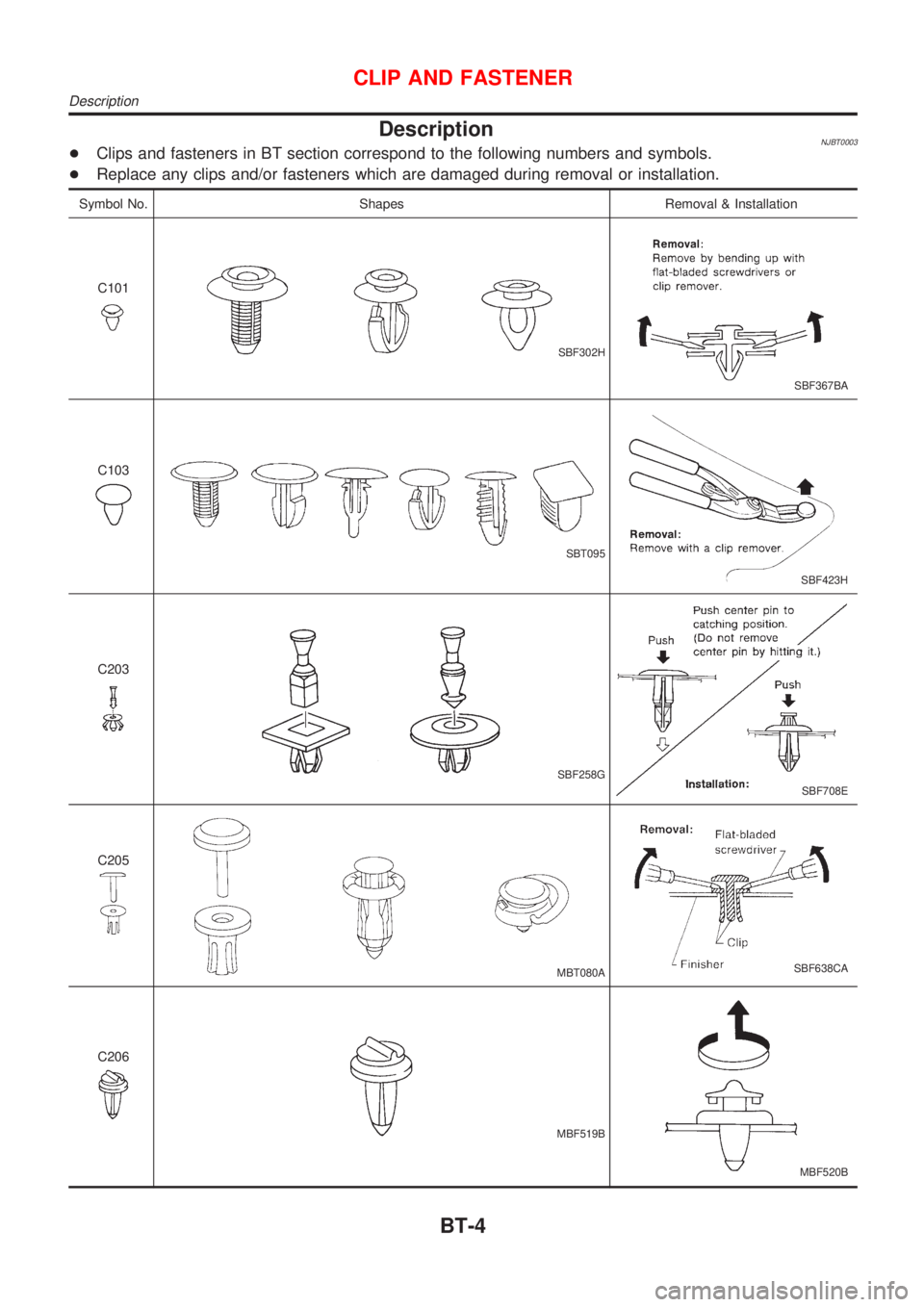
DescriptionNJBT0003+Clips and fasteners in BT section correspond to the following numbers and symbols.
+Replace any clips and/or fasteners which are damaged during removal or installation.
Symbol No. Shapes Removal & Installation
C101
SBF302H
SBF367BA
C103
SBT095
SBF423H
C203
SBF258G
SBF708E
C205
MBT080ASBF638CA
C206
MBF519B
MBF520B
CLIP AND FASTENER
Description
BT-4
Page 740 of 2898
Supplemental Restraint System (SRS) ªAIR
BAGº and ªSEAT BELT PRE-TENSIONERº
NJEC0002The Supplemental Restraint System such as ªAIR BAGº and ªSEAT BELT PRE-TENSIONERº used along with
a seat belt, helps to reduce the risk or severity of injury to the driver and front passenger for certain types of
collision. The SRS system composition which is available to NISSAN MODEL N16 is as follows (The compo-
sition varies according to the destination and optional equipment.):
+For a frontal collision
The Supplemental Restraint System consists of driver air bag module (located in the center of the steer-
ing wheel), front passenger air bag module (located on the instrument panel on passenger side), front seat
belt pre-tensioners, a diagnoses sensor unit, warning lamp, wiring harness and spiral cable.
+For a side collision
The Supplemental Restraint System consists of front side air bag module (located in the outer side of front
seat), side air bag (satellite) sensor, diagnoses sensor unit (one of components of air bags for a frontal
collision), wiring harness, warning lamp (one of components of air bags for a frontal collision).
Information necessary to service the system safely is included in theRS sectionof this Service Manual.
WARNING:
+To avoid rendering the SRS inoperative, which could increase the risk of personal injury or death
in the event of a collision which would result in air bag inflation, all maintenance should be per-
formed by an authorized NISSAN dealer.
+Improper maintenance, including incorrect removal and installation of the SRS, can lead to per-
sonal injury caused by unintentional activation of the system. For removal of Spiral Cable and Air
Bag Module, see the RS section.
+Do not use electrical test equipment on any circuit related to the SRS unless instructed to in this
Service Manual. SRS wiring harness can be identified by yellow harness connector.
Precautions for On Board Diagnostic (OBD)
System of Engine and A/T
NJEC0003The ECM has an on board diagnostic system. It will light up the malfunction indicator (MI) to warn the driver
of a malfunction causing emission deterioration.
CAUTION:
+Be sure to turn the ignition switch ªOFFº and disconnect the negative battery terminal before any
repair or inspection work. The open/short circuit of related switches, sensors, solenoid valves, etc.
will cause the MI to light up.
+Be sure to connect and lock the connectors securely after work. A loose (unlocked) connector will
cause the MI to light up due to the open circuit. (Be sure the connector is free from water, grease,
dirt, bent terminals, etc.)
+Certain systems and components, especially those related to OBD, may use a new style slide-
locking type harness connector.
For description and how to disconnect, refer to EL section, ªDescriptionº, ªHARNESS CONNEC-
TORº.
+Be sure to route and secure the harnesses properly after work. The interference of the harness with
a bracket, etc. may cause the MI to light up due to the short circuit.
+Be sure to connect rubber tubes properly after work. A misconnected or disconnected rubber tube
may cause the MI to light up due to the malfunction of fuel injection system, etc.
+Be sure to erase the unnecessary malfunction information (repairs completed) from the ECM and
TCM (Transmission Control Module) before returning the vehicle to the customer.
PRECAUTIONSQG
Supplemental Restraint System (SRS) ªAIR BAGº and ªSEAT BELT PRE-TENSIONERº
EC-16