display NISSAN ARMADA 2017 2.G Owners Manual
[x] Cancel search | Manufacturer: NISSAN, Model Year: 2017, Model line: ARMADA, Model: NISSAN ARMADA 2017 2.GPages: 614, PDF Size: 2.87 MB
Page 435 of 614
5-94Starting and driving
a stop, the vehicle decelerates to a standstill.
However, the DCA system can only apply up to
approximately 40% of the vehicle’s total braking
power. If a vehicle moves into the traveling lane
ahead or if a vehicle traveling ahead rapidly
decelerates, the distance between vehicles may
become closer because the DCA system cannot
decelerate the vehicle quickly enough. If this
occurs, the DCA system will sound a warning
chime and blink the system display to notify the
driver to take necessary action.
See “Approach warning” (P.5-95).
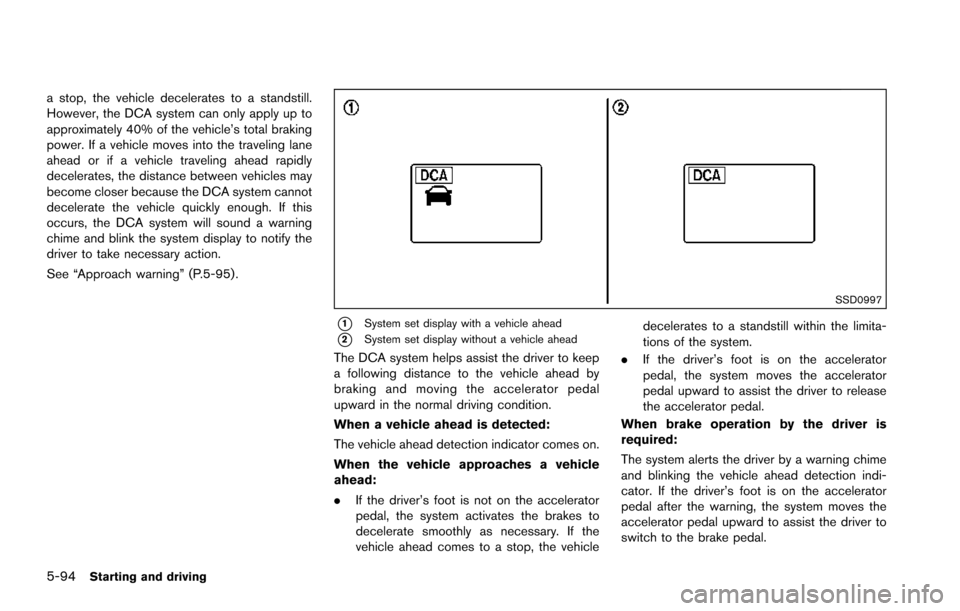
SSD0997
*1System set display with a vehicle ahead
*2System set display without a vehicle ahead
The DCA system helps assist the driver to keep
a following distance to the vehicle ahead by
braking and moving the accelerator pedal
upward in the normal driving condition.
When a vehicle ahead is detected:
The vehicle ahead detection indicator comes on.
When the vehicle approaches a vehicle
ahead:
.If the driver’s foot is not on the accelerator
pedal, the system activates the brakes to
decelerate smoothly as necessary. If the
vehicle ahead comes to a stop, the vehicle decelerates to a standstill within the limita-
tions of the system.
. If the driver’s foot is on the accelerator
pedal, the system moves the accelerator
pedal upward to assist the driver to release
the accelerator pedal.
When brake operation by the driver is
required:
The system alerts the driver by a warning chime
and blinking the vehicle ahead detection indi-
cator. If the driver’s foot is on the accelerator
pedal after the warning, the system moves the
accelerator pedal upward to assist the driver to
switch to the brake pedal.
Page 436 of 614
NOTE:
.The stop lights of the vehicle come on
when braking is performed by the DCA
system.
. When the brake operates, a noise may
be heard and/or vibration may be felt.
This is not a malfunction.
Overriding the system:
The following driver’s operation overrides the
system operation.
. When the driver depresses the accelerator
pedal even further while the system is
moving the accelerator pedal upward, the
DCA system control of the accelerator pedal
is canceled.
. When the driver’s foot is on the accelerator
pedal, the brake control by the system is not
operated.
. When the driver’s foot is on the brake pedal,
neither the brake control nor the alert by the
system operates.
. When the Intelligent Cruise Control (ICC)
system is set, the DCA system will be
inactive.Approach warning
If your vehicle comes closer to the vehicle ahead
due to rapid deceleration of that vehicle or if
another vehicle cuts in, the system warns the
driver with the chime and DCA system display.
Decelerate by depressing the brake pedal to
maintain a safe vehicle distance if:
.The chime sounds.
. The vehicle ahead detection indicator blinks.
The warning chime may not sound in some
cases when there is a short distance between
vehicles. Some examples are:
. When the vehicles are traveling at the same
speed and the distance between vehicles is
not changing
. When the vehicle ahead is traveling faster
and the distance between vehicles is
increasing
. When a vehicle cuts in near your vehicle
The warning chime will not sound when your
vehicle approaches vehicles that are parked or
moving slowly.
NOTE:
The approach warning chime may sound
and the system display may blink when the
radar sensor detects objects on the side of
the vehicle or on the side of the road. This
may cause the DCA system to decelerate or accelerate the vehicle. The radar sensor
may detect these objects when the vehicle
is driven on winding roads, narrow roads,
hilly roads or when entering or exiting a
curve. In these cases you will have to
manually control the proper distance
ahead of your vehicle.
Also, the sensor sensitivity can be affected by
vehicle operation (steering maneuver or driving
position in the lane) or traffic or vehicle condition
(for example, if a vehicle is being driven with
some damage) .
Starting and driving5-95
Page 437 of 614
5-96Starting and driving
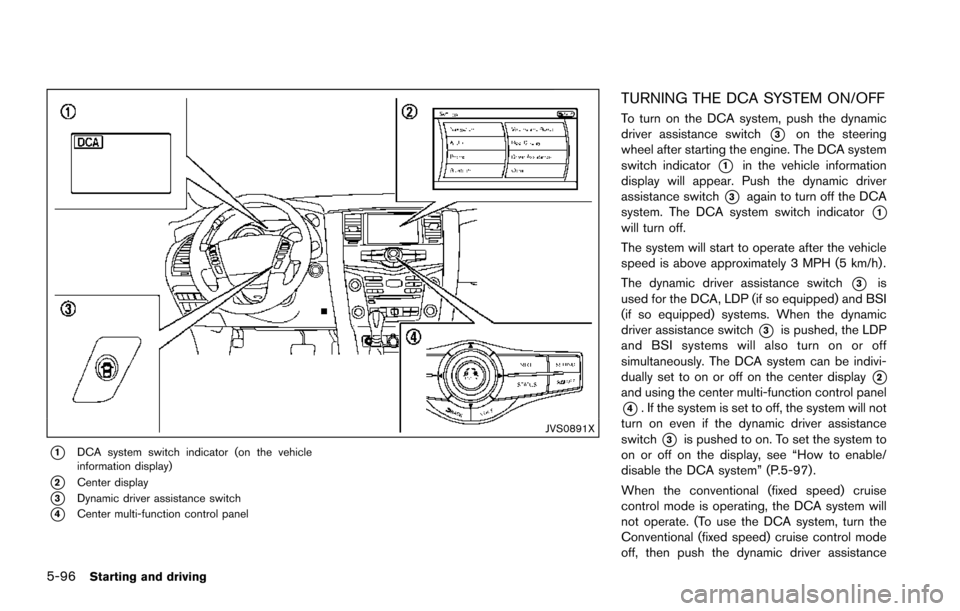
JVS0891X
*1DCA system switch indicator (on the vehicle
information display)
*2Center display
*3Dynamic driver assistance switch
*4Center multi-function control panel
TURNING THE DCA SYSTEM ON/OFF
To turn on the DCA system, push the dynamic
driver assistance switch
*3on the steering
wheel after starting the engine. The DCA system
switch indicator
*1in the vehicle information
display will appear. Push the dynamic driver
assistance switch
*3again to turn off the DCA
system. The DCA system switch indicator
*1will turn off.
The system will start to operate after the vehicle
speed is above approximately 3 MPH (5 km/h) .
The dynamic driver assistance switch
*3is
used for the DCA, LDP (if so equipped) and BSI
(if so equipped) systems. When the dynamic
driver assistance switch
*3is pushed, the LDP
and BSI systems will also turn on or off
simultaneously. The DCA system can be indivi-
dually set to on or off on the center display
*2and using the center multi-function control panel
*4. If the system is set to off, the system will not
turn on even if the dynamic driver assistance
switch
*3is pushed to on. To set the system to
on or off on the display, see “How to enable/
disable the DCA system” (P.5-97) .
When the conventional (fixed speed) cruise
control mode is operating, the DCA system will
not operate. (To use the DCA system, turn the
Conventional (fixed speed) cruise control mode
off, then push the dynamic driver assistance
Page 438 of 614
switch*3.)
For details about the conventional (fixed speed)
cruise control mode, see “Intelligent Cruise
Control (ICC)” (P.5-69) .
When the engine is turned off, the system is
automatically turned off.
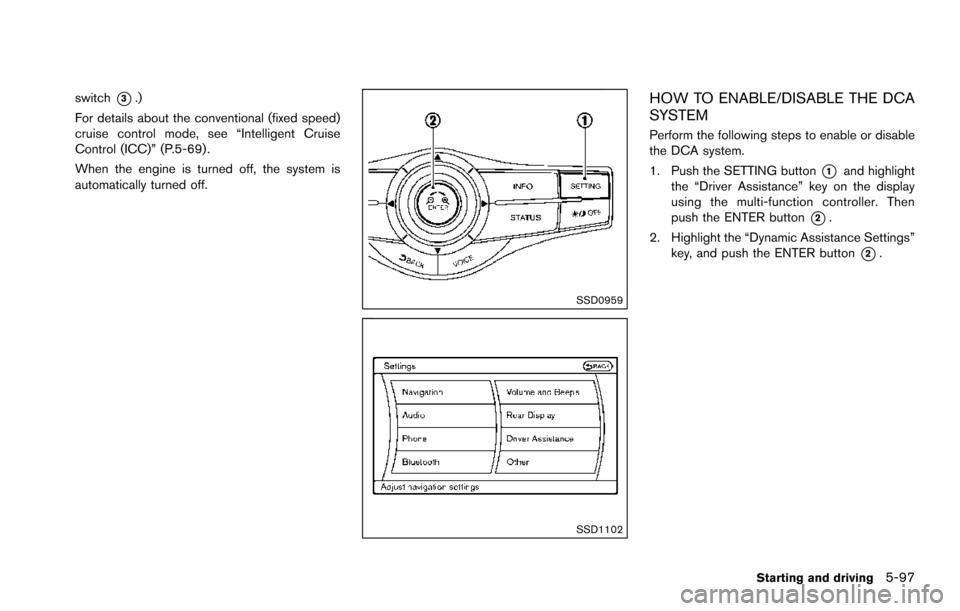
SSD0959
SSD1102
HOW TO ENABLE/DISABLE THE DCA
SYSTEM
Perform the following steps to enable or disable
the DCA system.
1. Push the SETTING button
*1and highlight
the “Driver Assistance” key on the display
using the multi-function controller. Then
push the ENTER button
*2.
2. Highlight the “Dynamic Assistance Settings” key, and push the ENTER button
*2.
Starting and driving5-97
Page 439 of 614
5-98Starting and driving
SSD1002
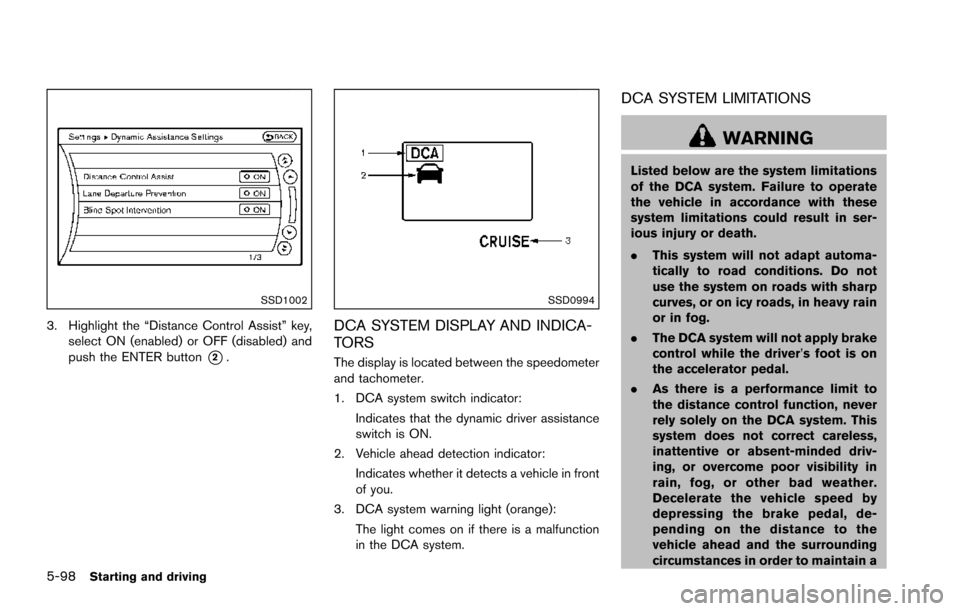
3. Highlight the “Distance Control Assist” key,select ON (enabled) or OFF (disabled) and
push the ENTER button
*2.
SSD0994
DCA SYSTEM DISPLAY AND INDICA-
TORS
The display is located between the speedometer
and tachometer.
1. DCA system switch indicator:
Indicates that the dynamic driver assistance
switch is ON.
2. Vehicle ahead detection indicator: Indicates whether it detects a vehicle in front
of you.
3. DCA system warning light (orange): The light comes on if there is a malfunction
in the DCA system.
DCA SYSTEM LIMITATIONS
WARNING
Listed below are the system limitations
of the DCA system. Failure to operate
the vehicle in accordance with these
system limitations could result in ser-
ious injury or death.
.This system will not adapt automa-
tically to road conditions. Do not
use the system on roads with sharp
curves, or on icy roads, in heavy rain
or in fog.
. The DCA system will not apply brake
control while the driver’s foot is on
the accelerator pedal.
. As there is a performance limit to
the distance control function, never
rely solely on the DCA system. This
system does not correct careless,
inattentive or absent-minded driv-
ing, or overcome poor visibility in
rain, fog, or other bad weather.
Decelerate the vehicle speed by
depressing the brake pedal, de-
pending on the distance to the
vehicle ahead and the surrounding
circumstances in order to maintain a
Page 444 of 614
.When the VDC or ABS (including the
traction control system) operates
. When the SNOW mode switch is ON (To
use the DCA system, turn off the SNOW
mode switch, then turn on the dynamic
driver assistance switch
*2.)
For details about the SNOW mode switch,
see “SNOW mode switch” (P.2-47).
. When the 4WD shift switch is in the 4H or
4L position (for 4WD models)
. When the radar signal is temporarily inter-
rupted
Action to take:
When the conditions listed above are no longer
present, turn the system off with the dynamic
driver assistance switch
*2. Turn the DCA
system back on to use the system.
JVS0482X
Condition B:
When the radar sensor area is covered with dirt
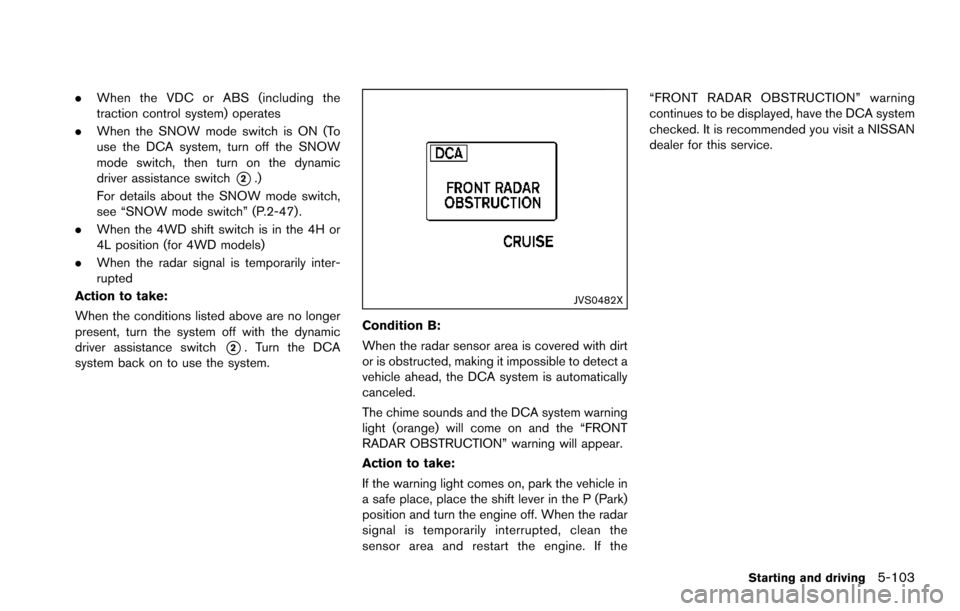
or is obstructed, making it impossible to detect a
vehicle ahead, the DCA system is automatically
canceled.
The chime sounds and the DCA system warning
light (orange) will come on and the “FRONT
RADAR OBSTRUCTION” warning will appear.
Action to take:
If the warning light comes on, park the vehicle in
a safe place, place the shift lever in the P (Park)
position and turn the engine off. When the radar
signal is temporarily interrupted, clean the
sensor area and restart the engine. If the “FRONT RADAR OBSTRUCTION” warning
continues to be displayed, have the DCA system
checked. It is recommended you visit a NISSAN
dealer for this service.
Starting and driving5-103
Page 447 of 614
5-106Starting and driving
JVS0913X
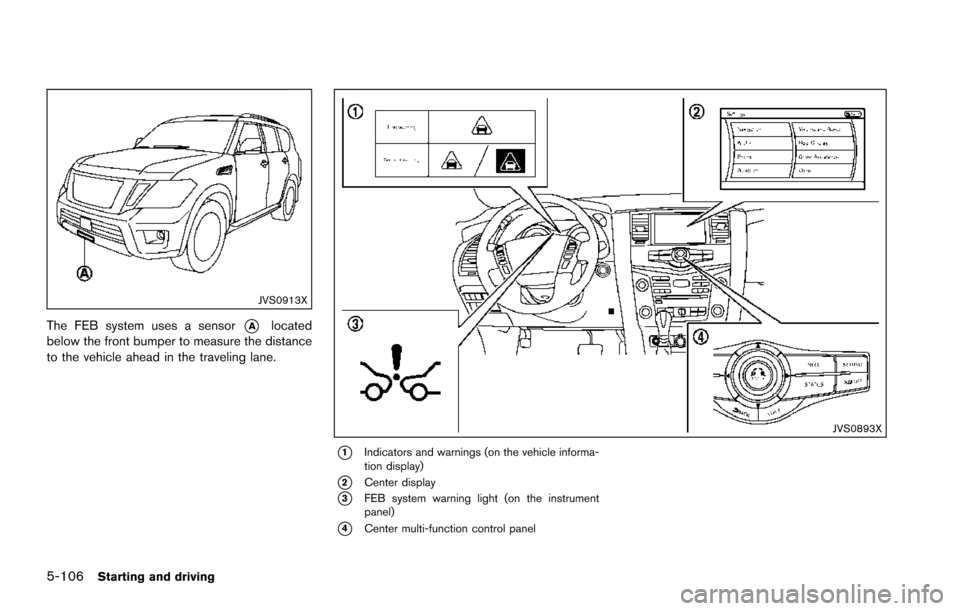
The FEB system uses a sensor*Alocated
below the front bumper to measure the distance
to the vehicle ahead in the traveling lane.
JVS0893X
*1Indicators and warnings (on the vehicle informa-
tion display)
*2Center display
*3FEB system warning light (on the instrument
panel)
*4Center multi-function control panel
Page 448 of 614
FEB SYSTEM OPERATION
The FEB system operates at speeds above
approximately 3 MPH (5 km/h) .
If a risk of a forward collision is detected, the
FEB system will provide the first warning to the
driver by illuminating the warning in the vehicle
information display and providing an audible
warning. In addition, the FEB system pushes the
accelerator pedal up. If the driver releases the
accelerator pedal, then the system applies
partial braking.
If the driver applies the brakes quickly and
forcefully after the warning, and the FEB system
detects that there is still the possibility of a
forward collision, the system will automatically
increase the braking force.
If a forward collision is imminent and the driver
does not take action, the FEB system issues the
second visual (flashing) and audible warning and
automatically applies harder braking.
NOTE:
The vehicle’s stop lights come on when
braking is performed by the FEB system.
Depending on vehicle speed and distance to the
vehicle ahead, as well as driving and roadway
conditions, the system may help the driver avoid
a forward collision or may help mitigate the
consequences of a collision should one beunavoidable.
If the driver is handling the steering wheel,
accelerating or braking, the FEB system will
function later or will not function.
The automatic braking will cease under the
following conditions:
.
When the steering wheel is turned as far as
necessary to avoid a collision.
. When the accelerator pedal is depressed.
. When there is no longer a vehicle detected
ahead.
If the FEB system has stopped the vehicle, the
vehicle will remain at a standstill for approxi-
mately 2 seconds before the brakes are
released.
Starting and driving5-107
Page 449 of 614
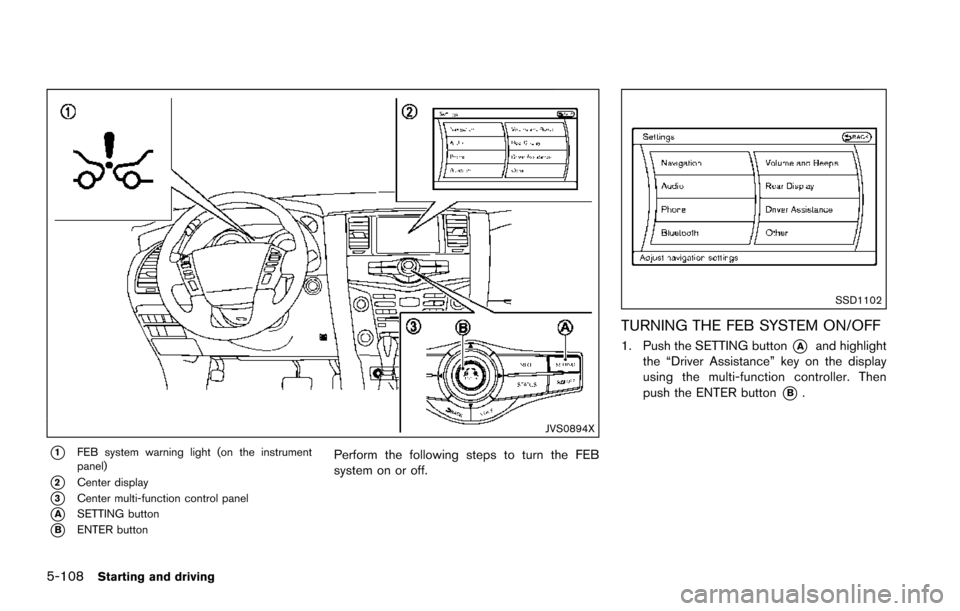
5-108Starting and driving
JVS0894X
*1FEB system warning light (on the instrument
panel)
*2Center display
*3Center multi-function control panel
*ASETTING button
*BENTER button
Perform the following steps to turn the FEB
system on or off.
SSD1102
TURNING THE FEB SYSTEM ON/OFF
1. Push the SETTING button*Aand highlight
the “Driver Assistance” key on the display
using the multi-function controller. Then
push the ENTER button
*B.
Page 450 of 614
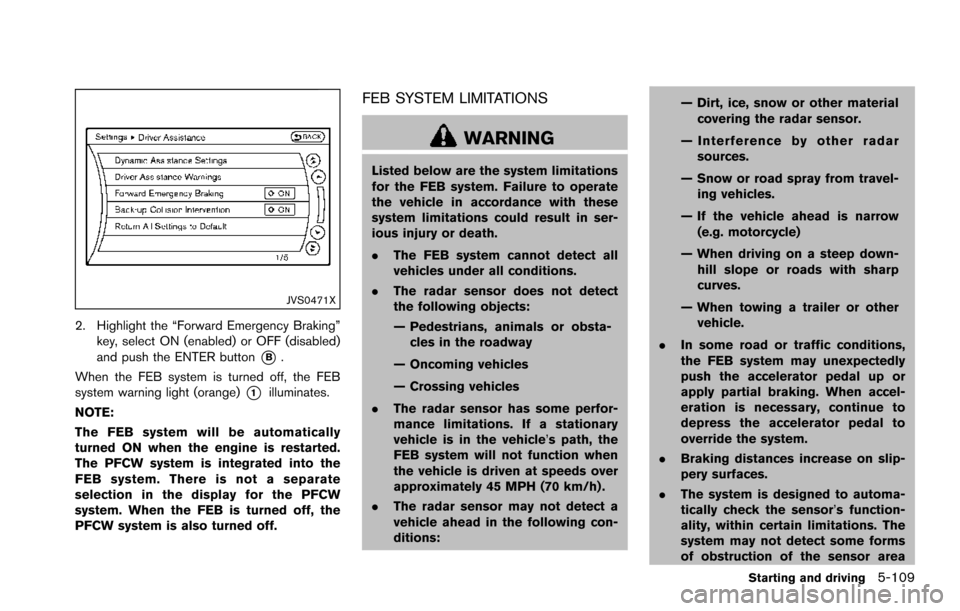
JVS0471X
2. Highlight the “Forward Emergency Braking”key, select ON (enabled) or OFF (disabled)
and push the ENTER button
*B.
When the FEB system is turned off, the FEB
system warning light (orange)
*1illuminates.
NOTE:
The FEB system will be automatically
turned ON when the engine is restarted.
The PFCW system is integrated into the
FEB system. There is not a separate
selection in the display for the PFCW
system. When the FEB is turned off, the
PFCW system is also turned off.
FEB SYSTEM LIMITATIONS
WARNING
Listed below are the system limitations
for the FEB system. Failure to operate
the vehicle in accordance with these
system limitations could result in ser-
ious injury or death.
. The FEB system cannot detect all
vehicles under all conditions.
. The radar sensor does not detect
the following objects:
— Pedestrians, animals or obsta-
cles in the roadway
— Oncoming vehicles
— Crossing vehicles
. The radar sensor has some perfor-
mance limitations. If a stationary
vehicle is in the vehicle’s path, the
FEB system will not function when
the vehicle is driven at speeds over
approximately 45 MPH (70 km/h) .
. The radar sensor may not detect a
vehicle ahead in the following con-
ditions: — Dirt, ice, snow or other material
covering the radar sensor.
— Interference by other radar sources.
— Snow or road spray from travel- ing vehicles.
— If the vehicle ahead is narrow (e.g. motorcycle)
— When driving on a steep down- hill slope or roads with sharp
curves.
— When towing a trailer or other vehicle.
. In some road or traffic conditions,
the FEB system may unexpectedly
push the accelerator pedal up or
apply partial braking. When accel-
eration is necessary, continue to
depress the accelerator pedal to
override the system.
. Braking distances increase on slip-
pery surfaces.
. The system is designed to automa-
tically check the sensor’s function-
ality, within certain limitations. The
system may not detect some forms
of obstruction of the sensor area
Starting and driving5-109