heating NISSAN NAVARA 2005 Repair User Guide
[x] Cancel search | Manufacturer: NISSAN, Model Year: 2005, Model line: NAVARA, Model: NISSAN NAVARA 2005Pages: 3171, PDF Size: 49.59 MB
Page 1113 of 3171
DTC P0217 ENGINE OVER TEMPERATURE
EC-133
C
D
E
F
G
H
I
J
K
L
MA
EC
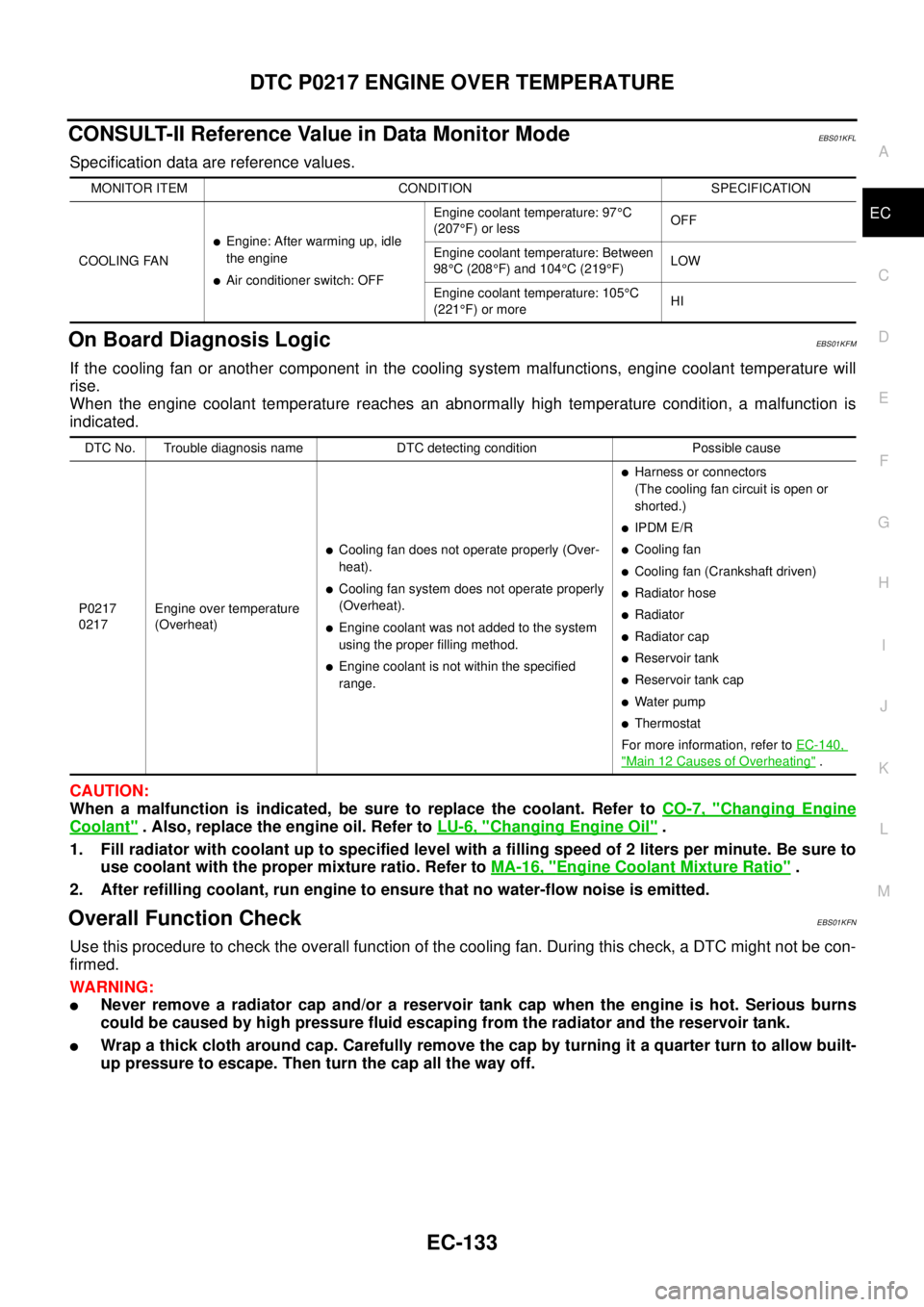
CONSULT-II Reference Value in Data Monitor ModeEBS01KFL
Specification data are reference values.
On Board Diagnosis LogicEBS01KFM
If the cooling fan or another component in the cooling system malfunctions, engine coolant temperature will
rise.
When the engine coolant temperature reaches an abnormally high temperature condition, a malfunction is
indicated.
CAUTION:
When a malfunction is indicated, be sure to replace the coolant. Refer toCO-7, "
Changing Engine
Coolant". Also, replace the engine oil. Refer toLU-6, "Changing Engine Oil".
1. Fill radiator with coolant up to specified level with a filling speed of 2 liters per minute. Be sure to
use coolant with the proper mixture ratio. Refer toMA-16, "
Engine Coolant Mixture Ratio".
2. After refilling coolant, run engine to ensure that no water-flow noise is emitted.
Overall Function CheckEBS01KFN
Use this procedure to check the overall function of the cooling fan. During this check, a DTC might not be con-
firmed.
WARNING:
lNever remove a radiator cap and/or a reservoir tank cap when the engine is hot. Serious burns
could be caused by high pressure fluid escaping from the radiator and the reservoir tank.
lWrap a thick cloth around cap. Carefully remove the cap by turning it a quarter turn to allow built-
up pressure to escape. Then turn the cap all the way off.
MONITOR ITEM CONDITION SPECIFICATION
COOLING FAN
lEngine: After warming up, idle
the engine
lAir conditioner switch: OFFEngine coolant temperature: 97°C
(207°F) or lessOFF
Engine coolant temperature: Between
98°C (208°F) and 104°C(219°F)LOW
Engine coolant temperature: 105°C
(221°F) or moreHI
DTC No. Trouble diagnosis name DTC detecting condition Possible cause
P0217
0217Engine over temperature
(Overheat)
lCooling fan does not operate properly (Over-
heat).
lCooling fan system does not operate properly
(Overheat).
lEngine coolant was not added to the system
using the proper filling method.
lEngine coolant is not within the specified
range.
lHarness or connectors
(The cooling fan circuit is open or
shorted.)
lIPDM E/R
lCooling fan
lCooling fan (Crankshaft driven)
lRadiator hose
lRadiator
lRadiator cap
lReservoir tank
lReservoir tank cap
lWater pump
lThermostat
For more information, refer toEC-140,
"Main 12 Causes of Overheating".
Page 1118 of 3171
EC-138
DTC P0217 ENGINE OVER TEMPERATURE
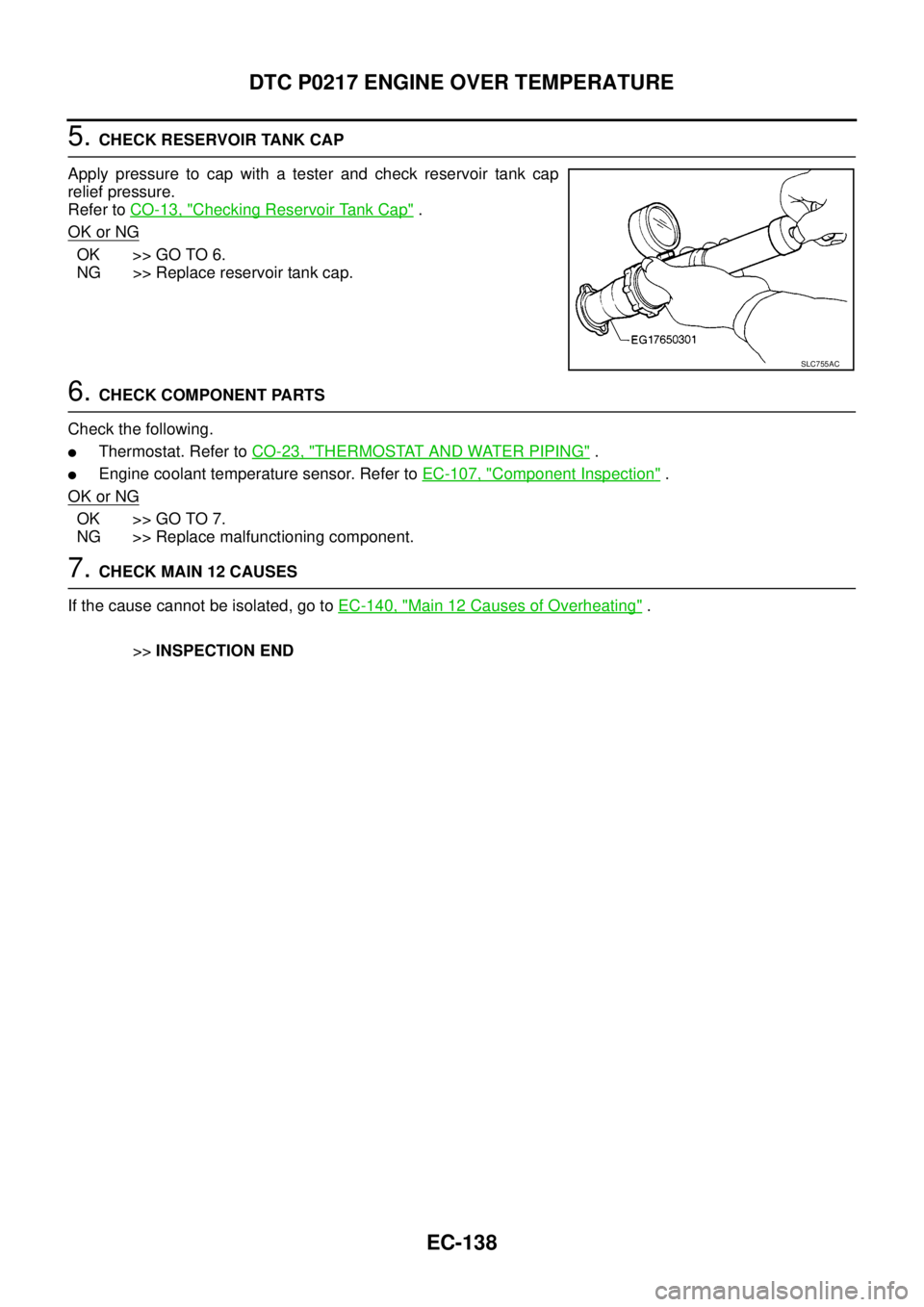
5.CHECK RESERVOIR TANK CAP
Apply pressure to cap with a tester and check reservoir tank cap
relief pressure.
Refer toCO-13, "
Checking Reservoir Tank Cap".
OK or NG
OK >> GO TO 6.
NG >> Replace reservoir tank cap.
6.CHECK COMPONENT PARTS
Check the following.
lThermostat. Refer toCO-23, "THERMOSTAT AND WATER PIPING".
lEngine coolant temperature sensor. Refer toEC-107, "Component Inspection".
OK or NG
OK >> GO TO 7.
NG >> Replace malfunctioning component.
7.CHECK MAIN 12 CAUSES
If the cause cannot be isolated, go toEC-140, "
Main 12 Causes of Overheating".
>>INSPECTION END
SLC755AC
Page 1120 of 3171
EC-140
DTC P0217 ENGINE OVER TEMPERATURE
5.CHECK COOLING FAN MOTOR
Refer toEC-141, "
Component Inspection".
OK or NG
OK >> GO TO 6.
NG >> Replace cooling fan motors.
6.CHECK INTERMITTENT INCIDENT
PerformEC-70, "
TROUBLE DIAGNOSIS FOR INTERMITTENT INCIDENT".
OK or NG
OK >> Replace IPDM E/R. Refer toPG-14, "IPDM E/R (INTELLIGENT POWER DISTRIBUTION MOD-
ULE ENGINE ROOM)".
NG >> Repair or replace harness or connector.
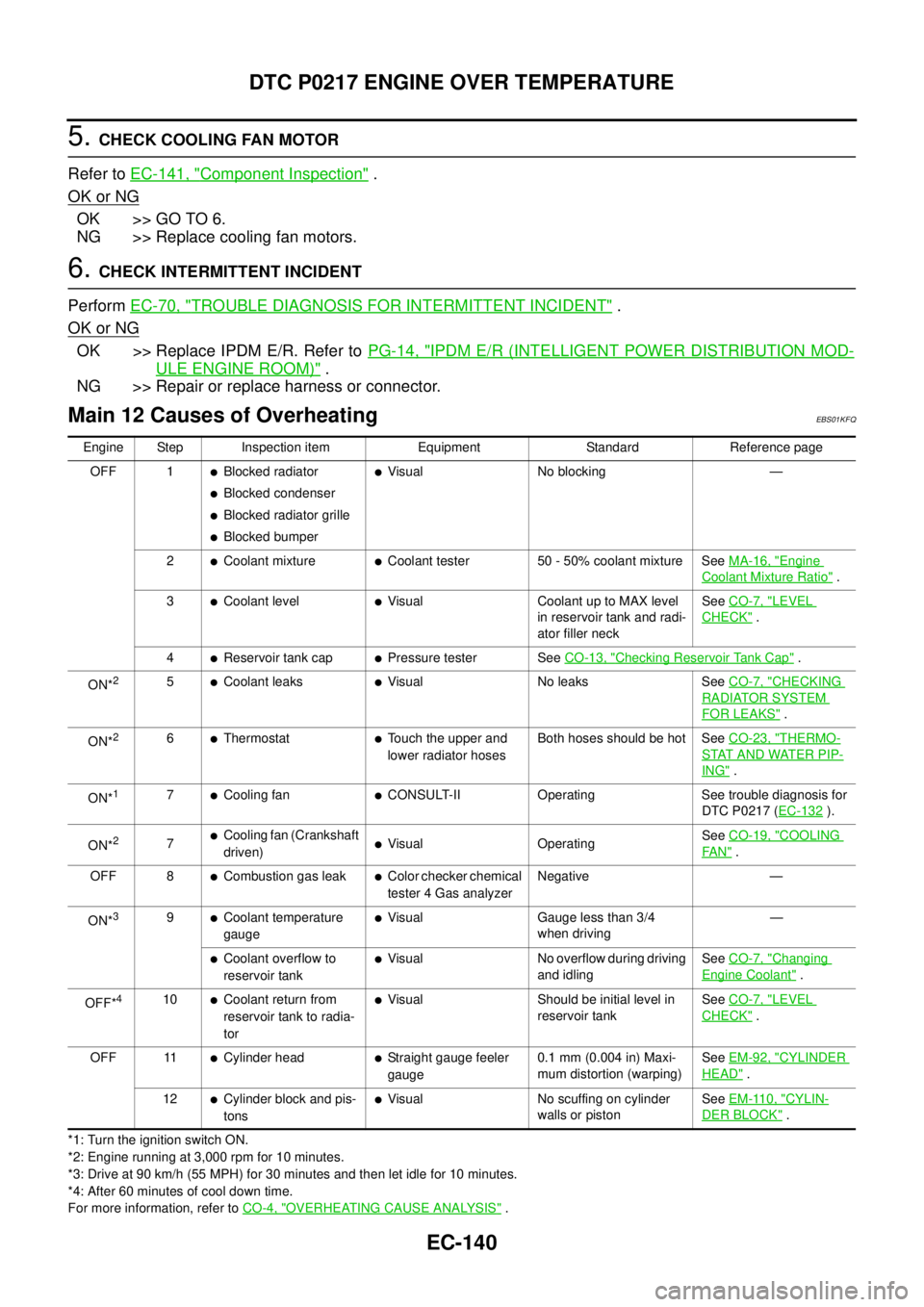
Main 12 Causes of OverheatingEBS01KFQ
*1: Turn the ignition switch ON.
*2: Engine running at 3,000 rpm for 10 minutes.
*3: Drive at 90 km/h (55 MPH) for 30 minutes and then let idle for 10 minutes.
*4: After 60 minutes of cool down time.
For more information, refer toCO-4, "
OVERHEATING CAUSE ANALYSIS". Engine Step Inspection item Equipment Standard Reference page
OFF 1
lBlocked radiator
lBlocked condenser
lBlocked radiator grille
lBlocked bumper
lVisual No blocking —
2
lCoolant mixturelCoolant tester 50 - 50% coolant mixture SeeMA-16, "Engine
Coolant Mixture Ratio".
3
lCoolant levellVisual Coolant up to MAX level
in reservoir tank and radi-
ator filler neckSeeCO-7, "LEVEL
CHECK".
4
lReservoir tank caplPressure tester SeeCO-13, "Checking Reservoir Tank Cap".
ON*
25lCoolant leakslVisual No leaks SeeCO-7, "CHECKING
RADIATOR SYSTEM
FOR LEAKS".
ON*
26lThermostatlTouch the upper and
lower radiator hosesBoth hoses should be hot SeeCO-23, "THERMO-
STAT AND WATER PIP-
ING".
ON*
17lCooling fanlCONSULT-II Operating See trouble diagnosis for
DTC P0217 (EC-132
).
ON*
27lCooling fan (Crankshaft
driven)lVisual OperatingSeeCO-19, "COOLING
FA N".
OFF 8
lCombustion gas leaklColor checker chemical
tester 4 Gas analyzerNegative —
ON*
39lCoolant temperature
gaugelVisual Gauge less than 3/4
when driving—
lCoolant overflow to
reservoir tanklVisual No overflow during driving
and idlingSeeCO-7, "Changing
Engine Coolant".
OFF*
410lCoolant return from
reservoir tank to radia-
torlVisual Should be initial level in
reservoir tankSeeCO-7, "LEVEL
CHECK".
OFF 11
lCylinder headlStraight gauge feeler
gauge0.1 mm (0.004 in) Maxi-
mum distortion (warping)SeeEM-92, "CYLINDER
HEAD".
12
lCylinder block and pis-
tonslVisual No scuffing on cylinder
walls or pistonSeeEM-110, "CYLIN-
DER BLOCK".
Page 1275 of 3171
GLOW CONTROL SYSTEM
EC-295
C
D
E
F
G
H
I
J
K
L
MA
EC
GLOW CONTROL SYSTEMPFP:25230
DescriptionEBS01KLM
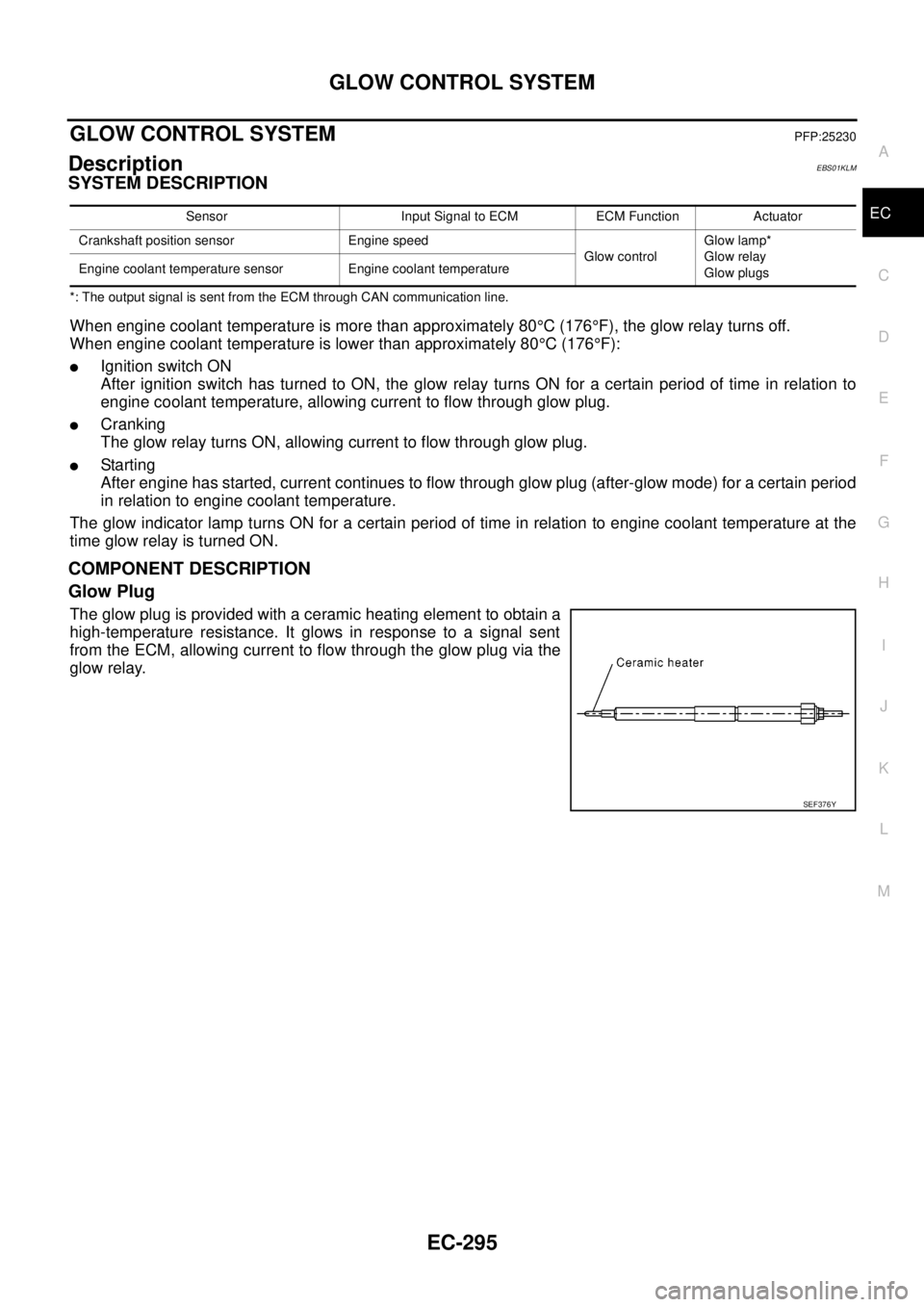
SYSTEM DESCRIPTION
*: The output signal is sent from the ECM through CAN communication line.
When engine coolant temperature is more than approximately 80°C(176°F), the glow relay turns off.
When engine coolant temperature is lower than approximately 80°C(176°F):
lIgnition switch ON
After ignition switch has turned to ON, the glow relay turns ON for a certain period of time in relation to
engine coolant temperature, allowing current to flow through glow plug.
lCranking
The glow relay turns ON, allowing current to flow through glow plug.
lSta rti ng
After engine has started, current continues to flow through glow plug (after-glow mode) for a certain period
in relation to engine coolant temperature.
The glow indicator lamp turns ON for a certain period of time in relation to engine coolant temperature at the
time glow relay is turned ON.
COMPONENT DESCRIPTION
Glow Plug
The glow plug is provided with a ceramic heating element to obtain a
high-temperature resistance. It glows in response to a signal sent
from the ECM, allowing current to flow through the glow plug via the
glow relay.
Sensor Input Signal to ECM ECM Function Actuator
Crankshaft position sensor Engine speed
Glow controlGlow lamp*
Glow relay
Glow plugs Engine coolant temperature sensor Engine coolant temperature
SEF376Y
Page 1281 of 3171
GLOW CONTROL SYSTEM
EC-301
C
D
E
F
G
H
I
J
K
L
MA
EC
15.CHECK INTERMITTENT INCIDENT
Refer toEC-70, "
TROUBLE DIAGNOSIS FOR INTERMITTENT INCIDENT".
>>INSPECTION END
Component InspectionEBS01KLP
GLOW RELAY
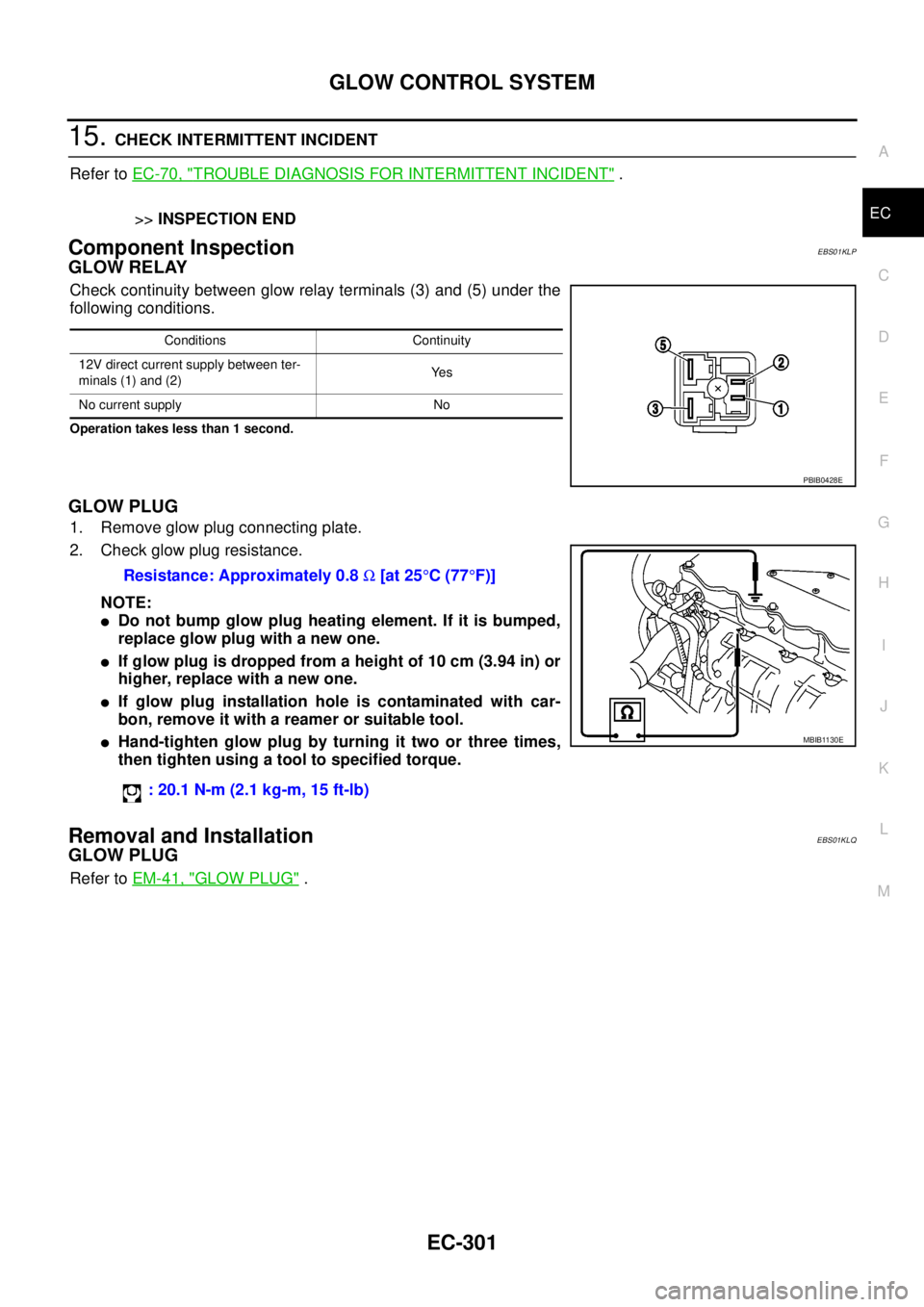
Check continuity between glow relay terminals (3) and (5) under the
following conditions.
Operation takes less than 1 second.
GLOW PLUG
1. Remove glow plug connecting plate.
2. Check glow plug resistance.
NOTE:
lDo not bump glow plug heating element. If it is bumped,
replace glow plug with a new one.
lIf glow plug is dropped from a height of 10 cm (3.94 in) or
higher, replace with a new one.
lIf glow plug installation hole is contaminated with car-
bon, remove it with a reamer or suitable tool.
lHand-tighten glow plug by turning it two or three times,
then tighten using a tool to specified torque.
Removal and InstallationEBS01KLQ
GLOW PLUG
Refer toEM-41, "GLOW PLUG".
Conditions Continuity
12V direct current supply between ter-
minals (1) and (2)Ye s
No current supply No
PBIB0428E
Resistance: Approximately 0.8W[at 25°C(77°F)]
: 20.1 N-m (2.1 kg-m, 15 ft-lb)
MBIB1130E
Page 1387 of 3171
PRECAUTIONS
EM-5
C
D
E
F
G
H
I
J
K
L
MA
EM
Precautions For Liquid GasketEBS01E5N
REMOVAL OF LIQUID GASKET
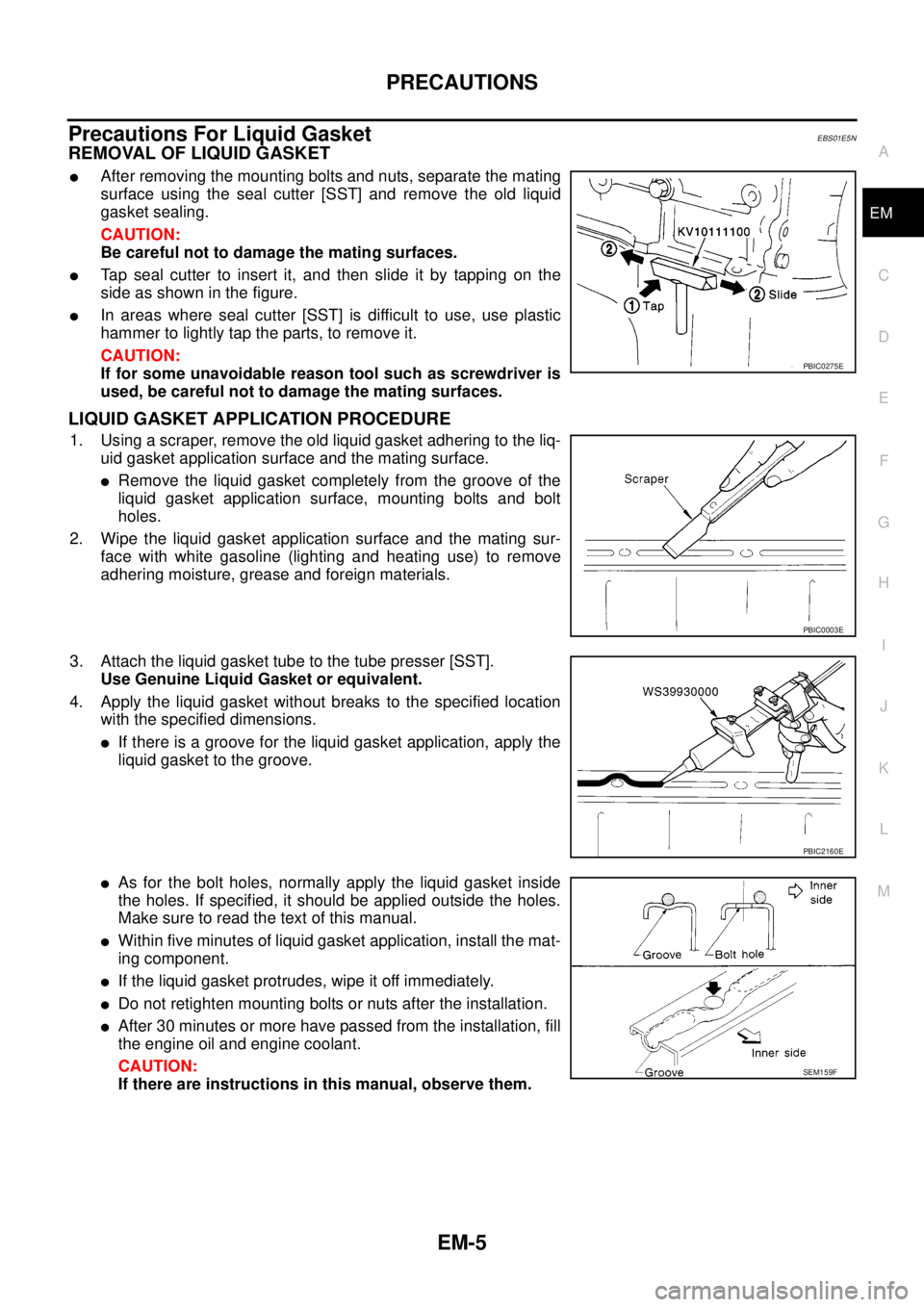
lAfter removing the mounting bolts and nuts, separate the mating
surface using the seal cutter [SST] and remove the old liquid
gasket sealing.
CAUTION:
Be careful not to damage the mating surfaces.
lTap seal cutter to insert it, and then slide it by tapping on the
side as shown in the figure.
lIn areas where seal cutter [SST] is difficult to use, use plastic
hammer to lightly tap the parts, to remove it.
CAUTION:
If for some unavoidable reason tool such as screwdriver is
used, be careful not to damage the mating surfaces.
LIQUID GASKET APPLICATION PROCEDURE
1. Using a scraper, remove the old liquid gasket adhering to the liq-
uid gasket application surface and the mating surface.
lRemove the liquid gasket completely from the groove of the
liquid gasket application surface, mounting bolts and bolt
holes.
2. Wipe the liquid gasket application surface and the mating sur-
face with white gasoline (lighting and heating use) to remove
adhering moisture, grease and foreign materials.
3. Attach the liquid gasket tube to the tube presser [SST].
Use Genuine Liquid Gasket or equivalent.
4. Apply the liquid gasket without breaks to the specified location
with the specified dimensions.
lIf there is a groove for the liquid gasket application, apply the
liquid gasket to the groove.
lAs for the bolt holes, normally apply the liquid gasket inside
the holes. If specified, it should be applied outside the holes.
Make sure to read the text of this manual.
lWithin five minutes of liquid gasket application, install the mat-
ing component.
lIf the liquid gasket protrudes, wipe it off immediately.
lDo not retighten mounting bolts or nuts after the installation.
lAfter 30 minutes or more have passed from the installation, fill
the engine oil and engine coolant.
CAUTION:
If there are instructions in this manual, observe them.
PBIC0275E
PBIC0003E
PBIC2160E
SEM159F
Page 1628 of 3171
GI-6
PRECAUTIONS
CAUTION:
Do not use leaded gasoline. Using leaded gasoline will damage the three way catalyst. Using a fuel
other than that specified could adversely affect the emission control devices and systems, and could
also affect the warranty coverage validity.
DIESEL ENGINE
Diesel fuel of at least 50 cetane.
If two types of diesel fuel are available, use summer or winter fuel properly according to the following temper-
ature conditions.
lAbove –7°C(20°F) ... Summer type diesel fuel.
lBelow –7°C(20°F) ... Winter type diesel fuel.
CAUTION:
lDo not use home heating oil, gasoline or other alternate fuels in your diesel engine. The use of
those can cause engine damage.
lDo not use summer fuel at temperatures below –7°C(20°F). The cold temperatures will cause wax
to form in the fuel. As a result, it may prevent the engine from running smoothly.
lDo not add gasoline or other alternate fuels to diesel fuel.
Precautions for Multiport Fuel Injection System or Engine Control SystemEAS001GN
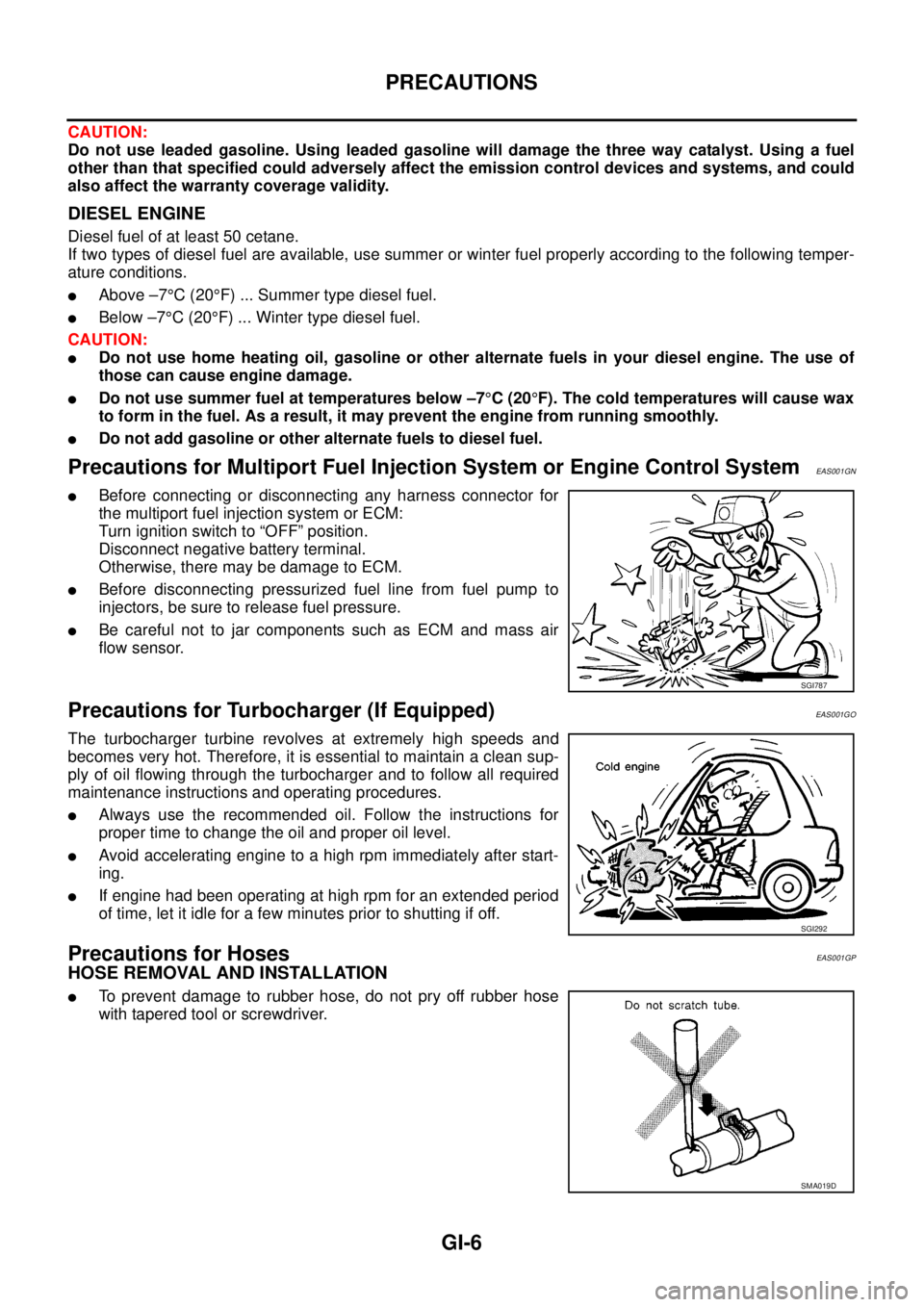
lBefore connecting or disconnecting any harness connector for
the multiport fuel injection system or ECM:
Turn ignition switch to “OFF” position.
Disconnect negative battery terminal.
Otherwise, there may be damage to ECM.
lBefore disconnecting pressurized fuel line from fuel pump to
injectors, be sure to release fuel pressure.
lBe careful not to jar components such as ECM and mass air
flow sensor.
Precautions for Turbocharger (If Equipped)EAS001GO
The turbocharger turbine revolves at extremely high speeds and
becomes very hot. Therefore, it is essential to maintain a clean sup-
ply of oil flowing through the turbocharger and to follow all required
maintenance instructions and operating procedures.
lAlways use the recommended oil. Follow the instructions for
proper time to change the oil and proper oil level.
lAvoid accelerating engine to a high rpm immediately after start-
ing.
lIf engine had been operating at high rpm for an extended period
of time, let it idle for a few minutes prior to shutting if off.
Precautions for HosesEAS001GP
HOSE REMOVAL AND INSTALLATION
lTo prevent damage to rubber hose, do not pry off rubber hose
with tapered tool or screwdriver.
SGI787
SGI292
SMA019D
Page 1648 of 3171
GI-26
SERVICE INFORMATION FOR ELECTRICAL INCIDENT
UNDER SEATING AREAS
An unclamped or loose harness can cause wiring to be pinched by seat components (such as slide guides)
during vehicle vibration. If the wiring runs under seating areas, inspect wire routing for possible damage or
pinching.
Heat Sensitive
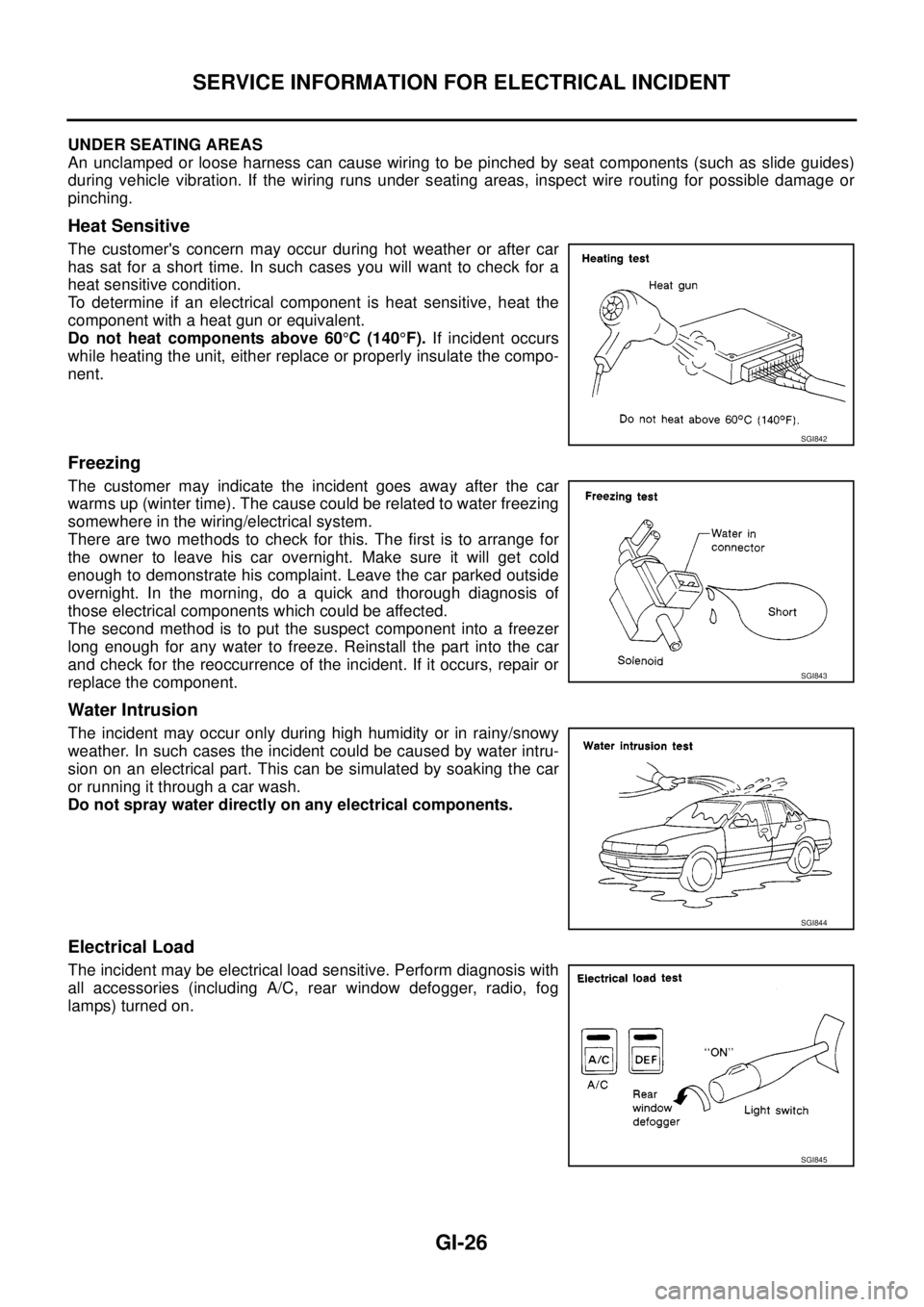
The customer's concern may occur during hot weather or after car
has sat for a short time. In such cases you will want to check for a
heat sensitive condition.
To determine if an electrical component is heat sensitive, heat the
component with a heat gun or equivalent.
Do not heat components above 60°C(140°F).If incident occurs
while heating the unit, either replace or properly insulate the compo-
nent.
Freezing
The customer may indicate the incident goes away after the car
warms up (winter time). The cause could be related to water freezing
somewhere in the wiring/electrical system.
There are two methods to check for this. The first is to arrange for
the owner to leave his car overnight. Make sure it will get cold
enough to demonstrate his complaint. Leave the car parked outside
overnight. In the morning, do a quick and thorough diagnosis of
those electrical components which could be affected.
The second method is to put the suspect component into a freezer
long enough for any water to freeze. Reinstall the part into the car
and check for the reoccurrence of the incident. If it occurs, repair or
replace the component.
Water Intrusion
The incident may occur only during high humidity or in rainy/snowy
weather. In such cases the incident could be caused by water intru-
sion on an electrical part. This can be simulated by soaking the car
or running it through a car wash.
Do not spray water directly on any electrical components.
Electrical Load
The incident may be electrical load sensitive. Perform diagnosis with
all accessories (including A/C, rear window defogger, radio, fog
lamps) turned on.
SGI842
SGI843
SGI844
SGI845
Page 2259 of 3171
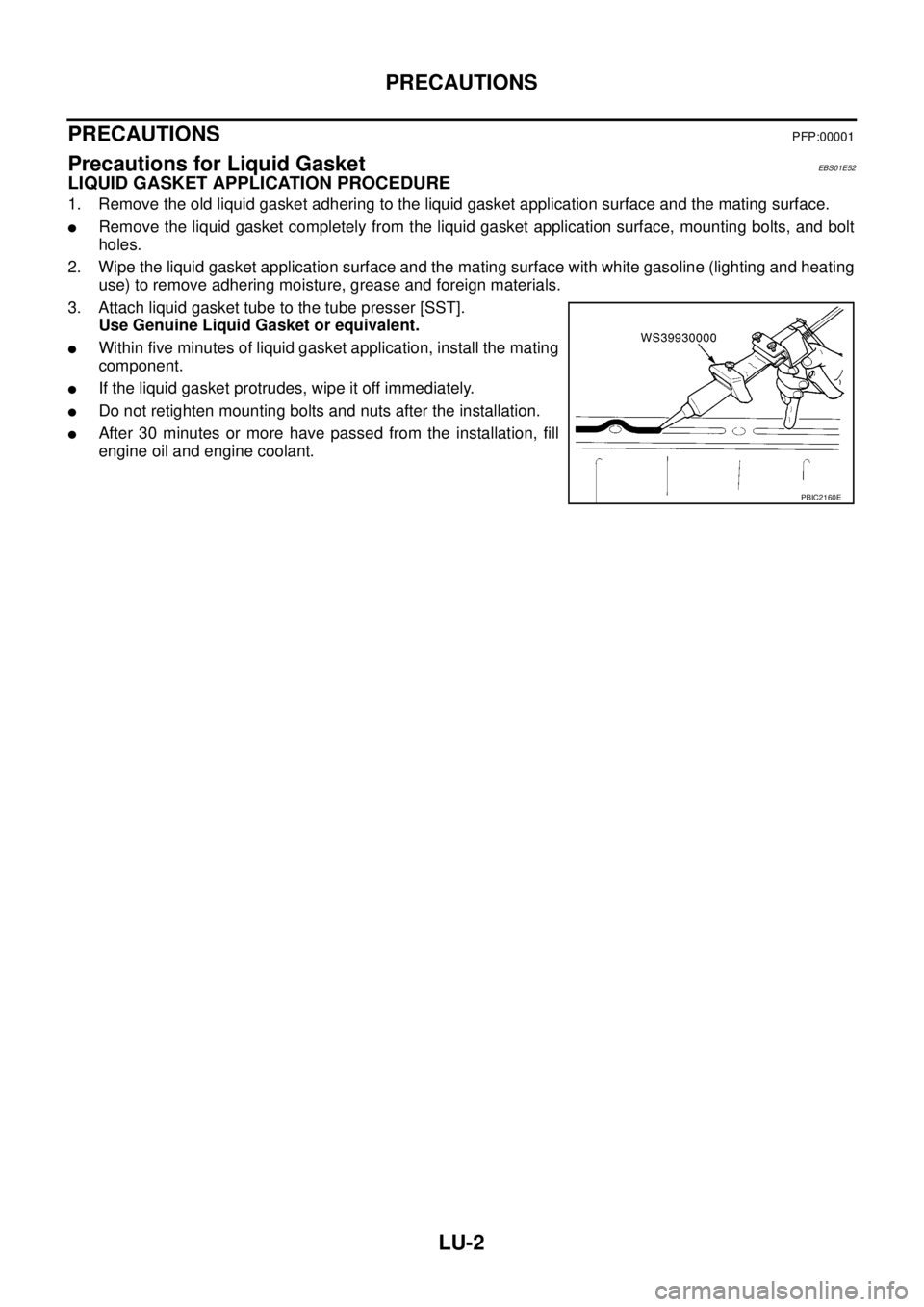
LU-2
PRECAUTIONS
PRECAUTIONS
PFP:00001
Precautions for Liquid GasketEBS01E52
LIQUID GASKET APPLICATION PROCEDURE
1. Remove the old liquid gasket adhering to the liquid gasket application surface and the mating surface.
lRemove the liquid gasket completely from the liquid gasket application surface, mounting bolts, and bolt
holes.
2. Wipe the liquid gasket application surface and the mating surface with white gasoline (lighting and heating
use) to remove adhering moisture, grease and foreign materials.
3. Attach liquid gasket tube to the tube presser [SST].
Use Genuine Liquid Gasket or equivalent.
lWithin five minutes of liquid gasket application, install the mating
component.
lIf the liquid gasket protrudes, wipe it off immediately.
lDo not retighten mounting bolts and nuts after the installation.
lAfter 30 minutes or more have passed from the installation, fill
engine oil and engine coolant.
PBIC2160E
Page 2281 of 3171

MA-6
DESCRIPTION
ROAD TEST
Check clutch operation
Check foot brake operation
Check parking brake operation
Check steering operation, self-centering and steering wheel alignment
Check engine performance
Check for squeaks, rattles and noise from interior, suspension and brakes
Check heating, ventilation and air conditioning operation
Check radio, cassette and CD player operation
Check odometer and trip meter operation and cancelling
Check instruments for operation
Check automatic transmission/transaxle shift pattern and kickdown operation (if applicable)
Check cruise control and navigation system operation (if applicable)
ENGINE OPERATING AND HOT
Check idle speed
Check automatic transmission/transaxle oil level (if applicable)
FINAL INSPECTION
Remove vehicle protection kit
Fit interior mats and wheel covers
Check for interior and exterior metal and paint damage
Wash, clean interior and exterior
: Not applicable to this model