engine NISSAN NAVARA 2005 Repair Repair Manual
[x] Cancel search | Manufacturer: NISSAN, Model Year: 2005, Model line: NAVARA, Model: NISSAN NAVARA 2005Pages: 3171, PDF Size: 49.59 MB
Page 83 of 3171

TROUBLE DIAGNOSIS
AT-75
D
E
F
G
H
I
J
K
L
MA
B
AT
65 OthersEngine speed does not
return to idle.
Refer toAT-199,
"Engine Speed Does
Not Return to Idle".ON vehicle1. A/T fluid level and stateAT- 4 3
2. ATF pressure switch 5 and direct clutch solenoid valveAT-160,
AT-142
3. ATF pressure switch 1 and front brake solenoid valveAT-156,
AT-137
4. Accelerator pedal position sensorAT- 11 6
5. Vehicle speed sensor A/T and vehicle speed sensor MTRAT-103,
AT-125
6. CAN communication lineAT- 9 1
7. Control valve with TCMAT-218
OFF vehicle8. Front brake (brake band)AT-2639. Direct clutchAT-298
No. Items Symptom Condition Diagnostic ItemReference
page
Page 85 of 3171
TROUBLE DIAGNOSIS
AT-77
D
E
F
G
H
I
J
K
L
MA
B
AT
CONSULT-II Function (A/T)ECS00FXA
CONSULT-II can display each diagnostic item using the diagnostic test modes shown following.
FUNCTION
CONSULT-II REFERENCE VALUE
NOTICE:
1. The CONSULT-II electrically displays shift timing and lock-up timing (that is, operation timing of each sole-
noid).
Check for time difference between actual shift timing and the CONSULT-II display. If the difference is
noticeable, mechanical parts (except solenoids, sensors, etc.) may be malfunctioning. Check mechanical
parts using applicable diagnostic procedures.
2. Shift schedule (which implies gear position) displayed on CONSULT-II and that indicated in Service Man-
ual may differ slightly. This occurs because of the following reasons:
–Actual shift schedule has more or less tolerance or allowance,
–Shift schedule indicated in Service Manual refers to the point where shifts start, and
–Gear position displayed on CONSULT-II indicates the point where shifts are completed.
3. Display of solenoid valves on CONSULT-II changes at the start of shifting, while gear position is displayed
upon completion of shifting (which is computed by TCM).
Diagnostic test mode Function Reference page
Self-diagnostic results Self-diagnostic results can be read and erased quickly.AT- 8 0
Data monitor Input/Output data in the ECU can be read.AT- 8 3
CAN diagnostic support
monitorThe results of transmit/receive diagnosis of CAN communication can be read.AT- 8 6
Function testConducted by CONSULT-II instead of a technician to determine whether each system
is “OK” or “NG”.—
DTC work support Select the operating condition to confirm Diagnostic Trouble Codes.AT- 8 6
ECU part number ECU part number can be read. —
Item name Condition Display value (Approx.)
VHCL/S SE-A/T
During drivingApproximately matches the speed-
ometer reading.
VHCL/S SE-MTR
ACCELE POSIReleased accelerator pedal. 0.0/8
Fully depressed accelerator pedal. 8.0/8
CLSD THL POSReleased accelerator pedal. ON
Fully depressed accelerator pedal. OFF
W/O THL POSFully depressed accelerator pedal. ON
Released accelerator pedal. OFF
BRAKE SWDepressed brake pedal. ON
Released brake pedal. OFF
ENGINE SPEED Engine runningClosely matches the tachometer
reading.
TURBINE REV During driving (lock-up ON)Approximately matches the engine
speed.
ATFTEMPSE1
0°C(32°F)-20°C(68°F)-80°C (176°F)3.3 - 2.7 - 0.9 V
ATFTEMPSE23.3 - 2.5 - 0.7 V
TCC SOLENOID When perform lock-up 0.4 - 0.6 A
LINE PRES SOL During driving 0.2 - 0.6 A
FR/B SOLENOIDFront brake engaged. Refer toAT- 1 7
. 0.6 - 0.8 A
Front brake disengaged. Refer toAT- 1 7
.0-0.05A
Page 87 of 3171
TROUBLE DIAGNOSIS
AT-79
D
E
F
G
H
I
J
K
L
MA
B
AT
CONSULT-II SETTING PROCEDURE
CAUTION:
If CONSULT-II is used with no connection of CONSULT-II CONVERTER, malfunctions might be
detected in self-diagnosis depending on control unit which carry out CAN communication.
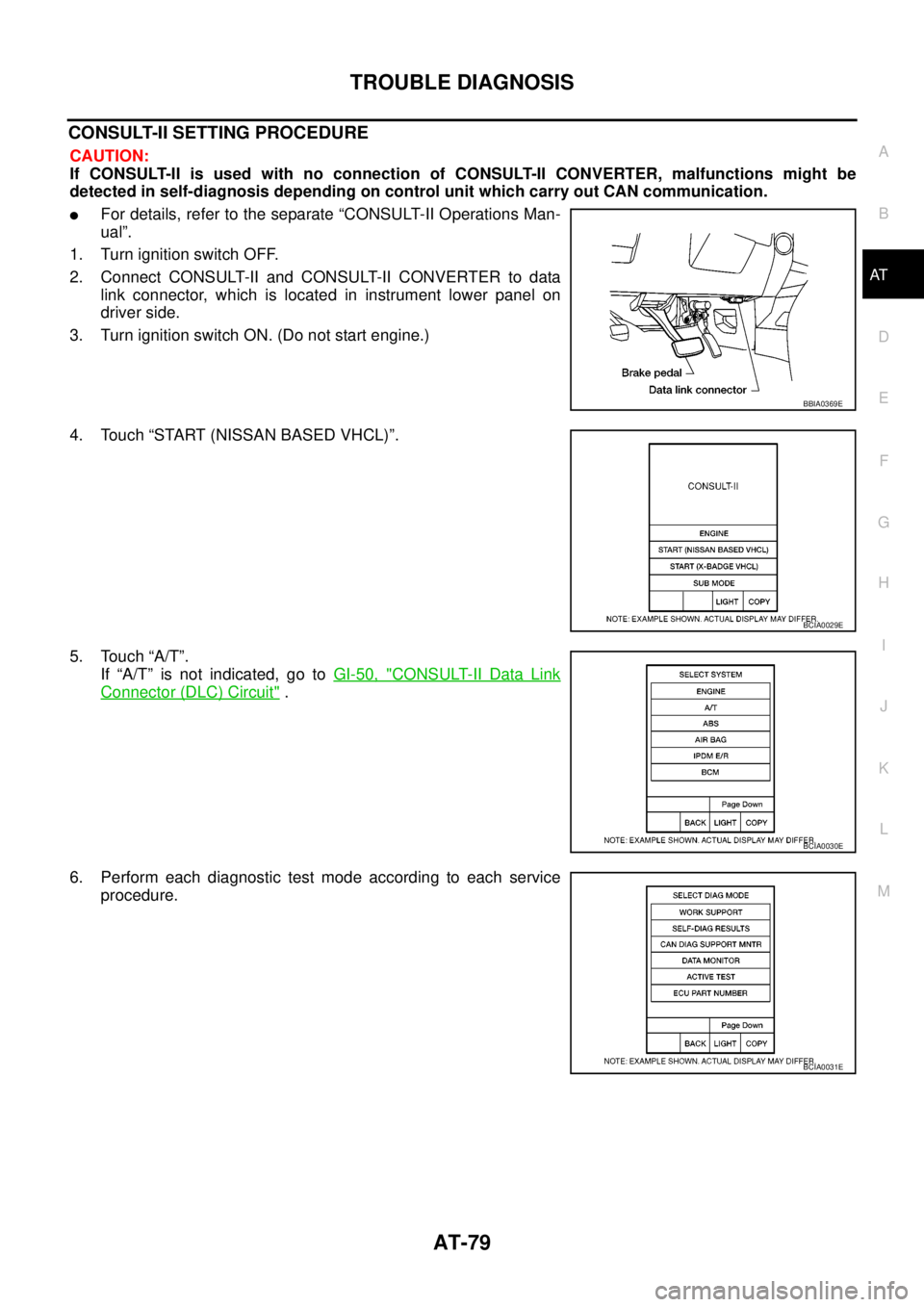
lFor details, refer to the separate “CONSULT-II Operations Man-
ual”.
1. Turn ignition switch OFF.
2. Connect CONSULT-II and CONSULT-II CONVERTER to data
link connector, which is located in instrument lower panel on
driver side.
3. Turn ignition switch ON. (Do not start engine.)
4. Touch “START (NISSAN BASED VHCL)”.
5. Touch “A/T”.
If “A/T” is not indicated, go toGI-50, "
CONSULT-II Data Link
Connector (DLC) Circuit".
6. Perform each diagnostic test mode according to each service
procedure.
BBIA0369E
BCIA0029E
BCIA0030E
BCIA0031E
Page 88 of 3171
AT-80
TROUBLE DIAGNOSIS
SELF-DIAGNOSTIC RESULT MODE
Operation Procedure
After performing self-diagnosis, place check marks for results on theAT-38, "DIAGNOSTIC WORKSHEET".
Reference pages are provided following the items.
1. PerformAT- 7 9 , "
CONSULT-II SETTING PROCEDURE".
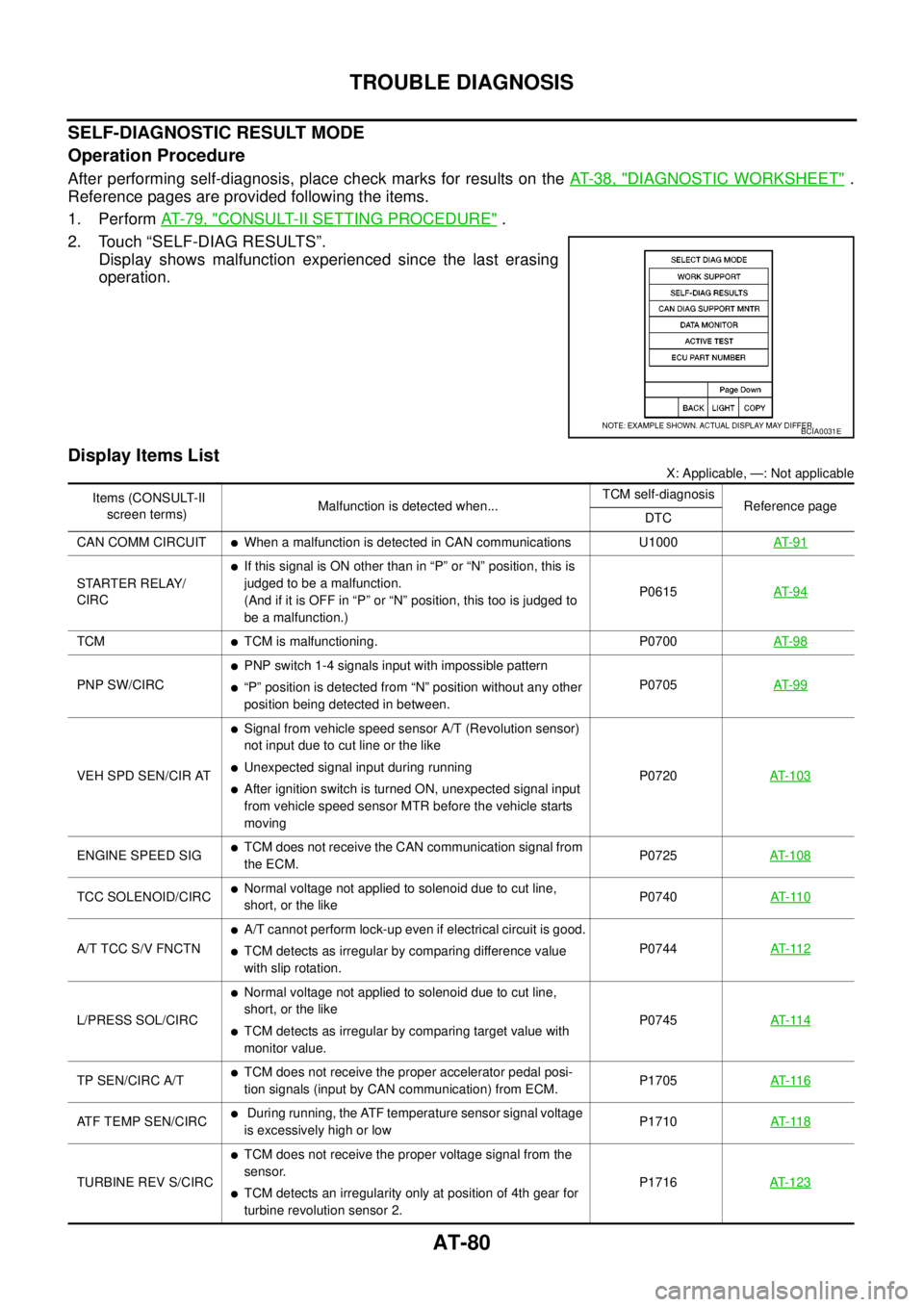
2. Touch “SELF-DIAG RESULTS”.
Display shows malfunction experienced since the last erasing
operation.
Display Items List
X: Applicable, —: Not applicable
BCIA0031E
Items (CONSULT-II
screen terms)Malfunction is detected when...TCM self-diagnosis
Reference page
DTC
CAN COMM CIRCUIT
lWhen a malfunction is detected in CAN communications U1000AT- 9 1
STARTER RELAY/
CIRC
lIf this signal is ON other than in “P” or “N” position, this is
judged to be a malfunction.
(And if it is OFF in “P” or “N” position, this too is judged to
be a malfunction.)P0615AT- 9 4
TCMlTCM is malfunctioning. P0700AT- 9 8
PNP SW/CIRC
lPNP switch 1-4 signals input with impossible pattern
l“P” position is detected from “N” position without any other
position being detected in between.P0705AT- 9 9
VEH SPD SEN/CIR AT
lSignal from vehicle speed sensor A/T (Revolution sensor)
not input due to cut line or the like
lUnexpected signal input during running
lAfter ignition switch is turned ON, unexpected signal input
from vehicle speed sensor MTR before the vehicle starts
movingP0720AT- 1 0 3
ENGINE SPEED SIGlTCM does not receive the CAN communication signal from
the ECM.P0725AT- 1 0 8
TCC SOLENOID/CIRClNormal voltage not applied to solenoid due to cut line,
short, or the likeP0740AT- 11 0
A/T TCC S/V FNCTN
lA/T cannot perform lock-up even if electrical circuit is good.
lTCM detects as irregular by comparing difference value
with slip rotation.P0744AT- 11 2
L/PRESS SOL/CIRC
lNormal voltage not applied to solenoid due to cut line,
short, or the like
lTCM detects as irregular by comparing target value with
monitor value.P0745AT- 11 4
TP SEN/CIRC A/TlTCM does not receive the proper accelerator pedal posi-
tion signals (input by CAN communication) from ECM.P1705AT- 11 6
ATF TEMP SEN/CIRClDuring running, the ATF temperature sensor signal voltage
is excessively high or lowP1710AT- 11 8
TURBINE REV S/CIRC
lTCM does not receive the proper voltage signal from the
sensor.
lTCM detects an irregularity only at position of 4th gear for
turbine revolution sensor 2.P1716AT- 1 2 3
Page 89 of 3171

TROUBLE DIAGNOSIS
AT-81
D
E
F
G
H
I
J
K
L
MA
B
AT
VEH SPD SE/CIR-MTR
lSignal (CAN communication) from vehicle speed sensor
MTR not input due to cut line or the like
lUnexpected signal input during runningP1721AT- 1 2 5
A/T INTERLOCK
lExcept during shift change, the gear position and ATF
pressure switch states are monitored and comparative
judgement made.P1730AT- 1 2 7
A/T 1ST E/BRAKING
lEach ATF pressure switch and solenoid current is moni-
tored and if a pattern is detected having engine braking 1st
gear other than in the “1” position, a malfunction is
detected.P1731AT- 1 3 0
I/C SOLENOID/CIRC
lNormal voltage not applied to solenoid due to functional
malfunction, cut line, short, or the like
lTCM detects as irregular by comparing target value with
monitor value.P1752AT- 1 3 2
I/C SOLENOID FNCTN
lTCM detects that actual gear ratio is irregular, and relation
between gear position and condition of ATF pressure
switch 3 is irregular during depressing accelerator pedal.
(Other than during shift change)
lTCM detects that relation between gear position and condi-
tion of ATF pressure switch 3 is irregular during releasing
accelerator pedal. (Other than during shift change)P1754AT- 1 3 4
FR/B SOLENOID/CIRC
lNormal voltage not applied to solenoid due to functional
malfunction, cut line, short, or the like
lTCM detects as irregular by comparing target value with
monitor value.P1757AT- 1 3 7
FR/B SOLENOID FNCT
lTCM detects that actual gear ratio is irregular, and relation
between gear position and condition of ATF pressure
switch 1 is irregular during depressing accelerator pedal.
(Other than during shift change)
lTCM detects that relation between gear position and condi-
tion of ATF pressure switch 1 is irregular during releasing
accelerator pedal. (Other than during shift change)P1759AT- 1 3 9
D/C SOLENOID/CIRC
lNormal voltage not applied to solenoid due to cut line,
short, or the like
lTCM detects as irregular by comparing target value with
monitor value.P1762AT- 1 4 2
D/C SOLENOID
FNCTN
lTCM detects that actual gear ratio is irregular, and relation
between gear position and condition of ATF pressure
switch 5 is irregular during depressing accelerator pedal.
(Other than during shift change)
lTCM detects that relation between gear position and condi-
tion of ATF pressure switch 5 is irregular during releasing
accelerator pedal. (Other than during shift change)P1764AT- 1 4 4
HLR/C SOL/CIRC
lNormal voltage not applied to solenoid due to functional
malfunction, cut line, short, or the like
lTCM detects as irregular by comparing target value with
monitor value.P1767AT- 1 4 7
HLR/C SOL FNCTN
lTCM detects that actual gear ratio is irregular, and relation
between gear position and condition of ATF pressure
switch 6 is irregular during depressing accelerator pedal.
(Other than during shift change)
lTCM detects that relation between gear position and condi-
tion of ATF pressure switch 6 is irregular during releasing
accelerator pedal. (Other than during shift change)P1769AT- 1 4 9
Items (CONSULT-II
screen terms)Malfunction is detected when...TCM self-diagnosis
Reference page
DTC
Page 91 of 3171
TROUBLE DIAGNOSIS
AT-83
D
E
F
G
H
I
J
K
L
MA
B
AT
DATA MONITOR MODE
Operation Procedure
1. PerformAT-79, "CONSULT-II SETTING PROCEDURE".
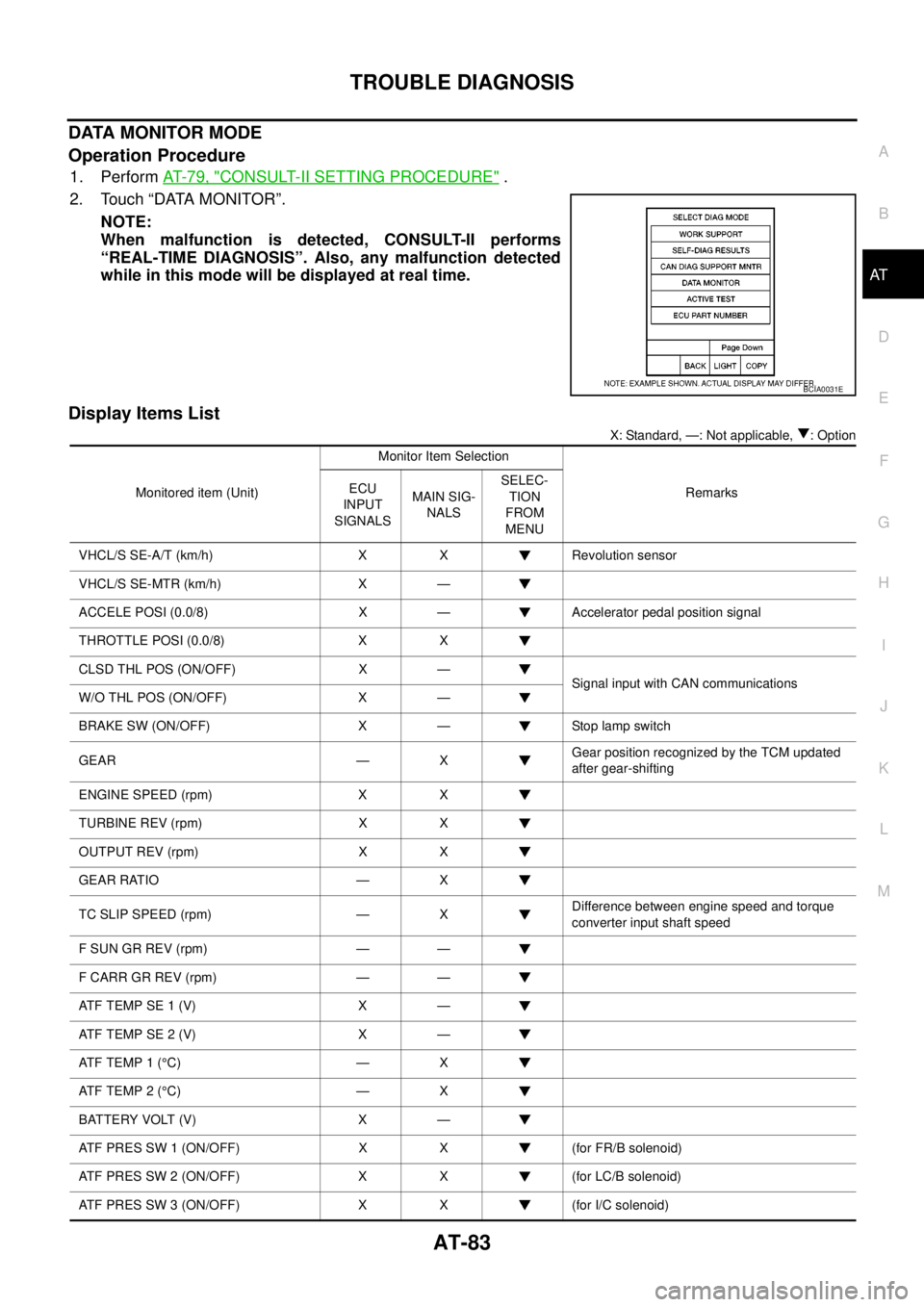
2. Touch “DATA MONITOR”.
NOTE:
When malfunction is detected, CONSULT-II performs
“REAL-TIME DIAGNOSIS”. Also, any malfunction detected
while in this mode will be displayed at real time.
Display Items List
X: Standard, —: Not applicable, : Option
BCIA0031E
Monitored item (Unit)Monitor Item Selection
Remarks ECU
INPUT
SIGNALSMAIN SIG-
NALSSELEC-
TION
FROM
MENU
VHCL/S SE-A/T (km/h) X X Revolution sensor
VHCL/S SE-MTR (km/h) X —
ACCELE POSI (0.0/8) X — Accelerator pedal position signal
THROTTLE POSI (0.0/8) X X
CLSD THL POS (ON/OFF) X —
Signal input with CAN communications
W/O THL POS (ON/OFF) X —
BRAKE SW (ON/OFF) X — Stop lamp switch
GEAR — XGear position recognized by the TCM updated
after gear-shifting
ENGINE SPEED (rpm) X X
TURBINE REV (rpm) X X
OUTPUT REV (rpm) X X
GEAR RATIO — X
TC SLIP SPEED (rpm) — XDifference between engine speed and torque
converter input shaft speed
F SUN GR REV (rpm) — —
F CARR GR REV (rpm) — —
ATFTEMPSE1(V) X —
ATFTEMPSE2(V) X —
AT F T E M P 1 (°C) — X
AT F T E M P 2 (°C) — X
BATTERY VOLT (V) X —
ATF PRES SW 1 (ON/OFF) X X (for FR/B solenoid)
ATF PRES SW 2 (ON/OFF) X X (for LC/B solenoid)
ATF PRES SW 3 (ON/OFF) X X (for I/C solenoid)
Page 97 of 3171
TROUBLE DIAGNOSIS
AT-89
D
E
F
G
H
I
J
K
L
MA
B
AT
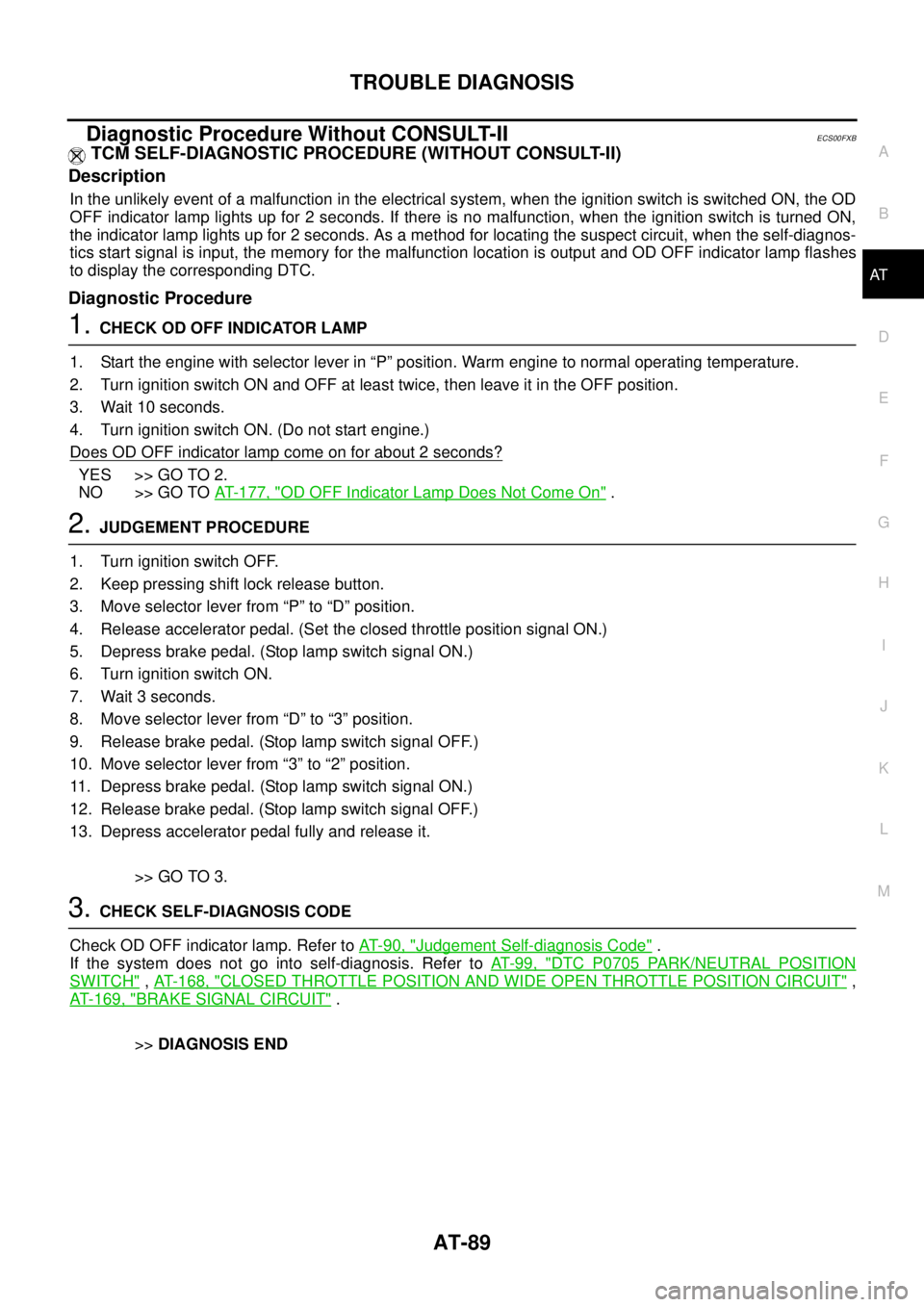
Diagnostic Procedure Without CONSULT-IIECS00FXB
TCM SELF-DIAGNOSTIC PROCEDURE (WITHOUT CONSULT-II)
Description
In the unlikely event of a malfunction in the electrical system, when the ignition switch is switched ON, the OD
OFF indicator lamp lights up for 2 seconds. If there is no malfunction, when the ignition switch is turned ON,
the indicator lamp lights up for 2 seconds. As a method for locating the suspect circuit, when the self-diagnos-
tics start signal is input, the memory for the malfunction location is output and OD OFF indicator lamp flashes
to display the corresponding DTC.
Diagnostic Procedure
1.CHECK OD OFF INDICATOR LAMP
1. Start the engine with selector lever in “P” position. Warm engine to normal operating temperature.
2. Turn ignition switch ON and OFF at least twice, then leave it in the OFF position.
3. Wait 10 seconds.
4. Turn ignition switch ON. (Do not start engine.)
Does OD OFF indicator lamp come on for about 2 seconds?
YES >> GO TO 2.
NO >> GO TOAT- 1 7 7 , "
OD OFF Indicator Lamp Does Not Come On".
2.JUDGEMENT PROCEDURE
1. Turn ignition switch OFF.
2. Keep pressing shift lock release button.
3. Move selector lever from “P” to “D” position.
4. Release accelerator pedal. (Set the closed throttle position signal ON.)
5. Depress brake pedal. (Stop lamp switch signal ON.)
6. Turn ignition switch ON.
7. Wait 3 seconds.
8. Move selector lever from “D” to “3” position.
9. Release brake pedal. (Stop lamp switch signal OFF.)
10. Move selector lever from “3” to “2” position.
11. Depress brake pedal. (Stop lamp switch signal ON.)
12. Release brake pedal. (Stop lamp switch signal OFF.)
13. Depress accelerator pedal fully and release it.
>> GO TO 3.
3.CHECK SELF-DIAGNOSIS CODE
Check OD OFF indicator lamp. Refer toAT-90, "
Judgement Self-diagnosis Code".
If the system does not go into self-diagnosis. Refer toAT-99, "
DTC P0705 PARK/NEUTRAL POSITION
SWITCH",AT- 1 6 8 , "CLOSED THROTTLE POSITION AND WIDE OPEN THROTTLE POSITION CIRCUIT",
AT- 1 6 9 , "
BRAKE SIGNAL CIRCUIT".
>>DIAGNOSIS END
Page 98 of 3171
AT-90
TROUBLE DIAGNOSIS
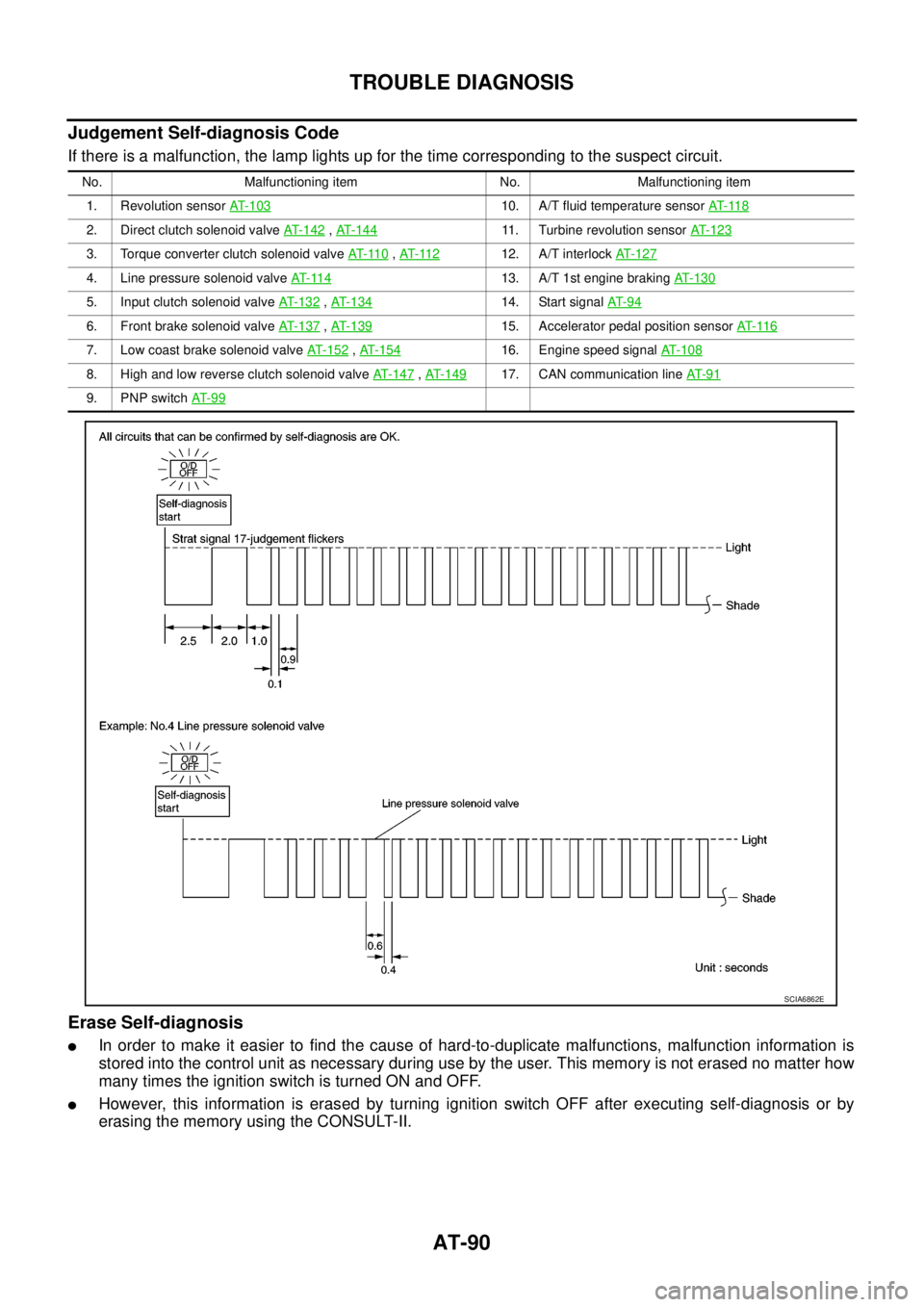
Judgement Self-diagnosis Code
If there is a malfunction, the lamp lights up for the time corresponding to the suspect circuit.
Erase Self-diagnosis
lIn order to make it easier to find the cause of hard-to-duplicate malfunctions, malfunction information is
stored into the control unit as necessary during use by the user. This memory is not erased no matter how
many times the ignition switch is turned ON and OFF.
lHowever, this information is erased by turning ignition switch OFF after executing self-diagnosis or by
erasing the memory using the CONSULT-II.
No. Malfunctioning item No. Malfunctioning item
1. Revolution sensorAT- 1 0 3
10. A/T fluid temperature sensorAT- 11 8
2. Direct clutch solenoid valveAT- 1 4 2,AT-14411. Turbine revolution sensorAT- 1 2 3
3. Torque converter clutch solenoid valveAT- 11 0,AT- 11 212. A/T interlockAT-127
4. Line pressure solenoid valveAT- 11 413. A/T 1st engine brakingAT-130
5. Input clutch solenoid valveAT- 1 3 2,AT- 1 3 414. Start signalAT- 9 4
6. Front brake solenoid valveAT-137,AT- 1 3 915. Accelerator pedal position sensorAT- 11 6
7. Low coast brake solenoid valveAT- 1 5 2,AT- 1 5 416. Engine speed signalAT-108
8. High and low reverse clutch solenoid valveAT-147,AT- 1 4 917. CAN communication lineAT- 9 1
9. PNP switchAT- 9 9
SCIA6862E
Page 99 of 3171
DTC U1000 CAN COMMUNICATION LINE
AT-91
D
E
F
G
H
I
J
K
L
MA
B
AT
DTC U1000 CAN COMMUNICATION LINEPFP:23710
DescriptionECS00FXC
CAN (Controller Area Network) is a serial communication line for real time application. It is an on-vehicle mul-
tiplex communication line with high data communication speed and excellent malfunction detection ability.
Many electronic control units are equipped onto a vehicle, and each control unit shares information and links
with other control units during operation (not independent). In CAN communication, control units are con-
nected with 2 communication lines (CAN H line, CAN L line) allowing a high rate of information transmission
with less wiring. Each control unit transmits/receives data but selectively reads required data only.
On Board Diagnosis LogicECS00FXD
Diagnostic trouble code “U1000 CAN COMM CIRCUIT” with CONSULT-II or 17th judgement flicker without
CONSULT-II is detected when TCM cannot communicate to other control units.
Possible CauseECS00FXE
Harness or connectors
(CAN communication line is open or shorted.)
DTC Confirmation ProcedureECS00FXF
NOTE:
If “DTC Confirmation Procedure” has been previously performed, always turn ignition switch OFF and
wait at least 10 seconds before performing the next test.
After the repair, perform the following procedure to confirm the malfunction is eliminated.
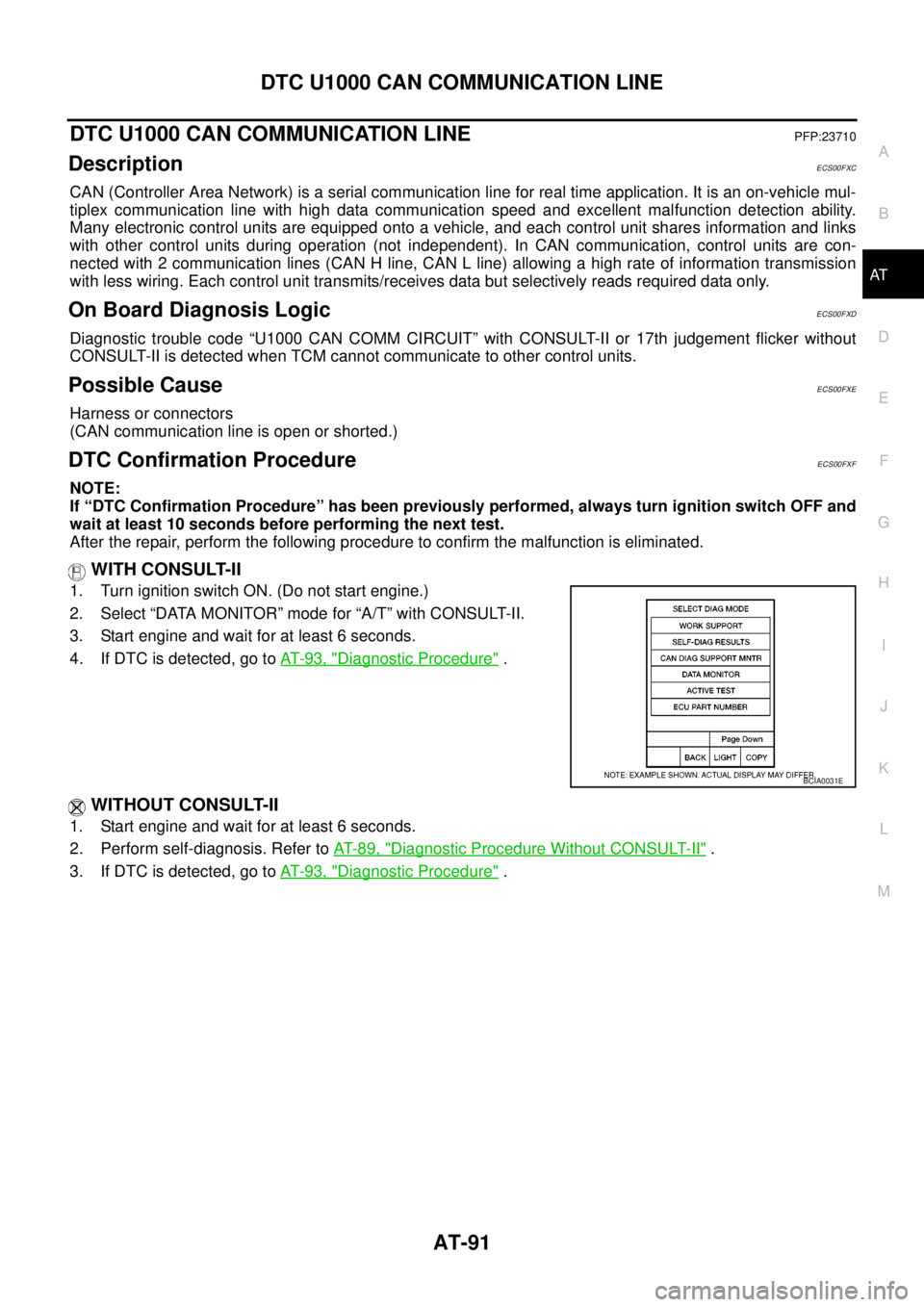
WITH CONSULT-II
1. Turn ignition switch ON. (Do not start engine.)
2. Select “DATA MONITOR” mode for “A/T” with CONSULT-II.
3. Start engine and wait for at least 6 seconds.
4. If DTC is detected, go toAT-93, "
Diagnostic Procedure".
WITHOUT CONSULT-II
1. Start engine and wait for at least 6 seconds.
2. Perform self-diagnosis. Refer toAT-89, "
Diagnostic Procedure Without CONSULT-II".
3. If DTC is detected, go toAT-93, "
Diagnostic Procedure".
BCIA0031E
Page 101 of 3171
DTC U1000 CAN COMMUNICATION LINE
AT-93
D
E
F
G
H
I
J
K
L
MA
B
AT
Data are reference value and are measured between each terminal and ground.
Diagnostic ProcedureECS00FXH
1.CHECK CAN COMMUNICATION CIRCUIT
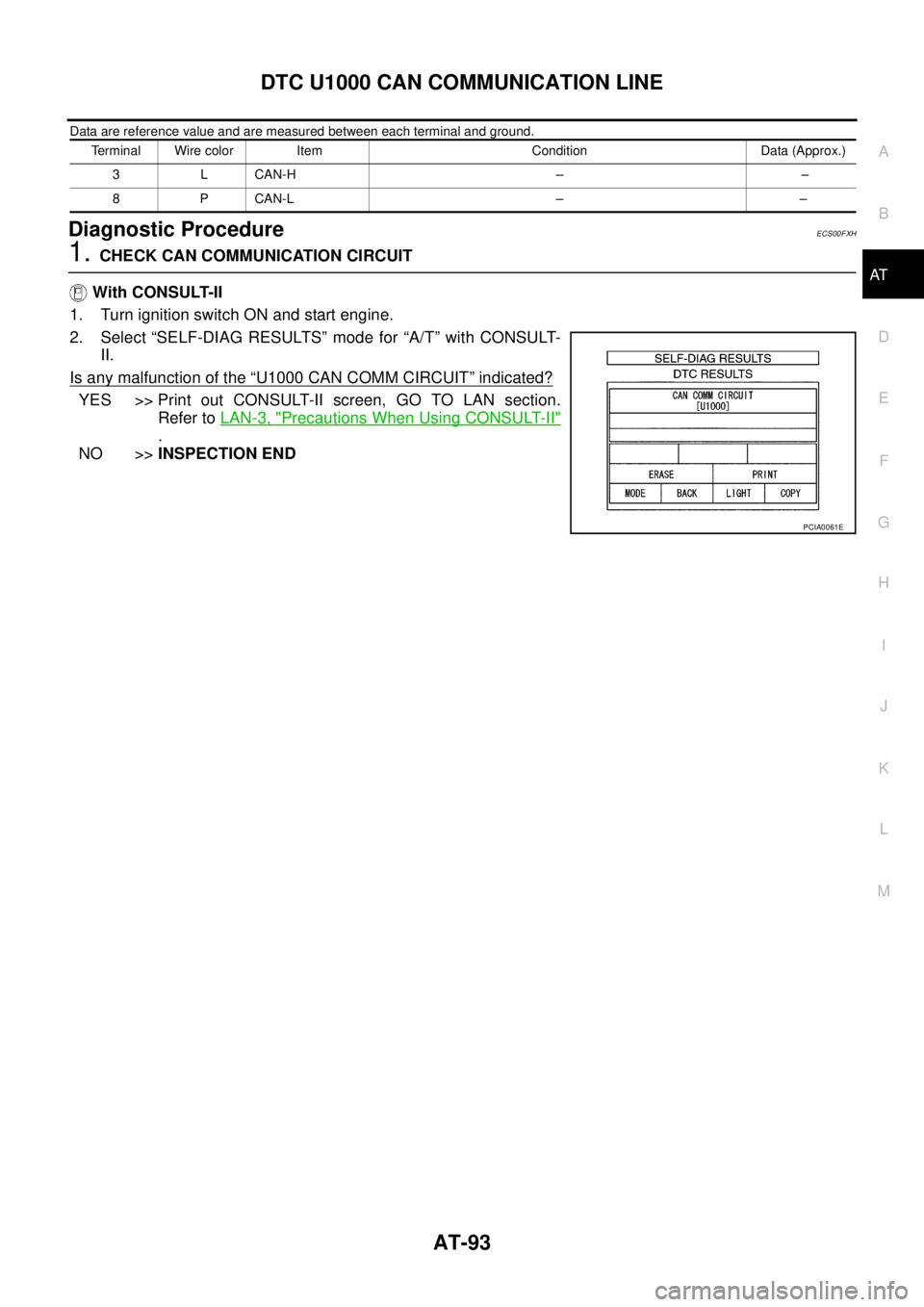
With CONSULT-II
1. Turn ignition switch ON and start engine.
2. Select “SELF-DIAG RESULTS” mode for “A/T” with CONSULT-
II.
Is any malfunction of the
“U1000 CAN COMM CIRCUIT”indicated?
YES >> Print out CONSULT-II screen, GO TO LAN section.
Refer toLAN-3, "
Precautions When Using CONSULT-II"
.
NO >>INSPECTION END
Terminal Wire color Item Condition Data (Approx.)
3 L CAN-H – –
8 P CAN-L – –
PCIA0061E