warning NISSAN NAVARA 2005 Repair Repair Manual
[x] Cancel search | Manufacturer: NISSAN, Model Year: 2005, Model line: NAVARA, Model: NISSAN NAVARA 2005Pages: 3171, PDF Size: 49.59 MB
Page 846 of 3171
![NISSAN NAVARA 2005 Repair Repair Manual BRC-24
[ABS]
TROUBLE DIAGNOSIS
BASIC INSPECTION 3 ABS WARNING LAMP AND BRAKE WARNING LAMP INSPECTION
ON and OFF Timing for ABS Warning Lamp, Brake Warning Lamp
´:ON –:OFF
Note 1:Brake warning lamp](/img/5/57362/w960_57362-845.png "NISSAN NAVARA 2005 Repair Repair Manual BRC-24
[ABS]
TROUBLE DIAGNOSIS
BASIC INSPECTION 3 ABS WARNING LAMP AND BRAKE WARNING LAMP INSPECTION
ON and OFF Timing for ABS Warning Lamp, Brake Warning Lamp
´:ON –:OFF
Note 1:Brake warning lamp")
BRC-24
[ABS]
TROUBLE DIAGNOSIS
BASIC INSPECTION 3 ABS WARNING LAMP AND BRAKE WARNING LAMP INSPECTION
ON and OFF Timing for ABS Warning Lamp, Brake Warning Lamp
´:ON –:OFF
Note 1:Brake warning lamp will turn on in case of operating parking brake (switch turned on) or of a actuating brake fluid level switch
(brake fluid is insufficient).
Note 2:After starting engine, turn OFF.
Check the following items when unsuitable for an above condition.
lABS warning lamp: Refer toBRC-28, "Inspection 4 CAN Communication Circuit".
lBrake waning lamp: Refer toBRC-28, "Inspection 4 CAN Communication Circuit",BRC-30, "Inspection 6
Brake Fluid Level Switch Circuit",BRC-32, "Inspection 7 Parking Brake Switch Circuit".
If malfunction is not found, refer toBRC-33, "
Inspection 8 Warning lamp system".
Inspection 1 Wheel Sensor SystemEFS005TZ
Check each part according to CONSULT-II self-diagnostic results, and then identify the parts to be replaced.
CAUTION:
Check each part between wheel sensor terminals.
INSPECTION PROCEDURE
1.CHECK SELF-DIAGNOSTIC RESULTS
Check self-diagnostic results.
Is above displayed in self-diagnosis display items?
YES >> GO TO 2.
NO >> INSPECTION END
2.CHECK TYRE
Check air pressure, wear and size.
Are air pressure, wear and size within standard values?
YES >> GO TO 3.
NO >> Adjust air pressure, or replace tyre.
Condition ABS warning lampBrake warning lamp
[Note 1]Remarks
Ignition SW OFF – — —
Approx. 2 seconds after ignition
switch is turned ON´´[Note 2] —
Approx. 2 seconds later after ignition
switch ON–´[Note 2]Go out 2 seconds after ignition
switch is turned ON.
ABS error´—There is an ABS actuator and
electric unit (control unit) error.
(Power, ground or system mal-
function)
EBD error´´—
Self-diagnostic results
FR RH SENSOR-1,-2
FR LH SENSOR- 1,-2
RR RH SENSOR-1,-2
RR LH SENSOR-1,- 2
ABS SENSOR [MALFUNCTION SIGNAL]
Page 855 of 3171
![NISSAN NAVARA 2005 Repair Repair Manual TROUBLE DIAGNOSIS
BRC-33
[ABS]
C
D
E
G
H
I
J
K
L
MA
B
BRC
Inspection 8 Warning lamp systemEFS005U7
INSPECTION PROCEDURE
1.CHECK SELF-DIAGNOSTIC RESULTS
Perform self-diagnosis of ABS actuator and elect](/img/5/57362/w960_57362-854.png "NISSAN NAVARA 2005 Repair Repair Manual TROUBLE DIAGNOSIS
BRC-33
[ABS]
C
D
E
G
H
I
J
K
L
MA
B
BRC
Inspection 8 Warning lamp systemEFS005U7
INSPECTION PROCEDURE
1.CHECK SELF-DIAGNOSTIC RESULTS
Perform self-diagnosis of ABS actuator and elect")
TROUBLE DIAGNOSIS
BRC-33
[ABS]
C
D
E
G
H
I
J
K
L
MA
B
BRC
Inspection 8 Warning lamp systemEFS005U7
INSPECTION PROCEDURE
1.CHECK SELF-DIAGNOSTIC RESULTS
Perform self-diagnosis of ABS actuator and electric unit (control unit). Refer toBRC-18, "
Self-Diagnosis".
OK or NG
OK >> GO TO 2.
NG >> Check items displayed by self-diagnosis. Refer toBRC-18, "
Display Item List".
2.CHECK COMBINATION METER
Check if the indication and operation of combination meter are normal. Refer toDI-13, "
Self-Diagnosis Mode
of Combination Meter".
OK or NG
OK >> INSPECTION END
NG >> Repair or replace combination meter. Refer toDI-27, "
Removal and Installation of Combination
Meter".
Symptom 1: Excessive ABS Function Operation FrequencyEFS005U8
1.CHECK START
Check longitudinal brake force distribution using a brake tester. Refer toBR-35, "
SERVICE DATA AND SPEC-
IFICATIONS (SDS)".
OK or NG
OK >> GO TO 2.
NG >> Check the following system. If any malfunction is found, repair or replace malfunctioning parts.
lBrake booster. Refer toBR-19, "BRAKE BOOSTER".
lHydraulic line. Refer toBR-12, "BRAKE TUBE AND HOSE".
lFront brake caliper. Refer toBR-24, "FRONT DISC BRAKE".
lRear wheel cylinder. Refer toBR-30, "REAR DRUM BRAKE".
2.CHECK FRONT AND REAR AXLE
Make sure that there is no excessive play in the front and rear axles. Refer to Front:FAX-5, "
WHEEL BEAR-
ING INSPECTION",Rear:RAX-6, "Rear Axle Bearing".
OK or NG
OK >> GO TO 3.
NG >> Repair.
3.CHECK WHEEL SENSOR AND SENSOR ROTOR
Check wheel sensor and sensor rotor for the following.
lWheel sensor installation for damage
lWheel sensor rotor installation for damage
lWheel sensor connector connection
lWheel sensor harness inspection
OK or NG
OK >> GO TO 4.
NG >>
lReplace wheel sensor or sensor rotor.
lRepair harness.
Page 856 of 3171
![NISSAN NAVARA 2005 Repair Repair Manual BRC-34
[ABS]
TROUBLE DIAGNOSIS
4.CHECK ABS WARNING LAMP DISPLAY
Make sure that the ABS warning lamp is turned off after the ignition switch is turned ON or when driving.
OK or NG
OK >> Normal
NG >> Pe](/img/5/57362/w960_57362-855.png "NISSAN NAVARA 2005 Repair Repair Manual BRC-34
[ABS]
TROUBLE DIAGNOSIS
4.CHECK ABS WARNING LAMP DISPLAY
Make sure that the ABS warning lamp is turned off after the ignition switch is turned ON or when driving.
OK or NG
OK >> Normal
NG >> Pe")
BRC-34
[ABS]
TROUBLE DIAGNOSIS
4.CHECK ABS WARNING LAMP DISPLAY
Make sure that the ABS warning lamp is turned off after the ignition switch is turned ON or when driving.
OK or NG
OK >> Normal
NG >> Perform self-diagnosis. Refer toBRC-18, "
Self-Diagnosis".
Symptom 2: Unexpected Pedal ReactionEFS005U9
1.CHECK BRAKE PEDAL STROKE
Check brake pedal stroke. Refer toBR-6, "
Inspection and Adjustment".
Is the stroke too big?
YES >>lBleed air from brake piping. Refer toBR-11, "Bleeding Brake System".
lCheck brake pedal, brake booster, and master cylinder for mount play, looseness, brake sys-
tem fluid leakage, etc. Repair if necessary. Refer to Brake pedal:BR-8, "
COMPONENTS",
brake booster and master cylinder:BR-20, "
COMPONENTS".
NO >> GO TO 2.
2.CHECK FUNCTION
Disconnect ABS actuator and electric unit (control unit) connector to deactivate ABS. Check if braking force is
normal in this condition. Connect connector after inspection.
OK or NG
OK >> GO TO procedure 3 “CHECK WHEEL SENSOR AND SENSOR ROTOR” of symptom 1. Refer to
BRC-33, "
Symptom 1: Excessive ABS Function Operation Frequency".
NG >> Check the following system. If any malfunction is found, repair or replace malfunctioning parts.
lBrake booster. Refer toBR-19, "BRAKE BOOSTER".
lHydraulic line. Refer toBR-12, "BRAKE TUBE AND HOSE".
lFront brake caliper. Refer toBR-24, "FRONT DISC BRAKE".
lRear wheel cylinder. Refer toBR-30, "REAR DRUM BRAKE".
Symptom 3: The Stopping Distance Is LongEFS005UA
CAUTION:
The stopping distance on slippery road surfaces might be longer with the ABS operating than when
the ABS is not operating.
1.CHECK FUNCTION
Turn ignition switch OFF. Disconnect ABS actuator and electric unit (control unit) connector to deactivate ABS.
In this condition, check stopping distance. After inspection, connect connector.
OK or NG
OK >> GO TO procedure 3 “CHECK WHEEL SENSOR AND SENSOR ROTOR” of symptom 1. Refer to
BRC-33, "
Symptom 1: Excessive ABS Function Operation Frequency".
NG >>
lBleed air from the brake piping. Refer toBR-11, "Bleeding Brake System".
lCheck the following system. If any malfunction is found, repair or replace malfunctioning parts.
–Brake booster. Refer toBR-19, "BRAKE BOOSTER".
–Hydraulic line. Refer toBR-12, "BRAKE TUBE AND HOSE".
–Front brake caliper. Refer toBR-24, "FRONT DISC BRAKE".
–Rear wheel cylinder. Refer toBR-30, "REAR DRUM BRAKE".
Page 857 of 3171
![NISSAN NAVARA 2005 Repair Repair Manual TROUBLE DIAGNOSIS
BRC-35
[ABS]
C
D
E
G
H
I
J
K
L
MA
B
BRC
Symptom 4: ABS Function Does Not OperateEFS005UB
CAUTION:
ABS does not operate when speed is 10 km/h (6 MPH) or lower.
1.CHECK ABS WARNING LAM](/img/5/57362/w960_57362-856.png "NISSAN NAVARA 2005 Repair Repair Manual TROUBLE DIAGNOSIS
BRC-35
[ABS]
C
D
E
G
H
I
J
K
L
MA
B
BRC
Symptom 4: ABS Function Does Not OperateEFS005UB
CAUTION:
ABS does not operate when speed is 10 km/h (6 MPH) or lower.
1.CHECK ABS WARNING LAM")
TROUBLE DIAGNOSIS
BRC-35
[ABS]
C
D
E
G
H
I
J
K
L
MA
B
BRC
Symptom 4: ABS Function Does Not OperateEFS005UB
CAUTION:
ABS does not operate when speed is 10 km/h (6 MPH) or lower.
1.CHECK ABS WARNING LAMP DISPLAY
Make sure that the ABS warning lamp is turned off after the ignition switch is turned ON or when driving.
OK or NG
OK >> GO TO procedure 3 “CHECK WHEEL SENSOR AND SENSOR ROTOR” of symptom1. Refer to
BRC-33, "
Symptom 1: Excessive ABS Function Operation Frequency".
NG >> Perform self-diagnosis. Refer toBRC-18, "
Self-Diagnosis".
Symptom 5: Pedal Vibration or ABS Operation Sound OccursEFS005UC
CAUTION:
Under the following conditions, ABS is activated and vibration is felt when brake pedal is lightly
depressed (just place a foot on it). However, this is normal.
lWhen shifting gears
lWhen driving on slippery road
lDuring cornering at high speed
lWhen passing over bumps or grooves [at approximately 50 mm (1.97 in) or more]
lWhen pulling away just after starting engine [at approximately 10 km/h (6 MPH) or more]
1.SYMPTOM CHECK 1
Check if there is pedal vibration or operation noise when the engine is started.
Do symptoms occur?
YES >> GO TO 2.
NO >> Perform self-diagnosis. Refer toBRC-18, "
Self-Diagnosis".
2.SYMPTOM CHECK 2
Check symptoms when electrical component (headlamps, etc.) switches are operated.
Do symptoms occur?
YES >> Check if there is a radio, antenna, antenna lead wire, or wiring close to the control unit. If there is,
move it farther away.
NO >> GO TO procedure 3²CHECK WHEEL SENSOR AND SENSOR ROTOR²of symptom 1. Refer to
BRC-33, "
Symptom 1: Excessive ABS Function Operation Frequency".
Symptom 6: ABS Warning Lamp Indication Is Not NormalEFS005UD
NOTE:
Lighting condition of ABS warning lamp refer toBRC-24, "
BASIC INSPECTION 3 ABS WARNING LAMP AND
BRAKE WARNING LAMP INSPECTION".
1.CHECK COMBINATION METER INDICATION
Check the combination meter indication and operation. Refer toDI-13, "
Self-Diagnosis Mode of Combination
Meter".
OK or NG
OK >> GO TO 2.
NG >> Combination meter is malfunctioning. Check combination meter. Refer toDI-4, "
COMBINATION
METERS".
Page 866 of 3171
CL-2
PRECAUTIONS
PRECAUTIONS
PFP:00001
ServiceNoticeorPrecautionsECS00ICC
lRecommended clutch fluid is brake fluid “DOT 3” or “DOT 4”. Refer toMA-14, "RECOMMENDED FLUIDS
AND LUBRICANTS".
lDo not reuse drained clutch fluid.
lBe careful not to splash clutch fluid on painted areas.
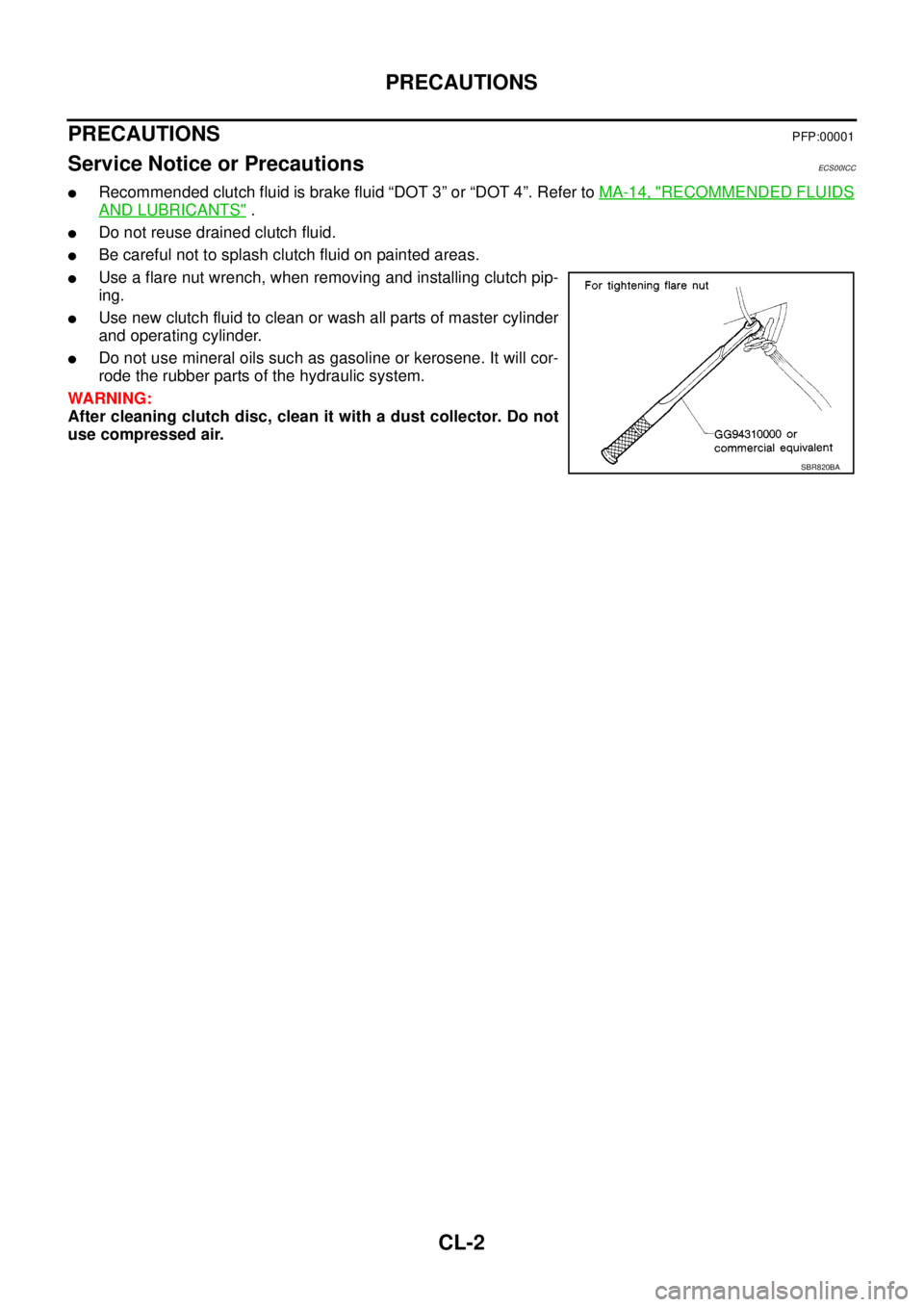
lUse a flare nut wrench, when removing and installing clutch pip-
ing.
lUse new clutch fluid to clean or wash all parts of master cylinder
and operating cylinder.
lDo not use mineral oils such as gasoline or kerosene. It will cor-
rode the rubber parts of the hydraulic system.
WARNING:
After cleaning clutch disc, clean it with a dust collector. Do not
use compressed air.
SBR820BA
Page 891 of 3171
ENGINE COOLANT
CO-7
C
D
E
F
G
H
I
J
K
L
MA
CO
ENGINE COOLANTPFP:KQ100
InspectionEBS01E6P
LEVEL CHECK
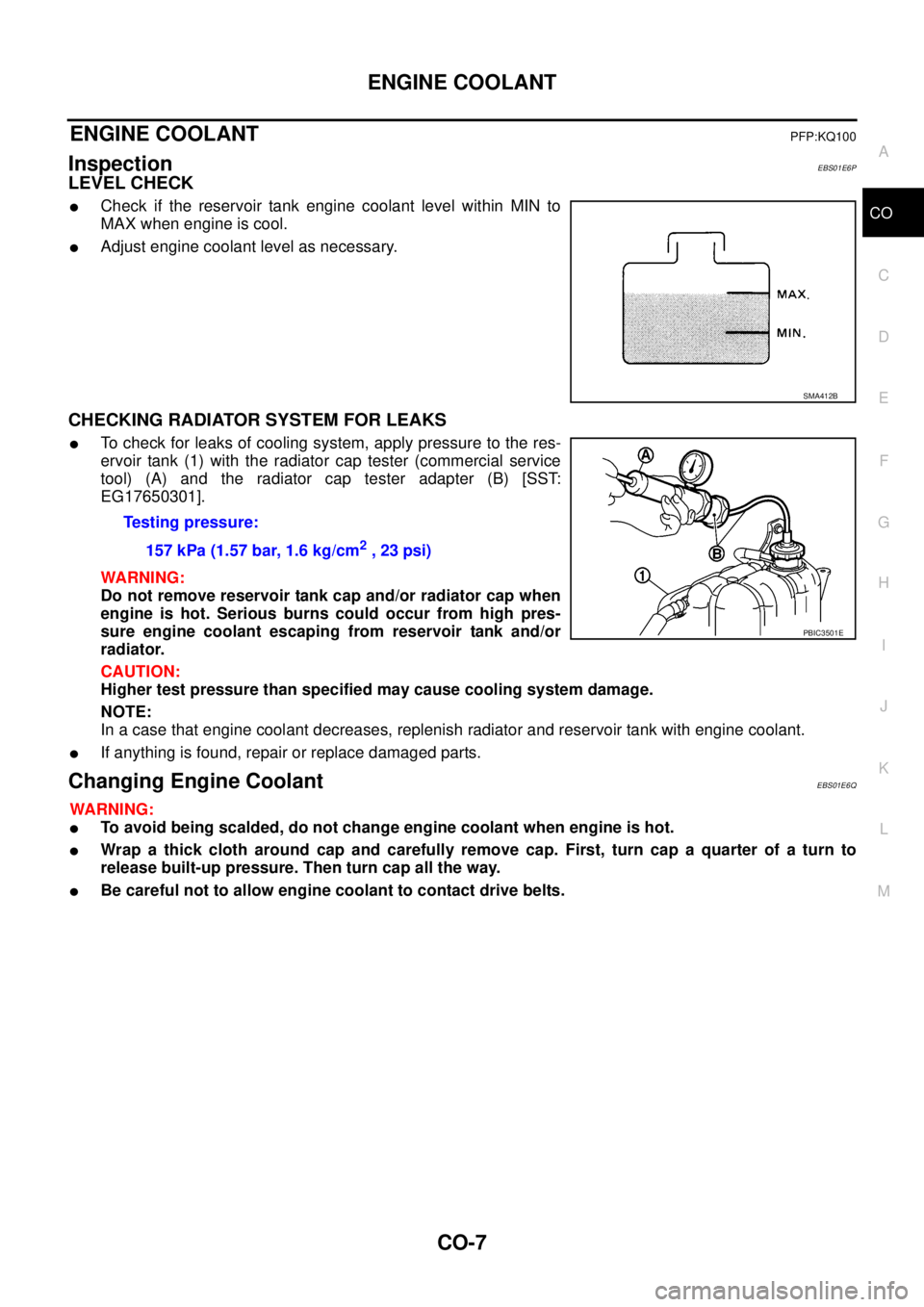
lCheck if the reservoir tank engine coolant level within MIN to
MAX when engine is cool.
lAdjust engine coolant level as necessary.
CHECKING RADIATOR SYSTEM FOR LEAKS
lTo check for leaks of cooling system, apply pressure to the res-
ervoir tank (1) with the radiator cap tester (commercial service
tool) (A) and the radiator cap tester adapter (B) [SST:
EG17650301].
WARNING:
Do not remove reservoir tank cap and/or radiator cap when
engine is hot. Serious burns could occur from high pres-
sure engine coolant escaping from reservoir tank and/or
radiator.
CAUTION:
Higher test pressure than specified may cause cooling system damage.
NOTE:
In a case that engine coolant decreases, replenish radiator and reservoir tank with engine coolant.
lIf anything is found, repair or replace damaged parts.
Changing Engine CoolantEBS01E6Q
WARNING:
lTo avoid being scalded, do not change engine coolant when engine is hot.
lWrap a thick cloth around cap and carefully remove cap. First, turn cap a quarter of a turn to
release built-up pressure. Then turn cap all the way.
lBe careful not to allow engine coolant to contact drive belts.
SMA412B
Testing pressure:
157 kPa (1.57 bar, 1.6 kg/cm
2,23psi)
PBIC3501E
Page 895 of 3171
RADIATOR
CO-11
C
D
E
F
G
H
I
J
K
L
MA
CO
RADIATORPFP:21400
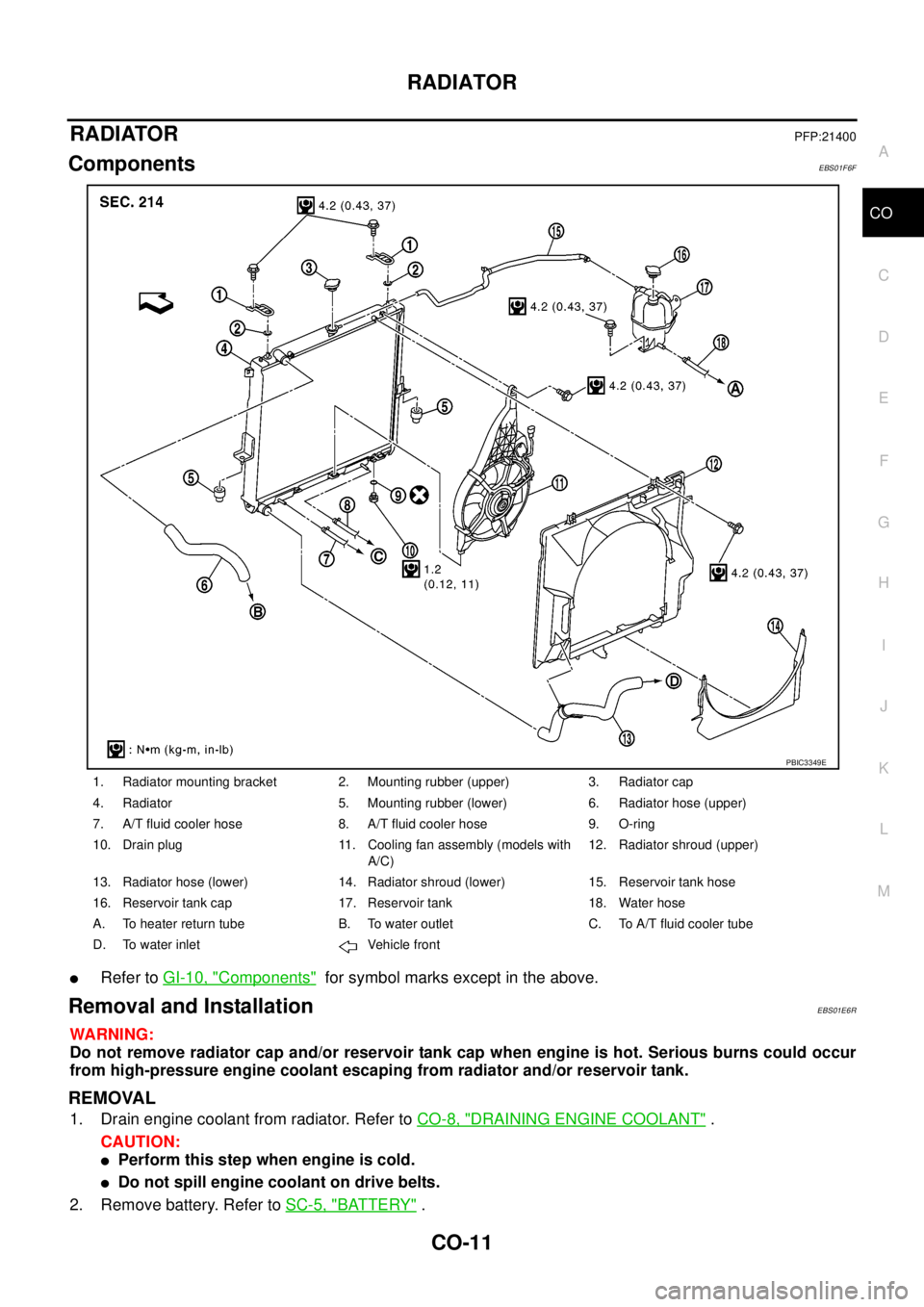
ComponentsEBS01F6F
lRefer toGI-10, "Components"for symbol marks except in the above.
Removal and InstallationEBS01E6R
WARNING:
Do not remove radiator cap and/or reservoir tank cap when engine is hot. Serious burns could occur
from high-pressure engine coolant escaping from radiator and/or reservoir tank.
REMOVAL
1. Drain engine coolant from radiator. Refer toCO-8, "DRAINING ENGINE COOLANT".
CAUTION:
lPerform this step when engine is cold.
lDo not spill engine coolant on drive belts.
2. Remove battery. Refer toSC-5, "
BATTERY".
1. Radiator mounting bracket 2. Mounting rubber (upper) 3. Radiator cap
4. Radiator 5. Mounting rubber (lower) 6. Radiator hose (upper)
7. A/T fluid cooler hose 8. A/T fluid cooler hose 9. O-ring
10. Drain plug 11. Cooling fan assembly (models with
A/C)12. Radiator shroud (upper)
13. Radiator hose (lower) 14. Radiator shroud (lower) 15. Reservoir tank hose
16. Reservoir tank cap 17. Reservoir tank 18. Water hose
A. To heater return tube B. To water outlet C. To A/T fluid cooler tube
D. To water inlet Vehicle front
PBIC3349E
Page 902 of 3171
![NISSAN NAVARA 2005 Repair Repair Manual CO-18
RADIATOR (ALUMINUM TYPE)
5. Make sure that there is no leakage.
Refer toCO-18, "
INSPECTION".
INSPECTION
1. Apply pressure with the radiator cap tester adapter [SST] and
the radiator cap tester](/img/5/57362/w960_57362-901.png "NISSAN NAVARA 2005 Repair Repair Manual CO-18
RADIATOR (ALUMINUM TYPE)
5. Make sure that there is no leakage.
Refer toCO-18, \"
INSPECTION\".
INSPECTION
1. Apply pressure with the radiator cap tester adapter [SST] and
the radiator cap tester")
CO-18
RADIATOR (ALUMINUM TYPE)
5. Make sure that there is no leakage.
Refer toCO-18, "
INSPECTION".
INSPECTION
1. Apply pressure with the radiator cap tester adapter [SST] and
the radiator cap tester (commercial service tool).
WARNING:
To prevent the risk of hose coming undone while under
pressure, securely fasten it down with hose clamp.
CAUTION:
Attach hose to A/T fluid cooler to seal its inlet and outlet. (A/
T models)
2. Check for leakage by soaking radiator in water container with
the testing pressure applied.Testing pressure
: 157 kPa (1.57 bar, 1.6 kg/cm
2,23psi)
SLC933
SLC934
Page 905 of 3171
WATER PUMP
CO-21
C
D
E
F
G
H
I
J
K
L
MA
CO
WAT E R P U MPPFP:21020
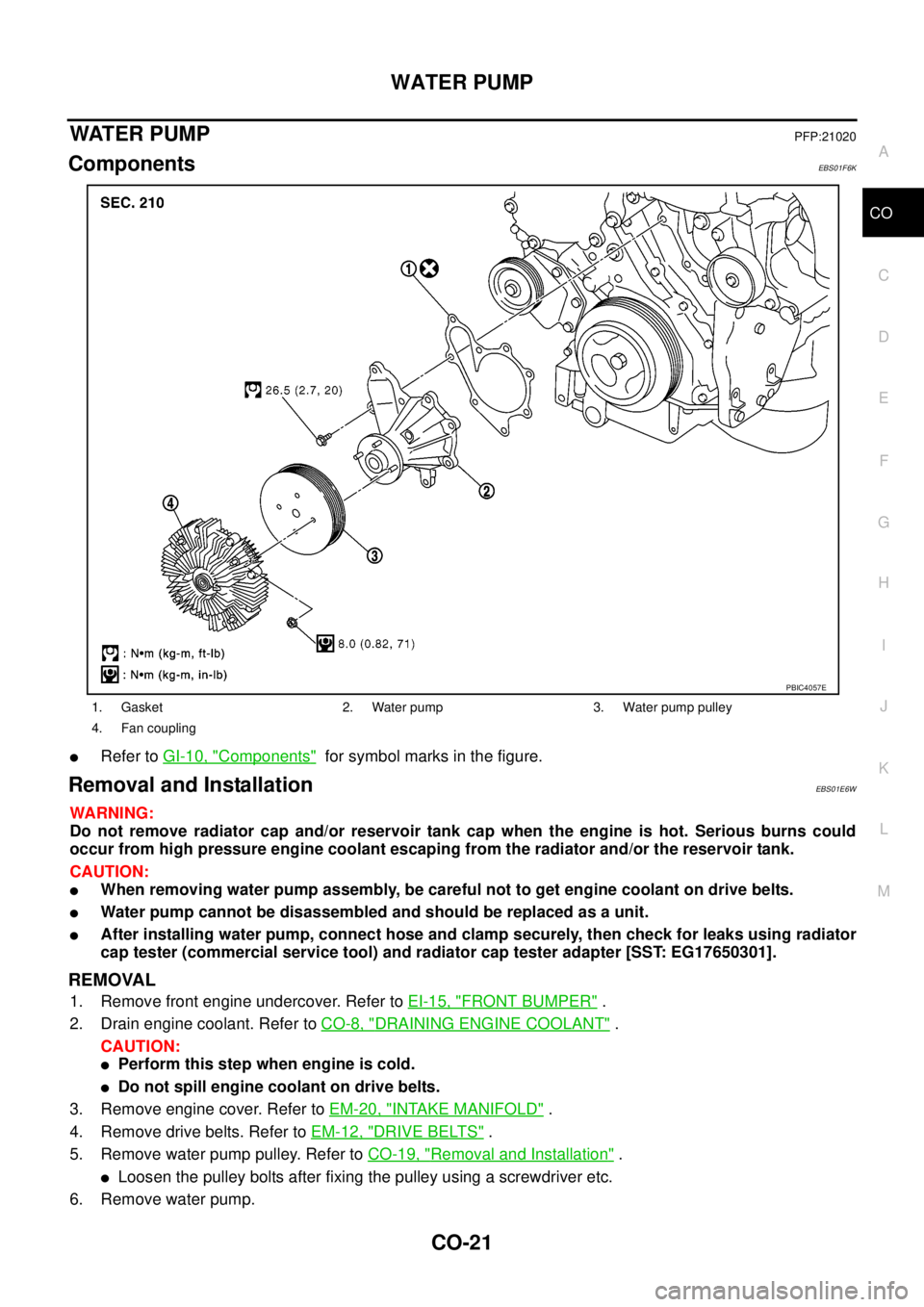
ComponentsEBS01F6K
lRefer toGI-10, "Components"for symbol marks in the figure.
Removal and InstallationEBS01E6W
WARNING:
Do not remove radiator cap and/or reservoir tank cap when the engine is hot. Serious burns could
occur from high pressure engine coolant escaping from the radiator and/or the reservoir tank.
CAUTION:
lWhen removing water pump assembly, be careful not to get engine coolant on drive belts.
lWater pump cannot be disassembled and should be replaced as a unit.
lAfter installing water pump, connect hose and clamp securely, then check for leaks using radiator
cap tester (commercial service tool) and radiator cap tester adapter [SST: EG17650301].
REMOVAL
1. Remove front engine undercover. Refer toEI-15, "FRONT BUMPER".
2. Drain engine coolant. Refer toCO-8, "
DRAINING ENGINE COOLANT".
CAUTION:
lPerform this step when engine is cold.
lDo not spill engine coolant on drive belts.
3. Remove engine cover. Refer toEM-20, "
INTAKE MANIFOLD".
4. Remove drive belts. Refer toEM-12, "
DRIVE BELTS".
5. Remove water pump pulley. Refer toCO-19, "
Removal and Installation".
lLoosen the pulley bolts after fixing the pulley using a screwdriver etc.
6. Remove water pump.
1. Gasket 2. Water pump 3. Water pump pulley
4. Fan coupling
PBIC4057E
Page 908 of 3171
CO-24
THERMOSTAT AND WATER PIPING
Removal and Installation
EBS01E6X
WARNING:
Do not remove radiator cap and/or reservoir tank cap when engine is hot. Serious burns could occur
from high pressure engine coolant escaping from radiator and/or reservoir tank.
REMOVAL
1. Remove front engine undercover and middle engine undercover. Refer toEI-15, "FRONT BUMPER".
2. Drain engine coolant from radiator drain plug at the bottom of radiator, and from water drain plug at the
side of cylinder block. Refer toCO-7, "
Changing Engine Coolant"andEM-110, "CYLINDER BLOCK".
CAUTION:
Perform this step when engine is cold.
3. Remove engine cover. Refer toEM-20, "
INTAKE MANIFOLD".
4. Disconnect radiator hoses (upper and lower) from engine side. Refer toCO-11, "
RADIATOR".
5. Remove air inlet pipe and air duct between air cleaner case and turbocharger. Refer toEM-15, "
AIR
CLEANER AND AIR DUCT"andEM-28, "TURBO CHARGER".
6. Remove water outlet, water inlet and thermostat.
7. Remove thermostat housing.
8. Disconnect heater return hose and water hoses at heater return pipe side, and remove heater return pipe.
9. Remove oil level gauge guide mounting bolt, vacuum hoses (to turbocharger boost control solenoid valve)
and spill hose. Refer toEM-36, "
OIL PAN AND OIL STRAINER",EM-20, "INTAKE MANIFOLD"andEM-
44, "INJECTION TUBE AND FUEL INJECTOR".
10. Disconnect water hoses (to EGR cooler) (A/T models), vacuum hoses and heater feed hose at heater
feed pipe side, and remove heater feed pipe. Refer toEM-20, "
INTAKE MANIFOLD".
INSPECTION AFTER REMOVAL
Thermostat
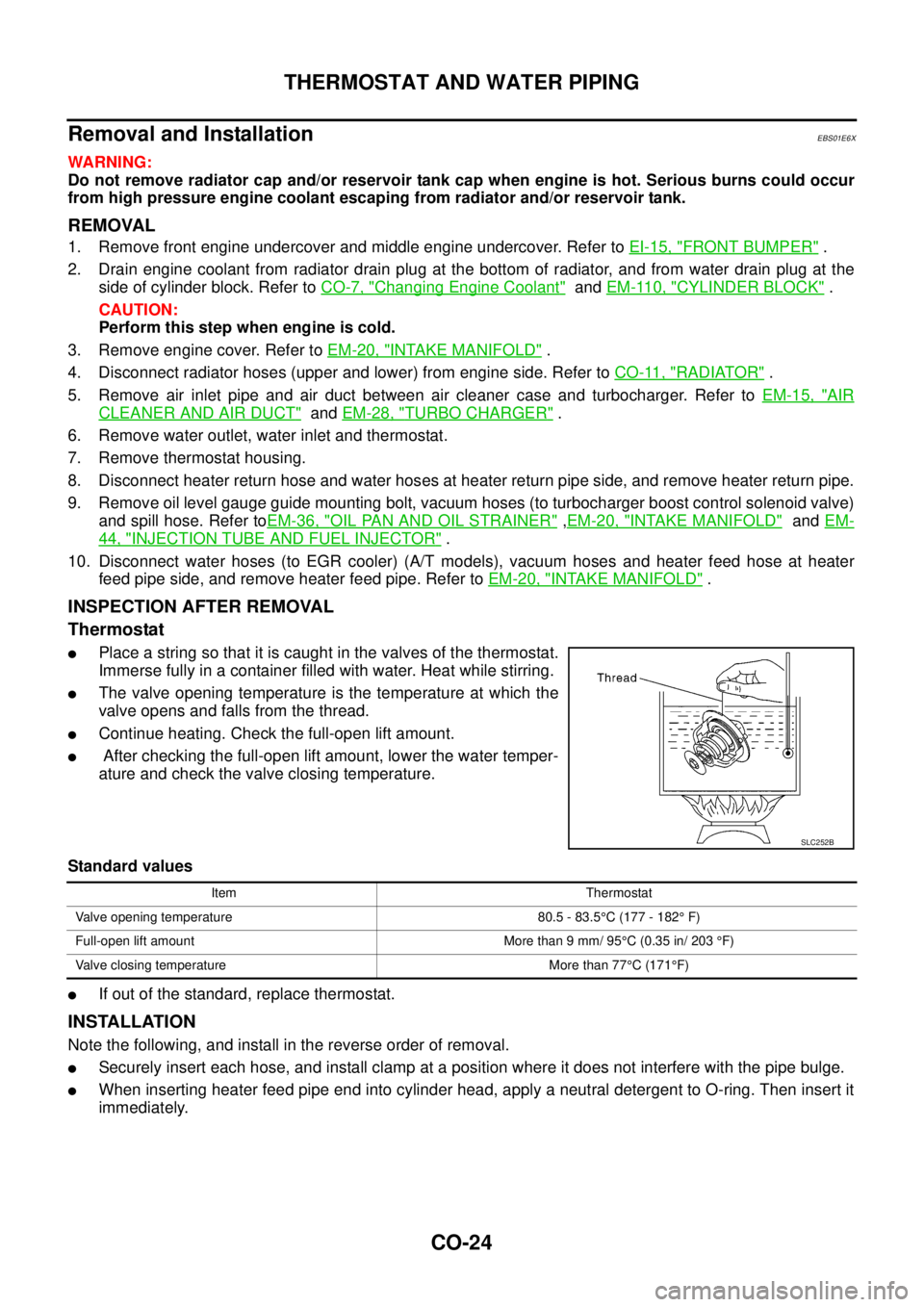
lPlace a string so that it is caught in the valves of the thermostat.
Immerse fully in a container filled with water. Heat while stirring.
lThe valve opening temperature is the temperature at which the
valve opens and falls from the thread.
lContinue heating. Check the full-open lift amount.
lAfter checking the full-open lift amount, lower the water temper-
ature and check the valve closing temperature.
Standard values
lIf out of the standard, replace thermostat.
INSTALLATION
Note the following, and install in the reverse order of removal.
lSecurely insert each hose, and install clamp at a position where it does not interfere with the pipe bulge.
lWhen inserting heater feed pipe end into cylinder head, apply a neutral detergent to O-ring. Then insert it
immediately.
SLC252B
Item Thermostat
Valve opening temperature 80.5 - 83.5°C (177 - 182°F)
Full-open lift amount More than 9 mm/ 95°C (0.35 in/ 203°F)
Valve closing temperature More than 77°C(171°F)