Heat NISSAN NOTE 2016 Service Repair Manual
[x] Cancel search | Manufacturer: NISSAN, Model Year: 2016, Model line: NOTE, Model: NISSAN NOTE 2016Pages: 3641, PDF Size: 28.72 MB
Page 1629 of 3641
![NISSAN NOTE 2016 Service Repair Manual CO-24
< REMOVAL AND INSTALLATION >[HR16DE]
WATER OUTLET
Removal and Installation
INFOID:0000000012432149
WARNING:
Do not remove the radiator cap when the engine is hot. Serious burns could occur from](/img/5/57363/w960_57363-1628.png "NISSAN NOTE 2016 Service Repair Manual CO-24
< REMOVAL AND INSTALLATION >[HR16DE]
WATER OUTLET
Removal and Installation
INFOID:0000000012432149
WARNING:
Do not remove the radiator cap when the engine is hot. Serious burns could occur from")
CO-24
< REMOVAL AND INSTALLATION >[HR16DE]
WATER OUTLET
Removal and Installation
INFOID:0000000012432149
WARNING:
Do not remove the radiator cap when the engine is hot. Serious burns could occur from high-pressure
engine coolant escaping from the radi ator. Wrap a thick cloth around the radiator cap. Slowly turn it a
quarter of a turn to release built-up pressure. Carefu lly remove radiator cap by turning it all the way.
NOTE:
When removing components such as hoses, tubes/lines, etc. , cap or plug openings to prevent fluid from spill-
ing.
REMOVAL
1. Drain engine coolant. Refer to CO-8, "Draining Engine Coolant".
CAUTION:
• Perform this step when engine is cold.
• Do not spill engine coolant on drive belt.
2. Remove air ducts and air cleaner assembly. Refer to EM-26, "
Removal and Installation".
3. Disconnect radiator hose (upper). Refer to CO-13, "
Exploded View".
4. Disconnect harness connector from engine coolant temperature sensor.
5. Disconnect harness connector from cylinder block heater (Canada only).
6. Disconnect water hoses and heater hoses from water outlet.
7. Remove water outlet.
8. Remove engine coolant temperature sens or from water outlet, if necessary.
9. Remove cylinder block heater from water outlet, if necessary (Canada only).
INSTALLATION
Installation is in the reverse order of removal.
CAUTION:
Do not reuse gasket.
INSPECTION AFTER INSTALLATION
• Before starting engine, check oil/fluid levels, including engine coolant and engine oil. If less than required quantity, fill to the specified level. Refer to MA-11, "
Fluids and Lubricants".
• Use procedure below to check for fuel leaks.
• Turn ignition switch ON (with engine stopped). With fuel pressure applied to fuel piping, check for fuel leaks
at connection points.
• Start engine. With engine speed increased, che ck again for fuel leaks at connection points.
• Run engine to check for unusual noise and vibration. NOTE:
If hydraulic pressure inside timing chain tensioner drops after removal and installation, slack in the guide
may generate a pounding noise during and just after engine start. However, this is normal. Noise will stop
after hydraulic pressure rises.
• Warm up engine thoroughly to make sure there is no leaks of fuel, exhaust gas, or any oils/fluids, including
engine oil and engine coolant.
• Bleed air from passages in lines and hoses, such as in cooling system.
• After cooling down engine, again check oil/fluid levels, including engine oil and engine coolant. Refill to spec- ified level, if necessary.
• Summary of the inspection items:
*Power steering fluid, brake fluid, etc. Item
Before starting engine Engine runningAfter engine stopped
Engine coolant LevelLeaks Level
Engine oil LevelLeaks Level
Transmission/
transaxle fluid CVT Models
LeaksLevel/Leaks Leaks
M/T Models Level/Leaks LeaksLevel/Leaks
Other oils and fluids* LevelLeaks Level
Fuel LeaksLeaksLeaks
Exhaust gas —Leaks —
Revision: August 2015 2016 Versa Note
cardiagn.com
Page 1632 of 3641
![NISSAN NOTE 2016 Service Repair Manual LU-2
< PRECAUTION >[HR16DE]
PRECAUTIONS
PRECAUTION
PRECAUTIONS
Precaution for Supplemental Restraint Syst
em (SRS) "AIR BAG" and "SEAT BELT
PRE-TENSIONER"
INFOID:0000000012432194
The Supplemental Res](/img/5/57363/w960_57363-1631.png "NISSAN NOTE 2016 Service Repair Manual LU-2
< PRECAUTION >[HR16DE]
PRECAUTIONS
PRECAUTION
PRECAUTIONS
Precaution for Supplemental Restraint Syst
em (SRS) \"AIR BAG\" and \"SEAT BELT
PRE-TENSIONER\"
INFOID:0000000012432194
The Supplemental Res")
LU-2
< PRECAUTION >[HR16DE]
PRECAUTIONS
PRECAUTION
PRECAUTIONS
Precaution for Supplemental Restraint Syst
em (SRS) "AIR BAG" and "SEAT BELT
PRE-TENSIONER"
INFOID:0000000012432194
The Supplemental Restraint System such as “A IR BAG” and “SEAT BELT PRE-TENSIONER”, used along
with a front seat belt, helps to reduce the risk or severity of injury to the driver and front passenger for certain
types of collision. Information necessary to service the system safely is included in the SR and SB section of
this Service Manual.
WARNING:
• To avoid rendering the SRS inopera tive, which could increase the risk of personal injury or death in
the event of a collision which would result in air bag inflation, all maintenance must be performed by
an authorized NISSAN/INFINITI dealer.
• Improper maintenance, including in correct removal and installation of the SRS, can lead to personal
injury caused by unintent ional activation of the system. For re moval of Spiral Cable and Air Bag
Module, see the SR section.
• Do not use electrical test equipmen t on any circuit related to the SRS unless instructed to in this
Service Manual. SRS wiring harn esses can be identified by yellow and/or orange harnesses or har-
ness connectors.
PRECAUTIONS WHEN USING POWER TOOLS (AIR OR ELECTRIC) AND HAMMERS
WARNING:
• When working near the Airbag Diagnosis Sensor Unit or other Airbag System sensors with the Igni-
tion ON or engine running, DO NOT use air or electri c power tools or strike near the sensor(s) with a
hammer. Heavy vibration could activate the sensor( s) and deploy the air bag(s), possibly causing
serious injury.
• When using air or electric power tools or hammers , always switch the Ignition OFF, disconnect the
battery and wait at least three minutes before performing any service.
Liquid GasketINFOID:0000000012432195
REMOVAL OF LIQUID GASKET SEALING
• After removing the bolts and nuts, separate the mating surface and remove the liquid gasket using Tool (A).
• In areas where the cutter is difficult to use, use a plastic hammer to lightly tap (1) the cutter where the liquid gasket is applied. Use a
plastic hammer to slide (2) the cutter by tapping on the side.
CAUTION:
Do not damage the mating surfaces.
LIQUID GASKET APPLICATION PROCEDURE
1. Using suitable tool (A), remove old liquid gasket adhering to the liquid gasket application surface and the mating surface.
• Remove liquid gasket completely from the groove of the liquidgasket application surface, mounting bolts, and bolt holes.
2. Wipe the liquid gasket application surface and the mating sur- face with white gasoline (lighting and heating use) to remove
adhering moisture, grease and foreign materials.Tool number (A) : KV10111100 (J-37228)
AWBIA1249GB
JPBIA0053ZZ
Revision: August 2015
2016 Versa Note
cardiagn.com
Page 1648 of 3641
PREPARATIONEX-3
< PREPARATION >
C
DE
F
G H
I
J
K L
M A
EX
NP
O
PREPARATION
PREPARATION
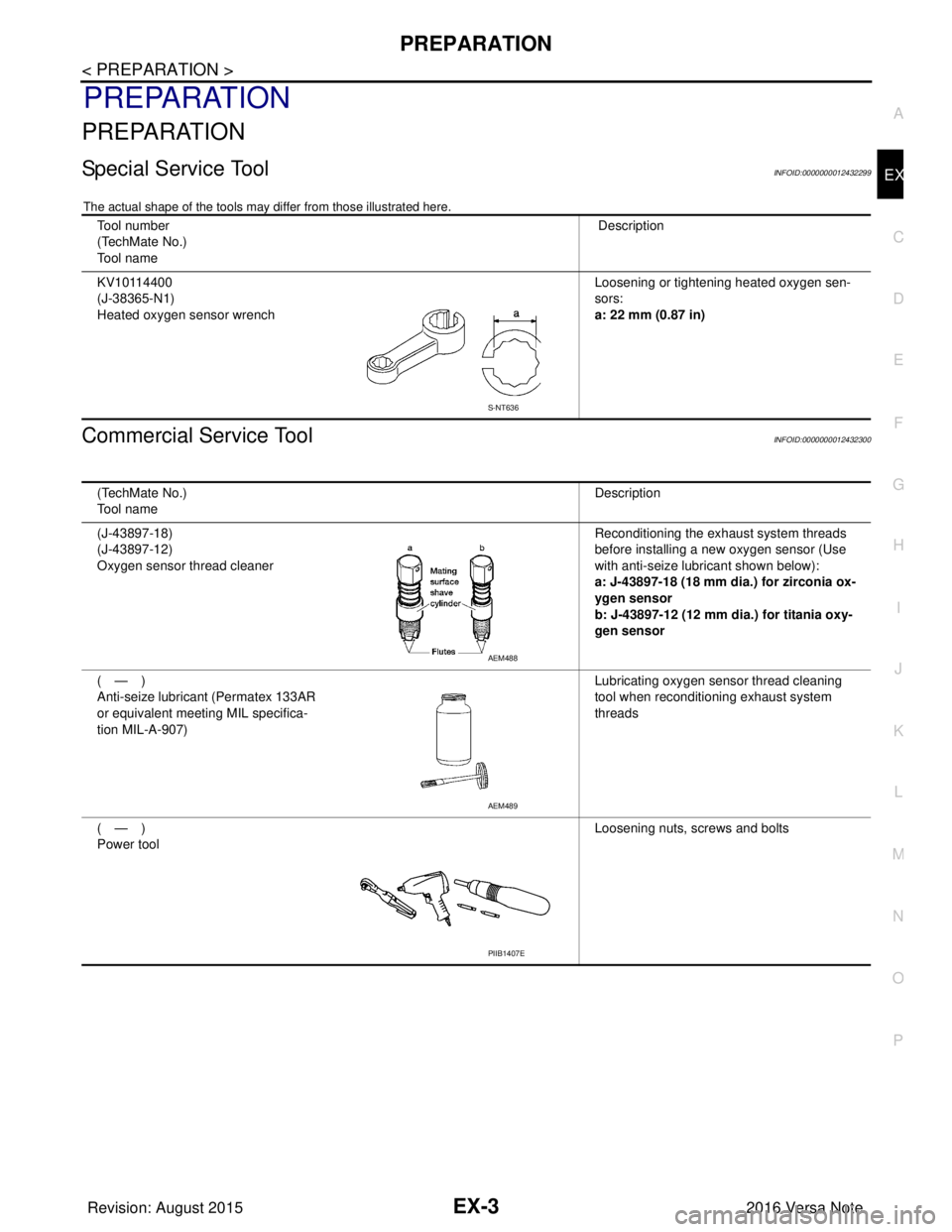
Special Service ToolINFOID:0000000012432299
The actual shape of the tools may differ from those illustrated here.
Commercial Service ToolINFOID:0000000012432300
Tool number
(TechMate No.)
Tool name
Description
KV10114400
(J-38365-N1)
Heated oxygen sensor wrench Loosening or tightening heated oxygen sen-
sors:
a: 22 mm (0.87 in)
S-NT636
(TechMate No.)
Tool name
Description
(J-43897-18)
(J-43897-12)
Oxygen sensor thread cleaner Reconditioning the exhaust system threads
before installing a new oxygen sensor (Use
with anti-seize lubricant shown below):
a: J-43897-18 (18 mm dia.) for zirconia ox-
ygen sensor
b: J-43897-12 (12 mm dia.) for titania oxy-
gen sensor
(—)
Anti-seize lubricant (Permatex 133AR
or equivalent meeting MIL specifica-
tion MIL-A-907) Lubricating oxygen sensor thread cleaning
tool when reconditioning exhaust system
threads
(—)
Power tool Loosening nuts, screws and bolts
AEM488
AEM489
PIIB1407E
Revision: August 2015
2016 Versa Note
cardiagn.com
Page 1650 of 3641
EXHAUST SYSTEMEX-5
< REMOVAL AND INSTALLATION >
C
DE
F
G H
I
J
K L
M A
EX
NP
O
REMOVAL AND INSTALLATION
EXHAUST SYSTEM
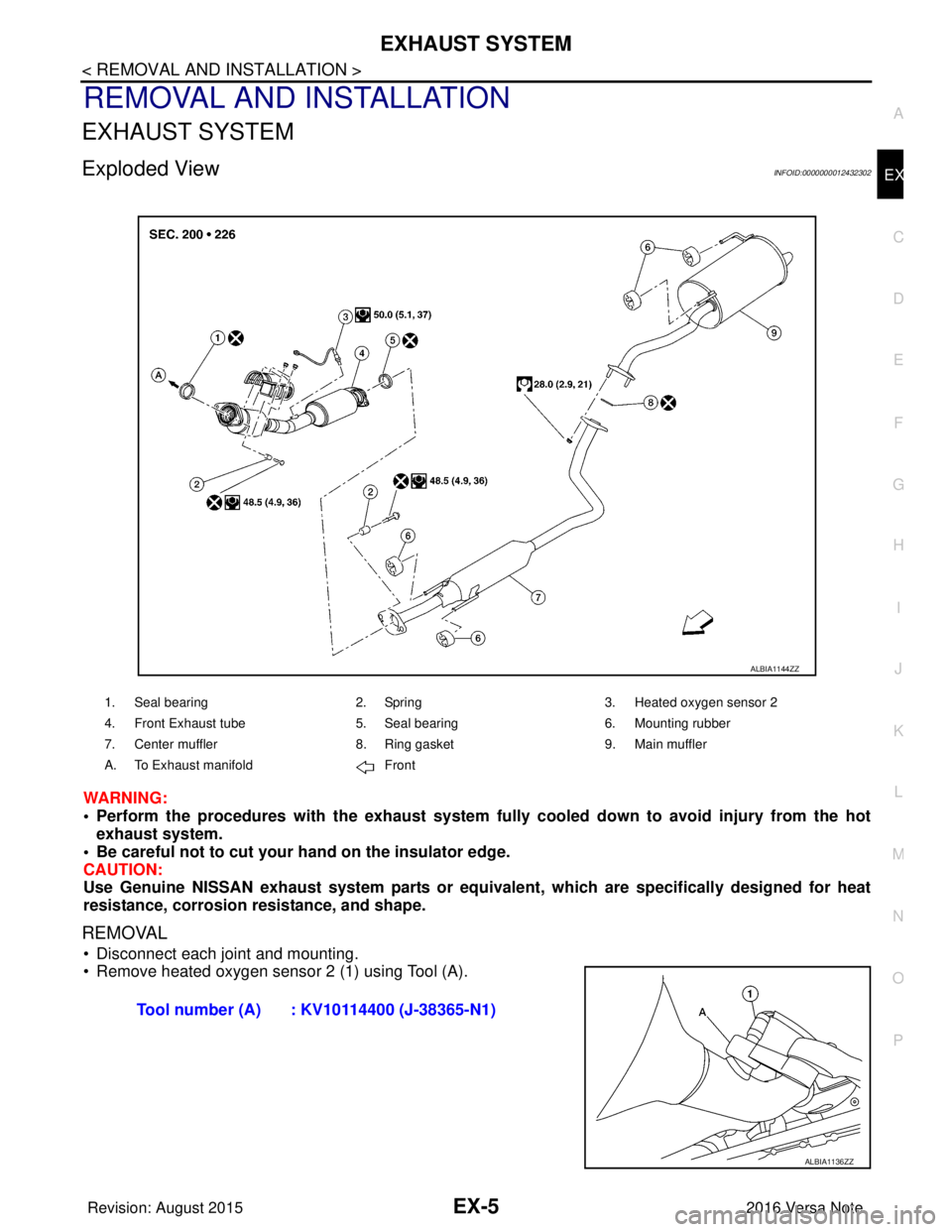
Exploded ViewINFOID:0000000012432302
WARNING:
• Perform the procedures with the exhaust system full
y cooled down to avoid injury from the hot
exhaust system.
• Be careful not to cut your hand on the insulator edge.
CAUTION:
Use Genuine NISSAN exhaust system parts or equivalent, which are specifically designed for heat
resistance, corrosion resistance, and shape.
REMOVAL
• Disconnect each joint and mounting.
• Remove heated oxygen sensor 2 (1) using Tool (A).
1. Seal bearing 2. Spring3. Heated oxygen sensor 2
4. Front Exhaust tube 5. Seal bearing6. Mounting rubber
7. Center muffler 8. Ring gasket9. Main muffler
A. To Exhaust manifold Front
ALBIA1144ZZ
Tool number (A) : KV10114400 (J-38365-N1)
ALBIA1136ZZ
Revision: August 2015 2016 Versa Note
cardiagn.com
Page 1651 of 3641
EX-6
< REMOVAL AND INSTALLATION >
EXHAUST SYSTEM
INSTALLATION
Installation is in the reverse order of removal.
CAUTION:
• Do not reuse gasket.
• Do not reuse seal bearing.
• Discard any heated oxygen sensor 2 which has been dropped from a height of more than 0.5 m (19.7
in) onto a hard surface such as a concrete floor. Use a new one.
• Before installing a new heated o xygen sensor 2, clean exhaust system threads using a suitable tool
and apply anti-seize lubricant.
• Do not over tighten heated oxygen sensor 2. Doin g so may cause damage to the heated oxygen sen-
sor 2, resulting in the “MIL” coming on.
• Prevent rust preventives from adhering to the sensor body.
• If heat insulator is badly deformed, repair or re place it. If deposits such as mud pile up on the heat
insulator, remove them.
• When installing heat insulator avoid large gaps or interference between heat insulator and each
exhaust pipe.
• Remove deposits from the sealing surface of each connection. Connect them securely to avoid
exhaust gas leaks.
• When installing each mounting rubber, use silicon oil to avoid twisting.
• Temporarily tighten nuts and bolts. Check each part for unusual interference and mounting rubber interference, and then tighten them to the specified torque.
• When installing each mounting rubber, avoid twisting or unus ual extension in up/down, front/rear
and right/left directions.
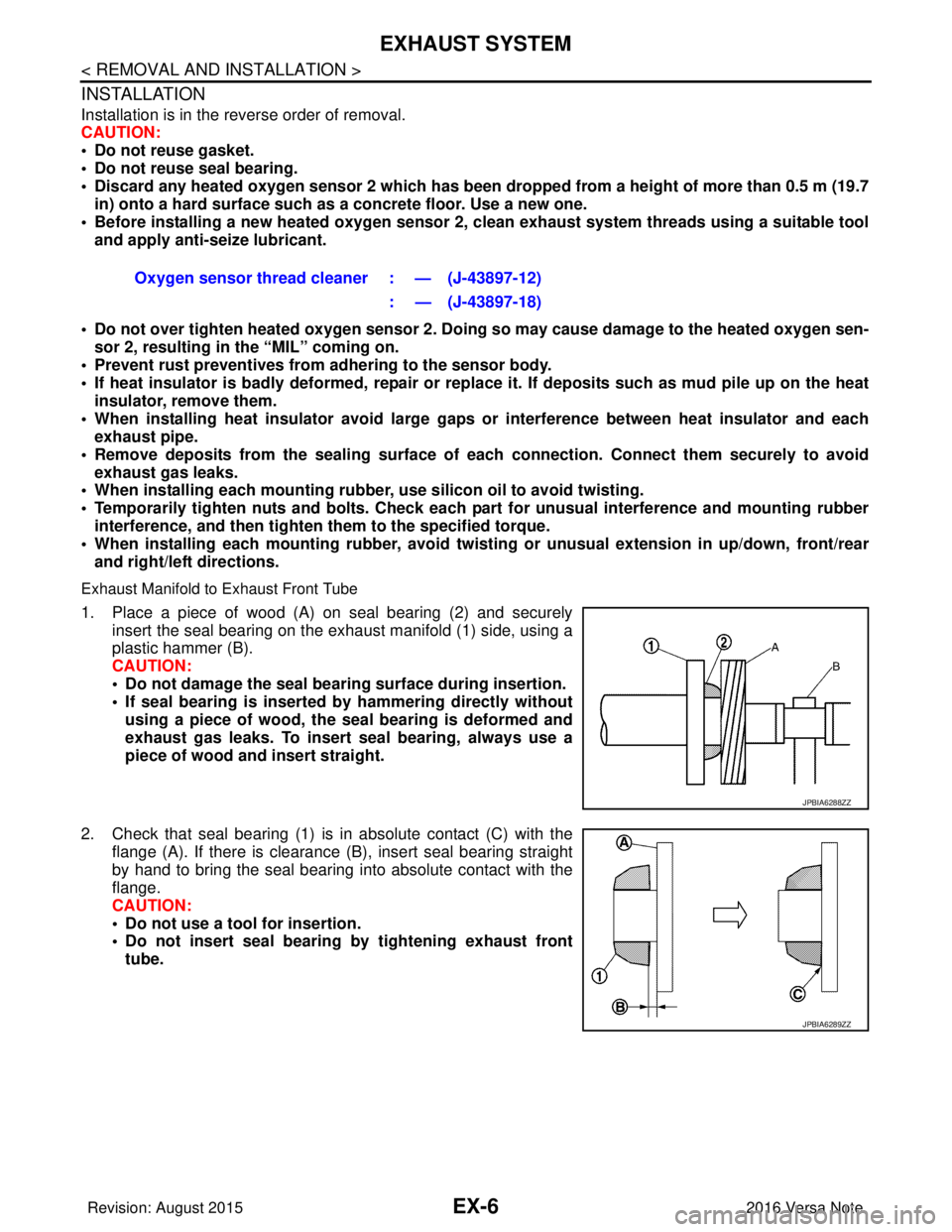
Exhaust Manifold to Exhaust Front Tube
1. Place a piece of wood (A) on seal bearing (2) and securely insert the seal bearing on the exhaust manifold (1) side, using a
plastic hammer (B).
CAUTION:
• Do not damage the seal bearing surface during insertion.
• If seal bearing is inserted by hammering directly without
using a piece of wood, the seal bearing is deformed and
exhaust gas leaks. To insert seal bearing, always use a
piece of wood and insert straight.
2. Check that seal bearing (1) is in absolute contact (C) with the flange (A). If there is clearance (B), insert seal bearing straight
by hand to bring the seal bearing into absolute contact with the
flange.
CAUTION:
• Do not use a tool for insertion.
• Do not insert seal bearing by tightening exhaust front
tube. Oxygen sensor thread cleaner : — (J-43897-12)
: — (J-43897-18)
JPBIA6288ZZ
JPBIA6289ZZ
Revision: August 2015 2016 Versa Note
cardiagn.com
Page 1810 of 3641
ROOF SIDE MOLDINGEXT-43
< REMOVAL AND INSTALLATION >
C
DE
F
G H
I
J
L
M A
B
EXT
N
O P
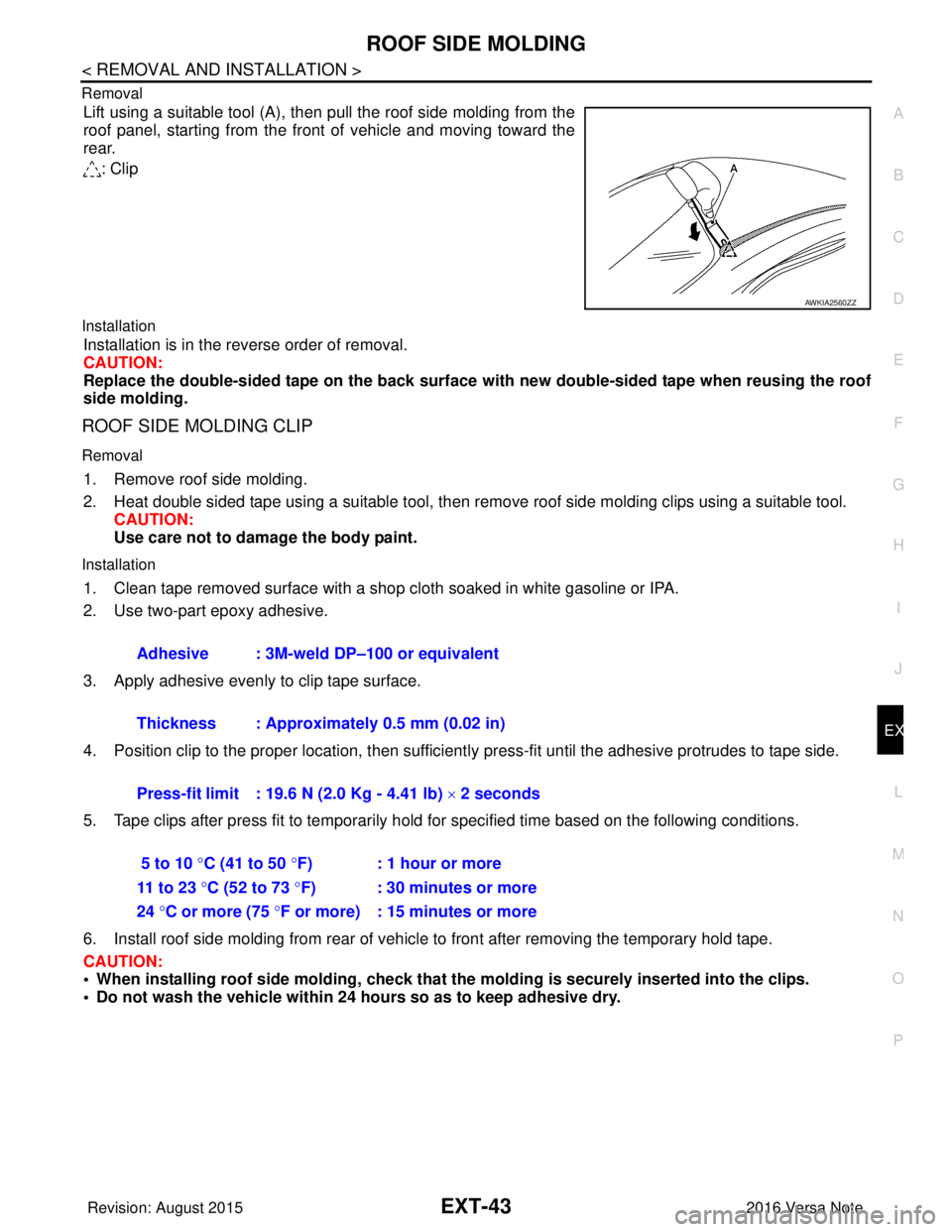
Removal
Lift using a suitable tool (A), then pull the roof side molding from the
roof panel, starting from the front of vehicle and moving toward the
rear.
: Clip
Installation
Installation is in the reverse order of removal.
CAUTION:
Replace the double-sided tape on the back surface with new double-sided tape when reusing the roof
side molding.
ROOF SIDE MOLDING CLIP
Removal
1. Remove roof side molding.
2. Heat double sided tape using a suitable tool, then remove roof side molding clips using a suitable tool.
CAUTION:
Use care not to damage the body paint.
Installation
1. Clean tape removed surface with a shop cloth soaked in white gasoline or IPA.
2. Use two-part epoxy adhesive.
3. Apply adhesive evenly to clip tape surface.
4. Position clip to the proper location, then sufficient ly press-fit until the adhesive protrudes to tape side.
5. Tape clips after press fit to temporarily hold for specified time based on the following conditions.
6. Install roof side molding from rear of vehicle to front after removing the temporary hold tape.
CAUTION:
• When installing roof side moldin g, check that the molding is securely inserted into the clips.
• Do not wash the vehicle within 24 hours so as to keep adhesive dry.
AWKIA2560ZZ
Adhesive : 3M-weld DP–100 or equivalent
Thickness : Approximately 0.5 mm (0.02 in)
Press-fit limit : 19.6 N (2.0 Kg - 4.41 lb) × 2 seconds
5 to 10 °C (41 to 50 °F) : 1 hour or more
11 to 23 °C (52 to 73 °F) : 30 minutes or more
24 °C or more (75 °F or more) : 15 minutes or more
Revision: August 2015 2016 Versa Note
cardiagn.com
Page 1812 of 3641
DOOR SASH TAPEEXT-45
< REMOVAL AND INSTALLATION >
C
DE
F
G H
I
J
L
M A
B
EXT
N
O P
Removal and InstallationINFOID:0000000012432187
REMOVAL
Heat door sash tape surface using a suitable tool and remove door sash tape.
CAUTION:
Use care not to damage body paint.
INSTALLATION
CAUTION:
• Degrease door assembly surface for sash tape.
• Grit or dust on surface of sash tape may spoil exterior appearance if not removed. Clean the surface
and check that no grit or dust rema ins before starting the operation.
• Do not reuse blackout tape.
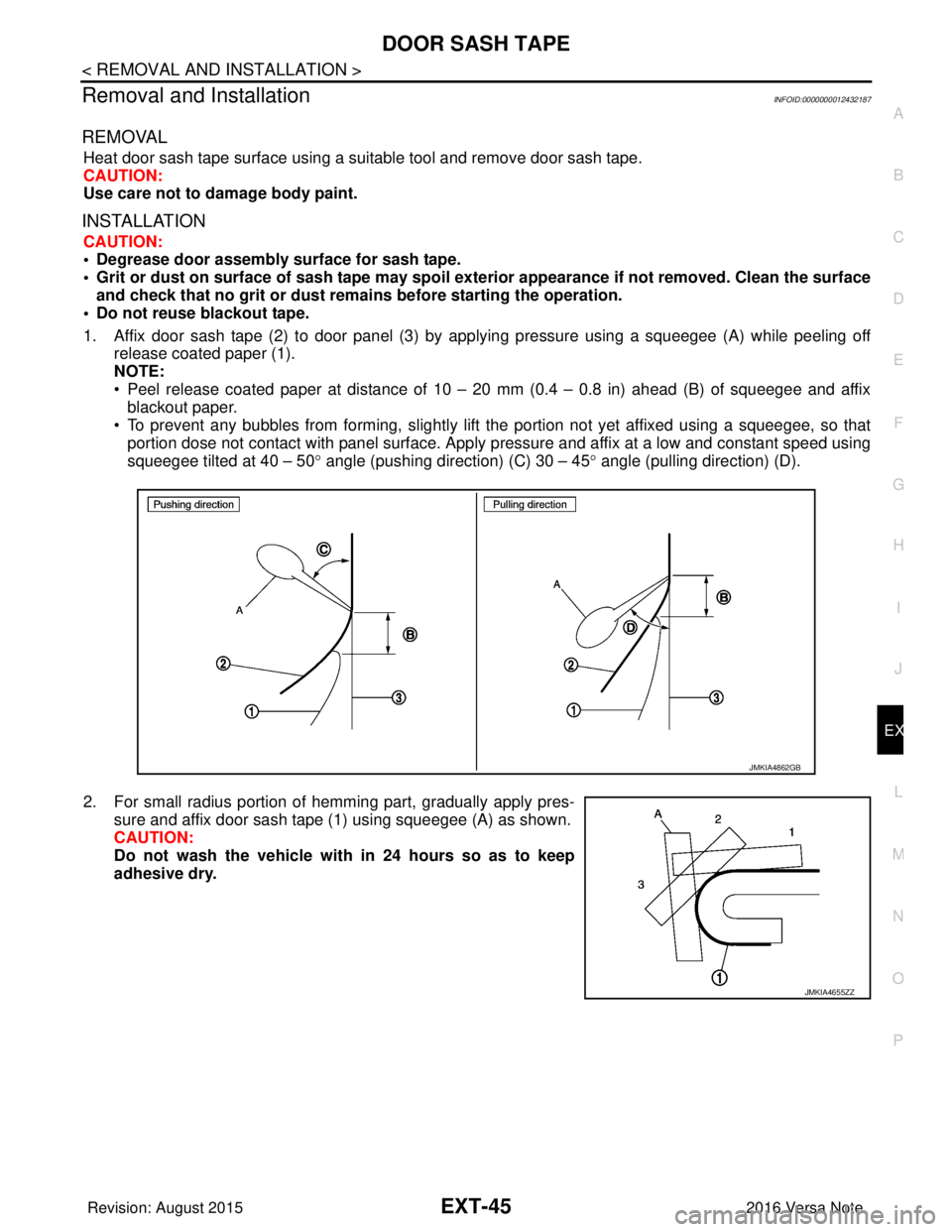
1. Affix door sash tape (2) to door panel (3) by applying pressure using a squeegee (A) while peeling off release coated paper (1).
NOTE:
• Peel release coated paper at distance of 10 – 20 mm (0.4 – 0.8 in) ahead (B) of squeegee and affixblackout paper.
• To prevent any bubbles from forming, slightly lift the portion not yet affixed using a squeegee, so that
portion dose not contact with panel surface. Apply pressure and affix at a low and constant speed using
squeegee tilted at 40 – 50 ° angle (pushing direction) (C) 30 – 45° angle (pulling direction) (D).
2. For small radius portion of hemming part, gradually apply pres- sure and affix door sash tape (1) using squeegee (A) as shown.
CAUTION:
Do not wash the vehicle with in 24 hours so as to keep
adhesive dry.
JMKIA4862GB
JMKIA4655ZZ
Revision: August 2015 2016 Versa Note
cardiagn.com
Page 1816 of 3641
REAR SPOILEREXT-49
< REMOVAL AND INSTALLATION >
C
DE
F
G H
I
J
L
M A
B
EXT
N
O P
REAR SPOILER
Exploded ViewINFOID:0000000012432192
Removal and InstallationINFOID:0000000012432193
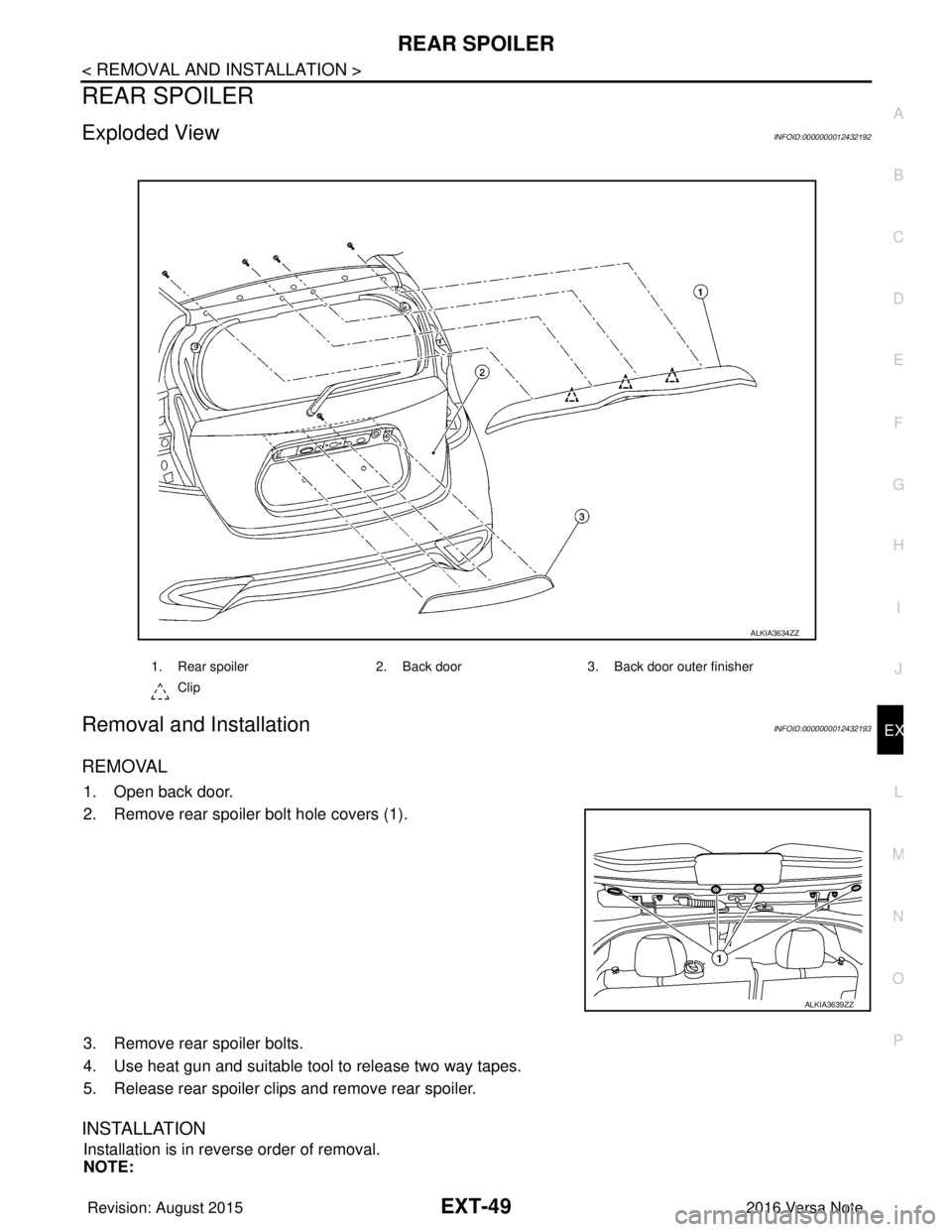
REMOVAL
1. Open back door.
2. Remove rear spoiler bolt hole covers (1).
3. Remove rear spoiler bolts.
4. Use heat gun and suitable tool to release two way tapes.
5. Release rear spoiler clips and remove rear spoiler.
INSTALLATION
Installation is in reverse order of removal.
NOTE:
1. Rear spoiler 2. Back door3. Back door outer finisher
Clip
ALKIA3634ZZ
ALKIA3639ZZ
Revision: August 2015 2016 Versa Note
cardiagn.com
Page 1871 of 3641
FUEL SYSTEMFL-5
< PERIODIC MAINTENANCE >
C
DE
F
G H
I
J
K L
M A
FL
NP
O
PERIODIC MAINTENANCE
FUEL SYSTEM
InspectionINFOID:0000000012432107
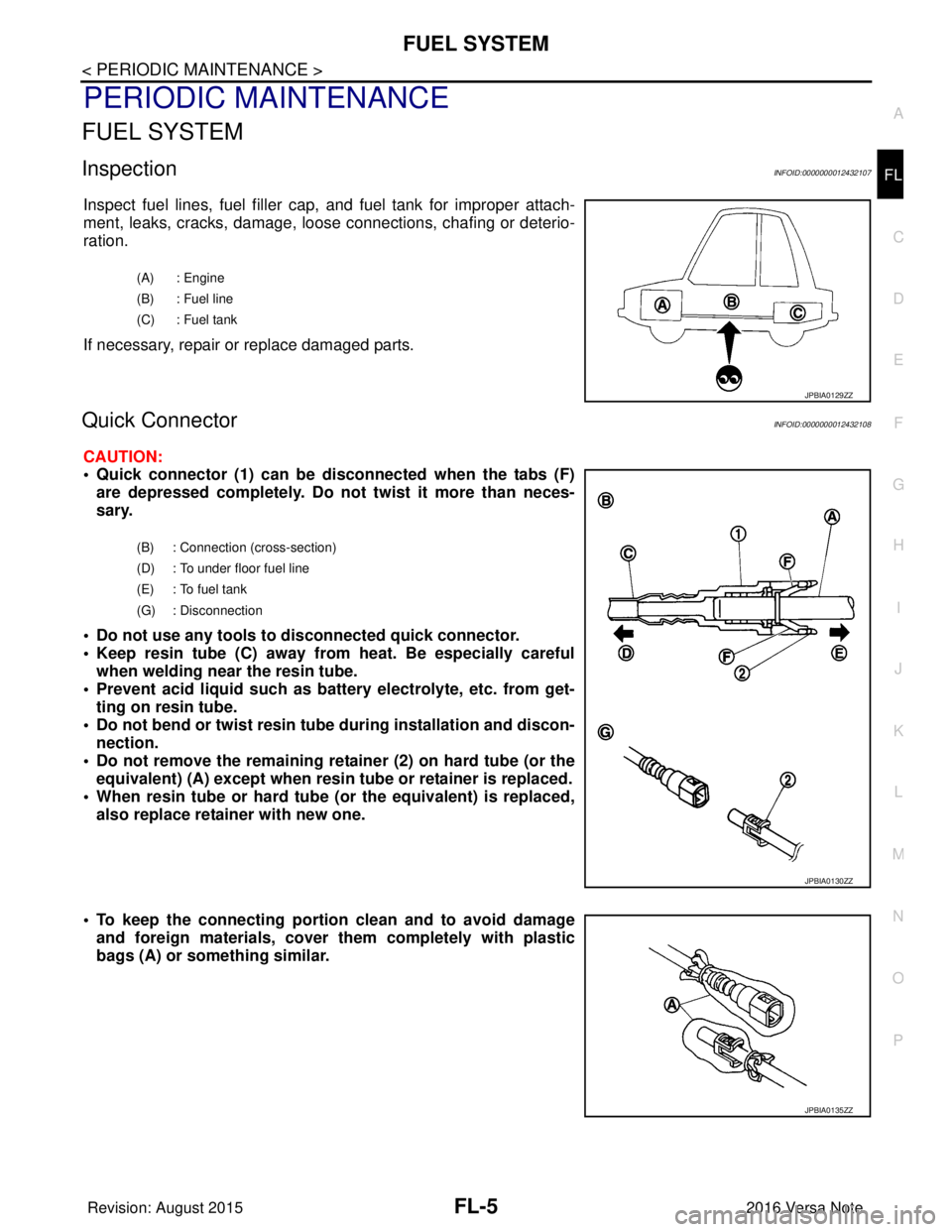
Inspect fuel lines, fuel filler cap,
and fuel tank for improper attach-
ment, leaks, cracks, damage, loos e connections, chafing or deterio-
ration.
If necessary, repair or replace damaged parts.
Quick ConnectorINFOID:0000000012432108
CAUTION:
• Quick connector (1) can be di sconnected when the tabs (F)
are depressed completely. Do not twist it more than neces-
sary.
• Do not use any tools to di sconnected quick connector.
• Keep resin tube (C) away from heat. Be especially careful when welding near the resin tube.
• Prevent acid liquid such as battery electrolyte, etc. from get- ting on resin tube.
• Do not bend or twist resin tube during installation and discon-
nection.
• Do not remove the remaining retainer (2) on hard tube (or the equivalent) (A) except when resin tu be or retainer is replaced.
• When resin tube or hard tube (or the equivalent) is replaced, also replace retainer with new one.
• To keep the connecting portion clean and to avoid damage and foreign materials, cover them completely with plastic
bags (A) or something similar.
(A) : Engine
(B) : Fuel line
(C) : Fuel tank
JPBIA0129ZZ
(B) : Connection (cross-section)
(D) : To under floor fuel line
(E) : To fuel tank
(G) : Disconnection
JPBIA0130ZZ
JPBIA0135ZZ
Revision: August 2015 2016 Versa Note
cardiagn.com
Page 1873 of 3641
FUEL LEVEL SENSOR UNIT, FUEL FILTER AND FUEL PUMP ASSEMBLYFL-7
< REMOVAL AND INSTALLATION >
C
DE
F
G H
I
J
K L
M A
FL
NP
O
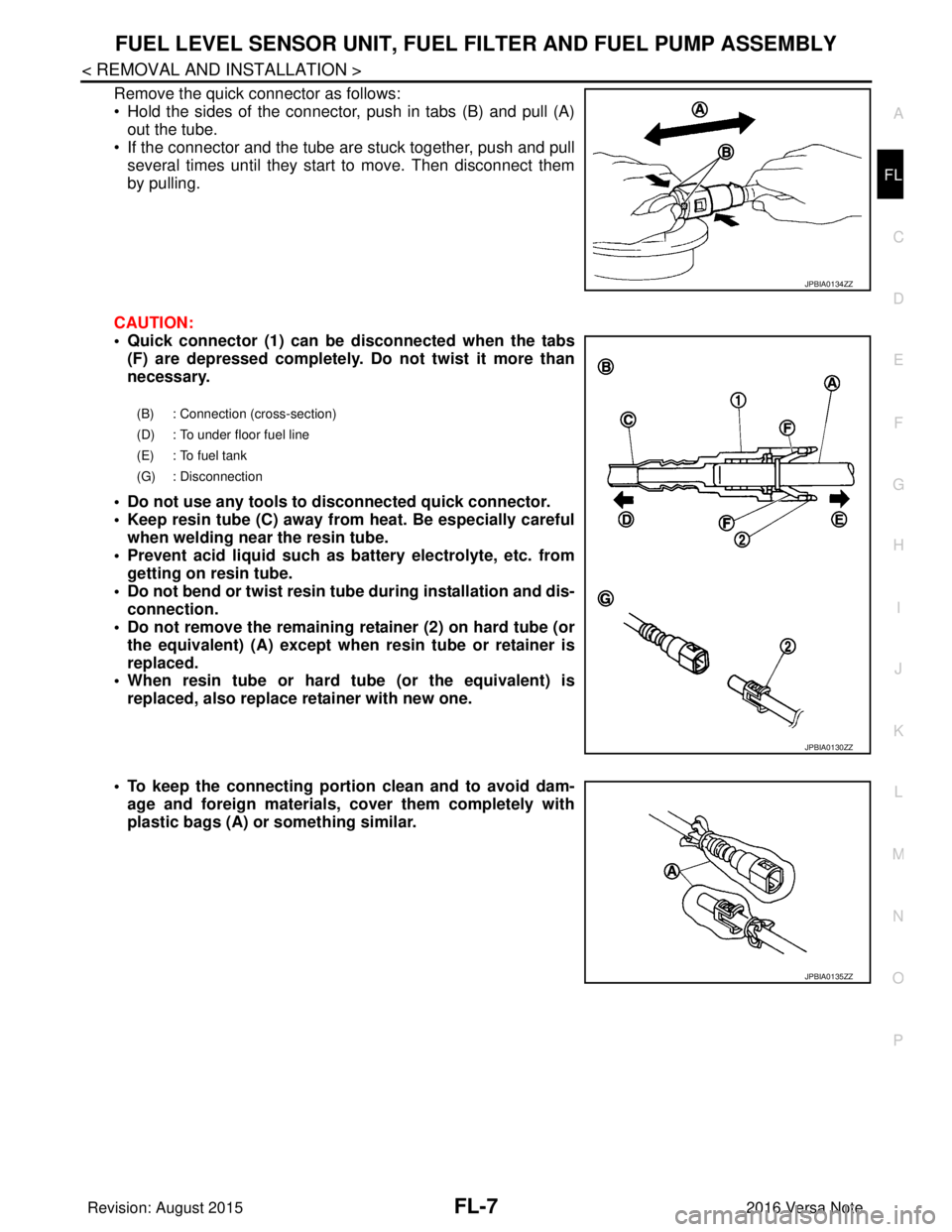
Remove the quick connector as follows:
• Hold the sides of the connector, push in tabs (B) and pull (A)
out the tube.
• If the connector and the tube are stuck together, push and pull several times until they start to move. Then disconnect them
by pulling.
CAUTION:
• Quick connector (1) can be disconnected when the tabs (F) are depressed completely. Do not twist it more than
necessary.
• Do not use any tools to disconnected quick connector.
• Keep resin tube (C) away from heat. Be especially careful when welding near the resin tube.
• Prevent acid liquid such as battery electrolyte, etc. from
getting on resin tube.
• Do not bend or twist resin tube during installation and dis- connection.
• Do not remove the remaining retainer (2) on hard tube (or
the equivalent) (A) except when resin tube or retainer is
replaced.
• When resin tube or hard tube (or the equivalent) is
replaced, also replace retainer with new one.
• To keep the connecting portio n clean and to avoid dam-
age and foreign materials, cover them completely with
plastic bags (A) or something similar.
JPBIA0134ZZ
(B) : Connection (cross-section)
(D) : To under floor fuel line
(E) : To fuel tank
(G) : Disconnection
JPBIA0130ZZ
JPBIA0135ZZ
Revision: August 2015 2016 Versa Note
cardiagn.com